
Marc Weidenbaum's Blog, page 94
August 29, 2023
Sound Ledger: Meta’s Language Model
6,500: estimated number of spoken and written forms of communication used by humans
100: number of languages that Meta’s SeamlessM4T can translate and transcribe
4,000,000: number of hours of (publicly available) speech mined to achieve the result
Source: engadget.com.


On the Line: Ulitskaya, McBride, Tools
That is from “The Autopsy,” a short story by Russian writer Lyudmila Ulitskaya, translated by by Richard Pevear and Larissa Volokhonsky (it’s in the August 28, 2023, issue of The New Yorker, and in Ulitskaya’s collection The Body of the Soul: Stories, due out at the end of October.)
. . .
"Though they never availed themselves of anything as obvious as a drumbeat, they tended to shape even their most abstract pieces around a tidal ebb and flow."That is Philip Sherburne, writing at Pitchfork about the great ambient musician Brian McBride (half of the duo Stars of the Lid), who recently died at age 53.
. . .
“I thought how differently different people react and use the same tools, and it might be a great way of finding out the range of this small synthesiser.”That is the musician Grant Wilkinson, writing about how he put together a synthesizer and then released an album of different musicians using the same equipment (himself, Darren Hayman, and three musicians sharing the name Phil: Maguire, Julian, and Bilsby).
August 28, 2023

August 27, 2023
Kronos at 50
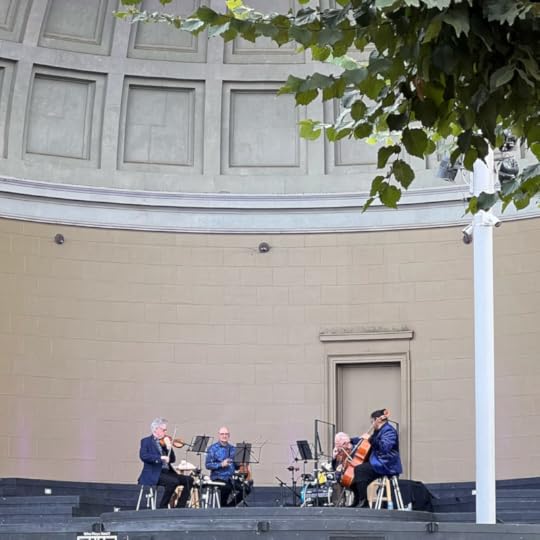
Kronos Quartet is shown here, celebrating its 50th anniversary with a free concert in Golden Gate Park on Saturday, August 26, 2023. When I took this photo, they had just begun a humorous piece by John Oswald. Earlier they had done works by Angelique Kidjo, Michael Gordon, Clint Mansell (one each from Requiem for a Dream and, later, The Fountain), and Sigur Rós, among others. Still to come were a “Summertime” that eerily channeled Janis Joplin’s ragged vocals, and an “All Along the Watchtower” that was indelibly Jimi Hendrix’s — and much more. We even got an encore. Fantastic afternoon.
That’s cellist Paul Wiancko, who joined Kronos this year (filling the seat vacated by Sunny Yang, who had been with the quartet for a decade), on the right, along with, from left to right, David Harrington, Hank Dutt, and John Sherba. Those three are on, respectively, violin, violin, and viola, but they all played other instruments over the course of the concert, including drums, voice, and additional percussion, and they employed some unusual bows for one theatrical piece. Born in 1983, Wiancko drew his first breath the year Kronos itself turned 10. Harrington noted that the group had lived in San Francisco for 46 years, and over the course of the afternoon mentioned numerous collaborators from the city — and also how he’d first heard one of the composers they later worked with thanks to the retail resource that is nearby Amoeba Records.
August 26, 2023
Scratch Pad: [ambient], Practice, Sound Art
I do this manually at the end of each week: collating most of the recent little comments I’ve made on social media, which I think of as my public scratch pad. I mostly hang out on Mastodon (at post.lurk.org/@disquiet), and I’m also trying out a few others.
▰ [ambient noise] [ambient noise] [indistinct chatter] [indistinct chatter] [background noise] [indistinct chatter] [ambient noise]
^ verbatim how a speech-to-text app “transcribed” a brief field recording I submitted (I’d intended to submit a different audio recording)
▰ After practicing guitar in the morning, you recognize that the hum of your amp is sorta soothing, so you just leave it on as you return to work
▰ Timed my walk to the supermarket to late afternoon in part because, on a day as clear and warm as this one, I expected to hear music students practicing through open windows. There’s usually a smattering of trumpets, pianos, and violins. But not a peep.
▰ There are a lot of sounds I love in urban life, key in recent years being the skateboard. I’m not sure if skateboarding’s more popular than it used to be here in San Francisco, or if wheels got louder, but I hear it more, pay attention to it more, and have come to cherish it.
▰ I’ve got a concert review, a book review, and a fun short piece about Ornette Coleman due out soon(ish)
▰ I’ve been practicing the basic* “spider walk” (plus some variations) on guitar every day. Something about it sounded familiar. Then I recognized that the first two lines are the first two bars of “Blue Monk” by Thelonious Monk.
*four frets in a row, then the next string higher
▰ I think often of a sound art exhibit I visited in London in 2019. I walked around the location and then went to the desk where the gallery-requisite woman in a black dress sat. I asked, trying not to seem stupid, where the sound was. She plugged something in. The sound started.
▰ What kind of a Friday is it? I found myself staring for a while at half of a “U” in a document on the left of my screen, and wondering why it was cut off. Turns out it was a “J”.
▰ Going through my inbox and slurping down /yum codes on Bandcamp. Forgive me if you sent me something and I’m only just getting around to it. The sheer amount of music is sort of insane. I’m not complaining. I’m down for the insanity, but that doesn’t make it any less insane.
After I posted the /yum comment, a friend — a composer, no less — asked what it is, and I replied: On Bandcamp.com, which is the main way many musicians sell their recordings, they can provide a free download to press (and other interested parties), and it is called a “yum” code. When you receive such a code, you then go to bandcamp.com/yum and enter the code. Then you can download the files, or access via your bandcamp library. If you write about music and/or record music for sale as downloads, a lot of time can involve /yum codes.
August 25, 2023
Hybrid
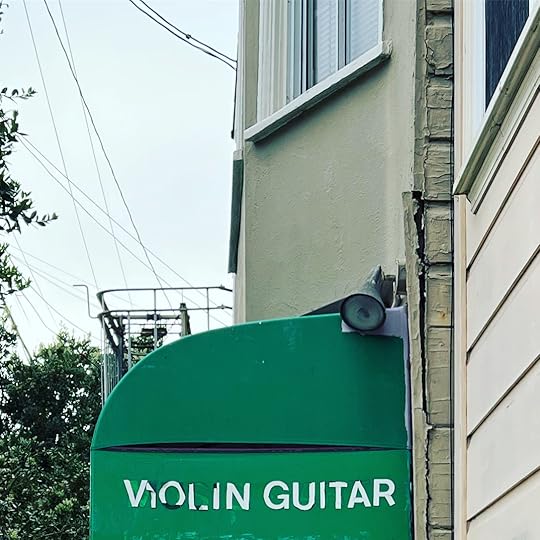
This shop breeds and cares for hybrids
August 24, 2023
TWiS Listening Post (0010)
This went out yesterday as a weekly bonus — a thank-you to people who financially support This Week in Sound. It supplements the free Tuesday and Friday issues, which feature a broader array of material from the field of sound studies. It contained an annotated playlist of recommended music. I wrote about (1) a video from FM3, best known for their Buddha Machines, posted by member Christiaan Virant, (2) a single from electronically mediated cellist Henrik Meierkord, and (3) a highlight, by Ina Kacz, from a recent compilation album.
Disquiet Junto Project 0608: Nature-to-Text
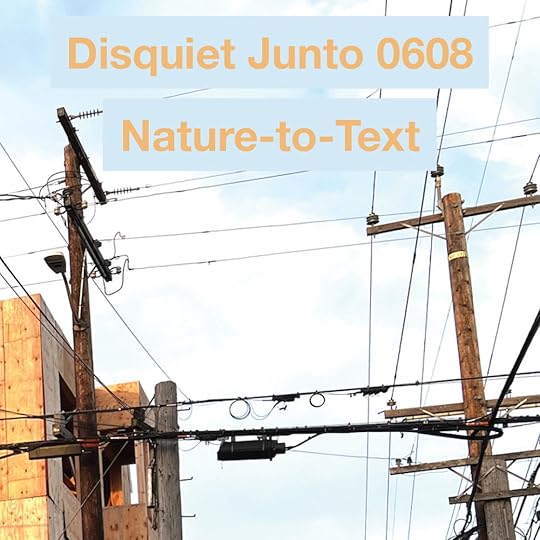
Each Thursday in the Disquiet Junto music community, a new compositional challenge is set before the group’s members, who then have just over four days to upload a track in response to the assignment. Membership in the Junto is open: just join and participate. (A SoundCloud account is helpful but not required.) There’s no pressure to do every project. It’s weekly so that you know it’s there, every Thursday through Monday, when you have the time and interest.
Deadline: This project’s deadline is the end of the day Monday, August 28, 2023, at 11:59pm (that is, just before midnight) wherever you are. It was posted on Thursday, August 24, 2023.
Tracks are added to the SoundCloud playlist for the duration of the project. Additional (non-SoundCloud) tracks appear in the lllllll.co discussion thread.
These following instructions went out to the group’s email list (at tinyletter.com/disquiet-junto).
Disquiet Junto Project 0608: Nature-to-Text
The Assignment: Using a speech-to-text tool, turn a field recording into instructions for a composition.
This project is perhaps more experimental than ordinary, simply because it may not work for everyone. Apologies in advance. As someone, I think Brian Eno, once said, “It’s only experimental music if there’s a chance it can fail.”
Step 1: When one uses speech-to-text tools, such as those now commonly included in word processing software, often those tools will mistakenly interpret ordinary, non-verbal sound as garbled words, or otherwise try to characterize the sound, such as with bracketed phrases like “[deep breath]” or “[background chatter].” One potential way to achieve the result is to upload the audio to YouTube and then apply automated captions. Check out your options. There is likely to be discussion of this topic on places where the Junto occurs, such as the llllllll.co BBS and the Junto Slack.
Step 2: Record some non-verbal audio, perhaps a field recording of the sound on the street, or down a hallway. It’s recommended to do the recording somewhere where there is likely to be variation.
Step 3: Submit a segment of the audio to a speech-to-text tool. Or perhaps multiple tools, to see the results.
Step 4: Assuming Step 3 yields a series of descriptions, then compose a piece of music that treats that sequence as a kind of score. That is, make music that achieves the result described by the speech-to-text tool’s results. Perhaps you could use someone else’s. Here, for example, is a sequence that I ended up with recently: “[ambient noise] [ambient noise] [indistinct chatter] [indistinct chatter] [background noise] [indistinct chatter] [ambient noise].”
Eight Important Steps When Your Track Is Done:
Step 1: Include “disquiet0608” (no spaces or quotation marks) in the name of your tracks.
Step 2: If your audio-hosting platform allows for tags, be sure to also include the project tag “disquiet0608” (no spaces or quotation marks). If you’re posting on SoundCloud in particular, this is essential to subsequent location of tracks for the creation of a project playlist.
Step 3: Upload your tracks. It is helpful but not essential that you use SoundCloud to host your tracks.
Step 4: Post your track in the following discussion thread at llllllll.co:
https://llllllll.co/t/disquiet-junto-project-0608-nature-to-text/
Step 5: Annotate your track with a brief explanation of your approach and process.
Step 6: If posting on social media, please consider using the hashtag #DisquietJunto so fellow participants are more likely to locate your communication.
Step 7: Then listen to and comment on tracks uploaded by your fellow Disquiet Junto participants.
Step 8: Also join in the discussion on the Disquiet Junto Slack. Send your email address to marc@disquiet.com for Slack inclusion.
Note: Please post one track for this weekly Junto project. If you choose to post more than one, and do so on SoundCloud, please let me know which you’d like added to the playlist. Thanks.
Additional Details:
Length: The length is up to you. A steady pace over an extended period of time can have a unique kind of impact.
Deadline: This project’s deadline is the end of the day Monday, August 28, 2023, at 11:59pm (that is, just before midnight) wherever you are. It was posted on Thursday, August 24, 2023.
Upload: When participating in this project, be sure to include a description of your process in planning, composing, and recording it. This description is an essential element of the communicative process inherent in the Disquiet Junto. Photos, video, and lists of equipment are always appreciated.
Download: It is always best to set your track as downloadable and allowing for attributed remixing (i.e., a Creative Commons license permitting non-commercial sharing with attribution, allowing for derivatives).
For context, when posting the track online, please be sure to include this following information:
More on this 608th weekly Disquiet Junto project, Nature-to-Text (The Assignment: Using a speech-to-text tool, turn a field recording into instructions for a composition), at: https://disquiet.com/0608/
About the Disquiet Junto: https://disquiet.com/junto/
Subscribe to project announcements: https://tinyletter.com/disquiet-junto/
Project discussion takes place on llllllll.co: https://llllllll.co/t/disquiet-junto-project-0608-nature-to-text/
August 23, 2023
This Week in Sound: “The Sirens Are Intended for Tsunamis”

These sound-studies highlights of the week originally appeared in the August 22, 2023, issue of the Disquiet.com weekly email newsletter, This Week in Sound. This Week in Sound is the best way I’ve found to process material I come across. Your support provides resources and encouragement. Most issues are free. A weekly annotated ambient-music mixtape is for paid subscribers. Thanks.
▰ BOY TROUBLE: “Female-focused dating simulation games — also known as otome games — and AI-powered chatbots have millions of users in China,” writes Viola Zhou. “They offer idealized virtual lovers, fulfilling the romantic fantasies of women.” When those conversation chatbots shut down, the emotional pain is real, as has been the case with “Him,” a former service of the voice startup Timedomain: “Devastated users rushed to record as many calls as they could, cloned the voices, and even reached out to investors, hoping someone would fund the app’s future operations.”
▰ WHITE OUT: Just a year ago, Bloomberg’s Ashley Carman reported on how some Spotify podcasters made as much as $18,000 per month with white noise. Now Carman reports that Spotify is looking to ban the very same material: “As of January, according to an internal document Bloomberg viewed, white noise and ambient podcasts accounted for 3 million daily consumption hours on the platform, inadvertently boosted by Spotify’s own algorithmic push for ‘talk’ content (versus music). … Once Spotify realized how much attention was going to white noise podcasts, the company considered removing these shows from the talk feed and prohibiting future uploads while redirecting the audience towards comparable programming that was more economical for Spotify — doing so, according to the document, would boost Spotify’s annual gross profit by €35 million, or $38 million.” Side note: I feel confident that a lot of the music I listen to would be mistaken for white noise by copyright bots. (Thanks, Michael Upton!)
▰ KONG KING: The longtime voice of Mario in the Nintendo video games has retired. According to Chris Kerr at gamedeveloper.com, Mario+Rabbids: Sparks of Hope (2022) is Charles Martinet’s final work as the character. He also played Luigi and Wario, among other Nintendo gaming favorites. Stephen Totilo notes at axios.com that Chris Pratt, not Martinet, did the voice for the recent film The Super Mario Bros. Movie — however, Martinet portrayed “Mario’s father as an Easter egg for fans.” As Totilo says, “Mario never said much in his various Nintendo games, but Martinet made the most out of the character’s exuberant exhortations.” Martinet started performing as Mario in 1994, with Mario Teaches Typing, having worked for Nintendo as a voice actor since 1991. Back in June, per Devindra Hardawar at engadget.com, fans were wondering if Martinet had moved on, based on how the characters sounded in teasers of upcoming games (via videogameschronicle.com).
▰ ACUTE ACCENT: “I have a foreign accent. You have a foreign accent. If you’re from the South in the United States, you speak very differently than someone from Boston or California. There are companies that think of this as a problem and are trying to make people working at call centers in India or the Philippines sound like they are from the United States. That business does not excite me.” That’s Seamus McAteer, founder and CEO of Speechlab, “a startup building generative AI for speech-to-speech translation,” in an interview by Caiwei Chen.
▰ QUICK NOTES: Wrong Direction: There’s an update on the lack of emergency sirens during the Maui fires: “The sirens are intended for tsunamis, and sounding them would have sent residents to the hills and into the fires,” said the director of the Maui Emergency Management Agency, who defended the decision. (New York Times gift link). ▰ Speakerboxxx: Mozilla has a handy breakdown of the privacy matters of the most popular smart speakers. ▰ Wave Rider: I look forward to reading Carolyn Birdsall’s forthcoming book Radiophilia: “Treating radiophilia as a dynamic cultural phenomenon, it unpacks the various pleasures associated with radio and its sounds, the desire to discover and learn new things via radio, and efforts to record, re-experience, and share radio.” (Thanks, Barbara Postema!). ▰ Call of the Wild: Australians voted on their favorite animal sound, and a full third gave their votes to Gymnorhina tibicen, the magpie. (Thanks, Alison Armstrong!) ▰ In Sea: “For a three-year pilot project funded by the National Science Foundation … a national team of researchers have transformed a year of carbon dioxide readings taken off the coast of New England into sound.” ▰ City Living: “NPR’s Pien Huang takes a sonic tour of Providence, Rhode Island with researcher Erica Walker and talks about noise pollution solutions with Jamie Banks the founder and president of Quiet Communities, and New York City Council member Gale Brewer.” (Thanks, Rich Pettus!) ▰ Call of the Wild (2): “Scientists are experimenting with sound to try and lure seabirds back to depleted environments,” reports the Australian ABC.net.au about “the ecological approach called Acoustic Restoration.” (Thanks, Michael Astill!) ▰ AI, Robot: An overview of recent text-to-music AI apps. ▰ This Is the Droid: “Android 14 will be more proactive in protecting your hearing with its new headphone loud sound alert feature.” ▰ Bad Apple: “Disabled people who rely on Apple’s accessibility features say that Voice Control has fallen behind Siri in both accuracy and capabilities, despite being an essential rather than a nice-to-have.” ▰ Siren Song: And on a local tip: San Francisco’s Tuesday noon sirens could be coming back by 2024. (Thanks, Michelle Milligan!)
August 22, 2023
Sound Ledger
63.4: The percent market share of audiobook sales belonging to Audible, an Amazon subsidiary
$1,800,000,000: The 2002 market for audiobooks in the United States
$35,000,000,000: Estimated U.S. audiobook market size in 2030
Source: goodereader.com


