
Marc Weidenbaum's Blog, page 90
September 24, 2023
I Watched My Voice Take Form on the Screen

One of my nighttime habits is to record myself speaking at the very end of the day before I go to sleep. I used to scribble notes, but after a day spent writing, the act of writing yet again at the very end of the day, just before sleep, can feel like one task too many. I generally sleep quite soundly, but part of preparing to sleep is winding down. To write, much as I enjoy writing — much as I am compelled to write — is to invoke work, which is not conducive to sleep. Also, my scribbles often prove illegible come morning, much as dreams can’t always be fully recalled.
In contrast, by simply recording stray thoughts with my voice at the end of the day, I can with ease unpack the day. To write is to work; to speak is to put work behind me. Speaking is unwinding, even if I’m only speaking to myself — well, to myself and to my phone. When I record my thoughts, I capture reflections on recent occurrences, and I make plans for the next day, and I collect extraneous bits of ideas. As with my scribbles, some of these I can’t even comprehend the next morning. If I’m particularly tired, the recordings can veer into the surreal, sometimes enjoyably so. (It can be an out-of-body experience, though that isn’t my goal.)
After simply listening to these recordings come morning, for years, I started using — or more to the point, beta-testing, a state many of us seem to be in in perpetuity — speech-to-text software tools. I spent a lot of time making the most of the tool built into Google Drive, and then the Recorder that comes with Android, and then the tool built into Apple Notes, among others. These are real-time recording tools: they transcribe as you speak. They trained me to speak more clearly, because as I spoke I watched my voice take form on the screen, and I self-corrected if the software was misunderstanding me. This was a positive feedback loop, but it also required me to observe my thoughts, which wasn’t as freeing as simply speaking aloud.
More recently I’ve gotten in the habit of using tools like MacWhisper and rev.com. These tools allow me to simply record something, and then after the fact have it transcribed into text. The quality of the results — the “fidelity,” to repurpose an audio term — is even higher, in my experience, than that of “real-time” tools such as Google Recorder and Apple Notes.
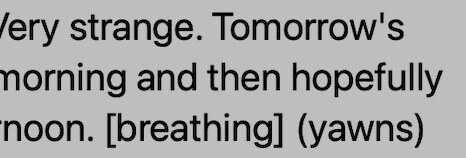
Now, one interesting thing about revisiting these auto-transcribed notes the next morning is that I also receive emotional cues: Was I terse or rhapsodic, prone to imagery or sticking to line items? I’m not recording my thoughts to keep track of my emotional state, but I can’t deny that is part of what I learn as the sun rises and I pull up the transcribed files. And, as it turns out, this is just as true about what happens between the words. The MacWhisper tool, in particular, lends an additional means by which I find myself gauging my emotional state: It actually characterizes my breathing and it notes the extended silences. The software is reading, so to speak, the way I communicate non-verbally, as then identified for me with brackets and parenthesis: “[sighs],” “[breathing],” “(yawns),” etc. It is eerie, fascinating, and, at a basic level, informative. And in my experience, not incorrect about what it observes.


Snazzy
On loan from a generous friend. Any tips, recommendations, or experiences with what is contained here? Note the heavy emphasis on modules from Snazzy FX. These are all new to me, with the exception of the Doepfer, the Make Noise, and the Tiptop.

September 23, 2023
Scratch Pad: Triptych, Guitar, Bandcamp
I do this manually at the end of each week: collating (and sometimes lightly editing) most of the recent little comments I’ve made on social media, which I think of as my public scratch pad. I mostly hang out on Mastodon (at post.lurk.org/@disquiet), and I’m also trying out a few others. And I take weekends off social media.
▰ Mid-afternoon sonic triptych through the open window, since it’s 67º out: heavy metal blasting from a convertible briefly paused(ish) at the stop sign, distant emergency vehicle siren, dog barking down the block
▰ Things I found myself saying in guitar class today: “I really like the shapes of diminished chords.”
▰ The Spanish Prisoner really holds up. I don’t think I’ve watched it since I saw it in a theater when it came out. I especially love how the artificiality of it all makes everything feel suspect as the story unfolds. And bonus points for a noir-tastic Carter Burwell score.
▰ I never before noticed that there’s a Disquiet Junto tag on Bandcamp:
https://bandcamp.com/tag/disquiet-junto
▰ (From Wednesday) Maybe I don’t go for my walk today?
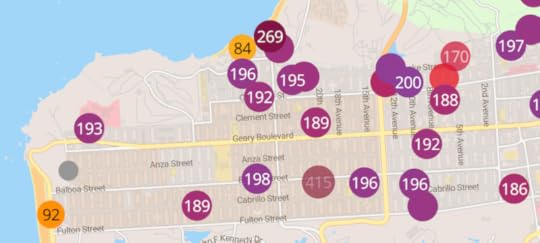
This is what I use to map air quality locally:
▰ Reminder: On Friday, Sept. 29, from 7pm to 9pm, I’m hosting a listening session at the Berkeley Alembic of music by recording artists who explore “the poetics of the buffer”: capturing sound and toying with it while it lingers in the mind’s ear.
▰ Notice: I made it to inbox zero. If you’re currently expecting an email from me, I respectfully ask you remind me what the subject was, because far as I can tell, I’m caught up. Thanks. (This doesn’t count requests for editorial coverage, because I can’t reply to all of those.)
September 22, 2023
Lia Kohl’s Cult Jam
Lia Kohl’s excellent 2022 album, Too Small to Be a Plain, has been reissued by the Florabelle record label, the music itself having been recorded alone by Kohl in late 2020 through early 2021 — which is to say, deep pandemic time. It is a superb collection of pristine tiny moments, combining her cello and voice with electronic sounds and processing, as well as field recordings and, if the word plaintive can be attributed to technology, bits of plaintive radio. Warbling lullabies and gently pleading Morse code, muted strings and enveloping drones, fragmented snippets and otherworldly effects — all are layered and sequenced, jumbled up and laid bare, as if in a tidy sonic exhibit of cherished wonders.
https://florabelle.bandcamp.com/album/too-small-to-be-a-plain
Lisa Kohl’s Cult Jam
Lisa Kohl’s excellent 2022 album, Too Small to Be a Plain, has been reissued by the Florabelle record label, the music itself having been recorded alone by Kohl in late 2020 through early 2021 — which is to say, deep pandemic time. It is a superb collection of pristine tiny moments, combining her cello and voice with electronic sounds and processing, as well as field recordings and, if the word plaintive can be attributed to technology, bits of plaintive radio. Warbling lullabies and gently pleading Morse code, muted strings and enveloping drones, fragmented snippets and otherworldly effects — all are layered and sequenced, jumbled up and laid bare, as if in a tidy sonic exhibit of cherished wonders.
https://florabelle.bandcamp.com/album/too-small-to-be-a-plain
Junto Profile: Mike Nolan
This Junto Profile is part of an ongoing series of short Q&As that provide some background on various individuals who participate regularly in the online Disquiet Junto music community.
What’s your name? Mike Nolan
Where are you located? I’ve been a New York City resident for the last 40 some years.
I was born in Joliet, Illinois, the home of the Blues. I spent my first 18 years in and around Chicago. I had a friend in high school whose brothers were a lot older than he was… probably a mistake kid… One of his brothers was a music writer for a Chicago newspaper at the time covering mostly jazz and blues. He would take my friend and me out to blues clubs with him when we were still underage. All the managers and owners knew him so they kind of looked the other way when some 15 year olds walked in. So through that connection I saw pretty much every major blues act from the era (1966 or so) in small clubs. Howlin’ Wolf, Muddy Waters, Hound Dog Taylor, John Lee Hooker, a very young Buddy Guy, etc. Of course all that was just before the British Blues invasion, so I did know where all of that music came from.
I was in a band by the time I was 13 years old or so. One of the band members was a rare only child from that era. His mom used to drive us around to see rock shows all over Indiana, Illinois, and Wisconsin. I got to see the Who on one of their first tours in a tiny club in Monticello, Indiana … at a little boardwalk resort on Lake Shafer. Indoor venue that held about 300 people, the stage was about a foot high, and we were standing right in front of it dodging swinging microphones and shrapnel from busting guitars. In Chicago I saw a lot of shows … memorable ones include 2-7-1969 Vanilla Fudge with Jethro Tull as the bottom bill and Led Zeppelin in the middle slot. Hendrix in early ‘68. Traffic, Blind Faith, the Doors, Jefferson Airplane (with It’s a Beautiful Day as the opener), lots more.
On one particularly interesting day in August of 1968 I had gone with a friend to see 2001: A Space Odyssey at one of the large pre-cinemax-type theaters that was in Chicago at the time. After the movie let out, we were just walking around and passed a gallery that had a Red Grooms exhibition, so we went in to have a look. There was some pretty outside music playing and I asked the gallery attendant what it was…. Silver Apples of the Moon!…. Which certainly influenced me to go down the electronic music rabbit hole. After leaving the gallery, we saw a bunch of long-haired kids running up the street, so we decided to follow and ended up in the middle of the Democratic National Convention riot. Got tear gassed and chased by the cops!
I went to college the first time at Indiana University in Bloomington. It was a pretty good music town and I was studying music and English literature. I played in a couple of bands and met a lot of people. The whole scene was revolving around John Mellencamp at the time, Just before he hit it.
I got bored with it for some reason in 1973 and moved to Paris, France…. Not Illinois or Texas… Played some acoustic guitar in Communist restaurants for food, wine, and tips. It was great! I was living a minimally comfortable bohemian life with a girlfriend and a cat! I got bored with that and on New Years Day 1974, I moved back to my parents’ house in Indiana. That really didn’t work out (a much longer story). On January 12th I went out for a ride around the ‘hood and on impulse pulled into a US Navy recruiting station and signed up. I was on a plane to San Diego on the 15th. Living in Paris on New Year’s Eve and in boot camp in San Diego two weeks later…. If you figure it out, let me know.
First day they asked if I could sing or play a musical instrument. Having not yet learned to never volunteer, I raised my hand. They asked about the instrument, and I said guitar. They were only interested in marching band instruments, so my guitar skills were not wanted. I said that I could sing, so they led a bunch of us off to a rehearsal room and made each of us sight sing something from random sheet music. I had been in choirs for all four years of high school so I had experience in that, thus becoming a member of the Blue Jacket Choir. I sang for three masses of various denominations each Sunday, and did some off-base things like singing the national anthem at a couple of tennis tournaments and the like. Back on base it was boot camp as usual except for the fact that the DIs tortured us with extra fun because they regarded us as shirkers. Things like the simulated boiler room fire, where you were locked in a room with deck grating over a bilge that was filled with fuel oil and set alight to train you in fire fighting. Everyone did it, but they made us sing “Anchors Aweigh” before letting us put out the fire.
I spent the next couple of years on various cruises and was stationed in Charleston, South Carolina. Some of us on the ship formed a vaguely country rock band and played around town. The usual Skynyrd, Allmans, Willie and Waylon, and the like plus some actual country like Ray Price, Johnny Paycheck, Hank, Buck, etc. In my last year, 1977, we were deployed on a show, the flag/diplomatic goodwill tour in Africa. We played a couple of pickup shows, sitting in for local African bands in the first couple of ports on the cruise. The captain got wind of that and checked us out. He managed to get us detached from the ship and attached to Special Services. I spent my last year in the Navy playing gigs all over Africa on bills with local acts. I learned a lot from the local cats who were in the Juju, Highlife, Afrobeat scene.
I got out in January of 1978… left on the dock in Mombasa with cab fare to the airport and a plane ticket to Philadelphia, where I was processed out.
I had made a couple of Nashville friends while in the service, so that’s where I moved from Philly. I played around a bit with folks in the David Allen Coe orbit and did a bit of session work. Along the way I picked up the pedal steel habit and wound up playing a bit as there was work for anyone who could make the “country sound” and few practitioners of that dark art. I did that for a while but realized that it wasn’t going to be a career. I went back to school in Bloomington and finished up my undergraduate degree. Met an artist, we got along, she got accepted to Yale Graduate School, so I tagged along to New Haven.
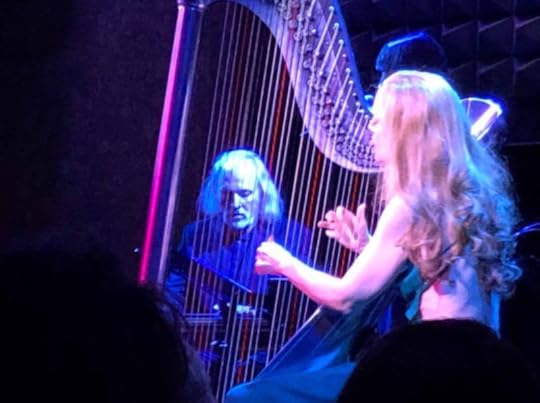 Mike Nolan with his wife, the harp player Erin Hill
I met a bunch of folks at the Yale Drama School, and ended up doing outside ambient music for several productions there. I started making large metallic “Sound Sculptures” that we used in a couple of Kabuki plays that I worked on. I got a lot of good feedback and direction from Mladen Kiselov, who was the director of the Bulgarian State Theater at the time.
I wanted some more control so I went to the local used music store and bought a used Korg MS-10 and an old echoplex, which was the gateway drug to the whole synthesis rabbit hole. My partner at the time (Debbie Huff) was in the painting school. We were flat broke and living the life. I managed to sell one guitar and buy a Moog Sonic VI, which I still have. That helped fill in the MS-10 sound. I was still looking for something and found out that ARP was going out of business and that a local music store was blowing out the three 2601s they had for $1,000. We scraped every penny we could and ate potatoes for a month so I could buy it. Still have it too.
After Yale we moved to NYC via a several month stay in Greenwich, Connecticut, back when it was still a sleepy almost farm town. Debbie developed a rare cancer and died in 1995. I’ve been in NYC since New Haven.
What is your musical activity? February 9th 1964. I was upstairs in my room reading a book. My mom came up and told me there was something on television that I should see. I went downstairs and it was the Beatles’ first appearance on Ed Sullivan. About a week later I pestered them into buying me a guitar. About two years later I was in a junior high school rock band playing the hits at bowling alley dances. I played in rock bands all through high school and college. I have made a couple records with a couple of bands that didn’t do too much. I have done music for film, theater, and dance productions, as well as playing on sessions and producing. Tonight I’m learning a couple of songs for a gig Friday night at some Country Club. In short, I’m still at it.
I think that you get a bit of what I’m up to through my bio above.
I have done music for about a hundred shows in NYC and regional theater. Almost never for musicals but rather for cinematic effect. I don’t really do that anymore but I did have shows on Broadway and off Broadway during the thick of it and got to work with a lot of interesting people. Notable was the broadway run of “Nixon’s Nixon” and Christopher Walken’s “HIM” at the Public Theater. I was a founding member of a still active NYC theater, but I no longer participate in the organization. There is a lot more from this period, if you want to know more.
I have played dive bars, stadiums, Madison Square Garden, Lincoln Center, regional art venues, museums, festivals, nursing homes, more dive bars, etc.
I’m playing fewer gigs nowadays as the NYC gig scene is still in a bit of disarray post-Covid, and I’m getting tired of the parking hassles in the city, but I always go out with my wife, Erin Hill, usually a couple of times a month.
I’m still building the Serge that I moved on to after my stint with Eurorack… it is at 10.5 panels and will top out at 12, when I get time to solder. It is a great solitary pursuit that lets me just listen and see what happens… maybe interact.
I really look forward to doing the Disquiet Junto projects each week because they give me an outlet for the kind of electronic music that I don’t or can’t perform live.
What is one good musical habit? Listen to something, music or the world, and play the essence of it on some instrument… or sing it.
What are your online locations? Lines, The Steel Guitar Forum, The Internet Archive, Arch Daily. On social media: SoundCloud and Instagram.
What Was a Particularly Meaningful Junto Project? Disquiet 0515 Talking Cure: I have a day job… 36 years (so far) as a professor of architecture. I liked this prompt as I am always thinking about the type of sound or music that fits with a space, especially when that space fits a very defined function.
You mention being a professor of architecture. Could you talk about how you came to that, and also how your knowledge of and experience in architecture correlates with your work in music? The architecture professorship wasn’t something that I had planned on doing. Debbie Huff, who I mentioned earlier, was hired at New York Institute of Technology to teach drawing and visualization plus some color theory courses. A few years into her time there, the architecture department decided to start a program in design computation. I wasn’t working in an office at the time and had no real desire to do that. So I was mostly working on design-build projects in the city. The design-build world is a volatile gig economy with no real security. So I decided to go ahead and apply for the job. Back then in 1987, there were almost no architecture offices using computers and almost no programs in any school for design computation in architecture, other than the really theoretical, high-end work at the MIT Media Lab started by Nick Negroponte and Jerome Wiesner in 1985. I was the only candidate that applied for the job, and despite that fierce competition, I was hired. I had been involved with programming on and off since 1971 so I had some experience with the couple of mainframes (DEC-PDP 11s) that were hanging around. At that time there was a quasi-independent department (read as for-profit) at NYIT (the Computer Graphics Lab) for development of computer graphics, and animation, that had some more advanced Silicon Graphics machines, so I hung out there a bit. The CGL eventually broke off from NYIT and became part of Industrial Light and Magic. Formed in 1974, CGL’s roster included future Pixar president Ed Catmull and co-founder Alvy Ray Smith, Walt Disney feature animation chief scientist Lance Joseph Williams, Dreamworks animator Hank Grebe, and Netscape and Silicon Graphics founder Jim Clark. I guess I came to NYIT as more of a computer jockey than as an Architect.
Playing in rock bands was kind of the opposite of space, as we were usually trying to fill everything up with the maximum possible amount of noise. The other part of my musical life started after hearing Silver Apples of the Moon. I searched out all of the electronic and experimental work I could find… a lot of work in the pre-internet days. That’s where I ran into Cage and started to understand the importance of silence, which is one musical equivalent for space. Varèse was really influential for the orchestral works, but more importantly for “The Poem Electronique.” The “Poem” led to my discovery of the Philips Pavilion… which led to Le Corbusier on the architecture front, and Iannis Xenakis on the architecture/music front. All of that has been linked for me since the late 1960s and has been a lifelong influence on musical thought…. in many genres…
Every couple of years, I run an elective class on intersections in technology, architecture, and music, where I can develop and expand on these ideas and pass some thoughts on to young architects.
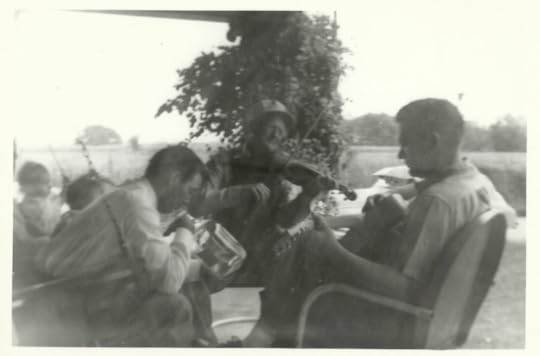 Mike at age one with his family: “My sister, plus my dad playing jug, my grandfather, my uncle Bob. On the front porch of my grandfather’s farm. Probably 1954.”
I think for a lot of casual listeners, and even for many musicians, abstract electronic music can feel quite separate from more traditional forms of music, especially the stuff you talked about early on, like the blues. Could you help connect the dots between playing guitar in a country rock band, and developing a Serge system to make electronic music? Yes, it all does seem completely separate and might have stayed that way except for another random event. During the Nashville period, I went to visit another musician from the scene. He had a plant stand in the front window that was made from a 1X12 shelf on the top of a pedal steel guitar. I asked him about that, and he said that he had tried to learn to play it, but had given it up as a lost cause. I asked about borrowing it for a bit, but he said that he didn’t really want it back and that I could have it…. If I built him another plant stand. So that started the pedal steel guitar journey. If you listen to the really good steel guitar players you can hear the space, the when to play and when to lay out. There are a number of modern pickers that can and do play a million notes a minute, but I don’t really appreciate that. As Jimmy Day (one of my favorite steel players) once said, “I wish I could play that fast, and then I wouldn’t.” I play steel in mostly pop and rock settings, but always try to leave space. There are a number of videos of live sets with my wife, Erin Hill, where you can hear my non-country playing (“Rocket Man,” “Gypsy”). The steel is a very good instrument for ambient drone music as well and is great for processing by or accompaniment to the Serge, or wherever modular. We aren’t that oddball… Check out Chas Smith, who has worked with Hans Zimmer and others on soundtracks, built his own instruments, is a steel guitar player, and owns a rather large Serge system.
It’s a continuing journey and who knows what’s next.
I want to thank you for creating and maintaining the Junto, it is a great hang and an opportunity to get things out quickly that can be heard by a lot of people outside in the bigger music community.
September 21, 2023
TWiS Listening Post (0013)
This went out yesterday as a weekly bonus — a thank-you to people who financially support This Week in Sound. It supplements the free Tuesday and Friday issues, which feature a broader array of material from the field of sound studies. It contained an annotated playlist of recommended music. I wrote about ambient and ambient-adjacent recordings from (1) Donny Mahlmeister (using a beat machine for quiet music), (2) Chieko Mori (koto minimalism), and (3) Öppenlab Yorkshire (employing a handheld game console).

Disquiet Junto Project 0612: Drum Vector
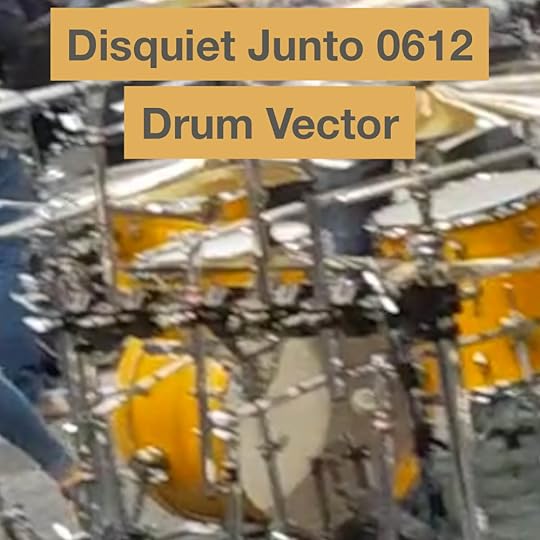
Each Thursday in the Disquiet Junto music community, a new compositional challenge is set before the group’s members, who then have just over four days to upload a track in response to the assignment. Membership in the Junto is open: just join and participate. (A SoundCloud account is helpful but not required.) There’s no pressure to do every project. It’s weekly so that you know it’s there, every Thursday through Monday, when you have the time and interest.
Deadline: This project’s deadline is the end of the day Monday, September 25, 2023, at 11:59pm (that is, just before midnight) wherever you are. It was posted on Thursday, September 21, 2023.
Tracks are added to the SoundCloud playlist for the duration of the project. Additional (non-SoundCloud) tracks appear in the lllllll.co discussion thread.
These following instructions went out to the group’s email list (at tinyletter.com/disquiet-junto).
Disquiet Junto Project 0612: Drum Vector
The Assignment: Walk the listener through variations on the same percussive instrument.
Thanks to Mahlen Morris for having proposed this project.
Step 1: Pick a single percussion instrument.
Step 2: Record between 4 and 12 different short examples (roughly 20 to 60 seconds each) of playing that instrument. Imagine that each recording is by a different musician exercising a different aspect of the instrument. Make no deliberate attempt to match key or tempo or sonic quality between them.
Step 3: Imagine moving through space over the course of time, and encountering the sounds — overlapping somewhat — as you proceed. Arrange the recordings over the course of a track so that at least one and at most five of the examples are audible at any one time. To further the spatial movement, each could fade in at the beginning and fade out. They might, as well, move from position to position within the stereo field.
Step 4: If you wish, consider adding a noise bed underneath the entire piece to sew all of the pieces together, to provide a sense of the space one is moving through.
Eight Important Steps When Your Track Is Done:
Step 1: Include “disquiet0612” (no spaces or quotation marks) in the name of your tracks.
Step 2: If your audio-hosting platform allows for tags, be sure to also include the project tag “disquiet0612” (no spaces or quotation marks). If you’re posting on SoundCloud in particular, this is essential to subsequent location of tracks for the creation of a project playlist.
Step 3: Upload your tracks. It is helpful but not essential that you use SoundCloud to host your tracks.
Step 4: Post your track in the following discussion thread at llllllll.co:
https://llllllll.co/t/disquiet-junto-project-0612-drum-vector/
Step 5: Annotate your track with a brief explanation of your approach and process.
Step 6: If posting on social media, please consider using the hashtag #DisquietJunto so fellow participants are more likely to locate your communication.
Step 7: Then listen to and comment on tracks uploaded by your fellow Disquiet Junto participants.
Step 8: Also join in the discussion on the Disquiet Junto Slack. Send your email address to marc@disquiet.com for Slack inclusion.
Note: Please post one track for this weekly Junto project. If you choose to post more than one, and do so on SoundCloud, please let me know which you’d like added to the playlist. Thanks.
Additional Details:
Length: The length is up to you. How long a walk do you want to take the listener on?
Deadline: This project’s deadline is the end of the day Monday, September 25, 2023, at 11:59pm (that is, just before midnight) wherever you are. It was posted on Thursday, September 21, 2023.
Upload: When participating in this project, be sure to include a description of your process in planning, composing, and recording it. This description is an essential element of the communicative process inherent in the Disquiet Junto. Photos, video, and lists of equipment are always appreciated.
Download: It is always best to set your track as downloadable and allowing for attributed remixing (i.e., a Creative Commons license permitting non-commercial sharing with attribution, allowing for derivatives).
For context, when posting the track online, please be sure to include this following information:
More on this 612th weekly Disquiet Junto project, Drum Vector (The Assignment: Walk the listener through variations on the same percussive instrument), at: https://disquiet.com/0612/
Thanks to Mahlen Morris for having proposed this project.
About the Disquiet Junto: https://disquiet.com/junto/
Subscribe to project announcements: https://tinyletter.com/disquiet-junto/
Project discussion takes place on llllllll.co: https://llllllll.co/t/disquiet-junto-project-0612-drum-vector/
September 20, 2023
This Week in Sound: “Every Appliance Is Serenading Us”
These sound-studies highlights of the week originally appeared in the September 19, 2023, issue of the Disquiet.com weekly email newsletter, This Week in Sound. This Week in Sound is the best way I’ve found to process material I come across. Your support provides resources and encouragement. Most issues are free. A weekly annotated ambient-music mixtape is for paid subscribers. Thanks.

▰ MUSIQUE D’AMEUBLEMENT: “As brands continue to search for ways to cut through the proverbial noise and connect with customers, we can only expect more appliance acoustics,” writes Johnny Brayson, reporting on what many people have noticed, which is that “Seemingly every appliance, from the vacuum to the dryer, is serenading us these days.” Also: “As novel as it may seem, it’s just new to the West. Appliances have been singing in other parts of the world before the dawn of the millennium, with Japanese appliance manufacturer Zojirushi incorporating chimes in their rice cookers as early as 1999. The sounds not only helped the brand stand out in the sea of standard beeps made by competitors’ products, but also it showcased the capabilities of then-new microcomputer tech, as programming the tones wasn’t possible before. Like Zojirushi, the consumer electronics brands filling American homes with song today are doing so for both emotional and practical reasons.” Erik Satie might be proud. (Thanks, Lowell Goss!)
▰ VOCAL DISCORD: Lisa Mulcahy at the Washington Post (gift link) explains both why one might find one’s voice annoying (“58 percent of the survey subjects said they didn’t like listening to themselves,” per Harvard teaching hospital research), and what can be done about it: “Several interventions are possible, including vocal cord injections using collagen, gel fillers or Botox. … Voice therapy using airflow exercises can be a helpful, safe alternative.” Me, I depend on speech-to-text tools, like MacWhisper and rev.com, to transcribe things for me, in part to save time, but also so I don’t have to hear myself. (Thanks, Mike Rhode!)
▰ TOTALLY TUBULAR: A new update to the more recent of the AirPod Pros — or, as scriveners in the field of gadget journalism term them, AirPods Pro — means the devices “will automatically adjust to your environment or activity so you don’t have to touch the earbuds or reach for your phone.” Yes, this is a product update, and no it isn’t the end all or be all of just about anything, but per other recent writing here, I do think it’s highly valuable to track both technological milestones and exploratory interface tweaks, because today’s peculiar, fledgling firmware adjustment is the near future’s new normal. Not just observing these changes but documenting them in real time is highly valuable. “When there’s a change in your surroundings,” writes Billy Steele at Engadget, “Adaptive Audio gradually starts tweaking the blend of ANC and transparency. So if you enter a loud coffee shop or sit near a noisy A/C unit, AirPods Pro gently increases the level of noise cancellation to combat the clamor. The point is to smooth the transition, so the change in cancellation level doesn’t become a distraction itself.” (Related but less of a tectonic shift: there are 20 new iOS ringtones, including ones crafted by musician Adam Young, of the electronica act Owl City.)
▰ ALL EARS: SonarWorks has posted a survey of data about the headphone industry, noting: “The headphone market is highly consolidated with the top 10 headphone models together representing 36% market share and the top 3 models 19% market share.” Details include market share among the top 162 models, with Apple at roughly 20%, between three models. (Caveat: “Unfortunately, China and India were left out of our research due to a lack of available data.”) There are also several charts. This one below: “The frequency responses of the top 162 headphone models are represented by colored lines with the weighted average shown as a solid black line.” The variance at the high end (on the right) is quite striking. (Thanks, Kirke Godfrey!)

▰ QUICK NOTES: Pivot Tabled: I’m comfortable saying that I don’t understand the new product offering from Clubhouse, the “voice social media” service. ▰ Class App: Duolingo’s music lessons are, indeed, coming. I’ve been doing German for — checks phone — a 135-day streak. I’m looking forward to trying it out. ▰ Quiet Mode: Nathan Moody notes, on Twitter/X, the ASMR promotion of the upcoming Expendables film (apparently Extraction 2 and A Quiet Place did similar things). ▰ The Other Tweet App: Check out birdsong.fm, which is what it seems like (thanks, Jason Wehmhoener!) ▰ Mm-Hmm: 3M is on the hook for six billion dollars (for veterans and service members) due to hearing loss “from faulty earplugs.” That’s two billion per M. (Thanks, Rich Pettus!) ▰ Doggone Crazy:Researchers in Hungary are learning how best to talk to a dog. (Also, thanks, Rich!)
September 19, 2023
On the Line: Roden, Yong, Furst
The “His” is Steve Roden, the late artist (and a friend of mine), who died earlier this month. The “I” is Lawrence English, writing an appreciation in the Quietus. I fully subscribe to English’s “tidal” prediction — the projected ebb and, especially, the flow.
. . .
“I didn’t find birding so much as it found me.”That is Ed Yong, author of An Immense World: How Animal Senses Reveal the Hidden Realms Around Us, in his newsletter.
. . .
“The Zebra owned a little radio; it played static, and also a station that stayed on the air all night long, playing scratchy recordings of Schumann and Chopin from somewhere in the darkness of Central Europe, where insomnia had become something of a religion.”That sentence is “recent” only as in the “recent to me” sense. It’s from 1991. It’s from the second novel, Dark Star, of apparently 15 in the Night Soldiers historical spy series by Alan Furst. And for context, the “Zebra” is the nickname of someone the book’s protagonist spends an evening with. The time is just prior to World War II.


