
Marc Weidenbaum's Blog, page 91
September 19, 2023
Sound Ledger: Laguna Beach
30: Number of minutes of “nonstop” dog barking that becomes eligible as a noise complaint in Laguna Beach, California
60: Number of minutes of “intermittent” dog barking that becomes eligible as a noise complaint in Laguna Beach
500: Cost, in U.S. dollars, for a “third and subsequent offenses within a 12-month period”
Source: latimes.com


September 18, 2023
New Jack Swing
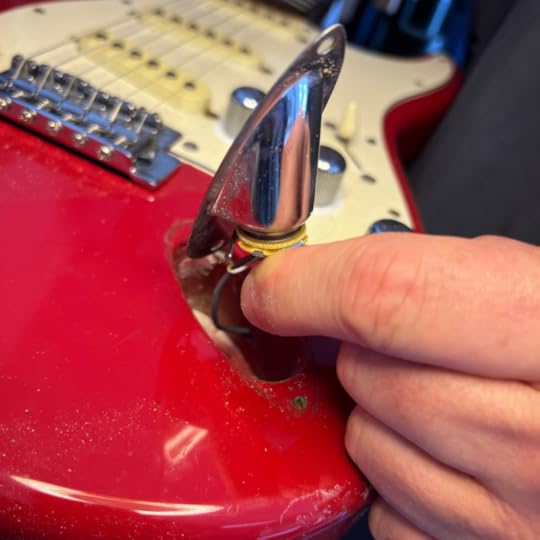
Learning why I wasn’t correctly tightening the jack on my guitar. (Note: that isn’t my guitar.)
September 17, 2023
Junto Profiles: The First 20
Something I’ve wanted to do for the longest time was not just to get to know more members of the Disquiet Junto music community, but to do so in a way that helps others get to know them. I’d attempted trial runs along these lines a few times over the years, but it only finally kicked in these past few months, when I’ve managed to interview a range of Junto participants with a wide variety of backgrounds in terms of experience, geography, aesthetics, training, and other characteristics. The first 20 are now online, and there are more to come. Here they are in reverse order of publication date, between February 6, 2023, and September 15, 2023:
Matthew Ackerman: From Los Angeles: “joyfully avant-garde,” experimenting in DAWs, collaborating online
leon clowes: From London, England: autoethnography, transdisciplinary creative practice, revisiting the music of one’s teens
Ray Cobley: From Orkney Islands, Scotland: discarding nothing, living remotely, working with Pure Data
Magnus Lindencrona (aka gis_sweden): From south of Gothenburg, Sweden: observing while commuting, working with limitations
Darren Bourne (aka halF unusuaL): From Nottingham, England: ignoring dead ends, composing for dance and theater
Kel Smith (aka Suss Müsik): From Pennsylvania: handmade electroacoustic instrumentation; reducing complexity
Paul Beaudoin: From Tallinn, Estonia (previously Boston): studying with Morton Feldman and adding beats
Ethan Hein: From New York City: teaching technology and theory, sampling Thelonious Monk
Nick Sinnenberg, aka Sinny: From New York: drumming, collaborating, opting for blemishes
Andreas Winterer, aka Krakenkraft: From Munich, Germany: breaking rules and making “boring” music
Mark Rushton: From Des Moines, Iowa: streaming live, and leaving nothing on the shelf
Michel Banabila: From the Netherlands: “Be open for anything that can happen.”
Joe McMahon, aka Equinox Deschanel: From West Virginia, now SF Bay Area: welcome imperfection, false dichotomies
Klaus-Dieter Hilf, aka RabMusicLab: From Heidelberg, Germany: Mathematics, Munich, MIDI
Jason Richardson, aka Bassling: From Leeton, New South Wales, Australia: drafting, redrafting, and collaborating
Aethyr: From Sheffield, England: eschewing perfection, tweaking genres
Kei Terauchi Sideboard: From San Francisco, California (and Japan): embracing contradictions, reading to compose
xiiixxi: From York, England: growing up with Italian opera, working with Euclidean rhythms
Ian Joyce: From the North Wales coast: soporific synths, having fun, the cat’s meow
Daniel Díaz: From Paris, France: working in film, making space, keeping a notebook
September 16, 2023
Declaring Inbox(es) Zero
Status
I’ve made it to true inbox zero. Not just inbox — inboxes, plural.
Plural?
I maintain a half dozen or so email addresses for various purposes. The main one remains the one associated with this URL, disquiet.com.
Impact
If you’re expecting an email from me (please note the qualification below), I respectfully ask that you remind me what the subject was. After a long haul, I’ve dug myself out of a voluminous email backlog, in some cases going back years. This required some tough decisions about what might plausibly be relegated to the past. Such is email. Such is life, digital or otherwise. Also, an empty inbox doesn’t mean a blank to-do list.
Qualification
If what you’re expecting a reply to is an inquiry from you to me about me writing about your music or art, please understand that I can’t reply to all of those emails, because I receive upwards of 100 a day. (This topic is covered in the Disquiet F.A.Q.) The majority of such inbound emails don’t even make it to my inbox. They’re filtered immediately to a series of folders that I explore when I have the time.
Process
I know people who can’t imagine letting more than a half dozen emails linger in their inbox. And I know people who think “inbox zero” is a load of procedural hogwash. To each their own. I’m not here to argue, least of all that one size fits all.
Hello
Don’t read this as an admonition against correspondence. I live, in many ways, a long-distance life, even though I have an active “in-person” social life, and I dwell in the U.S. city with the second highest population density (for a city with over 300,000 residents). My writing, my interests, my listening, and the Disquiet Junto music community put me in touch with countless people far away — the vast majority of whom I will never meet in person. All things said, I’m pro-email. You can, though, have too much of a good thing.
Scratch Pad: Metrics, AI, Pan
I do this manually at the end of each week: collating most of the recent little comments I’ve made on social media, which I think of as my public scratch pad. I mostly hang out on Mastodon (at post.lurk.org/@disquiet), and I’m also trying out a few others. And I take weekends off social media.
▰ The first spam call of the day is such a special moment.
▰ I was reading how the full line of new iPhones can output 4K DisplayPort video , and I started to wonder when I won’t even own a “computer” anymore. A lot of steps between now and then, but seems quite close.
▰ When I watched the preview for the upcoming Aquaman movie, my first thought was, “He’s fighting Deadmau5?”
▰ I fed the latest Disquiet Junto prompt into the Stable Audio web app (stableaudio.com) from Stability AI, and it’s been running for a few minutes. Either traffic is heavy, or it broke the neural network’s brain.
▰ I love details like this. It’s from Jon Pareles’ article about the new Rolling Stones album. The Watt mentioned here is the album’s producer, Andrew Watt. Can’t say I loved the first single, but I’m looking forward to hearing the rest of it.

▰ This next comment is solely for fans of Jonathan Hickman’s X-Men comics, but in Hickman’s world it would turn out there is only one Florida Man and he did everything ever attributed to “Florida man.” (I have been helpfully reminded by a friend that this is, in essence, the proposal offered by LaKeith Stanfield’s Darius in Atlanta.)
▰ This isn’t the first time, but I purposefully wiped clean my organized MP3s, stuck ’em all in one folder (mostly by album) and have slowly been re-adding them to Apple Music (I don’t subscribe to Apple Music but I do to iTunes Match) one at a time. Getting reacquainted is nice.
▰ I have quantified my sense of the profession:

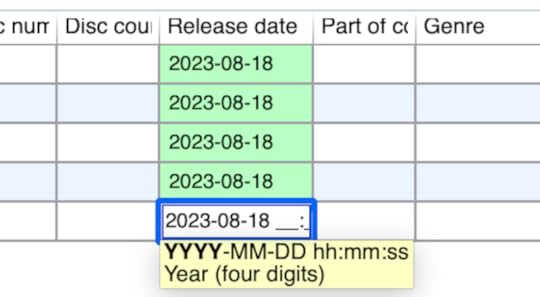
▰ There’s metadata trainspotting, and there’s “What second of what minute did this album release appear in public?” metadata trainspotting.
September 15, 2023
Junto Profile: Matthew Ackerman
This Junto Profile is part of an ongoing series of short Q&As that provide some background on various individuals who participate regularly in the online Disquiet Junto music community.
What’s your name? Matt Ackerman. Moniker: modus pony.
Where are you located? Los Angeles/Redondo Beach. I grew up in Sacramento. Moved to LA after high school and lived here for 22 years now with a short stint in Orange County where I studied Film and Media at UC Irvine. Growing up in Sacramento, there really wasn’t much experimental or weird going on in terms of the music scene. I think there is now, and actually there has been since at least the 2000s but in the nineties it just seemed like everyone was into new metal. I wouldn’t say this was the reason I moved but generally speaking, I just didn’t feel there was much possibility there for me.
What is your musical activity? Even though I don’t sing or write lyrics, I still think in terms of songs. It’s kind of second nature to me. I have on occasion tried to throw that learning out the window but I don’t enjoy it as much. That being said, I’m a big fan of the sort of prompt-based, or limitation-based thinking the Junto exemplifies. Prompts allow you to try on new personas and create something you wouldn’t have otherwise. In fact, I often need some sort of prompt or idea to even get started on something. I think it takes practice however, to use discretion, to keep what really works from the experiment and toss the rest. I try not to get too obsessed with the “rules” I’ve decided to follow. Ideally, I’d like my music to be both enjoyable and interesting, but if I could only pick one, I think I’d rather be enjoyable. I’ve been told on occasion that my music is “funny,” sometimes even when I didn’t intend it to be. I take it as a compliment regardless.
I started on bass guitar when I was 15 (I’m 41 now). Learned mostly on my own with some help from a friend. I had a 4-track recorder and a sampler too. I would record eclectic little funk punk things that were more like jams than songs. I also remember experimenting with the 4-track, recording a bunch of non-sense and playing it backwards.

After being in LA a few years, I played bass in a band called Strofik. The style was sort of an extension of the heavy rock you heard back then but the riffs were a little more ornate. We played a handful of venues and I pretty much hated performing. Still do. This was circa 2004-2006. We didn’t know what we were doing composition-wise but we were all learning together. The camaraderie was really pretty great. Then, unfortunately the guitarist passed away. There was a few other attempts at starting bands after that but it just wasn’t the same. By then, digital recording had advanced a little and I didn’t really need a band to do what I wanted anymore.
After my band days, I got more into writing and recording on my own, releasing things on Bandcamp. I found it easier to experiment on my own in a DAW like Ableton than it was in a band context. I was lucky enough to meet some interesting talented people to collaborate with through Soundcloud and through an experimental music blog I used to run, Caliper Music. I did two albums with the Madrid based singer-songwriter, Suko Pyramid in 2018 and 2020 that I think are pretty unique. Collaborating online is different than working in a live band for sure, but I find it’s a little easier in some regards and that camaraderie can still be found even when you’re thousands of miles apart.
During the pandemic, like a lot of people, I was off from work for a while. I decided to take guitar lessons from Bill Harkleroad (“Zoot Horn Rollo” of Captain Beefheart’s Magic Band) after seeing an interview with him on YouTube. I already knew some basic music theory but I learned a ton more from Bill. You can sort of hear the change in my music after 2020. My music before was very rhythmic and riff-based but the harmonic element was sort of simple (as you might expect from a bassist). My stuff these days is a lot more jazzy (at least harmonically) and guitar oriented. Practice is also more important to me these days as I’m trying to claw back some musicianship that I think was lost when I decided to focus on recording a decade ago.
What is one good musical habit? I would say try to continually start in a new place. Where you start influences where you’ll end up so if you want variety in your sound, try starting in a new place. It could be some clever experimental idea but it really doesn’t have to be. If your songs lately have started with some guitar chords, try starting with a bass line, or a rhythm. Play an instrument you don’t know how to play. Try a new synth sound you wouldn’t normally use and tailor the music to that sound. Choose something you want to get better at and make it the focus. Just start in a new place, whatever it is.
What are your online locations? For social media, I’m mainly on Mastodon these days: zirk.us/@ModusMatt. I still have my Twitter (sorry, “X”) but use it strictly for promotion now: twitter.com/moduS_ponY. Also on Soundcloud: soundcloud.com/moduspony and soundcloud.com/modusmatt. And Bandcamp of course: moduspony.bandcamp.com.
What was a particularly meaningful Junto project? I would say the Junto project I was most happy with as far as the end product was Hot Mise en Abyme (disquiet0348). Mise en Abyme is the art historical term for fractal/recursion. I called the track Praugress, referring to the augmented chord that overlaid the entire piece, the individual notes being drones over each of three parts. Then three drones were nested within each of those parts, with a series of three chord progressions, 9 in total. The time signature was also 3/4 which gave it sort of a waltzy/classical feel at times. I was so happy with the results I put it on an my album, Ulterior Frequencies: moduspony.bandcamp.com/track/praugress.
If I could pick another one simply for how fun it was, it would be Gronkytonk (disquiet0302), which was a fictional genre that appeared in a Malka Older book, Infomacracy. The assignment was simply to imagine what Gronkytonk would sound like. I imagined “weird honkytonk” and set about replicating some honkytonk conventions with some unconventional electronic elements added. The result was a goofy jam called Dog Bite my Jesus Baby: soundcloud.com/moduspony/dog-bite-my-jesus-baby-disquiet0302. It’s also probably the only track on which I sing, kind of. It’s very badly pitch shifted with a sampler. My favorite comment on that track was: “what kind of pills were used for this, love it.”
You mentioned the lack of experimental music locally when you were growing up. The web was just getting going in the early 1990s. Do you have any sense if for younger people today online accessibility of esoteric culture means local influences are less important? Yeah, I think if I were a little more plugged into what was going on, I would have been in the know about some interesting things happening in Sacto in the ’90s, but as you say the internet was just getting going and it took a little more initiative to find something unique, whereas now you fall into a rabbit hole without even trying.
Also, I was young so a computer was still something I mainly used for homework. But I think it’s fair to say something shifted not just with the internet providing access to esoteric culture but also with digital distribution. Everyone is their own scene, so to speak, meaning an artist doesn’t have to cater to local culture and interests to get attention. Any small town can and probably does have a few bedroom musician weirdos doing their own unique thing. It’s also easier for said weirdos to find each other and collaborate, whether it be locally or globally. There’s obviously a downside we could talk about as far as the subversion of local culture and the atomization of society but as far as individual expression, I think it’s great.
Can you talk a bit more about your sense of what makes your music “funny” and what “funny” means for music more generally? Well, there’s the obvious tracks I’ve done that have a humorous element, like “Bananafest Destiny,” which has a cut-up of talking samples made to say silly things. But it’s harder to say what can make an instrumental track funny, one where there’s no semantic language element. It may have something to do with shared cultural expectations with music (or maybe just expectations set up by the music itself), and having those expectations defied. I have a track called “if you only knew what I did for this 6 piece bakeware set” that ends with a progressively frenetic series of random synth notes, then a long pause, then one more little unexpected note at the end. When I think about music that makes me smile or laugh, there’s a recognition by the listener that the artist is being joyful or silly, being adventurous in a fun way rather than a serious way. I think Thelonius Monk is a good example of what I would call “joyfully avant-garde.” He always makes me smile. In the same way a comedian might make their audience see the world in some new absurd way, so can a musician make the listener hear the world in a new absurd way.
September 14, 2023
Disquiet Junto Project 0611: Music That Listens to Itself
Each Thursday in the Disquiet Junto music community, a new compositional challenge is set before the group’s members, who then have just over four days to upload a track in response to the assignment. Membership in the Junto is open: just join and participate. (A SoundCloud account is helpful but not required.) There’s no pressure to do every project. It’s weekly so that you know it’s there, every Thursday through Monday, when you have the time and interest.
Deadline: This project’s deadline is the end of the day Monday, September 18, 2023, at 11:59pm (that is, just before midnight) wherever you are. It was posted on Thursday, September 14, 2023.
Tracks are added to the SoundCloud playlist for the duration of the project. Additional (non-SoundCloud) tracks appear in the lllllll.co discussion thread.
These following instructions went out to the group’s email list (at tinyletter.com/disquiet-junto).
Disquiet Junto Project 0611: Music That Listens to Itself
The Assignment: Record a piece of music that repurposes itself as it proceeds.
Background: On September 29, 2023, there is going to be an event at a place called the Berkeley Alembic, in Berkeley, California, where I’ll play recordings of music that share a specific theme, and I’ll discuss the sounds with the people who come to listen. The event is titled Music That Listens to Itself, part of the Expanded Listening series developed by Erik Davis (Techgnosis, Burning Shore). That is the theme. Part of the goal of this project is to develop tracks for potential inclusion in the event, and to pursue ideas related to the event’s theme.
Step 1: The underlying idea is to produce music that, so to speak, listens to itself. This would be music that employs techniques to revisit itself — repurposes itself — as it proceeds. From reverb to echo to tape loops to granular synthesis to accessing a buffer, various techniques serve such a compositional and performance purpose. Consider a means to achieve this result.
Step 2: Record a piece of music that employs the technique you focused on as a result of Step 1. Please note: for the Berkeley Alembic event, I’ll be sharing music that is particularly quiet, particularly appropriate to a meditative state of mind. You don’t need to record quiet music for this project, but quiet music is what I’ll be playing at the event.
Additional details:
https://disquiet.com/2023/09/03/music-that-listens-to-itself-expanded-listening-berkeley-alembic/
Tickets:
https://www.eventbrite.com/e/expanded-listening-music-that-listens-to-itself-tickets-712124101357
About the venue:
Eight Important Steps When Your Track Is Done:
Step 1: Include “disquiet0611” (no spaces or quotation marks) in the name of your tracks.
Step 2: If your audio-hosting platform allows for tags, be sure to also include the project tag “disquiet0611” (no spaces or quotation marks). If you’re posting on SoundCloud in particular, this is essential to subsequent location of tracks for the creation of a project playlist.
Step 3: Upload your tracks. It is helpful but not essential that you use SoundCloud to host your tracks.
Step 4: Post your track in the following discussion thread at llllllll.co:
https://llllllll.co/t/disquiet-junto-project-0611-music-that-listens-to-itself/
Step 5: Annotate your track with a brief explanation of your approach and process.
Step 6: If posting on social media, please consider using the hashtag #DisquietJunto so fellow participants are more likely to locate your communication.
Step 7: Then listen to and comment on tracks uploaded by your fellow Disquiet Junto participants.
Step 8: Also join in the discussion on the Disquiet Junto Slack. Send your email address to marc@disquiet.com for Slack inclusion.
Note: Please post one track for this weekly Junto project. If you choose to post more than one, and do so on SoundCloud, please let me know which you’d like added to the playlist. Thanks.
Additional Details:
Length: The length is up to you. About 10 minutes maximum is best, and probably no shorter than three minutes.
Deadline: This project’s deadline is the end of the day Monday, September 18, 2023, at 11:59pm (that is, just before midnight) wherever you are. It was posted on Thursday, September 14, 2023.
Upload: When participating in this project, be sure to include a description of your process in planning, composing, and recording it. This description is an essential element of the communicative process inherent in the Disquiet Junto. Photos, video, and lists of equipment are always appreciated.
Download: It is always best to set your track as downloadable and allowing for attributed remixing (i.e., a Creative Commons license permitting non-commercial sharing with attribution, allowing for derivatives).
For context, when posting the track online, please be sure to include this following information:
More on this 611th weekly Disquiet Junto project, Music That Listens to Itself (The Assignment: Record a piece of music that repurposes itself as it proceeds), at: https://disquiet.com/0611/
Some of the music resulting from this project may be included in a September 29, 2023, event at the Berkeley Alembic in Berkeley, California: https://www.eventbrite.com/e/expanded-listening-music-that-listens-to-itself-tickets-712124101357
About the Disquiet Junto: https://disquiet.com/junto/
Subscribe to project announcements: https://tinyletter.com/disquiet-junto/
Project discussion takes place on llllllll.co: https://llllllll.co/t/disquiet-junto-project-0611-music-that-listens-to-itself/
September 13, 2023
Death Hags’ Junto Episode
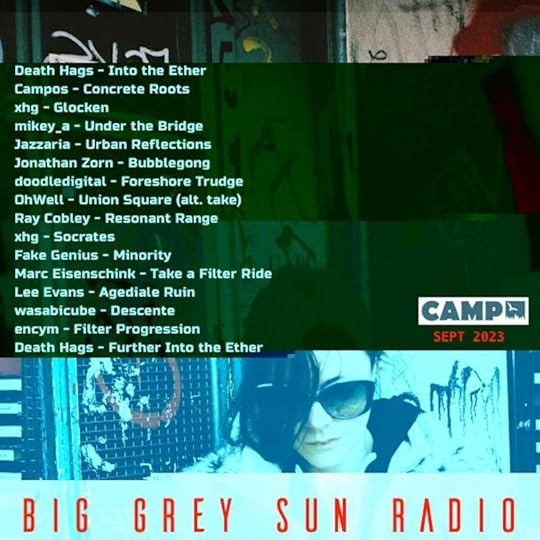
For the September 9, 2023, episode on her listen.camp show, Big Grey Sun 2.0, L.A. musician/producer Lola G. (aka Death Hags) played over a dozen tracks from the first of the three Disquiet Junto projects that participants did this year in collaboration with Musikfestival Bern. The theme of this project, number 0590, Concrète Roots, was: Make music combining field recordings and feedback.
This is the playlist from “Big Grey Sun 2.0 / 09th September 2023,” which is hosted at mixcloud.com:
Campos – “Concrete Roots”xhg – “Glocken”mikey_a – “Under the Bridge”Jazzaria – “Urban Reflections”Jonathan Zorn – “Bubblegong”doodledigital – “Foreshore Trudge”OhWell – “Union Square (alt. take)”Ray Cobley – “Resonant Range”xhg – “Socrates”Fake Genius – “Minority”Marc Eisenschink – “Take a Filter Ride”Lee Evans – “Agediale Ruin”wasabicube – “Descente”encym – “Filter Progression”Recent Posts of Note
From the past couple months:
▰ A trip down the rabbit hole that is the archive of Tape Recording magazine, following an obituary about its publisher, who loaned a video camera to Andy Warhol in the mid-1960s
▰ A personal memory of seeing free jazz saxophonist Charles Gayle perform live, on the occasion of his death at age 84
▰ An interview with me, talking about the Disquiet Junto music community’s participation, for the fifth year in a row, at Musikfestival Bern in Switzerland, thanks to Tobias Reber’s support.
▰ A work-in-progress, as I track my listening to the massive recent set of Autechre live concerts from 2022
▰ An appreciation of Dedalus Ensemble’s album of Brian Eno covers
▰ An essential sonic moment from Kwon Yeo-sun’s novel, Lemon
▰ My review for Pitchfork of Caterina Barbieri’s new album, Myuthafoo
▰ A quick little meme about Steven Soderbergh
September 12, 2023
Work Tools (Apps)
I write a lot, all the time, and I do so in a lot of different apps. I work on a MacBook laptop, an iPhone, and an iPad of late. Not so many years ago, I was evenly split between a Windows laptop, an Android phone, and an Apple iPad. Back then I used to joke that Dropbox was my operating system. I was on Nokia phones before the Android G1, and then on various other Android phones until the iPhone 13 came out. Due to a confluence of reasons, after that I ended up, for the first time, with all my major devices in the same single corporate realm (née “ecosystem,” which is a snazzy word for variably regulated shopping mall). I also have a cheap, used Samsung tablet as a second screen (or third, given the iPad). Below are the main pieces of software I use. I use a bunch of others, too, and I may add some to this list as time goes on.
Notes / Writing
I primarily use Obsidian (obsidian.md) for the majority of my organized notes, which are broken down by date and project. Obsidian is a recent move for me, from IA Writer, and before that a variety of other Markdown tools, including Atom and Sublime. I sync Obsidian with my iPhone and iPad thanks to iCloud, which works fine. I use the tabbed and multi-window options in Obsidian a lot.I take quick notes in Apple Notes, which syncs fairly well, though there are odd hiccups.I do most of my longer-form writing (anything over 1,000 words) in Scrivener (literatureandlatte.com) for a simple reason: a specific feature that, to my knowledge, only Scrivener and another writing tool, called Ulysses, provide. This is the ability to split a single document into multiple sections, and to be able to view and edit any consecutive subset of them. It’s fantastic.Anything simple that requires collaborative editing I do in Google Drive.To Do
I have several sheets in Google Sheets that are formatted as virtual whiteboards, one of which is always displayed on my side screen (a cheap, used Samsung tablet). This has two benefits: (1) I can turn off my whiteboard at the end of the day; (2) I can see my whiteboard even when I’m not home.Apple Reminders — I’ve tried ’em all (Any.do, Trello, etc.), and none of them have really worked for me, but to the extent I use any to-do app, it’s currently Reminders. Before this, Todoist was the one that worked best for me.Other
Pinboard.in for bookmarks, with an app that syncs on my phone. It’s incredibly bare bones, which is to say: it does what it’s supposed to. I tag everything by project, and I have a few lists of things (like newspapers and other resources) that I check every morning over coffee.Duet (duetdisplay.com) lets me use my Samsung tablet as a second screen from my laptop.Horo (matthewpalmer.net) is a laptop timer. It’s somewhat finicky, but it’s simple and sits in the menu bar.Blurred (via github.com) is set up in the laptop menu bar. Whichever window is currently “active” appears slightly brighter than all the others, of which there are generally many.Chill (see the dev’s website) is a white-noise app that sits in the laptop menu bar. I like the Airplane mode.MacWhisper (goodsnooze.gumroad.com) is a fantastic laptop speech-to-text tool. I use it a lot.Keysmith (keysmith.app) is an easy way on your laptop to save text phrases to be called up with keyboard commands. I pretty much use it for just one thing consistently, which is the day’s date, which I format as “YEAR.MM.DD / Weekday” (e.g., 2023.09.12 / Tuesday).TextSniper (textsniper.app) is an incredible tool to copy any text from your laptop screen. If I’m watching a movie and the end credits roll and I want to simply copy the names of everyone involved in sound, I select that portion of the screen, and TextSniper turns that into actual words I can then paste into a document.AirBuddy (airbuddy.app), which hangs out in the laptop menu bar, for whatever reason connects my AirPods to my laptop better than the default Apple settings.MonitorControl (via github.com) lets you control the brightness of external monitors the way you do your laptop monitor.Goodnotes (goodnotes.com) is the primary tool I use for (1) reading and making notes on PDFs, and (2) taking handwritten notes on specialized “virtual” paper (e.g., sheet music). I’m hopeful that the eventual reMarkable 3 tablet will be backlit. If that happens, I’ll give it a try.Kindle: I have a Kindle (the current one, the first with USB-C) and it’s the main thing I read books on (other than comic books), though I sometimes read on my laptop and iPad, too.

