Rebecca Roland's Blog, page 14
February 14, 2013
Thumbnail Thursday with Abby Goldsmith
Today I'd like to welcome Abby Goldsmith to the blog. Read on to find out why you might want to take her up an offer to go to lunch, particularly if you're in Maine.
What are you working on right now?
The fifth novel in my epic science fantasy series (visit http://abbygoldsmith.com/torth/ for information). Is it foolish to write an entire linear series before getting the first book published? Many people tell me so.
What's your pre-writing ritual?
Turn on the fireplace. Make sure the dog is fed. Sit down in recliner with netbook, and write.
Tell me about your favorite story that you've published. What inspired it, and what does it mean to you?
My favorite is the first story I ever got published, in 2002. Unfortunately, the magazine went defunct and I've been unable to get the story reprinted. I might sell it in an ebook anthology or put it on my website for free. Anyway, the story is a modified excerpt from a half-completed novel that takes place in a far-future spinoff of my epic series. I may never complete that old trunk novel, but the story stands on its own, and I think it showcases my skill with characters. I've seen it copied on a couple of random blogs, which is a form of flattery, although it never got officially reviewed.
You can have lunch with any writer, living or dead. Who would it be, and why?
Let's see. I've already had lunch with Robert Jordan and George R.R. Martin, two of my biggest influences. I'd love to do that again with either of them. Stephen King is my earliest major influence, and I haven't had lunch with him yet. That would be grand.
What's one of the best novels and/or short stories you've read recently?
I've enjoyed some nonfiction books recently, including Stealing God's Thunder (about Benjamin Franklin), Over the Edge of the World(about Magellan), and Catherine the Great. I also just read the final book in Robert Jordan's epic Wheel of time series, which was satisfying.
Writing is a sedentary endeavor. What do you do to stay healthy and active?
My dog helps me by requiring a 30 – 60 minute walk every day. I live in a neighborhood with steep hills.
***
Visit http://abbygoldsmith.com/online.html for links to Abby's published fiction and articles. She's a freelance animator, and her extensive website includes her art gallery and an FAQ.


February 11, 2013
For the Introverts
Every so often I check out the search items that bring people to my blog, and one of the most popular ones is some form of "physical therapy introvert." So this post is not only for all of the introverted therapists out there, but for any introvert looking to thrive in a workplace dominated by extroverts.
According to the Myers-Briggs personality assessment, most PT's are extroverts. This means they are energized by being around other people. They would rather go out and engage in small talk at a party filled with strangers than stick around the house reading a book. As an introvert, however, the idea of going to a party where I hardly know anybody makes me anxious.
But! This doesn't mean introverts are shy or incapable of going to a party and impressing people with their witty banter. It just means that it drains them, and so they don't want to do it very often. And being an introvert certainly doesn't mean a person shouldn't enter this career or that career. It just means that you often have to make certain adjustments.
For example, therapists spend all day surrounded by people: patients, co-workers, doctors, nurses, social workers, occupational and speech therapists, family members of patients, etc, etc, etc. I enjoy helping people. But it's exhausting, mentally and physically. After a long day of togetherness, the introvert should take care of herself by taking the long way home, or curling up and reading a book, or taking a run or bike ride solo.
When it comes to interacting with patients, I often take my cues from them. Some people seem to want relative silence. I get the hint when I flip on the ultrasound machine and the patient closes his eyes or cracks open a magazine. Others, however, feel the need to talk. So I have a list of go-to questions. It probably goes without saying, but it's best to steer clear of topics such as religion and politics unless you know the patient absolutely shares your beliefs and ideas, and even then I'd be wary. Usually I ask things along the lines of books they've read lately, movies they've enjoyed, weekend plans, holiday plans, children/grandchildren, pets, upcoming local events (the Big Game or Balloon Fiesta, for example), and even what's for dinner (usually I ask this of my last patient of the day). In general, people love to talk about themselves--I mean, look at me blathering away on this blog--and once you ask a few questions and get them going, you don't have to do much to keep the conversation moving.
And finally, there's always some sort of meet-and-greet situation. Some people belong to professional organizations, or your job might require you to do marketing or community reach out. This is almost exactly like being invited to a party where you know only one or two people (or nobody, eek!), and this sort of situation usually makes an introvert's heart go into palpitations and their hands sweat. So how do you keep from freezing up? First, think of why you're going. How much do you really have to talk? Can you breeze in, say hello to a few people, and then breeze out? Come up with a few questions or comments ahead of time and practice them if you have to. Second, loosen up. Take a few deep breaths. Meditate in the car before you go in. Listen to Queen's "We Are The Champions" at full volume as you drive there. At a professional gathering, I wouldn't rely on alcohol as a way to loosen up, though. Loose lips and all that. And finally, take an acting class. Do some improv. Sometimes I find that I'm too far into my own head to have a meaningful exchange with another person, and improv techniques have helped with that.
Now go out there and embrace your introversion! I'll be over here, curled up in the corner with the cat and a good book.
According to the Myers-Briggs personality assessment, most PT's are extroverts. This means they are energized by being around other people. They would rather go out and engage in small talk at a party filled with strangers than stick around the house reading a book. As an introvert, however, the idea of going to a party where I hardly know anybody makes me anxious.
But! This doesn't mean introverts are shy or incapable of going to a party and impressing people with their witty banter. It just means that it drains them, and so they don't want to do it very often. And being an introvert certainly doesn't mean a person shouldn't enter this career or that career. It just means that you often have to make certain adjustments.
For example, therapists spend all day surrounded by people: patients, co-workers, doctors, nurses, social workers, occupational and speech therapists, family members of patients, etc, etc, etc. I enjoy helping people. But it's exhausting, mentally and physically. After a long day of togetherness, the introvert should take care of herself by taking the long way home, or curling up and reading a book, or taking a run or bike ride solo.
When it comes to interacting with patients, I often take my cues from them. Some people seem to want relative silence. I get the hint when I flip on the ultrasound machine and the patient closes his eyes or cracks open a magazine. Others, however, feel the need to talk. So I have a list of go-to questions. It probably goes without saying, but it's best to steer clear of topics such as religion and politics unless you know the patient absolutely shares your beliefs and ideas, and even then I'd be wary. Usually I ask things along the lines of books they've read lately, movies they've enjoyed, weekend plans, holiday plans, children/grandchildren, pets, upcoming local events (the Big Game or Balloon Fiesta, for example), and even what's for dinner (usually I ask this of my last patient of the day). In general, people love to talk about themselves--I mean, look at me blathering away on this blog--and once you ask a few questions and get them going, you don't have to do much to keep the conversation moving.
And finally, there's always some sort of meet-and-greet situation. Some people belong to professional organizations, or your job might require you to do marketing or community reach out. This is almost exactly like being invited to a party where you know only one or two people (or nobody, eek!), and this sort of situation usually makes an introvert's heart go into palpitations and their hands sweat. So how do you keep from freezing up? First, think of why you're going. How much do you really have to talk? Can you breeze in, say hello to a few people, and then breeze out? Come up with a few questions or comments ahead of time and practice them if you have to. Second, loosen up. Take a few deep breaths. Meditate in the car before you go in. Listen to Queen's "We Are The Champions" at full volume as you drive there. At a professional gathering, I wouldn't rely on alcohol as a way to loosen up, though. Loose lips and all that. And finally, take an acting class. Do some improv. Sometimes I find that I'm too far into my own head to have a meaningful exchange with another person, and improv techniques have helped with that.
Now go out there and embrace your introversion! I'll be over here, curled up in the corner with the cat and a good book.
February 7, 2013
Thumbnail Thursday with Barbara A. Barnett
I'd like to welcome fellow Odyssey grad Barbara A. Barnett to the blog today! She is one of the wittiest, loveliest people I know. Read on to find out more about her!
What are you working on right now?
I've been working on a particularly slow-going round of revisions on a tricksy little beastie of a short story involving a violin, a magical military chaplain, and things that go boom. I've also got me a shiny new flash story to tweak and polish.
What's your pre-writing ritual?
I don't have one. I just apply butt to chair and start writing. Actually, even the butt-to-chair part doesn't always happen. I've been doing a lot more writing while standing recently.
What is one of the most surprising/interesting things you've discovered while doing research for a story?
One of my favorites was learning about the town of Longyearbyen, which is part of Norway's Svalbard Islands. You're not allowed to die in Longyearbyen. Because of the climate, bodies buried there won't decompose, hence the no-death policy. I found that fascinating. Now if I could just sell the story that research spawned . . .
Tell me about your favorite story that you've published. What inspired it, and what does it mean to you?
It's tough to pick, but at present I'd have to go with "Mortis Persona," which was published in Fantasy Magazineand reprinted in Wilde Stories 2011: The Year's Best Gay Speculative Fiction. The story was inspired by a panel I attended at World Fantasy Convention. One of the panelists mentioned the ancient Roman funereal practice of actors wearing death masks to represent ancestors of the deceased. My brain immediately went, "Dude, what if the actors actually became the ancestors when they wore the masks?" The story was challenging to write, but I fell in love with the world and the characters, and getting to see several readers fall in love with them too resulted in many warm fuzzy feelings.
You can have lunch with any writer, living or dead. Who would it be, and why?
Peter Beagle, because I absolutely adore The Last Unicorn. It's one of the few books I've read multiple times. I tend to be a super-slow reader, so that's saying a lot.
What's one of the best novels and/or short stories you've read recently?
Sadly, I haven't been able to do much fiction reading lately because of grad school and my raging case of slow-reader-itis. One book I did manage to read recently was The Blind Assassinby Margaret Atwood. I love the voice and style with which she writes.
Writing is a sedentary endeavor. What do you do to stay healthy and active?
I'm lucky in that I have a day job that frequently keeps me on my feet carrying around large folders full of orchestral music. As I mentioned before, I've also taken to standing while I write, which helps. And I find that regular exercise helps me both physically and mentally, especially walks and yoga—two things I've unfortunately been slacking on lately.
***
Barbara A. Barnett is an avid rejection letter collector (aka writer), musician, Odyssey Writing Workshop graduate, SFWA member, coffee addict, wine lover, bad movie mocker, and all-around geek. Her short fiction has appeared in or is forthcoming in publications such as Fantasy Magazine, Shimmer, Daily Science Fiction, Intergalactic Medicine Show, Flash Fiction Online and Wilde Stories 2011: The Year's Best Gay Speculative Fiction. In addition to writing, she works in an orchestra library and is currently pursuing a master's degree in library and information science at Rutgers University. Barbara lives with her husband in southern New Jersey, frequently bursts into song, and can be found online at www.babarnett.com.
February 4, 2013
The Next Big Thing Blog Hop
The witty, talented, and charming Barbara A. Barnett tagged me in her blog for The Next Big Thing Blog hop. Barbara was in my Odyssey class in 2007 and is a fellow wine connoisseur. Her writing ranges from humorous to dark, and everything in between, and her work has appeared in publications such as Fantasy Magazine, Daily Science Fiction, Black Static, Shimmer, and Wilde Stories 2011: The Year's Best Gay Speculative Fiction. Should you come across her work (and I do encourage you to seek it out), you'll be glad you took the time to read it.
What is the Next Big Thing Blog Hop, you ask? An author answers some questions, then tags other authors, who then tag other authors, and so on, giving readers a chance to find some great new writers they may otherwise have never discovered. So read on to find out what I'm working on right now, and then consider the work of some other writers who might turn out to be the Next Big Thing.
What is the working title of your book?
I'm pretty awful at coming up with titles, but I like the working title of my current novel-in-progress, Death is the New Normal. It's a young adult/new adult urban fantasy novel set in Albuquerque about a recent high school graduate named Rose who comes from a long line of necromancers.
Where did the idea come from for the book?
I took an online writing class about a year ago taught by Bruce Holland Rogers. One of our assignments was to come up with a scene-by-scene outline for a novel. I did that for a young adult-space opera sort of novel and then realized that I didn't want to write it, at least not at that time. I wanted to write something more along the lines of urban fantasy, and maybe with a character just out of high school (because really, I don't want to revisit that part of my life, even in my imagination), and maybe something a little dark. Don't ask me how my brain got from the first idea to the second.
What genre do you write? What genre does the book fall under?
I write primarily fantasy, and I occasionally dabble in science fiction and horror. If I'm honest with myself, the reason I set aside the young adult-space opera novel is that I don't feel as confident in writing science fiction as I do fantasy. I'm slowly overcoming that, and I look forward to writing that sf novel someday.
Which actors would you choose to play your characters in a movie rendition?
I have a toddler, I've hardly been to the movies lately! Seriously, I have no idea who I'd pick. I don't know current actors that well. But if I could go back in time and choose Anne Hathaway as she was in The Princess Diaries, I'd have her play the lead.
What is the one-sentence synopsis of your book?
An eighteen year-old discovers she can raise the dead and unintentionally draws the attention of three self-proclaimed angels who believe it's their duty to kill her.
Will your book be self-published or represented by an agency?
I'll pursue publishing through more traditional means.
How long has the editing taken you?
I wrote two drafts last year, and right now I'm waiting for responses from beta readers. So all together, it will probably be a year of edits before it's ready to send out into the world.
What other books would you compare your book to within the genre?
Hmm, I'm not sure. I'll get back to you on that one.
Who or what inspired you to write this book?
I wanted to explore what it means to be good or evil.
What else about your book might pique your reader’s interest?
Rose works in her brother, Ed's, restaurant, which is a fusion of Cajun and New Mexican cuisine. As far as I know, a restaurant like that does not exist in the real world. I wish it did.
***
And now for the tagging, in no particular order:
If you enjoy haunting stories and lyrical writing, you'll love Luisa Prieto's work. I met Luisa at The Never Ending Odyssey, where I discovered her work. It's dark, it pulls no punches, and I love it. She's the author of the After Series, Cooking With Ergot, Written in Blood, and Shadow Hunt.
Susan Abel Sullivan is the author of The Haunted Housewives of Allister, Alabama and Cursed: Wickedly Fun Stories from World Weaver Press, as well as the short story collection--Fried Zombie Dee-light: Ghoulish, Ghostly Tales. Her short fiction and poetry have appeared in numerous online and print publications, including Asimov's Science Fiction Magazine, Andromeda Spaceways Inflight Magazine, ASIM Best of Horror: Vol II, Beyond Centauri, New Myths, AlienSkin, and Writers' Journal. She is a graduate of the Odyssey Writing Workshop for Speculative Fiction. When not writing she likes to get her groove on by teaching Zumba Fitness classes. Visit her website at: http://susanabelsullivan.weebly.com/.
Abby Goldsmith is a fellow Odyssey graduate and has been working on an epic science fiction series. And she is a fabulous artist. And she started a web show. And she's had several short story publications. I think she sleeps. Sometimes. I can't wait to see her Torth series on book shelves some day. Until then, go to her blog, or her website, to find out more. She'll also be making an appearance on this blog on February 14th.
What is the Next Big Thing Blog Hop, you ask? An author answers some questions, then tags other authors, who then tag other authors, and so on, giving readers a chance to find some great new writers they may otherwise have never discovered. So read on to find out what I'm working on right now, and then consider the work of some other writers who might turn out to be the Next Big Thing.
What is the working title of your book?
I'm pretty awful at coming up with titles, but I like the working title of my current novel-in-progress, Death is the New Normal. It's a young adult/new adult urban fantasy novel set in Albuquerque about a recent high school graduate named Rose who comes from a long line of necromancers.
Where did the idea come from for the book?
I took an online writing class about a year ago taught by Bruce Holland Rogers. One of our assignments was to come up with a scene-by-scene outline for a novel. I did that for a young adult-space opera sort of novel and then realized that I didn't want to write it, at least not at that time. I wanted to write something more along the lines of urban fantasy, and maybe with a character just out of high school (because really, I don't want to revisit that part of my life, even in my imagination), and maybe something a little dark. Don't ask me how my brain got from the first idea to the second.
What genre do you write? What genre does the book fall under?
I write primarily fantasy, and I occasionally dabble in science fiction and horror. If I'm honest with myself, the reason I set aside the young adult-space opera novel is that I don't feel as confident in writing science fiction as I do fantasy. I'm slowly overcoming that, and I look forward to writing that sf novel someday.
Which actors would you choose to play your characters in a movie rendition?
I have a toddler, I've hardly been to the movies lately! Seriously, I have no idea who I'd pick. I don't know current actors that well. But if I could go back in time and choose Anne Hathaway as she was in The Princess Diaries, I'd have her play the lead.
What is the one-sentence synopsis of your book?
An eighteen year-old discovers she can raise the dead and unintentionally draws the attention of three self-proclaimed angels who believe it's their duty to kill her.
Will your book be self-published or represented by an agency?
I'll pursue publishing through more traditional means.
How long has the editing taken you?
I wrote two drafts last year, and right now I'm waiting for responses from beta readers. So all together, it will probably be a year of edits before it's ready to send out into the world.
What other books would you compare your book to within the genre?
Hmm, I'm not sure. I'll get back to you on that one.
Who or what inspired you to write this book?
I wanted to explore what it means to be good or evil.
What else about your book might pique your reader’s interest?
Rose works in her brother, Ed's, restaurant, which is a fusion of Cajun and New Mexican cuisine. As far as I know, a restaurant like that does not exist in the real world. I wish it did.
***
And now for the tagging, in no particular order:
If you enjoy haunting stories and lyrical writing, you'll love Luisa Prieto's work. I met Luisa at The Never Ending Odyssey, where I discovered her work. It's dark, it pulls no punches, and I love it. She's the author of the After Series, Cooking With Ergot, Written in Blood, and Shadow Hunt.
Susan Abel Sullivan is the author of The Haunted Housewives of Allister, Alabama and Cursed: Wickedly Fun Stories from World Weaver Press, as well as the short story collection--Fried Zombie Dee-light: Ghoulish, Ghostly Tales. Her short fiction and poetry have appeared in numerous online and print publications, including Asimov's Science Fiction Magazine, Andromeda Spaceways Inflight Magazine, ASIM Best of Horror: Vol II, Beyond Centauri, New Myths, AlienSkin, and Writers' Journal. She is a graduate of the Odyssey Writing Workshop for Speculative Fiction. When not writing she likes to get her groove on by teaching Zumba Fitness classes. Visit her website at: http://susanabelsullivan.weebly.com/.
Abby Goldsmith is a fellow Odyssey graduate and has been working on an epic science fiction series. And she is a fabulous artist. And she started a web show. And she's had several short story publications. I think she sleeps. Sometimes. I can't wait to see her Torth series on book shelves some day. Until then, go to her blog, or her website, to find out more. She'll also be making an appearance on this blog on February 14th.
January 31, 2013
Thumbnail Thursday with Jake Kerr
Today I'd like to welcome Jake Kerr to the blog. Read on to find out more about him and how researching for a story can bring greater understanding.
What are you working on right now?
I’m working on my first novel. It’s a contemplation of memory and how people’s memories are such powerful and yet inconstant things. What if a good memory is a false representation of a moment that was actually bad? Does one’s memory of the best moment of his or her life actually deserve that designation? By having my characters experience these things directly via an SF mechanism, I hope to address these and similar questions.
What's your pre-writing ritual?
You know, this is something that I would love to have. I love the calming power of ritual, and even something as simple as making tea, arranging a desk, and then closing my eyes for 60 seconds before writing would be a wonderful thing. Unfortunately, with the chaos in my life, I tend to just open the laptop and start typing. Even finding a quiet location is often a challenge. So my ritual is that I don’t have a ritual. I open the laptop, read the previous few pages I wrote before, and then continue.
What is one of the most surprising/interesting things you've discovered while doing research for a story?
It was perhaps not surprising so much as powerful and illuminating. I was researching a novel that would feature an emotionally abused woman, and as I read books on emotional abuse I saw things that were familiar in friends and learned the profoundly sad nature of women trapped in such a relationship. It was so painful that I ended up scrapping the novel. I just couldn’t do the character justice.
Tell me about your favorite story that you've published. What inspired it, and what does it mean to you?
My favorite story is probably the one that Lightspeed just purchased. It will be released in March. It’s titled “Biographical Fragments of the Life of Julian Prince,” and it was inspired by a story in a contest that I read. That story partially used an indirect story-telling method—a eulogy—to illustrate a character. I loved the idea of indirectly telling a story and doing it on both the personal level and the global level. In short, could I tell a story about a person’s life without any straight narrative really involving him at all, and—at the same time—tell the story of a global catastrophe that never actually addresses the catastrophe? In short, we are being given external fragments of a person’s life, and it is entirely about HIM, but by learning about him we learn about this global catastrophe. I’m very happy with the result.
You can have lunch with any writer, living or dead. Who would it be, and why?
I don’t know why, but I find this question really hard to answer. My first thought was Charles Dickens. I absolutely loved his characters and his novels are still some of my favorites. Then I thought Ray Bradbury, because I really aspire to be the writer he was. Then I considered maybe Cormac McCarthy, because I am in awe of his ability to carve a novel down to its essence. But wait! What about Stephen King? Or Edgar Rice Burroughs? So, in the end, I have to just say that I can’t answer this question as there are so many writers I would love to spend time with, I can’t just pick one.
What's one of the best novels and/or short stories you've read recently?
I am in awe of both “A Visit From the Goon Squad” by Jennifer Egan and “The Fault in Our Stars” by John Green. Both of which I’ve read in the past month.
On the short story side, “The Waves” by Ken Liu is extraordinary. It was in the December Asimov’s, and there are so many things going on in that story. At a high level, his ability to use science fiction to examine the nature of creation and the nature of God is breathtaking, but then you look at what he actually DID in a novelette, and it shouldn’t really be possible. To take a personal story about a woman and her family and then extend that out to the distant distant future on a cosmic scale, and he pulls it off in a short story. Beyond that: The way he plays with point-of-view. It’s something a reader may not even notice, but his characters speak via a telepathic type device, and as a result the points-of-view move from character to character. Everyone is in everyone else’s head. But then when the protagonist decides to isolate herself, her interactions with everyone else are all from her point-of-view. It’s that rare story that is truly epic and yet thoroughly personal and executed with genius. Go out and read it.
Writing is a sedentary endeavor. What do you do to stay healthy and active?
Unfortunately, this is something I need to work on. About the most exercise I get is walking my dogs, which, while certainly not to be laughed at, is a far cry from a three mile jog.
***
You can find out more about Jake here.
January 28, 2013
Restless Under the Full Moon
I tried several blog topics for today and rejected all of them. I think I'm going through one of my 'picky' phases, probably because I'm in full-on editing mode and doing very little in the way of writing new material at this time. By the time I finish polishing and submitting all of the short stories clamoring at me, I will have inundated the market with more short fiction than I ever have before. Ha, quiver in fear, all ye editors!
Or perhaps it's the weather. New Mexico isn't known for cloudy days, but we've had a couple of Seattle-esque days in a row. It puts me in mind of that line from Madeleine L'Engle's A Wrinkle In Time in which Mrs. Whatsit says, "Wild nights are my glory!" The rain we got the other day was far from wild, but in this part of the country, it's certainly rare. Add to that a full moon, and maybe my inner wolf is restless.
Perhaps by next week my thoughts will have calmed down and I can find something coherent to talk about.
Or perhaps it's the weather. New Mexico isn't known for cloudy days, but we've had a couple of Seattle-esque days in a row. It puts me in mind of that line from Madeleine L'Engle's A Wrinkle In Time in which Mrs. Whatsit says, "Wild nights are my glory!" The rain we got the other day was far from wild, but in this part of the country, it's certainly rare. Add to that a full moon, and maybe my inner wolf is restless.
Perhaps by next week my thoughts will have calmed down and I can find something coherent to talk about.
January 24, 2013
Thumbnail Thursday with David Walton
I'd like to welcome David Walton to the blog. Read on to find out why I'm convinced he must have a time machine or a clone stashed somewhere in order to accomplish so much.
What are you working on right now?
My second novel, Quintessence, is coming out from Tor this March. I'm about 70% through writing the sequel, which is provisionally titled Quintessence Star. I’m pleased by the way it’s coming together. I think fans of Quintessencewill find it enough like the original to feel like they’re returning to the same world, but there are a lot of new mysteries and plot elements that make it a fresh new book, not just a reboot of the first one. I’ve also recently finished a new science fiction novel called Superposition, a quantum physics murder mystery with a lot of fun plot twists along the lines of movies like Inception and The Prestige.
What's your pre-writing ritual?
Besides a full-time job writing software, I have six children and a seventh on the way. I don't have time for ritual! My writing opportunities come in small increments, and I never know when they'll be interrupted by a crying baby, a young child who needs help getting a snack, or an older child asking about homework. I've learned to take what I can get and make the most use of the time available for putting words to the page. Before I had kids, I had a LOT of time to write, but I was much less productive with it. Now I have less time, but I feel like I'm a better writer.
What is one of the most surprising/interesting things you've discovered while doing research for a story?
I discovered that, contrary to popular myth, few people in Columbus's day actually thought the Earth was flat. In Quintessence, therefore, I turned the truth upside-down: in the novel, although the traditional belief is in a round Earth, the Earth is truly flat, and it is quite possible to sail off the end of it. At the very edge of this flat Earth, where the sky reaches so low to nearly touch the ground, the influence of the stars is so great that the normal rules of nature no longer apply...
Tell me about your favorite story that you've published. What inspired it, and what does it mean to you?
I tend to be most pleased with what I've written recently. Those stories are, after all, inspired by my most recent thoughts and experiences. I've published around 20 short stories, but it's been a few years since I've written any, since I've been focusing on novels. So I'd have to say my favorite of my published stories is Quintessence (at least, it's very nearly published). Quintessencewas partly born from my own struggles reconciling my religious upbringing with my love of science. The characters in the novel live in the sixteenth century, when religion was still a central part of life and culture, but an experimental approach to science was just beginning. They encounter a very different science than exists in our world, but the challenges to their core beliefs are just as unsettling.
You can have lunch with any writer, living or dead. Who would it be, and why?
Orson Scott Card. He's still alive, so it's possible, right? His writing was one of the first reasons I became a writer myself, and I've benefitted greatly from his books on writing. He was a judge in a contest that led to my first professionally-published story ("All The Rage This Year", on which the world of my first novel, Terminal Mind, was based). I only met him once, briefly, at a book signing. I still enjoy his fiction; I'm currently reading Ruins.
What's one of the best novels and/or short stories you've read recently?
Children of the Sky, by Vernor Vinge, and its predecessor, The Fire in the Deep, which include one of the most fascinating alien species I've ever encountered.
Writing is a sedentary endeavor. What do you do to stay healthy and active?
Not as much as I probably should. My day job is a sedentary one, too, which makes it worse. We do like taking five mile walks as a family, when the weather is nice, but in the winter, we get very little exercise.
***
David is the author of the Philip K. Dick award-winning novel Terminal Mind. He lives near Philadelphia with his wife and six children, where he works as a software engineer for Lockheed Martin. He also plays jazz piano and invents puzzles and brain teasers. If you want to know more, you can visit his website at http://www.davidwaltonfiction.com .
January 21, 2013
A Flash in the Pan
Right now I'm in the middle of a flash fiction contest running on an online writing group I belong to. Flash fiction is the term for a short-short story. Some people define it as anything less than 1,000 words, others say less than 750. Some publications want stories that are exactly 100 words long, or no longer than 500, or exactly 666 (muahaha!), and on and on and on. However a person defines flash, it's gotta be short.
Flash is the hardest length to write, in my opinion. A short story has much more leeway, a novella even more, and in a novel you can explore characters and setting and plot to your heart's content. Is your magnum opus running over 150,000 words and still showing no signs of ending any time soon? No problem! Make it a series!
But flash is short. It has to fit character and plot and setting into a page or two. I've written a lot of flash, but only published three stories at that length. A lot of times it ends up coming across as a vignette, or the beginning of a longer story, or I try to cram too much into too little of a space. It's like somebody handing you a lunchbox and telling you to pack everything you need in it for a month's vacation in Europe.
While it's difficult to do well, flash can also be fun. It's the perfect length to experiment with. A structure or premise that would get annoying if it were longer than 500 or 700 words can work as a short-short. And when flash is done well, it stays with you for a long time. Some stories that stand out for me include Todd Vandemarks's "Let Slip the Dogs," Desmond Warzel's "Wikihistory," and Annie Bellet's "Lists." Bruce Holland Rogers is quite prolific when it comes to writing short fiction, and he has an excellent series of posts on writing flash at Flash Fiction Online.
Flash is the hardest length to write, in my opinion. A short story has much more leeway, a novella even more, and in a novel you can explore characters and setting and plot to your heart's content. Is your magnum opus running over 150,000 words and still showing no signs of ending any time soon? No problem! Make it a series!
But flash is short. It has to fit character and plot and setting into a page or two. I've written a lot of flash, but only published three stories at that length. A lot of times it ends up coming across as a vignette, or the beginning of a longer story, or I try to cram too much into too little of a space. It's like somebody handing you a lunchbox and telling you to pack everything you need in it for a month's vacation in Europe.
While it's difficult to do well, flash can also be fun. It's the perfect length to experiment with. A structure or premise that would get annoying if it were longer than 500 or 700 words can work as a short-short. And when flash is done well, it stays with you for a long time. Some stories that stand out for me include Todd Vandemarks's "Let Slip the Dogs," Desmond Warzel's "Wikihistory," and Annie Bellet's "Lists." Bruce Holland Rogers is quite prolific when it comes to writing short fiction, and he has an excellent series of posts on writing flash at Flash Fiction Online.
January 17, 2013
Thumbnail Thursday with Catherine Schaff-Stump
I'd like to welcome Catherine Schaff-Stump to the blog! Read on to find out more about her and one of her characters, a gnome inspired by her mechanics' shop.
What are you working on right now?
I am finishing up a Gothic Werewolf novella set in Southern Iowa. I have just finished a middle-grade book about young monster hunters called Abigail Rath Versus Blood-Sucking Fiends. I have just begun researching and writing a book about demon binders in the 1840s, which requires a lot of research.
What's your pre-writing ritual?
I’m afraid like many writers, I goof around on the Internet. I usually do a little research, and then I open up Scrivener, and I start in.
What is one of the most surprising/interesting things you've discovered while doing research for a story?
Just this weekend, I discovered that Venice was part of Austria for a long time. This means I have to rethink Venice during the time my characters visit.
Tell me about your favorite story that you've published. What inspired it, and what does it mean to you?
So far, my favorite published story is a piece called The Love Song of Oliver Toddle. My husband and I use these wonderful mechanics who have a shop that is constantly humming. It’s a shop that is a chain, however, and they keep it clean and neat. I thought, how might that happen? Oliver Toddle became the house gnome character who lived in the garage and cleaned it. In order to pass the time, because gnomes never leave their home, he reads poetry on the Internet. And then he and a female mechanic start leaving poems for each other. They become love poems. And the story goes from there.
You can have lunch with any writer, living or dead. Who would it be, and why?
I would really like to sit down with Alexandre Dumas. I know he was a colorful story teller, and I would like to ask him not only about his elaborate plotting skills, but also about his vivid characterizations and integration of history. I also know he was very good at planning elaborate entertainments, so I couldn’t lose.
What's one of the best novels and/or short stories you've read recently?
This is a hard choice, but recently the best novel I’ve finished is Beth Bernobich’s Passion Play, which is a story about loss and redemption, love and the past. It’s very good.
Writing is a sedentary endeavor. What do you do to stay healthy and active?
That’s an excellent question! I have just recently developed osteoarthritis from an old running injury, so my diet is undergoing a complete makeover. I would say I could support a small family garden now given the amount of produce I eat. I walk mostly, and I do tai chi. I am hoping for more yoga and weight training as my knee becomes better at adapting to its new condition.
***
To find out more about Catherine, what she's written, and what she does when she's not writing, visit her website.
January 14, 2013
The Glass is Half Full
I'm not big on New Year's resolutions. I feel that any time of year is a good time for making a positive change, so I don't hold myself to attempting them annually. But this year was different. I decided to try a year of positive thinking. Remember Stuart Smalley from SNL?
Seriously, though, I wanted to lower my blood pressure and ease my stress. What better way than taking some time each day to think about the things I was grateful for? Sunshine, a walk in the park with my son, chocolate, cuddly dogs and cat, a thoughtful husband, friends, coffee. Sometimes it's easy to focus on the negative rather than the positive. So I started a gratitude jar (or vase, in this case).
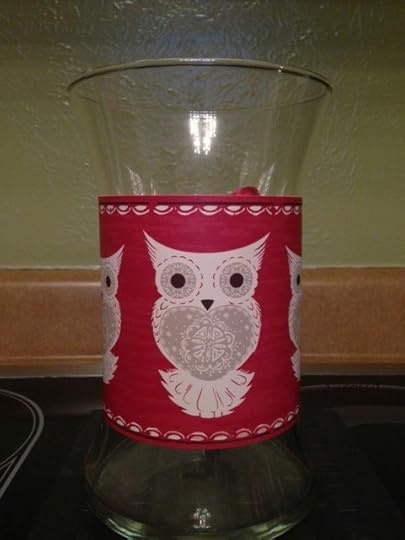
Isn't it cute? Next I channeled my inner kindergartener and cut up construction paper into small strips. Every evening, I've jotted down a couple of things that made the day pleasant and tossed the paper into the vase. It brings a smile to my face, which is nice, but here's the surprising thing... I find myself thinking about little moments during the day and saying to myself, "Hey, I should add this to the vase later." I've been focusing more on the positive. Holy cow, this works!
I've been doing this for a mere couple of weeks. I'm curious about the long-term effects. I'll be sure to give updates on the experiment from time to time as the habit becomes more ingrained in my everyday life.
Seriously, though, I wanted to lower my blood pressure and ease my stress. What better way than taking some time each day to think about the things I was grateful for? Sunshine, a walk in the park with my son, chocolate, cuddly dogs and cat, a thoughtful husband, friends, coffee. Sometimes it's easy to focus on the negative rather than the positive. So I started a gratitude jar (or vase, in this case).
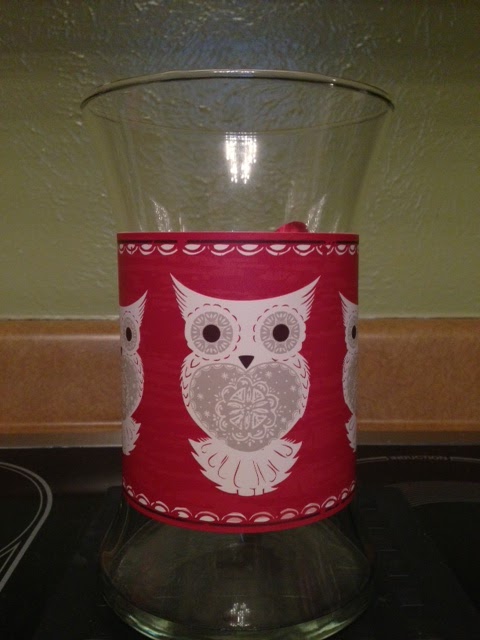
Isn't it cute? Next I channeled my inner kindergartener and cut up construction paper into small strips. Every evening, I've jotted down a couple of things that made the day pleasant and tossed the paper into the vase. It brings a smile to my face, which is nice, but here's the surprising thing... I find myself thinking about little moments during the day and saying to myself, "Hey, I should add this to the vase later." I've been focusing more on the positive. Holy cow, this works!
I've been doing this for a mere couple of weeks. I'm curious about the long-term effects. I'll be sure to give updates on the experiment from time to time as the habit becomes more ingrained in my everyday life.