Rebecca Roland's Blog, page 12
May 27, 2013
Some Classic Military SF for Your Memorial Day
It's Memorial Day, and that puts me in mind of many things, including military sf, and how different authors have such wildly different views on war. I realize that
Starship Troopers
is a classic, but (confession time here), I've tried reading Heinlein, and I just can't get into his stuff. I've seen the movie, which I'm sure is only somewhat like the book, and so I offer no opinion on the theme of war in that particular story.
I have, however, read The Forever War , by Joe Haldeman, who, incidentally, served in the military during the Vietnam War. I found this book to be a criticism of the Vietnam War, the poor reception the troops received when they returned home, and how difficult it can be for a soldier to assimilate to non-military society once their service is over.
Orson Scott Card's novel Ender's Game is finally coming out as a movie later this year. I've read this one twice, and enjoyed it. If you haven't read it, do so before the movie comes out, just in case the movie screws up the ending. In this novel, the enemy is completely and utterly alien, which I read as a metaphor for how people often view the enemy. They look different. They have strange customs. They're non-human, other. These are the sort of messages people often encourage in order to make it easier to kill the enemy. This novel is more of a commentary on the lens through which we view the enemy.
Most recently I read Old Man's War by John Scalzi. As the title suggests, the elderly are sent to a faraway front line in order to fight the enemy. Soldiers are often seen as expendable, and so are the elderly. I found it an interesting line to draw between the two groups, and the premise certainly held my attention. My only quibble with this novel was that I never felt all that drawn to the main character. He often came across as cold and aloof, even though I know he wasn't, and so I don't plan to read the rest in this series.
Military sf shows the effects of war through the lens of something new and different. It's a subgenre worth reading.
I have, however, read The Forever War , by Joe Haldeman, who, incidentally, served in the military during the Vietnam War. I found this book to be a criticism of the Vietnam War, the poor reception the troops received when they returned home, and how difficult it can be for a soldier to assimilate to non-military society once their service is over.
Orson Scott Card's novel Ender's Game is finally coming out as a movie later this year. I've read this one twice, and enjoyed it. If you haven't read it, do so before the movie comes out, just in case the movie screws up the ending. In this novel, the enemy is completely and utterly alien, which I read as a metaphor for how people often view the enemy. They look different. They have strange customs. They're non-human, other. These are the sort of messages people often encourage in order to make it easier to kill the enemy. This novel is more of a commentary on the lens through which we view the enemy.
Most recently I read Old Man's War by John Scalzi. As the title suggests, the elderly are sent to a faraway front line in order to fight the enemy. Soldiers are often seen as expendable, and so are the elderly. I found it an interesting line to draw between the two groups, and the premise certainly held my attention. My only quibble with this novel was that I never felt all that drawn to the main character. He often came across as cold and aloof, even though I know he wasn't, and so I don't plan to read the rest in this series.
Military sf shows the effects of war through the lens of something new and different. It's a subgenre worth reading.


May 20, 2013
And the Good News Keeps Coming
Quite a few exciting things have been happening in Writer Land. This past week I made a guest appearance on the Science Fiction and Fantasy Writers of America (SFWA) blog to talk about ergonomics. Not only have I worked with plenty of people with issues related to working at a desk, but I've also had some problems myself, and it really blows when you can't type because it hurts too much. So sit up a little straighter, and go read the article!
Tomorrow, the print edition of Shards of History becomes available. Quick, run out and get your copy! Here I am, holding the ARC:
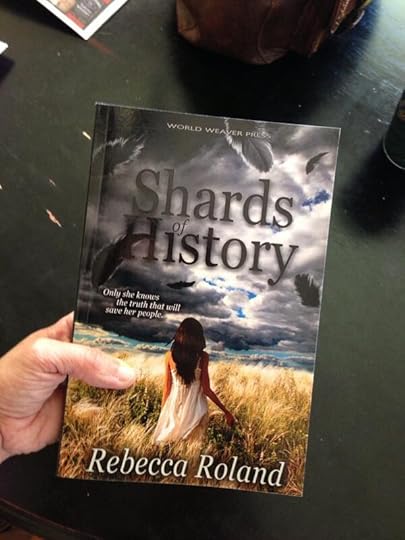
I even stopped biting my nails so they would look nice when I took this picture. YES, I am that vain. We'll see how long the nails last. I picked up the habit again a few years ago when we closed on our house. I was a nervous wreck.
My first short story collection will be available electronically on June 4th. The cover reveal will be soon. And the day after that, my short story "Good Deeds in a Weary World" will be available in issue 6 of Plasma Frequency. It's a story about a young man who comes back from Spring Break as a zombie. Having grown up near a popular Spring Break destination, I can assure you that it isn't as much of a stretch as you might imagine. And by the way, my story inspired the cover art for that issue.
Tomorrow, the print edition of Shards of History becomes available. Quick, run out and get your copy! Here I am, holding the ARC:
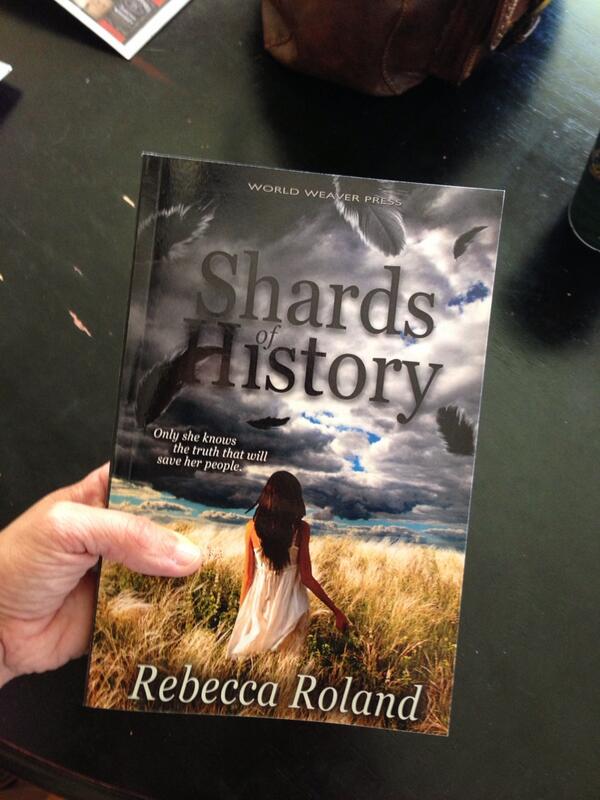
I even stopped biting my nails so they would look nice when I took this picture. YES, I am that vain. We'll see how long the nails last. I picked up the habit again a few years ago when we closed on our house. I was a nervous wreck.
My first short story collection will be available electronically on June 4th. The cover reveal will be soon. And the day after that, my short story "Good Deeds in a Weary World" will be available in issue 6 of Plasma Frequency. It's a story about a young man who comes back from Spring Break as a zombie. Having grown up near a popular Spring Break destination, I can assure you that it isn't as much of a stretch as you might imagine. And by the way, my story inspired the cover art for that issue.
May 13, 2013
Fictional Moms
A post on Christine Amsden's blog got me thinking about fictional mothers (as did Mother's Day) and which ones I enjoy, or at least could relate to.
The first that came to mind was Captain Cordelia Naismith of Lois McMaster Bujold's Vorkosigan universe. Yes, I mention these books a lot, but I love them. If you read the first two books in the series, which are bundled together in Cordelia's Honor, then you get to witness her transformation from captain of a starship to mother. It's difficult to describe without providing oodles of spoilers, but trust me when I tell you that you don't want to mess with this woman. Anyhow, she's intelligent, brave, and diplomatic in her own special way. While the reader doesn't get to witness her in mothering action with a young Miles (the series, from his point of view, begins when he is 17 years old), the reader does get to see the repercussions of his having a mother from a different planet, and one who was a ship's captain in a time and society where most women lived according to more conservative standards.
I also want to mention Claire Beauchamp Randall, a character in Diana Gabaldon's Outlander series. I gave up on the series after four books, incidentally, because (1) too many coincidences began to happen, and (2) I started to dislike the characters for a variety of reasons. Spoiler alert! If you plan to read the series and you don't want to know a thing that happens, then skip to the next paragraph. So, Claire is a complex character to begin with, and motherhood definitely adds another layer to that. She ends up married to a man she used to love (but doesn't any longer) while pregnant with another man's child. While her daughter is an infant, Claire attends medical school. Claire is stretched thin, thin, thin. She struggles with her marriage, motherhood, and school, all while dreaming of the man she truly loves. And eventually, she leaves her adult daughter to return to her true love.
I enjoy reading about motherhood when it's done right. I enjoy saying, "Yes, that's how it is!" I don't like reading about women who are perfect or who simply exist to rub their hands gleefully as they plot evil things. I like messy, complex women who have to deal with colicky babies or temper tantrums while they're trying to accomplish whatever it is they want, or while trying to hold together their relationships or achieve things at work, because that's how life is, and anyone who finds things coming too easily to them just makes me want to roll my eyes.
The first that came to mind was Captain Cordelia Naismith of Lois McMaster Bujold's Vorkosigan universe. Yes, I mention these books a lot, but I love them. If you read the first two books in the series, which are bundled together in Cordelia's Honor, then you get to witness her transformation from captain of a starship to mother. It's difficult to describe without providing oodles of spoilers, but trust me when I tell you that you don't want to mess with this woman. Anyhow, she's intelligent, brave, and diplomatic in her own special way. While the reader doesn't get to witness her in mothering action with a young Miles (the series, from his point of view, begins when he is 17 years old), the reader does get to see the repercussions of his having a mother from a different planet, and one who was a ship's captain in a time and society where most women lived according to more conservative standards.
I also want to mention Claire Beauchamp Randall, a character in Diana Gabaldon's Outlander series. I gave up on the series after four books, incidentally, because (1) too many coincidences began to happen, and (2) I started to dislike the characters for a variety of reasons. Spoiler alert! If you plan to read the series and you don't want to know a thing that happens, then skip to the next paragraph. So, Claire is a complex character to begin with, and motherhood definitely adds another layer to that. She ends up married to a man she used to love (but doesn't any longer) while pregnant with another man's child. While her daughter is an infant, Claire attends medical school. Claire is stretched thin, thin, thin. She struggles with her marriage, motherhood, and school, all while dreaming of the man she truly loves. And eventually, she leaves her adult daughter to return to her true love.
I enjoy reading about motherhood when it's done right. I enjoy saying, "Yes, that's how it is!" I don't like reading about women who are perfect or who simply exist to rub their hands gleefully as they plot evil things. I like messy, complex women who have to deal with colicky babies or temper tantrums while they're trying to accomplish whatever it is they want, or while trying to hold together their relationships or achieve things at work, because that's how life is, and anyone who finds things coming too easily to them just makes me want to roll my eyes.
May 6, 2013
Four Ways to Outline a Novel
If you're a writer, the word "outline" might bring to mind all sorts of images, some positive, others not so much. For me, it often takes me back to high school English class, carefully making bullet points using capital letters, number, little letters, etc, and then trying to figure out where to plug things. It's awful. The word makes me shudder. I despise those outlines. I don't use them when planning a novel or a short story. That sort of outline zaps all the creativity right out of me (as well as zapping all my joy and sending me spiraling back to high school). No, thank you.
I prefer to think of the planning process as just that... planning. Brainstorming. Sorting out major points before I get down to the nitty gritty. Ah, that's much better. I'm feeling calmer already. Maybe you're like me, and the idea of doing an outline makes you want to run screaming. But still, you're tempted to try it. Maybe you rewrote that last novel five times and you're sure there's a better, lazier more efficient way. Well, there are ways to outline and still have some fun and spontaneity.
Mind mapping might appeal to those of you who are the most averse to the idea of rigid outlines. I like using it at the very beginning of a project when I just want to get down any idea that springs to mind. You can use different colors for different ideas or characters. I like to get one of those huge drawing pads at the arts and crafts store and settle down with my markers and just fill the paper with ideas. Also, the finished project is art in and of itself. Some mind maps look like dendrites to me.
If you have an idea of who your characters are, but you have no idea what's going to happen to them, you can sit down with a series of questions and sketch out a novel outline in an hour. You spend up to five minutes on each question and end up with your character's goal, what's at stake, potential sources of conflict, and a character arc. Not bad for an hour's work. I like to type this one up as I type way faster than I can write by hand. I end up jotting down any and every idea that comes to mind, then going back over the questions and adding details later or throwing out what doesn't resonate with me.
If you're looking for a more traditional method of outlining, the three act structure might appeal to you. Now, plenty of people have described the three act structure, but none, to my knowledge, have ever compared it to spanx, at least until recently. This is actually a great, simple description of three act structure, and the post also includes a few cute pictures in case you're more of a visual learner. I'm not the biggest fan of the three act structure, but somehow my stories end up fitting the mold if I don't plan for a different structure ahead of time.
Yet another method of outlining is the seven point structure. I first heard of this when I watched this video, the first in a series of lectures given by Dan Wells. You can also find out more by googling "seven point story structure," but I really enjoyed the lecture and took notes as I watched it. However, I wouldn't necessarily recommend it for planning a novel ahead of time. Instead, I think it works better when you're getting ready to edit and you want to make sure the story you've already written hangs together well. But, it's still good to have in the back of your mind as you're planning and writing.
And now, if you'll excuse me, it's time to pull out some blank paper and my markers.
I prefer to think of the planning process as just that... planning. Brainstorming. Sorting out major points before I get down to the nitty gritty. Ah, that's much better. I'm feeling calmer already. Maybe you're like me, and the idea of doing an outline makes you want to run screaming. But still, you're tempted to try it. Maybe you rewrote that last novel five times and you're sure there's a better, lazier more efficient way. Well, there are ways to outline and still have some fun and spontaneity.
Mind mapping might appeal to those of you who are the most averse to the idea of rigid outlines. I like using it at the very beginning of a project when I just want to get down any idea that springs to mind. You can use different colors for different ideas or characters. I like to get one of those huge drawing pads at the arts and crafts store and settle down with my markers and just fill the paper with ideas. Also, the finished project is art in and of itself. Some mind maps look like dendrites to me.
If you have an idea of who your characters are, but you have no idea what's going to happen to them, you can sit down with a series of questions and sketch out a novel outline in an hour. You spend up to five minutes on each question and end up with your character's goal, what's at stake, potential sources of conflict, and a character arc. Not bad for an hour's work. I like to type this one up as I type way faster than I can write by hand. I end up jotting down any and every idea that comes to mind, then going back over the questions and adding details later or throwing out what doesn't resonate with me.
If you're looking for a more traditional method of outlining, the three act structure might appeal to you. Now, plenty of people have described the three act structure, but none, to my knowledge, have ever compared it to spanx, at least until recently. This is actually a great, simple description of three act structure, and the post also includes a few cute pictures in case you're more of a visual learner. I'm not the biggest fan of the three act structure, but somehow my stories end up fitting the mold if I don't plan for a different structure ahead of time.
Yet another method of outlining is the seven point structure. I first heard of this when I watched this video, the first in a series of lectures given by Dan Wells. You can also find out more by googling "seven point story structure," but I really enjoyed the lecture and took notes as I watched it. However, I wouldn't necessarily recommend it for planning a novel ahead of time. Instead, I think it works better when you're getting ready to edit and you want to make sure the story you've already written hangs together well. But, it's still good to have in the back of your mind as you're planning and writing.
And now, if you'll excuse me, it's time to pull out some blank paper and my markers.
April 29, 2013
But What's The Story *Really* About?
I recently read Sidelines by Lois McMaster Bujold, which is a collection of essays, speeches, and travel writing. I found that it's geared more towards writers, but really, anybody who is a huge fan of hers would probably find this a good read.
There are quite a few gems in Sidelines, one of which includes this quote: "A true statement like 'plot is what happens, and theme is what the book's about' failed to create a distinction for me. It wasn't until I became a writer that it came clear. Plot is what a book's about. Theme is what a book's really about."
This was certainly true for me. Back in high school English, we'd read something, and then the teacher would discuss the theme as if it were some hidden message put there by the author, and only the clever people were capable of figuring it out. I felt like there was a code, or maybe a key, that would allow me to figure out the theme (and thus pass the darn test). But theme is both more complicated, and easier, than that.
Many authors don't even know their story's theme, or themes, until after it's written. I might have an inkling of theme when I write, but often I don't have it figured out until afterwards, and then I go through and make sure the story supports it in character action, symbolism, dialogue, etc. Then I hand the story to another person who has a different life experience than me. They bring that with them as they read, and they might find a completely different meaning in the story, and that's okay. Phew. It took me a while to figure that out.
So what is a story really about? It could be about repressive Victorian ideas, or that love conquers all, or a political diatribe, or a comment on how science will make or break humanity, or the role of religion in a person's life, and so forth. There are many meanings that a story can hold. One of the exciting things about having other people read my work is what they bring to it. Sometimes a reader comments upon something in a whole new way, and I see my own story in an entirely new angle, and that's just pretty darn cool.
There are quite a few gems in Sidelines, one of which includes this quote: "A true statement like 'plot is what happens, and theme is what the book's about' failed to create a distinction for me. It wasn't until I became a writer that it came clear. Plot is what a book's about. Theme is what a book's really about."
This was certainly true for me. Back in high school English, we'd read something, and then the teacher would discuss the theme as if it were some hidden message put there by the author, and only the clever people were capable of figuring it out. I felt like there was a code, or maybe a key, that would allow me to figure out the theme (and thus pass the darn test). But theme is both more complicated, and easier, than that.
Many authors don't even know their story's theme, or themes, until after it's written. I might have an inkling of theme when I write, but often I don't have it figured out until afterwards, and then I go through and make sure the story supports it in character action, symbolism, dialogue, etc. Then I hand the story to another person who has a different life experience than me. They bring that with them as they read, and they might find a completely different meaning in the story, and that's okay. Phew. It took me a while to figure that out.
So what is a story really about? It could be about repressive Victorian ideas, or that love conquers all, or a political diatribe, or a comment on how science will make or break humanity, or the role of religion in a person's life, and so forth. There are many meanings that a story can hold. One of the exciting things about having other people read my work is what they bring to it. Sometimes a reader comments upon something in a whole new way, and I see my own story in an entirely new angle, and that's just pretty darn cool.
April 22, 2013
Music and Writing
Plenty of people listen to music while they write. I make 'soundtracks' to my novels. While I don't necessarily listen to music while writing the rough draft, I often do listen to it while editing or rewriting in order to get me back to the same head space where I was when I originally wrote the scene. Or, I'll listen to the music and jot down ideas and images, then write in silence.
I just finished revising a YA novel. I added nearly 30 songs to this novel's 'soundtrack,' but felt that during revisions I needed a few more songs, preferably released this year or last year, and capturing the feel of the novel overall. Plus, I really needed to procrastinate before I tackled revisions.
The main character is eighteen years old and prone to enjoying alternative music (much like me, ha). I spent some time stumbling around iTunes and found The Graveyard Girl by M83. I love Midnight City, so I gave Graveyard Girl a whirl. It's reminiscent of the 80's in sound and subject (the lyrics even refer to Molly Ringwald). It's angsty, it reminds me of the movie The Craft, and my inner 15 year old loved it. I probably would have really enjoyed this song up to the age of 20 or so (and even a ways beyond), and so I felt it suited my 18 year old character well.
I also stumbled across a new artist, Jeremy Messersmith, and his song A Girl, A Boy, and a Graveyard. The album's cover art is adorable and a bit tongue-in-cheek, the song has a folksy, sorrowful sound that his voice is well suited for, and the lyrics are pretty darn nice. Plus, the song is about a relationship, and death, which are a couple of things my main character is wallowing in.
I would've never come across these songs if I hadn't been looking for something more to add to my 'soundtrack' (also, procrastination isn't always a bad thing). These songs, and others, helped me remember my adolescent angst and pour it into the novel.
I just finished revising a YA novel. I added nearly 30 songs to this novel's 'soundtrack,' but felt that during revisions I needed a few more songs, preferably released this year or last year, and capturing the feel of the novel overall. Plus, I really needed to procrastinate before I tackled revisions.
The main character is eighteen years old and prone to enjoying alternative music (much like me, ha). I spent some time stumbling around iTunes and found The Graveyard Girl by M83. I love Midnight City, so I gave Graveyard Girl a whirl. It's reminiscent of the 80's in sound and subject (the lyrics even refer to Molly Ringwald). It's angsty, it reminds me of the movie The Craft, and my inner 15 year old loved it. I probably would have really enjoyed this song up to the age of 20 or so (and even a ways beyond), and so I felt it suited my 18 year old character well.
I also stumbled across a new artist, Jeremy Messersmith, and his song A Girl, A Boy, and a Graveyard. The album's cover art is adorable and a bit tongue-in-cheek, the song has a folksy, sorrowful sound that his voice is well suited for, and the lyrics are pretty darn nice. Plus, the song is about a relationship, and death, which are a couple of things my main character is wallowing in.
I would've never come across these songs if I hadn't been looking for something more to add to my 'soundtrack' (also, procrastination isn't always a bad thing). These songs, and others, helped me remember my adolescent angst and pour it into the novel.
April 15, 2013
A Review of Let's Pretend This Never Happened
On a day like today--Monday, and tax day to boot--we all need a laugh. Without further ado, I present my review of Let's Pretend This Never Happened (A Mostly True Memoir) by Jenny Lawson. Neil Gaiman endorsed it. So did Wil Wheaton. And so am I. I give it 4&1/2 out of 5 stars.The book is filled with expletives and some rather blunt observations, as well as humor that probably has rankled quite a few people. If you're easily offended, it's not the book for you. The reason it got 4&1/2 stars rather than 5 is because sometimes the humor felt forced. Most of the time, however, it flows naturally, and I often found myself snickering uncontrollably.
This is the story of someone who grew up in a tiny town in West Texas with a taxidermist for a father. She had a... unique... childhood. There was, for instance, the time she ran into--as in, stepped inside--the deer carcass her father was working on and ended up puking, because really, in that situation, who wouldn't? She talks about her childhood with humor, as she does her anxiety disorder, rheumatoid arthritis, miscarriages, marriage, and loss. The book is chock-full of fantastic quotes, such as this beauty: "Considering that we spent a majority of our workday in pajamas while porn played in the background, there was a surprising amount of stress in that workplace."
Beyond the humor, you get a sense that this is someone you can relate to. She's flawed, she has mental health issues and physical health issues, and yet you get the sense that she's pulled through it and come out all right. With a sense of humor about it all, even. So if you need a laugh (and who doesn't?), run out and get this book, or follow Jenny on her blog. You won't regret it, y'all.
This is the story of someone who grew up in a tiny town in West Texas with a taxidermist for a father. She had a... unique... childhood. There was, for instance, the time she ran into--as in, stepped inside--the deer carcass her father was working on and ended up puking, because really, in that situation, who wouldn't? She talks about her childhood with humor, as she does her anxiety disorder, rheumatoid arthritis, miscarriages, marriage, and loss. The book is chock-full of fantastic quotes, such as this beauty: "Considering that we spent a majority of our workday in pajamas while porn played in the background, there was a surprising amount of stress in that workplace."
Beyond the humor, you get a sense that this is someone you can relate to. She's flawed, she has mental health issues and physical health issues, and yet you get the sense that she's pulled through it and come out all right. With a sense of humor about it all, even. So if you need a laugh (and who doesn't?), run out and get this book, or follow Jenny on her blog. You won't regret it, y'all.
April 9, 2013
Random Thoughts on Labeling Books
The other day at work while sitting around in the break room having lunch, my co-workers and I started talking about role playing games and books, namely fantasy and science fiction (did I mention that I work with some awesome people?). One of my co-workers piped up and said, "Have you read Becky's book? It's great. It's sort of fantasy." (Seriously, I work with some awesome people. They pimp my book!).
It was the 'sort of' that I thought about later. There was absolutely nothing wrong with that person's assessment of the book. She felt it was fantasy, but not quite. I never got a chance to pursue that idea with her, but it got me thinking about how different readers focus on different aspects of a book. Some people have read Shards of History and labeled it straight fantasy. I've also heard historical fiction, social sf, and even hard sf/fantasy mash-up.
I just finished reading Let's Pretend This Never Happened (A Mostly True Memoir). As the title suggests, it's a memoir. But it's also a comedy. And sometimes while reading it, I thought, "No way this ever happened. This must be fiction." But then I realized the author grew up in a tiny town in west Texas, and I totally believed even the craziest stuff because that's how West Texas is. If you asked everybody who read the book how they'd classify it, some would call it a memoir, and others would label it a comedy. How do people choose one over the other? And why does it matter?
Book labels are for marketing, and marketing is meant to make it as easy as possible for readers to find it. Some books can be promoted as paranormal with a romantic twist for one group, and a romance with a paranormal twist for another. Ultimately, I think it's good to know every possible interested group to whom you could market your book. And, it helps to understand what people think of when you tell them your book is 'fantasy.' Some people will think of elves, others will think of young wizards, and still others will think of demons or vampires. This is why it's good to be able to tell people, "This book is like (insert another book/series here)."
It was the 'sort of' that I thought about later. There was absolutely nothing wrong with that person's assessment of the book. She felt it was fantasy, but not quite. I never got a chance to pursue that idea with her, but it got me thinking about how different readers focus on different aspects of a book. Some people have read Shards of History and labeled it straight fantasy. I've also heard historical fiction, social sf, and even hard sf/fantasy mash-up.
I just finished reading Let's Pretend This Never Happened (A Mostly True Memoir). As the title suggests, it's a memoir. But it's also a comedy. And sometimes while reading it, I thought, "No way this ever happened. This must be fiction." But then I realized the author grew up in a tiny town in west Texas, and I totally believed even the craziest stuff because that's how West Texas is. If you asked everybody who read the book how they'd classify it, some would call it a memoir, and others would label it a comedy. How do people choose one over the other? And why does it matter?
Book labels are for marketing, and marketing is meant to make it as easy as possible for readers to find it. Some books can be promoted as paranormal with a romantic twist for one group, and a romance with a paranormal twist for another. Ultimately, I think it's good to know every possible interested group to whom you could market your book. And, it helps to understand what people think of when you tell them your book is 'fantasy.' Some people will think of elves, others will think of young wizards, and still others will think of demons or vampires. This is why it's good to be able to tell people, "This book is like (insert another book/series here)."
April 1, 2013
Fool Me Once...
Ah, April the first, that glorious day when you simply can't believe the announcements that people make. Don't you just love the constant state of vigilance and having to sniff the whipped cream before topping your pie to make sure it's not shaving cream? Maybe you didn't have brothers like mine, though. Or friends like mine. Or co-workers like mine.
In honor of April Fool's Day, I thought I'd share a couple of my favorite con/heist movies. As a general rule, I don't like those sort of movies (or books). Sometimes the characters come across as cruel and have no redeeming qualities whatsoever. But sometimes, as bad as the con artist may be, the person they're conning is even worse.
Take Ocean's Eleven, for example. These people plan to steal money from Las Vegas casinos, and the owner of these casinos is a real jerk. Now, I don't feel sorry for casinos as an entity in the first place. Their job is to tilt the odds in their favor and take money. Add to that an owner that the audience despises, and you're rooting for George Clooney to take all the cash and a couple of comped cocktails, too. But really, you're probably rooting for George Clooney anyway. At least, I do.
In Tower Heist, a group of workers fall victim to their boss's Ponzi scheme (almost typed Fonzie there). Their boss pulls a scam on them, and they, in turn, attempt to pull an even bigger one on him. It's a movie that reflects recent financial woes, both in the Ponzi scheme and in portraying the feeling that it's the 'little guy' against the wealthiest one percent. I started out just watching at this movie and soon forgot all about whatever else I was doing. Unlike many other con stories, I never felt that the group performing the con was ever unlikeable.
Feel free to recommend movies or books that made you root for the con artist. And watch out for the pranksters today.
In honor of April Fool's Day, I thought I'd share a couple of my favorite con/heist movies. As a general rule, I don't like those sort of movies (or books). Sometimes the characters come across as cruel and have no redeeming qualities whatsoever. But sometimes, as bad as the con artist may be, the person they're conning is even worse.
Take Ocean's Eleven, for example. These people plan to steal money from Las Vegas casinos, and the owner of these casinos is a real jerk. Now, I don't feel sorry for casinos as an entity in the first place. Their job is to tilt the odds in their favor and take money. Add to that an owner that the audience despises, and you're rooting for George Clooney to take all the cash and a couple of comped cocktails, too. But really, you're probably rooting for George Clooney anyway. At least, I do.
In Tower Heist, a group of workers fall victim to their boss's Ponzi scheme (almost typed Fonzie there). Their boss pulls a scam on them, and they, in turn, attempt to pull an even bigger one on him. It's a movie that reflects recent financial woes, both in the Ponzi scheme and in portraying the feeling that it's the 'little guy' against the wealthiest one percent. I started out just watching at this movie and soon forgot all about whatever else I was doing. Unlike many other con stories, I never felt that the group performing the con was ever unlikeable.
Feel free to recommend movies or books that made you root for the con artist. And watch out for the pranksters today.
March 25, 2013
The Best Things in Life
This weekend I went to the third annual Chocolate and Coffee Fest, and it made me realize a few things.
First, I had already gone to many of the stores represented prior to this weekend. Chocolate and coffee are two of my favorite things. Add wine to that, and I'm in heaven (actually, there was a wine seller there, but the line was too long). I've long had this dream of what I'd do if I ever opened my own restaurant. The three main items I'd sell? Chocolate, coffee, and wine. There would be some small tables and chairs, but a lot of it would consist of plush armchairs, walls covered with shelves of books, and a wall separating sections where a huge fireplace would run in the winter. Part of it would be an actual bar, and part of it would be like a living room/library. I'd never want to leave.
Back to the coffee. My parents were coffee drinkers. I bugged my mom endlessly to drink some of hers when I was a kid. Sometimes she'd give in, putting lots of milk and sugar in a small amount of coffee and let me have at it. Then I turned from coffee, preferring sugary sodas during my adolescence and early twenties.
And then grad school happened.
I started getting a small cup of coffee in the mornings. Then the medium. Then the large. This coincided with the ever-shrinking amount of time I spent sleeping at night. I got my coffee at the campus cafe. Then I tried a cappuccino. Not bad. I branched out to local coffee houses and tried their brew. I found it unbelievably strong and reverted to my childhood by adding tons of milk and sugar. Some wacky Seattle-based coffee chain came along and I started drinking their flavored mochas. By then, clearly, the addiction had dug its claw deep into my flesh. A few years ago, my husband and I took a trip to Seattle. I planned part of our itinerary around the local coffee shops (and no, I never once went to the international chain that started there). At this point, I brew my own in the mornings and add a packet of Splenda and a dash of milk.
Then there's chocolate. I prefer dark chocolate, but really, any kind will do. I love it all. But I didn't know how much it was possible to love chocolate until I learned about pairing it with port wine. If you've never tried it, you must. The next time you go out to eat at a nice restaurant, save room for dessert. Order a chocolate ganache, or something decadently chocolate, and a glass of port. By itself, port is just a super sweet wine. But! Take a bite of chocolate. Then sip the port. The wine will make the chocolate even more chocolatey. You will hear angels singing. You will want to run around giving everybody a hug (don't). You will want to name your firstborn after me (go ahead). It's that good.
And now, if you'll pardon me, there's a cup of coffee calling my name.
First, I had already gone to many of the stores represented prior to this weekend. Chocolate and coffee are two of my favorite things. Add wine to that, and I'm in heaven (actually, there was a wine seller there, but the line was too long). I've long had this dream of what I'd do if I ever opened my own restaurant. The three main items I'd sell? Chocolate, coffee, and wine. There would be some small tables and chairs, but a lot of it would consist of plush armchairs, walls covered with shelves of books, and a wall separating sections where a huge fireplace would run in the winter. Part of it would be an actual bar, and part of it would be like a living room/library. I'd never want to leave.
Back to the coffee. My parents were coffee drinkers. I bugged my mom endlessly to drink some of hers when I was a kid. Sometimes she'd give in, putting lots of milk and sugar in a small amount of coffee and let me have at it. Then I turned from coffee, preferring sugary sodas during my adolescence and early twenties.
And then grad school happened.
I started getting a small cup of coffee in the mornings. Then the medium. Then the large. This coincided with the ever-shrinking amount of time I spent sleeping at night. I got my coffee at the campus cafe. Then I tried a cappuccino. Not bad. I branched out to local coffee houses and tried their brew. I found it unbelievably strong and reverted to my childhood by adding tons of milk and sugar. Some wacky Seattle-based coffee chain came along and I started drinking their flavored mochas. By then, clearly, the addiction had dug its claw deep into my flesh. A few years ago, my husband and I took a trip to Seattle. I planned part of our itinerary around the local coffee shops (and no, I never once went to the international chain that started there). At this point, I brew my own in the mornings and add a packet of Splenda and a dash of milk.
Then there's chocolate. I prefer dark chocolate, but really, any kind will do. I love it all. But I didn't know how much it was possible to love chocolate until I learned about pairing it with port wine. If you've never tried it, you must. The next time you go out to eat at a nice restaurant, save room for dessert. Order a chocolate ganache, or something decadently chocolate, and a glass of port. By itself, port is just a super sweet wine. But! Take a bite of chocolate. Then sip the port. The wine will make the chocolate even more chocolatey. You will hear angels singing. You will want to run around giving everybody a hug (don't). You will want to name your firstborn after me (go ahead). It's that good.
And now, if you'll pardon me, there's a cup of coffee calling my name.