Rickey Gard Diamond's Blog, page 7
August 29, 2018
Wake Up, Corporate Bodies!

The glass ceiling was a phrase first coined in an article in The Wall Street Journal, to describe what professional women confront—an invisible, unspoken rule that says, you can only go so far. Men continue to dominate corporate management and corporate boards that direct a company’s mission, goals and bottom line, as well as its spirit and character.
Now a California state senator, Hannah-Beth Jackson (D-Santa Barbara) is the author of a bill intended “to blow up the glass ceiling,” she says, adding that company boards need “a woman’s perspective.” Ken Martin at FOXBusiness reports that a majority in the California Senate agrees with her. They just passed this game-changer, sending it halfway to the finish line. The bill would require at least one woman on company boards by the end of 2019, with a schedule for increasing numbers. By 2021, a six-member board would seat three women members.
OMG. Equal numbers? Opposed by many business groups, of course, amendments are expected. Some San Francisco corporations already have met the standard, according to this source, noting Airbnb just expanded its board to include one added woman, and the female Pixar CFO, Ann Mather, now serves on two boards. Wowee.
Is that progress? Only if you believe ambitious women will be Angels. Right now the selling point made by Catalyst, a women’s organization examining women’s status in business, is that boards with more women do better financially. That’s not a bad thing, but in itself would not necessarily make for change down where the majority of women still work. Kim Elsesser at Forbes cites a study that actually claims boards with women paid their CEOs 15 percent more—hardly the group most in need of pay raises.
Work policies need to change to include greater diversity and pay equity, more flexible work schedules, and ample family leave time for everyone. For that we’ll need reshaping of corporate structure and cultures from the bottom, as well as from the top, aMarjorie Kelly argues in Owning Our Future. An economy now waged as competitive war, measured solely by dollars, can be changed into one that wages life. But a living economy needn’t “blow up” a thing—nor are richer CEOs and profits for a few its best yardstick.
Nevertheless, Jackson is shaking norms that need to be woke! You go, girl!


August 22, 2018
Another Woman Lifts the Curtain on Big Money Wizards

I just finished reading Democracy in Chains by historian Nancy MacLean, a book colored, she says, by a transformation of politics in North Carolina, where she teaches at Duke University. MacLean discovered an abandoned trove of documents on school vouchers, belonging to a little known economist named James McGill Buchanan. Promoting theories he misleadingly named “public choice,” Buchanan first rose to prominence at the Univ. of Virginia, while actually working for minority rule by the wealthy. He also eventually won the “almost-Nobel prize” in Economics that I expose in my book, Screwnomics.
I write about a similar mean-spirited change in my home state of Michigan, and critique prize-winner Milton Friedman’s damage—but had no knowledge of Friedman’s friend, until MacLean’s book. That’s how Buchanan wanted it. He and his colleagues, well funded by wealthy donors like Scaife, Volker, and the Koch brothers, provided economic arguments to oppose the civil rights movement, social security, public schools, Medicare and Medicaid. Eventually he and the Kochs set up influential centers at Virginia’s George Mason University, closer to Washington D.C.
All along the way, Buchanan’s autocratic moves trumped academic freedom. MacLean doesn’t note the hyper-masculinity of their true-believer culture, but it surely was male-dominated by male dominators. Backed by big male money, Buchanan’s rationales transformed law schools and state legislatures, favoring the corporate elite, not us less powerful plebes. In their new orthodoxy, only personal responsibility of the so-called “makers” counted—and income taxes or Medicare or Social Security taxes that sensibly redistributed wealth was robbery of the rich.
Interestingly, Buchanan and his tribe knew they needed to cloak their real intents, and did so, using code to avoid extremist and racist terms. They considered women a problem. Why? Women, who’d only won the vote in 1920, and who largely remain less wealthy, were more readily open to governmental “collective action,” they said, or democracy in action.
That’s to be celebrated. We can be glad that females can now go to school, a relatively new phenomenon, and still far from universal. (The University of Virginia accepted its first black male student in 1955—but did not admit women until 1970.) Together with two other courageous women’s books, Naomi Klein’s Shock Doctrine and Jane Mayer’s Dark Money, Nancy MacLean’s Democracy in Chains pulls back the curtain on a fake money wizardry that has not only impoverished our US Treasury, but threatens to bankrupt our American ideals.

The Kochs and their billionaire network are not the first to aspire to a kingdom—but corruption like theirs never ends well. A sizeable number of American men have been so seduced by an ideology with chest-pounding Alpha baboon traits, that perhaps only American women can awaken a larger, more essential context of mutual exchanges—ones more productive, humane, and sustainable than constant male battles for dominance.
August 15, 2018
A Drop of Water Explains Our $ Universe

Water: no other element is as necessary for sustaining life. And no other necessity so brings into focus the overreach of private corporate wealth, picking our nation’s public pockets. How so? Guess which city in Michigan, the Great Lakes state surrounded by fresh water, still has schools with dangerous levels of lead in its water, PLUS the highest water bills of any of 500 in the nation?
Flint. Yes, that Flint. $910 annually for all the lead you can drink. (Although when I was at Totem Books in Flint, people there said, no! That was on the low side!)
Now guess which state just handed over 576,,000 gallons of water per day to Nestle Corporation for free, so they could pump the state’s groundwater Great Lakes Basin for private profit, despite overwhelming input from citizens protesting the piracy— 80,945 against, to 76 in favor? Michigan!
Flint's Michigan water first got national attention in 2014, thanks to Mona Hannah-Attisha, a young pediatrician who noticed the dangerous levels of lead in children’s blood. She undertook blood test surveys on her own, when the Michigan government failed to respond, instead covering up their crimes. Gov. Rick Snyder had earlier indulged sweeping powers given him by the Michigan legislature, to override the city’s elected representatives by means of a fiscal manager. Synder's appointee made the change in water source, despite the city council’s protests, that not only poisoned kids, but ruined Flint’s plumbing systems.
In other words, the state's regime declared that bucks will trump democracy. Eventually 15 people were criminally charged, including for negligent homicide, but not so, the Governor, who only oversaw the whole fiasco.
The city’s deficit has made for the latest cruel decision—namely shutting off water to those 1000 residents who cannot pay their water bills. Food and Water Watch is calling for water bill forgiveness and new state funds to repair the damage done to the city’s water system.
Now here’s some good news: Maryland is poised to declare that water is an “inalienable right” for its citizens through a Water Taxpayer Protection Act. The city of Baltimore has been fighting the takeover of its public water system by private corporations, having studied the results from cities that took that private route. In every case, the cost of water for citizens went up.
Profits skimmed from the top apparently leaves a scummy ring around your water bill. Essentials like water need to be kept public.
—Rickey Gard Diamond
NOTE: That a drop of water could explain the universe was something Lucy Larcom wrote, recalling her girlhood at the earliest textile factories. Dr. Mona also writes about water in her memoir, What the Eyes Don’t See: A Story of Crisis, Resistance and Hope in an American City.
August 8, 2018
Women & Economics: from "Redlined" to "Screwnomics," the Impact of Economic Policy on Gender and Race
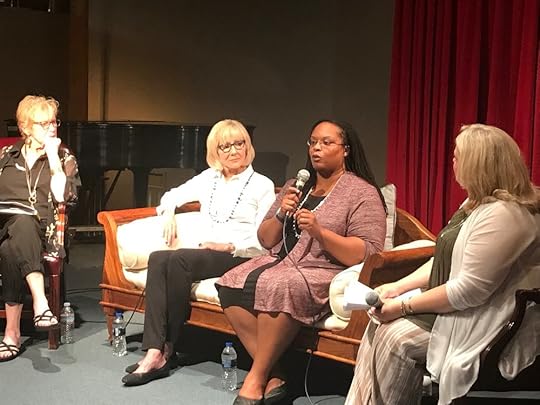
(l.to r.) Rickey Gard Diamond, author of Screwnomics; Linda Gartz, author of Redlined, Elizabeth McCree, Benton Harbor, Michigan attorney, and Kim Jorgensen Gane, St. Joseph, Michigan realtor, discuss the real life results of economic policies with an audience at The Box Factory in St. Joseph, July 31, 2018. Ami Hendrickson (not pictured) co-hosted the event, and reported on it at MuseInks.
On Tuesday, I had the honor of being the emcee for "Women & Economics: Impact of Economic Policy on Gender & Race" at the Box Factory for the Arts in St. Joseph, MI.
This event, organized and produced by my dear friend and #Write2TheEnd co-founder, Kim Jorgensen Gane, featured authors Rickey Gard Diamond and Linda Gartz.
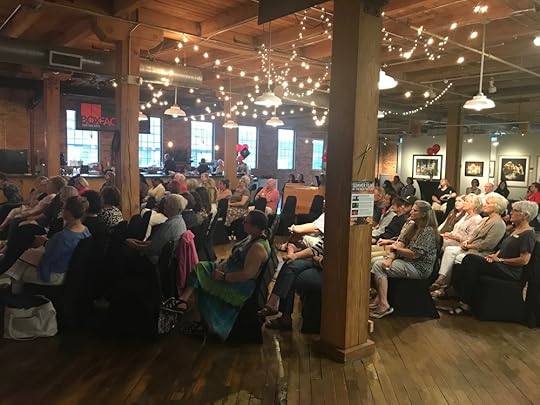
Close to a hundred women (and the men who love them) attended the event, asking questions, and sharing stories. Yes, the personal is economic.
Gartz is an Emmy award-winning video producer whose documentaries and TV productions have been featured on ABC, NBC, CBS, PBS, and syndicated nationwide. She kicked off the evening with her new book Redlined.
Gartz' family lived in Chicago West Side at a time when racist lending rules allowed banks to refuse loans or mortgages to anyone in areas with even one black resident.
Set against the backdrop of the Civil Rights Movement of the 1960's, Redlined tells the story of Gartz’s parents, Fred and Lil, who choose to stay in their integrating neighborhood, overcoming prejudices even as their community sinks into increasing poverty and their own relationship decays.
Diamond spoke next. She is a Berrien County native who lived in Benton Harbor, St. Joseph, and Coloma during her formative years. Now she hails from Vermont, where she was the founding editor of Vermont Woman and taught at Vermont College of Norwich University.
In 2014, she received a Hedgebrook fellowship to create a readable, relatable book on economics. And thus, Screwnomics was born.
Screwnomics introduces readers to EconoMan (not every man, thank heaven) and encourages those who have traditionally been encouraged to work for less -- or for nothing -- to think about their own economic memoir and confront our economic system’s hyper-masculine identity. Lest you fear it's full of man-bashing: it's not. However, some of its truths about the systematic erasure of women from economic discussion are rather uncomfortable. For instance, Diamond says:
"Around the world, women and their children remain the poorest of the poor, the most vulnerable, and the least noteworthy to most economists. For example, Thomas Piketty's recent and much celebrated 700-plus-page work, Capital in the Twenty-First Century, which so expertly describes growing inequality has exactly seven index listings for women or females."
Using humor, personal anecdotes, and history, Diamond's book is the most readable one on the subject of economics I have ever encountered.
After the author presentations, local attorney Elizabeth McCree joined us for a panel discussion on the realities of gender, race, poverty, and ways to combat the inequalities we see.
What can we do? Some suggestions from the evening:
1.) Educate yourself. Read. Familiarize yourself with the policies and practices that affect you.
2.) Recognize inequality when you see it. Even if you are not on the receiving end of the inequality, be prepared to identify it and -- most importantly -- to insist on equitable change.
3.) Vote. Seriously. Do this thing. Laws exist to serve the people and benefit society. Make your voice heard and make your vote count.
4.) Speak up. Many people told their personal stories on Tuesday evening. Our shared experiences pave the way toward greater empathy, in-depth dialogue, and a more informed community.
—Ami Hendrickson
August 1, 2018
Notice to Lady Justice
Women’s eNews has been on the beat since 1999, providing news on issues women care about that don’t always get covered elsewhere. For instance, this week a decision came down on a lawsuit brought by the state of New York on behalf of women patients and staff at Choices Women’s Medical Center in Jamaica, Queens. The state sought enforcement of federal and state laws that prohibited threats or acts of force, verbal harassment or intimidation of women accessing reproductive health services. For years, the Center and its patients had endured an active campaign of harassment, despite the abortion procedure being legal, private, and constitutionally protected.
The Federal District Court for Eastern New York ruled against the enforcement, and according to Lori Sokol at Women’s eNews, disregarded testimony of patients, and “bent over backwards to credit the testimony of harassers, and to interpret video evidence in their favor, without regard to the atmosphere of harassment and intimidation created by anti-choice zealots.”
Keep that court decision in mind as the Senate interviews President Trump’s choice for a second Supreme Court pick, Brett Kavanaugh, expected to weigh in against Roe v. Wade. Even more deadly is his stance on the Affordable Health Care Act’s rules that enable the sick with “pre-existing conditions” to find insurance. For an increasingly radical-right court system, being female may become a pre-existing condition that discounts citizen rights.
As Sokol also reported, CNN reporter Kaitlan Collins, was barred from a Presidential Rose Garden event, an unprecedented move. The White House said, she had asked an “inappropriate question.” Her question concerned this week’s reports on a tape recording on pay-offs to silence Playboy Bunny Karen McDougal before the 2016 election. Kaitlan Collins’ QUESTION was inappropriate? Really?
And then there are the 700 “ineligible” kids who remain separated from their mothers by this administration’s no-tolerance policy at the border—one in three kids still alone, despite a court-ordered deadline from a Bush-appointed judge. CNN shared audios of immigrant and refugee mothers in a strange land begging US courts to learn about their children. Take off your blindfold, Lady Justice! Call your Senator. Register to vote!
July 24, 2018
Anonymous Speaks: Master's Degree and $16/Hour

“Even with a Master's in Accounting, I face the fact every day when I go to work that I'm not getting paid what I'm worth. I can't afford many things, including paying back my student loans because I've worked the past 10-1/2 years for a family-owned multi-million-dollar construction firm, making $12 to start and $16 an hour after 10 years. That's only a 40-cent raise per year.
I no longer have my medical benefits, because I can't afford my half, so my employer gets away with not even paying that benefit. I am too old to look for another job; I will retire at 70 in about seven years on only Social Security. Yes, I have the value of 10 years experience, but what good does that do me now? I'm nearly 63 years old, and no one is going to hire an aging, overweight, gray-haired woman!”
—AnonymousSpeaks
(Got a story to share with other women? Click here and we'll share your story in confidence.)
Screwnomics says: You are not alone! A 2016 report from GlassDoor, which examines the gender gap in accounting in five countries, found it a fact in all five. The “unexplained” US gap between women and men is a whopping 30 percent difference. Here’s what GlassDoor says about the reasons for “explained” differences in accounting job placement (with boldface, ours):
WHAT’S THE MAIN CAUSE? The single biggest cause of the gender pay gap is occupation and industry sorting of men and women into jobs that pay differently throughout the economy. In the U.S., occupation and industry sorting explains 54 percent of the overall pay gap—by far the largest factor. For example, Census figures show women make up only 26 percent of highly paid chief executives but 71 percent of low-paid cashiers. Past research suggests this is due partly to social pressures that divert men and women into different college majors and career tracks, or to other gender norms such as women bearing disproportionate responsibility for child and elderly care, which pressures women into more flexible jobs with lower pay.
Others in the industry point to better prospects than usual right now. So don’t overlook the possibility of taking your ten years’ experience to another position. Even a small improvement plus benefits would make a difference to your retirement. The American Association of University Women (AAUW) is a great resource for learning how to negotiate a pay raise with benefits!
July 23, 2018
ERA Update: Where Have All the Flowers Gone?

If you remember that old Pete Seeger song and its lyrics, used in my title, you may even be curious about 1972, the year when our US Congress, with only 11 females among its 535 legislators in both House and Senate, approved by a wide margin the proposed Equal Rights Amendment. Only 32 members of both House and Senate voted against the ERA.
Mind you, women had only been urging a male majority to pass an ERA soon after women finally won the vote in 1920. After a couple of drafts, ERA author and activist Alice Paul first proposed this simple wording to Congress in 1943: “Equality of rights under the law shall not be denied or abridged by the United States or by any state on account of sex.”
Polls in the 70s showed that most Americans thought this the right thing to do. But changing the US Constitution is no simple matter, settled by a single vote. Its amendments require three-quarters of all state legislatures to ratify the measure also. Congress set a seven-year deadline for this, later extended to 1982. Still, when that second deadline passed, only 35 states, including Vermont, had ratified the ERA. Women still needed three more, to make it to the required 38.
Why on earth would anyone fail to vote for such a fair and simple measure?
A 2016 poll the ERA Coalition Fund for Women’s Equality found that 80 percent of respondents assumed that the ERA was already in place in the Constitution. But the times, post-1972, they had gotten complicated.
Some feminist labor organizers worried that protections they’d won for pregnant women and working mothers would be contested on the grounds of the new amendment; the ERA was not needed in their view. Other women, rumored to be burning their bras, in the eyes of some seemed dangerously pushy: in 1970, for instance, women declared Equality Day, and marched to the Statue of Liberty to hurl a flag from her heights—eegads. Importantly by then, Christian fundamentalists had also become newly political, joined with Roman Catholics in an unholy alliance to keep women pregnant and secondary in God’s supposed “order of the sexes.”
Women’s equality, however, had gotten out of the genie bottle. Though the national ERA missed its deadline, by 1984 Madeleine Kunin had become the first female governor of Vermont, and more women were running for, and being elected to, state and national offices. As women had learned from the suffrage vote, a state strategy also could work. In 1986, an ERA measure for the Vermont Constitution was passed by Vermont’s state legislature, but with an added requirement for ratification by popular referendum.
That same year, Vermont Woman observed its first anniversary of publication. We had a front-row seat to a year’s worth of the wack-a-doo politics that now dominate the country. Phyllis Schlafley of the Eagle Forum came to Burlington to challenge women’s legal right to an abortion and, while she was at it, opposed the ERA: Who knew what horrors would be set loose if all women were as free as Phyllis apparently was, running a national organization, and flying around the country, giving speeches?
Purple pamphlets everywhere raised questions about the terror of unisex bathrooms. If the ERA were passed, homosexuals would teach in our schools, and even get married—perdition and confusion would prevail, and God would let loose AIDs as righteous punishment. Vermont’s measure went down in defeat—narrowly I’m relieved to say, 49 to 51 percent—but still marking a distressing signpost for the nation.
Sturdy and persistent Vermont legislators brought ERA issues back again by another name for a fuller airing to ensure that gender inclusive language be used in Vermont’s Constitution. That measure passed in 1994. Many other states have either passed de-facto ERA measures or a state ERA. And now in the era of Trump and Pence in a US White House, pink-hatted wonderfully pushy women are marching out in the streets again—and the national ERA has reared her head upright. She remains very much alive!
In a “failing New York Times” editorial in April, that gray lady’s entire editorial board gave continued ERA efforts a thumbs-up, saying, “Enshrining women’s rights in the Constitution matters. Doing so now, during this presidency, would be particularly fitting.” Last year, Nevada ignored the imposed deadline and ratified the ERA. Now the state of Illinois just has too, on May 30, 2018.
Only one more state is needed to ratify it, and Virginia, Florida and Utah are all considered good bets. As for that imposed deadline, will it stand? The 27th Constitutional Amendment that James Madison first proposed over 200 years ago about Congressional pay was just passed—so why did women’s amendment get a deadline in the first place?
Women stand ready to challenge its legality. And then there are the five states—Nebraska, Tennessee, Idaho, Kentucky and South Dakota—that have tried to rescind their ratification. Can they do that? That will have to be contested in court, too.
But that backwards move by backwards states only underlines the importance of whaSupreme Court Justice Ruth Bader Ginsberg said to the National Press Club in 2014: “…[L]egislation can be repealed, it can be altered. So I would like my granddaughters, when they pick up the Constitution, to see that notion—that women and men are persons of equal stature—I’d like them to see that is a basic principle of our society.”
We need Constitutional assurances in a time when Donald Trump is expected to seat more judges in the third branch of government, and when the nation has indulged in an overly bully pulpit. The ERA won in Illinois—but not with the wide agreement we saw in our Congress in the 70s. The Illinois final vote in both houses was narrow, 115 votes in favor of the measure, 57 against. That’s not quite as close as Vermont’s ERA defeat in 1986, but fear still reigns in our divided country, primed by deliberate fools.It was when I was remembering the happy vote of 1972, and saw those numbers of Illinois that Pete Seeger’s song popped into my head. His plaintive chords originally hit home as the Vietnam war went on and on, and the Pentagon Papers told us how five male presidents of both parties had kept on lying, each wanting to appear stronger than all the others: “Where have All the Good Men Gone, Long Time Passing? When Will They Ever Learn? When Will They Ehhhhver Learn?”
—From Vermont Woman, Summer 2018. Rickey Gard Diamond was founding editor of Vermont Woman. Her latest book, Screwnomics: How the Economy Works Against Women and Real Ways to Make Lasting Change has just been released by She Writes Press; you can contact her at www.screwnomics.org.
July 18, 2018
Why an #EconoMeToo Movement Matters
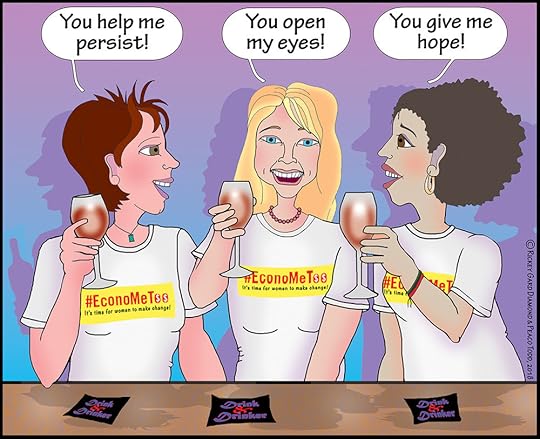
Ten years ago, Tarana Burke began encouraging women to share their stories with each other. She knew they weren’t easy stories to tell. She herself had experienced sexual assault, and seeing how common it was, and how often women blamed themselves, she began #MeToo. Women learned they weren’t alone. Far from it. When they united, they became survivors and stronger. They could support one another to make change.
My book Screwnomics, more than ten years in the making, puts forward a similar idea. Screwing is not a woman’s word. It is a male vernacular made common in the world of money. It describes someone cheated, humiliated, and dominated. Most often we laugh it off. But whatever your gender, or sexual preference, to be screwed means essentially to be made "female," or used against your will by a more powerful someone, who demonstrates he cares nothing about you. The use of this metaphor is now so common, we seldom think about its gendered nature.
Like Tarana, I encourage women to share their story with other women. Money tales are also difficult to confide. Money’s our last taboo, as loaded and shameful as sex—and often connected to sexual messaging and racial and gender identity. But together women can face what so often is painful and infuriating—and can be changed when we end our silence. Because of Screwnomics and its workbook, Where Can I Get Some Change?, designed to help women claim their own economic story, women often confide in me. In the past month, I’ve heard diverse but similar tales. When asked if I can share them, they're afraid, and say no. They don’t want to go public, or be recognized. It feels too dangerous—and probably is. Until we unite.
That’s why we’ve introduced our new blog spot: AnonymousSpeaks. It’s an easy way to tell your story, which we promise to share in confidence, without using your name, unless you tell us you want to make specifics public on our website. How’s it work?
Just go to: https://www.screwnomics.org/ and you’ll see: What Is Your Economic Story? A big red button says: Click here to share!
We’ll respond and get your confirmation to make sure it’s really you. We may also request style edits, and reserve the right to publish only stories that our editors believe will be helpful to others. Feel free to share any solutions that worked for you, also. We’ll share it with our followers on Facebook and on Twitter, using #Screwnomics #EconoMeToo. Together, we are powerful.
July 8, 2018
June 21, 2018
Home of the Brave and the Free

A Boston Herald photo of President Trump's turnaround on no-tolerance, a public show of powerful white men expounding on how great the country is doing.
I admit, the young piping voice of that little girl in the borderlands of Texas asking for her aunt to come get her, while another desolate child cried for his Papi, broke my heart. I felt grateful when Rachel Maddow broke down while reading an Orwellian euphemism, a new alien phrase, “tender age shelters.” What was being done in our name, with our tax dollars, by our government?
Today my head feels clearer, my heart braver, because so many Americans felt the same, and said, no, this isn’t who we are. What great news of that practical couple, who proposed raising bail money on Facebook for parents, so separation wouldn’t happen. Hoping for $15,000, they now have $13 million in donations to help local agencies that will work to reunite families.
It’s money needed, since our federal government has no system in place to do so, and remains silent on the matter. There is much talk about long sought-after immigration reform in Congress, but no mention of public hearings or a full airing of problems legislators only call “complex,” but seldom take time to explain. Republicans control matters, but even they can’t agree, the real reason we’re stuck.
If like me you’re weary, and becoming aware of how little you understand about legalities that ensnare people who seek safety and a future for their children, there’s help. These books go to places our legislators refuse to brave, busy waging war. These books freely wage life. Check them out!
Sonia Nazario’s recently updated, Enrique’s Journey: The Tale of a Boy’s Dangerous Odyssey to Reunite with His Mother. It highlights the stakes, the personal risks, and also the people who help.
Shanti Hekaran’s novel, Lucky Boy, reveals an undocumented immigrant mother’s journey, her detention and separation from her child, Ignacio, and another more privileged immigrant couple trying to adopt him. Honest—with comedy relief.
C. Susan Nunn’s young adult novel, Song of the Earth, is the passionate tale of a newcomer journalist’s changing take on Arizona’s borderlands, its flash floods, its illegal immigrants, drug-runners, “coyotes,” and an ATF agent. An educational page-turner.
—Rickey Gard Diamond