Rickey Gard Diamond's Blog, page 4
June 21, 2019
Think We're Past Sexism? Try Keeping a Diary

Chavisa Woods documents her personal experience with sexism in this new book from Seven Stories Press . This excerpt involves the police. But what if more os us kept track of small everyday ways of being discounted, harassed, or not counted?
This piece is from Women’s E-News today. Sign up to get their newsletter here.
When she was 5, the little boy Chavisa Woods was playing with pinched her butt. His mother, upon hearing the story, told her she probably liked it. When she was 36, a cab driver locked the doors and wouldn’t let her out until she gave him her phone number. In 100 TIMES: A MEMOIR OF SEXISM (Seven Stories Press; June 25, 2019), Woods lays out one hundred personal vignettes of the sexism, harassment, discrimination, and sexual assault she’s experienced in her life. The incidents, which range from lewd comments to attempted rape, take place when she was growing up in poor rural Southern Illinois, when she was working in St. Louis as a young adult, when she was living with her girlfriend in Brooklyn, and when she was a Shirley Jackson Award-winning author and three-time Lambda Finalist writing this book.
While Chavisa Woods chronicles these 100 stories to show how sexism and misogyny have impacted her life, something else happens simultaneously: she lays bare how these dynamics shape all women’s lives, and how relentlessly common they are. She underscores how thoroughly men feel entitled to women’s spaces and to their bodies, and how conditioned women are to endure it. It’s impossible to read 100 TIMES as a woman without cataloging one’s own “Number of Times.” As Woods writes in the book’s introduction, “It’s not that my life has been exceptionally plagued with sexism. It’s that it hasn’t.”
Excerpt:
#30
When I was twenty, still living in Saint Louis, two of my female lovers and one of my close gay male friends were all raped in the same year, two by strangers, and one by someone we knew. This didn’t happen to me, but going through this repeatedly with three unrelated people I was deeply intimate with in such a short time changed me forever.
One of my lovers was hospitalized and had to have stitches in the places where the man who assaulted her had bitten out chunks of her esh. She was a butch lesbian, and it was strange and painful seeing someone who seemed to be so strong and beautiful become so helpless. To me, she was the strongest, hottest, butchest girl in the Midwest. When she was around, I’d always felt safe. I’d never thought of her as someone who needed protecting. Every dyke wanted to be with her. She was a stud. e idea that a man could have rendered her powerless was surreal.
The man was a stranger who had pushed his way into her house as she was coming home from work. He told the police he was having an a air with her, and that her boyfriend had come home and caught them having sex, and chased him out, and that it must have been her boyfriend who beat her uncon- scious, and that she was claiming it was rape for her boyfriend’s bene t, so that he wouldn’t get mad at her.
She didn’t have a boyfriend. She’d never had a boyfriend. She was a gold-star butch. She was my lover, and probably had another girl on the side, too. But the police still believed him, somehow.
She was hospitalized for days, and the detectives on the case sympathized with her rapist. While she was in the hospital, one detective on the case even referred to him as “that poor man.” Because of this, and after several months of intense emotional discussions with a lawyer and arguments with the detectives, she decided not to go to court and press charges.
When she told me this, I thought, “we’re nothing to them.”
Queer women, that is. We don’t exist. They don’t see us.
They looked at this hot, fierce butch, and I wondered what they saw; a “larger,” plain woman with a short haircut who dressed unassumingly and for some reason needed to pathetically lie about being beaten and raped?
When she got out of the hospital she came and stayed with me, and we didn’t leave my bed for two days. It was a blue cocoon. I did my best to comfort her, but I was also young and emotional, and it was difficult in moments for me to give exactly what she needed. I was also hurting and not coping well. I did my best. I hope it is a good memory for her, because, for me, those days lying together and holding each other for hours on end are sacred.
I remember her bruises as blue, the room as blue, and the color of the air as blue. I realized, for the first time in our long relationship, that she must see me as powerful, too, if she came to me after that happened to her. I realized we were both powerful together, because we could actually see and value
each other. But that time left a blue mark on my heart also, as I realized, after everything that had happened that year, we were really nothing to the cops, nothing to so many straight men . . . nothing to the powers that order the world. Nothing.
Brooklyn-based writer Chavisa Woods is the author of the short story collection Things to Do When You’re Goth in the Country (Seven Stories Press, 2017), the novel The Albino Album (Seven Stories Press, 2013); and the story collection Love Does Not Make Me Gentle or Kind (Fly by Night Press, 2009). Woods was the recipient of the 2014 Cobalt Prize for fiction and was a finalist in 2009, 2014, and 2018 for the Lambda Literary Award for fiction. In 2018 Woods was the recipient of the Kathy Acker Award for Writing and the Shirley Jackson Award for Best Novelette.


May 14, 2019
March 31, 2019
Don't Confuse Confidence with Competence

Tomas Chamorro-Premuzic left Argentina, his birth country, because its government had despoiled its rich resources and become corrupt. Setting out to understand why, he became a psychologist studying leadership. He noticed most leaders in government and business were male, and that Argentina’s leaders had been, one after the other, male and bad.
In 2013, backed by worldwide data that reported most workers leave their jobs because of their bosses, he dared ask a question out loud in a paper for The Harvard Business Review, titled: “Why Do So Many Incompetent Men Become Leaders?” It’s HBR.org’s most-read article, and he still hears from people about it. In a book with the same title, issued this month, he says, “I argued that the underrepresentation of women in leadership was not due to their lack of ability or motivation, but to our inability to detect incompetence in men.”
He claims we misinterpret men’s character flaws, calling over-confidence and self-absorption, “charisma,” of “leadership potential,” when we’d be smarter to ask for real evidence of experience that inspired and motivated people who function smoothly together to meet goals.
The book comes in perfect time for the leadup to 2020. We’ll be weighing a group of women and men more diverse than ever, for longer than ever, as would-be leaders of our country. They’ll face off against someone who, whatever you think of him, oozes self-assurance, always very well pleased with himself.
There’s evidence of increased profits when women are part of leadership. But Chamorro-Premuzic doesn’t think it’s because of all those diversity programs that he says wrong-headedly focus on women’s imitating male leaders: acting confident, faking it until you make it, or just leaning in. We’d be better off understanding how women and productive men actually operate in our fast-changing work environment.
His book is full of studies that show women’s transformative skill, communicating a vision, being flexible in solving problems, and empowering their subordinates. By contrast, other studies find that male leaders are less likely to connect with or reward their subordinates for actual performance, more focused on their own career than developing others. The rates for narcissism and psychopathic tendencies among corporate CEOs, mostly male—sorry, guys—are three and four times the general population rate.
Generally, he says, the differences between male and female capability aren’t huge. Yet sadly, those male managers, who show empathy, are more flexible and don’t pretend to know it all, tend to suffer from worse perceptions than their female counterparts. Clearly, we need to revamp our notions of what top tier talent looks like. This book warns that we’re looking for the wrong traits—but with a subtitle (How to Fix It), we also get tools for rethinking what traits actually serve a nation or a company best. It’s an insightful read that shows us what to look for—and what to watch out for!
—Rickey Gard Diamond
March 29, 2019
"You Don't Know How Hard the World Can Be."
This 2018 film about young college women in pre-Roe v Wade Chicago makes clear what life was like when abortion was strictly a criminal operation, when everyone but the woman involved made decisions and had opinions about her womb and her sexuality. The Women’s Freedom Center in Brattleboro has an annual Women’s Film Festival each spring, and you can see Ask For Jane on March 30 at 6:00 pm at the New England Youth Theater. Gloria Steinem says every American should see this film—and we think our young people especially should see this.
One woman in the film speaks to her jailed companions about their naiveté, organizing an anonymous referral system for women “in trouble,” as it used to be called. “You don’t know how hard the world can be. But you’re about to find out.”
Jail was only part of it. Shaming continues to be a widespread weapon, but only for wombs, not for the penises involved. And beneath all that shame, violence still stalks us. The Women’s Freedom Center works with women who have been sexually assaulted or are in endangered by partner violence and abuse, which often includes financial abuse. The Women’s Film Festival is an educational fundraiser for the organization. Let’s keep on helping instead of judging. I think I remember hearing that it’s the Christian thing to do.
March 17, 2019
A Peace Economy Could Save You and Our Mother Earth
Treat yourself to a Green St. Patrick’s Day! Here’s ecofeminist Vandana Shiva in conversation with Amy Goodman about her two latest books, Who Really Feeds the World, and Oneness vs. the One Percent.. What she reveals is eye-opening and scary, the threats to survival very real. When Himalayan snow no longer feeds the rivers of Asia, what will its life, its people, do? But she also inspires with proven and doable fixes for our broken natural cycles, organic carbon sequestering a green new vision we can fuel with a Green New Deal.
Beautiful Vandana Shiva has led global efforts to save life-giving seeds now threatened by GMO patents that endanger life by forgetting what corporate-owned scientists don’t know. They patent seeds with BT, a poison that A.) doesn’t work and even backfires, creating superbugs and superweeds, and B.) .enriches the 1 percent. No one knows what joining genes with toxins will do to all life that feeds on it.
Shiva fought for India’s law that says to corporations: hey, you cannot patent life. She calls the 1 percent “rent collectors” on our new digital communication, digital currency, global finances, and our means for staying alive.. They turn our intelligence into “intellectual property,” and AI. She names Bezos and Gates “life-lords,” similar to the 19th century’s landlords, who got rich without working, and whose hubris imagined their ruthlessness natural. They were only “the fittest,” a dangerous misreading of Darwin if ever there was one.
They’ve turned the global economy into “a company store,” the same way landlords controlled what renters and share-croppers earned from their labors, and what share-croppers must pay for their needs at the company-owned store. No such regular robbery could happen without the threat of violence always present. But Shiva helps us remember Ghandi, non-violence, and democracy: we are many, and they are so few.
March 14, 2019
What's a Mondragon?
It’s the largest worker-owned cooperative corporation in the world. Georgia Kelly of the Praxis Peace Institute in California has been taking Americans there for decades, but most American have never heard of it. Mondragon doesn’t advertise; it has no public relations department. Started in Franco’s Spain, this cooperative kept a low profile, but since then they’ve transformed their poverty into wealth that values people over profits, and has put education at its center. This video shares Georgia describing how they handled the 2008 crash when so many jobs were lost. How? Not the way so many American companies did. This is an hour-long, but worth a watch—including great questions from the audience.
There are still spots available in this year’s Mondragon Seminar and Tour in Spain, June 16-22, 2019. To register, go to www.praxispeace.org/mondragon for info on registration, prices and travel.
March 7, 2019
One Hundred and Eight Years of Marching

This photo shows a woman with a sign that mentions the Shirtwaist Factory, a reference to the deadly New York City fire that took the lives of 145 women seamstresses in 1911. But as early as 1908, working women were organizing and marching for better working conditions and pay, and still we’re waving signs in the streets, believing a better world with women’s say-so is not only possible, but essential.
Tomorrow is International Women’s Day, March 8, celebrated around the world. Do something special! Wear a big hat, go out with your girlfriends, negotiate for a raise, march for your rights! The date it commemorates marks its beginning in 1908, when 15,000 women marched in the streets of New York City, demanding shorter hours, better pay, and the right to vote.
The following year, an enterprising Socialist Party of America organized a women’s conference and proposed there that March 8th become an annual commemoration of women. The next year, 1911, a working women’s conference in Copenhagen attended by 100 women from 17 countries proposed March 8th become an international day of recognition. This year marks the 108th International Women’s Day.
So what do we American women have to show for it? Well, economist Heidi Hartmann, who founded the Institute for Women’s Policy Research in Washington D.C., and who introduced us to the gender pay-gap and updates it every year, came out with a longer-term analysis with her colleague Stephen Rose in November 2018. They say that when looked at in 15-year increments, women make only 49 cents on a man’s dollar, not the more often cited 80 cents of Equal Pay Day that makes us feel as if we’re gaining a bit.
It’s pretty simple why this is so: American women are still much more likely than men to cut back hours or take a break from the job market to have children or care for a sick family member. Without affordable child care or family leave time built into our American social contract, women workers and their families cannot help but come up short.
Meanwhile, the American Association of University Women (AAUW) just released an update on women’s educational debt. Going to college in greater numbers than men now, women also tend to borrow more money. They owe two-thirds of the nation’s $1.3 TRILLION in educational debt—and then the pay gap (see above) makes it harder for her to pay it back. The women most deeply in debt upon graduating are African American women—on average owing $33,000, compared to $22,000 for white women and $19,500 for white men. The educational benefit that exists for military veterans just doesn’t apply here—but it could, with adequate state and federal support.
That apparently will take more women marching in the streets, and perhaps (gasp) more dread democratic socialists like Alexandria Ocasio-Cortez.
March 5, 2019
Student Debt is a Woman's Issue
Thanks, AAUW, for highlighting a dangerous situation for all of us. Screwnomics has often pointed out that women now graduate from college at higher rates than men, borrowing to do so, and when they get jobs, a persistent pay gap makes it harder for them to pay them back. Meanwhile, SLABS (Student Loan Asset-Backed Securities) have taken the place of mortgage securities on Wall Street, which is cashing in on all that dangerous debt. Throw in continued expectations for US women to birth and care for children without the kind of help other nations provide, and it cripples our national future.
February 12, 2019
No Human Being is Illegal: A Letter from the Border
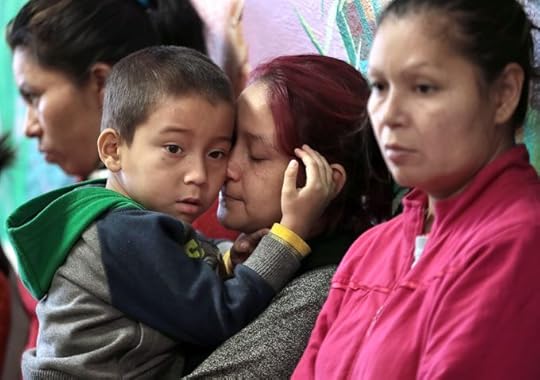
El Paso was in the news this week, with crowds attending Beto O’Rourke’s March for Truth to counter a Trump Rally across the street. .The El Paso Times reported big crowds for both but untruths for Trump and toned down crime talk in light of a new Congressional deal. This woman’s letter cuts to the heart of matters..
On Friday, Sally, Abby and I arrive in El Paso to see the city’s sights, and also to volunteer. Our goal is to welcome, feed, clothe and help refugees, arriving daily with their next destination somewhere in the United States. On Sunday we begin orientation with Annunciation House. Because a new site to receive immigrants has just opened at a hotel, Annunciation House asks us to travel Sunday morning to Las Cruces, New Mexico. We three are up for the trip, 45 minutes away from El Paso.
We arrive shortly before 50 immigrants do, mostly from Guatemala, some from Honduras and El Salvador. There’s no time for our orientation! Fifty people arrived by bus and sit outside on sidewalks and curbs in the hotel parking lot, mostly small, young families, usually pairs, a mother or father with a child.
We learned about their journey. They cross over the bridge from Mexico to El Paso. They are taken to a detention center to be registered. They are given a thin metallic blanket and must sleep on a cold hard concrete floor, one blanket for two of them. The air conditioning is turned up high, the people kept very cold, not what they’re used to. Adults are given one frozen burrito three times a day. The children are given a juice box and animal crackers, three times a day. When each adult and child is registered, they are given a date for legal action.
A thick, heavy, black ankle monitor is put on the adult, programmed with the address of their sponsor, while they wait for the immigration court proceedings to unfold. It is a stark and frightening experience for them, on purpose, we are told. The officials at the holding center are directed to make the stay very unpleasant in hopes they will decide to ‘self deport’. A fair number of these people develop sickness, colds, fevers, and upset stomachs during their 2-5 day stays.
You may have read about this in the news. Currently there are 30 people in one detention center in El Paso that are on hunger strike because of the conditions. They are force-fed by a tube that is put through the nose and down their throats. The government officials at the detention centers refer to the immigrants as “bodies,” and when it is time for them to eat, they say, “It is feeding time,” as if they were animals on farms, not human.
I am furious and very disturbed, hearing the experiences confirmed. Often a new site needs to be opened at a hotel to meet the need, as happened in Las Cruces when we arrived. There are 300-400 people arriving daily in El Paso seeking asylum from poverty and violence in their home countries. The Detention Centers call Annunciation House Director Ruben Garcia daily to say how many they are releasing from detention. There is a tremendous amount of coordination going on to make this system flow daily. Thus the need for local and faraway volunteers like us.
Nearly all the refugees have someone in the US who will sponsor them. The destinations of those I’ve worked with so far included Chicago, Pennsylvania, Ohio, Mississippi, Missouri, Atlanta, Washington D.C., upstate New York and New York City, Philadelphia, North and South Carolina, Florida, California, Oregon, Washington, Texas, Colorado, Arizona, and even Vermont. The receiving family member, friend or sponsor pays for a plane or bus ticket, trips that take one to three more days of travel.
What do we do as volunteers? Each mother and child, or father and child (sometimes there are 2 or 3 children per adult) is welcomed by the site coordinator, and told they are safe, there will be food to eat, and enough water to drink, and medicine for those that need it. They will be warm here, respected and supported to complete their journey to their sponsor.
Volunteers are introduced, so families know who can help or answer questions. They then are escorted, family by family, into “the central office,” really two hotel rooms, where four Spanish-speaking volunteers complete intakes. One volunteer writes down the full name of the mom or dad, the name and age of the child(ren), where they are from, and where they need to get to next.
Then the family moves to another table where another Spanish-speaking volunteer begins to make transportation plans. They call the receiving sponsor in the US, and the sponsor and volunteer arrange for plane or bus tickets. Usually the parent and sponsor talk on the phone to ensure both parties understand the plan. Forms are filled out and pinned to complex whiteboards, delineating next steps by date—today, tomorrow, or the next day, by bus, plane, or pickup, if very local.
On those occasions when the destination address changes from the one programmed into the government’s ankle bracelet, it’s a real problem. Then arrangements have to be made to take the adult back to the detention center to get permission, and to reprogram the ankle monitor!
(Editor’s note: The Associated Press reports that early in 2018, immigrant families were separated as part of a “zero tolerance” program. But after a presidential executive order reversed that, families are often detained, then issued ankle monitors and released while they go through sometimes lengthy court proceedings. Inquiries into costs and suppliers and whether these monitors are effective remain unanswered by ICE—but that they associate immigration with criminality is clear.)
After intake, the family goes to Annunciation’s next station, where I am serving as a volunteer who coordinates and assigns a hotel room number. That sounds simple, but keeping track of the rooms, and where everyone is assigned, is a feat. There’s a large matrix on the wall, filling in who is where, with colored sticky notes, color depending on the day they arrived, and making sure that parent roommates are matched by gender, and by children with a matching age and gender. Yes, it is complicated!
I give families their room number and escort them to the next station where Sally is volunteering, and they get a small packet of toiletries (soap, toothbrush, toothpaste, comb). Sally takes them to meet a “runner.” Abby is serving as a “runner,” taking the adult and child(ren) to their assigned room, and speaking enough Spanish to help them get settled in their room.
She tells them how to open and close the door, how to work the shower, makes sure they know to flush toilet paper inside the toilet, rather than put it in the trash can, as they did back home. She explains they cannot use the hotel phone and only have one key for two families, shares the schedule for breakfast, lunch, and dinner, and explains that while they are free to come down to the lobby, they must not leave the building, and can come to the office any time with any questions or medical needs.
Families then can relax—or sometimes not! Rooms are limited. I often have to reassign a family to another room at a moment’s notice. Abby then goes to them, and asks them to relocate to the room I reassign. Abby says they are all so accommodating— “Sure no problem, and thank you.”
Other Spanish-speaking volunteers work on transportation plans, time and flight, and find and assign a volunteer “transporter” to take the family to the airport or the bus station. I took one family to the local bus station in Las Cruces and made sure they got on the bus, but people are being transported to buses or planes throughout the day, morning or night, every day. I am amazed at the coordination it takes for all these volunteers and all this responsibility—and then there are the missed buses or connecting flights that have to be solved.
There is a room assigned for medical help and supplies. Today, there was a mom and three-year-old daughter, who had a rash. The nurse practitioner was called in to look at it and he determined it was scabies. So a prescription was called in, and a volunteer had to go to pharmacy in El Paso to pick it up, etc.
At any time during their short stay, families may choose to go to the “clothing room” where Sally, Abby and I also volunteer, organizing and sorting donated clothing. Each person is provided one new pair of socks, one new pair of underpants, a pair of pants, a blouse or shirt, and a winter coat if needed for a cold destination.
Local churches volunteer to provide lunches and dinners for our hundred people, which consists of rice, pinto beans, corn tortillas, sometimes shredded chicken, and when there is a lack of volunteering, pizza is brought in. When the moms and dads and children leave, they are provided with a bag filled with food. If leaving on a bus, a family of two traveling on a three-day bus trip requires 18 sandwiches.
Sally, Abby and I are pretty busy from 7:00 AM into the evening, making peanut butter and jelly sandwiches and packing destination bags with fruit and snacks. We smile and comfort these folks, many of whom are frightened. It is our honor to greet our neighbors from abroad with empathy, compassion and a smile. As the mission of my home Unitarian Church says, we welcome all, as we build a loving community, to honor each person’s spiritual journey, to serve human need and protect the earth, our home.
Love, Jo Romano
Interested in helping? Find more about Annunciation House and volunteering here: https://annunciationhouse.org/volunteer/
On Friday, Sally, Abby and I arrive in El Paso to see the city’s sights, and also to volunteer. Our goal is to welcome, feed, clothe and help refugees, arriving daily with their next destination somewhere in the United States. On Sunday we begin orientation with Annunciation House. Because a new site to receive immigrants has just opened at a hotel, Annunciation House asks us to travel Sunday morning to Las Cruces, New Mexico. We three are up for the trip, 45 minutes away from El Paso.
We arrive shortly before 50 immigrants do, mostly from Guatemala, some from Honduras and El Salvador. There’s no time for our orientation! Fifty people arrived by bus and sit outside on sidewalks and curbs in the hotel parking lot, mostly small, young families, usually pairs, a mother or father with a child.
We learned about their journey. They cross over the bridge from Mexico to El Paso. They are taken to a detention center to be registered. They are given a thin metallic blanket and must sleep on a cold hard concrete floor, one blanket for two of them. The air conditioning is turned up high, the people kept very cold, not what they’re used to. Adults are given one frozen burrito three times a day. The children are given a juice box and animal crackers, three times a day. When each adult and child is registered, they are given a date for legal action.
A thick, heavy, black ankle monitor is put on the adult, programmed with the address of their sponsor, while they wait for the immigration court proceedings to unfold. It is a stark and frightening experience for them, on purpose, we are told. The officials at the holding center are directed to make the stay very unpleasant in hopes they will decide to ‘self deport’. A fair number of these people develop sickness, colds, fevers, and upset stomachs during their 2-5 day stays.
You may have read about this in the news. Currently there are 30 people in one detention center in El Paso that are on hunger strike because of the conditions. They are force-fed by a tube that is put through the nose and down their throats.
The government officials at the detention centers refer to the immigrants as “bodies,” and when it is time for them to eat, they say, “It is feeding time,” as if they were animals on farms, not fellow humans.
I am furious and very disturbed, hearing the experiences confirmed. Often a new site needs to be opened at a hotel to meet the need, as happened in Las Cruces when we arrived. There are 300-400 people arriving daily in El Paso seeking asylum from poverty and violence in their home countries. The Detention Centers call Annunciation House Director Ruben Garcia daily to say how many they are releasing from detention. There is a tremendous amount of coordination going on to make this system flow daily. Thus the need for local and faraway volunteers like us.
Nearly all the refugees have someone in the US who will sponsor them. The destinations of those I’ve worked with so far included Chicago, Pennsylvania, Ohio, Mississippi, Missouri, Atlanta, Washington D.C., upstate New York and New York City, Philadelphia, North and South Carolina, Florida, California, Oregon, Washington, Texas, Colorado, Arizona, and even Vermont. The receiving family member, friend or sponsor pays for a plane or bus ticket, trips that take one to three more days of travel.
What do we do as volunteers? Each mother and child, or father and child (sometimes there are 2 or 3 children per adult) is welcomed by the site coordinator, and told they are safe, there will be food to eat, and enough water to drink, and medicine for those that need it. They will be warm here, respected and supported to complete their journey to their sponsor.
Volunteers are introduced, so families know who can help or answer questions. They then are escorted, family by family, into “the central office,” really two hotel rooms, where four Spanish-speaking volunteers complete intakes. One volunteer writes down the full name of the mom or dad, the name and age of the child(ren), where they are from, and where they need to get to next.
Then the family moves to another table where another Spanish-speaking volunteer begins to make transportation plans. They call the receiving sponsor in the US, and the sponsor and volunteer arrange for plane or bus tickets. Usually the parent and sponsor talk on the phone to ensure both parties understand the plan. Forms are filled out and pinned to complex whiteboards, delineating next steps by date—today, tomorrow, or the next day, by bus, plane, or pickup, if very local.
On those occasions when the destination address changes from the one programmed into the government’s ankle bracelet, it’s a real problem. Then arrangements have to be made to take the adult back to the detention center to get permission, and to reprogram the ankle monitor!
(Editor’s note: The Associated Press reports that early in 2018, immigrant families were separated as part of a “zero tolerance” program. But after a presidential executive order reversed that, families are often detained, then issued ankle monitors and released while they go through sometimes lengthy court proceedings. Inquiries into costs and suppliers and whether these monitors are effective remain unanswered by ICE—but that they associate immigration with criminality is clear.)
After intake, the family goes to Annunciation’s next station, where I am serving as a volunteer who coordinates and assigns a hotel room number. That sounds simple, but keeping track of the rooms, and where everyone is assigned, is a feat. There’s a large matrix on the wall, filling in who is where, with colored sticky notes, color depending on the day they arrived, and making sure that parent roommates are matched by gender, and by children with a matching age and gender. Yes, it is complicated!
I give families their room number and escort them to the next station where Sally is volunteering, and they get a small packet of toiletries (soap, toothbrush, toothpaste, comb). Sally takes them to meet a “runner.” Abby is serving as a “runner,” taking the adult and child(ren) to their assigned room, and speaking enough Spanish to help them get settled in their room.
She tells them how to open and close the door, how to work the shower, makes sure they know to flush toilet paper inside the toilet, rather than put it in the trash can, as they did back home. She explains they cannot use the hotel phone and only have one key for two families, shares the schedule for breakfast, lunch, and dinner, and explains that while they are free to come down to the lobby, they must not leave the building, and can come to the office any time with any questions or medical needs.
Families then can relax—or sometimes not! Rooms are limited. I often have to reassign a family to another room at a moment’s notice. Abby then goes to them, and asks them to relocate to the room I reassign. Abby says they are all so accommodating— “Sure no problem, and thank you.”
Other Spanish-speaking volunteers work on transportation plans, time and flight, and find and assign a volunteer “transporter” to take the family to the airport or the bus station. I took one family to the local bus station in Las Cruces and made sure they got on the bus, but people are being transported to buses or planes throughout the day, morning or night, every day. I am amazed at the coordination it takes for all these volunteers and all this responsibility—and then there are the missed buses or connecting flights that have to be solved.
There is a room assigned for medical help and supplies. Today, there was a mom and three-year-old daughter, who had a rash. The nurse practitioner was called in to look at it and he determined it was scabies. So a prescription was called in, and a volunteer had to go to pharmacy in El Paso to pick it up, etc.
At any time during their short stay, families may choose to go to the “clothing room” where Sally, Abby and I also volunteer, organizing and sorting donated clothing. Each person is provided one new pair of socks, one new pair of underpants, a pair of pants, a blouse or shirt, and a winter coat if needed for a cold destination.
Local churches volunteer to provide lunches and dinners for our hundred people, which consists of rice, pinto beans, corn tortillas, sometimes shredded chicken, and when there is a lack of volunteering, pizza is brought in. When the moms and dads and children leave, they are provided with a bag filled with food. If leaving on a bus, a family of two travelling on a three-day bus trip requires 18 sandwiches.
Sally, Abby and I are pretty busy from 7:00 AM into the evening, making peanut butter and jelly sandwiches and packing destination bags with fruit and snacks. We smile and comfort these folks, many of whom are frightened. It is our honor to greet our neighbors from abroad with empathy, compassion and a smile. As the mission of my home Unitarian Church says, we welcome all, as we build a loving community, to honor each person’s spiritual journey, to serve human need and protect the earth, our home.
Love, Jo Romano
Interested in helping? Find more about Annunciation House and volunteering here:
https://annunciationhouse.org/volunteer/
February 5, 2019
The Trouble with THE Truth

Dan Coats, the director of national intelligence, gathered by 17 federal agencies, reported to Congress on Jan. 22, about our national security in 2019. He said our American goal must be seeking the truth and speaking the truth, which was embraced by newscasters as a hopeful development, given Trump’s flip relationship with facts. Yet I couldn’t help but notice the security team was mostly male, as were the intelligence system’s creators. All seem resigned to a world under threat and guarding against inevitable war with more and bigger guns.
The inclusion of Gina Haspel, the first woman to ever head the CIA, hardly put me at ease. She’s the one who destroyed tapes of waterboarding that would hold the CIA responsible for using terror—a cherry on top of a banana-split history of political disruption and foreign violence. It was close enough to Martin Luther King Day that you’d think they might be mulling over why he said America had three big problems: race, poverty, and militarism. He left out gender, but back in his day, most everyone did. Did I mention our top intelligence team is as white as I am?
So why give us old news from the same old crew who says their mission is THE truth, the seeker and speaker of a single truth? Who exactly runs the distillery of their truthiness, and what rum-recipe are they using?
In our post-colonial time, we have learned there are many truths, and different ways to see matters. History is a war tale written by “victors,” and most updates of our time have come from the victims, not so much from the perps. When entrenched power speaks of change or apologies, it’s most often unconvincing—as with Guliani’s spins, the Virginia governor’s recent black-face moonwalk, or those priestly and corporate settlements out of court to avoid public exposure.
While the public is pretty accepting of lies and half-truths after a century of advertising—the traditional funder of our journalism—lately the lies slip closer to ceaseless nuttiness. A masculine market logic of bloodless numbers, and impersonal facts of profitable threats undermine trust and solutions. A more genuine security report would surly include more girls, more color and difference, and more freedom to feel more than fear. Check out the link above.!
The mid-term election of more diverse voices showed us a majority of Americans already know this. Unless we cherish all the life on our one green earth and begin to plot collaboration and peace, we may not survive, much less prosper. That requires a truth spoken by diverse bodies using all five senses: a shared feeling and hearing and touching of genuine thoughts, experiences, and emotions to discover what we hold in common.
Then we might speak a more unified and inclusive truth—not THE truth, which can only be imposed by those with the biggest guns.
—Rickey Gard Diamond