Russell Atkinson's Blog, page 86
November 3, 2016
The Lightless Sky by Gulwali Passarlay
 The Lightless Sky: A Twelve-Year-Old Refugee’s Harrowing Escape from Afghanistan and His Extraordinary Journey Across Half the World by Gulwali Passarlay
My rating: 4 of 5 stars
This first-hand non-fiction account of an Afghan refugee’s journey from the land of the Taliban to the safety of the UK is both shocking and inspiring. Only twelve months old when he was sent forth by his mother into the hands of smugglers, he was a scared boy who became a man on his year-long journey. I was tempted to call it an adventure but that would put an unwarranted gloss on the hellish endurance race. At various times he was cheated, jailed, starved, beaten, robbed, held hostage, and shoved into poisonous chemicals that left him permanently scarred. It is a near miracle he made it to the UK, or even survived for that matter. He gives us a credible and very different view of life in an Afghan village and the views and attitudes of other Afghans. He also recounts many tales of kindness, bravery, and loyalty that allowed him to survive and ultimately reach the end of his flight.
This is the third non-fiction book I’ve read by authors who were there in Afghanistan’s war-torn regions. Two of them, there is no goat and Red Platoon: A True Story of American Valor, were by U.S. military personnel. These three were written from very different political points of view, but one thing appears to be a common thread: the U.S. should not be there. We are doing no good for the people of Afghanistan and in fact are damaging our own security by bombing and other military action that serves only to help the Taliban and Al-Qaeda recruit future terrorists who hate the U.S. Nation-building in our democratic model simply does not work in that culture. The Afghans, at least the ones in the mountain areas controlled by the Taliban, do not want western values. Life was stable and good under Taliban control before the U.S. came. Of course there were some atrocious events like the stoning of women who were accused of some immorality, but the number of deaths and maimings and other atrocities there, such as bombings of hospitals and innocent family homes, has increased greatly under the U.S. occupation. At the same time we are putting the lives of U.S. service personnel at risk for no useful purpose, and every year producing a new crop of full body bags and limbless veterans with PTSD.
The author had a co-author, but the story is his. The writing would be remarkably good for someone of his background had he been the sole author, but it was still rather dull and repetitive with a generally whining I’m-a-victim tone to it. The co-author should have taken more of a lead role in cleaning it up. The author is clearly highly intelligent and his smarts played a big role in his success in getting to the UK, but he still seems to be carrying demons from his experience. I get the feeling he is still suffering from PTSD, although that is not mentioned in the book. His education and life in the west have clearly broadened and matured him. The chip has finally fallen from his shoulder, or so it seems. Yet there is still a part of him that hates the U.S. and the UK for their roles in bringing chaos to his world and his family with their invasion. He admits that had a few things gone differently he might very well have become radicalized and joined the terrorists.
The post The Lightless Sky by Gulwali Passarlay appeared first on OnWords.


November 2, 2016
Bizarro
It took me a few beats before I got this one.

Courtesy King Features
October 28, 2016
Research fail – Pure Genius
This blog is about writing, so here’s a lesson for you would-be writers out there. As I do every TV season, I record almost all the new network comedy and drama series and check them out. Tonight I watched the premier episode of a new series called Pure Genius. It was a failure for several reasons, but there was one particular flaw that applies to writers of novels as well as TV shows: bad research. It is set in Palo Alto, California, which for those of you who have been living in a cave for the last thirty years, is in the heart of Silicon Valley. Geographically speaking, it is on the San Francisco Peninsula. At one point the main billionaire entrepreneur/philanthropist (think Elon Musk clone) introduces a black character as a total gang banger who grew up “dirt poor in the East Bay Area.”
This is wrong on at least three levels. To locals, the nine counties that border San Francisco Bay are as a whole called “the Bay Area.” This term may be extended to include some other neighboring areas at times. Three counties east of the bay are called “the East Bay.” No one who lives here refers to that region as “the East Bay Area.” Hollywood writers have conflated the two terms. It would be like a New Yorker telling a fellow New Yorker that he grew up in “the Bronx Borough.” It’s just “the Bronx.” This kind of laziness destroys the believability of the entire show.
The second fail is the idea that you might identify this fellow’s humble origins by specifying such a large area. The Hollywood writers must think the entire East Bay is a poor area, probably because of the news coverage of riots, murders and other nasty events in Oakland, Richmond, and maybe Vallejo if those make it to the outside world. Those cities all harbor some very poor areas with black or Hispanic gangs, to be sure, as well as some nice areas. But the East Bay as a whole is mostly a wealthy area. It includes generally wealthy, lily white and low crime cities like Orinda, Lafayette, Walnut Creek, and even the hill area of Oakland among others. This is like saying a character from Bedford-Stuyvesant grew up dirt poor on Long Island. Hello… have you never heard of the Hamptons? Bedford-Stuyvesant is in Brooklyn and technically is on Long Island, but people usually don’t think of it or talk about it that way. A real New Yorker would describe the character as coming from Bed-Stuy, and a real Silicon Valley resident would also refer to the gang-infested area in this case as East Oakland (which, ironically, is actually in the western half of the city), or some other particular neighborhood of a particular city. The writers didn’t bother to do even minimal research on how people in the area actually talk or on the demographics of the area.
Third, this is just clunky dialogue. It’s pure exposition crammed into the first ten minutes to let us viewers know that this clean-cut male model of an African-American is living proof that poor disadvantaged minority youth in Silicon Valley can grow up to be well-paid scientists and tech workers and apparently lose any hint of black speech patterns prevalent in the area from which they supposedly came. Our token mascot! Can you imagine actually introducing someone that way? It’s sort of like introducing a gorgeous young woman as “meet my friend Linda who used to be the fattest girl in her class when she was a kid.” I could level plenty of other criticisms about the series just from the twenty or so minutes I watched it, but I’ll leave it at that for now. Needless to say, I canceled the series.
By the way, if you want to know a good series to watch, try Life in Pieces. It’s in its second year and is absolutely hilarious, clearly the best comedy on the air today. Last night’s episode had me laughing out loud, something I can’t remember doing at any time in the last two or three years.
The post Research fail – Pure Genius appeared first on OnWords.
October 25, 2016
Saturn Run by John Sandford and Ctein
 Saturn Run by John Sandford
My rating: 3 of 5 stars
An alien vessel is detected approaching Saturn. Before long it departs, but it is clear that it rendezvoused with something in or near the rings. The U.S. and China, the two superpowers of 2066, are in a race to get there to make first contact with the aliens or explore what they left. Sandford, essentially a thriller writer, handled the story line; Ctein handled the hard science. I listened to the audio version.
On a superficial level the book was satisfying enough. It kept me generally entertained for the requisite number of hours. Still, I would have to call it uneven. The hard science part was quite good. Ctein did his part. The story line, though, struck me as artificial and simplistic, with stereotyped characters, especially on the Chinese side. None of the main characters, Sandy and Fiorella in particular, seemed entirely believable but they did have the virtue that they weren’t obvious superheroes or supervillains. My real gripe, though, is that it seemed to me to be a bait and switch. I was expecting a first contact sci-fi novel but it turned out to be a cold-war-in-the-future space race novel. *spoiler warning* Virtually the entire plot was about the competition between the U.S. and China. The entire first contact part was a huge anticlimax. The hard science all pertained to the technological approaches taken by the two human nations in their ships, the basics of orbital mechanics, and so forth. As such it was earth-bound stuff you could read on any science blog. As mentioned, that part was quite imaginative and well done as far as it went. The political skullduggery of the plot was not.
Another shortcoming was the reader, although at times he was quite good. At other times he was too mechanical in his reading almost as if reading from a badly timed TelePrompter. As a Mandarin speaker, I also had to grit my teeth at his pronunciation of the Chinese names, especially Cui’s, although I suppose that’s forgivable. He did a good job of adopting accents for the various characters.
The post Saturn Run by John Sandford and Ctein appeared first on OnWords.
October 23, 2016
1776 by David McCullough
 1776 by David McCullough
My rating: 3.5 of 5 stars
This non-fiction account of America’s year of birth is well-researched, well-written, and full of action and interesting characters. If you loved it, you have good reason to, but then you are probably a lover of history. I am not. To be clear, three stars at Goodreads means I liked it. On my blog OnWords I’ll stretch that to 3.5. I am not writing a negative review.
So why am I giving it only three stars rather than four or five? It is because of the subject matter, not the writing. I’m one of those who agrees with Henry Ford that History is Bunk. I also think the old saw that those who fail to study history are doomed to repeat it has it backward. It is those who study it who are so doomed. Just look at how the military is always preparing for the last war. After WWI we spent billions on battleships only to find that aircraft carriers and bombers were what was needed in WWII. After WWII we spent billions on those and found that we fought in jungles and tunnels where those were useless. The current war is being fought on social media and the military has no clue how to fight it. My point is that history is pointless at best, dangerous at worst. Virtually every major scientific breakthrough was made by someone who met with near universal resistance from all those experts who had studied the history of their field and thus were sure the new guy who hadn’t must be wrong. When I say history is bunk, I refer to recorded human history. If you study the history of species in general, or even humans over millennia instead of centuries, and see the dangers of overhunting to the point of driving your food source to extinction, for example, then you might learn something worthwhile. We need people who can imagine the future, not remember the past. But I digress.
The book is quite readable although it is limited in its scope, describing only the military campaign by the British and Americans in its title year. If you are into historical battles or colonial lifestyle, you will probably find this quite a good read. History was my worst subject in school and for me this book was a chore I undertook only because it was chosen by my book club. Although it was quite professional for the most part, it did have a surprising number of minor but odd errors, like on page 289 when the author said “Washington had reigned in his horse.” Perhaps he was confusing Washington with Shakespeare’s Richard III who famously said “My kingdom for a horse.”
The post 1776 by David McCullough appeared first on OnWords.
October 20, 2016
Podcast appearance on Geocachetalk.com
Fans, readers, or whoever you are, I will be appearing on the podcast Geocachetalk on November 6, 2016. If you have questions you’d like me to answer, you can watch the show or even send in questions to me here using the contact form on the top menu, or contact the podcast through their email link geocachetalk@gmail.com. I’ll be talking about my books, my geocaching, and my FBI career.
The post Podcast appearance on Geocachetalk.com appeared first on OnWords.
October 19, 2016
The Torture is Over – I voted!
I just voted by mail. I don’t have to watch, listen to, or read any more that crap!
The post The Torture is Over – I voted! appeared first on OnWords.
October 13, 2016
Ratagrams
I’ve just invented a new(ish) word game I’m calling Ratagrams. The name comes from my American Cryptogram Association (ACA) nom de plume and geocaching name THE RAT. It is in simplest form just anagramming, but with some rules. If it catches on, I’ll keep it going. It’s impossible for me to judge the difficulty of these Ratagrams since I created them and know the answers, so I’m hoping you will give them a try and give me feedback via comment or use the contact form linked on the top menu. A Ratagram consists of a common phrase or sentence (the answer/plaintext) that is anagrammed into another phrase (the puzzle/ciphertext). First, the puzzles, then the rules.
The Puzzles
A streamer of wall
Intent no buy mouthy
Age shortens what to three
[Edit] Someone sent me link to an anagram site that solves these three because it has the plaintext in its database. So I have created two more that that site does not solve. If you want a challenge, try these harder ones.
skeletal basic smidgen flowerpots
Brother a renowned eel i barren or
The Rules
The answer must be a common, recognizable English language phrase or sentence
Word lengths and divisions are kept (i.e., the puzzle has the same “shape” as the answer)
Except for 1-letter words, none of the words in the answer may appear in the puzzle
No personal names, foreign words, abbreviations, acronyms, or swear words are allowed
Punctuation and capitalization are removed
For example, if the puzzle is “Band partners angels” the answer is “Star Spangled Banner.” Note that the words of the puzzle are of length 4, 8, 6, the same as the answer in compliance with Rule 2. I’ve written a program that solves all three of these, so I know these are solvable, but it’s having trouble with some longer ones, so I am not showing those for now. I may institute a rule about the maximum length if I get enough feedback. I fully expect you to use resources available out there on the web or elsewhere such as anagramming sites or programs. There is no such thing as cheating. Just bear in mind that you must get the correct answer, not just create another anagram from the letters. Place names are permitted, but only very widely known ones like America or England. Common contractions are allowed like “I’m” but the apostrophe will not be visible. Personal names that are also common words are permissible, like Mark Twain or Bob Dole. Rules 1 – 4 are intended to help the solver.
Suitable Ratagrams would be titles of well-known books/movies/songs, maxims, quotations, etc. The important thing is that the answer be recognizable by the general public. The title to your favorite zombie movie or romance novel is not suitable unless it also happens to be a common phrase. If you enjoy solving these, please send me Ratagrams of your own. If I can solve them, I’ll publish them in a future post. I review all comments before they are published, but I will allow people to post their answers, so if you want to avoid spoilers, don’t read the comments. I will link to this post on Facebook and Google+ and can’t prevent spoilers there.
October 11, 2016
Our Ignorant Newsies – Lester Holt edition
Once again Lester Holt got his prepositions confused. He said that Hurricane Matthew was blamed on 14 deaths. That means the 14 deaths caused Hurricane Matthew. What he meant was Hurricane Matthew was blamed for the 14 deaths. The hurricane caused the deaths, not the other way around. It’s for, not on, Lester.
The post Our Ignorant Newsies – Lester Holt edition appeared first on OnWords.
October 4, 2016
Epitaph for a Tramp by David Markson
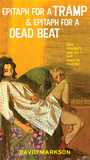 Epitaph for a Tramp & Epitaph for a Dead Beat: The Harry Fannin Detective Novels by David Markson
My rating: 5 of 5 stars
Raymond Chandler lives! Or one might have thought so in 1959 when Markson wrote this remarkable novel (published the same year Chandler died, ironically). I’ve only read Epitaph for a Tramp. I’m saving the second one for dessert. Harry Fannin is a tough, sardonic, New York private eye. One night his ex-wife, a beauty and a beast (the tramp in the title), shows up knocking on his door. By the time he opens it, she lay dead, a trail of blood leading from the sidewalk. Harry calls Brannigan, an archetypal burly, cigar-chewing city cop. Together they set out into the night to chase leads until the murder is solved.
The style is classic 30’s despite the two decade gap. Cigarettes, booze, and the crunch of fists on faces abound. Markson never uses a simple declarative sentence when he has a pithy metaphor or simile in his quiver. Or three. It’s more noir than a black cat in a coal mine.
I thought this was absolutely terrific, but it is something of an acquired taste. Read at your own risk. If you become addicted, don’t blame me.
The post Epitaph for a Tramp by David Markson appeared first on OnWords.