
Larissa Reinhart's Blog, page 242
March 6, 2012
Quick & Easy Japanese Food: Mabodofu (Tofu & Ground Meat)
MABODOFU: HAVE YOUR MEAT AND EAT TOFU, TOO
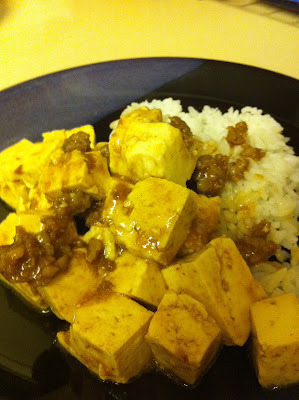 Today I present a tofu dish, another Japanese dish brought over from China and Japanified. Mabodofu (dofu = tofu) is a common meal at home and in Chinese restaurants. According to legend (and Wikipedia), a Japanese chef made mabodofu popular at the first Sichuanese restaurant in Tokyo in the 1950s. In China, it's made with spicy chili bean paste. In Japan, the recipe was modified for the milder Japanese palette. It's so common now in Japan, you can buy the Hamburger Helper equivalent in a grocery store (which is pretty good). It is one of the few dishes that our youngest will pick over noodles, which is a startling revelation if you knew her.
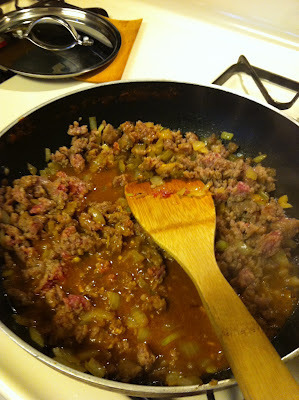 See all the meat? If you're vegetarian,
use a ground Bocca Burger type productYet, it's tofu and I know what you're thinking. It's tofu.
Listen, my family likes tofu, but I was raised in a Midwestern farm town where we ate meat every day. If you offered me a choice between grilled steak and grilled tofu, I would choose the steak. I am not here to convince you to hang out in the tofu aisles of Whole Foods. Mabodofu is not even a vegetarian dish, generally it includes ground pork (although you can use ground beef or other ground meats). It has a rich gravy, which gives the tofu a savory flavor. And you use firm tofu which has enough bite and texture that it feels creamy without being squishy.
Believe me, I do not like squishy.
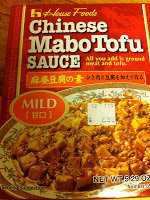 A Mabodofu mix
bought in an Asain grocery
in the U.S.First, the Hamburger Helper way. Here's a picture of a package of Mabodofu mix. You can get them in Asian grocery stores at different heat levels. (Mild has absolutely no heat). This is super simple. All you need is about a quarter pound of ground pork, a package of tofu, and green onions (you can actually leave the green onions out). Make some rice, saute the pork, add the sauce and cubed tofu, and you are done. Aside from the rice, it takes about 10 minutes.
I know. 10 minutes. I'd double the recipe for an American family, though. It will cost you about $6 for two packages.
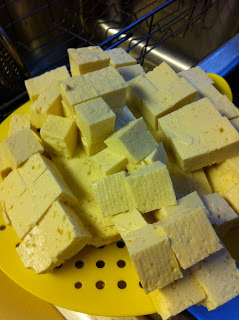 I cut & drain my tofu, but notice
my lack of style. No squeezing necessary.For those of you who would like more control over the contents of your meal (the mix probably has MSG), JustBento.com has a great recipe. I've looked at other recipes and theirs is the simplest I've found so far. My family loved it. The ingredients are also pretty easy to find: tofu, ground meat, onions, miso paste (the soybean paste in miso soup), garlic, ginger, crushed red pepper, soy sauce, sesame oil, sugar, and water.
Go here for the JustBento.com recipe for Mabodofu.
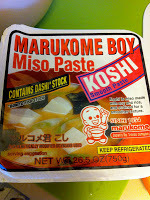 Miso paste from U.S. Asian
groceryI had never had onions in Mabodofu before, but they added extra flavor and texture. Sarah, the blogger who created this recipe, also used ground beef. Traditionally, the meat is ground pork, and I used ground pork when I made it. I also like the addition of miso. What's missing is the Chinese chili paste you normally see in Mabo recipes. The miso is used as sweet bean paste.
I would NOT use a tablespoon of cayenne pepper unless you are a heat freak. I used a dash, which is plenty for my family's timid tastebuds. Sichuan Mabo Tofu is spicy, so let your tastebuds make your decision.

 Today I present a tofu dish, another Japanese dish brought over from China and Japanified. Mabodofu (dofu = tofu) is a common meal at home and in Chinese restaurants. According to legend (and Wikipedia), a Japanese chef made mabodofu popular at the first Sichuanese restaurant in Tokyo in the 1950s. In China, it's made with spicy chili bean paste. In Japan, the recipe was modified for the milder Japanese palette. It's so common now in Japan, you can buy the Hamburger Helper equivalent in a grocery store (which is pretty good). It is one of the few dishes that our youngest will pick over noodles, which is a startling revelation if you knew her.
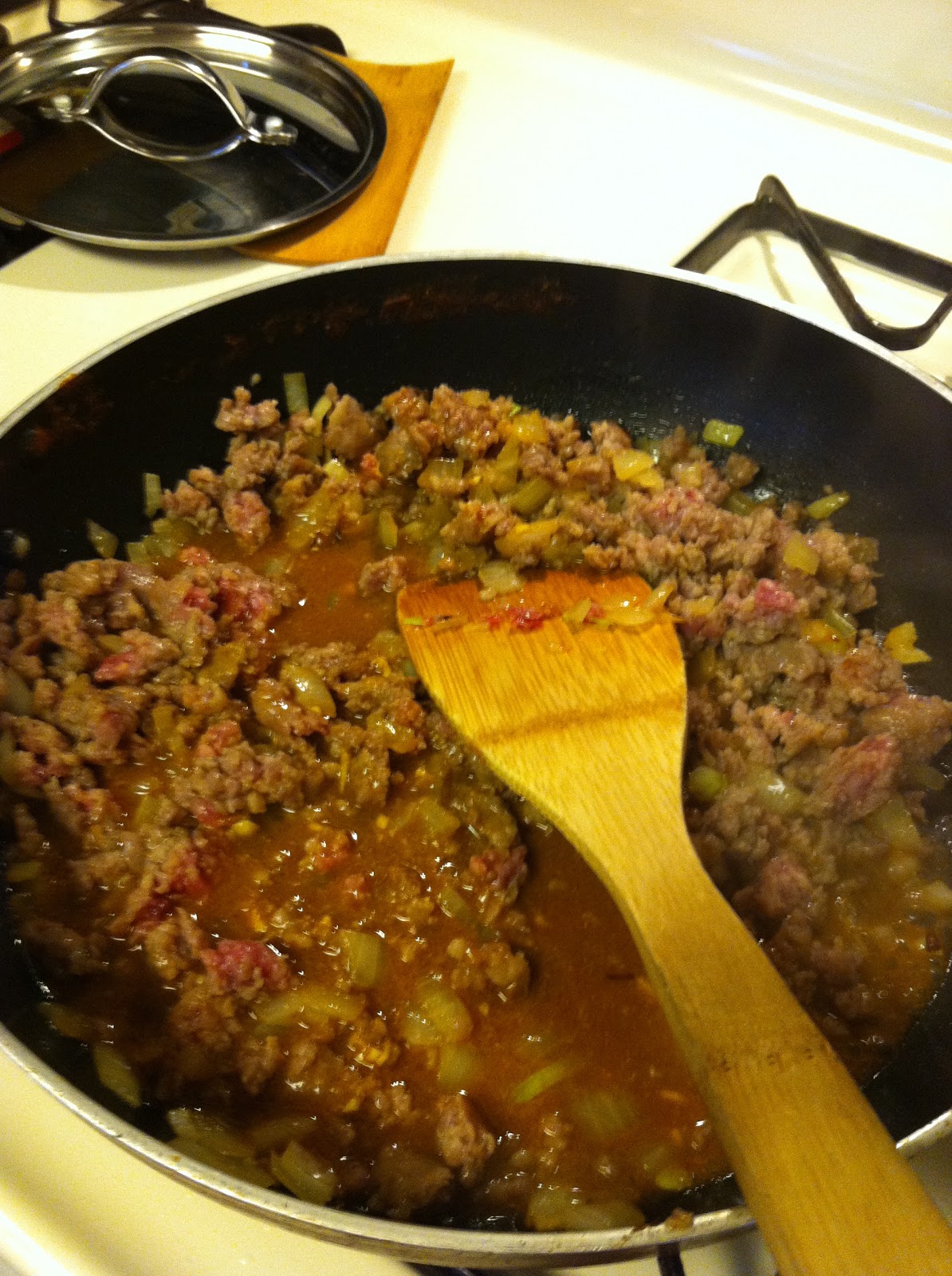 See all the meat? If you're vegetarian,
 use a ground Bocca Burger type productYet, it's tofu and I know what you're thinking. It's tofu.
Listen, my family likes tofu, but I was raised in a Midwestern farm town where we ate meat every day. If you offered me a choice between grilled steak and grilled tofu, I would choose the steak. I am not here to convince you to hang out in the tofu aisles of Whole Foods. Mabodofu is not even a vegetarian dish, generally it includes ground pork (although you can use ground beef or other ground meats). It has a rich gravy, which gives the tofu a savory flavor. And you use firm tofu which has enough bite and texture that it feels creamy without being squishy.
Believe me, I do not like squishy.
 A Mabodofu mix
 bought in an Asain grocery
in the U.S.First, the Hamburger Helper way. Here's a picture of a package of Mabodofu mix. You can get them in Asian grocery stores at different heat levels. (Mild has absolutely no heat). This is super simple. All you need is about a quarter pound of ground pork, a package of tofu, and green onions (you can actually leave the green onions out). Make some rice, saute the pork, add the sauce and cubed tofu, and you are done. Aside from the rice, it takes about 10 minutes.
I know. 10 minutes. I'd double the recipe for an American family, though. It will cost you about $6 for two packages.
 I cut & drain my tofu, but notice
my lack of style. No squeezing necessary.For those of you who would like more control over the contents of your meal (the mix probably has MSG), JustBento.com has a great recipe. I've looked at other recipes and theirs is the simplest I've found so far. My family loved it. The ingredients are also pretty easy to find: tofu, ground meat, onions, miso paste (the soybean paste in miso soup), garlic, ginger, crushed red pepper, soy sauce, sesame oil, sugar, and water.
Go here for the JustBento.com recipe for Mabodofu.
 Miso paste from U.S. Asian
groceryI had never had onions in Mabodofu before, but they added extra flavor and texture. Sarah, the blogger who created this recipe, also used ground beef. Traditionally, the meat is ground pork, and I used ground pork when I made it. I also like the addition of miso. What's missing is the Chinese chili paste you normally see in Mabo recipes. The miso is used as sweet bean paste.
I would NOT use a tablespoon of cayenne pepper unless you are a heat freak. I used a dash, which is plenty for my family's timid tastebuds. Sichuan Mabo Tofu is spicy, so let your tastebuds make your decision.


February 27, 2012
15 years later
We really loved living in Japan. My wife Palmarin and I met there, it's where I launched my career, and where I made the best friends of my life. To say that was a "special" time is a vast understatement: it was THE seminal experience in my adult life, and I wouldn't trade the experience for anything.That said, after 5 years in Japan we'd reached the point where things weren't fun and exciting anymore, and we were eager to come home -- a state many of our expat friends said they were in as well. Most of us expats were eager to get on with the next stage in our lives: many were heading into graduate school, others were making career changes, and still others were just looking forward to getting away from the high cost of living and crowded conditions of Tokyo. Just before I left, I had lunch with a friend, Brian, and the topic of what it would be like to move home came up as it had with so many expat friends. He asked me that day to write about my experience re-assimilating once I got back home. So, after postponing this missive for 15 years, I'm finally writing about what I learned as a former expat. Sorry for the delayed response, Brian!When we moved back, we really enjoyed the things we had missed: easily accessible outdoor activities, low-cost options for nearly everything, and the career/ education opportunities. I have no regrets about living in Japan, nor about moving back when we did. But I found it hard to answer Brian's question, "what's it like to move back," at least at first. I remember trying to write this article in the months after moving back, but then concluded that I just didn't have enough perspective yet. It seemed I needed more time after the "honeymoon period" of moving back home had worn off to really make an account. What I remember the most was how ill prepared – psychologically – we were to make the move. In some ways we felt it would be very easy slotting back into the US lifestyle, and in many ways it was. Still what we didn't realize is that to move "back home" is as stressful as any move ever is. All the anxieties, transitions and adjustments that come with moving from one country to another (or even one city to another) still apply when you move back "home." So if you're an expat who is planning to move home soon, get as mentally ready as you would for a move overseas. Even if you're moving back to the same home you lived in before, your neighbors may have changed, the neighborhood may have changed, familiar places you once knew will probably have changed. And, the people you knew have probably changed too.I have to say that one thing was a little disappointing: how little most people – both educated and not-so-educated – cared or "got" what a life-changing experience living overseas was for us. Shortly after returning I was having lunch with a friend and I mentioned what a large transition it was to move to Japan, adjust to life there for 5 years, and then move back home. He attempted to empathize, saying "I know what you mean. It was a huge adjustment for me when I moved from LA to San Francisco." Wow, I didn't say. It isn't like that at all. And I wonder if anyone really can "get it," unless they too have been there ... and back again.

February 21, 2012
Arrietty the Borrower: Reliving Japan Thru Studio Ghibli
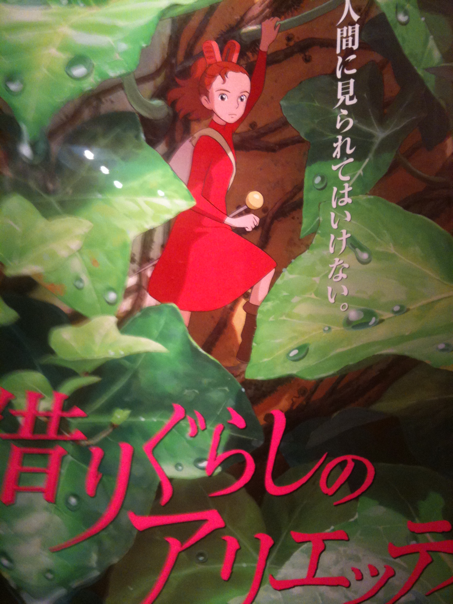 The Japanese poster for ArriettyI took the kids to see
The Secret World of Arrietty
this weekend. I'm not sure how American kids will respond to the movie, but I loved it. The film is beautiful and paced for exploring the studio's artistry in creating the lush landscape and detailed settings. My kids enjoyed the story, but they really enjoyed seeing Japan through the movie even more.
The Japanese poster for ArriettyI took the kids to see
The Secret World of Arrietty
this weekend. I'm not sure how American kids will respond to the movie, but I loved it. The film is beautiful and paced for exploring the studio's artistry in creating the lush landscape and detailed settings. My kids enjoyed the story, but they really enjoyed seeing Japan through the movie even more.The Borrowers by Mary Norton was one of my favorite books growing up. I longed to shrink into their little world and drink tea from thimbles and eat off of buttons. I don't know why the world of itsy bitsy holds such pleasure for children (maybe our desire to be bigger than something else?), but I couldn't get enough of The Borrowers world and read every book in the series available at that time.
 In 2010, Hiyao Miyazaki's animation studio, Studio Ghibli, released Arrietty The Borrower in Japan. Studio Ghibli's best known film in America is My Neighbor Totoro. We were still living in Nagoya at the time and visiting a wonderful park, Mori-koro Park. One of their halls had a Studio Ghibli exhibition with drawings and posters from all the Studio Ghibli films as well as three-dimensional mock-ups of Arrietty's film set. I was thrilled to see one of my childhood books made into a movie by an animation studio that I admire.
 Now that it finally came to the U.S., I took my girls opening weekend hoping they would love Arrietty's world and want to read the book. They've watched several Studio Ghibli films, Totoro is a favorite as well as Kiki's Delivery Service (adorable) and Ponyo.
 Loving Totoro at Morikoro ParkThe movie started and the girls gasped, "Look! Arrietty lives in Japan!"
 I hadn't counted on the Japanese background in watching the movie. The girls were taken with the everyday items of Japan more than the story of the Borrowers. Arrietty's house is under a futon closet. Her mother makes green tea. The sugar borrowed is cubed, not so unusual, but completely normal in a Japanese sugar pot. Signs are in Japanese. My kids even recognized the kind of car Shawn's grandmother drives. The crow in the movie is as much of a nuisance as crows are in real Japan.
As I watched, I realized the Japaneseness of Studio Ghibli's stories may be one of the things I most love about their films as well. It's nice to revisit places you love in films. Even when you're not expecting it.

February 14, 2012
Celebrating Other Countries' Holidays
EXPORTING HOLIDAYS: WHICH WAY TO DO VALENTINE'S DAY?
How many of you ex-expats still celebrate the holidays of your former foreign land?
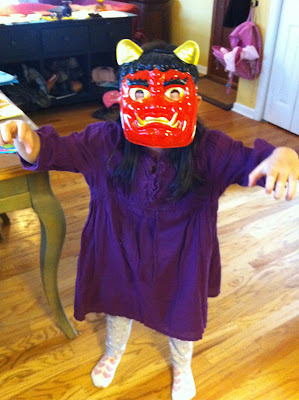 Our little Oni
 With no roasted soybeans,
we made due with popcorn this yearLast week in Japan, they celebrated Setsubun, one of our kids' favorite holidays. It's a spring rite that involves throwing roasted soybeans at someone in an Oni demon mask to cleanse your house of bad spirits and usher good tidings in for spring.
It may sound odd, but how many times a year are my children allowed to throw food at their parents? There just isn't a holiday equivalent in America. Poor kids.
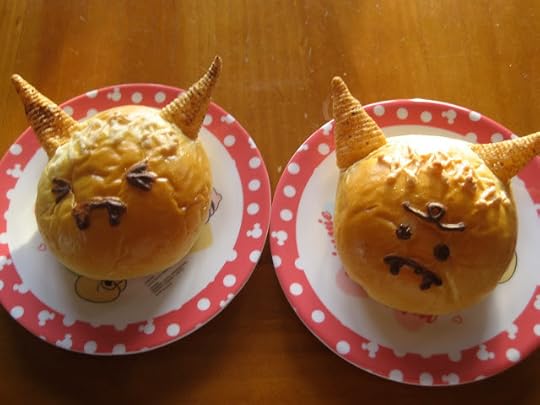 Setsubun pastries in Japan
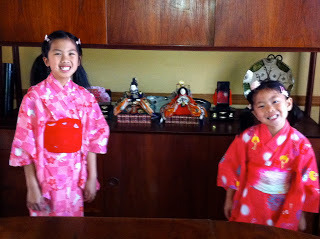 Our tiny Hina Ningyo courtMarch 3rd is Girl's Day or the Doll Festival, Hina Matsuri, another holiday my kids love (boys get their turn in May on Children's Day). In Japan, grandparents buy their newborn granddaughters Hina Ningyo, dolls that replicate the Emperor, Empress and court from the ancient Heian Period. These beautiful china and silk dolls are displayed on tiered steps covered in red cloth in a place of prominence. If Grandma and Grandpa are well coffered, or if you inherit a set, you might have a royal court complete with furniture, lights, and beautiful lacquer bento boxes.
 A well attended Hina Ningyo courtWe found our Emperor and Empress set and a couple pieces of lacquer furniture at a flea market. I was probably more entranced with the furniture than my young daughters. The drawers open and shut. The craftsmanship is remarkable. Our daughters love the dolls. Unfortunately we weren't farsighted enough to buy two sets, so a fight may ensue when the little chickies fly the nest and want to take the dolls with them.
 Cute Girls' Day treatsOn Hina Matsuri, girls are given special rice cracker treats (in pastel colors!) and families may eat chirashisushi, a vinegared-rice dish with sliced vegetables, omelette, and salmon on top. Last year, I went to a Japanese friend's home and we made California sushi rolls for our kids. You adapt. We still display our dolls through February (you have to take them down after Girl's Day or your daughter may not marry, so the saying goes).
Yesterday was Valentine's Day. In Japan the day is celebrated by women giving men dark chocolate. The men are supposed to return the favor with white chocolate a month later, March 14, on White Day.
Fun to see in Japan, but I'm not taking that one back with me! I'll keep my dark chocolate to myself.
What holidays from your host country do you still celebrate? How have you adapted them to your home country? What holidays do you miss?
How many of you ex-expats still celebrate the holidays of your former foreign land?
 Our little Oni
 With no roasted soybeans,
we made due with popcorn this yearLast week in Japan, they celebrated Setsubun, one of our kids' favorite holidays. It's a spring rite that involves throwing roasted soybeans at someone in an Oni demon mask to cleanse your house of bad spirits and usher good tidings in for spring.
It may sound odd, but how many times a year are my children allowed to throw food at their parents? There just isn't a holiday equivalent in America. Poor kids.
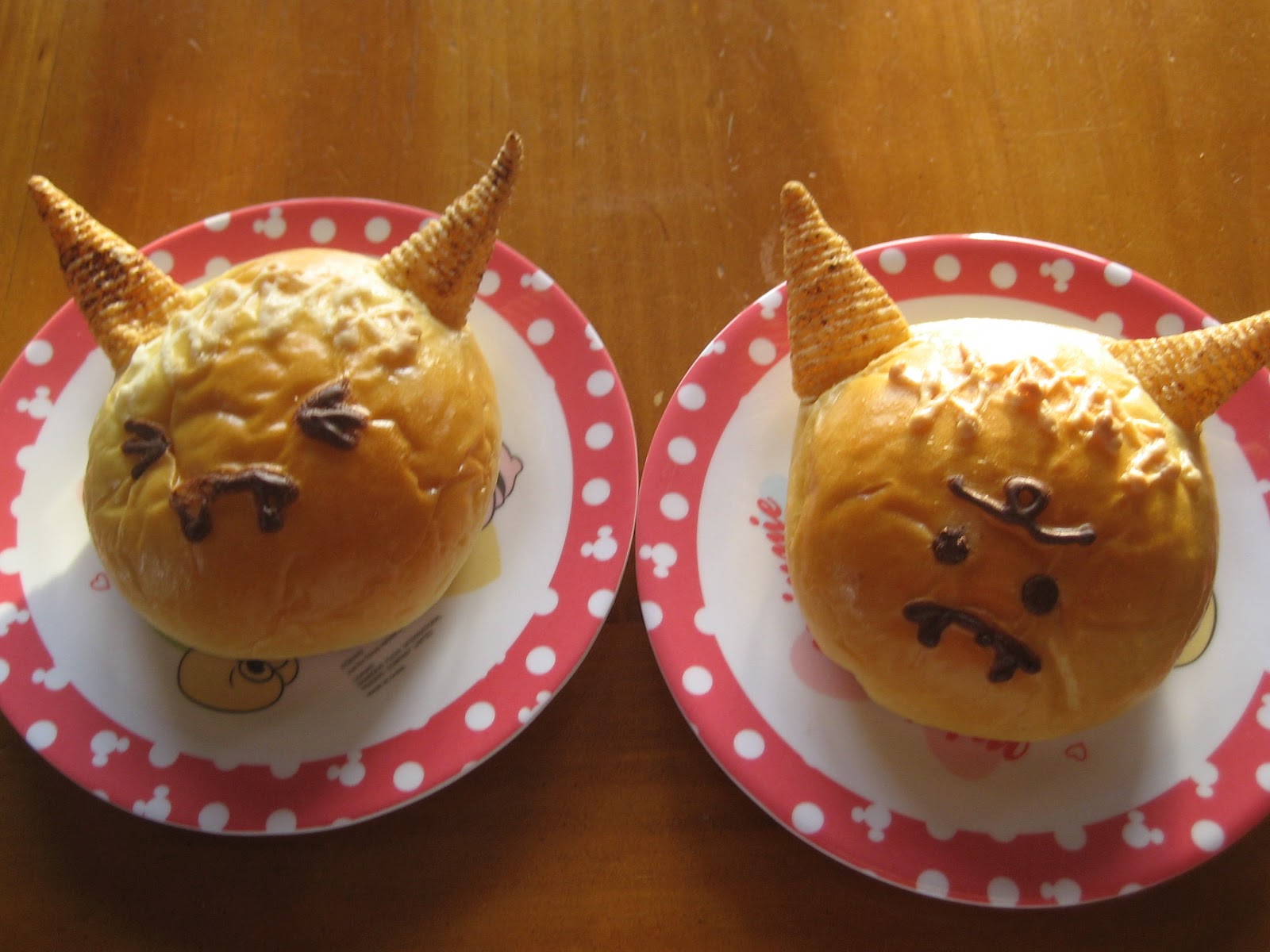 Setsubun pastries in Japan
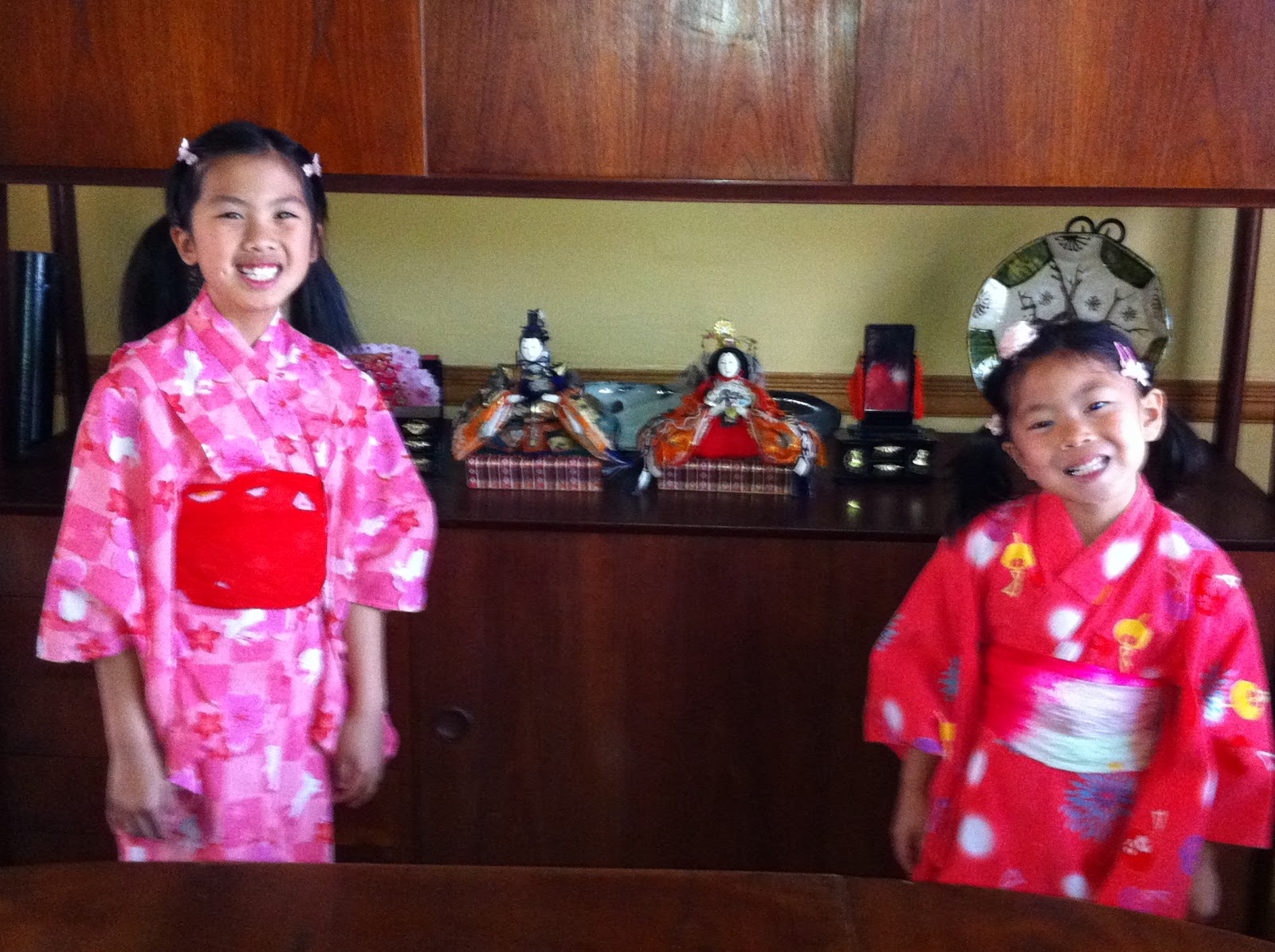 Our tiny Hina Ningyo courtMarch 3rd is Girl's Day or the Doll Festival, Hina Matsuri, another holiday my kids love (boys get their turn in May on Children's Day). In Japan, grandparents buy their newborn granddaughters Hina Ningyo, dolls that replicate the Emperor, Empress and court from the ancient Heian Period. These beautiful china and silk dolls are displayed on tiered steps covered in red cloth in a place of prominence. If Grandma and Grandpa are well coffered, or if you inherit a set, you might have a royal court complete with furniture, lights, and beautiful lacquer bento boxes.
 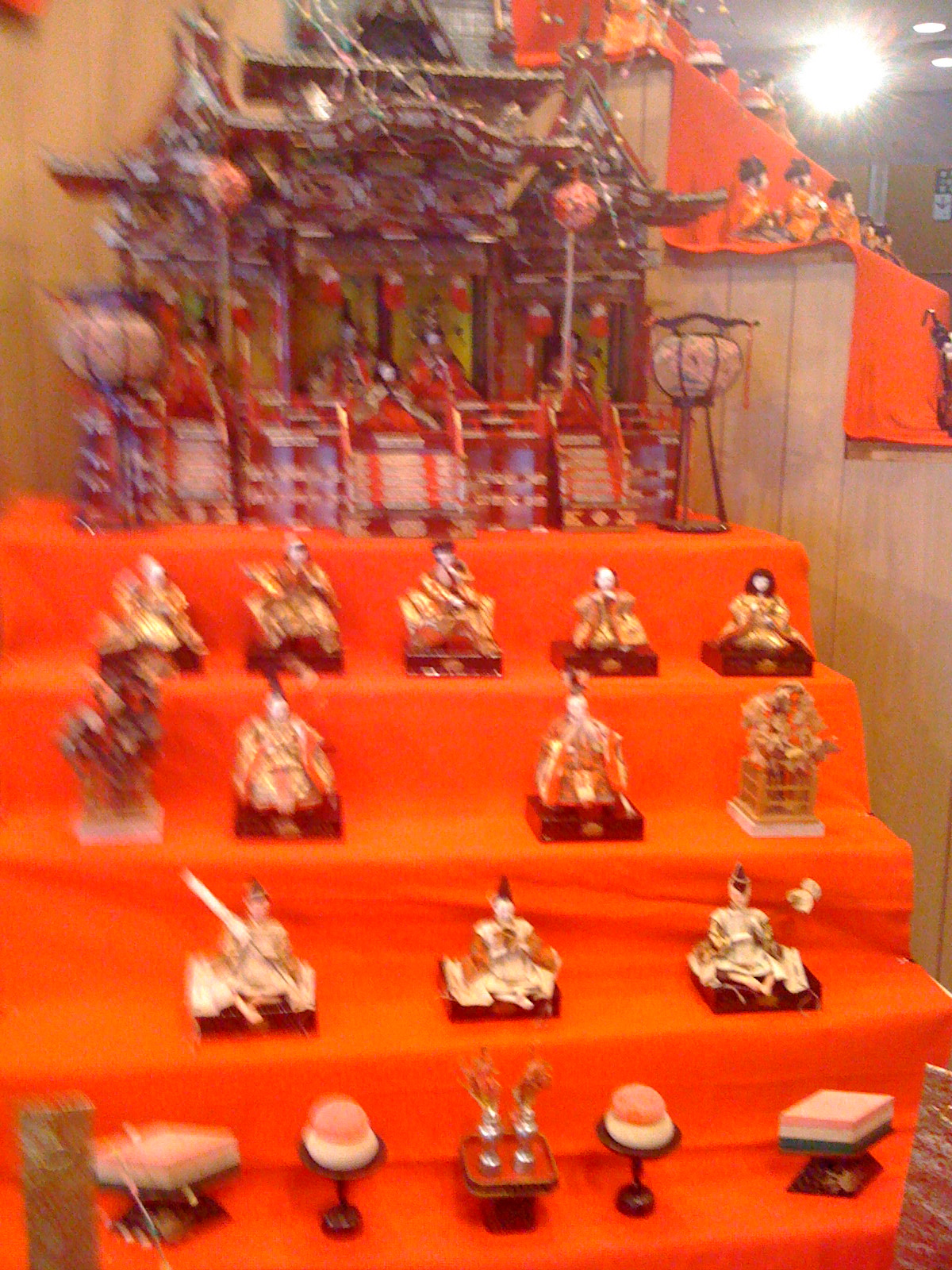 A well attended Hina Ningyo courtWe found our Emperor and Empress set and a couple pieces of lacquer furniture at a flea market. I was probably more entranced with the furniture than my young daughters. The drawers open and shut. The craftsmanship is remarkable. Our daughters love the dolls. Unfortunately we weren't farsighted enough to buy two sets, so a fight may ensue when the little chickies fly the nest and want to take the dolls with them.
  Cute Girls' Day treatsOn Hina Matsuri, girls are given special rice cracker treats (in pastel colors!) and families may eat chirashisushi, a vinegared-rice dish with sliced vegetables, omelette, and salmon on top. Last year, I went to a Japanese friend's home and we made California sushi rolls for our kids. You adapt. We still display our dolls through February (you have to take them down after Girl's Day or your daughter may not marry, so the saying goes).
Yesterday was Valentine's Day. In Japan the day is celebrated by women giving men dark chocolate. The men are supposed to return the favor with white chocolate a month later, March 14, on White Day.
Fun to see in Japan, but I'm not taking that one back with me! I'll keep my dark chocolate to myself.
What holidays from your host country do you still celebrate? How have you adapted them to your home country? What holidays do you miss?
February 7, 2012
Chicken & Rice: What Else Do You Need?
QUICK AND DIRTY WEDNESDAY
CHICKEN AND EGG ON RICE: OYAKODON

How many countries have a classic chicken and rice dish? I know one of my favorite meals at my friend's house is arroz con pollo, rice and chicken.
My taste buds melt at the thought of arroz con pollo...
As I write, my stomach is making a noise similar to a lawnmower hitting a chunk of wood. That's how good it is. And maybe she'll share the recipe (hint, hint) for the blog. But I've got another chicken and rice dish for you, another recipe I've brought home from Japan. This is my go-to meal and a family favorite. It's simple, fairly healthy, and very cheap to make.
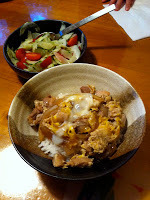 Oyakodon Oyakodon literally translates as parent and child (oyoko) rice bowl (don), but the basic translation is chicken and egg on rice. A very traditional meal that you can find in many restaurants and homes in Japan, this is another simple and delicious Japanese dish that doesn't involve raw fish.
One of these days maybe I'll slip raw fish into the mix, but I'd rather inspire you with these great comfort foods from Japan that are easy to make outside the country.
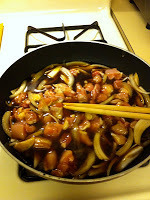 chicken & onion in sauce
OYAKODON, THE RECIPE:
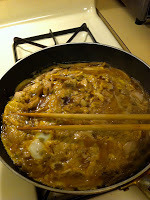 Letting eggs setNow it's your turn! Do you have a simple chicken and rice dish from your expat country or something similar? Let's swap recipes. Send it to me and I'll post it in a Quick and Dirty Wednesday.
CHICKEN AND EGG ON RICE: OYAKODON

How many countries have a classic chicken and rice dish? I know one of my favorite meals at my friend's house is arroz con pollo, rice and chicken.
My taste buds melt at the thought of arroz con pollo...
As I write, my stomach is making a noise similar to a lawnmower hitting a chunk of wood. That's how good it is. And maybe she'll share the recipe (hint, hint) for the blog. But I've got another chicken and rice dish for you, another recipe I've brought home from Japan. This is my go-to meal and a family favorite. It's simple, fairly healthy, and very cheap to make.
 Oyakodon Oyakodon literally translates as parent and child (oyoko) rice bowl (don), but the basic translation is chicken and egg on rice. A very traditional meal that you can find in many restaurants and homes in Japan, this is another simple and delicious Japanese dish that doesn't involve raw fish.
One of these days maybe I'll slip raw fish into the mix, but I'd rather inspire you with these great comfort foods from Japan that are easy to make outside the country.
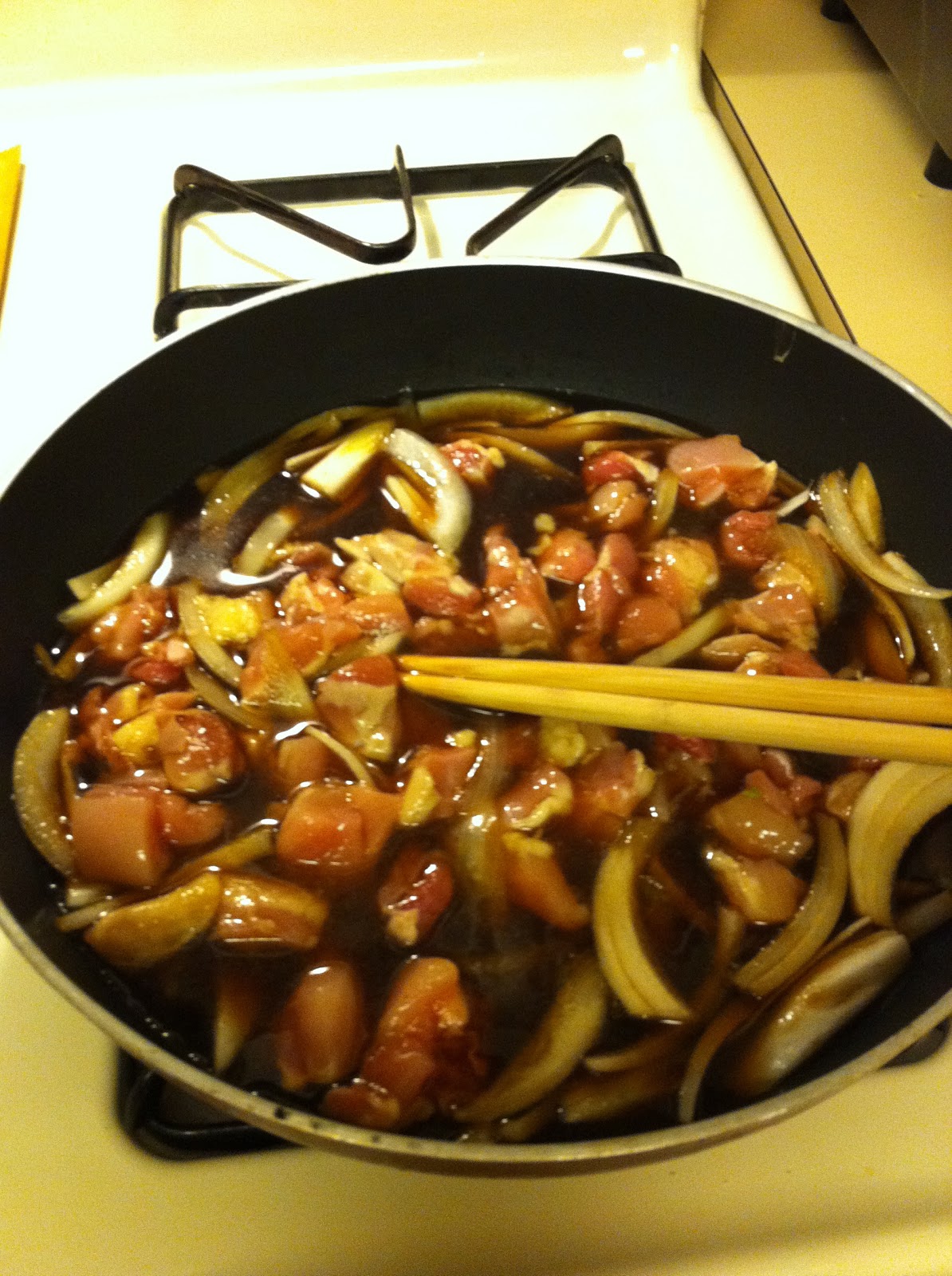 chicken & onion in sauce
OYAKODON, THE RECIPE:
It should serve 4 people, but the ratios are easy to double.
*3-4 chicken thighs: deboned, deskinned and cut into bite-size pieces
1 onion, sliced thin
4 TB soy sauce
4 TB mirin (Japanese sweet cooking wine, easy to find now in major supermarkets)
3 tsp sugar
1 c. water
3 beaten eggs
Hot cooked rice (3-4 cups). Japanese rice is short grain, stickier and less dry than long grain. But use what you've got. That's my motto.
Combine all ingredients in a skillet except the egg and rice. Boil for about 4 minutes (until chicken no longer looks pink). Add the beaten egg in a thin stream, turning the pan, so that it covers the cooked mixture. Continue to cook until eggs are almost firm. Scoop rice into individual bowls and ladle chicken and egg mixture on top of the rice.Adding beaten egg
You can't get much easier than that!
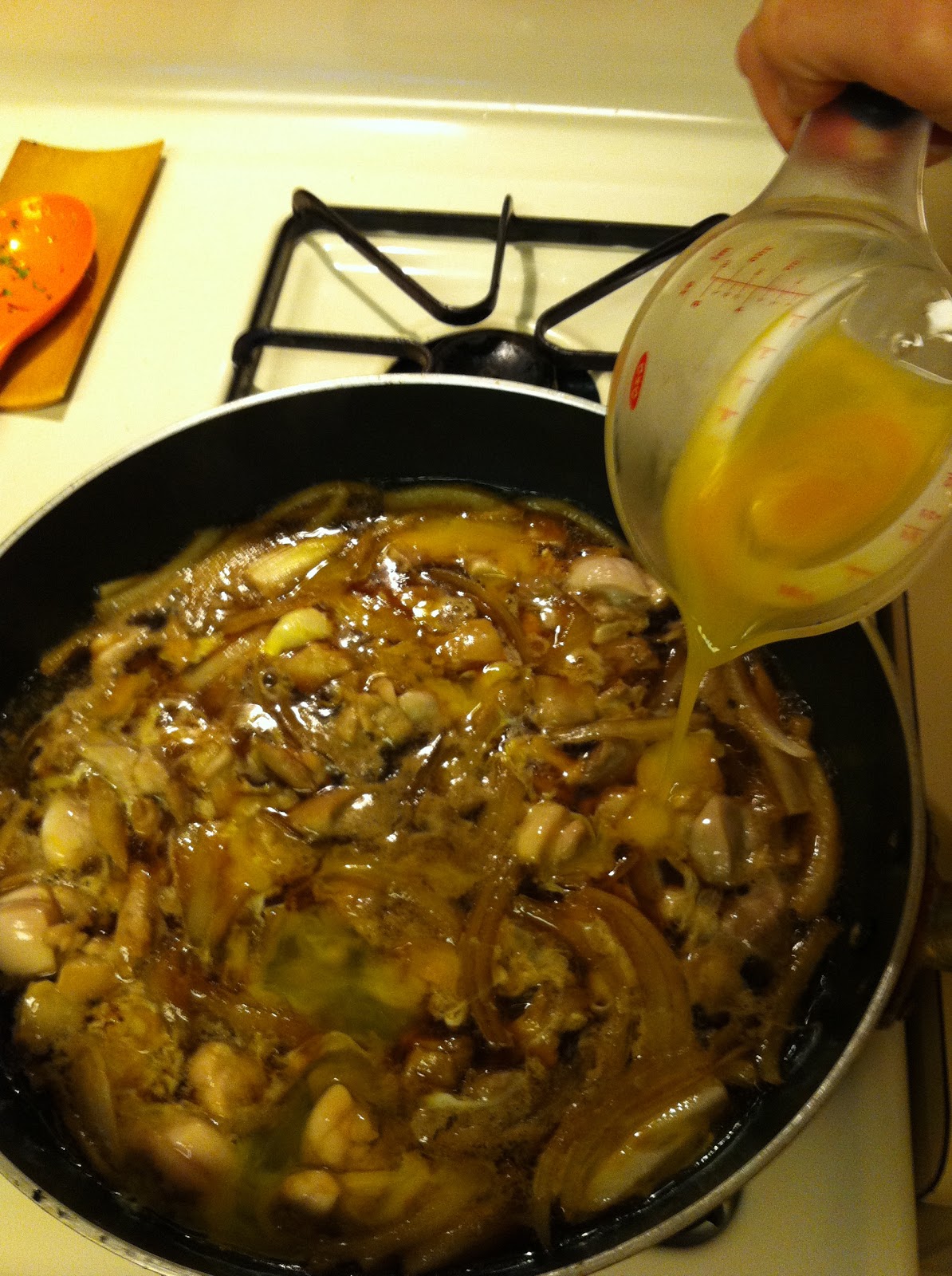
*To make it healthier, you could use chicken breast meat. Japanese people generally use thigh meat, but we've cooked with breast. Just be sure not to cook it too long.
 Letting eggs setNow it's your turn! Do you have a simple chicken and rice dish from your expat country or something similar? Let's swap recipes. Send it to me and I'll post it in a Quick and Dirty Wednesday.
January 31, 2012
New Year's Dumplings (Also Good for the Superbowl!)
 Today's "Quick and Dirty" recipe comes from my friend who hosted the Japanese New Year party I wrote about in the last blog entry. Her recipe is neither quick nor (in a Japanese kitchen) dirty, but so delicious I had to share. My friend warned me it took her an hour to make these by hand (and corrected my blog entry, she made 90!). For convenience sake, you can buy frozen gyoza in Asian food stores and other stores that carry Asian food, like Trader Joe's.
I'm also including my Quick and Dirty Gyoza recipe which begins with buying a bag of frozen, pre-made gyoza.
You are welcome.
Like many foods in Japan, gyoza was imported from China and modified for the Japanese palette. We call them potstickers in the U.S. Similar to a ravioli, they are thin dough stuffed with filling, usually pork and vegetables, pressed to close and cooked. Chinese pan-fried jiaozi (guotie) tend to have thicker skins than Japanese gyoza and the fillings are slightly different, particularly the use of garlic in Japan. This particular form of dumpling is panfried and then steamed to finish, hence the translated name potsticker.
In Japan, gyoza is a common bar food, ubiquitous appetizer, readily found in Chinese restaurants, and so popular certain restaurants are devoted to that one food. One of our favorite places to eat was called Gyoza No Osho, "Gyoza King", a kind of Chinese cuisine diner. We ate at another gyoza restaurant that featured about thirty different fillings including cheeseburger and pumpkin. It's difficult to find gyoza of this quality in the U.S., so we are forced to make it at home. Just Hungry also has a good gyoza recipe.
True Quick and Dirty Gyoza: Buy it frozen (directions are on the bag):
My husband likes to make it them a cast iron skillet for a crispier finish but any skillet will do. Heat skillet on a medium high to high flame with about 1 T of oil. Cook frozen gyoza until browned on the bottom. Add 2 TB of water, cover, and turn the flame down to low for about 7-8 minutes.
Eat immediately.
If dipping sauce is not included in the bag, mix 2 parts soy sauce to 1 part vinegar, add hot chili oil as you like.
Bam.
Not Quick but Truly Delicious And Worth the Trouble Homemade Gyoza:
Gyoza skins can be readily found in Asian grocery stores and large supermarkets. Caveat: wonton wrappers (often used for eggrolls and other kinds of dumplings) are thicker than gyoza skins. This recipe is for gyoza skins. The round packs come frozen or refrigerated. For 1 lb. of ground pork, you will probably need about 2 packs.
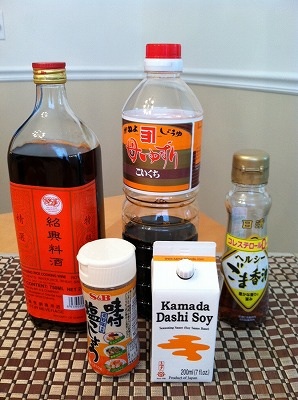
1 lb. ground pork
1/2 bunch of chinese chive or garlic chives (these chives have a distinctive garlic flavor rather than onion. If you can't find them, you can use green onion instead)
1 lb. white cabbage (napa cabbage)
2 TB soy sauce
2 TB Shioxing (or 1 TB of mirin and 1 TB of cooking sake)
2 TB shiro-dashi (prepared base stock)
2-3 cloves of garlic, pressed or ground
1 TB fresh ginger, ground
1/3 TB sugar
1 TB sesame oil
1.Mince the chives and cabbage. Sprinkle with salt, toss, and set aside.
(キャベツとニラをみじん切りにして塩をふって混ぜ、しばらくおく)
2. Using a large bowl, sprinkle salt and pepper on ground pork and mix well until sticky.
(豚ひき肉と塩コショウを加え、ねばり気が出るまでよく混ぜる)
3.Squeeze out the chive and cabbage mixture tightly to remove as much water as possible and add to the pork.
(1のキャベツとニラの水気をしっかりしぼって豚ひき肉のボウルに加える)
4. Add a few dashes of salt and pepper, soy sauce, Shaoxing (or sake and mirin mixture), garlic, ginger, sugar, and shiro-dashi. Mix well.
Finally, add the sesame oil and mix again.
(さらに塩コショウ、しょうゆ、紹興酒←かわりに酒&みりんでもOK、すりおろしにんにく、すりおろししょうがを少々、砂糖少々、白だし少々を加える)
5. Quoted from my friend's recipe,
***I recommend to eat it the next day! You should keep it in fridge for 1night.***
6. Wrap about a teaspoon of the filling in a gyoza skin, folding diagonally and sealing edges by crimping or wetting with a dab of water. Traditional gyoza are crescent shape, but like ravioli, you could experiment with the shape. The key is to make sure the skin is sealed.
7. Cook as you like. (See Quick and Dirty recipe above, but steaming will be much quicker, 5 minutes or less). You can pan fry or use in a soup.

January 24, 2012
Celebrating Lunar New Year with Osechi Ryori
 Our Chinese New Year tree:
a melting pot originalOur kids are adopted from China. We use their heritage to make our own melting pot, adjusting their culture to what personally fits in our family. Now they've lived in Japan. Sprinkle that into the pot. We stayed ten days in a rented house in Loire, France (shouldn't really count, but WTH, it's France, after all). My kids now eat crepes almost every weekend. Toss that experience in. We're also Catholic, so we add in all the fun feast days.
By our rights we get noodles on Chinese New Year, King Cake on Fat Tuesday, Chirashizushi on Japanese Girls' Day, and wine and cheese whenever we feel like it.
 Our beautiful hostess in
her "working" kimono.
Thank you, Char!We will celebrate anybody's feast days, particularly if it involves food. The kiddos have yet to meet a country's cuisine that they haven't found edible.
Last weekend we went to a belated New Year's party given by a Japanese host. Japan celebrates the New Year on January 1. It felt somewhat ironic to celebrate it just days before Chinese New Year. However, a party is a party. And a Japanese New Year Party at Chinese New Year makes it even more fun.
For all the years we lived in Japan, we never tried Osechi Ryori, traditional Japanese New Year food. These are dishes families only eat at the New Year, kind of like Thanksgiving for Americans. They are prepared days ahead because it's considered bad luck to cook on New Year's Day. (I love traditions that allow people to relax on the holiday). Norecipes.com has some beautiful pictures and explanations of different Osechi Ryori fare. JustHungry also has a more personal explanation of New Year's food.
 Osechi RyoriI was a little hesitant to try. In my experience, the more brown and plain the meal, the better it tastes. The more beautiful... Well, my eyes aren't eating, my mouth is. But I'm a culinary philistine. Osechi Ryori is pretty, colorful, and surprisingly delicious. Of course, all the dishes have symbolic meaning for good health, fortune, etc. in the New Year. None of the Japanese families gathered could remember which one meant what. And anyway, we all just wanted to eat and drink.
On the menu (center in the picture): Kuromame, black beans simmered in soy sauce and sugar. Our hostess added gold flakes which drew my kids to the beans like magpies. Datemaki, are the yellow, ridged foods tucked in among the bowls. They taste like egg sushi, sweet and savory, and ours had shrimp in them. Really yummy. One bowl held sugared beans (sweet and dry at the same time). One bowl holds tiny roasted fish. Another holds a shredded daikon and carrot vinegar salad. The bowl with the dark brown food is a simmered salmon dish.
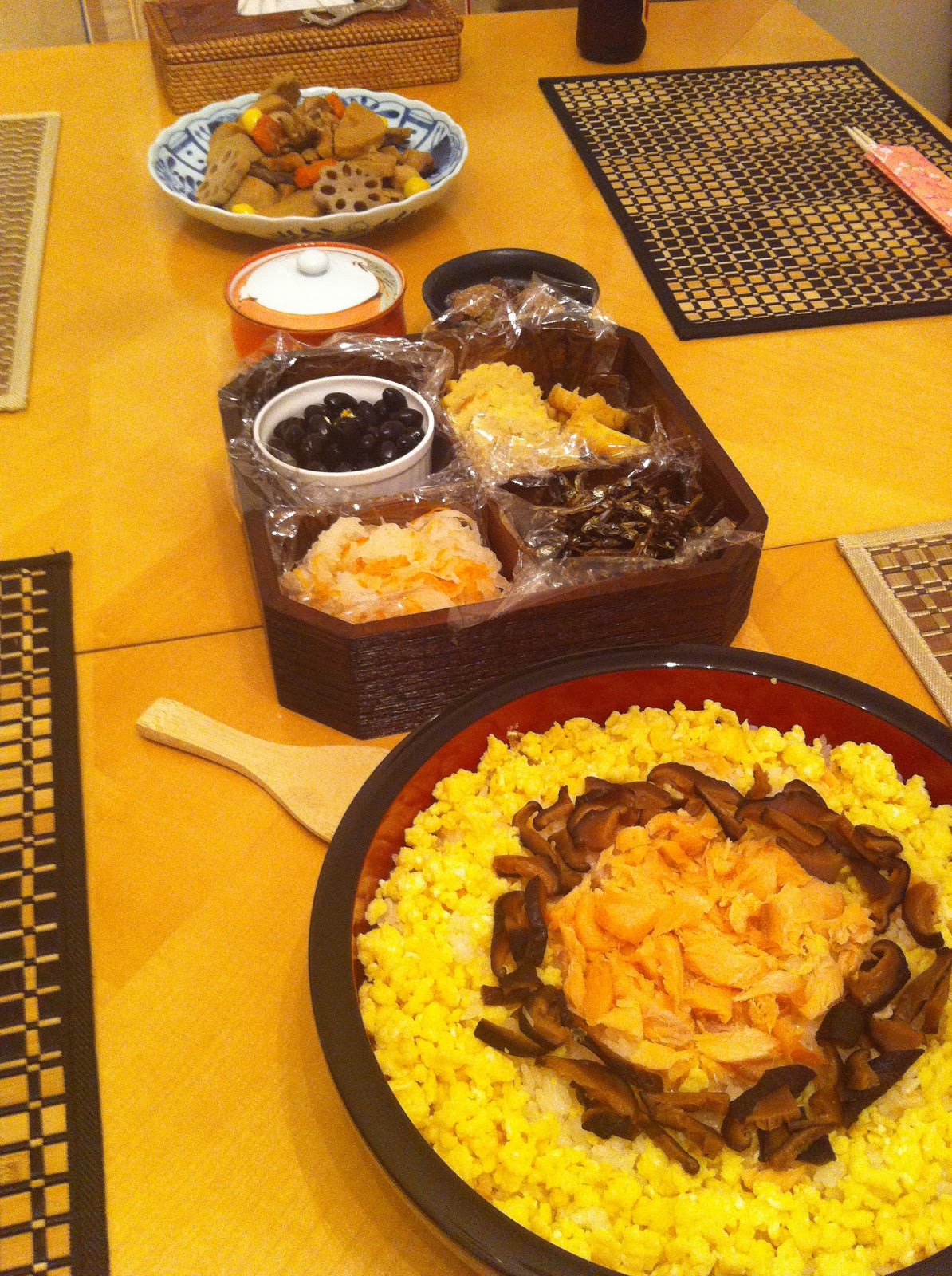 Sushi dishMoving down the table we also had simmered winter vegetables and a sushi (vinegared rice) dish topped with egg, hand smoked salmon, and simmered soy mushrooms. These were the first courses. We drank beer and ate and talked while our lovely hostess prepared the next course.
I secretly unbuttoned my pants and accepted the first round of cold sake.
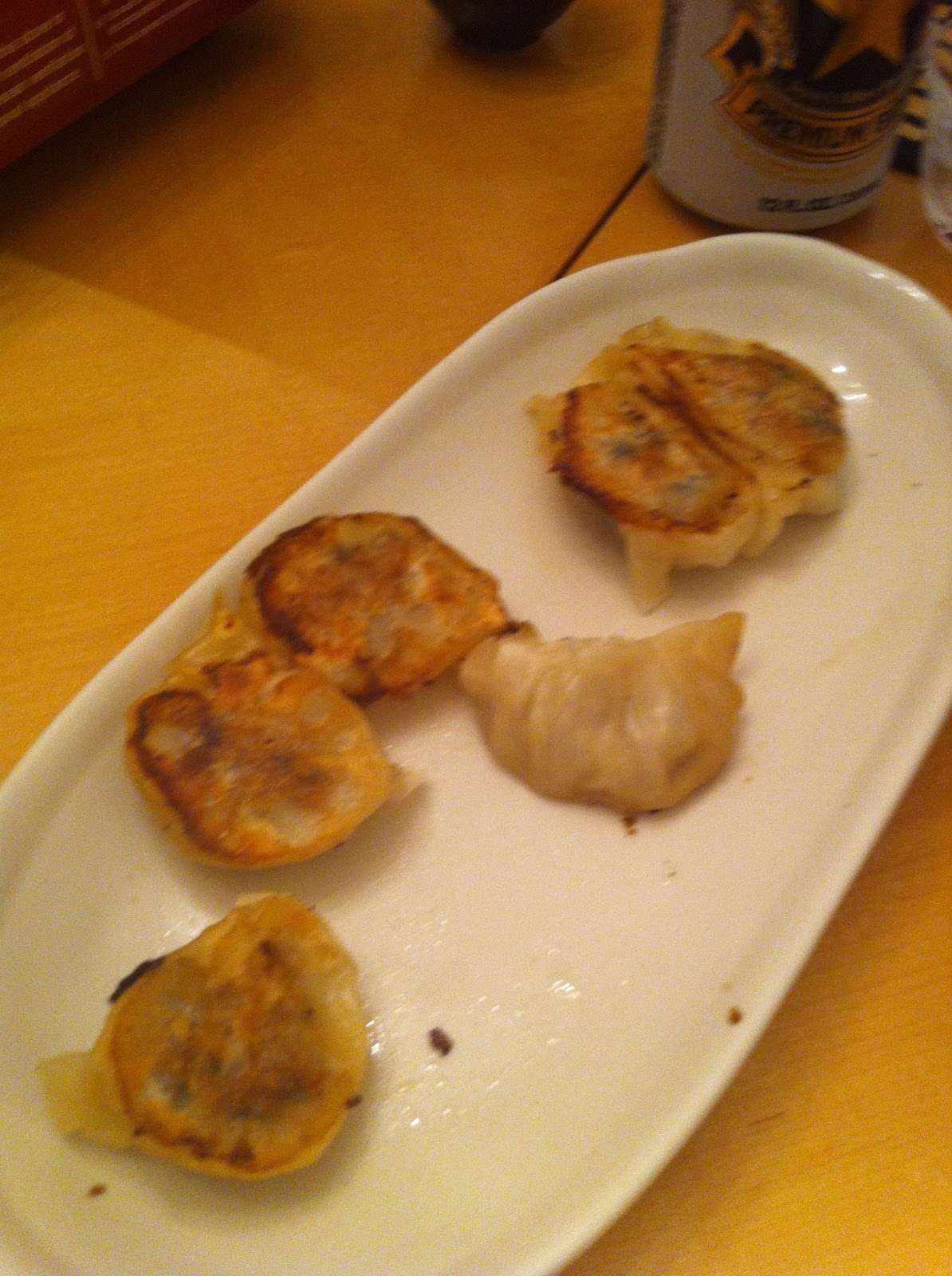 Gyoza, gone before I
could take a pictureNext up, homemade gyoza. These are dumplings (potstickers) and one of our family's all-time favorite foods. These are a Japanese dish taken from Chinese cuisine. In Japan they are typically cooked in a hot pan until crispy, then steamed until fully cooked. My six year old ate nine. Our hostess made about 60. No leftovers.
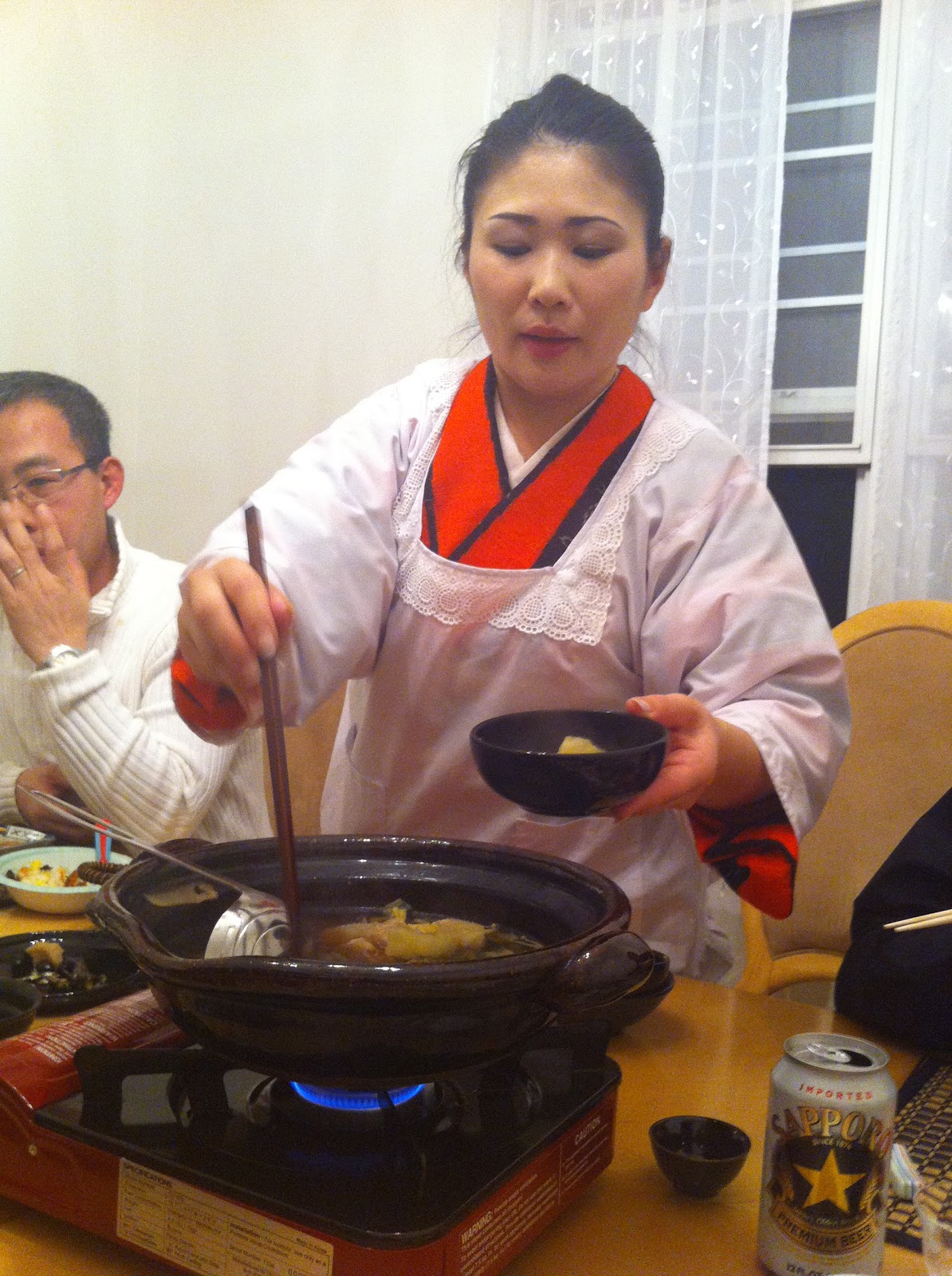 Cooking nabe tablesideI leaned back in my chair and accepted sparkling plum wine while everyone else moved on to hot sake. Our hostess brought a portable stove to the table and zipped back to the kitchen. The crowd sucked in their breath. She reappeared with a nabe pot, a clay tureen used for cooking soups and stews. Everyone clapped.
 At that point, I gave in to the discomfort of the over-sated. And tried the hot sake.
Nabe is a broth-based "hot pot." Generally you find cabbage, green onion, tofu, pork, and mushrooms in it, but you can also make it with beef (sukiyaki style), chicken, and other vegetables. Our nabe was made with a soy, mirin, and dashi (fish) broth with cabbage, green onion, giant slices of pork, and enoki mushrooms. Very healthy, very filling.
But we weren't done.
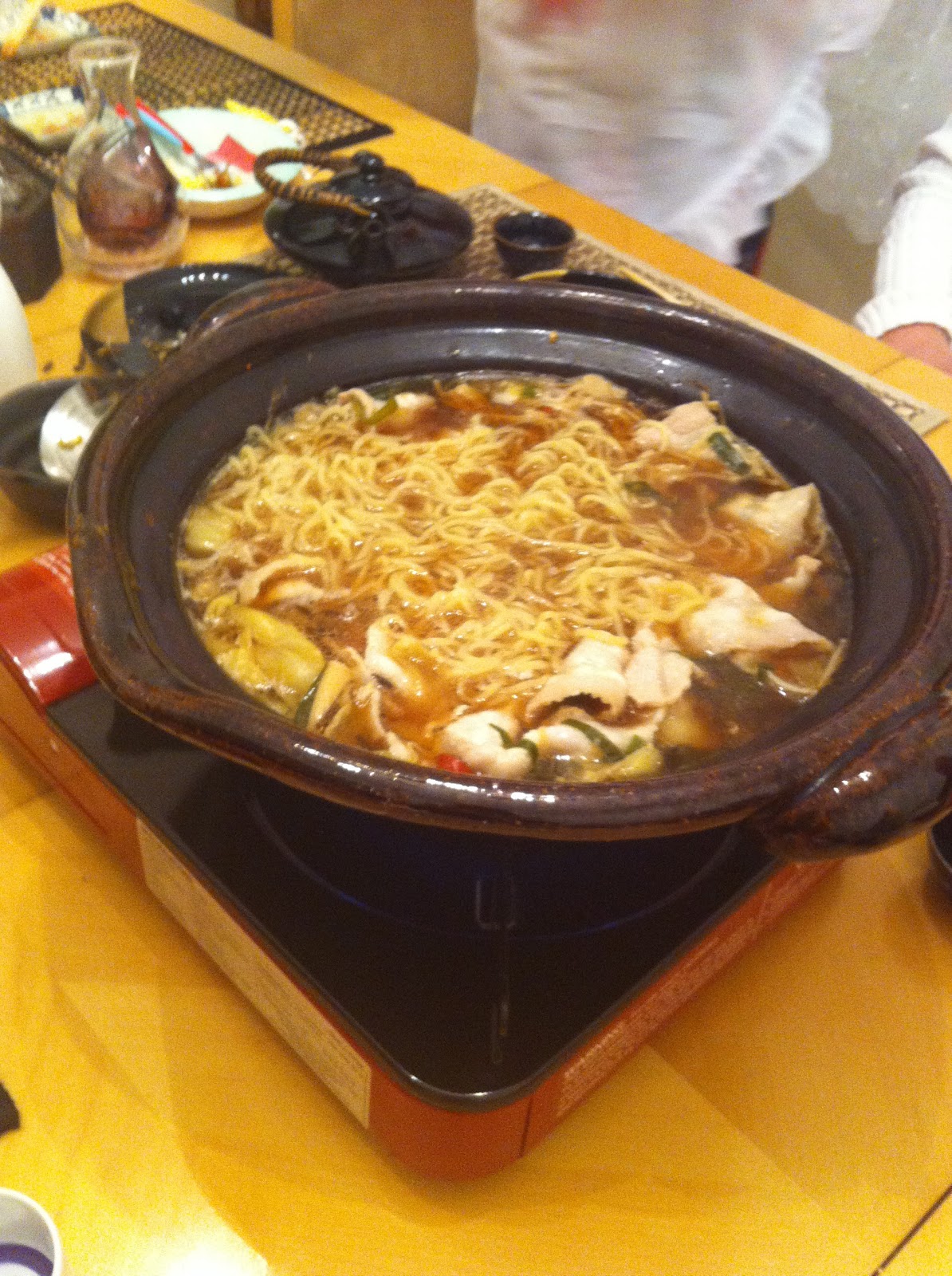 Ramen noodles added
to the nabe--this is not
Cup O'Noodle people!After the pork and vegetables were gone, ramen noodles were added to the pot (our six year old left an engrossing movie to run to the table and steal my noodle bowl). By that time, high grade tequila and whiskey had arrived at the table. Hot sake still flowed. Bottles of water appeared. Ramen disappeared like magic.
Finally the table was cleared except for final snacks: individual packages of flavored peanuts, dried squid and senbe rice crackers. The kids devoured candy and gummies. Insatiable, they attacked the dried snacks.
We had eaten for four hours without stopping. Oh my goodness, it was incredible.
No recipe today. I'm too exhausted from eating.
Bring on your feast days!

January 21, 2012
I Ain't Got No Home: The Returnee's Lament
 Clarence "Frogman" Henrysaid it best. As a returning expat from Japan, I have moved on to other digs,back to the U.S., but still a strange land. What am I to do with all theexperiences, wonderful and frustrating, that I had for 5 years of observationand assimilation into another culture? Do I forget them? No one here cares tolisten to my stories. Do I scrapbook them? Seems impersonal and simplistic. DoI relive them? Can't do that here, Japanese restaurants are few and far between.No, it's time to re-assimilate into a whole other culture, make new friends,and start over.
Moving to Charleston, SC seemed like agood idea at the time. After all, I grew up in the southeast, Atlanta to beprecise, and now live within driving distance of my family. So why do I feellike I don't belong here?
But I want to, I need to, I HAVE TO.
My indescribable time in Japan has taught me that there's something tobe said about finding your "niche", a place where you feel at home, wrapped ina blanket of belonging, a place where you can relax and breathe life in deeply.Who would guess that place would be in a foreign land, a topsy turvy world, aplace where everything is opposite from what I have learned to be "normal." Butindeed it was "home." I can't explain how a southern girl, turned west coastSeattle-ite, can find peace and acceptance in a place so alien. But I did, andfrankly, I miss it like hell.
So now I am plagued with questions like how to transition from a placewhere everyone knows your name and is always glad you came to…a place wherealthough you share the same values, appearance, interests as those all aroundyou, they don't take notice of you or care to get to know you? How do I makefriends?
So what have I done toconnect and find friends in this new place? Well I know that to find a friend,the first step is to BE a friend. I go to church. I join bible studies. Ipray a lot. I found a newcomers group and participate in their activities. ButI still find that there are no connections with 350 members. I don't know why. Maybethose who have not experienced the challenges and excitement of expat life, arenot as "hungry" to develop real relationships.
 The Crowder family in JapanExpats know that "time" isa very limited thing. We know that our "time" will soon be over. I wish thateveryone would live their daily life knowing that their "time" in this place islimited and will soon be over and to therefore take every chance to formlasting friendships with those people whom God puts in their lives. The model Imanwas once asked what the secret of her beauty and fashion was, she said, "I wakeup and live every day as if it is my last".
Expats know how to live their livesthis way. I am blessed because of my experience. Whereas I used to say "home iswhere I hang my hat", now I know that "home is where I open my heart".
Cheryl Crowder has just returned to the U.S. from Nagoya, Japan, where her husband was on assignment for the past 5 years with Boeing. Originally from Atlanta, GA, she moved to Seattle in 1981 to begin a new life out west. She has had several careers that took her from city life to farm life and considers herself adaptable to any living situation. She and her husband of 28 years are now beginning a new journey in Charleston, SC with their teenage daughter, dog, and 2 cats.

January 17, 2012
"Quick & Dirty" Nikujaga: Japanese Meat and Potatoes
 Last night's Nikujaga.
 My potatoes should be soy sauce colored.
I failed but it still tasted good.Who doesn't love a savory dish of simmered meat and potatoes when the weather gets cold and blustery? (Aside for vegetarians, vegans and the anti-potato folk). This is another family standard that makes everyone happy and reminds us of Japan. Folks that aren't familiar with Japanese home cooking may be surprised by this dish. Any "meat and potatoes" person can eat eat this meal without fear of funkiness you may think is typical of Japanese cooking.
No raw fish. No seaweed. No squid guts.
Just potatoes, meat, and onion in a savory broth served with rice. Carrots, green beans, peas or other vegetables can be added. I use carrots and green beans because that's what the Hoffman kids prefer.
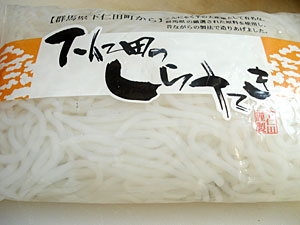 If you want something a little funkier, you can add shirataki noodles (also called konnyaku, made from the devil's tongue plant) to this dish. JustHungry.com has a great post on these "miracle" noodles that are zero-calorie and a filling additive to a lot of Japanese dishes. Shirataki may not appeal to less adventurous eaters because of their wobbly consistency and their strong smell before cooking (you have to parboil them before adding to a dish. Add at same time as the potatoes). My kids like them, but they like noodles in any form.
(Seriously, the smell out of the bag will put you off. Hold your breath and parboil those suckers! Yes they're a health nut's superfood, but incredibly stinky before boiling.)
NikuJaga
This dish can be made from thinly sliced pork or beef. Pork is more popular in Eastern Japan and beef in the west. To make with beef: substitute beef for pork, chop carrots into .25" chunks, reduce sugar to 3 Tb, mirin to 1/3 c., and 1/3 c. light soy sauce instead of regular. I add the carrots at the same time as the onions.
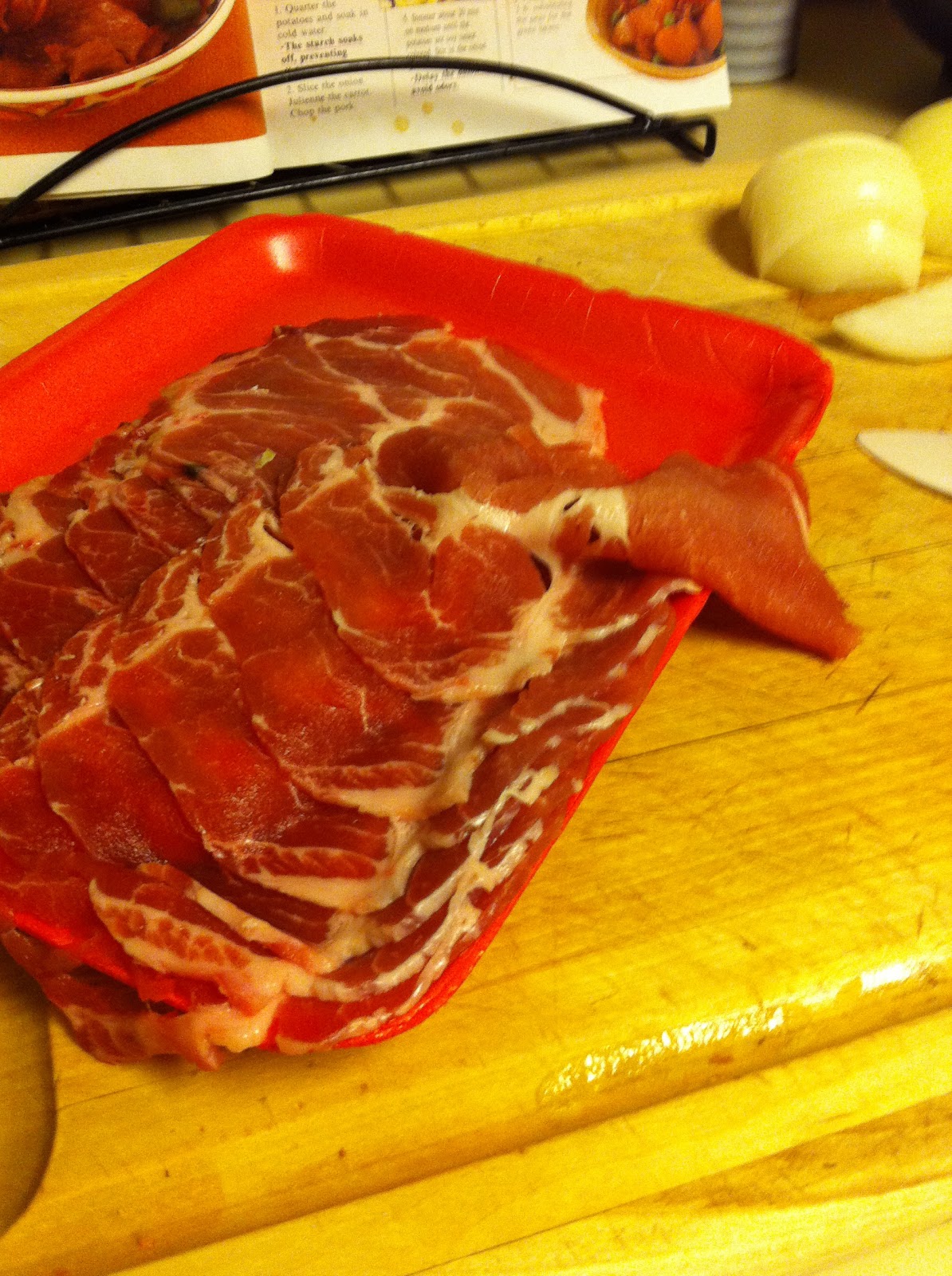 Thin sliced beef
 Potatoes in soy mixture4 potatoes, quartered
1 onion, sliced
1 small carrot, julienned
1/2 lb. (8 oz.) thinly sliced pork (you can find this in Asian stores or ask a butcher to slice some loin 1/16")
3 c. water
5 Tb. sugar
1/2 c. mirin
1/2 c. soy sauce
handful of 1" cut green beans (you can also use peas or snow peas)
1. Soak the potatoes in cold water and chop the sliced pork into bite-sized pieces.
2. Bring the potatoes, water, sugar, mirin and soy sauce to a boil. Blanche the green vegetable at the same time, then set aside.
 Adding meat and onions.3. When the potatoes boil, bring them to a simmer. Add the meat and onions and simmer for about 20 minutes until the potatoes are soft and soy-sauce colored.
4. Add the carrots. Cook 2-3 minutes longer if you like the carrots soft or take off the heat and sit in the liquid a few minutes if you like them al dente.
5. There will be a lot of liquid. Serve the pork-potato mixture in the broth, but it's not soup, so use your own discretion on how much broth you want. Ladle into a bowl and scatter with the green beans.
Our family likes Nikujaga on top of rice (which is more like another meat dish), but that's not traditional.
6. Rice on the side. But whatever. It's your house.


