
Luisa Weiss's Blog, page 10
June 22, 2015
Rice and Peas and Broth and Cheese
I've just returned from a week in Sicily, where Rachel and I taught our food writing workshop at the splendidly picturesque Anna Tasca Lanza Cooking School. I have so much to tell you, but the words and impressions and images are still swirling around in my head and haven't had a chance to settle yet. While I was away, Hugo and Max went to visit Max's grandparents in deepest Bavaria. They communed with sheep, cows and chickens, wore rain boots all week, and generally had the best vacation a little boy could hope for.
We all got home this past weekend, to an empty fridge and an uninspiring larder. Even the bread box was bare. And since stores in Germany are closed on Sundays, shopping was out. Mercifully, my mother had us over for lunch on Sunday. There were oven-baked polpette encrusted with breadcrumbs, roast potatoes, salad, and gratineed eggplant. After a week of being cooked for at breakfast, lunch and dinner, I thought I might feel like cooking again once I got home. But no, actually, being fed by someone else still felt pretty good.
At dinnertime, though, we were on our own. I picked up and considered a can of baked beans, a jar of millet, some carrots asleep in the fridge. I thought about doing a bit of tinkering. Roasting nuts, cooking lentils, trying to make something fresh out of the drabness staring back at me from the pantry. But after all that Sicilian home cooking - the expertly balanced menus, richly flavorful sauces, the vegetables that tasted so deeply of themselves and the earth, and crisp fritti - culinary experimentation felt a little sacrilegious. And after a week of not seeing my loves, the last thing I felt like doing was sequestering myself in the kitchen for an hour.
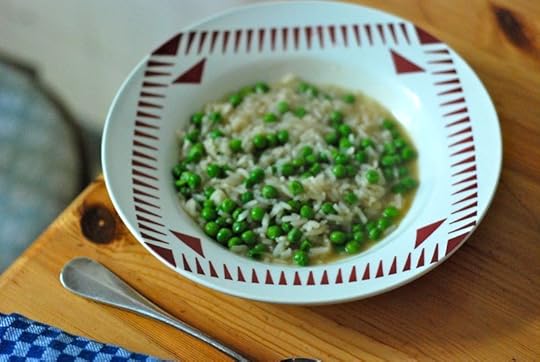
Instead, I went all the way back to the most basic of basics with the things I always always always have around: rice and peas and a little bit of broth; an abbreviated, simplifed risi e bisi. You could go elsewhere for more complicated versions of that classic Italian dish (David Tanis' with pancetta and pea shoots and lemon zest, oh my, or Rachel's via Marcella Hazan, with homemade stock, fresh peas and Italian rice). But in a pinch, it's good to know that cutting corners works just fine too. This is how I cook when I don't want to cook.
I heated olive oil in a pan, then cooked the rice (regular long-grain, nothing fancy) in the oil until it was toasty and fragrant. In went a lot of water, enough to cook the rice and still have a bit pooling in each plate after serving. The water sizzled as it hit the hot pan. Then a few spoonfuls of Better than Bouillon's vegetable base were stirred in. (You could also use a bouillon cube. I often do.) When the rice was halfway cooked, tiny droplets of oil pooling at the surface of the water, I added twice as many frozen peas, then let the whole mixture cook together until the rice was finished.
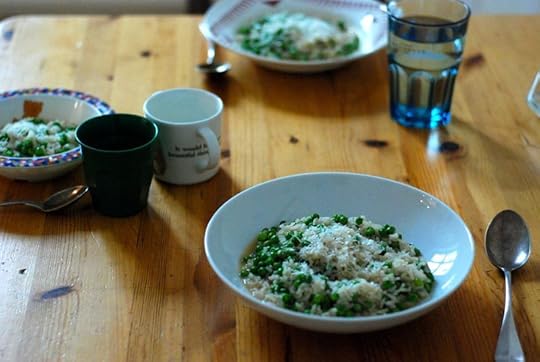
I spooned the rice and peas into our bowls, the broth pooling just slightly at the edges, put grated Parmesan on top to shrivel in the heat and melt. It felt like the truest nursery food, calming and nourishing, piping hot and agreeably savory.
You don't actually need a recipe for this, I think. But sometimes it's nice to know about the simplest, silliest meals, how we feed ourselves when we must make do. Knowing how to make a little thing that will fill you up and taste like home is just as important as knowing how to make a feast. These are the dishes that end up making up the fabric of flavors of your life.
Rice and Peas and Broth and Cheese
Serves 2 adults and one toddler
2 tablespoons olive oil
1 cup long-grain rice
2-3 teaspoons Better Than Bouillon vegetable base (or a bouillon cube)
2 cups frozen peas
Grated Parmesan, for serving
1. Heat the olive oil in a medium sauce pan, then add the rice and cook, stirring, until the rice is fragrant and slightly toasted. Pour in 3 cups of cold water and add the bouillon base. Bring to a boil, then reduce to the heat to a simmer, with the lid on and slightly askew.
2. After about 7 minutes, add the frozen peas and stir well. Raise the heat to bring the water back to a boil, then reduce to a simmer again and finish cooking, with the lid on and slightly askew, another 7-10 minutes. The rice should be soft but not mushy. There should still be some liquid in the pan.
3. Ladle the mixture into bowls and top with freshly grated Parmesan. Serve immediately.


June 8, 2015
The Art of the Picnic
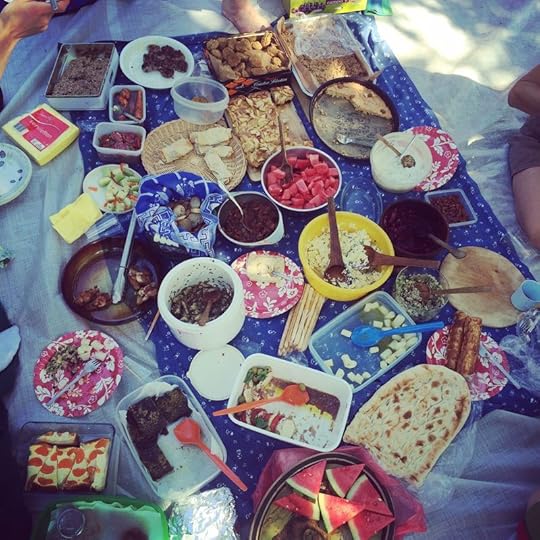
Yesterday was Joanie's annual birthday picnic yesterday, which I look forward to like nothing else. Rain or shine, the picnic happens every single year. Everyone is encouraged to bring something to eat if they want to, but Joanie spends a few days preparing a bunch of her favorite things too - the result is a huge, diverse spread of absolutely delicious picnic food. Some things, like the brownies, potato salad and spinach-feta turnovers, are all-stars that make an appearance every year. But the rest changes with each passing year and with the guests who come. I love seeing the new things that appear and always wonder about the things that don't make it a second year. It's such a wonderful reflection of how the food culture is constantly changing and evolving.
In no particular order, here's what served at the picnic yesterday (with the exception of the Turkish pide bread, the bread sticks, and - uh - the fruit, everything was homemade):
Seeded crackers
Meatballs
Carrots in dill vinaigrette
Spinach-and-feta turnovers
Jam bars
Almond cake
Fresh watermelon and cherries
Potato salad with yogurt or Quark (I think? It's the best creamy potato salad I've ever had.)
Pickled white asparagus
Quinoa salad with herbs and peas
Caprese salad
Hummus
Hamantaschen filled with Quark and guava paste (!)
Lentil and parsnip salad
Stewed eggplant and tomato salad
Baked chicken wings
Stuffed celery
Grape leaves filled with yogurt, herbs and pine nuts (I think it's this recipe.)
Marinated tomatoes
Cheesecake with mandarin oranges
Brownies
Breton far with prunes
Beet salad with endives (or fennel?)
Spiced roasted almonds
Hungry yet? :)
Besides the food, Joanie always brings a couple of huge plastic tarps to spread out and then tablecloths to put on the tarps (the food goes on the tablecloth, the people sit on the tarps). There are coolers of iced tea and homemade fruit punch, bottles of wine and water. There are plastic cups (the same ones she's been toting there for the past 40 years and counting) and metal flatware and wooden spoons for serving. The only things that are disposable are the napkins and plates.
At the end of the day, our bellies full, the leftovers are divvied up and wrapped, the tarps and cloths are folded, the trash is collected and tied into bags. Those of us still remaining make our way down from the hill, the long grass tickling our legs, little gnats suspended in air and silhouetted in the setting sun. Some of my earliest, happiest memories are from Joanie's picnic. It fills my soul all the way up to think that now Hugo gets to have the same ones.
June 7, 2015
Writing. Something. Anything.
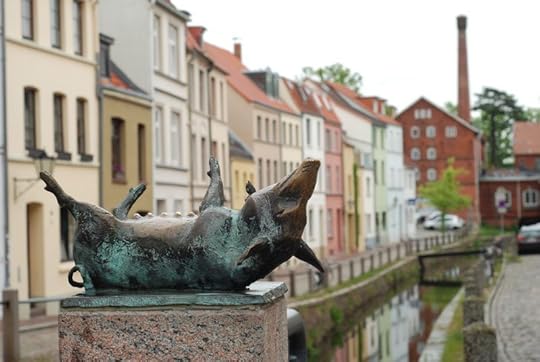
Dear readers, much like this little bronze pig on a bridge in Wismar, I have fallen and I can't get up. Though something tells me this pig would characterize his prone position as something far more pleasurable and intentioned than I am able to. In fact, the more I think about it, I'm in more of a Samsa-ian cockroach phase than an indolent pig phase. But you get the picture. Metaphorically speaking, I seem to be somewhat...blocked.
I've decided that instead of belly-aching about it, I'm going to just make pretend that no one is reading and get back to writing. Something. Anything. Because if I keep letting my endless to-do list rear its head while the annoying little voice in my head that tells me I have nothing to say, the days will keep clicking by and I will become so paralyzed that I might never write again.
(I have a penchant for the dramatic, DONTCHA KNOW.)
So. Here is a list of stuff from my brain.
1. I went to London last weekend to see my best friend (we stayed here, it was perfect) and while there, we had a glorious dinner at Barshu, the Sichuanese restaurant in Soho for which Fuchsia Dunlop consults. We had pickled vegetables and bang-bang chicken and fish-fragrant eggplant and ma po tofu and it was so good that we ate until it hurt (literally), and then some. I didn't sleep much that night - do you ever sleep well after gorging yourself? - but it was worth it.
2. Did you know that I am a serial cuticle biter? I have been since I was 13 years old. It drives everyone who knows me absolutely bonkers. Keeping my nails short and manicured helps keep this filthy habit somewhat in check, but it's a little weird to spend so much time in the kitchen with fire engine red (or Yves Klein blue!) nails. I recently discovered Deborah Lippman's Naked, though, and it's the best nude nail color ever for an olive-skinned neurotic home cook like myself. It has a sort-of monochrome, sort-of sixties thing going on with my skin and makes my nails seem really elegant and cared-for, when nothing could be further from the truth. (I like to alternate weeks of keeping my nails neat and tidy and then having them fall apart completely in an anxiety-riddled gnash-fest.)
3. After falling hard for Kate Atkinson's Life After Life last year and then actually screaming out loud (seriously) when I read the news that she was writing a sequel of sorts to it, I got my grubby little hands (see previous point - am currently in the second phase mentioned) on A God in Ruins last weekend. I'm forcing myself to read it in small doses because...wait...I don't actually know why. It's quieter than Life After Life, if you know what I mean, less of a compulsive page-turner, and more of a meditation on life and its compromises. But I've had all sorts of epiphanies while reading it and I'm only a third of the way in, so I guess what I'm trying to say is that I like it, a lot.
4. Joanie's annual birthday picnic is in an hour. I'm bringing wedges of nicely sour German cheesecake with mandarin oranges and squares of really simple apple cake made with a super-thin yeasted dough, both of which are from our most recent round of recipe testing for the book. (For more on the progress of the book, check out my Instagram profile.) I'll report back in case any of you are also total picnicophiles and need some inspiration.
And with that, I leave you. For now. Thanks. xo
May 5, 2015
Our New Kitchen
Hellooo! Let's talk about renovating kitchens today, shall we? I love reading these kinds of makeover posts elsewhere, so here's hoping this interests you. (Just so you're warned: this is going to be a looong, picture-heavy post.) As you know, Max and I bought an apartment in December. It's in a turn-of-the-century building in Berlin, just a few streets away from where I grew up. When we bought the apartment, this is what the kitchen - tucked away in the back of the apartment - looked like:
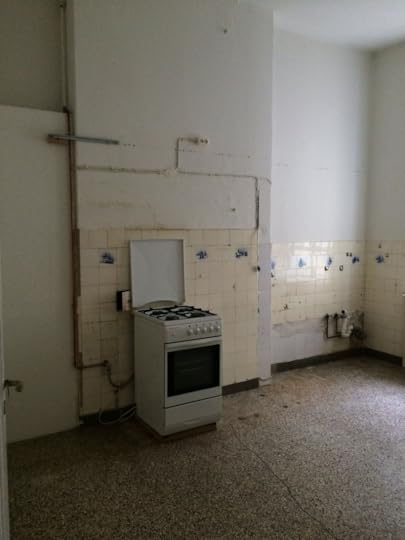
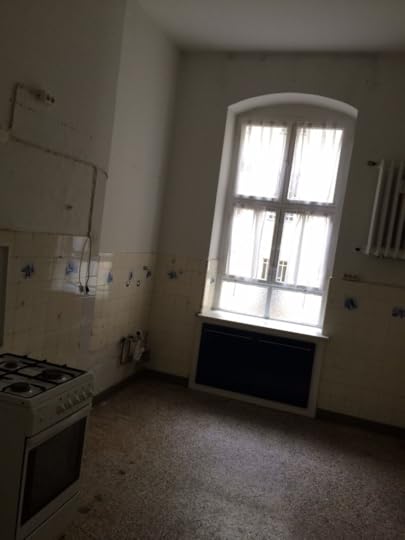
The room is a rectangle with tiles on all four walls, one window looking onto the courtyard, a windowed pantry (I know!), and a door to the back staircase hidden behind that shoddy-looking wall to the left of the stove. Those are the original tiles from 1910, as well as the original terrazzo floors. It's sort of hard to see just how stained the floor is, but it's pretty bad. You can see one huge crack in the floor in the photo above, and there was a second one, too, running perpendicularly. The tiles were in varying states - on the other side of the kitchen, where we assume there was never any counter-top, the tiles look great. On this side, they are pretty banged up - edges frayed, holes everywhere.
Early on in the process, we decided to hire an architect/contractor to help us with the renovations, especially for the kitchen. Over the course of a few meetings, we sat down and hashed out what we wanted to do with the kitchen, what kinds of counter tops, cabinets and layout we wanted, where we could put outlets without further damaging the tiles and how to maximize counter space.
(A quick aside: if money had been no matter, we would have seriously considered moving the kitchen out of the back of the apartment and putting it in one of the front rooms facing the street, creating a sort of living-dining space and turning the back room into Hugo's bedroom. But the costs were prohibitive and so we stuck with the existing kitchen.)
A close-up of the tiles on the less-damaged side of the kitchen:

Since we thought the tiles were pretty, and our architect/contractor was vehemently opposed to messing with historical elements and it was most definitely out of our budget to have the kitchen re-tiled, we decided to keep the tiles. They set the tone for what the rest of the kitchen would look like - creamy-white cabinets, wood work surfaces, old-fashioned knobs and handles.
We thought we'd keep the floor too, but when we found out that to have it stripped and resealed (to clean it and fill the cracks) would cost almost €2,000, it was an easy decision: We decided to lay Nordic wood planks (second choice planks, with bigger knots and uneven lengths, to keep costs down) on top of the terrazzo. This way, if one day someone else should live here and desperately want the original floors, they can just take off the wood. In the meantime, we would have a much lighter, brighter, warmer kitchen and it'd be easier on my back too. Plus, most importantly, it was much cheaper.
To maximize counter space, we decided to close up the door to the back staircase, which was used 100 years ago by the family's maid or cook, but had outlived its purpose. Here is a picture of the demolition of the flimsy existing wall (the previous tenants had walled it up) and the kitchen before the entire apartment was rewired:
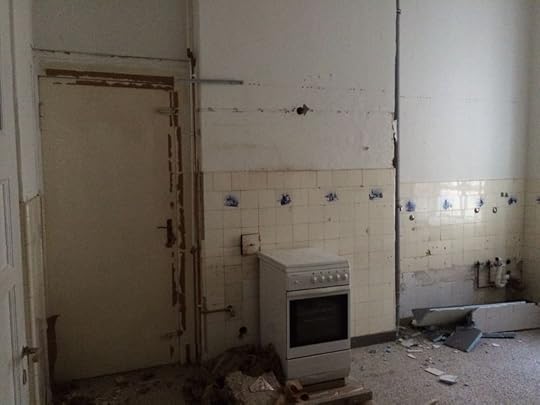
Gnarly, huh?
Once the electrical work was done (new outlets everywhere!), the walls were skimmed and painted. The rest of the apartment was painted with a dupe for Farrow & Ball's Strong White, but the kitchen was painted with a plain white (in German painter parlance, "Küchenweiß"). When all of that was done, we had the wood floors put in the kitchen. The change was instantaneous:
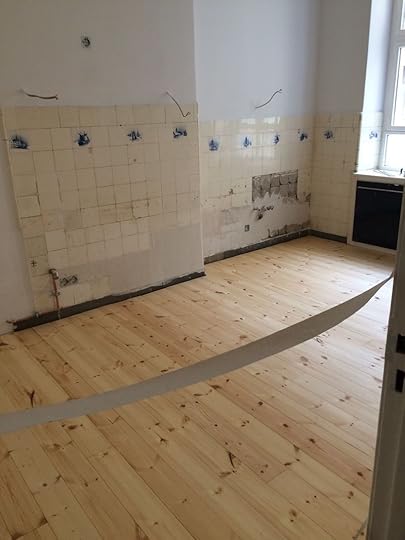
So much brighter, right? Our contractors have assured us that the floors will age relatively quickly, which I'm looking forward to. I like a little patina in my wood!
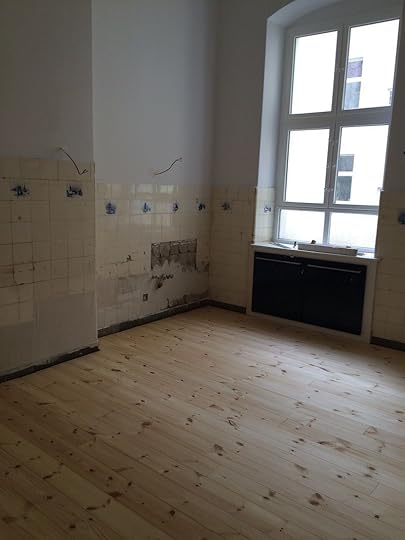
Over there, under the window, is a little cabinet with a vent to the outside. It's called a "Berlin refrigerator" and used to be used for food storage. Sometime in the 1980's, I assume, the previous tenants had dark blue doors installed with metal rods. The original doors would have been wood (painted white or left natural) and much prettier, but they are nowhere to be found. Our contractors wanted to have a carpenter recreate the doors (with pretty little porcelain knobs), but on one of our cost-cutting pow-wows, we decided to deal with this another time. And I kind of regret it - we should have just had it done right away. It's a small detail, but those darn blue doors and those metal rods bum me out all the time.
Another unsexy detail: we kept the existing window, but had a carpenter redo the entire wood frame, which was very, very old and rotting, and therefore no longer properly insulated.
A week before we moved in, IKEA delivered our new kitchen: cabinets (Bodbyn fronts in ivory), fridge, stove, the works. Here is everything, all 900 kilos of it, waiting patiently in our dining room to be installed: 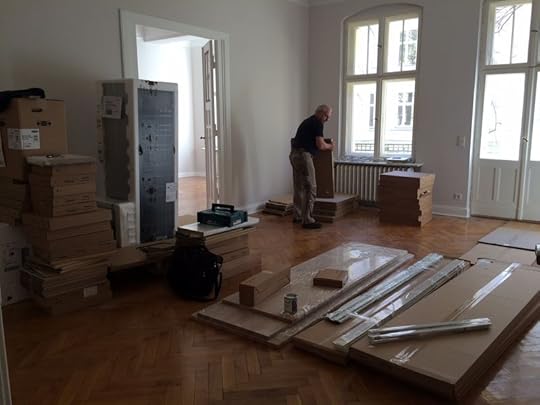
Installing the cabinets:
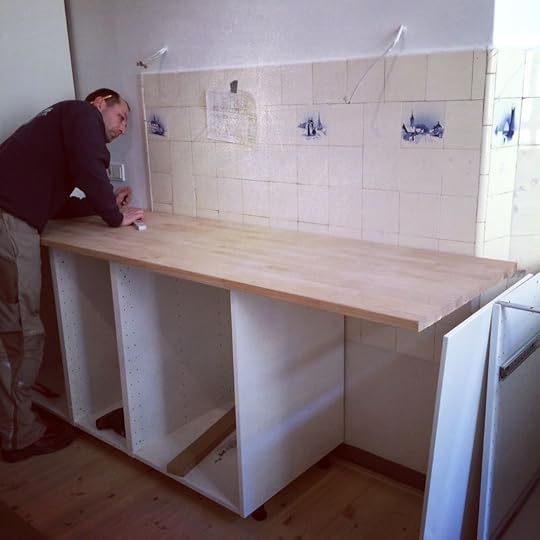
And this is where things got a little hairy. (Of course!)
The morning of the kitchen installation (6 days before our moving date), the contractors called me in a fit: They had mistakenly measured the kitchen 30 centimeters too large - in both directions. On one side of the kitchen, it wasn't a big deal - IKEA has shallower drawers that actually fit the space available perfectly. On the other side of the kitchen, however, where we had planned for cabinets and hanging cabinets to be centered in an archway, there was no way they were going to fit anymore, not as long as we wanted the fridge (in the picture below, on the right) to open. I was summoned to the apartment immediately.
When I got there, none of the cabinets had been installed yet, but they had been assembled. For a while, we stood around in the kitchen, holding the cabinets up here and there and trying to figure out a solution. With everything else already done (the plastered-up wall, the electrical wiring), we really didn't have much wiggle room to change things around. Plus, did I mention we were moving less than a week later?
The most obvious solution, which was to simply push the cabinets all the way over in the left curve of the archway, was the one we went with. And I'll be honest: I was really miserable about it for a few days. It felt ugly and weird and so not what I wanted. For a few more days, I seriously contemplated simply getting rid of all the cabinets and just putting in a few open shelves in the archway.
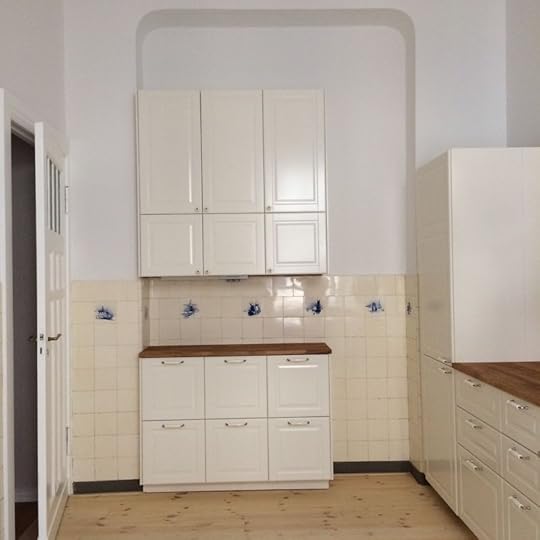
Here Max and Hugo are inspecting the rest of the kitchen, while I skulk around the archway and chew my cuticles:
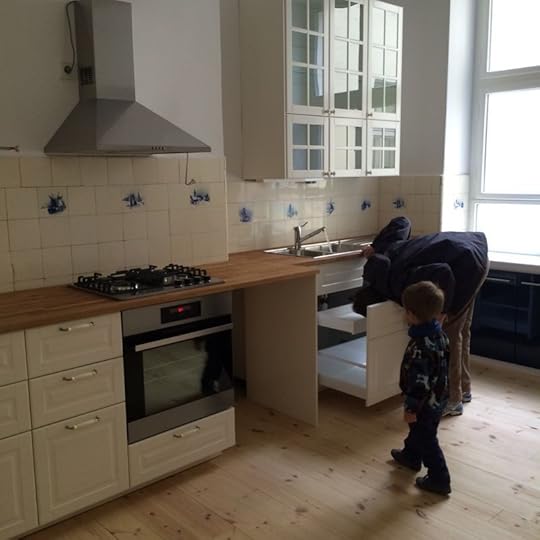
And then I got a grip.
With the door open, you barely even notice the un-centered cabinets. As we were promised by everyone around us, we've already gotten used to the way it looks. Now a little trash can fits perfectly in the nook between the cabinets and the wall. And the truth is, I kind of like imperfect things. It was time to move on. And move in!
Today, a month after moving in, this is what our kitchen looks like:
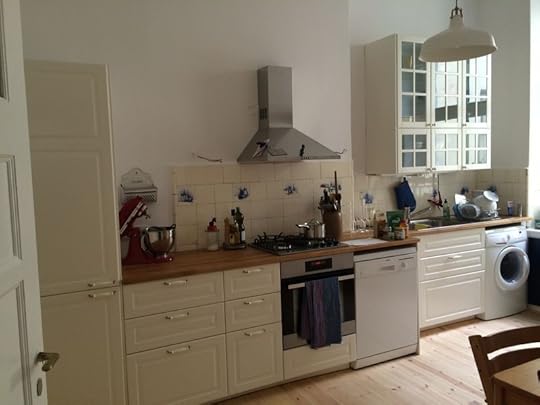
We are still figuring out what kind of lamps to put on either side of the range hood. For under-cabinet lighting, we used the UTRUSTA line, which included outlets and hooks.
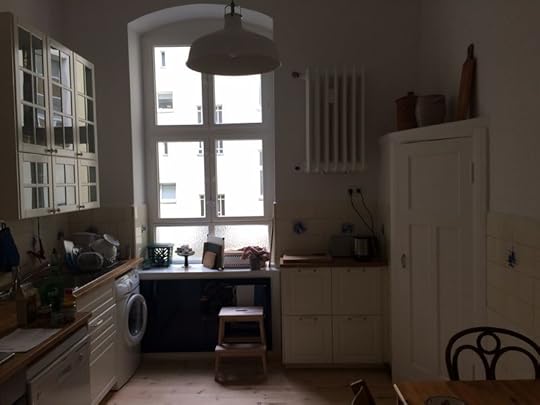
That is an RANARP hanging lamp and I love it.
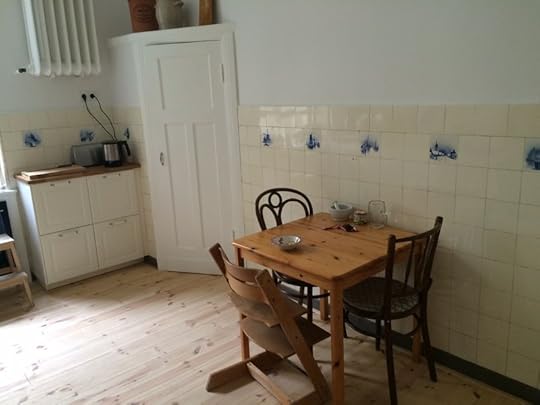
The pantry! My beloved! When you open the door, a little latch on the door frame turns the light on in the pantry and when you close the door, the light turns off. Be still my beating heart.
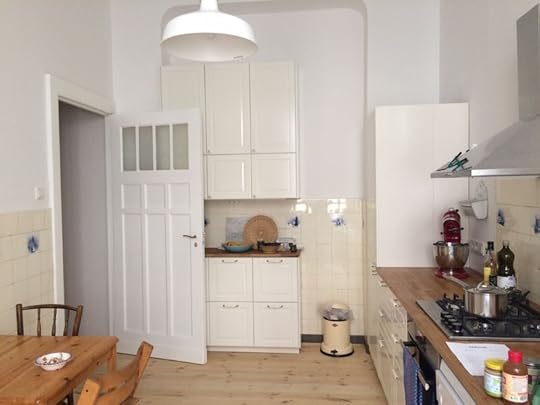
The offending off-centered cabinets, no longer really offending anyone. (I hope?)
I'm still adjusting to the new place - I keep reaching for things in the places they would have been in the old apartment - but I love how much storage space we have (some of those cabinets are empty!), the pantry thrills me each time I open it, and the kitchen feels warm and homey, which is the most important thing.
And when I think about it, there's very little I would change. Though, yes, I should have listened to my father and not put wood counters around the sink area. (And I can't wait to replace those dark blue doors under the window.) You live, you learn!
Thanks for reading my little renovation diary. If you have any questions about anything, leave them in the comments below and I'll try to answer them. Part of me hopes to never renovate another kitchen again, while another part of me feels like we're just getting started. :)
May 3, 2015
June in Sicily
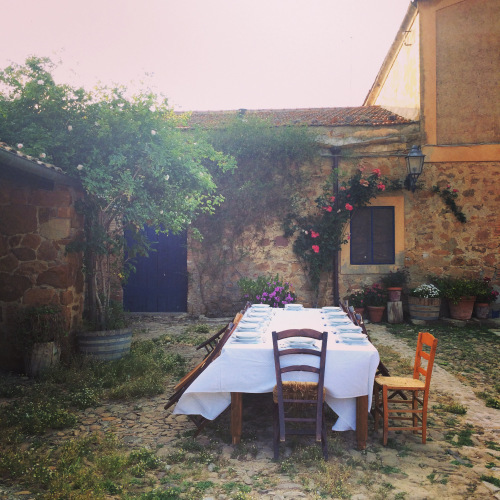
Next month, Rachel and I will be teaching a week-long food writing class at a little piece of paradise on earth, the Anna Tasca Lanza cooking school in Sicily. It's the first time the school has held a food writing class and to say that we are honored and excited to be hosting it is the understatement of the century.
For a week, we will be using the grounds of the school, Case Vecchie, as the gathering point for the class. We'll read and write and workshop together. We'll make little trips to a local cheesemaker, to Agrigento and Polizzi Generosa, and to the estate's vineyard. We'll cook together, learning from the school's owner Fabrizia Lanza, the daughter of Anna Tasca Lanza. And we'll use all these little excursions and experiences as inspiration for writing assignments.
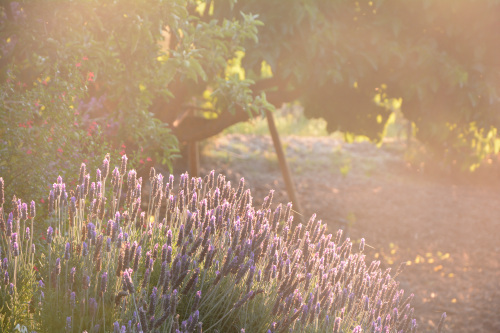
To read more about Case Vecchie and its magical pull, please read Rachel's posts here and here (and here is David's). She was there last summer for the school's 25th anniversary celebration - which I was forced to miss because Hugo got sick - and soaked it all up so beautifully. The more I read about it, the more I have come to believe that Case Vecchie is one of the world's special places. You may visit only once, but it moves and even changes you in such a way that you spend the rest of your life remembering the smell and feel of it, the way the light falls at dusk, the sounds of the birds and the wind.
The fee for the class is €2,500 per person, which we know feels steep, but it includes full room and board for the week as well as all the excursions, plus an intimate learning experience from Rachel and me. And, if you fly into Palermo (as I will be), you can tack a day or two on in that splendid city and eat gelato-stuffed brioche for breakfast (#yolo!).
The itinerary is as follows:
Day 1: Monday, June 15
Arrive in late afternoon or early evening, for a welcome dinner and introductory discussion over Sicilian aperitifs at Case Vecchie.
Day 2: Tuesday, June 16
Morning writing lesson followed by lunch at Case Vecchie
In the afternoon we will visit local shepherd and cheesemaker Filippo Privitera, where we will watch traditional ricotta production and sample both freshly produced cheeses and the family’s aged cheeses.
Cook together for dinner at Case Vecchie. Post-dinner gathering and reading.
Day 3: Wednesday, June 17
A morning trip to Agrigento’s ancient “Valley of the Temples” where we will write and picnic under the blossoming citrus groves.
Afternoon writing lesson and free time for writing, resting, or exploring around Case Vecchie, followed by cooking lesson and dinner.
Day 4: Thursday, June 18
Morning writing lesson and communal lunch at Case Vecchie.
Afternoon free time for resting, writing, and exploring the vineyards.
Evening visit to the Case Grandi winery for a tasting workshop, where we will sample a variety of Tasca d’Almerita wines and learn a little about the language of wine. Dinner at Case Grandi.
Day 5: Friday, June 19
Morning writing lesson and communal lunch at Case Vecchie.
That afternoon, we’ll drive to the beautiful hillside village of Polizzi Generosa, with a chance to write in the scenic piazza, sample the local specialties, and visit one of the most ancient pottery producers in the area, before returning through the twilight hills for a farewell dinner at Case Vecchie, followed by a chance to share our work and reflect on the week.
Day 6: Saturday, June 20
Departure after breakfast.
There are still a few spots left, so please contact the school (itinerary and class information here, contact info here) if you are interested in attending. And if you have any questions about the class, feel free to contact me or Rachel.
We are counting the days!
Photos from rachel eats
April 19, 2015
Sara Jenkins' Prosciutto di Parma
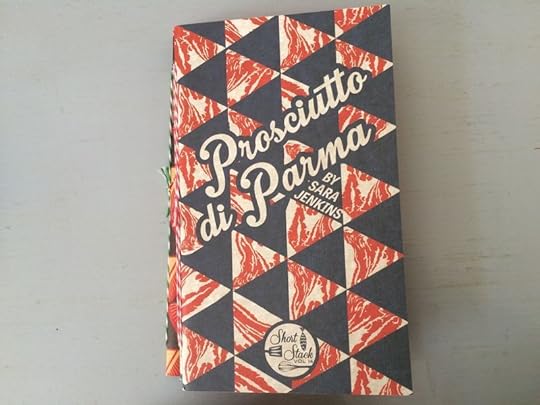
Do you know about Short Stack Editions? It's a small publishing venture dedicated to publishing single subject cookbooks authored by food authorities like Susan Spungen (strawberries) and Ian Knauer (eggs), Alison Roman (lemons) and Virginia Willis (grits). The editions are hand-sewn, illustrated with sweetly simple drawings, and bound in gorgeous paper (the aesthetic is sort of psychedelically Mast-Brothers'-ish). You won't want to have just one.
The booklets, or pamphlets, I should say, feel both super-modern and old-fashioned, sort of like something you'd expect to find in your grandmother's stash of old books and neatly displayed in a cutting edge magazine store in Antwerp or Berlin (cough). But beyond their covers is some really good food. Furthermore, the recipes are tightly edited - each edition only has 20, which feels refreshing in this era of information overload.
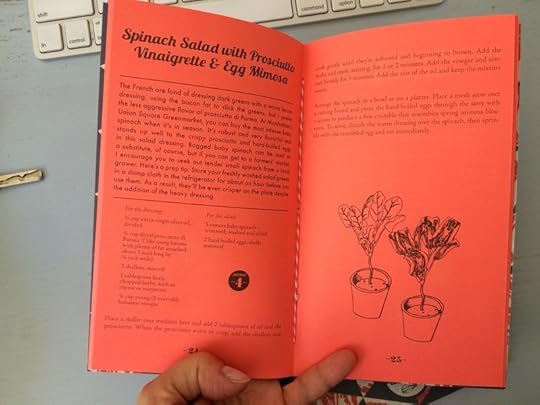
The latest edition, on prosciutto di Parma, is written by Sara Jenkins, owner of Porsena and Porchetta in New York City. Jenkins grew up partially in Italy and has amassed a neat little collection of recipes showcasing prosciutto. Some skew a little fancy (think cold cantaloupe soup topped with prosciutto crostini, which actually requires no cooking, just a bit of puréeing, chilling and toasting) and others will make you do a double-take - in a good way, like the olive oil-fried slices of persimmon wrapped in prosciutto or roasted corn and crispy prosciutto tucked into warm corn tortillas and topped with lime, pepper and cilantro! Yet more will have you marching straight to your closest deli for a couple ounces of ham - in my case, the potted and deviled prosciutto with mustard seeds, harissa and parsley, and the stir-fried rice, in which Italy meets China, producing my favorite kind of food.
Short Stack was generous enough to send me a copy of Prosciutto di Parma for a giveaway, so please leave a comment below to be entered and I'll pick a winner on Tuesday morning! You can find the other Short Stack Editions online or at a selection of bricks-and-mortar stores.
P.S. Even Nigella's a fan...
April 1, 2015
Moving House
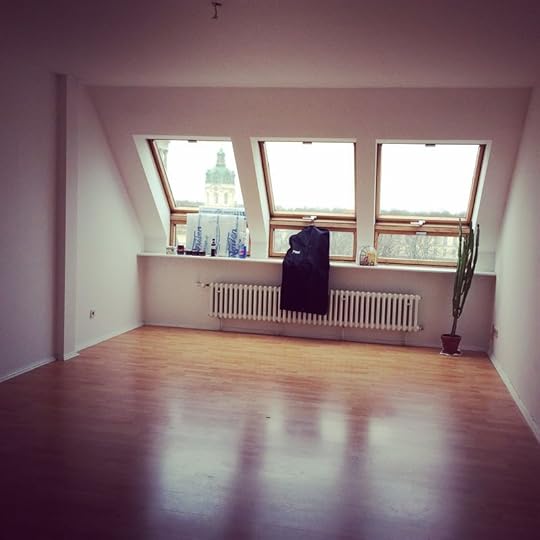
Dear friends and readers! We moved apartments last Friday, leaving our sweet tree-house apartment with the incredible view almost five years to the day after we moved in. I still distinctly remember how much I disliked the apartment when we first moved in. Isn't that nuts? I missed Max's old place where we'd been camping out after I moved to Berlin from New York, and I was convinced I'd never feel at home in the new place. Now, of course, it feels like it was the truest, most perfect home I ever had the privilege of living in and it's the new place that feels weird and foreign and not quite right. (Even though it is right, I know it is - just in my brain, not my belly yet.)
I do this to myself every time I move and yet I'm never prepared for the force of melancholia associated with moving house, changing perspective, seeing your whole life packed up in anonymous brown boxes and schlepped around by a bunch of guys with big forearms and blue overalls. I never quite know how to deal with it.
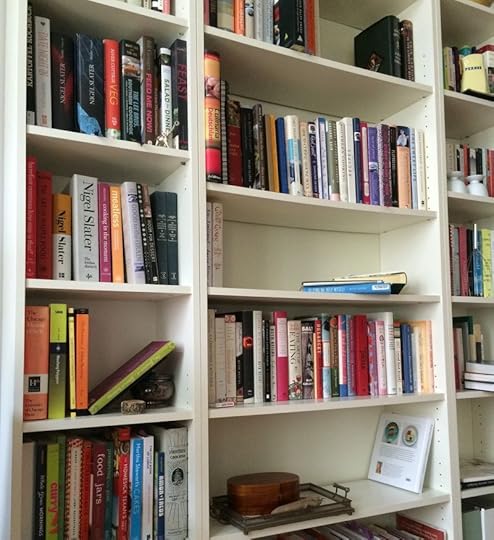
We've been in the new place for five days now and it is beautiful and we have made great progress unpacking things and moving furniture into its rightful place and putting my beloved books where they belong and yet I'm still a little shaky on the inside. When I dropped off Hugo at Kita this morning (taking the car back to our old neighborhood instead of running down the sidewalk with him) and realized I couldn't just walk back home the way I have the past few years, my heart sank just a little.
Silly, I know.
I'll soon get used to the new place, will stop tripping over the bathroom door step, will learn which floorboards creak particularly loudly, will know precisely which corner of the place is the best one for me to curl up in when I need a quiet moment. One day, I tell myself, I will feel the same way about the new place as I do about the last. It will be ours and it will be home and it will mean something really deep to all of us. Until then, patience.
As for the little guy, we took Hugo to the apartment many times while it was being renovated to show him "his room" and get him acquainted with the place. He always seemed cheerful enough. But when we started packing things up in boxes last week, he got really upset. "Dis my home!" he said indignantly when we explained why we were packing. We gave him to my in-laws for two days while we did the move itself and unpacked the bulk of the boxes. On Saturday night, he came back to us and slept in the new place, falling asleep just fine as he always does The first morning, Sunday, though, he woke up cranky and sad, whiny and angry. It took him all morning to work it out, so we talked about how strange it is to move and that it's okay to miss the old place and be sad and mad, but that this new place would feel like home one day too. By the afternoon, he was back to his sweet old self again. On Monday, I took him to the old apartment to say goodbye, but I realized as we were doing it that he'd already moved on. So I nipped it in the bud and that was that. Bye bye, apawt-men.
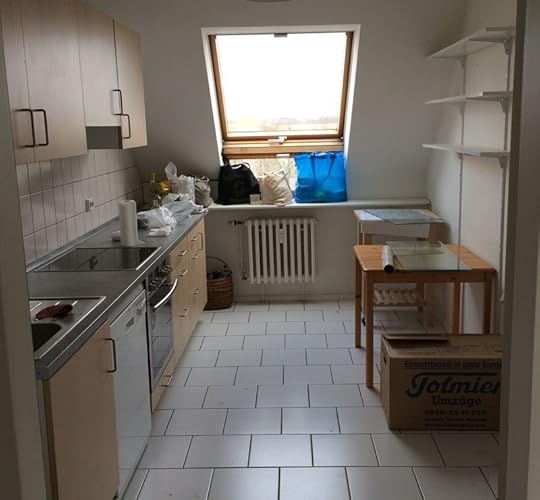
On Monday morning, the gas stove got switched on, but it took me a couple days to work up the courage to use it. (I also couldn't bring myself to drink out of any of our glasses, drank out of the Oxo plastic measuring cup instead. I have no explanation for that one either.) We went to my mother's house for lunch and dinner instead, since she's just a short walk away now, and it felt good to have her feed us. Maybe that's it.
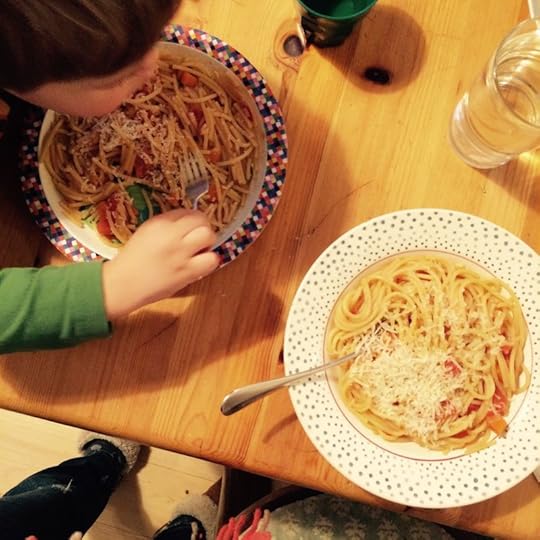
Last night, I finally made dinner - my dad's tomato sauce with onions and carrots*, and spaghetti, because I always have to make that the first time I cook somewhere new, to feel like I'm home - and Hugo slurped up two portions and we talked about how my papa used to cook for me every night when I was little and how my papa is his Grandpa (Hugo saying "grempa", with a big old German "rrr") and even though the counter tops felt too tall and the sink was too far away and I kept reaching in vain for the dishtowel that doesn't hang in the new place where it hung in the old, it all felt really good. Hopefully I'll do it again tonight and tomorrow and soon enough, I'll know my way around again and it will start to feel like home.
I'll be back with stories and pictures of the new kitchen and its, uh, transformation soon. (We have no phone line or internet and my computer is literally buried underneath a stack of 84 empty boxes, so bear with me on this one for a little bit.)
In the meantime, thank you, as always, for reading and for steadying me, dear people. xo
*The recipe for my dad's tomato sauce, in case you were wondering, is in the second chapter of my book, on page 18.
March 10, 2015
Saltie's Currant Pickle
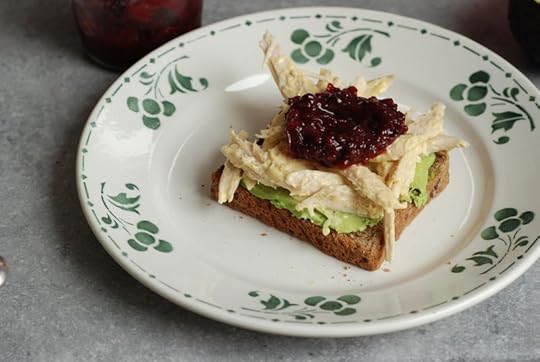
Sometimes you just want a chicken salad sandwich.
So you buy a plump little chicken and you boil it up with the usual trio of carrots and celery and onion. You add some peppercorns (which you end up skimming off with the muddy scum a few minutes later) and an old bay leaf from your grandfather's garden for flavor. (It is so old, in fact, it was picked before he died. Seven years ago, may he rest in peace. The bay leaves still work, though, even though they're brown and brittle.) When the chicken is good and cooked and the broth is flocked with golden gobs of molten chicken fat, you pull out the chicken and let it cool a little; how long depending on just how little feeling you have left in your fingertips.
You shred the chicken, mix it with mayonnaise (I use Maille's because I think it tastes the most like homemade and because it keeps in the fridge for ages, but no one is stopping you from making your own), and then pile it on bread. Ideally, you have good bread. Something holey and crusty, with a crumb that's cool to the touch. Homemade foccacia would be good too, if you have that kind of time. But toast isn't bad either. In fact, some think toast is precisely what you need with chicken salad. That nice crunch against the rich filling. Whatever, the point is, sometimes what's ideal isn't what's in the fridge and I hate how food has become so fetishized now that you can't even crave a stupid chicken salad sandwich without someone somewhere telling you that you're doing it wrong. So forget about the "ideally". Just put it on some bread, whatever you've got is fine.
But I also need a little something sharp in the sandwich, something to help all that rich and soothing meat and cream stand at attention a little. For me, that something is Saltie's red currant pickle, which I have mentioned a half dozen times and yet never blogged about and which I will remedy today. It is my favorite condiment in the fridge besides Heinz's ketchup and my Seville orange marmalade. It is, as the authors of Saltie: A Cookbook describe, "more of a chutney" than a traditional pickle. It's piercingly sour and sharp. It's delicious with cold meats, makes them taste richer and fuller, if you know what I mean. The book says it keeps for 2 months, but I am here to say that I made it 8 months ago and am still eating it with gusto. It is still delicious. The sugar and vinegar are pretty good preservatives.
I'm sorry that you can't make this pickle right now since red currants aren't in season at the moment. I hope you bookmark it for when you can get them. In my feeble defense, I wasn't really planning on writing about red currants today, I just wanted to write about craving a chicken salad sandwich and then somehow that pickle snuck in. You know how it is, right? Sort of like when you wake up thinking "today is going to be great!" and by 10:30 am, it's the worst day ever. Or the other way around, you drag yourself through the motions in the morning, dreading everything and hating everyone, and then you go outside and have some kind of human experience that makes you feel so grateful to be alive that your feet practically tingle.
(At the last minute, I added two slices of avocado to the sandwich, squishing them into the bread before layering on the shredded chicken. Not really sure what possessed me. The color, maybe? I'm pretty sure the sandwich would have been just as good without it.)
Anyway, I was craving a chicken salad sandwich today and so I made myself one and it was just as good as I hoped. Sometimes that's all there is and it is enough.
Saltie's Currant Pickle
From Saltie: A Cookbook
Makes 2 cups
2 cups red currants
2 teaspoons mustard seeds
1 tablespoon fresh thyme
1 cup sherry vinegar
1/4 cup granulated sugar
1/4 cup brown sugar
In a large saucepan, combine all the ingredients and bring to a boil over medium-high heat. Lower the heat and simmer gently, stirring, for 30 minutes, until the pickle is thickened and reduced. Let cool completely before storing in an airtight container in the fridge for up to a year.
February 27, 2015
Amy Chaplin's Black Rice Breakfast Pudding with Coconut and Banana
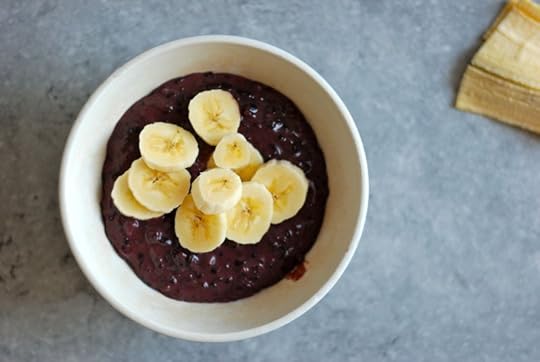
Last fall, a publisher sent me a heavy package. Inside were two copies of Amy Chaplin's At Home in the Whole Food Kitchen, a vegan cookbook and whole foods manual of sorts. Amy used to be the executive chef at Angelica's Kitchen, the legendary vegan restaurant in New York City, and now works as a private chef, teacher and recipe developer. At Home in the Whole Food Kitchen is her magnum opus, if I may be so bold, a well-researched, deliciously crafted and carefully written guide to making the most of all the wide array of plants - from whole grains to beans to vegetables to seaweed, yes - available to us today. It feels like an instant classic, modern and interesting and definitive. (Also, the photography is jaw-droppingly beautiful.)
These days, it's tough to keep up with the onslaught of information blaring at you from every corner, and the cookbook market is no exception. The rate at which new cookbooks come down the pipeline is crazy, for lack of a better word, and the speed and haste in which they are thrown together is sometimes depressingly apparent. But in this case it's clear that Amy poured an enormous amount of work into getting the book just right. There is so much information here, so many thoughtful little tips and nice stories, not to mention the delicious recipes, that it really earns the adjective of encyclopedic. I'm so impressed.
I've cooked from the book for several months now, but I've also kept it by my bed for a soothing bedtime read and I'm happy to say that it works on both counts. For those of you who are interested in why soaking grains is so good for you, how to use seaweed to bolster the flavor of beans, for example, or how to make desserts out of things like ground toasted coconut, maple syrup and oat flour, you need this book. And if you're a vegan, this book will become your Joy of Cooking. I'm not a vegan, or even a vegetarian, but the recipes are so richly conceived and so well-developed that they don't read as "special diets" food, but rather as warming, soulful, wonderful food, the kind I'd like to eat all the time. (There are a few exceptions, mostly in the dessert chapter, but I imagine that for people who are gluten-free or vegan or lactose-intolerant or all of the the above, it's manna from heaven. I mean, toasted coconut crust for pies, chocolate pots de crème, Earl Grey fruit cake, helloooo?)
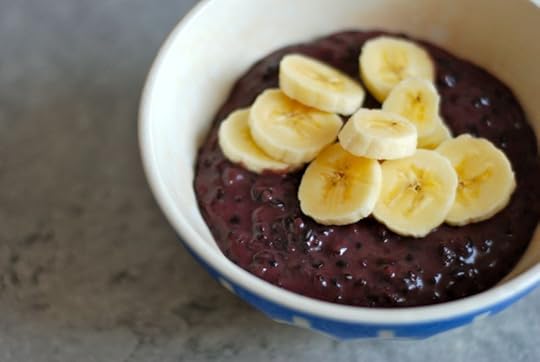
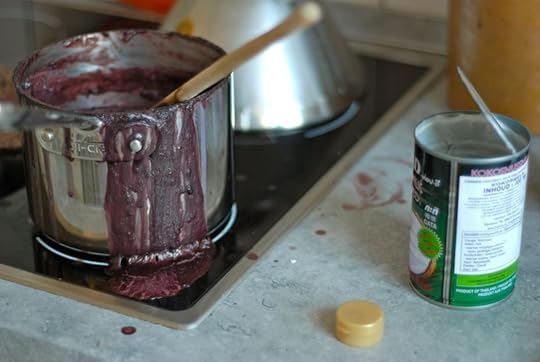
My latest discovery in the book is a black rice breakfast pudding made with coconut milk and lightly sweetened with maple syrup. You soak the rice overnight first, then cook it with coconut milk, water and nut milk (those of us who aren't vegan can use regular milk, like I did, which makes the pudding creamier than nut milk will) until it's soft and creamy and the "pudding" is a deep, beautiful purple. Spooned into a bowl and topped with cool slices of banana and some crisped-up toasted pieces of coconut (regretfully missing from the photos here), it's the nicest breakfast I've had in a long while. Warming, rib-sticking, tropical. Hugo loved it too, by the way!
My husband is obsessed with Amy's turmeric lemonade that I doctored with blood oranges during a recent onset of the flu, and next up on our to-try list is her silky cauliflower-celery root soup made with two whole roasted heads of garlic and roasted shiitakes. There's cherry-coconut granola and a corn-tofu frittata, a hibiscus drink made with ginger and citrus and a black bean butternut stew, among so many other things I cannot wait to try.
And! The second copy is for one of you! Yippee! Just leave me a comment and tomorrow evening I'll pick a winner.
Have a wonderful Friday, everyone. March is almost here!
Amy Chaplin's Black Rice Breakfast Pudding with Coconut and Banana
Adapted from At Home in the Whole Food Kitchen
Serves 4 to 6
1 cup black rice, washed and soaked in 4 cups of water for 12-24 hours
1 cup coconut milk
1 1/4 cups milk (cow or almond)
2 cups water
Pinch of salt
1/4 cup maple syrup or coconut nectar
Sliced banana, for serving
Toasted coconut flakes, for serving
1. Drain and rinse the rice. Place in a heavy-bottomed pot and add the coconut milk, almond or cow's milk, the water and the salt. Bring to a boil over high heat without the lid, then reduce the heat to low, cover and simmer for one hour, stirring every 15 minutes. (Some liquid may escape - as above.)
2. When the rice is tender and the pudding is creamy, remove from heat and stir in the sweetener. If desired, you can thin the pudding with a little extra nut or cow's milk. Serve topped with sliced banana and toasted coconut. Leftovers can be reheated the next day with a little water stirred in to loosen the pudding.
February 21, 2015
Saturday Round-Up
In a little less than half an hour, my husband and I are leaving the apartment, taking the bus six stops and checking into this hotel for a much-needed one-night getaway. It feels totally indulgent and also totally fantastic and I am basically counting the seconds until we get there. (I think I should also be packing a bag right now?)
But before I go, a few things that I read and loved this week:
Shauna's post on a weekly cooking routine. SO GOOD. Do you guys do this?
How to sharpen a knife without a knife sharpener or steel. (!!)
Brilliant: A comic book Piglet review! One of my favorites ever and that's saying a lot because I basically love everything about the Piglet.
My favorite thing about this article on a recent uproar in Rome about school lunches is the last paragraph.
Ira Glass talks about his creative process. Interesting, funny and enlightening.
We are on a crazy roll with recipe testing for the book, but I'm starting to develop a serious aversion to sugar. Wholesome meals like this one, with buckwheat and roasted romanesco, sound even more appealing these days.
Finally, Max introduced me to The War on Drugs a few weeks ago and I've fallen hard for the music. It makes me want to get in a car and drive for days, preferably somewhere where the sky is always blue.
The whole album is amazing; here's just the first song:
Thanks for being patient while things got quiet around here this week. Next week: turmeric lemonade! Black bean soup! A report on our little adventure tonight!
Have a lovely weekend, you all.


