Carolee Dean's Blog, page 32
January 20, 2012


January 18, 2012
My tweets
January 15, 2012
Мои твиты
January 13, 2012
Мои твиты
AUTHOR RESEARCH PANEL
On Tuesday, January 10th, I had the pleasure of conducting author research panels at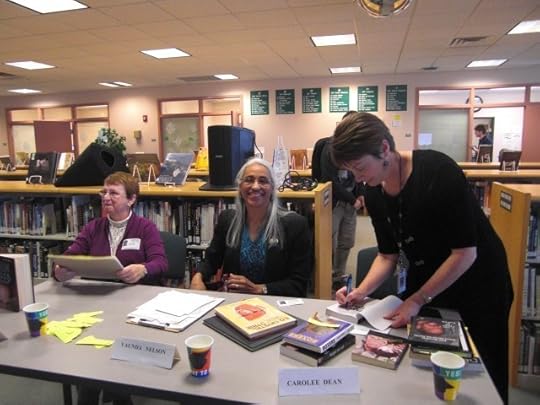 Rio Rancho High School and Cleveland High School. Joining me were authors Lois Ruby and Coretta Scott King winner Vaunda Michaux Nelson. We covered a variety of topics including how we use the internet and other resources to research our books. Students were surprised to discover that even authors of fiction use an abundance of non-fiction resources to find background information for their stories. In this photo I'm autographing a copy of TAKE ME THERE for one of the students who attended.
Students and teachers both commented that the most interesting part of the panel was when we discussed some of the intriguing people we had met while conducting interviews for our books. I told them about former death row warden, Jim Willet, who used to oversee the executions in Huntsville, Texas. I met with him at the Texas Prison Museum while researching TAKE ME THERE. Old Sparky, the actual electric chair used in numerous executions, is housed in that museum.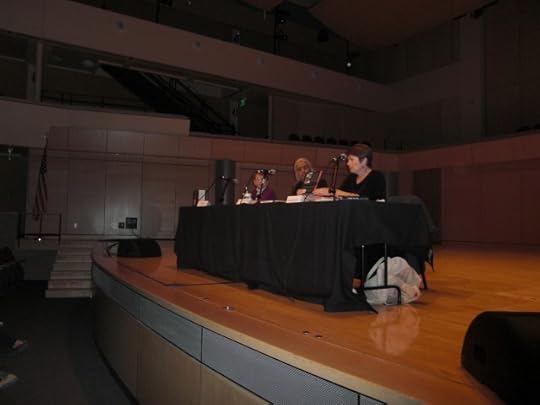 Lois Ruby told a humorous and at times unsettling account of the three skinheads she took to lunch at Taco Tiko while researching her novel, SKINHEADS. Lois, a former librarian, believes strongly in First Amendment rights and freedom of speech. Vaunda Nelson, who is also a current city librarian, told of meeting poet Nikki Giovanni and the children of Malcolm X while she researched NO CRYSTAL STAIR, a documentary novel exploring the life and work of her great grandfather, Lewis Michaux, a Harlem bookseller.
The purpose of the panel was to get students excited about research by connecting them with authors who love it. From the feedback we have received, it was a great success.
August 11, 2011
caroleedean @ 2011-08-10T20:44:00

On Tuesday night - August 9th, I gave a verse novel workshop for our local New Mexico SCBWI chapter with Caroline Starr Rose. I talked about the history of the genre. It's not just a YA/middle grade fad. Some of the greatest works of western literature are verse novels - (i.e. THE ILIAD and THE ODYSSEY by Homer - not SImpson).
Caroline gave pointers for determining if this genre is right for you as an author. She said to consider the following before you ever begin writing:
Is the subject matter right for poetry? •Is the protagonist right for poetry? •Are you right for poetry? n
She then gaves tips for story considerations:
Can each poem stand alone? nDoes each poem contribute to the whole?
We began the workshop with a five minute descriptive free write using photos from various non-fiction picture books for inspiration. After discussing the types of techniques poets utilize in creating verse, participants then rewrote their descriptions in poetry form. We got everything from a personal add from Henry VIII to a jump rope chant from children in war torn Europe. I love hearing the work of my talented SCBWI friends.

Caroline and I both have verse novels coming out in 2012. My YA novel FORGET ME NOT (Simon Pulse) explores a high school filled with dead people. Her historical novel MAY B. (Schwartz and Wade) follows the story of a young girl facing hardship on the Kansas prairie. There was a rumor that Ellen Hopkins quoted from Caroline's debut novel during her verse novel workshop this past weekend at the SCBWI national
conference in LA. One of the reasons I love being a children's author is because of the great generosity of spirit that seasoned authors show to up and coming authors. Caroline will definitely be one to watch.
July 20, 2011
THE DOG DAYS OF SUMMER
Have you ever had a day like this?
Yesterday I went to TJ Maxx looking for some workout shorts. After trying on five pair and not finding a single one to buy, I walked out to discover I'd spent half an hour in the men's dressing room.
Then I walked over to Shoes on a Shoestring where my daughter was trying on tennis shoes. The "discount" shoes were eighty dollars. When I returned home I realized I had a card on my key ring for a ten percent discount. If only I had figured it out an hour earlier...
When I told my husband the story I said, "I could kick myself in the butt."
He said, "I'd love to see that!"
So I tried to kick myself in the butt, but I couldn't even do that right. The dog was standing behind me and I accidentally kicked her in the head.
She ran away from me the rest of the day.
Thank goodness dogs are forgiving
and forgetful.
June 25, 2011
POST REWRITE PARTY - WHITE WATER RAFTING
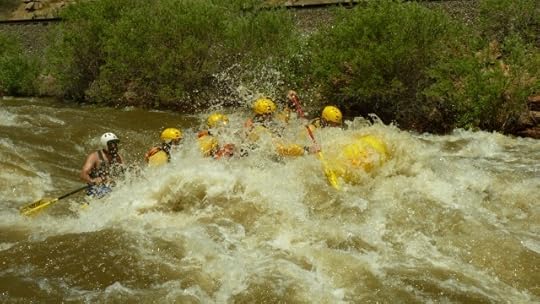
Did I mention that the water was freezing? Even with a wetsuit, I lost all feeling from the knees down and couldn't move my toes for an hour after we got out of the water. Fortunately, we spent the afternoon on a zip line tour with two crazy guides named Nate and Dave. Three hours, nine zip lines. I slept well that night.
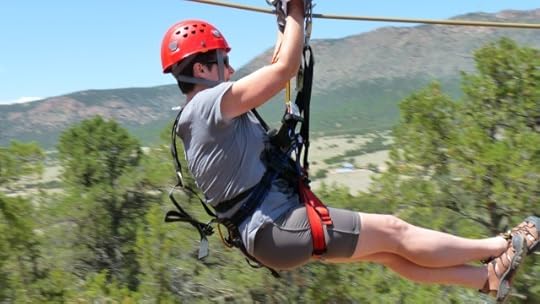
Does this helmet make my head look fat?

Here are our crazy guides, Dave...

and Nate.
Maybe I'll put them in a book one day. Wouldn't that be fun?
Now I'm back home and working on another verse novel. Perhaps I'll write a White Water Sonnet:)
April 17, 2011
NON-FICTION AUTHOR Q&A

The author Q&A below is from the April issue of Spellbinders. To read the additional articles go to spellbindersbooknews.blogspot.com
TO TELL THE TRUTH?
We are focusing on non-fiction books for our April issue of SPELLBINDERS and we decided to pick the collective brains of some of our author/librarian/teacher/scientist friends. Joining us this month are:
Shutta Crum: picture book author, novelist, and retired librarian. Her first book, Who Took My Hairy Toe? was classified as "retold folklore." Visit Shutta
Uma Krishnaswami: author of picture books, retold tales, and middle grade novels. She teaches creative writing at the Vermont College. Visit Uma
Fred Bortz: Fred Bortz holds a doctorate in physics and is one of the nation's leading writers of science and technology for young people with a twenty-five year career in teaching and research in physics, engineering, and science education. Visit Fred
Kimberley: Some of the questions we'd like to ask you are: what are the different kinds of non-fiction, the strengths of each type of non-fiction and some of your experiences and knowledge about writing non-fiction as well as how to use non-fiction effectively in the classroom.
Shutta: When exploring the different kinds of non-fiction, the librarian in me goes straight to the Dewey Decimal Numbers that include things like the social sciences (philosophy, crime, religion, etc.). The 300s include myths, folk and fairy tales, the 700s crafts, and the 800s include poetry, plays, short story collections, etc. The 900s include such things as travel and genealogy. You can get a shortened copy of Dewey and see what major groupings you can make with it.
Kimberley: Yes, yes, yes, Shutta! Thank you for including these crucial areas of the library. We got books from our local library under these Dewey numbers all the time with my boys when I was homeschooling.
Uma: Thanks, Shutta, for mentioning retold tales that all too often get thought of as "fiction." The point being not whether they are "true" or not (and what is that, anyway? One person's religious belief may be another's fairy tale) but what kind of research is needed to write them and what is the writer's obligations to stay true to the sources yielded by that research.
Carolee: That's a good point, Uma. As an educator in a public high school, I have trouble explaining this distinction to my students in a concise and meaningful way. When we study mythology, one of them will invariably ask if these stories are "real" or fiction. I will explain that they are non-fiction, which tends to make them think they really happened. They often assume that non-fiction means "real" or "true" which are sometimes difficult concepts to explain in the realm of non-fiction.
Uma: When I get asked the "is this real" question, I say, well, I didn't make it up. Someone else did, years ago. So when I rewrite a story like this, I need to stay "true" to that old version. In other words, I'm not going to meet Ganesha or Anansi or Grandmother Spider (or for that matter the animals from the Ark) in the parking lot when I leave here, but I need to pay attention to how I retell traditional stories because they're not mine to change however I want to. That's why retold tales are seen as nonfiction.
Carolee: It's a complex concept so I guess there's no quick and easy explanation.
Uma: If anyone wants to go into it further (as in middle or high school) I will talk about geography and the shaping of some stories, so that kernels of reality emerge--lost rivers, archeological discoveries, etc. and the technical differences between legend and myth, assuming you buy into those terminologies.
Kimberley: Does anyone have an observation about the current trends in publishing non-fiction?
Fred: The biggest recent change in nonfiction is the emphasis on series. The school/library publishers rarely do single titles anymore, and the trade publishers are doing more series also.
The biggest change in my own writing is a move toward speculative topics. My work-in-progress is about humanity's future in space, looking ahead to the settlement of other worlds and the possible exploration of other solar systems.
My latest book, Seven Wonders of Space Technology Visit Seven Wonders has speculative chapters on "Moon Water and Moon Bases" and "Future Technologies for Space Travel" and a forward-looking chapter about the New Horizons Mission to Pluto and the Kuiper Belt (arrival date: 2015).
Shutta: I might add that one of the more exciting things I have seen in the last ten years is an explosion in nonfiction picture books. This usually takes the form of a picture book that focuses in on a very specific event, person, period, etc. It is presented with large illustrations as picture books are, and sometimes there are end notes to fill out the details. I am thinking of books like: Bad New for Outlaws: The Remarkable Life of Bass Reeves by Vaunda Nelson, We Are the Ship: The Story of Negro League Baseball by Kadir Nelson, and Dave the Potter: Artist, Poet, Slave by Laban Hill just to name a couple. I love this . . . it provides a good point of access to nonfiction for young readers who may still be a little fearful of text-laden nonfiction.
Carolee: I've been delighted to see the expansion of non-fiction picture books. I work with poor readers, many of whom are boys, and they often prefer non-fiction over fictional stories. Quality non-fiction trade books contain great visuals and facts that grip their attention. A textbook biography is often boring, but a biography that is structured to read like a novel or short story based on fact can be fascinating.
Fred: It's not just bios that feel like novels, and it's not just sci/fi that looks at speculative ideas.
I began to get a little bit of notice nationally when a reviewer said that my 1995 book Catastrophe! Great Engineering Failure--and Success "reads like an adventure story," and was one of nine designated a Selector's Choice on the National Science Teachers Association/Children's Book Council list of Outstanding Science Trade Books for Children for 1996.
It was then that I realized that I was at my best as a "teller of true tales." Catastrophe! was more like a short-story collection around a common theme (Murphy's Law as a recipe for success) than a novel.
Kimberley: Speaking of awards, what are the non-fiction awards out there? I know some like the Sibert, but I know I'm probably missing a lot.
Fred: I am also a winner of one of those other awards. I imagine there are several other fields that offer them. Mine was the American Institute of Physics Science Writing Award for works intended for young readers in 2002 for Techno-Matter: The Materials Behind the Marvels. That was not a true-story book, but rather an overview of materials science and engineering, though I tried to work in a little storytelling in some of the technologies I described.
Kimberley & Carolee: This is wonderful, thank you all so much! You've clarified several things as well as given good examples and the direction of series and awards. Thanks to all of you for joining us for this month's issue of SPELLBINDERS
February 19, 2011
You Tube and School To World
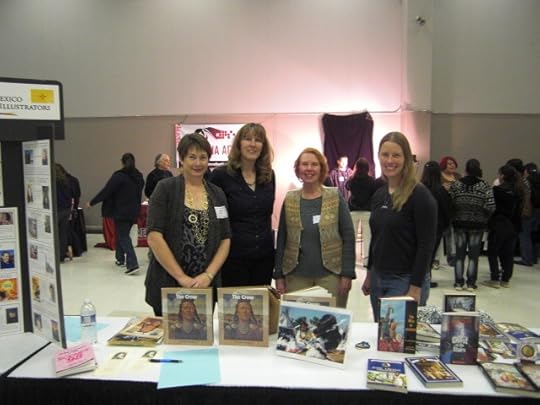
Here I am below showing off my new book trailer to Caroline Rose. Josh Stuyvesant, a film student at UNM put together the video and his friend, Kyle Ruggles, did the music.

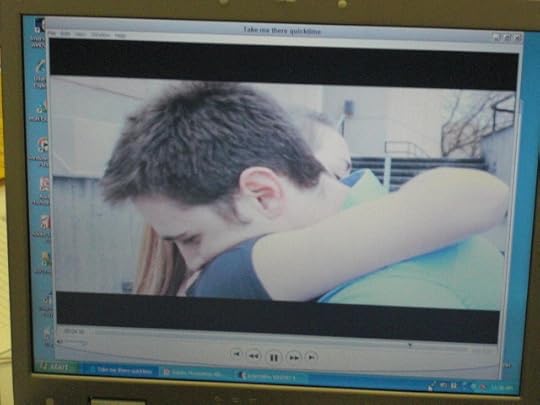
Check it out at www.youtube.com/watch