Carolee Dean's Blog, page 2
July 25, 2025
COR - The Components of Reading - Part 5 - Vocabulary

VOCABULARY
Continuing our series on COR Instruction, where we highlight the activities explored in the HOT ROD activity books (Higher Order Thinking through the Reading of Decodables), this month’s topic is Vocabulary. For more information about decodable books, visit the page on our website titled "Decodable Books."
Sign up for my newsletter to receive more free activities for my ongoing COR series HERE.
One of the main features of HOT ROD books is their focus on providing decoding practice within a meaningful context, utilizing key vocabulary that can be used to address a variety of COR skills.
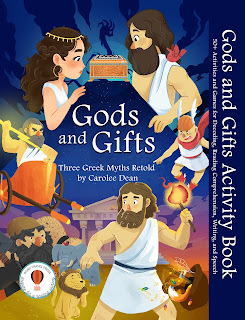
Vocabulary is a foundational building block of both listening and reading comprehension, but it can be challenging to include robust vocabulary in a Structured Literacy lesson when focusing on the limited syllable constructs often found in decodable books and stories. On the other hand, even the most basic word forms can provide opportunities for exploring advanced vocabulary, especially when multi-syllable words are included. Consider these words based on closed syllables with short vowel sounds from Gods and Gifts: Three Greek Myths Retold - asp, vast, crag, smelt, crept, pox, kestrel, linnet, prospect, gallant, Vulcan, scandal, rascal, tempest, vespid.
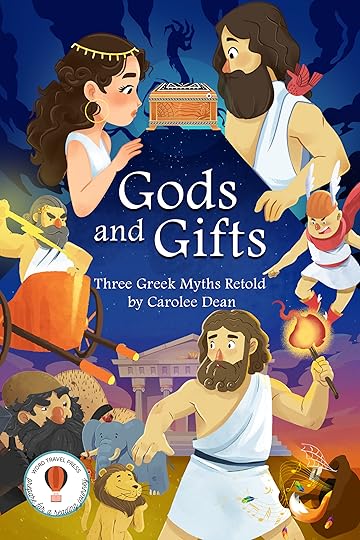
When vocabulary is based on rich content, comes from material related to the curriculum, is used for additional activities that address skills like cognitive flexibility, morphological awareness, sentence structure, and more... repeated exposure to words happens naturally.
We know it is beneficial to pre-teach new words before students are asked to read them in context. However, it is also vitally important to teach students strategies for determining the meaning of new words independently. Students with reading challenges require even more exposure to a word than their peers, so even if they have already been introduced to a definition, it is still beneficial to explore it in context. Context is especially significant for understanding words with multiple meanings. Consider these multiple-meaning words from Gods and Gifts: bat, drill, hog, rat, pelt, land, last, spit, bluff, band, top, spin, class, jam, craft.
Multiple Meaning Word Search
To promote both vocabulary and reading fluency, instruct students to:
1) Reread a story and create a list of any words that may have multiple meanings.
2) Write down all the possible meanings of the word.
3) Reread the context to determine which meaning fits that word as it is used within the story.
Rereading helps students develop confidence and fluency, but there needs to be a meaningful reason for rereading, or it feels like busy work. Tying rereading into vocabulary instruction gives students a purpose for tackling a text more than once.
Word Clues
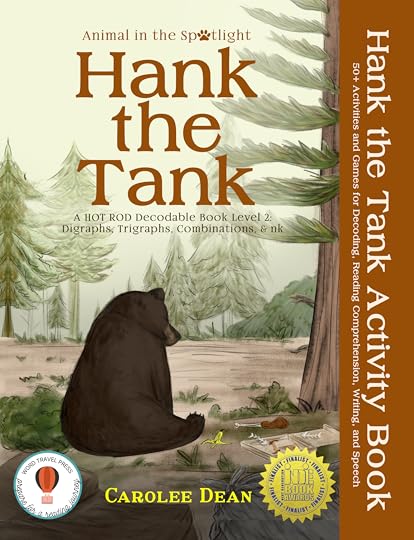
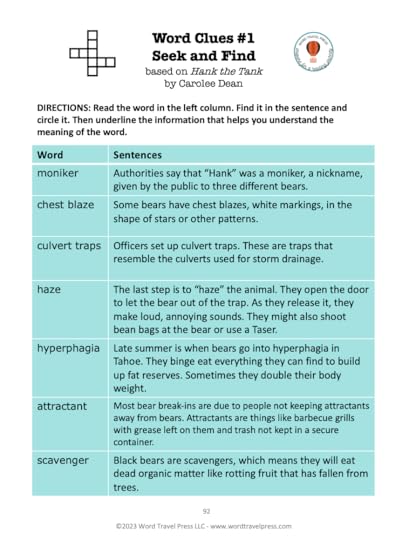
Searching for the meaning of a word within the context of the story is a bit like being a word detective. It's helpful to teach students the specific ways a text can reveal the meaning of a word. The Hank the Tank Activity Book (based on the decodable chapter book - Hank the Tank: Animal in the Spotlight) contains three levels of activities to help students develop the skills needed to use context clues to determine the meaning of a word. The activity for Level 1 is available in a PDF below
Level 1 – Seek and Find: Sometimes the meaning of a new word is given within the context of a nearby sentence. Authors of children's books frequently provide definitions directly within the text. In the activity below, students underline the provided definition. Get the FREE PDF for this activity.
When reading books with your students, be aware of examples of "planted" definitions and direct your students to reread a sentence or paragraph to see if they can find it. Practice this skill often so they will know how to use it during independent reading.
The following activities are taken from the background section of the story and are not decodable, so you may need to read the sentences aloud to students. One of the strengths of HOT ROD books is a strategy called Pair and Share Reading. The adult reads the sections that are not decodable to provide background and context, while the student reads decodable sections containing words with syllable structures that have been previously taught. Using this strategy, upper-level Tier 3 vocabulary can easily be introduced to students with low levels of decoding skills. Here is an example incorporating the word hyperphagia.
Late summer is when bears go into hyperphagia in Tahoe. They binge eat everything they can find to build up fat reserves. Sometimes they double their body weight.
Word and Definition: Hyperphagia is when bears binge eat everything they can find to build up fat reserves.
Level 2 – Making Inferences: Sometimes hints about a word’s meaning are given, but the meaning is not stated outright. For this activity, students are asked to write down what they think the word means based on the clues. Look for opportunities in the stories you read with your students to demonstrate how to make inferences about word meanings.
Here's an example from the Hank the Tank Activity Book, using the word' canids. In this example, hints about the definition are provided. From the information given, depending on the extent of their background knowledge, a student might be able to deduce that canids are animals in the dog family.
Bears have developed a fear of canids. A barking, snarling dog looks just as dangerous to a mother bear as a wolf or coyote.
Word and Definition: A canid is an animal like a wolf or coyote. These are animals in the dog family.
Level 3 – Opposite Meanings: Sometimes the context tells us the opposite of what a word means. Look for negative words like no, don’t, instead, unfortunately, or any other words that have prefixes like un. as a clue that the information may be hinting at an opposite meaning. Then write down what you think the word really means.
Here's an example from the Hank the Tank Activity Book using the word instincts.
When a bear loses its instincts, it has unnatural impulses to do things like eat garbage.
Word and Definition: If losing instincts results in unnatural impulses, we can deduce that instincts are natural impulses.
Independent Learning
Students typically learn around 2,000 to 3,500 new words per year, about 6 to 10 new words per day. This includes both explicit vocabulary instruction and implicit or incidental learning from reading and other experiences.
By teaching strategies for determining the meaning of new words independently, we empower students to improve their ability to learn words incidentally and become lifelong learners, continually adding new words to their lexicon. This is vital, as we cannot possibly teach all the words students need to meet the demands of an ever-changing world.
See last month's post or COR Instruction and Morphology.
Sign up for my newsletter to receive more free activities for my ongoing COR series HERE.
References:
Wright, T.S., & Neuman, S.B. (2015). The power of content-rich vocabulary instruction. Perspectives on Language and Literacy, 41 (3), 25-28.
Shanahan, T. (2015). Are you lactating? On the importance of academic language. Perspectives on Language and Literacy, 41(3), 14-16.


June 28, 2025
COR - The Components of Reading - Part 4 - Morphology

MORPHOLOGY
Continuing our series on COR Instruction, where we highlight the activities explored in the HOT ROD activity books (Higher Order Thinking through the Reading of Decodables), this month’s topic is Morphology.
One of the main features of HOT ROD books is a focus on providing decoding practice within a meaningful context, utilizing key vocabulary and other concepts that can also be used to address COR skills like morphological awareness.
While phonemes represent the smallest units of sound, morphemes represent the smallest units of meaning. English is a morphophonemic language, which means that the phonemes and the morphological structure work together to affect how words are pronounced.
In her chapter on “Morphology for Reading, Spelling, and Vocabulary,” in Speech to Print: Language Essentials for Teachers (Third Edition), Louisa Moats talks about the power of morphological awareness for building vocabulary. The ability to recognize morphemes enhances a student's ability to make reasonable inferences about a word's meaning in context. That recognition and understanding help to “anchor a word in memory.” In addition, we remember words best when we understand their relationship to other words.
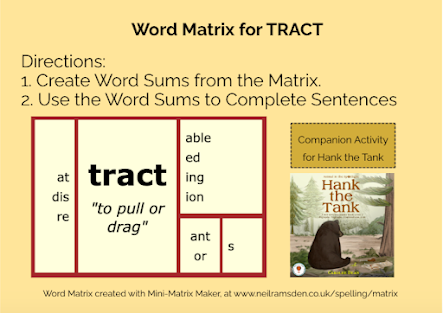
It's never too early to start teaching morphology. Children as young as kindergarten benefit from learning basic suffixes such as -s, -ed, and -ing. Many older students working on a Scope and Sequence that starts with closed syllables (short vowel sounds) can handle word sums like the one below from the Gods and Gifts Activity Book: 50+ Activities and Games for Decoding, Reading Comprehension, Writing, and Speech. The word matrix examples in this blog were all created using the Mini-Matrix Maker at www.neilramsden.co.uk/spelling/matrix.
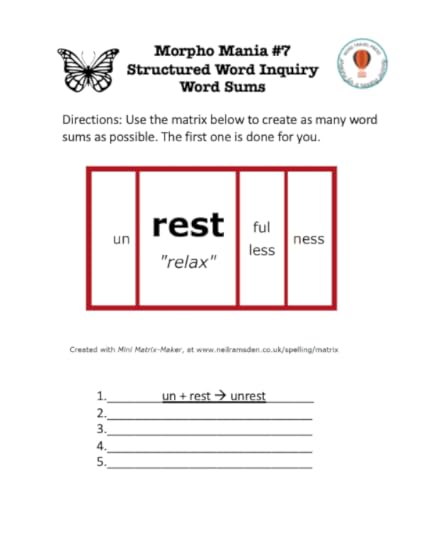
About the Word Matrix
The Word Matrix is a concept explored by Peter Bowers in Teaching How the Written Word Works: Using Morphological Problem-Solving to Develop Students’ Language Skills & Engagement with the Written Word. This is how word sums work:
1. A Word Matrix helps us explore word structure by organizing elements like prefixes, base elements, and suffixes into columns.
2. Prefixes are in the left column. Base elements are in the middle column. Suffixes are in the right columns.
3. A Word Sum is created by using one element from one column at a time to construct a word. You do not have to use an element from every column, but do not skip over columns.
4. Students create words using the Word Sums and then use those words to complete a variety of activities.
In the example above from the Gods and Gifts Activity Book, students work with basic syllable types. Etymology is also an important part of the Morphological Problem-Solving process. For that reason, the activity book also explores the etymology of Prometheus, Epimetheus, & Pandora, main characters in the Greek Creation Myth. More advanced students (those working beyond closed syllable types) study the origin of these names and the meanings of those Greek combining forms. Students who are not ready to tackle reading those words still benefit from the discussion of those names. One of the strategies that makes the HOT ROD books unique is the emphasis on Pair and Share reading. A rich background context is read by a reading partner, allowing struggling readers to build world knowledge even as they learn basic decoding skills.

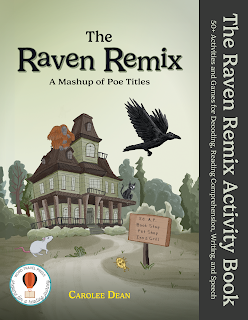
The example for SPECT above is from Level 3 and The Raven Remix Activity Book, which also explores the etymology of Pluto, the name of Edgar Allan Poe's infamous feline from his short story "The Black Cat."
The Hank the Tank Activity Book includes morphology games and activities for re, tract, and -ing, as well as information about the etymology of the word bear, but it does not include any Word Sums. For that reason, I have made a digital activity available for free on Boom TM Cards HERE, exploring word sums for TRACT.
Sign up for my newsletter to receive more free activities for my ongoing COR series HERE.
References:
Bowers, P. (2009). Teaching how the written word works: Using morphological problem-solving to develop students’ language skills & engagement with the written word. Ontario, Canada: Peter Bowers
Eggleston, R. L., Marks, R. A., Sun, X., Yu, L., Zhang, K., Nickerson, N., Hu, X., Caruso, V., & Kovelman, I. (2024). Lexical morphology as a source of risk and resilience for learning to read with dyslexia: An fNIRS investigation. Journal of Speech, Language, and Hearing Research. https://doi.org/23814764000300140072
Farrell, L.M., & Cushen-Whte, N. (2018). Structured literacy instruction. In J.R. Birsh & S. Carreker (Eds.) Multisensory teaching of basic language skills (4th ed., pp. 35-72). Baltimore, MD: Paul H. Brookes Publishing Co.
Moats, L.C. (2020). Speech to print: Language Essentials for Teachers. Baltimore, MD: Paul H. Brookes Publishing Co.
Ramsden, N. Mini-Matrix Maker -https://www.neilramsden.co.uk/spelling/matrix/
May 26, 2025
COR - The Components of Reading - Part 3 - Cognitive Flexibility

COGNITIVE FLEXIBILITY
Continuing our series on COR Instruction, where we highlight the activities explored in the HOT ROD activity books, this month’s topic is Cognitive Flexibility.
What is Cognitive Flexibility?
Cognitive flexibility is an important executive function skill that centers on the ability to switch between different types of information. It can involve switching between different tasks or thinking about more than one concept at a time. Working memory is an important element of cognitive flexibility that helps a person manage more than one task, concept, or piece of information simultaneously. It impacts reading, writing, spelling, and more.
How Cognitive Flexibility Impacts Reading
Specific to reading, cognitive flexibility is essential for both decoding and comprehension. Students need cognitive flexibility to hold different possible pronunciations for a letter or combination of letters in mind while decoding unfamiliar words. At the same time, they must consider the word’s meaning. Working memory enables a reader to compare the possible pronunciations of a word with words in their lexicon (internal dictionary). While figuring out how to pronounce the word and determining what it means, a reader must also keep the rest of the sentence in mind. The content and structure of the sentence will also affect the word's meaning. If a word has multiple meanings, cognitive flexibility is required to hold the possible options in short-term memory while making judgments about the best fit within the context of the sentence and paragraph.
While many tasks help develop cognitive flexibility, few directly relate to reading and decoding. The activities developed for the HOT ROD (Higher Order Thinking through the Reading Of Decodables) activity books address executive function skills that directly relate to a structured literacy scope and sequence, as well as to the content found in our decodable stories.
Students can work on cognitive flexibility by sorting words that belong to two different categories simultaneously. If you and your students are tired of the same old word card drills, consider spicing up your routine by incorporating Cognitive Flexibility games. The easiest way to understand how these games work is to explore one of them with your students.
The game above was part of a research project completed by me and Kelly Cartwright, Ph.D., last year that focused on open and closed syllables (long and short vowel sounds) in the first syllable of two-syllable words. Now that the study is over, the 8 different word sorts used in the study are available at Boom TM Learning. The first game is free HERE or at the link above, but you must open a free Boom account. The complete Bundle of 8 digital games is available for $5.99 HERE. It contains several target words from the Level 3 decodable book, The Raven Remix: A Mashup of Poe Titles. Printable PDF copies of all 8 games may be found in The Raven Remix Activity Book: 50+ Activities and Games for Decoding, Reading Comprehension, Writing, and Speech. Both titles, as well as books for Levels 1 and 2, are available on Amazon or in the online STORE on our website.

The target words in the free online Boom game are from the Category Sort #1 from the activity book and include the categories of Foods and Objects.
This digital Boom Deck has three component parts:
1. First, students sort words into two categories (ex., Foods vs. Objects).
2. Next, they sort the SAME cards into two different categories: Open vs. Closed Syllables (found in the first syllable of a word).
3. Finally, students sort the same words on a 2x2 matrix in the Multiple
Classification Activity while considering all 4 categories at once.
The online Bundle of 8 digital Boom TM Learning games is available HERE for $5.99. If you participated in the research study, you should still be able to access these games for free. If that is not the case, please contact me at info@wordtravelpress.com.
If you would like to receive future information about the study results when they are available, sign up for my newsletter HERE.
References:
Cartwright, K.B. (2023). Executive skills and reading comprehension: A guide for educators (Second Edition). New York, NY: Guilford Press.
Tunmer, W.E., & Chapman, J.W. (2012). Does set for variability mediate the influence of vocabulary knowledge on the development of word recognition skills? Scientific Studies of Reading, 16(2), 122–140.
Vadasy, P.F., Sanders, E.A., Cartwright, K.B. (2022). Cognitive flexibility in beginning decoding and encoding. The Journal of Education for Students Placed at Risk, in press.
Zipke, M. (2016). The importance of flexibility of pronunciation in learning to decode: A training study in set for variability. First Language. 36 (1), 71–86.
May 19, 2025
Up and Away - Five Fun First-Flight Facts
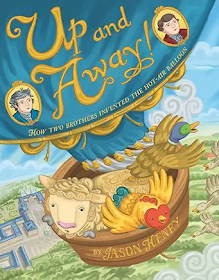
I'm working on a book of poems about inventions for my HOT ROD series (Higher Order Thinking through the Reading of Decodables), which led me to research hot air balloons. See the titles in the sidebar of this blog or visit my website at https://www.wordtravelpress.com to learn more about decodable books and how to work with emerging readers.
Up and Away is the type of narrative non-fiction picture book I used to share with upper elementary and middle school students when I worked as an SLP in the public schools. The text is written at an advanced level. It also includes rich vocabulary and concepts like what the discovery of science was like in the mid-1700s when the Montgolfier brothers first experimented with the idea that hot air might be able to lift a flying machine into the air.
I don't want to spoil the story, so I will share a few interesting facts from the narrative and leave you to investigate this delightful book on your own.
#1 - A hot-air balloon, the very first flying machine, was launched in 1783. That's 120 years before the Wright brothers' historic flight at Kitty Hawk. Joseph and Etienne Montgolfier demonstrated the first recorded flight of the inflatable globe they called an aerostat in the town square near their home in Annonay, France, on June 4, 1783. They asked officials to record the date so no one else could claim credit.
#2 - King Louis XVI heard about the invention and invited Etienne Montgolfier to show off their invention at the palace in Versailles. Louis and Marie Antoinette invited thousands of people to attend the demonstration that would occur on September 19, 1783.
#3 - The Montgolfier brothers owned a paper-making factory and decided to cover their experimental balloon in wallpaper. Ettiene Montgolfier asked his friend, Jean-Baptiste Reveillon, a famous wallpaper designer, to embellish the new aerostat for the demonstration at the palace. He covered the taffeta fabric with beautiful royal blue and gold wallpaper. The king's signature, two interlocking Ls, was part of the design. The balloon was named the Aerostat Reveillon. (NOTE: The balloon below was made in October. The September version did not have the faces in gold, but did have the interlocking letter L pattern.)
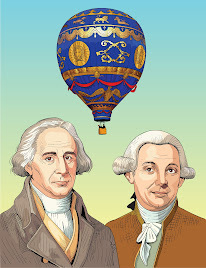
#4 - The Montgolfier balloon was destroyed in the rain, and the historic flight at Versailles almost had to be cancelled. Wallpaper may seem like an unlikely choice to use to cover a balloon heated over an open fire, but it was actually rain that proved to be more problematic. While Etienne and Reveillon were doing a test run of their new balloon just days before they were supposed to take it to Versailles, a rainstorm destroyed the paper covering the taffeta fabric. Their balloon was ruined. But all's well that ends well. They got rid of the paper, started from scratch, and this time they covered the taffeta in varnish. They worked day and completed the new design in four days.
#5 - The very first hot-air balloon passengers were a sheep, a rooster, and a duck. That may seem like an odd combination, but there was a good reason for those choices. Flying was dangerous, and no one knew how the human body would react to being at such a high altitude. The Montgolfiers' father had made the brothers swear that they would not go up in the balloon. A sheep was chosen because it was a mammal of about the same weight as a small man. The duck was expected to be fine, since ducks can fly at significant heights, and the rooster was questionable, since it was a bird that usually stayed near the ground. They all survived, and according to some stories, they got to spend the rest of their days at the king's menagerie in Versailles.
Stay tuned for more fun balloon facts coming later this month. I'm obviously spending a lot of time researching a subject for the purpose of writing one decodable poem. You may wonder why? Content matters. For a deeper discussion of why content learning is so important, check out Natalie Wexler's book, The Knowledge Gap: The Hidden Cause of America's Broken Education System and How to Fix It.

So, the next time you do a balloon-making project, talk about balloons, or even just bring balloons into your classroom or home for an event, remember the history and science behind the hot-air balloon and take a teachable moment to talk to your kids about this fun and exciting precursor to human flight. Also, make sure your library has the book Up and Away .
Check out my books at https://www.wordtravelpress.com/Sign up for my monthly newsletter HERE.
May 11, 2025
A ROGUE BALLOON AND A BOOK FOR MOTHER'S DAY
A friend texted Tom to say he had a strange request. A friend of this friend launched a solar weather balloon from the Albuquerque Balloon Park with a group of middle school students on Friday, and the balloon went rogue. It ended up 400+ miles southeast and from the GPS coordinates appeared to have landed outside Greenwood, Texas. We were in Midland, TX, about an hour away, so he asked if we knew someone who could look for it.
Naturally, we volunteered.
Surprisingly, the mapping program took us right to the balloon, even though we had to drive through about 15 miles on unmarked oil field/ranch roads past numerous oil pump jacks and tank batteries.

Fortunately, we didn't encounter any rattlesnakes. It is that time of year.
Once we found the balloon and the parachute, we had to untangle them from the mesquite bush they had landed in. Then we had another problem. The box with the expensive tracking device and camera was nowhere to be found. We had to look around for a bit. You'll never guess where it was!
Yep! It was tangled in an electric wire on a utility pole.

Climbing poles and dealing with live electric wires was beyond our skill set, so we called for backup. While we waited, we picked pieces of balloon out of the mesquite bushes. We didn't want cows eating them.
A man from the power company arrived a bit later, and he and Tom were able to get the box down. Yay!! In a couple of weeks, we will drive the contraption back to Albuquerque.
The funny thing is that I spent this last week researching hot air balloons for my new book. The working title is CORN CAKES TO CARS: POEMS ABOUT INVENTIONS. Did you know that the first balloon passengers weren't human? Three animals made the inaugural trip: a sheep, a duck, and a rooster.
This past Thursday, I was on the website for the Albuquerque Balloon Museum at https://balloonmuseum.com/montgolfier-day/ researching the first hot air balloon flight. Friday, I got this book I ordered from Amazon - Up and Away: How Two Brothers Invented the Hot-Air Balloon.

I haven't read it yet. I got a little distracted searching for the solar balloon this weekend, but stay tuned, and I will keep you posted about my thoughts on the picture book, the progress of my new poetry book, and anything I learn about the solar balloon we rescued this weekend. I'm still not sure what the experiment was about that all those middle school students were running, but I will find out and let you know.
By the way, the logo for my website is a hot air balloon. Check out my books at https://www.wordtravelpress.com/Sign up for my monthly newsletter HERE.

April 4, 2025
COR - The Componentes of Reading - Part 2 - Phonological Awareness
PHONOLOGICAL AWARENESS
Continuing our series on COR Instruction - The Components of Reading and Writing, this month's topic is Phonological Awareness. To see last month's post on DECODING, go HERE.
The ability to recognize and manipulate rhymes, syllables, and phonemes is a foundational skill of reading. Phonological awareness skills are so crucial to reading that they can be used in preschool and kindergarten to predict later reading ability (Paulson, 2018). Phonemes are the speech sounds (consonants and vowels) that distinguish one word from another (ie., pit vs. pat). They may be represented by one or more letters (ie., phone vs. fun). There are many products designed to work on phonological and phonemic awareness, but they rarely connect to a meaningful context.
Phonological Awareness Activities based on the HOT ROD series of decodable books were designed to use the same words found in the stories. The activity below is from the Gods and Gifts Activity Book based on Gods and Gifts: Three Greek Myths Retold. "No Gift for Man" is the first story of the Greek creation myth in that book.
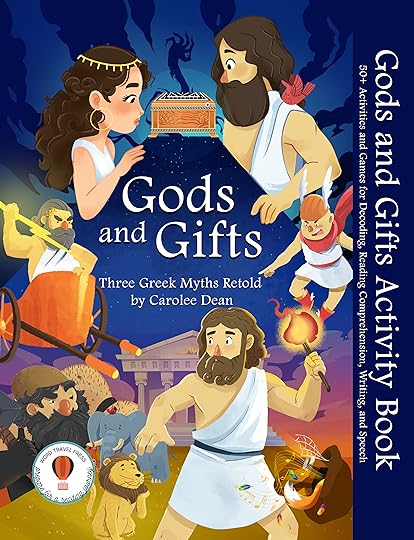
Find information about the Gods and Gifts Activity Book HERE.
FREE ACTIVITY - Rhyme Time
This activity uses rhyme and alliteration to work on phonological awareness skills. The Gods and Gifts Activity Book includes six different Rhyme Time Activities. The complete downloadable PDF for this activity may be found HERE.
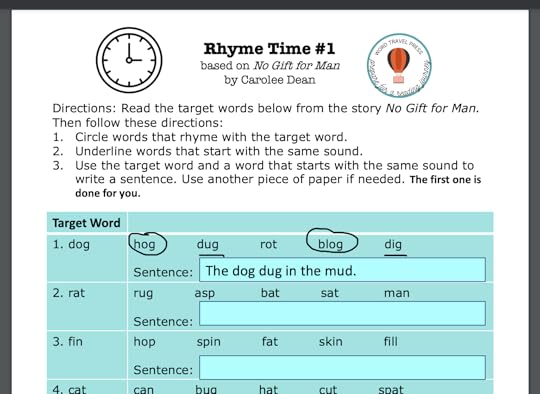
Rhyme Time explores one way that book content can be incorporated into phonological awareness activities. The educator creates a list of target words from the story in the left column. In the right column, list words that either rhyme with the target word or start with the same sound. Students then circle words from the story that rhyme and underline alliterations (words that start with the same sound). They then create a sentence that uses alliteration, which helps them understand and use literary devices. Additionally, switching between these three tasks requires students to use cognitive flexibility at both the letter-sound and meaning levels. We will have a deeper conversation about Cognitive Flexibility next month, so stay tuned.
You can use any decodable book or even a traditional storybook in a similar way by making lists of target words from the book and then finding words that rhyme.
ADDITIONAL FREEBIES
Two additional free phonological awareness activities, including applications for speech-language pathologists, will be available in my April 18th, 2025 newsletter for subscribers. You may sign up for my newsletter HERE.
March 20, 2025
COR - The Components of Reading - Part 1 (Decoding)

Many different skills or Components of Reading and Writing (COR) are needed for students to become proficient readers and writers. In celebration of the recent release of my new resource, The Raven Remix Activity Book, I will explore a different component each month and share a free activity from one of my activity books to demonstrate how you can support student reading and writing. The bicycle diagram above shows how a wide range of skills can be addressed by starting with a book and using that context to improve content knowledge while simultaneously addressing literacy subskills.

This month my focus is decoding. If you have been following my blog or reading my newsletters, you know about my series of decodable books - HOT ROD (Higher Order Thinking through the Reading of Decodables) for grades 4-8. The Scope and Sequence most closely aligns with the Sounds-In-Syllables program which is based on the Science of Reading. The Scope and Sequence may be found on the Resource Menu on the Website. The chapter book Hank the Tank: Animal in the Spotlight may be accessed for free if you have a membership to Kindle Unlimited.

What you may not know is that each decodable chapter book also has a companion activity book to explore all of the components of reading typically addressed in a Structured Literacy Lesson such as flashcards for word reading practice, sentence reading, dictation, phonological awareness activities, vocabulary, and morphology with games and activities to support each area. In addition, therapists, tutors, classroom teachers, and parent educators can explore additional activities for sentence structure, paragraph writing, essay writing, creative writing, and more.

DECODING
Most regular English words are based on six main syllable types. When students learn these syllable types and become proficient at breaking words down into manageable units, they are better equipped to tackle longer words. Level 3 of the HOT ROD series covers four syllable types: open, closed, consonant-le syllables, and the vowel teams, ee, and oo. What makes a book decodable is when stories include only the syllable types a student has previously been taught. The Raven Remix: A Mashup of Poe Titles focuses on two-syllable words. The examples below of Open and Closed syllables emphasize those patterns in the first syllable of the word. Final consonant-Le is a pattern found at the end of words.
Open Syllables - A vowel makes its open or long sound when nothing comes after the vowel in that syllable. (examples: silent, spiral, request, relax, broken, ladle, table, maple)
Closed Syllables - A vowel makes its closed or short sound when it is followed by a consonant. (examples: sudden, simple, socket, skillet, splendid, reddish, riddle, little, middle). In the first 6 words, the second syllable is also a closed syllable.
Consonant -le - This final stable syllable is found at the end of words (examples: ladle, table, maple, riddle, pickle, puzzle, riddle, kettle)
Vowel Teams - When two or more letters work together to make one vowel sound, it is a vowel team. There are several. Only oo and ee are used in Level 3. (examples: sleeping, creeping, greeted, book, wooden).
The Raven Remix Activity Book provides numerous ways to practice these words to prepare students to read them in the story found in The Raven Remix: A Mashup of Poe Titles.
FREE ACTIVITY
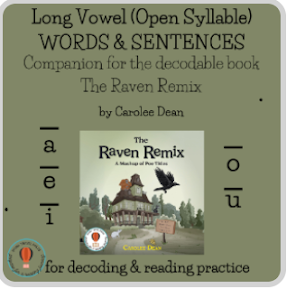
The Long Vowel Word and Sentence Deck is a free Digital Resource at Boom (TM) Learning. You will need a free Boom account to use this activity.

This deck includes a keyword and sound card for each long vowel along with words and sentences that may used for both reading and spelling practice. For dictation, read the content of each card to the student and instruct them to write the sentence.


ADDITIONAL FREEBIES
Two additional free decoding activities, including Four-In-A-Row Gameboard for Final Consonant-le and Articulation Flashcards for Speech-Language Pathologists, will be available in my March 28th newsletter for subscribers. You may sign up for my newsletter HERE.
COMING UPTo become proficient decoders, students need to practice distinguishing between the different graphemes (letters) and the phonemes (sounds) those letters represent. Next month we will discuss Phonological Awareness. English is a morphophonemic language. That means that in addition to understanding phonemes, students need to understand how morphology impacts both meaning and word pronunciation. Watch for that topic coming soon!

The Raven Remix Activity Book is a companion resource for The Raven Remix: A Mashup of Poe Titles from the HOT ROD Series of Decodable Books Level 3. Access to downloadable PDFs and online games explore over 50+ activities supporting decoding practice, reading comprehension, writing, and speech-language development. It is available on Amazon.
Sign up HERE for the Carolee Dean, Author newsletter and receive a FREE digital copy of my book, No Gift for Man. You will also receive monthly updates, book news, and FREEBIES.
January 19, 2025
Twelve Writing Prompts - One for Everyone Month
Start the new year right with Twelve Different Writing Prompts - One for Every Month by revisiting my 2024 Year of AWE - Authentic Writing Experiences below. SIGN UP for my newsletter for new resources coming all through 2025 that will be based on my HOT ROD Activity Books.

January - Explore how to turn thank-you notes into a powerful literacy experience. Find highlights in the January Blog.
February - Read about an Edgar Allan Poe Valentine Scandal and get tips for creating acrostic poems. Find highlights HERE.
March - Get ideas for using food and recipe writing to celebrate culture. Students learn how to write step-by-step directions for a practical and fun purpose. Find highlights HERE.
April - Download the FREE poetry writing PDF Activity called Pandora's Lunch Box. Learn how to write List Poems HERE.
May - Explore using summer vacation themes to research topics and create information posters HERE.
June - Create a Nature Journal and encourage students write down their observations about the natural world HERE.
July - Stimulate the imagination of young people by exploring inventions at your local fair. If you don't have the opportunity to go to a real fair, read the book, Mr. Ferris and His Wheel. Read more HERE.
August - Read a book and write a letter to the author. Discover tips for connecting with authors and for writing multi-paragraph letters HERE.
September - Plan a day at the museum and discover tips for using photographs and captions to summarize the experience HERE.
October - In celebration of the release of my new book, The Raven Remix: A Mashup of Poe Titles, this month's Authentic Writing Experience is about Scary Stories. Find it HERE.
November -in addition to being a famous poet and short story writer, Poe was also a magazine editor and literary critic. Visit my BLOG for details about Poe's other career and to discover tips for helping students write book reviews.
December - Learn how to write song spoofs HERE by enjoying this Edgar Allan Poe inspired rendition of "Jingle Bells."
Sign up HERE for the Carolee Dean, Author newsletter and receive a FREE digital copy of my book, No Gift for Man. You will also receive monthly updates, book news, and FREEBIES
December 12, 2024
Read My New Book for Free - And Write a Review
My new book The Raven Remix: A Mashup of Poe Titles, can be read online for FREE on Net Galley until January 2, 2025. Use this LINK to Net Galley or the QR code below. You can quickly sign up for free to be a member. Once you are a member, you can access hundreds of books at no charge, many before they are released to the public. All they ask is that you write a review.
.png)
I have received over a dozen reviews on Goodreads, but none on Amazon. If you read my book, please leave a review.
Go HERE to write a review on Amazon.
Go HERE to write a review on Goodreads.
Here is what people are saying about The Raven Remix...
"An unusual alternative introduction to Poe..." Kirkus Reviews
"Dean transforms the darker tones of Poe into imaginative humor and mystery." Paula Moraine, Me. Ed. Author of Helping Students Take Control of Everyday Executive Functions.
"Dean has provided a simple introduction to Poe's exciting work while increasing awareness of the lifelong resilience that many students need." Cynthia Barton, LSP, MA, PA, School Psychologist
From Goodreads...
"The Raven Remix is a clever parody of "The Raven" by Edgar Allan Poe."
"Bringing classics into the vernacular, while still maintaining the style, structure, and concept of the original is a very clever way way to engage kids."
"This book was such a clever way of incorporating Edgar Allan Poe for a younger audience."
If you would rather have a hard copy of the book for your students, it may be found at my online STORE, on AMAZON, or you may order it from your favorite local bookstore.
Sign up HERE for the Carolee Dean, Author newsletter and receive a FREE digital copy of my book, No Gift for Man. You will also receive monthly updates, book news, and FREEBIES.
December 9, 2024
Holiday Song Parodies - A Remake of "The Bells" by Poe (Jingle Bell Style)
%20(13).png)
This is my final installment for 2024 - A Year of AWE - Authentic Writing Experiences. My definition of AWE is any writing intended to be shared with more people than the classroom teacher. This month I'm exploring Winter Song Parodies.
Songs written to the tune of popular winter melodies can be great fun. Singing and performing them in front of classmates adds a social element that makes this activity highly interactive. If you pair a winter songwriting activity with a book review, poetry analysis, or author-inspired profile, you may get some hilarious results and some very different interpretations.
I have had Edgar Allan Poe on my mind all year, as you may have noticed from previous posts about my book, The Raven Remix. In my Song Parody Below, I combine "Jingle Bells" with Poe's famous poem, "The Bells," and a few other Poe-inspired images for good measure. Try this with your students.
1. Provide a variety of winter songs to choose from.
2. Choose a rhyming poem, multiple poems, or a body of work from a famous poet or author that students may use to create a parody. I use poems in the public domain, so I can be careful not to infringe on anyone's copyright.
3. Make a list of rhyming words inspired by the work.
4. Use words, images, and ideas from the poem to write a spoof based on the winter song.
5. Be sure to credit the original poet and acknowledge that this is a parody of their work.
Inspired by "The Bells" by Edgar Allan Poe
Verse 1:
Dashing through the snow
on a sledge with silver bells
Passing ghouls, we go,
with screams and shouts and yells.
Bells on steeples ring.
Spirits roam at night.
What fun it is to listen to
a scary tale tonight.
Chorus:
Jingling bells, Tinkling bells,
bells that clang and chime.
Oh, what fun it is to plot.
What fun it is to rhyme.
Scary birds, made-up words,
bugs that bite and sting,
treasure maps, pits and traps,
bells that ring and ring.
Verse 2
If you're looking for a tale
to give yourself a fright
If you like to stay up late
reading in the night...
Check out Ed A. Poe,
a man of mystery.
Open up a book.
This is what you'll see...
Chorus:
Jingling bells, Tinkling bells,
bells that clang and chime.
Oh, what fun it is to plot.
What fun it is to rhyme.
Scary birds, made-up words,
bugs that bite and sting,
treasure maps, pits and traps,
bells that ring and ring.
My new decodable book The Raven Remix: A Mashup of Poe Titles is now available on Ingram, Amazon and Barnes & Noble. You can also order it from your favorite local bookstore.

Sign up for my newsletter HERE and receive a free copy of my first decodable book, No Gift for Man. Don't miss any of the fun-filled activities coming up in 2025.