Carolee Dean's Blog, page 5
June 22, 2024
Authentic Writing Experience for June - The Nature Journal

Reading Rockets has put together a wonderful, free resource called Start With a Book. They suggest several children's titles on a variety of topics and then suggest activities to explore with those topics. One of my favorites is Keeping a Nature Journal. They provide practical suggestions for everything from creating the journal itself to finding specific things to observe. Some of their selections include Scientist Field Notes, Ant Watching, and creating a Nature Scavenger Hunt. They also provide a list of children's books to encourage observations in nature.

I recently traveled from Denver, Colorado to Albuquerque, New Mexico to Sedona, Arizona. The photo of the beautiful blooming cactus above was taken in Sedona. Kids take take photos like this to put in a journal, draw a picture, or use words to describe what they see.
Encourage kids to write observations using the following prompt:
I saw
I think... because or since
I wonder
Using the photo above, you might write:
I saw a cactus with a huge white flower in Sedona, AZ.
I think that it must need very little water to grow because Sedona is in the Desert.
I wonder if the flower will turn into a fruit. I wonder if it will produce seeds.
That's a scientific approach, but people of all ages might have fun turning some of their responses into a creative exercise using a little imagination. Keep in mind that some of the best experiences can't be photographed as in the example below.

Every summer, I go to an Abbey in a remote area outside of Albuquerque, NM for a writer's retreat. This trip was a little different.
I saw a coyote outside my bedroom window early each morning. I tried to get its photograph, but it was too fast. It walked away before I could get to my phone. The day I left, I saw two coyote pups with the adult coyote. I jumped out of my car to get a photo, but they trotted off into the desert.
I think that maybe the adult coyote was a female and a mother because it was with two pups.
I wonder if the coyote turns into a person who works at the Abbey during the day. Maybe that person works in such a secluded place so that no one will know their secret.
The second response starts as a direct observation but soon turns into something quite fanciful. This is one way that writers get their stories. They observe the world around them and ask, WHAT IF.....
That is one thing that writers and scientists have in common. They are always wondering about things and asking questions.

June 19, 2024
Let's Connect at ALA

Are you a librarian? Do you know one? Would you like to learn more about decodable books and how to use them with struggling readers? Let's connect at ALA if you are going! The American Library Association (ALA) Annual Conference will be in Sunny San Diego June 30-July 1. I am signing books (Hank the Tank: Animal in the Spotlight & the Activity Book) at Booth 2210. It's the booth for Headline Books and Zoom Into Books. They are hosting the award-winning authors for the Next Generation Indie Book Awards. I'll be there Monday, July 1 from 11am-1pm. Stop by if you are around and let your librarian friends know about it if they are going. Check out the updated cover below for the Hank the Tank Activity Book with the award in the corner! Hank is a 2024 Next Generation Indie Book Award Finalist!
.png)
I will also be hanging out at the IBPA (Independent Book Publishers Association) booth #1837 from 3-5pm on Sunday, June 30. On Monday from 9-9:30am, I will give a book demonstration at that same booth. Both books will be displayed with IBPA all weekend if you just want to stop by and take a look. Read more about the award and about decodable books in my May post HERE.
Sign up for my newsletter HERE and receive a free copy of my first decodable book, No Gift for Man. Don't miss any of the fun-filled activities coming up for A Year of AWE: Authentic Writing Experiences.
May 18, 2024
Authentic Writing Experience for May - The Great Outdoors

As we all prepare for summer, the authentic writing experience for May centers on the Great Outdoors. Summer is a time for fun, but that doesn't mean kids stop learning. Summer provides a great opportunity to build background knowledge by exploring special interests and activities through books. If families are traveling to unfamiliar locations, make a list of things to learn about and explore them at the library or on the interest.
For example, if you are camping or just happen to live in bear country, read up on bears and learn how to keep your home and campsite safe from furry intruders. Check out my decodable book, Hank the Tank: Animal in the Spotlight and other books like Backyard Bears: Conservation, Habitat, and the Rise of Urban Wildlife by Amy Cherrix. Have kids take notes from the books on practical things the family can do to stay safe and have them create a poster. You can also read both books and talk about comparing a story with a book of traditional non-fiction. Hank the Tank contains both.

By the way, my Hank the Tank Activity Book was just named a Next Generation Indie Book Award Winner Finalist! Read about it on Last Week's Blog Post and find a free downloadable PDF full of fun activities.

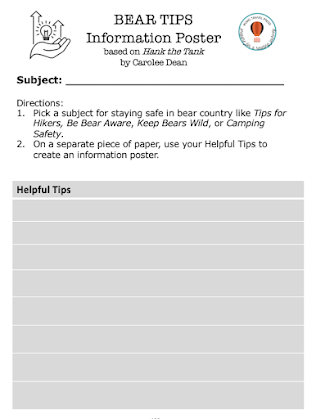
The page below is an excerpt from the Hank the Tank Activity Book that gives directions for creating an Information Poster full of Bear Tips. There are 50+ Activities in the Activity Book as well as connections to online games I have created to work on everything from phonological awareness to cognitive flexibility.
Sign up for my newsletter HERE and receive a free copy of my first decodable book, No Gift for Man. Don't miss any of the fun-filled activities coming up for A Year of AWE: Authentic Writing Experiences.
May 15, 2024
Next Generation Indie Book Award Winner
 My
Hank the Tank Activity Book
has just been named a finalist for the Next Generation Indie Book Awards in the category of Activity Books. The awards banquet will be June 28th in San Diego at the same time as the American Library Association (ALA) Conference. Speaking of ALA, if you happen to be attending, stop by the IBPA (Independent Book Publishers of America) Booth # 1837. The Hank the Tank Activity Book will be on display and so will the decodable book upon which it is based, Hank the Tank: Animal in the Spotlight. Many other unique books by independent publishers will also be available.
My
Hank the Tank Activity Book
has just been named a finalist for the Next Generation Indie Book Awards in the category of Activity Books. The awards banquet will be June 28th in San Diego at the same time as the American Library Association (ALA) Conference. Speaking of ALA, if you happen to be attending, stop by the IBPA (Independent Book Publishers of America) Booth # 1837. The Hank the Tank Activity Book will be on display and so will the decodable book upon which it is based, Hank the Tank: Animal in the Spotlight. Many other unique books by independent publishers will also be available. It's exciting that decodable books and the materials that support those resources are getting more and more attention from the larger book industry. If you'd like information about decodable books, see my web page entitled Choosing the Right Decodable Books for Your Students. I talk about what decodable books are and where to find them. For information about how to set up literacy hubs and acquire decodable books for your school or local library, visit Teach My Kid to Read.
%20(4%20x%202%20in)%20(3%20x%202%20in).png)
The Hank the Tank Activity Book (available at Amazon & Barnes and Noble) is based on Hank the Tank: Animal in the Spotlight, a decodable chapter book, available now in hardcover, paperback, audiobook, and e-book formats at Amazon. You can even read it for free on Kindle Unlimited if you have a membership. You may also find the hardcover and paperback versions at Barnes & Noble or you may order them from your favorite local bookstore. Read more about how to credit local bookstores with online purchases HERE. In addition, Many of the games from the Activity Book are available as digital Boom Cards. See the Hank the Tank Bundle. It includes 15 decks/games and several are FREE.
Preview the first part of the story as well as some of the activities in this FREE ACTIVITY GUIDE PDF DOWNLOAD.

Sign up for my newsletter HERE and receive a free copy of my first decodable book, No Gift for Man. Don't miss any of the fun-filled activities I'm creating for A Year of AWE: Authentic Writing Experiences.
April 20, 2024
Celebrating National Poetry Month - Pandora's Lunch Box
%20(5)%20copy.png)
Poetry is a great example of authentic writing because poetry is meant to be shared. Poems can be used to entertain and may be displayed on classroom walls and halls. They may easily be slipped into a letter to a relative or friend and be given as a gift. Interesting words may even be printed on magnets and hung on refrigerators to inspire family members to create spontaneous lines of poetry.
This month I'm sharing a fun poetry-writing activity based on my new decodable book, The Box. Read my recent post HERE to learn more about the story, my process for creating decodable books, and list poems in general. The Box is on sale for $8.99 for the month of April on Amazon. Watch for the black-and-white chapter book version for older students, Gods and Gifts, coming this summer. It includes the first three books of the series reconfigured as chapters telling the Greek Creation Story.

Now back to Pandora... Imagine that Pandora's Box was a lunch box. What kind of disgusting things might have come out of it? What is something good that might have been left at the bottom? A link to the Free Activity PDF may be found at the bottom of this post.
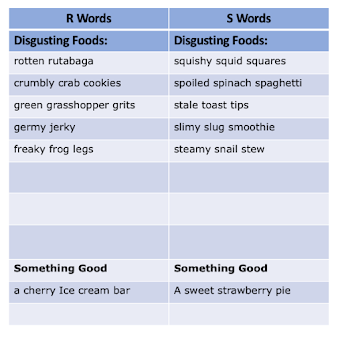
Directions: Start by brainstorming lists of disgusting foods with your students like moldy meatballs, soggy sandwiches, and squishy squid soup. The PDF includes one blank chart and one that already has a few suggestions. Choose whichever one works best for your students.
You may want to focus on word patterns you are studying in class such as consonant-L-silent e (CLe) words like maple, waffle, and apple. Speech-language pathologists might have their students choose words that start with the /r/ sound like rice with lice, bologna rigatoni, and rabbit foot stew or /s/ like spicy spinach spam.
1. Help students brainstorm a list of disgusting foods and write them on the graphic organizer in the PDF.
2. Write down one delicious food at the bottom of the graphic organizer.
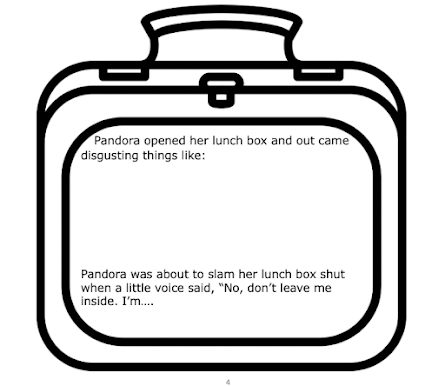
3. Draw a lunch box, use plain brown lunch sacks, or use the lunchbox graphic in the PDF.
4. Write this phrase at the top of the box or sack - Pandora opened her lunch box and out came disgusting things like...
5. Cut out 3 disgusting foods and glue them underneath.
6. Write this phrase near the bottom - Pandora was about to slam her lunch box shut when a little voice said, "No, don't leave me inside, I'm...
7. Cut out the last delicious food item and glue it at the bottom.
Here are some examples from the downloadable PDF:
Get the Free Activity PDF HERE. Sign up for my newsletter HERE and receive a free copy of my first decodable book, No Gift for Man. Don't miss any of the fun-filled activities I'm creating for A Year of AWE: Authentic Writing Experiences.
April 14, 2024
Celebrating Poetry Month with a New Decodable Picture Book in Verse

It's April and I'm celebrating National Poetry Month with the release of my new decodable picture book, The Box. It's a sassy retelling in verse of Pandora's Box. If you have read any of my recent decodable books, you know that I use poetry to create fun ways for older struggling readers to practice syllable patterns. The Box is on sale on Amazon. It is the third installment in the Greek Creation Myth series. You can get the first book No Gift for Man as a free PDF download when you sign up for my newsletter HERE. The second book is The Bandit , a retelling of Prometheus stealing fire for the first humans. Together, these three full-color 32-page picture books form the Greek Creation Myth.
.png)
If you would prefer a chapter book version of the same stories with black and white illustrations for older students, watch for Gods and Gifts coming this summer. It's a 95-page chapter book that includes the same three story poems above. In addition, it is filled with background information about the discovery of fire, the origins of the Greek alphabet, and comparisons to indigenous myths.

To celebrate my new book, I have created a simple and fun poetry-writing activity called Pandora's Lunch Box which will appear in my next blog post. But first, to prepare for that activity, I'd like to talk about list poems and how I use them to create decodable books. Decodable books contain stories that focus on using words with specific syllable patterns. These patterns follow a scope and sequence that has been taught to students using a structured literacy and Science of Reading (SoR) approach. You can read more about decodable books on my WEBSITE.
These are my steps for creating a list poem that also serves as a decodable book:
1. First, I study a list of decodable words that fit a certain pattern. For the three stories in the Greek creation myth, I focused on closed-syllable words. Closed syllables contain only short vowel sounds.
Some of the words for The Box follow a straight consonant-vowel-consonant CVC pattern (tin, box, lid). Some have consonant blends at the beginning of the word - CCVC (spit, slop, trap). Some have consonant blends at the end of a word - CVCC (bend, band, gift). Some of the words have blends at the beginning and the end - CCVCC (craft, swift, swept).There are even some multi-syllable words, which I split into syllables for students who have not learned that skill (dis-tant, at-tic, splen-did, ). If the stressed syllable comes later in the word, I make that syllable bold (dis-con-tent-ment, prob-lem-at-tic, in-dig-nant).
By breaking large words into manageable parts and highlighting certain stressed syllables, I'm able to include more sophisticated words for older students who are ready for higher-level vocabulary but still face challenges with decoding and reading basic syllable patterns.
2. As I study the word lists, an idea begins to emerge for ways to group the words together. Then I come up with a theme or concept. For The Box, I made a list of all of the bad and annoying things that might come out of Pandora's box (mumps, strep, slips, bumps) Then I got a bit silly with my list and added things like dentist drills and rotten eggs.
3. After I generate a list of theme-related words and phrases, I join them together in stanzas of rhyming verse.
Ban-dits with a dras-tic plot,pans that rust and eggs that rot.
Tun-nel traps and den-tist drills.Ants in pants and milk that spills.
You will notice that the lines of poetry above don't follow typical sentence structure patterns. That is often true of poetry. It is the reason that poems are difficult to analyze using grade-level metrics that are based on sentence length.
As mentioned above, the story I created for The Box is based on the structure of a list poem. A list poem focuses on a list of related people, places, things, or ideas with a lead-in and a conclusion. The structure of a list poem works well for my decodable books since the purpose is to provide students a fun way to practice lists of words in a meaningful context.
4. After I write my poem, I create an Introduction to provide additional background information and context. I use the ATOS scale to determine an approximate reading level for that part of the book. The introduction for The Box is written at a fifth-grade reading level which means it can be read independently by students with a fifth-grade reading level and with support by students reading at a fourth-grade level. It may also be read aloud by an adult in a strategy I call Pair and Share Reading. To find more information on how ATOS reading levels are calculated, visit ATOS. Their analyzer tool is free.
5. Finally, I make a list of the words in the poem that don't follow the specified patterns. This list might include irregular words such as was, of, does, or words with concepts and patterns that have not yet been introduced such as th or wh in with, that. when. That way students can practice these words before they read the story poem.
That's it! Then I ask someone familiar with the scope and sequence to proofread my work to make sure I followed the patterns. Another reviewer looks specifically at the rhyme and meter of the poems. Then I find an illustrator. Here is one of the internal illustrations from The Box. It was created by a company called 1000 Storybooks. They also made the cover.

Finally, I create an Activity Book, online games, and an audiobook. I'm still working on those things for The Box. In the meantime, go to the page for COR Instruction on my website to find several free activities for Book 1. Scroll to the bottom to locate the FREE Plot Analysis Activity for the entire three-book Creation Story. Also applicable to all three books are a set of electronic Boom Card games called Four in a Row (similar to Connect 4). This closed syllable deck includes 8 different games that may be used for in person or online learning.
Information about other books and resources may be found on my WEBSITE.
Watch for the FREE Pandora's Lunch Box activity coming in a few days. It will be based on a list poem inspired by The Box.
The word lists I use come from the Sounds In Syllables (SIS) program created by Sandra Dillon and used at the Multisensory Language Training Institute of New Mexico which is currently run by Mary Gilory and Erin Brown. They offer online training for those interested in becoming a dyslexia therapist and a Certified Academic Language Therapist (CALT). This is the training that I went through to get my CALT certification and I highly recommend it. They have a new Summer 2024 Cohort starting June 12 with an Introductory class on Zoom.
Last but not least, sign up for my newsletter HERE and receive a free copy of my first decodable book, No Gift for Man.
April 8, 2024
TOTALITY in Texas - Celebrating the Solar Eclipse
.png)
Friends new and old gathered in the Hill Country of Northeast Texas to watch today's Total Solar Eclipse.
Festivities started on Thursday when several of us arrived at Casa De Milagros in Rainbow, TX to attend an Episcopal Women's Retreat. Casa de Milagros is a beautiful property on the Brazos River with 11 casitas and an outdoor deck for weddings, reunions, retreats, and much, much more. Some of us made plans to stay for the eclipse today since Rainbow was in the path of TOTALITY. A few husbands joined us as well.
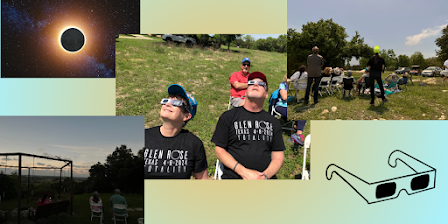
Several women started the day on the deck for morning yoga and a Sun Salutation.

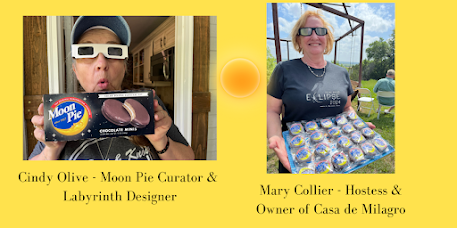
We snacked on Moon Pies provided by Cindy Olive and served up by Mary Collier, the owner of Casa de Milagros. Cindy's daughter had her wedding on the deck shown above. Cindy is the creator of the Labyrinth that sits at the heart of the property.
Mary Collier has created a beautiful retreat for rejuvenation, celebration, fun, and reconnection. There is a .9 mile walking path, a grove of Crepe Myrtles, and kayaking. You will also want to visit Dinosaur Valley State Park while you are here.
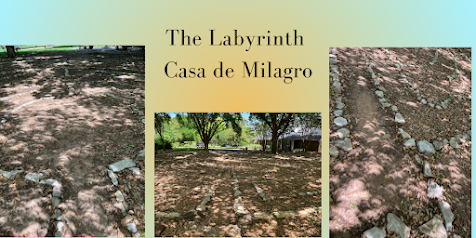
If you look closely at the Labyrinth path below, you can see images of the eclipse appearing as crescents of light.
One of the highlights of the eclipse experience was meeting the Princeton astrophysicist Robert Lupton, Ph.D. He was kind enough to give me an impromptu interview on eclipses which may end up in a future murder mystery involving solar eclipse glasses. I do get story ideas from the most unusual places. Stay tuned for more on that subject.
Eclipses and astrological events have caused awe and wonder throughout the history of mankind. It's no wonder that the cultures of the world have created stories to explain natural phenomena. On that subject, see my latest book for kids - The Bandit: A Greek Myth Retold. It's about Prometheus and the gift of fire. Watch for the third book in the series, The Box coming later this month.

For more information about Casa de Milagros, visit https://casademilagrostx.com/.
To keep up with book news, Sign up for my newsletter HERE. Watch for my new decodable book, THE BOX coming later in April.
March 24, 2024
Celebrating the 75th Anniversary of IDA
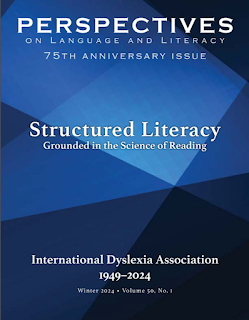
The International Dyslexia Association (IDA) is celebrating its 75th anniversary by offering a FREE Special Anniversary Edition of their highly acclaimed publication, Perspectives on Language and Literacy. You may read the entire Anniversary Edition online HERE. Watch for the downloadable PDF coming soon.
Josh Clark, Chairman of the Board at IDA says, "We are excited about this issue and hope that it will help stakeholders and educators betterunderstand and explain why implementing high-quality Structured Literacy instruction is soimportant. We thank the experts who havededicated their time to creating these articles with the mission of building a common language andframework around Structured Literacy, which will bring awareness, answer questions, and pave theway for effective literacy instruction across the country."
Read the full press release HERE.
There are so many great thought leaders represented in this publication speaking on so many important topics, but the one that really popped for me was the article about creating equity through literacy.
In "Inclusivity and Excellence: Why Structured Literacy is Essential to Safeguard Student's Civil Rights" Kareem Weaver states, "Calls for equity without ensuring that systematic, direct, explicit instruction is provided, open the door for bias and assumption to enter into the classroom." p. 30
Equity is such a hot topic. We hear a lot of information in the media these days about equity. The authors in the Special 75th Anniversary Edition provide a road map for how to get there by empowering children through literacy:
You may join IDA via the MEMBERSHIP page to support the mission of this important organization. Special discounted teacher memberships are only $50. Advocate and parent memberships are only $40. That is less than the cost of one small mocha latte per month. Join Today! Whether or not you decide to join, be sure to explore the many free resources at https://dyslexiaida.org/ such as the Advocacy Toolkit and the downloadable Fact Sheets.On a separate but related note, leaders from IDA branches across the country met in Baltimore for strategic planning March 15-17 to support the IDA sharpened vision of "Structured Literacy for every child in every classroom across the nation and around the world."
While in Baltimore, I stopped by the Edgar Allan Poe Museum before I left to do a little research for my upcoming decodable book, The Raven Remix: A Mash-Up of Poe Titles. Watch this blog for Poe Trivia from my museum visit. Stay tuned for a special poetry writing activity coming in April. Sign up for my newsletter HERE to keep up with book news. Read my March 11 post about Poe's Irish Heritage.
March 11, 2024
Poe's Irish Heritage
.png)
I'm celebrating March, shamrocks, and all things Irish with a bit of Edgar Allan Poe trivia and information about Poe's Irish Heritage. Although his father's family was Scottish, his grandfather, David Poe, was born in Ireland. David Poe left Ireland for America around 1750 with his parents and settled in Baltimore. David Poe fought in the Revolutionary War and the War of 1812. His son, David Poe Jr., Edgar's father, was planning to be a lawyer but pursued acting instead.
Edgar's mother, Eliza, came from England with her mother who was an actress. She joined a traveling acting troupe and Eliza soon began to perform with them. From the young age of nine, Eliza was quite accomplished on stage and had a beautiful singing voice. Her mother died during the yellow fever epidemic of 1798 leaving her an orphan around the age of 11. She stayed with the acting troupe and continued performing with them, and they became her family. She married David Poe Jr. and they had three children. Edgar was born in the theater district in Boston near Carver Street. Although the street no longer exists, the city of Boston has left up the street sign to commemorate the place of Poe's birth.

I was able to visit Carver Street, or what's left of it, while I was in Boston this past November for the ASHA (American Speech-Language-Hearing) Conference. Just around the corner is a lovely statue entitled "Poe Returning to Boston." If you look closely, you can see all sorts of interesting things coming out of Poe's satchel including manuscripts, a raven, and a tell-tale heart. Across the street sits a cemetery.


Although the theater critics loved Poe's mother, Eliza, they were unkind to her husband and often critical of his performances. He left the family when Edgar was two years old. Just before Edgar turned three, his mother died of tuberculosis, and her three children went to live with three separate families. The Allan family took in Edgar but never formally adopted him.
My new book, The Raven Remix: A Mash-Up of Poe Titles will be available in September. Watch for more Poe trivia coming soon. Join my newsletter HERE to keep up with book news and free activities like last week's Boxty Recipe for Irish Potato Pancakes in my post about Sharing Recipes to Celebrate Culture.
March 5, 2024
Sharing Recipes to Celebrate Culture
%20(4).png) Sharing recipes and foods specific to a particular culture is a great way to explore diversity. The Irish may not seem very diverse, but there was a time in our history when we were immigrants. In 1845, a terrible potato famine caused mass starvation throughout Ireland. By 1850, a million people had died. Others chose to leave Ireland looking for a better life. Throughout the 1840s, nearly half of people immigranting to America were Irish. They brought with them their religion, their culture, and their foods.
Sharing recipes and foods specific to a particular culture is a great way to explore diversity. The Irish may not seem very diverse, but there was a time in our history when we were immigrants. In 1845, a terrible potato famine caused mass starvation throughout Ireland. By 1850, a million people had died. Others chose to leave Ireland looking for a better life. Throughout the 1840s, nearly half of people immigranting to America were Irish. They brought with them their religion, their culture, and their foods.Saint Patrick's Day started as a religious holiday honoring the patron saint of Ireland in the Feast of Saint Patrick. He is credited with bringing Christianity to Ireland and explaining the mystery of the Holy Trinity by using a three-leaf clover. Over the years, the religious meaning of the holiday faded, but people still celebrate March 17 as a time to honor Irish culture, mostly through food and a lot of beer.
On the subject of food, when I was a speech-language pathologist serving in public schools, I often used cooking to work on all kinds of receptive and expressive language objectives like following directions, giving directions, planning, sequencing, and problem-solving. I often partnered with the school's occupational therapist who simultaneously worked on fine motor skills like gathering and combing the ingredients and writing down directions.

I don't know about you, but I have never come across a recipe I have not immediately changed in some way. This practice has become more common over the years as I strive to accommodate the gluten and dairy free diets of family members. Collecting a variety of recipes for a specific type of food while comparing and contrasting the type and amount of ingredients in each is a great way to get kids thinking about the practical uses of research. Altering the measurements to make more or less of a dish is a wonderful way to work on fractions and math.
Considering how ingredients work together brings in science and a bit of art. For instance, if you use honey as a substitute for sugar, you may need more dry ingredients to balance the extra liquid. Writing out the directions, step-by-step requires Theory of Mind which is the ability to take another person's perspective by considering what they do or do not understand.
I recently came across a wonderful Irish potato pancake called boxty. The recipe is below. This one has been adapted to be dairy and gluten free. It would be fairly easy to make at home, with a classroom, or in a therapy session. The parent, teacher, or therapist could talk through the directions with the kids while students wrote them down. Many special education classrooms are equipped with kitchens because of the value of cooking as a practical life skill and multi-sensory learning experience. Use special safety precautions when cooking with young children and people with disabilities, or save the sharp and hot parts of the process for the instructor.

Older students could make boxty or another cultural dish of their choice at home and write down the recipe to share with peers. You could have a potato cook-off focusing on how different cultures use potatoes in everything from gnocchi to latkes, patatas bravas, and kartoffelpuffers. Students could write down a brief description of the food and how it relates to their culture and share the experience with the class. For parents and homeschoolers, you might try a potato recipe from a different culture and read about that culture to learn more about it. Finally, assessing what ingredients are needed for a recipe and making a grocery list is another authentic writing opportunity.
Whatever way you slice it, cooking can be a powerful literacy experience.
RECIPE FOR BOXTY
Ingredients:
1 cup mashed potatoes
1 cup grated raw potatoes
1 cup gluten-free flour
1 teaspoon salt
1 teaspoon garlic powder
1 1/2 cups almond milk
1 egg
cooking oil
Directions:
1. Prepare the mashed potatoes ahead of time and put in the refrigerator. Use russet potatoes. They are more starchy than other types of potatoes.
2. Grate one medium potato, approximately one cup. Squeeze out the excess water. You can use your hands or a cheesecloth.

3. Combine the flour salt and garlic powder. Mix together with a whisk to distribute the salt.
4. Add the mashed potatoes and shredded potatoes. Stir.
5. Whisk together the milk and egg in a separate bowl.
6. Add the wet ingredients to the dry ingredients. Stir. The batter should be a little bit thicker than pancake batter. If it's too thick, add more milk. If it's too thin, add more flour.
7. Heat two tablespoons of oil in a skillet.
8. Spoon the batter into the hot skillet and press it down to make it into a flat 3-inch pancake. You can probably fit four pancakes on a skillet.
9. Cook for about 3-4 minutes on one side. Flip the pancake. Cook for another 3-4 minutes. If it is not golden brown, then cook a bit longer.
After you have tried my recipe, make your own variation. For a savory pancake add cheese, bacon bits, or green onions. For a sweeter pancake, add applesauce.
Enjoy!
Sign up for my newsletter HERE and receive a free copy of my first decodable book, No Gift for Man. That way you won't miss any of the fun-filled activities I'm creating for A Year of AWE: Authentic Writing Experiences.