Annie Cardi's Blog, page 54
February 20, 2013
The Glamorous Movie Life of Editoral Assistants
From the Onion, the movie version of publishing:
“After being offered her dream job as an editorial assistant at a high-powered, nationally syndicated magazine last week, area film character Eleanor “Eddie” Edison moved into a beautiful brownstone home in the heart of Brooklyn, sources confirmed. “This place is perfect!” said the attractive, if naively hopeful, protagonist, who graduated with a degree in English/Creative Writing from a well-known northeastern university and now lives in a 5,000-square-foot waterfront property overlooking lower Manhattan.”
Change that around to “writer” and you’d have the same movie scenario, too. For anyone who wants to get into publishing/writing for the money, Amy Poehler has a suggestion:
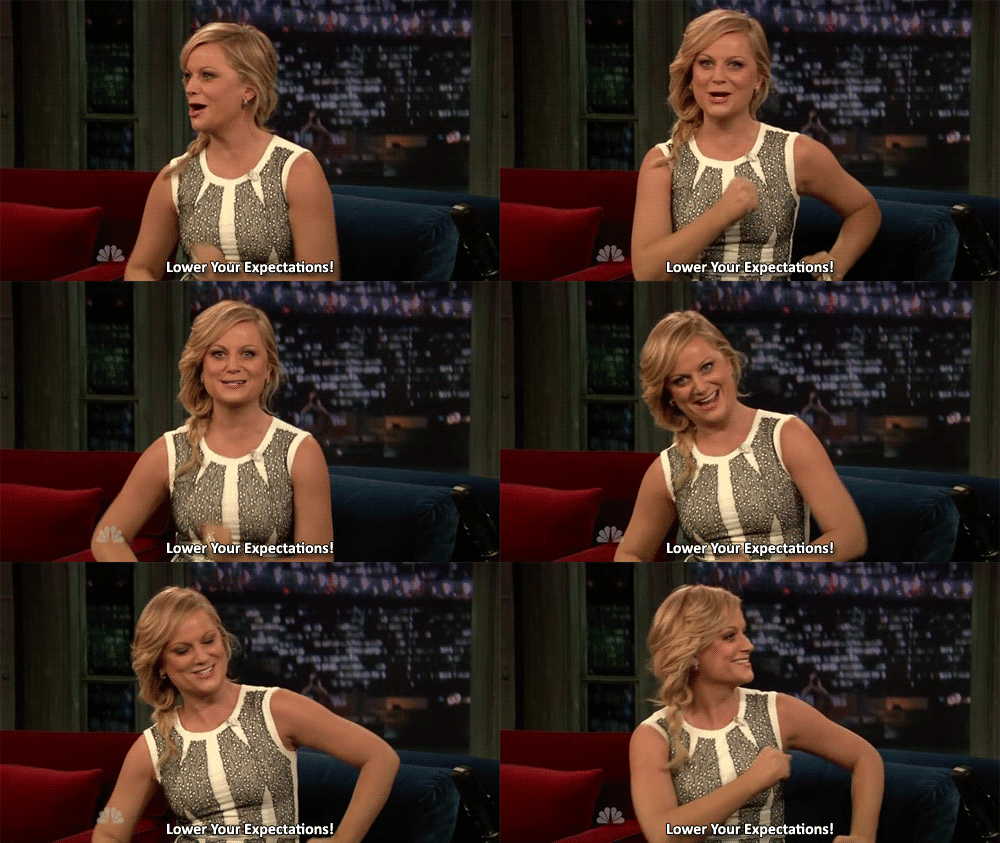
Okay, so those of us in the book world may not have perfect brownstones, but we sure do love literature!


February 19, 2013
Links Galore
A few fun (library love-heavy) links for today:
Have libraries had their day? No way!
Famous writers agree that libraries rock.
Still not convinced? Here’s a giant list of things kids will miss without a school librarian.
The good, the bad, and the ugly in Pride and Prejudice covers.
Excellent post on writing from the transgender perspective–would love to see more books on this list.
I want to print out this post by fellow 2014 debut author Michelle Krys and hand it to anyone who says, “Your book isn’t out yet?”


February 18, 2013
Set the Table
[image error]Plot is exciting. Plot throws your characters into the action and shakes things up and makes you wonder “Oh my gosh, how are they going to get out of this?” You need plot. But what happens to your story if you take away that plot? If we were just left with characters, would we care at all about them and still want to spend time with them?
Ryan Howse’s Table Theory of Characterization suggests we should still care about characters, even when they’re just hanging out. He explains that characters and their regular interactions should be just as compelling as any major plot points. The idea comes from Firefly, so of course I’m on board:
“It comes out of Joss Whedon’s Firefly. Oftentimes, my favorite scenes in the show would simply be listening to the banter of the crew around the dinner table. Whether it was Simon’s birthday or Mal and Zoe talking about the war or Shepherd Book pontificating on rosemary, these scenes were consistently fascinating, with excellent acting and writing.”
Of course, there’s a lot in Firefly that’s exciting and moves the characters along in the plot, but as Howse says, even when they’re hanging out and talking, we still want to be with these characters. The same can easily be said for Harry Potter or His Dark Materials or any number of books that make you feel a deep connection with the characters. We want to hang out with the Order of the Phoenix at Christmas, not in case anything exciting happens, but because we want to be part of this group. The strongest, most exciting plot in the world doesn’t mean anything if you don’t match it with characters who would be just as interesting sitting around a table, talking to each other.
Not to say that plot isn’t important. You need plot to help your characters change and grow. But as Howse says:
“Yet at its core the Table Theory of Characterization is merely meant to be a starting place for making certain the characters are not merely ciphers for the plot, but truly fleshed out people with their own idiosyncratic goals, histories, personalities, and relationships.”
This is what I think makes the difference between a pretty interesting story and a story that really connects with readers. No matter what you’re writing–YA literature, a television show, an epic fantasy series, etc.–you need characters we want to sit around a table with and talk to.


February 15, 2013
Friday Fifteen
Another Friday, another Friday Fifteen! Check out this week’s best (only?) fifteen-word book reviews:
 1. Little Women by Louisa May Alcott
Still bitter that Jo ended up with Bhaer, who was down on her fiction.
2. Troubling a Star by Madeleine L’Engle
Feels out of place among the other Austins, especially after A Ring of Endless Light.
3. High Fidelity by Nick Hornby
Hornby captures an honest, relatable (if not always likable) voice.
4. The Messy Room by Stan and Jan Berenstain
Mama Bear loses it when Brother and Sister can’t clean up their stuff.
5. Mockingjay by Suzanne Collins
Collins provides a powerful look at how war sucks for everyone. Even the “winners.”


Quote of the Day
Valentine’s Day got a little away from me, so this is a day late, but no less swoon-y. When I was in middle school, one of my very favorite books was Cyrano de Bergerac. Poetry, fencing, unrequited love–what more could a shy middle schooler want? I must have read it a dozen times. It’s also the source of one of my favorite romantic quotes:
A kiss, when all is said,—what is it?
An oath that’s ratified,—a sealed promise,
A heart’s avowal claiming confirmation,—
A rose-dot on the ‘i’ of ‘adoration,’—
A secret that to mouth, not ear, is whispered,—
Brush of a bee’s wing, that makes time eternal,—
Communion perfumed like the spring’s wild flowers,—
The heart’s relieving in the heart’s outbreathing,
When to the lips the soul’s flood rises, brimming!
If you haven’t seen/read Cyrano yet, I’d recommend checking it out. Share your favorite romantic quotes in the comments!


DFTBA, America
Worlds collide when John Green was invited to appear in President Obama’s Google+ Hangout. See the results below:
Smooth move, Obama. I also love how this brings together the world of YA and the world of politics. When I was a teen, I wasn’t that involved in politics. I didn’t see it as something I could have any part in and, frankly, found it kind of boring. (Totally untrue on both counts, but there you have it.) But videos like this could make teens feel like politics is a approachable, which could lead them to finding ways to get involved and get their voices heard.
Also, I’m voting for Eleanor.


February 14, 2013
Hearts on a String
Happy Valentine’s Day, everybody! I know it’s not a happy holiday for everyone, but I think it should be. Valentine’s Day is a chance to share all kinds of love–love for your friends, love for your family, love for your partner, etc. And you can do things your own way. Bake cookies, play board games, put on music and dance like crazy, go to a basketball game, curl up with a favorite collection of short stories–whatever you and your favorites like to do.
In case you’re still looking for ways to share your love, I suggest checking out these adorable bookish Valentine’s Day crafts. My favorite:

This garland would be fun to keep up year-round.
Hope you’re all having a great Valentine’s Day. Cool plans with loved ones? Share in the comments!
(image: Book Riot)


February 13, 2013
Links Galore
A few more fun links for today:
Old English is new again–Beowulf is now online.
Maybe the grammar snob in me should relax.
Selecting books for awards is a huge job that doesn’t necessarily land you with a book that everyone loves. (There’s a chocolate metaphor in there, too, which left me hungry.)
An excellent post on how sexuality is portrayed for female protagonists in YA.
Color coding dystopian novels.
How has it been 15 years since Harry Potter was first published?! Good thing we have lovely new covers to help me get over the shock.


Becoming an Artist
A touching video in which children’s book author/illustrator Jarrett Krosoczka talks about how he became an artist.
“He liked making this book” might be the best line in any author bio I’ve ever seen. I also love how he talks about the support he got from his grandparents and his teachers. Even though writing/illustrating requires a lot of work and you have to power through a lot of challenges, as Krosoczka details, but having a wonderful support system can make all the difference. And I love that Krosoczka set up a scholarship in his grandparents’ honor. What a beautiful way to keep the support going.
(via SCBWI: The Blog)


February 11, 2013
Epiphanies Don’t Last
At the Atlantic, author Jim Shepard looks at Flannery O’Connor’s famous short story “A Good Man is Hard to Find” and what it tells us about character epiphanies. As much as we may want characters to have epiphanies that change their lives for the better, these moments of clarity don’t always last–just like in real life. You tackle a pile of Valentine’s Day candy, get sick and vow to give up chocolate forever, and soon you’re back on the chocolate horse. (Mmm…anyone want chocolate now?) Humans are used to running into the same problem again and again.
But that doesn’t mean epiphanies aren’t worthwhile in fiction As Shepard says:
“But you still don’t want to write them off. The fact that there’s a brevity to human connection and human empathy—the fact that it goes away—might make you feel that we should not make a big deal that it was there at all. But of course we can’t do that. We have to value the moments when a person is everything we’d hope this person would be, or became briefly something even better than she normally is. We need to give those moments the credit they’re due. The glimpse of this capacity is part of what allows you to write characters who are so deeply flawed. Given that so much great literature is about staggering transgression, knowing that that capability of striving for something better is crucial for keeping you reading.”
Epiphanies aren’t so much about change as they are about hope. The possibility of being better. Striving to overcome our flaws. It’s a nice balance to those deep flaws that make so many characters so interesting.
So what does that mean for YA fiction? One thing I like about YA is that it’s essentially a coming-of-age genre. How can characters make choices and have realizations that define their lives while acknowledging that epiphanies aren’t necessarily life-changing? As with any fiction, it’s about the hope. And a lot of times, I think YA provides a greater capacity for hope. It’s okay if your characters aren’t perfect, changed people by the end of the book. They’re still going to run into problem and resort to old behaviors. They haven’t figured everything out yet–and that’s okay. But they’re learning and they’re growing. Even if this story encapsulates the most important moments of their lives, they’re still going to spend the rest of their lives making mistakes and learning from them. YA provides an opportunity to look at lots of first epiphanies as teen narrators navigate the world and their own challenges and strengths for the first time.
In general, I like fiction with complicated characters who don’t always get the easy out. But that doesn’t mean we can’t get a satisfying ending, either. It’s all about the hope that we can be better.