Sara Horn's Blog, page 3
November 3, 2014
Reader Survey Results (and the winner!)
Thank you to all of you who participated in my Reader Survey last month! I heard from 171 of you and your feedback was extremely helpful. My goal and my desire in everything I write – whether it’s on this blog, or in my books, or even in the messages I prepare and share at retreats and conferences – I want to meet you where you are, encourage you in your journey, and point both of us to the hope we have in Christ through all of it!
Congratulations to Brooke M. from North Carolina!
Congrats to Brooke! Your survey was chosen as the winner! You will receive the Love HIS Way prize pack – copies of My So-Called Life as a Proverbs 31 Wife and My So-Called Life as a Submissive Wife AND that adorable Laundry sign! Enjoy!

Survey Results
I thought some of you might like to know what the results were.
BY GENDER:
168 women (98.2%)
3 men (1.8%)
BY AGE:
18-25….. 9 (5.3%)
26-30…. 29 (17%)
31-40…. 83 (48.5%)
41-50…. 29 (17%)
51-60…. 13 (7.6%)
60+ …….. 8 (4.7%)
BY EDUCATION:
Some H.S.………… 1 (.6%)
H.S. ………………. 15 (8.8%)
Some college.… 80 (46.8%)
Bachelor’s……… 41 (24%)
Grad. Deg……… 34 (19.9%)
MARITAL STATUS:
Single…………………….. 2 (1.2%)
Married ………… 160 (93.6%)
Separated ……….. 1 (.6%)
Divorced …………. 2 (1.2%)
Divorced/Remrd..… 6 (3.5%)
NUMBER OF CHILDREN:
0 ………………………………16
1 ……………………………… 24
2 ……………………………… 57
3 ……………………………… 43
4 ……………………………… 19
5 …………………………….. 7
10 …………………………… 1
CHILDREN’S AGES:
NB – 2yo …………………….. 42
3-5 ……………………………… 60
6-10 ……………………………. 71
11-13 …………………………. 23
13-15 …………………………. 23
16-18 …………………………. 28
19-25 …………………………. 31
26 and up ………………….. 25
HOW READERS DESCRIBE THEMSELVES
As a spouse: 122
As a parent: 118
As a homemaker: 102
As a military spouse: 60
Other: 38
As a teacher: 34
As a ministry leader: 29
As a writer/blogger: 16
As a professional: 15
As a pastor’s wife: 7
As a full-time student: 6
BLOG TOPICS YOU ENJOY MOST
Marriage: 153
Faith: 136
Family: 151
Military: 57
Writing: 30
YOUR TOP FOUR BIGGEST CHALLENGES
Not enough time: 90
Not enough patience: 77
Not enough money: 67
Not enough confidence: 64
YOUR TOP FOUR – CONTENT YOU WANT MORE OF
Practical tools and resources to be a better spouse: 114
Strategies to keep God first: 105
Encouragement in daily living: 94
Solid biblical teaching: 92
A FEW OF MY FAVORITE COMMENTS YOU SHARED
“I just started reading all your books and I have noticed a change (for the better) in my life. Just wanted to say thank you.”
“You and your story of becoming a P31 wife and mother was so inspirational to me! I am trying a similar experiment… let’s see how it goes!”
“I appreciate your commitment to writing stuff that helps military spouses. We had a military spouses bible study at our church that after one year they stopped doing because they felt it made non military spouses feel left out. We loved your stuff so much we decided to keep it going outside of our church. Right now we are going through the Proverbs 31 woman book right now and it is wonderful. Thank you for what you do to help keep us moving closer to God.”
“I am so grateful for the experiences you share. It is the first time I learned that Christians are not expected to perfect!”
and my absolute hands-down favorite one….
“You have a great blog! A lot that helped me. I first found you when I wanted to throw a pillow at my sleeping husbands jerky face one night. Instead, I googled “when your husbands being a jerk”, I found your blog and it was just what I needed to hear. I was part of the problem as well, go figure. You reminded me that I can’t change his jerkiness he may be displaying at that moment but I can change myself and my attitude towards him. Thank you :)”
Thank you!
Thanks again for taking the time to answer my reader survey. I have another one ready to go, if you’d like to participate! To see the prize pack and the survey, go here.
Until next post, I’ll be busy working on new content just for you, and hopefully still saving one husband’s jerky face from a pillow at a time. HA!!
The post Reader Survey Results (and the winner!) appeared first on Sara Horn.


October 30, 2014
5 Easy Ways Women Focus on Time to Pray
When you’re a busy wife, mom, business owner, employee, ministry leader or church volunteer, there are a few things you know you always need.
A good calendar.
A good system to manage everything you have to remember.
A couple of favorite restaurants on speed dial for last minute takeout when dinner disasters strike.
Seven to eight uninterrupted hours of sleep.
An hour of exercise a day to keep those brain cells sharp and those oxygen levels at peak performane.
I’m guessing a couple of you chuckled at those last two and you may be thinking… – really? Sleep? What’s that? My 5-month old doesn’t know what that is. Exercise? You mean when I’m rushing the kids out the door, or chasing the kids back to bed after their 50th billion time to get up and say “I’m thirsty”?

We’ve talked this week about spiritual growth. Following God’s direction. Understanding the Bible more. Today I want us to talk about prayer, because finding time to pray is just as important to our spiritual health as finding time to sleep is for our physical health – and yet, we don’t always place either of those as priorities like we should.
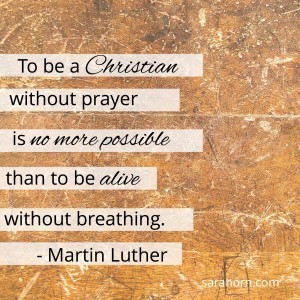
Martin Luther once said that “To be a Christian without prayer is no more possible than to be alive without breathing.”
This is so true. As wives, as mamas, as women who others depend on in such a variety of ways, we need to make sure we depend on God in everything we do, and that dependence starts with prayer.
So here are some ideas I hope will encourage you to see prayer as less of something you have to “fit in” and as more of something you know you can’t go without. What other ways can you incorporate prayer into your life? Share with me in the comments!
5 Easy Ways Women Focus on Time to Pray
1. They get up a little earlier.
If you’re not a morning person, this one may not feel like such a great solution. Your pillow sounds a whole lot better! But setting your alarm even 15 minutes earlier can give you those few minutes you need to collect your thoughts for the day and give them to God. By asking Him for His lead and guidance on your to-do-list, your scheduled plans and even your not-yet-scheduled plans, He can give you the start and the confidence you need to face whatever comes.
2. They have a set routine.
Some women don’t like routine, but many do, and if you’re able to have daily habits you do, be sure prayer is one of them. Unless I’m traveling, I typically try to have a routine that looks like this: I get up by 5 a.m., and I shower and dress before my son is up. I feed the dogs, empty the dishwasher, make my son some breakfast (and my husband, too, if he wants it) and spend some time with Caleb before I drive him to school. After I come home, I make a cup of hot tea, grab my Kindle (which I use for my daily Bible reading) and then I spend about 10 minutes praying. Sometimes it’s more, sometimes it’s less. But I know when I don’t do it, I can tell a big difference in my attitude and my spirit.
3. They use reminders.
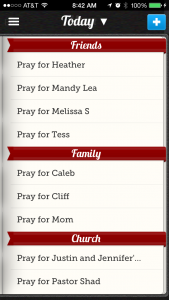
One of the best things I have done to develop a good consistent prayer time is to use a prayer app (yes, there are apps… even for that). I use the Prayer Notebook, which I love because you can set up different categories, assign different prayer needs for different days, and set alarms if there are requests you want to pray for at specific times, or just at various times during the day. But you don’t have to be high-tech for your reminders. You may prefer a prayer journal, or prayer cards you keep in a little recipe box on the kitchen counter. Having a reminder or a list of prayer needs you want to bring before the Lord is a great way to remember some of the reasons for WHY we pray in the first place. (Philippians 4:6).
4. They pray when they can.
Sometimes I think women convince themselves that a prayer time requires a literal prayer room or prayer closet where you can go in, shut the door, light some candles, and spend an hour or two alone with God. Sounds wonderful – but not very likely when you’re a busy lady! Billy Graham is known for constantly praying throughout his life, even in his early years of ministry, taking long walks to pray, and when he couldn’t take walks, praying throughout the day, even as he went from meeting to meeting or event to event.
 He likely modeled his constant prayer life after Jesus, who we often see in the Bible going off to pray, in between healing the sick, preaching to the people and instructing and sometimes correcting His disciples. Keep the radio off and pray in the car after you drop the kids off at school, or on your way to work. If you homeschool, incorporate prayer time in your school day or if your children are young, during nap time. If you have a little one who still needs those nighttime feedings, use those times as scheduled times to pray as you rock your baby back to sleep. There will never be “perfect” times to pray. But we can always make time to pray…. when we’re intentional about it.
5. They pray where they are.
Pray for your kids when you’re making them their lunches for the day. Pray for your friends when you get a text from one of them. Pray for your husband when you hear him singing in the shower. Pray for your co-worker when you get their email. Keeping God as our consistent focus during the day helps us keep our attitude of prayer close, as we keep Him even closer.
Do you struggle with knowing how to pray? Or finding time to pray? What’s the hardest thing that keeps you from praying consistently?
The post 5 Easy Ways Women Focus on Time to Pray appeared first on Sara Horn.
5 Ways Busy Women Find Time to Pray
When you’re a busy wife, mom, business owner, employee, ministry leader or church volunteer, there are a few things you know you need. A good calendar, a good system to manage everything you have to remember, a couple of favorite restaurants on speed dial for last minute takeout when someone forgot to turn the slow cooker on before she left the house for the day, and at least 7-8 uninterrupted hours of sleep and if you’re lucky, an hour of exercise a day (to make up for the fast-food you ate with that whole slow cooker dibacle.)
I’m guessing a couple of you chuckled at those last two and you just may be thinking… – really? Sleep? What’s that? My 5-month old doesn’t know what that is. Exercise? You mean when I’m rushing the kids out the door, or chasing the kids back to bed after their 50th billion time to get up and say “I’m thirsty”?
To be fair, I did say things you “know” you need. Not necessarily things you always have.
We’ve been talking this week about spiritual growth. Following God’s direction. Understanding the Bible more. Today I want us to talk about prayer, because finding time to pray is just as important to our spiritual health as finding time to sleep is for our physical health – and yet, we don’t always place either of those as priorities like we should.
Martin Luther is quoted as saying “To be a Christian without prayer is no more possible than to be alive without breathing.”
This is so true. As wives, as mamas, as women who have others depending on us in such a variety of ways, we need to make sure we’re depending on God in everything we do, and that dependence starts with prayer.
So here are some ideas I hope will encourage you to see prayer as less of something you have to “fit in” and as more of something you know you can’t go without. What other ways do you have to incorporate prayer into your life? Share with me in the comments!
5 Ways Busy Women Find Time to Pray
1. They get up a little earlier. I know, if you’re not a morning person, this one may not feel like such a great solution. Your pillow sounds a whole lot better! But setting your alarm even 15 minutes earlier can give you those few minutes you need to collect your thoughts for the day and give them to God. Asking Him for His lead and guidance on your to-do-list, your scheduled plans, your not-yet-scheduled plans can give you the start and the confidence you need to face whatever comes.
2. They have a set routine. Some women don’t like routine, but many do, and if you’re able to have daily habits you do, be sure prayer is one of them. Unless I’m traveling, I typically try to have a routine that looks like this: I get up by 5 a.m., and I shower and dress before my son is up. I feed the dogs, empty the dishwasher, make my son some breakfast (and my husband, too, if he wants it) and spend some time with Caleb before I drive him to school. After I come home, I make a cup of hot tea, grab my Kindle (which I use for my daily Bible reading) and then I spend about 10 minutes praying. Sometimes it’s more, sometimes it’s less. But I know when I don’t do it, I can tell a big difference in my attitude and my spirit.
3. They use reminders. One of the best things I have done to develop a good consistent prayer time is to use a prayer app (yes, there are apps… even for that). I use the Prayer Notebook, which I love because you can set up different categories, assign different prayer needs for different days, and set alarms if there are requests you want to pray for at specific times, or just at various times during the day. But you don’t have to be high-tech for your reminders. You may prefer a prayer journal, or prayer cards you keep in a little recipe box on the kitchen counter. Having a reminder or a list of prayer needs you want to bring before the Lord is a great way to remember some of the reasons for WHY we pray in the first place. (Philippians 4:6).
4. They pray when they can. Sometimes I think women convince themselves that a prayer time requires a literal prayer room or prayer closet where you can go in, shut the door, light some candles, and spend an hour or two alone with God. Sounds wonderful – but not very likely when you’re a busy lady! Billy Graham is known for constantly praying throughout his life, even in his early years of ministry, taking long walks to pray, and when he couldn’t take walks, praying throughout the day, even as he went from meeting to meeting or event to event.
He likely modeled his constant prayer life after Jesus, who we often see in the Bible going off to pray, in between healing the sick, preaching to the people and instructing and sometimes correcting His disciples. Keep the radio off and pray in the car after you drop the kids off at school, or on your way to work. If you homeschool, incorporate prayer time in your school day or if your children are young, during nap time. If you have a little one who still needs those nighttime feedings, use those times as scheduled times to pray as you rock your baby back to sleep. There will never be “perfect” times to pray. But we can always make time to pray…. when we’re intentional about it.
5. They pray where they are. Pray for your kids when you’re making them their lunches for the day. Pray for your friends when you get a text from one of them. Pray for your husband when you hear him singing in the shower. Pray for your co-worker when you get their email. Keeping God as our consistent focus during the day helps us keep our attitude of prayer close, as we keep Him even closer.
Do you struggle with knowing how to pray? Or finding time to pray? What’s the hardest thing that keeps you from praying consistently?
The post 5 Ways Busy Women Find Time to Pray appeared first on Sara Horn.
October 28, 2014
10 Simple Ways to Improve Your Understanding of the Bible
As Christians, reading and understanding the Bible is key to growing in our understanding of God – and important if we want to deepen and grow our relationships with Him. But many of us aren’t exactly sure of how to do that.
I get it. I’ve been there. It’s hard knowing where to start. It’s hard knowing what something means – or where to go to find out. Add everything else you’re doing with all your many roles – a wife, a mom, an employee, a PTO volunteer, chaffeur, family activity coordinator, vacation planner, to name just a few – and it’s easier to quit before you even attempt to even try! There’s only so much time in a day, right?

But when we apply God’s Word to our hearts, we add rich fuel to our souls. And if we want strength and wisdom and direction for our marriages and our kids and everything else we’re doing – understanding the Bible can’t be optional.
We have to start somewhere. So scan this list and choose one you’ll tackle this week, or for a couple of weeks. Got it down? Pick another one. You’ll find your understanding of the Bible quickly gaining altitude.
10 Simple Steps to Better Understand the Bible
1. Choose a different translation.
Sometimes we get stuck in habits or preferences that no longer help us or make us better, and our Bible study can experience the same type of limbo. If you find your eyes glaze over every time you try to sit down and read your Bible, a trip to your local Christian bookstore may be part of the solution. The first time I ever successfully read through the Bible in a year, I used the Message translation. While not a literal interpretation but a paraphrase, the contemporary language gave me fresh eyes and helped me be open to what God wanted to show me. I grew deeper that year in my desire to understand God’s Word and spend more time reading it, and that excitement carried over in the years that have followed.
2. Read to enjoy before trying to understand.
When you haven’t spent much time reading the Bible, it can be difficult to understand certain sections or specific books when you first start. Get in a habit of reading before you attempt any studying. Develop the habit of a regular Bible reading time first, before you try breaking down what a specific word means, or understanding what the Greek or Hebrew root actually refers to. Once reading feels natural to you, asking questions and finding answers will come much easier.
3. Try chunks before chapters.
If you’re not really a reader to begin with (less than 1% of Americans are!), telling yourself you need to read 5 chapters a day of the Bible may not work for you. So read in chunks. Pick 10 verses, or 5, or 20. The goal is to start somewhere.
4. Use a journal.
We all vary in ways we like to learn, and for some, writing or copying things down is one way you can better focus and remember something. Find or purchase a little spiral-bound notebook you can use as a scripture journal. Each time you sit down to read your Bible, write down one or two scriptures that make an impression on you. Include what God says to you through those verses and why they’re so meaningful.
5. Read by topic.
If reading through the Bible in a year seems overwhelming, than start by reading portions of the Bible on a topic that interests you most. There are many topical reading plans available online, or in books that offer lists of scriptures. Maybe you need scriptures that can apply to your life as a busy mom, or you’re dealing with fear and want to know what God’s Word says about that. Here are a few to get you started:
6. Start with one specific book.
If reading the entire Bible sounds completely overwhelming and impossible with your schedule, than start with one book. Read the Gospel of John, or Genesis or Exodus, the Psalms or the book of Proverbs (with 31 chapters, you could read one chapter a day in a month).
7. Ask questions. When you read something you aren’t sure about, or one question you have leads to another, don’t be afraid to ask someone for an answer. I have a dear friend who is a fairly new believer. She often feels intimidated by others in her Sunday school class. She thinks everyone must know more about the Bible than she does, so she’s always reluctant to ask a question when she doesn’t understand something. But asking questions helps us find the answers. Ask your pastor, ask your Sunday school teacher, ask Google (but be cautious – not every source on the Internet is a good one – contrary to the commercial that says if it’s on the Internet, it must be true!) Some good websites to go to for research and references: BibleGateway.com, Bible.org, BibleStudyTools.com, StudyLight.org, and BibleHub.com.
8. Use a devotional. Sometimes it’s helpful to start with using a devotional – there are many out there to choose from, with a wide range of topics. Some have one author, some have many. Some focus on specific topics like parenting or marriage; others aren’t so specific. A good devotional will focus on specific scripture, and then share a story or thought for the day that helps offer life application in reference to that scripture. Try to avoid devotionals that simply tell stories and try to fit a scripture in just for the sake of fitting a scripture in. When we approach reading God’s Word, we want to read it for what it says – not for what we want to try and make it say. My favorite devotional I’ve repeatedly used over the years, and am using this year is My Utmost for His Highest but there are many worth trying. Ask your friends what they’re using.
9. Pray for understanding. Before you begin reading, take a moment and pray for God to help you read what He wants you to learn. Ask Him for eyes to see, ears to hear, and a heart open to receiving His Word for your life. Expect to learn from what you read – and be ready to act on it! If praying to God doesn’t come easy for you, or you’re not exactly sure what to say, or how to pray, then I hope you’ll come back for my next post. We’re going to talk about 7 Ways Busy Women Find Time to Pray.
10. Apply scripture to memory.
If you have no time to sit down and read on a regular basis, then make time each day to focus on one scripture verse and put it to memory. Use notecards and keep a scripture verse in your car, or on your bathroom mirror, or on the refrigerator in your kitchen, where you can be reminded. Or do what I do, and use an app. My favorite scripture memory app is Scripture Typer. I’ve used it while waiting in the doctor’s office, or sitting in my car in the car line, waiting to pick up my son. We can find what works for us, when we make Bible learning a priority for our lives.
Has this list been helpful for you? What else would you add? If you know a friend who is struggling to find time to read or better understand the Bible, please share this post with them! And if you haven’t signed up to be one of my subscribers, let me invite you to do that now, so you can be sure you won’t miss a post.
The post 10 Simple Ways to Improve Your Understanding of the Bible appeared first on Sara Horn.
10 Simple Steps to Better Understand the Bible
As Christians, reading and understanding the Bible is key to growing in our understanding of God – and important if we want to deepen and grow our relationships with Him. But many of us aren’t exactly sure of how to do that.
I get it. I’ve been there. It’s hard knowing where to start. It’s hard knowing what something means – or where to go to find out. Add everything else you’re doing with all your many roles – a wife, a mom, an employee, a PTO volunteer, chaffeur, family activity coordinator, vacation planner, to name just a few – and it’s easier to quit before you even attempt to even try! There’s only so much time in a day, right?
But when we apply God’s Word to our hearts, we add rich fuel to our souls. And if we want strength and wisdom and direction for our marriages and our kids and everything else we’re doing – understanding the Bible can’t be optional.
We have to start somewhere. So scan this list and choose one you’ll tackle this week, or for a couple of weeks. Got it down? Pick another one. You’ll find your understanding of the Bible quickly gaining altitude.
10 Simple Steps to Better Understand the Bible
1. Choose a different translation.
Sometimes we get stuck in habits or preferences that no longer help us or make us better, and our Bible study can experience the same type of limbo. If you find your eyes glaze over every time you try to sit down and read your Bible, a trip to your local Christian bookstore may be part of the solution. The first time I ever successfully read through the Bible in a year, I used the Message translation. While not a literal interpretation but a paraphrase, the contemporary language gave me fresh eyes and helped me be open to what God wanted to show me. I grew deeper that year in my desire to understand God’s Word and spend more time reading it, and that excitement carried over in the years that have followed.
2. Read to enjoy before trying to understand.
When you haven’t spent much time reading the Bible, it can be difficult to understand certain sections or specific books when you first start. Get in a habit of reading before you attempt any studying. Develop the habit of a regular Bible reading time first, before you try breaking down what a specific word means, or understanding what the Greek or Hebrew root actually refers to. Once reading feels natural to you, asking questions and finding answers will come much easier.
3. Try chunks before chapters.
If you’re not really a reader to begin with (less than 1% of Americans are!), telling yourself you need to read 5 chapters a day of the Bible may not work for you. So read in chunks. Pick 10 verses, or 5, or 20. The goal is to start somewhere.
4. Use a journal.
We all vary in ways we like to learn, and for some, writing or copying things down is one way you can better focus and remember something. Find or purchase a little spiral-bound notebook you can use as a scripture journal. Each time you sit down to read your Bible, write down one or two scriptures that make an impression on you. Include what God says to you through those verses and why they’re so meaningful.
5. Read by topic.
If reading through the Bible in a year seems overwhelming, than start by reading portions of the Bible on a topic that interests you most. There are many topical reading plans available online, or in books that offer lists of scriptures. Maybe you need scriptures that can apply to your life as a busy mom, or you’re dealing with fear and want to know what God’s Word says about that. Here are a few to get you started:
6. Start with one specific book.
If reading the entire Bible sounds completely overwhelming and impossible with your schedule, than start with one book. Read the Gospel of John, or Genesis or Exodus, the Psalms or the book of Proverbs (with 31 chapters, you could read one chapter a day in a month).
7. Ask questions. When you read something you aren’t sure about, or one question you have leads to another, don’t be afraid to ask someone for an answer. I have a dear friend who is a fairly new believer. She often feels intimidated by others in her Sunday school class. She thinks everyone must know more about the Bible than she does, so she’s always reluctant to ask a question when she doesn’t understand something. But asking questions helps us find the answers. Ask your pastor, ask your Sunday school teacher, ask Google (but be cautious – not every source on the Internet is a good one – contrary to the commercial that says if it’s on the Internet, it must be true!) Some good websites to go to for research and references: BibleGateway.com, Bible.org, BibleStudyTools.com, StudyLight.org, and BibleHub.com.
8. Use a devotional. Sometimes it’s helpful to start with using a devotional – there are many out there to choose from, with a wide range of topics. Some have one author, some have many. Some focus on specific topics like parenting or marriage; others aren’t so specific. A good devotional will focus on specific scripture, and then share a story or thought for the day that helps offer life application in reference to that scripture. Try to avoid devotionals that simply tell stories and try to fit a scripture in just for the sake of fitting a scripture in. When we approach reading God’s Word, we want to read it for what it says – not for what we want to try and make it say. My favorite devotional I’ve repeatedly used over the years, and am using this year is My Utmost for His Highest but there are many worth trying. Ask your friends what they’re using.
9. Pray for understanding. Before you begin reading, take a moment and pray for God to help you read what He wants you to learn. Ask Him for eyes to see, ears to hear, and a heart open to receiving His Word for your life. Expect to learn from what you read – and be ready to act on it! If praying to God doesn’t come easy for you, or you’re not exactly sure what to say, or how to pray, then I hope you’ll come back for my next post. We’re going to talk about 7 Ways Busy Women Find Time to Pray.
10. Apply scripture to memory.
If you have no time to sit down and read on a regular basis, then make time each day to focus on one scripture verse and put it to memory. Use notecards and keep a scripture verse in your car, or on your bathroom mirror, or on the refrigerator in your kitchen, where you can be reminded. Or do what I do, and use an app. My favorite scripture memory app is Scripture Typer. I’ve used it while waiting in the doctor’s office, or sitting in my car in the car line, waiting to pick up my son. We can find what works for us, when we make Bible learning a priority for our lives.
Has this list been helpful for you? What else would you add? If you know a friend who is struggling to find time to read or better understand the Bible, please share this post with them! And if you haven’t signed up to be one of my subscribers, let me invite you to do that now, so you can be sure you won’t miss a post.
The post 10 Simple Steps to Better Understand the Bible appeared first on Sara Horn.
October 27, 2014
How to See God’s Direction When You’re a Little Lost
Some people are blessed with a gift I only wish I had: a sense of direction. I’m not talking about understanding God’s direction for your life (we’ll get to that in a few minutes) – but literally – knowing the direction you need to go, when you need to go there.
Understanding where I am and arriving where I want to go isn’t a skill I’ve spent any time developing, I’m sorry to say. Why would I? Isn’t that why God created GPS?
You might agree, though, it’s pretty bad when you need a GPS to walk three blocks.

But that’s what I did when I stopped at the MetroCenter in D.C. for an event at the National Press Club. My first thought walking out of the station into the bright afternoon sun was to type the address on my phone’s handy little Maps app and hit ‘start’. But as Siri told me in her very nasal but familiar tone of where to go, I froze and started arguing with myself in my head (do you do this too?):
I can’t have this thing talking to me as I’m walking, unless I want EVERYONE knowing how directionally clueless I am. And that I’m ‘not from around here.’ Why not just hold a neon sign that says “ROB ME” for all of the pickpockets and criminals I’m sure are just waiting at 4:30 in the afternoon on a really bright sunny day for GPS-on-phone-focused, directionally-challenged visitors like myself?
div.TT_wrapper {
margin: 23px auto 25px;
padding: 10px 15px;
width: 80%;
}
div.TT_wrapper div.TT_text {
font-size: 21px;
line-height: 140%;
}
div.TT_wrapper div.TT_footer {
border-top: 1px solid #cdcdcd;
margin-top: 11px;
}
div.TT_wrapper div.TT_footer a {
color: #666;
font-size: 16px;
text-decoration: none;
}
div.TT_wrapper div.TT_tweet_link_wrapper img {
float: left;
margin-right: 6px;
margin-top: -5px;
}
div.TT_wrapper div.TT_tweet_link_wrapper {
padding: 10px 5px 0 0;
}
It’s pretty bad when you need a GPS to walk three blocks.
 Tweet This
Then I had a brilliant idea. Noticing all of the people passing me by on the sidewalk with headphones over their ears, I decided to blend in like the locals and quickly pulled out my own earbuds. Clever, right?
Now I had the reassuring voice of Siri in my ear and the map with the little dot on my phone and no one around me knew any different. Nothing could go wrong now. Problem solved!
Directions Aren’t Always So Obvious
With phone in hand, I casually but purposefully headed in the direction the map displayed and listened for the next verbal set of instructions from my invisible tour guide. But after walking about 500 feet, I realized I’d missed something because my walk suddenly increased three more minutes. This wasn’t a good option on a very unusually warm October day in the nation’s capital. So I turned around and doubled back, and tried it again.
I walked another 500 feet, still following the moving dot on the gps in my hand, but sure enough, I STILL wasn’t going the right way.
(Y’all. I told you. Directionally challenged. Even with a GPS. Is there a support group for people like me?)
Yes, my current direction might get me to my destination, but not by the best, most direct way.
As I noticed the time of my event moving closer, I stopped and pulled up a screenshot of instructions I found earlier that day on the venue’s website. By following those clear steps designating the streets and turns in front me, with the voice from my phone giving me verbal cues and matching the words in front of me, I easily arrived where I needed to be.
In that moment, stepping through the building’s entrance, I sensed God’s soft whisper to my heart. Pay attention to this, He said.
That little dot on the GPS followed me, not the other way around.
That dot might know my destination, but it follows my steps. If I take a wrong detour, the GPS detours with me. I might arrive where I want to go, but spend more time getting there.
Only by reading and following instructions from the place I want to end up, listening for the voice in my ears to confirm those instructions, can I successfully land at my destination.
div.TT_wrapper {
margin: 23px auto 25px;
padding: 10px 15px;
width: 80%;
}
div.TT_wrapper div.TT_text {
font-size: 21px;
line-height: 140%;
}
div.TT_wrapper div.TT_footer {
border-top: 1px solid #cdcdcd;
margin-top: 11px;
}
div.TT_wrapper div.TT_footer a {
color: #666;
font-size: 16px;
text-decoration: none;
}
div.TT_wrapper div.TT_tweet_link_wrapper img {
float: left;
margin-right: 6px;
margin-top: -5px;
}
div.TT_wrapper div.TT_tweet_link_wrapper {
padding: 10px 5px 0 0;
}
That dot might know my destination, but it follows my steps.
Tweet ThisIsn’t that how God works with us?
When we attempt to understand God’s direction for our lives and how we should get there without relying on His instructions or His voice in our heads, we add unnecessary steps. We get lost. Sometimes, so lost, we give up. We stop listening. We stop following. We stop moving.
But by heeding God’s instructions in His Word, we listen more intently for His voice. We hear His Holy Spirit whisper and speak confirmation over those instructions and our next step from God. We take specific steps, make clearer choices, and follow God’s now more obvious turns.
We arrive where God wants us, on His terms and not ours.
Still need convincing? Some assurance? A little encouragement? What does the Bible say about following God’s lead?
10 Directions God Gives Us in Scripture
Colossians 3:17 – “And whatever you do, in word or in deed, do everything in the name of the Lord Jesus, giving thanks to God the Father through Him.”
1 John 3:10 – “This is how God’s children—and the Devil’s children—are made evident. Whoever does not do what is right is not of God, especially the one who does not love his brother.”
Matthew 28:19 – “Go, therefore, and make disciples of all nations, baptizing them in the name of the Father and of the Son and of the Holy Spirit…”
Micah 6:8 – “Mankind, He has told you what is good and what it is the Lord requires of you: to act justly, to love faithfulness, and to walk humbly with your God.”
1 John 1:9 – “If we confess our sins, He is faithful and righteous to forgive us our sins and to cleanse us from all unrighteousness.”
Ephesians 5:15-16 – “Pay careful attention, then, to how you walk—not as unwise people but as wise— making the most of the time, because the days are evil.”
Matthew 6:33 – “But seek first the kingdom of God[a] and His righteousness, and all these things will be provided for you.”
Jeremiah 29:11-13 – “‘For I know the plans I have for you’ —this is the Lord’s declaration—’plans for your welfare, not for disaster, to give you a future and a hope. You will call to Me and come and pray to Me, and I will listen to you. You will seek Me and find Me when you search for Me with all your heart.'”
Romans 12:2 – “Do not be conformed to this age, but be transformed by the renewing of your mind, so that you may discern what is the good, pleasing, and perfect will of God.”
John 3:16-17 – “For God loved the world in this way: He gave His One and Only Son, so that everyone who believes in Him will not perish but have eternal life. For God did not send His Son into the world that He might condemn the world, but that the world might be saved through Him.”
I’m so grateful God has laid out so many clear directions in His Word, aren’t you? (And I said clear – not easy to follow. Obedience is a whole different topic!) Which of these scriptures will you write out this week and apply in your day to day? Share with me in the comments, I’d love to know!
Like this list of scriptures? Click here for your free printable!
Do you struggle with following the dots of understanding God’s Word and connecting what He wants you to do to your life? Do you find it harder to move forward using His instructions and instead, you wander around, relying on your own sense of direction? Do you get lost more often in the process? If so, I hope you’ll come back for my next post – I’m sharing 10 simple steps you can take to better understand the Bible. We’ll look at how you can learn to rely on God’s instructions for your life, and not your own.
The post How to See God’s Direction When You’re a Little Lost appeared first on Sara Horn.
Understanding God’s Direction for Your Life
Some people are blessed with a gift I only wish I had: a sense of direction. I’m not talking about understanding God’s direction for your life (we’ll get to that in a few minutes) – but literally – knowing the direction you need to go, when you need to go there.
Understanding where I am and arriving where I want to go isn’t a skill I’ve spent any time developing, I’m sorry to say. Why would I? Isn’t that why God created GPS?
You might agree, though, it’s pretty bad when you need a GPS to walk three blocks.
But that’s what I did a few weeks ago as I stopped at the MetroCenter in D.C. for an event at the National Press Club. My first thought walking out of the station into the bright afternoon sun was to type the address on my phone’s handy little Maps app and hit ‘start’. But as Siri told me in her very nasal but familiar tone of where to go, I froze and started arguing with myself in my head (do you do this too?):
I can’t have this thing talking to me as I’m walking, unless I want EVERYONE knowing how directionally clueless I am. And that I’m ‘not from around here.’ Why not just hold a neon sign that says “ROB ME” for all of the pickpockets and criminals I’m sure are just waiting at 4:30 in the afternoon on a really bright sunny day for GPS-on-phone-focused, directionally-challenged visitors like myself?
div.TT_wrapper {
margin: 23px auto 25px;
padding: 10px 15px;
width: 80%;
}
div.TT_wrapper div.TT_text {
font-size: 21px;
line-height: 140%;
}
div.TT_wrapper div.TT_footer {
border-top: 1px solid #cdcdcd;
margin-top: 11px;
}
div.TT_wrapper div.TT_footer a {
color: #666;
font-size: 16px;
text-decoration: none;
}
div.TT_wrapper div.TT_tweet_link_wrapper img {
float: left;
margin-right: 6px;
margin-top: -5px;
}
div.TT_wrapper div.TT_tweet_link_wrapper {
padding: 10px 5px 0 0;
}
It’s pretty bad when you need a GPS to walk three blocks.
Tweet ThisThen I had a brilliant idea. Noticing all of the people passing me by on the sidewalk with headphones over their ears, I decided I’d just blend in like the locals and quickly pulled out my own earbuds. I know, I’m so clever, I could be a spy.
Now I had the reassuring voice of Siri in my ear and the map with the little dot on my phone and no one around me knew any different. Nothing could go wrong now. Problem solved!
Directions Aren’t Always So Obvious
With phone in hand, I casually but purposefully headed in the direction the map displayed and listened for the next verbal set of instructions from my invisible tour guide. But after walking about 500 feet, I realized I’d missed something because my walk suddenly increased three more minutes. This wasn’t a good option on a very unusually warm October day in the nation’s capital. So I turned around and doubled back, and tried it again.
I walked another 500 feet, still following the moving dot on the gps in my hand, but sure enough, I STILL wasn’t going the right way.
(Y’all. I told you. Directionally challenged. Even with a GPS. Is there a support group for people like me?)
Yes, my current direction might get me to my destination, but not by the best, most direct way.
As I noticed the time of my event moving closer, I stopped and pulled up a screenshot of instructions I found earlier that day on the venue’s website. By following those clear steps designating the streets and turns in front me, with the voice from my phone giving me verbal cues and matching the words in front of me, I easily arrived where I needed to be.
In that moment, stepping through the building’s entrance, I sensed God’s soft whisper to my heart. Pay attention to this, He said.
That little dot on the GPS followed me, not the other way around.
That dot might know my destination, but it follows my steps. If I take a wrong detour, the GPS detours with me. I might arrive where I want to go, but spend more time getting there.
Only by reading and following instructions from the place I want to end up, listening for the voice in my ears to confirm those instructions, can I successfully land at my destination.
div.TT_wrapper {
margin: 23px auto 25px;
padding: 10px 15px;
width: 80%;
}
div.TT_wrapper div.TT_text {
font-size: 21px;
line-height: 140%;
}
div.TT_wrapper div.TT_footer {
border-top: 1px solid #cdcdcd;
margin-top: 11px;
}
div.TT_wrapper div.TT_footer a {
color: #666;
font-size: 16px;
text-decoration: none;
}
div.TT_wrapper div.TT_tweet_link_wrapper img {
float: left;
margin-right: 6px;
margin-top: -5px;
}
div.TT_wrapper div.TT_tweet_link_wrapper {
padding: 10px 5px 0 0;
}
That dot might know my destination, but it follows my steps.
Tweet ThisIsn’t that how God works with us?
When we attempt to understand God’s direction for our lives and how we should get there without relying on His instructions or His voice in our heads, we add unnecessary steps. We get lost. Sometimes, so lost, we give up. We stop listening. We stop following. We stop moving.
But by heeding God’s instructions in His Word, we listen more intently for His voice. We hear His Holy Spirit whisper and speak confirmation over those instructions and our next step from God. We take specific steps, make clearer choices, and follow God’s now more obvious turns.
We arrive where God wants us, on His terms and not ours.
Still need convincing? Some assurance? A little encouragement? What does the Bible say about following God’s lead?
10 Directions God Gives Us in Scripture
Colossians 3:17 – “And whatever you do, in word or in deed, do everything in the name of the Lord Jesus, giving thanks to God the Father through Him.”
1 John 3:10 – “This is how God’s children—and the Devil’s children—are made evident. Whoever does not do what is right is not of God, especially the one who does not love his brother.”
Matthew 28:19 – “Go, therefore, and make disciples of all nations, baptizing them in the name of the Father and of the Son and of the Holy Spirit…”
Micah 6:8 – “Mankind, He has told you what is good and what it is the Lord requires of you: to act justly, to love faithfulness, and to walk humbly with your God.”
1 John 1:9 – “If we confess our sins, He is faithful and righteous to forgive us our sins and to cleanse us from all unrighteousness.”
Ephesians 5:15-16 – “Pay careful attention, then, to how you walk—not as unwise people but as wise— making the most of the time, because the days are evil.”
Matthew 6:33 – “But seek first the kingdom of God[a] and His righteousness, and all these things will be provided for you.”
Jeremiah 29:11-13 – “‘For I know the plans I have for you’ —this is the Lord’s declaration—’plans for your welfare, not for disaster, to give you a future and a hope. You will call to Me and come and pray to Me, and I will listen to you. You will seek Me and find Me when you search for Me with all your heart.'”
Romans 12:2 – “Do not be conformed to this age, but be transformed by the renewing of your mind, so that you may discern what is the good, pleasing, and perfect will of God.”
John 3:16-17 – “For God loved the world in this way: He gave His One and Only Son, so that everyone who believes in Him will not perish but have eternal life. For God did not send His Son into the world that He might condemn the world, but that the world might be saved through Him.”
I’m so grateful God has laid out so many clear directions in His Word, aren’t you? (And I said clear – not easy to follow. Obedience is a whole different topic!) Which of these scriptures will you write out this week and apply in your day to day? Share with me in the comments, I’d love to know!
Like this list of scriptures? Click here for your free printable!
Do you struggle with following the dots of understanding God’s Word and connecting what He wants you to do to your life? Do you find it harder to move forward using His instructions and instead, you wander around, relying on your own sense of direction? Do you get lost more often in the process? If so, I hope you’ll come back for my next post – I’m sharing 10 simple steps you can take to better understand the Bible. We’ll look at how you can learn to rely on God’s instructions for your life, and not your own.
The post Understanding God’s Direction for Your Life appeared first on Sara Horn.
October 13, 2014
3 Important Ways for How to be Content In Married Life
Do you remember how you felt on your wedding day?
How excited you were? How many butterflies you had in your stomach? How you just could not stop smiling? Did everything go perfectly? Did it all feel perfect, even if it wasn’t?

At our wedding, the ceremony itself went off without any problems. That is, as long as I don’t consider our little red-headed ring-bearer picking his nose the whole time on stage behind us a problem – his side show never made it into the wedding video so I’m choosing to believe it didn’t happen. Everyone else is just lying.
What happened after the ceremony almost burned the church down, though. A fake plant got too close to a still-lit candle arrangement, caught fire and fell to the tile below, smoldering and smoking out the entire sanctuary which forced us to wait to take our post-wedding pictures longer than we’d planned. (It’s also why that church has a no-drip candle policy now.)
You might think I would have been mortified that we almost burned our home church down. But when someone tapped me on the shoulder to tell me as I was standing in our receiving line next to my handsome new husband, I was so crazy happy to finally be married to the man of my dreams, I didn’t realize what actually happened until much later. Like years.
My knight in shining armor had arrived and I couldn’t see or think about anything else.
That is… until the day he did something that irritated me. Or that day he disappointed me. Or that other day he hurt my feelings. Suddenly my knight didn’t look nearly as shiny as he did in the beginning.
Have you been there? Are you there now?
Our conflict with others INCREASES when our own contentment DECREASES. This is particularly true for our marriages. The opposite is true too – When our contentment INCREASES – our conflict with others DECREASES.
div.TT_wrapper {
margin: 23px auto 25px;
padding: 10px 15px;
width: 80%;
}
div.TT_wrapper div.TT_text {
font-size: 21px;
line-height: 140%;
}
div.TT_wrapper div.TT_footer {
border-top: 1px solid #cdcdcd;
margin-top: 11px;
}
div.TT_wrapper div.TT_footer a {
color: #666;
font-size: 16px;
text-decoration: none;
}
div.TT_wrapper div.TT_tweet_link_wrapper img {
float: left;
margin-right: 6px;
margin-top: -5px;
}
div.TT_wrapper div.TT_tweet_link_wrapper {
padding: 10px 5px 0 0;
}
When our contentment INCREASES – our conflict with others DECREASES.
Tweet ThisHaven’t you noticed that a minor irritation does a really great snowball imitation? It only takes one legitimate frustration to get that little ball started – and very little is required to start everything rolling downhill after that! Now you constantly see everything your husband is doing wrong, and you completely miss what he’s doing right.
We cannot change our spouses. But we can change ourselves – not for our husbands, but for God because He never leaves us as we start out – at the end of the day, He wants us much, much closer to Him. He wants us to be content – in Him. When we’re content in our relationships with Christ, we will find ourselves feeling much more contentment for our marriages.
But it’s not always easy to try being content when you’re struggling in a season of discontentment. But it is possible to move away from discontentment and conflict.
1. Stop the Name-Calling.
If you want to see an increase in your contentment for your marriage, stop calling your spouse names. This means you don’t call him an idiot, stupid, or a jerk among other things – not to his face, and not to your friends. Name-calling doesn’t address the actual problem, and it makes the actual problem a lot worse than it often is.
2. Start Using Positive Words of Affirmation.
There is power in your words, for better or worse, and when we choose to use words that are positive, they don’t just have the potential to bless your husband, they also have the potential to change your own feelings. Choose to compliment your husband on something he does right; thank him for what he does each day for your family; let him know you’re thankful for something specific that he does. If you have trouble thinking of positive words because your feelings are so negative – then start simple – did he go to work today? Then he’s helping provide for your family. Tell him that, and that you’re grateful. The blessings often come once our attitudes are willing to go!
3. Pray for greater understanding.
Ask God to help you find ways to show your husband love, the way God created your husband to receive it.
Normally, we like the prayer suggestion that says “pray for your husband, that God will change his heart.” God can answer that prayer, but I also think that many times, when He hears us asking Him to make big changes to someone else’s heart, He’s thinking, “And when are you going to start with yours?” So start with yours. Spend time praying and ask God to give you insight and a few good steps you can take to minister to your husband that your husband will receive… and receive well.
A heart full of discontent can discover a heart that struggles to forgive. If this is you, I hope you’ll read the first chapter of my new book, How Can I Possibly Forgive , which includes 5 N.O.I.S.E.S that prevent us from hearing God’s voice speaking into our seasons of discontent. Is there one you’re listening to right now? Visit my store for more info.
How do you add contentment to your marriage? share your thoughts in the comments!
Is this one of your first times visiting this blog? If you’ve liked what you’ve read, please subscribe! You’ll receive a gift when you do – my 30 Days to Love HIS Way devotional which comes with a quick devotional, an encouraging scripture, and a Love HIS Way moment to give you one specific practical thing you can do to immediately put the Love HIS Way lesson to work! Subscribe here.
The post 3 Important Ways for How to be Content In Married Life appeared first on Sara Horn.
How to Add More Contentment to Your Marriage
Do you remember how you felt on your wedding day?
How excited you were? How many butterflies you had in your stomach? How you just could not stop smiling? Did everything go perfectly? Did it all feel perfect, even if it wasn’t?

At our wedding, the ceremony itself went off without any problems. That is, as long as I don’t consider our little red-headed ring-bearer picking his nose the whole time on stage behind us a problem – his side show never made it into the wedding video so I’m choosing to believe it didn’t happen. Everyone else is just lying.
What happened after the ceremony almost burned the church down, though. A fake plant got too close to a still-lit candle arrangement, caught fire and fell to the tile below, smoldering and smoking out the entire sanctuary which forced us to wait to take our post-wedding pictures longer than we’d planned. (It’s also why that church has a no-drip candle policy now.)
You might think I would have been mortified that we almost burned our home church down. But when someone tapped me on the shoulder to tell me as I was standing in our receiving line next to my handsome new husband, I was so crazy happy to finally be married to the man of my dreams, I didn’t realize what actually happened until much later. Like years.
My knight in shining armor had arrived and I couldn’t see or think about anything else.
That is… until the day he did something that irritated me. Or that day he disappointed me. Or that other day he hurt my feelings. Suddenly my knight didn’t look nearly as shiny as he did in the beginning.
Have you been there? Are you there now?
Our conflict with others INCREASES when our own contentment DECREASES. This is particularly true for our marriages. The opposite is true too – When our contentment INCREASES – our conflict with others DECREASES.
div.TT_wrapper {
margin: 23px auto 25px;
padding: 10px 15px;
width: 80%;
}
div.TT_wrapper div.TT_text {
font-size: 21px;
line-height: 140%;
}
div.TT_wrapper div.TT_footer {
border-top: 1px solid #cdcdcd;
margin-top: 11px;
}
div.TT_wrapper div.TT_footer a {
color: #666;
font-size: 16px;
text-decoration: none;
}
div.TT_wrapper div.TT_tweet_link_wrapper img {
float: left;
margin-right: 6px;
margin-top: -5px;
}
div.TT_wrapper div.TT_tweet_link_wrapper {
padding: 10px 5px 0 0;
}
When our contentment INCREASES – our conflict with others DECREASES.
Tweet ThisHaven’t you noticed that a minor irritation does a really great snowball imitation? It only takes one legitimate frustration to get that little ball started – and very little is required to start everything rolling downhill after that! Now you constantly see everything your husband is doing wrong, and you completely miss what he’s doing right.
We cannot change our spouses. But we can change ourselves – not for our husbands, but for God because He never leaves us as we start out – at the end of the day, He wants us much, much closer to Him. He wants us to be content – in Him. When we’re content in our relationships with Christ, we will find ourselves feeling much more contentment for our marriages.
But it’s not always easy to try being content when you’re struggling in a season of discontentment. But it is possible to move away from discontentment and conflict.
1. Stop the Name-Calling.
If you want to see an increase in your contentment for your marriage, stop calling your spouse names. This means you don’t call him an idiot, stupid, or a jerk among other things – not to his face, and not to your friends. Name-calling doesn’t address the actual problem, and it makes the actual problem a lot worse than it often is.
2. Start Using Positive Words of Affirmation.
There is power in your words, for better or worse, and when we choose to use words that are positive, they don’t just have the potential to bless your husband, they also have the potential to change your own feelings. Choose to compliment your husband on something he does right; thank him for what he does each day for your family; let him know you’re thankful for something specific that he does. If you have trouble thinking of positive words because your feelings are so negative – then start simple – did he go to work today? Then he’s helping provide for your family. Tell him that, and that you’re grateful. The blessings often come once our attitudes are willing to go!
3. Pray for greater understanding.
Ask God to help you find ways to show your husband love, the way God created your husband to receive it.
Normally, we like the prayer suggestion that says “pray for your husband, that God will change his heart.” God can answer that prayer, but I also think that many times, when He hears us asking Him to make big changes to someone else’s heart, He’s thinking, “And when are you going to start with yours?” So start with yours. Spend time praying and ask God to give you insight and a few good steps you can take to minister to your husband that your husband will receive… and receive well.
A heart full of discontent can discover a heart that struggles to forgive. If this is you, I hope you’ll read the first chapter of my new book, How Can I Possibly Forgive , which includes 5 N.O.I.S.E.S that prevent us from hearing God’s voice speaking into our seasons of discontent. Is there one you’re listening to right now? Visit my store for more info.
How do you add contentment to your marriage? share your thoughts in the comments!
Is this one of your first times visiting this blog? If you’ve liked what you’ve read, please subscribe! You’ll receive a gift when you do – my 30 Days to Love HIS Way devotional which comes with a quick devotional, an encouraging scripture, and a Love HIS Way moment to give you one specific practical thing you can do to immediately put the Love HIS Way lesson to work! Subscribe here.
The post How to Add More Contentment to Your Marriage appeared first on Sara Horn.
October 8, 2014
Can You Look for God’s Good Even in the Bad?
Just a few months after I’d turned my manuscript in to my editor for How Can I Possibly Forgive, I found myself in the middle of a tough situation. It was a hurtful situation where the circumstances went beyond just a simple mistake. I had nothing to do with the decisions or the outcome, but I was still impacted by the actions of someone else.
I realized I was facing a choice: I could forgive, or not forgive.

Immediately, God brought the scripture to mind that I’ve declared as the verse for my life: “We know that all things work together for the good of those who love God: those who are called according to His purpose.” (Romans 8:28).
It was hard to understand why something so unfair had occurred, but as I thought about those words in Romans, I noticed that instead of immediately thinking about the wrong that had happened – what I could have taken as very personal in those moments – God helped me see through different eyes.
div.TT_wrapper {
margin: 23px auto 25px;
padding: 10px 15px;
width: 80%;
}
div.TT_wrapper div.TT_text {
font-size: 21px;
line-height: 140%;
}
div.TT_wrapper div.TT_footer {
border-top: 1px solid #cdcdcd;
margin-top: 11px;
}
div.TT_wrapper div.TT_footer a {
color: #666;
font-size: 16px;
text-decoration: none;
}
div.TT_wrapper div.TT_tweet_link_wrapper img {
float: left;
margin-right: 6px;
margin-top: -5px;
}
div.TT_wrapper div.TT_tweet_link_wrapper {
padding: 10px 5px 0 0;
}
God helped me see through different eyes.
Tweet ThisI realized I was thinking more about the sin that had happened against God than this being about me, and in that moment, I saw this situation was a whole lot more about this other person and their relationship with the Lord.
Choosing to Forgive
So I made the choice. I forgave what had been done, I trusted that out of something bad, God could in fact do something good, and through that process, I ultimately got to see someone close to me enter into a new relationship with God.
I’ve thought about that moment a lot, and I don’t share it with you to say, “Wow, look at me and how I was able to forgive.” Because I know it wasn’t me. If it had been me, I probably would not have forgiven. I might have ended that relationship, that friendship, immediately. But God was doing a work in my heart way before that opportunity for forgiveness ever happened and right when I (and probably that other person) needed it, the Holy Spirit was there, guiding my heart.
 Over and over God showed me how many times He’s forgiven me. He’d consistently reinforced to me that He was my foundation, and the one I lean on for strength. So when news came that could have knocked me down, I didn’t completely lose my footing because I wasn’t standing on shaky ground – the ground I was standing on was rock hard because long before that difficult news, I’d realized God was my foundation – and no one and nothing else could match what He brought me.
Because He forgave me, I could forgive this person. Because I’d spent time studying His Word, I knew God was bigger than the big mess in front of me. Because of God’s love for me, I knew I could still continue to show love towards this person, even in the midst of the wrong that had been done.
div.TT_wrapper {
margin: 23px auto 25px;
padding: 10px 15px;
width: 80%;
}
div.TT_wrapper div.TT_text {
font-size: 21px;
line-height: 140%;
}
div.TT_wrapper div.TT_footer {
border-top: 1px solid #cdcdcd;
margin-top: 11px;
}
div.TT_wrapper div.TT_footer a {
color: #666;
font-size: 16px;
text-decoration: none;
}
div.TT_wrapper div.TT_tweet_link_wrapper img {
float: left;
margin-right: 6px;
margin-top: -5px;
}
div.TT_wrapper div.TT_tweet_link_wrapper {
padding: 10px 5px 0 0;
}
I trusted that out of something bad, God could in fact do something good.
Tweet ThisSituations that come up requiring forgiveness aren’t always easy, simple or pain-free. But you can walk through them with less difficulty when you’re already walking with God.
How’s your relationship with Him today? Does He feel close to you? Or far away? Are you reading His Word daily? Or do you only pick it up in times of desperate need? The latter is okay to do, better to do it then, than never at all – but you’ll react much better in times of crisis if you’re connecting with Him consistently.
The more you do, the more you’ll see His good. And the more you see His good, the easier you’ll believe that His good will prevail.
Even when you’re walking through the bad.
I’m traveling this week (Oct. 8-Oct. 15) – if you’re near Fayetteville, NC or Newport News, VA, I’ll be in your area soon! Click here for the details. I’d love to meet you!
Reader Survey Now Open
Your input is important to me. Take my Reader Survey and enter to win a Wife-Life Prize Pack!
 I
I
Are you struggling with resentment or regret right now? I’d love for you to read my new book, How Can I Possibly Forgive – and now’s the perfect time – everything in my store is ONLY $7! Sale ends Oct. 13.
The post Can You Look for God’s Good Even in the Bad? appeared first on Sara Horn.