
Matador Network's Blog, page 2161
January 13, 2015
Buenos Aires: Don't call it Paris

Photo: korpisto
WHEN I first came to Buenos Aires, I played a particular conversational card when (especially older) porteños asked what I thought of their wonder city.
I wanted to say something complimentary and simple, enough to earn a smile, but not so much that my rudimentary castellano might trip me up first. And so, lo and behold, out came the favorite line of travel agencies and second-rate tour books: “It’s the Paris of South America!” This happened at least five times in my first two weeks, and it worked every time. Eyes lit up, smiles broadened and a proud “Ah, siiiiiii!” bellowed from the heart of each porteño. But these moments were never without feelings of guilt. Though it was an easy way to bring a smile to the face of every porteño I met, it did have the one problem of being untrue.
Because Buenos Aires is not Paris.
Somewhere along the way, Paris became the heavyweight champion in the culture department, and sometime a little bit later, Buenos Aires found out about it. The Argentine culture was literally founded on a fondness for the French, with Sarmiento’s French-filled and kind of racist “Facundo” setting the Franco-focus for the city’s early elites. But even with time, this culture boner refused to die, extending well into the time Julio Cortázar sent Oliviera to Paris in “Rayuela.” Today, this French cultural hangover survives on Paris-themed ‘AY Not Dead’ T-shirts and among those who refuse to let go of the kinda-sorta economic and historical ties Buenos Aires once held with Europe.
But once you see Buenos Aires with an eye a smidge more critical than that of an in-flight magazine, you realize how the comparison is not only incorrect, but also a massive under-sell — Buenos Aires is not Paris. It’s in fact much, much more.
Paris is just one city, but Buenos Aires is what happens when everyone is invited to the party — the Fernet is from Italy; the teatime is from England, and the empanadas, beer, and wine are all homemade. Porteños were flooding this city with new things, thoughts, and culture long before the buzzwords of “cosmopolitanism” and “globalization” entered the minds of city planners. Buenos Aires is the only city that can have streets seeming exactly like London, Los Angeles, and Latin America all in the same barrio, and more importantly, streets that are uniquely our own (and not only because they are clogged with colectivos.)
You know you’re on a Buenos Aires street when it’s lined with French architecture built with British material housing American stores, but you’re too enthralled by all the various characters to notice. In one walk to my local market, I bore witness to a young man’s shouts of “Andrea!” as he chased down his distraught lover, an old woman buying herself a bouquet of tulips because she can, and a group of children sitting on a sidewalk, playing with a sack of limes. Why were they playing with a sack of limes, you ask? The answer is the same for all inexplicable happenings in our streets: this is Buenos Aires, who are you to tell them they can’t play with a sack of limes?
We certainly know the economic history of Argentina is nothing if not unique. But despite the distinct chaos that is the Argentine economy, Buenos Aires refuses to call it quits. This city has seen it all, yet has somehow never allowed its passions to harden into cynicism. Through it all, Buenos Aires wears its heart on its sleeve, passion and opinion front and center, marching in the street or dancing in the boliches, or neither, if that’s what your into. And if it is neither you’re into, there is certainly something here to suit your tastes, and even if there isn’t, Buenos Aires welcomes you to build your own niche.
In an attempt to explore the music offerings of Buenos Aires one weekend, I went from a hip-hop club to an indie rock show to a jazz club to La Bomba de Tiempo — all four bound together by the common element of feverish fun and sincerity, as if each one truly believed it was their genre that represented the city. People here never run out of new things to do or the energy with which to do them — whether that be partying or embarking on a new entrepreneurial project. Even when the economic forecasts look dim, the intrepid spirit of Buenos Aires has never been extinguished, bringing new meaning to the phrase: “Turn down for what?” (Someone show Lil Jon Buenos Aires). This may be the most distinct quality of Buenos Aires — it’s very much alive. While other cities may have settled into given identities and expectation, Buenos Aires has never been so easily pinned down, always climbing, falling and redefining, mystifying onlookers and energizing those who fell in love with this city. No one can quite define what Buenos Aires is — it’s all at once so many different influences and like nothing else before.
I like to think that this keeps us young. The morphing mystery that is Buenos Aires keeps us on our feet — once a city has defined itself, quickly its pride can sour into snobbery, and its unique elements harden into routine. In always having something new to try, events and ideas in Buenos Aires never develop the air of haughtiness behind those of many old Western cities; where people go to the same places to see the same people because that is what is considered the culture — we do things here in Buenos Aires because they are fun as hell and because we want to.
This truth made itself known to me as I exited a swanky Palermo nightclub one summer evening to a growing dance party on the sidewalk. As the multitude of well-dressed patrons spilled out onto the humid street, they gravitated to the stereo of unknown origin, dancing and clapping along. Without a pause for self-consciousness, everyone began to have as much fun as our $100 pesos had bought us inside.
Buenos Aires is a city where you’re just as likely to be struck by art hung in the MALBA as sprayed under a bridge, where some of the best tango is performed for coins in Plaza Dorrego, where the tastiest licuados aren’t sold by some corporate machine, but by two Venezuelan expats who wanted to move to Buenos Aires and open a smoothie shop, so that’s what they did. As I write this from a Belgrano Starbucks, a group of school children are rearranging all the furniture to accommodate their gathering of young gusto — café sophistication and corporate sensibilities of furniture feng shui be damned.
Simply put, it’s a city with more to do than anywhere in the Americas, but gives less of a shit than any city in Europe.
OK, that may be a bit of a generalization. But the point is, this ‘is-it-Europe-is-it-Latin-America’ identity crisis (that has, by the way, earned us zero friends) must come to an end. Historically, economically, and demographically, Buenos Aires is an incomparable city, and though there are those who will try to throw this city’s identity under the shadow of another, we should revel in the ambiguity, take pride in the uniqueness, and refuse to be compared.
Because it simply cannot be done. Buenos Aires is like Buenos Aires, nada mas. And the city’s pride should stem from that uniqueness — not from Paris-themed niceties or travel book taglines.
So I call an end to such Franco-flattery and false com-PARIS-ons, and ask the guidebooks and in-flight magazines to use a more appropriate tagline: “Buenos Aires — it’s the Buenos Aires of South America!” 
This article was originally published on The Bubble, and it has been re-posted here with permission.


10 British idioms that Americans won’t understand

Photo: f_lynx
1. I’ve got the hump
Feeling blue and grumpy? Then in England you have got the hump. Usually it refers to feeling grumpy for no real reason, which is a common occurrence on a grey day in the UK. But do be careful with the word “hump,” because to hump someone means to have a bit of “How’s ya father?” By which we obviously mean to have sex…Is that all clear?
2. What a cock up!
Don’t worry Americans, there is no cock going up anything here. In fact, this is a pretty innocuous British way of saying the something got messed up.
Example: We went to the theatre and all the actors forgot their lines and the orchestra played the wrong songs. What a cock up!
3. Going up the wooden hill to Bedfordshire
Feeling tired? Well, head up that wooden hill (the stairs) to Bedfordshire (bed). Bedfordshire is a county (like a state but much smaller) of England, so it is just word play…simple, right?
4. I just went arse over tit
You know when you fall over really badly? Maybe you tumble down the stairs or fall over revealing your underwear to the world. Well, in England you went arse over tit!
5. I’ve got to go see a man about a dog
Need to take care of some business and don’t necessarily want to share all the details? Well then you can say you are going to see a man about a dog and no one will ask any more.
6. Let’s have a butcher’s
A well-used piece of Cockney rhyming slang (a way of speaking using rhyming words, developed in the East End of London) that has been shortened for everyday use. “Let’s have a butcher’s” is short for “Let’s have a butcher’s hook,” which means a ‘look.’ See what we did there? So if someone has something new or interesting to show you, you would ask for a “butcher’s.”
Example: “Let’s have a butcher’s at your new dress.”
7. I’m off to spend a penny
My American friends tell me that saying “I’m going to the toilet” feels pretty explicit to them, like I might as well tell them exactly what I’ll be doing in there. So maybe they would prefer I said that I was off to spend a penny, which literally means I am going for a wee…or as you would say in the US, a pee.
8. Sweet Fanny Adams
Sweet Fanny Adams basically means ‘nothing’ and is a much more polite version of Sweet F**k All, which means the same thing. The Fanny Adams version can be used in polite company, even with your granny.
Example
“What did your boyfriend get you for your birthday?”
“Sweet Fanny Adams…can you believe it?”
9. He’s a bit dishy
This is a common way to describe a good-looking guy. Maybe used a little more in older generations, but I have certainly heard it pass my lips a few times.
10. Going up the apples and pears
Here’s another bit of Cockney rhyming slang for you: ‘Apples and Pears’ rhymes with ‘stairs’ and that is exactly what it means.
Example:
“Where’s the toilet”
“It’s just at the top of the apples and pears”
How travel has made me a better mom

Photo: Adam Jackson
My kids see the importance of pursuing their passion.
Miserable, frustrated, unfulfilled moms are definitely not the best role models for their kiddos.
Since my own childhood, I have been drawn almost magnetically to travel, yet I grew up in a family where travel was seen as a luxury for the privileged, and certainly not as a responsible option for a full-time lifestyle. Fast forward one divorce and a few years later, I took a leap of faith, left suburbia behind, followed my heart, and I am now a full-time travel writer living in the Andes of Patagonia who gets to take my kids with me on many adventure-travel assignments all over the world.
My kids see me tapped into my passion, now full of life, a mom who looks forward to every new day. They see me living a life authentic to my interests, one that makes me feel alive, and they know I will not ever again settle for anything less. They also know that I will not accept less for them. Whether their passion is painting or archaeology, skiing or journalism, my traveling has given my kids a solid example of how it is possible, necessary, and expected at any stage of life to pursue their own passion with a vengeance.
Travel helps me raise open-minded, tolerant children who aren’t geographically stupid.
In my experience, US kids in general are not exactly known for their impressive geography skills. Most have never been outside of the US, and all too many couldn’t place South Africa or Peru on a map if their life depended on it. Also, it is my opinion that kids are born naturally curious and open, yet parents who raise their kids in a bubble soon end up with children who learn to fear anyone who isn’t just like them and their clone neighbors.
Other countries and cultures are relevant and vivid to my children. When I go on assignment to Costa Rica, it gives us a great opportunity to talk about where it is, what the culture is like, and how the country is politically and economically. My kids will always remember that Costa Rica has both a big coffee industry and a focus on organic agriculture because I brought home about 25 bags of organic coffee from my last trip. It becomes memorable to them geographically that Uruguay is on the coast when we spent time together learning to surf there. When my kids plant in our garden quinoa and corn seeds gifted to them by an indigenous woman in Bolivia, Bolivian food culture becomes incredibly relevant and not just a quiz question in social studies class in school.
Traveling expands their world and what they are exposed to. The more they walk the earth, the more people they will meet – many of different races, religions, sexual orientation, and traditions. Travel has helped my kids see themselves not just as “American’ or “white” or “middle class,’ but as world citizens, walking just one of many possible paths in life, and has helped to give them the ability to interact with anyone, anywhere, with a curious and open mind.
Jumping out of our comfort zone together has brought us closer.
There’s nothing like ending up in a shanty town of the Amazon with two lost bank cards, a grand total of three pesos left, and no way to call home or get online, to make you get creative and quickly work together as a team. My kids and I have dealt with being temporarily homeless in Argentina, having our dog shot point blank by a hardcore gaucho, and we’ve stood in the pouring rain for hours as we’ve waited for hitchhiking rides together. We’ve been pet like animals simply for having light hair, and we’ve been at dinners together where we don’t speak a word of the language everyone else speaks. We’ve crashed, cuddled up, on flea-ridden couches.
We are the Browns, and that’s how we have consciously decided to roll — full on, open-hearted, and open-minded into whatever crazy situation life presents us with.
In the end, we laugh. We have stories. We realize that no situation that we end up in is the end of the world. We know that together we can handle anything, and that we always have the choice to turn the ‘bad’ into nothing more than part of a grand adventure.
Travel makes me supportive of more possibilities for my kids.
When I was raising my kids in white, rich suburbia, it was all too easy to get dragged into the idea that they should turn 18, go to a reputable college that would wipe out my savings, get a good job, marry well, then have kids (one boy, one girl — Tyler and Madison, or some equally socially acceptable names).
Then I traveled. I realize that the world is really big and full of infinite possibilities, some of which are way cooler than the study-work-marry-procreate-die scenario. I realize that my kids can learn so much on the road, and if they want to skip traditional university for a few years backpacking on the road, so be it. I will be their biggest cheerleader. If they instead want to start a surf shop in Ecuador or work with an heirloom seed bank in Chile or learn acupuncture in China, they will have the contacts to do so. And if they want to do the traditional college-work route, at least I can relax knowing that through our travels they have learned to question and to observe, and should have the presence of mind to know if their souls are being sucked or if they are actually on the right path for themselves.
Traveling has made me more appreciative of my kids’ company.
While my kids will grow up to do whatever they want to do, I expect that in a few short years they just might be strewn all over the world. My travels have shown them that the entire world awaits them if they want, and I think that their spirits are too big to be contained, even by our current home of wild Patagonia. My son currently has aspirations to be a mountain guide in Alaska or Antarctica. My eldest daughter I can envision being the powerful CEO of her own clothing design company in Milan or Paris or London. And my middle daughter will probably run away with the circus in Romania, accompanied by her troupe of mangy street animals she rescued along the way.
So the fact that we are all under the same roof for now is most likely a temporary luxury. I know that I need to appreciate every short-lived moment we have of eating heart- or dragon-shaped pancakes in the morning together. Someday soon it might seem like a miracle if we can arrange to share one meal a year under the same roof. I love it that they still get excited when we go on beach trips together, because I know full well that one day I might get replaced by some hot surfer boyfriend or free-spirited kayaker girlfriend who they would prefer to travel with. For now, I enjoy what I can get, because I don’t know what tomorrow will bring; I trust that I have raised spunky and curious kids who will leave the house with a fierce independence and self-confidence to go explore the world, not needing mommy at every turn.
Traveling gives me more energy to be a more present mom.
To all of you saintly moms out there who wake up with an effortless Colgate smile, jumping out of bed to prepare a huge, time-consuming breakfast for grateful children all before you take time for your own cup of coffee, who actually enjoy putting in 400 miles a week in the minivan between play dates, soccer games, and piano lessons, all while joyfully listening to at high volume whatever teeny-bopper popstar crap is the new big thing on the radio: I am not you. You fascinate me, you kind of scare me a little, but one thing I do know is that we are not cut from the same cloth.
From time to time, I get burned out by 24-7 mommyhood. I can just imagine some of the haughty and self-righteous comments from ‘supermoms’ I will receive for actually writing that sentence. I love my kids with all my heart, to the moon and back, but, damn, sometimes it’s best for all of us if I get a little break. A few days mountain climbing is all it takes for me to come rushing home, wanting nothing more out of life once again than to snuggle my kids and watch some horridly mindless movie in bed together eating popcorn, with buttery kid hands always somehow getting rubbed onto my down comforter. And I love it, because I realize that no matter how many mind-blowingly amazing places around the world I visit, nothing will ever beat home and kid snuggles.
On the trail of ancient civilizations in Northern Peru

Photo: Fundación Afi
NORTHERN PERU was home to advanced cultures before the Incas moved in and certainly well before the arrival of the Spanish conquistadors. By the time of Christ, the Chavín and the Cupisnique had already passed their mantle to the Recuay, Moche, and Cajamarca, who had faded from memory when the Sicán, Chimú, and Chachapoyas people fought and were conquered by the Incas in the 1450s.
They all left their mark, and dozens of ruins are spread throughout northern Peru. Despite their historical importance, the following sites are nearly empty of tourists.
Chavín de Huántar (near Huaraz)

Photo: Christopher Muhs
One of Peru’s oldest ruins, Chavín de Huántar was the center of Chavín religious life (1000BC-200BC). The temple’s passageways have been buried by landslides to form an underground labyrinth of narrow tunnels. At their center is a sculpture of the supreme feline deity known as the Lanzón.
Many anthropomorphic carvings found at the site are now on display in the Ancash Archeological Museum in Huaraz (Avenida Luzuriaga #762), but you’ll still find whimsical heads along the temple walls.
You can reach Chavín de Huántar by bus from Huaraz, or explore the Cordillera Blanca in a three-day hike from Olleros that follows a pre-Inca stone road beneath glacier-covered peaks through several traditional villages. (Galaxia Expeditions is recommended.)
Huaca de la Luna and Chan Chan (Trujillo)

Chan Chan ruins. Photo: Carlos Adampol Galindo
In Trujillo, the Moche culture (50AD-800AD) built the Huacas de la Luna y del Sol (Temples of the Moon and Sun) as their religious and administrative centers. Only the Huaca de la Luna is open for tours.
The ceremonial plaza on top of the adobe pyramid was filled in and rebuilt every few generations, and archeologists have uncovered three earlier layers, each with colorfully painted warriors, spiders, snakes, and differing interpretations of the Moche’s octopus-inspired destroyer god.
The Chimú culture (1100AD-1450AD) built Chan Chan a few kilometers up the coast. The walls of the world’s largest adobe city have been melted by the rains of periodic El Niño storms, and what was once home to 30,000 people is now a mass of crumbling hills cut through by a major road.
Several of the buildings have been preserved by the drifting sands, including the palace of Nik An and its intricate adobe carvings: fish, nets, and pelicans that tell of the Chimú reliance on the sea.
Cumbe Mayo (Cajamarca)

Photo: Jorge Gobbi
In the Andes, the Cajamarca culture (200AD-800AD) built networks of stone roads throughout the mountains, as well as the extensive system of aqueducts known as Cumbe Mayo (“Thin Rivers” in Quechua).
The porous volcanic rock of the mountains stored water in the rainy season and distributed it in the dry season, so water flowed year-round in the channels that were cut nearly 8 kilometers down to the valley. They vary in width and take advantage of 90-degree zigzags to control the force of the current and prevent erosion.
Surrounding Cumbe Mayo is the stone forest “Los Frailones,” so named because the stones — some over 20 meters tall — have been eroded and fractured by wind and rain to take on forms resembling hooded monks (frailes).
To get here, take a day tour from Cajamarca, or go on an overnight hike and camp under the stars where the ancient Cajamarca people worshipped the water that gave them life (VIP Tours is recommended).

More about Peru: 9 ways to outdo the guidebooks in Peru
Laguna de los Condores (Leymebamba)
From Cajamarca, take the unpaved 253km road that winds over steep Andean passes, carving across dry desert cliffs on its way to the cloud forests that were once the homeland of the Chachapoyas people (800AD-1450AD).
Most buses from Cajamarca only go as far as Celendín, so best to book on a Movil Tours Chachapoyas-bound bus to Leymebamba.
In 1996 a group of farmers discovered a row of stone mausoleums high on a cliff above the Laguna de los Condores, with more than 200 mummies entombed inside.
Today the mummies can be seen in the Museo Leymebamba, but travelers can also take a three-day hike through the cloud forest to visit the mausoleums and the nearby ancient settlement of Llaqtacocha. Ask at the museum to be connected with a local guide, or book a tour from Chachapoyas.
Kuelap (Chachapoyas)

Photo: Salta Conmigo
Chachapoyas is the sleepy capital of the Amazonas region and the best base for exploring the ruins of the Chachapoyas culture. The most famous is Kuelap, an ancient fortress built on a crag so that its towering 20-meter limestone walls seem part of the cliff face.
Though most of the houses were demolished by the Spanish in the 16th century, over 400 of the characteristic circular foundation platforms remain, decorated with bromeliads and orchids.
Visit the site on a guided day trip, or take a 4-day trek that follows anciently paved roads through the cloud forest to Kuelap and other ruins, including the sarcophagi of Karajia and the settlement of Gran Vilaya. (Turismo Explorers is recommended.)
Sipán, Túcume, and Batan Grande (Chiclayo)
Chiclayo was home to the Moche (50AD-800AD), Sicán (700AD-1370AD), and Chimú (1100AD-1450AD) cultures, who left massive adobe pyramids and tombs stuffed with ceramics, precious stones, and gold artifacts.
Though many of the sites have been looted over the years, findings like the tomb of the Lord of Sipán shed light on the customs of these ancient civilizations. Likewise, the nearby Túcume and Batan Grande pyramids have been devastated by El Niño rains, but excavations continue to yield new information.
These crumbling adobe ruins can start to blur together, but the area’s many museums, including the Sicán National Museum, the Bruning National Archaeological Museum, and the Royal Tombs of Sipán Museum, help you sort them out.
This article was originally published on December 16th, 2009.
How to piss off someone from Indiana

Photo: Sean Molin Photography
1. Believe that the KKK was formed here and that we’re all racists.
You’re imagining us spitting a large wad of tobackey out of our mouths and raising our rebel flags while riding evil-looking horses. Or something like that. I’ve heard this since I was young, and it has always pissed me off. My hometown is New Palestine, and our school mascot was The Dragons. The name supposedly came from the Red Dragon. You know — the leader of the KKK. The fact is, yes, there was a large KKK presence in Indiana years ago and there still is (to a lesser degree) to this day. But the vast majority of Hoosiers have no ties to the group and see it as a scar upon their state’s history. Another misconception — that the group was formed here — is not true at all. It formed in 1865 in Pulaski, Tennessee.
2. Use “Naptown” as a derogatory term.
I’ve heard way too many people claim, “Indianapolis is called Naptown because you’re behind on the times.” Anyone familiar with Indy’s history knows this term is actually tied to the 1930s jazz scene of the Circle City, one of the first and largest jazz scenes outside of New Orleans. IndiaNAPolis was deemed Naptown as a “hip” nickname for the city where jazz greats such as J.J. Johnson, David Baker, and Wes Montgomery were creating music.
Today, we use it as a term of endearment for the ever-growing town we love and live in. So many awesome events take place in this state every year: The Bean Blossom Bluegrass Festival (the longest-running bluegrass festival in the world), The Indiana State Fair (since 1852), and in keeping with our jazz history, the Indy Jazz Fest, which runs for 10 days every summer. So welcome to Naptown!
3. “Isn’t it just a bunch of cornfields?”
No. Don’t get me started with this. Yes, there are cornfields. But there are also top-notch museums (the largest children’s museum in the world), historic monuments (the largest number in any US city outside of DC), remarkable breweries (Three Floyds in Munster has been voted the number one brewery worldwide more than once), and mouth-watering restaurants (Forbes rated St. Elmo’s one of “10 great classic restaurants well worth visiting”).
If you’re an outdoor enthusiast, we have 24 state parks with over 280 miles of National Recreational Trails to hike, 452 lakes to go fishing, kayaking, or boating on, and we offer 15 miles of beach along Lake Michigan.
And sports fans are more than covered. Hoosiers and Rudy both take place in Indiana, for Christ’s sake. We hold the largest IndyCar race in the world — the Indianapolis 500. The Pacers are consistently one of the best teams in the NBA. The Colts are the pride of the state and can do no wrong, and Indianapolis, which hosted Super Bowl XLVI, is consistently rated the best Super Bowl venue of all time. Four of our colleges have been nationally ranked in different sports: I.U., Purdue, Notre Dame, and my alma mater, Butler. Go Dawgs!
So, yes, there is much, much more to this state than just cornfields. Even though I have to admit to playing hide and seek in them as a kid. I wouldn’t recommend it: it’s itchy as hell.
4. Talk smack about Peyton Manning / Reggie Miller / Bobby Knight.
Oh no you didn’t! Don’t talk down about them at all, ever. They are not to be trifled with. Okay, you can say Bobby is an asshole, but you can’t take away the fact that he basically won the triple crown of college basketball (the NIT title, the NCAA title, and an Olympic Gold medal) while at IU. Peyton may be hanging out in Denver selling pizzas to stoners and winning against the Colts (most of the time), but he is still a point of pride for this state and has a major presence in Indianapolis, including at the Peyton Manning Children’s Hospital. Reggie, well, he is like our Michael Jordan, and unlike MJ, he never left our city.
5. Tell us Indiana has no impact on culture.
James Dean, John Mellencamp, Larry Bird, David Letterman, Johnny Appleseed (yes, he’s real), Jim Davis, Eli Lilly (thank him for those sexy pharm reps), Carole Lombard, Cole Porter (“Oysters down in Oyster Bay do it”), Madame C.J. Walker (the first self-made female millionaire), Kurt Vonnegut, and Michael Jackson along with the rest of the Jackson Five are all from Indiana.
Also, Honest Abe. You know, the president who brought freedom to our country? He was raised here too. Outside of these cultural icons, our state is continuing to be a cultural hub here in the Midwest and in the country as a whole.
6. Take away our ranch dressing!
Don’t you ever take away our ranch! Actually, bring some extra.
8 of the best Nevada hot springs

Warm water and a classic Nevada view — nothing more required. Photo: Sydney Martinez, via TravelNevada
1. Trego Hot Springs
Burning Man side trip, anyone? Ditch the clothes and you’ll be right at home soaking in the buff at Trego Hot Springs. Located on the east side of the playa in the southern Black Rock Desert, this deep warm-water pond provides an all-natural mud bath thanks to the sediment that makes up the bottom of the spring. Just be careful getting in — there are a few other springs in the area that are at scalding temperatures, so it’s always wise to dip a toe first before making the full plunge.
Find it: From Gerlach, head south on NV 447, then turn left on 48. This turns into Jungo Road. After 14 miles, hang a left on Trego Road and the springs will be approximately half a mile up on the right.
2. 12 Mile (Bishop Creek) Hot Springs
12 Mile Hot Springs is one of the most scenic places to take an au naturel dip in northern Nevada. Located outside Wells at the foot of the Humboldt Range, this massive, gravel-bottom soaking pool sits right on the creek with views of the rocky cliffs that flank the river’s edge. The pool is the ideal temperature, hovering right around 100 degrees — if you get too hot, you can always take a quick (and chilly!) dip in the river.
Find it: From the town of Wells, make a left on 8th Street and drive 9.1 miles. Look for a dirt road on the right just past a series of old ranch houses. Head down this road for 2 miles until you reach the springs. Note: The road can get pretty hairy, and a high-clearance vehicle is recommended. If your car can’t make it to the end, go as far as you can and walk the rest of the way.
3. Fish Lake Valley Hot Springs
In Nevada’s Great Basin, Fish Lake Valley Hot Springs is sandwiched between the Silver Peak Mountains and the White Mountains, while Boundary Peak — Nevada’s tallest — is directly west of the springs. The site comprises a large concrete hot pool and two natural warm ponds. Free camping, fire pits, and grills can attract a weekend crowd, so be prepared to don that birthday suit with other hot spring junkies.
Find it: From the junction of NV 264 and 773, head south on 264 for almost 6 miles. Look for a gravel road on the east side of the highway. Follow this for 7 miles until you reach the parking area.
Use this map to find all 8 Nevada hot springs on this list. Note: Some locations are approximations.
4. Arizona Hot Spring
The three tiered pools at Arizona Hot Spring are some of the most accessible from the Vegas strip. Just 45 minutes from downtown, they’re located in a narrow slot canyon above the Colorado River, where vertical canyon walls are as close as six feet apart, giving the springs a cave-like feel. The pools are built up with sandbags, and temperatures range from lukewarm in the lowest pool up to a blazing 111 degrees in the source pool. Wanna get naked? Go for a late-night trek and soak when you’re least likely to run into families.
Find it: This spring sits on the Arizona side of the Colorado River, but is most easily accessed via the Las Vegas / Boulder City area. Park at the trailhead parking lot located 4.2 miles south of the Hoover Dam on US 93. From there, hike 3 miles down the wash until you come to the Colorado. Follow the river a quarter mile downstream, going over a hill that drops you at the beach. Walk up the canyon and climb the 20ft ladder to reach the first pool.
5. Gold Strike Hot Springs
Gold Strike Hot Springs are a second set of cascading pools on the Colorado River, where water trickles straight out of fractures in the canyon walls. Like Arizona Hot Spring, they’re located within Lake Mead National Recreation Area and can be reached via a four-mile hike down a narrow, rocky canyon.
The trail itself is awesome, requiring scrambling and lowering yourself over several large boulders using ropes that have been installed at major obstacles. It’s nothing that a moderately limber adult can’t handle, but you’ll want to keep those clothes on until you reach your final destination. For a more unique adventure, you can also paddle to Gold Strike Hot Springs from Hoover Dam through the Black Canyon section of the Colorado River. There are a ton of Boulder City-based outfitters who rent kayaks or canoes and provide round-trip transportation.
Find it: Just past the Hacienda Hotel & Casino on US 93, take exit 2. Make a left at the stop sign and drive down Gold Strike Canyon Road until you reach the trailhead.
6. Spencer Hot Springs
Spencer Hot Springs are primitive pools with a few nice manmade additions. First, you have the option of skinny dipping in a large metal tub. Being closest to the heat source, soaking here can get pretty steamy. When you’re ready to take it down a notch, use the diverter to adjust the temperature…or make a dash to the in-ground spring. Some nice rock shelving has been added to this natural pool for comfortable seating. In either pool, you’ll enjoy views of the open desert landscape backed by the peaks of Central Nevada’s Toiyabe Range. Look out for the local brood of wild burros while you bathe.
Find it: From Austin, Nevada, head east on 50 and then south on 376. Make an immediate left on NF 001. After 5.6 miles you’ll reach a fork. Go left for another 1.6 miles and you’ll find the metal tub. Continue on another 500 or so yards to reach the second pool.

Photo: Sydney Martinez, via TravelNevada
7. Alkali Hot Springs
Once a popular resort a few miles north of the semi-abandoned ghost town of Goldfield, Alkali Hot Springs now consists of two small concrete soaking tubs that vary in temperature from 100 to 108 degrees. While the water can get a bit murky, the remoteness of these springs means you should have them all to yourself, making them perfect for late-night nudie stargazing. Camping here is also free.
Find it: Head 4 miles north of Goldfield, Nevada, on US 95 and hang a left on Silver Peak Road. At mile 7, the springs will be on your left.
8. Ruby Valley Hot Springs
In the middle of a vast marsh at the edge of Elko County’s Ruby Wildlife Refuge, you’ll find a dozen or so isolated potholes framed by Nevada’s high-alpine Ruby Mountains. The main soaking pool is 50 feet across and deep enough to swim in, and depending on the season, temperatures range from 90 to 103 degrees. The surrounding field can get muddy, but there’s a couple of wood platforms at the edge of the cerulean pool where you can strip down or work on your full-body tan post-soak.
Find it: From Elko, drive south on NV 227 for 6.8 miles. Then turn south on NV 228 towards Jiggs. Drive 30 miles and continue on to Harrison Pass Road, which becomes Forest Road 113. Continue on Forest Road 113 for 5.8 miles and turn north (left) onto Ruby Valley Road. Take your first right onto Harrison Pass Drive. Follow this for 1.1 miles and continue onto Ruby Wash Road for 1.5 miles. Finally, make three slight rights, now on rough terrain, to reach the springs.

This post is proudly produce in partnership with our friends at TravelNevada.

Story behind the shot: Mount Muir
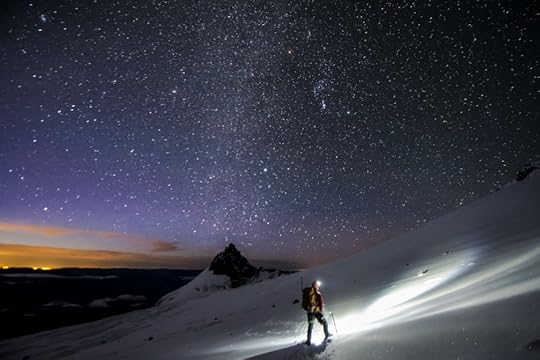
AFTER spending the first 2 days at Camp Muir, and unable to establish a second camp higher on the mountain due to bad weather, the decision to make the summit bid from Muir was made. We arose to mint climbing weather on the third day.
It was game time.
We slowly started our ascent for the summit just after 1am, but by the time the team made it to the Ingraham Flats, I knew I wasn’t going to be able to reach the top. Just a couple of days before, I had hurt my hip while crouching down to take photos with a heavy pack. The pain was flaring up more and more with each step. I wanted to keep going, I felt that I could had gone a lot higher up the mountain, but at the same time I did not wanted to become a liability for my team.
It was a tough decision, but I started making my way down to Camp Muir. That’s when I snapped this shot of the Cowlitz Glacier and the amazing sky. I left with unsettled business, but I’ll be back next season.
My 6 dumbest travel mistakes

Photo: Donye nhy’m [Kim]
1. Converting wrong and getting way too much cash from an ATM
Those living in the European Union, like me, are spoiled. We use euros and we can use them in the vast majority of the EU. Traveling to France or Spain or Germany? No problem. In Hungary however, they use the Hungarian Florint (HUF). One euro is now 312 HUF. If you don’t pay close attention to currency conversion, like I did, you might end up withdrawing 10 times the amount of money you need, two days before departure. Oops. I converted the extra back to euros but lost a lot of money in the exchange process.
2. Losing my debit card and not having a credit card (twice)
In the Netherlands, we only use debit cards. Credit cards are hardly accepted in general stores and only used for big or online purchases. So I didn’t have one. I only had a debit card. And if you only have one card, you better not lose it. This turns out to be easier said than done..
Summer 2010: I was working at a summer camp in New York and went shopping on my day off. The lady behind the counter was in a hurry and there was a long line waiting, so, instead of putting my card back in my wallet, I threw it in the shopping bag to sort it out later. Big mistake! By the time I got back to the camp, I had totally forgotten it was still in the little plastic bag, and threw the bag out as waste and I only realized a few days later that my card was gone. I rushed to the garbage, but by then it had been picked up. My card was gone.
It wasn’t a total disaster as I hardly used it while working at the summer camp and I had enough time to order a new one. It’s a different story, however, when you lose your card at the airport on the day of arrival. When withdrawing money from an ATM in the Netherlands, the machine first gives you back your card and your money after that. In Beijing, it’s the other way around. After landing, I withdrew some money. But instead of giving me my card back, the machine dispensed my money, kept my card, and asked if I wanted to withdraw more. I was so impressed by the cool Chinese money that I totally forgot about my card. Only when I got to my hostel, I realized my card was gone and the ATM had swallowed it. Great way to start my trip!
3. Losing my visa documents
As a tourist you don’t need a visa for the US if your country is part of the visa waiver program (ESTA), but if you stay longer than three months you do. And so I had a visa when working at the aforementioned summer camp in New York. One time I suddenly needed them and I remembered I had put them in a really, really safe place…but I couldn’t remember where that really, really safe place was. Seriously, those moments are the worst. I turned the entire place upside down and eventually found them in my night drawer. Looking back, I’m not entirely sure why I thought that was the perfect place to put them, but I got them back. So, 1) store your visa documents in an actual really, really safe place and 2) don’t forget where that really, really safe place is!
4. Having two months of salary wired to the wrong bank account
This is probably the dumbest mistake of them all. By far. I had over $3,000 of salary in my US bank account, but of course I wanted to bring it back to the Netherlands. So I was going to wire transfer it to my Dutch bank account. I filled out all the forms at the bank in New York.. yup, looked good, all set. It would show up in my Dutch bank account in a few days. So I checked, and checked again, and checked again. After a week still nothing. After 1.5 weeks, still nothing. But by now, all my colleagues had received their salaries, but where had my money gone?! I checked the forms again and realized I had entered the wrong bank account number…so $3,000 gone?
Thankfully, it was no one’s bank account number, so the money was still stuck and on hold somewhere in the wire system. When I called the lady at the bank in New York from Toronto, she was like, “But you signed the form, confirming the details.” Yeap I did, but apparently I didn’t pay enough attention. All turned out okay eventually, but I was very lucky it hadn’t ended up in someone else’s account, as it’s then pretty much up to the willingness of that person to give it back.
5. Forgetting travel health insurance and ending up in a US hospital
My parents are always really keen on insurances, but none of us had ever traveled outside Europe when I took off to New York back in 2006. So I had a health and travel insurance, but as it turned out the insurance only covered me in Europe. None of us had thought about this.
And then it happened. While camping in the Catskill Mountains of Hudson Valley, a pot of boiling water tipped over and burned my entire foot — second-degree burns, big yellow, jelly blisters. Not cool. There was no fast way out of the mountains, so when we got back to civilization the next day I was brought to the hospital. They popped the blister, put some cream on, and applied a few bandages. A few weeks later I got the bill — over $800! Yes, that’s a shitload of money for some burn cream and bandages! Imagine the cost of getting hit by a truck! Lesson learned — never travel without proper insurance.
6. Forgetting my luggage on a plane/train station
Ok, full disclosure: I also made this mistake twice.
The first time I was traveling back from the US and everything went wrong. Flights were cancelled and changed, and someone in my group suddenly wasn’t listed on the flight — complete chaos. Instead of flying to Amsterdam we were put on a flight to Paris and so I spent those seven hours trying to come up with a plan. When the plane touched down I had so much on my mind! Number 1 was finding the airline desk and getting us on another flight to Amsterdam as soon as possible. And so I just jumped from my chair, got myself out of the plane as fast as I could and tried to sort things out. Meanwhile, I totally forgot my carry-on luggage on the plane — including passport, wallet, laptop. I only realized it an hour after the fact. Luckily, the plane was still at the gate and one of the flight attendants went back inside to get it for me. (Thank you Air France for helping us out in so many ways that day!)
The second time was at a train station in Canada at Niagara falls. My friend and I had been waiting a while and carried lots of bags with us during that trip. And when the train finally arrived, we jumped up, ran to it, and tried to get a good seat. Totally forgot one of the bags. Thankfully, nothing really important or valuable was in it as I never got it back! Maybe it’s still out there somewhere, traveling.
This article originally appeared on Flying Dutch Girl and is republished here with permission.
3 American habits I lost in Finland

Photo: CollegeDegrees360
A YEAR AGO, I moved to Helsinki with my Finnish wife Johanna and our one-year-old son. I had a feeling that moving to Finland would change me. I just didn’t know how until recently.
Like you, many of my habits have been shaped by my culture of origin. In Finland, I’m navigating across a different cultural landscape and I’m watching several of my American habits slip away.
I don’t mind being naked with strangers
In the land of 3.3 million saunas, it is inevitable that you will eventually find yourself naked with people you don’t know. And not care whatsoever.
I didn’t realize that I had reached this level of Finnishness until last month. A close friend of mine from New York was visiting us in Helsinki and I insisted that — on his last night in Finland — he must join me for a trip to one of the city’s public saunas.
I explained that Finns go naked — but men and women have separate saunas. The sauna is not, in any way, sexual. Coed saunas exist in Finland, or so I’ve heard, but the general consensus is that they’re creepy.
I was convinced that my American friend would fall in love with the Finnish sauna culture, savoring the searing heat and the refreshing dip in chilly seawater. But I was wrong. Very wrong.
Before entering the sauna via the changing room, I smiled and quipped to my friend, “This is where we leave the towels, man.” My friend was not amused. Clutching his towel around his waist, he growled “no way” indignantly.
Unfazed by my friend’s reluctance, I hung up my own towel and strolled into the sauna Finnish-style. I found a spot on the top platform — along with another naked man. A few moments later, my American buddy timidly opened the door to the sauna and located a spot on the lowest bench, still gripping his towel as if his life (or manhood) depended on it.
He lasted about three minutes before declaring “enough” to me and the other naked strangers in the dimly lit room. Since we had already agreed to swim in the sea, I followed him out of the sauna and outside onto the deck where there were stairs leading into the water. (Keep in mind that it’s November, so the sea hasn’t frozen over yet in Helsinki, but it’s getting close).
I descended the stairs first and submerged my whole body into the sea, except for my head. Finnish friends have taught me to avoid putting my head under so that I won’t suffer permanent brain damage.
After I had grabbed my towel from the railing at the top of the steps, my friend — true to form — climbed down the stairs so that the water was up to his knees and, immediately, he bolted back up the steps where he quickly snatched his towel.
Without saying a word to each other, we headed back inside. I ditched my towel in the changing room and walked back into the steamy sauna. I assumed my friend would show his face a few moments later, but he never came. This was when I started to wonder if I had ruined my friend’s trip to Finland.
When I emerged from the sauna, my friend was changing into his clothes. Apparently, he had just taken a long, hot shower in his bathing suit and he was ready to put this sauna experience behind him.
I don’t ask “How are you?” carelessly.
In Finland, “How are you?” is a dangerous question — because you may actually get a truthful response. And before asking this question, you need to ask yourself if you can handle the truth.
At one dinner party, I’m reaching for a slice of rye bread and to be polite, I ask a middle-aged friend of my wife’s family how she’s doing. She thanks me for asking and goes on to explain how she’s not sleeping very well. Not only that, but she’s convinced that she needs to take medication for her sleeping disorder, but she won’t be able to get medication for some time. I nod without saying anything, caught off guard by her honesty. Too much information, I’m thinking.
In the United States, if I ask someone how he or she is doing, that person knows that I’m most likely being polite and I’ll be met with the standard answer (“Good, thanks”). This happens even when things are not going well at all for that individual. If someone dares to share that he or she is just “okay” or “fine”, I know that this person is going through a major crisis and I should probably back off.
On another occasion, I’m at Hesburger — the Finnish fast food equivalent of McDonald’s — and I step up to place an order. I start with the traditional American pleasantry, “Hi. How are you?”
The jaw of the young Finnish woman behind the counter drops. She stammers, looks down and then, mumbles, “Uh, I’m okay.” I wonder if I just offended her by my warm greeting?
About 20 minutes later, I stroll up to the counter again and order an ice cream sundae with caramel sauce. This time I leave out “How are you?” and surprisingly, she looks more comfortable. I mention that I’m American and somehow that makes sense to her. She smiles faintly and under her breath, she mutters “Oh, that explains it.” In that moment, she surely has forgiven me for asking “How are you?” without caring.
I don’t grab coffee to go.
In America, we like things on-the-go. We eat breakfast in the front seats of our cars. We eat lunch at our desks, catching up on emails. And of course, we drink coffee on the run. America runs on Dunkin’, right?
In Finland, people slow down when they drink coffee. They sit down. They sip leisurely. They chat. They’re so relaxed that I often catch them staring into space.
Given our on-the-go obsession with coffee, one might suspect that Americans would far outpace Finns in coffee consumption. Nope.
The United States isn’t even in the top ten when you rank actual coffee consumption per person. The average Finn drinks twice as much coffee as the average American.
The fact that Finland is leading the world in coffee drinking, behind the Netherlands, doesn’t surprise me at all. Everywhere I go in Helsinki I’m offered coffee. And it’s hard to say no. Before moving to Finland, I averaged about one cup each day in Boston; now I’m up to four cups.
And the most surprising thing is that I rarely take coffee to go. I’ve learned from my colleagues to adopt the Finnish way of taking breaks to drink coffee — from actual mugs.
But a couple of weeks ago, I had an American relapse. I needed to rush out of our apartment, and I didn’t have time to sit down for a cup of coffee. I knew exactly what this situation called for.
Frantically, I rummaged through the shelf that held our coffee mugs and sippy cups. Eventually, I found one silver to-go mug, but its black cap was warped. And when I poured the coffee in, the bottom of the mug started to hiss and form tiny bubbles. Arrgh, this will spill all over me in the subway, I thought.
I shouted gruffly to my wife, “Why don’t we have one decent thermos in this house!?”
Johanna—without the slightest hesitation—snapped back, “Because we live in Europe. And Europeans don’t take coffee to go!”
January 11, 2015
2 climbers are about to make history
The Dawn Wall of El Capitan in Yosemite National Park is considered to be the hardest climbing route in the world. As of the writing of this piece, it has never been successfully climbed without the aid of ropes. But by the time you read this, that may well have changed: two men, Kevin Jorgeson and Tommy Caldwell, are attempting to make it all the way up the 32 sections (called “pitches”) in a free climb — meaning that they will not be using ropes to help them up, only to prevent them from falling to their deaths.
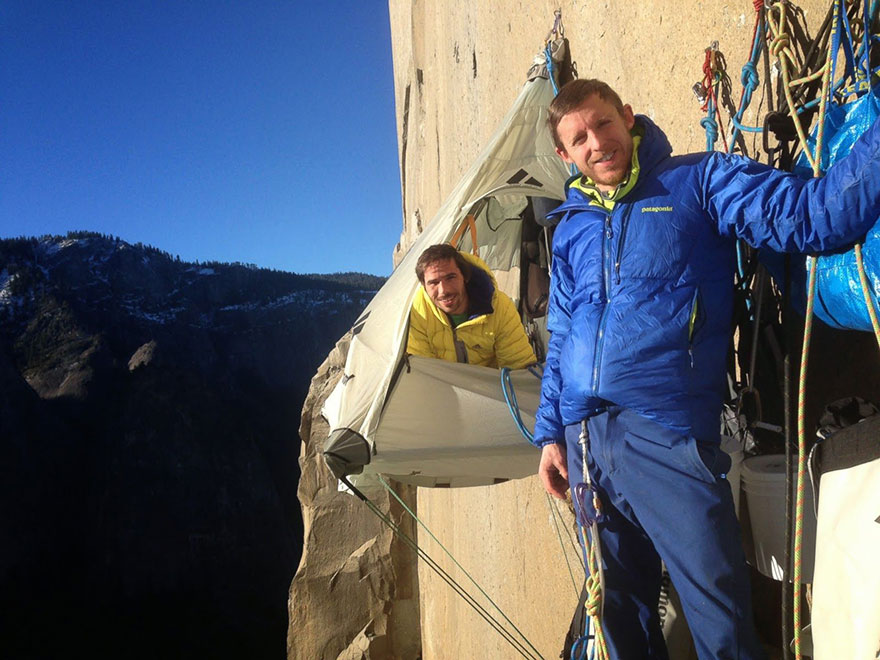
The entire endeavor is expected to take well over two weeks — they were over halfway up 11 days in, but still had around a week left before they get to the top.

El Capitan is a granite formation in California’s Yosemite National Park. It is an incredibly popular rock climbing destination, and has been climbed plenty of times in the past. This instance is notable because it’s the first free climb of the Dawn Wall, the hardest route on the formation.
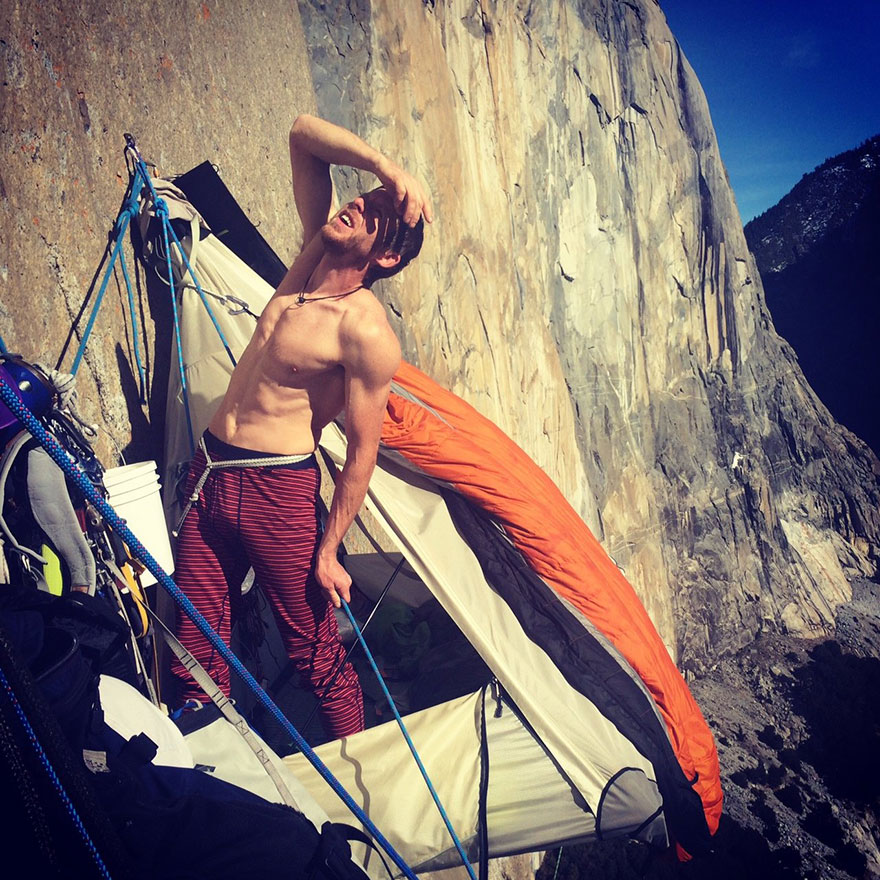
The two climbers are assisted by a team that drops supplies down to them, and are joined by a team that is documenting the journey up the formation. They have solar-powered equipment that allows them to give constant updates on social media.
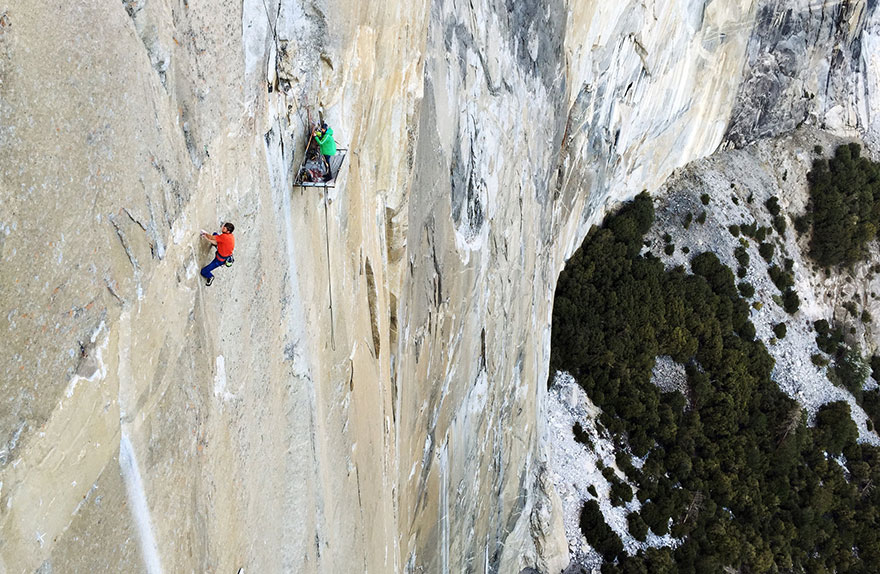
The Dawn Wall route, according to climber Alex Honnold, is “almost not possible” to climb.
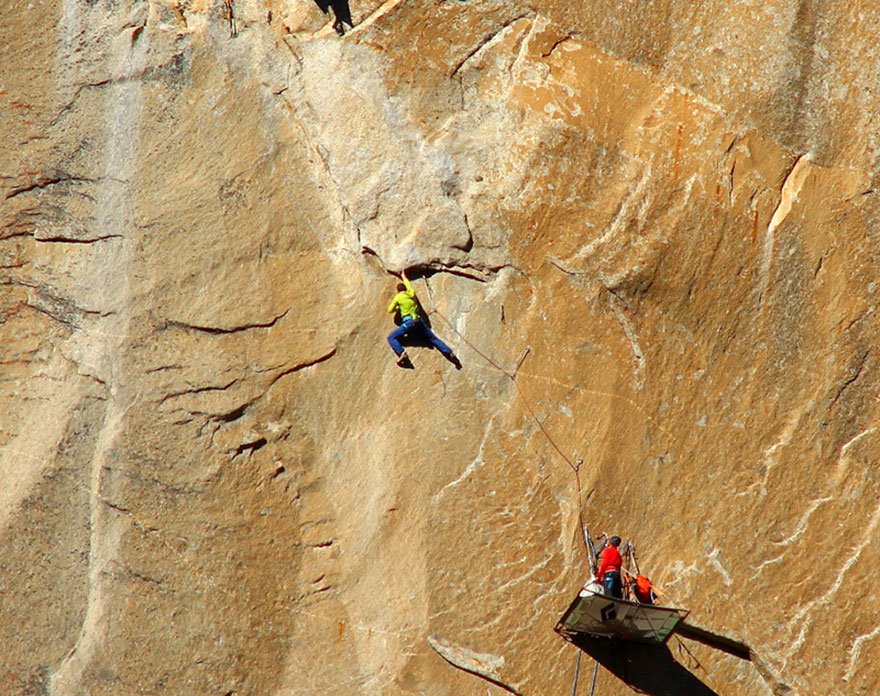
Of the 32 pitches on the Dawn Wall, only 13 have been free climbed.
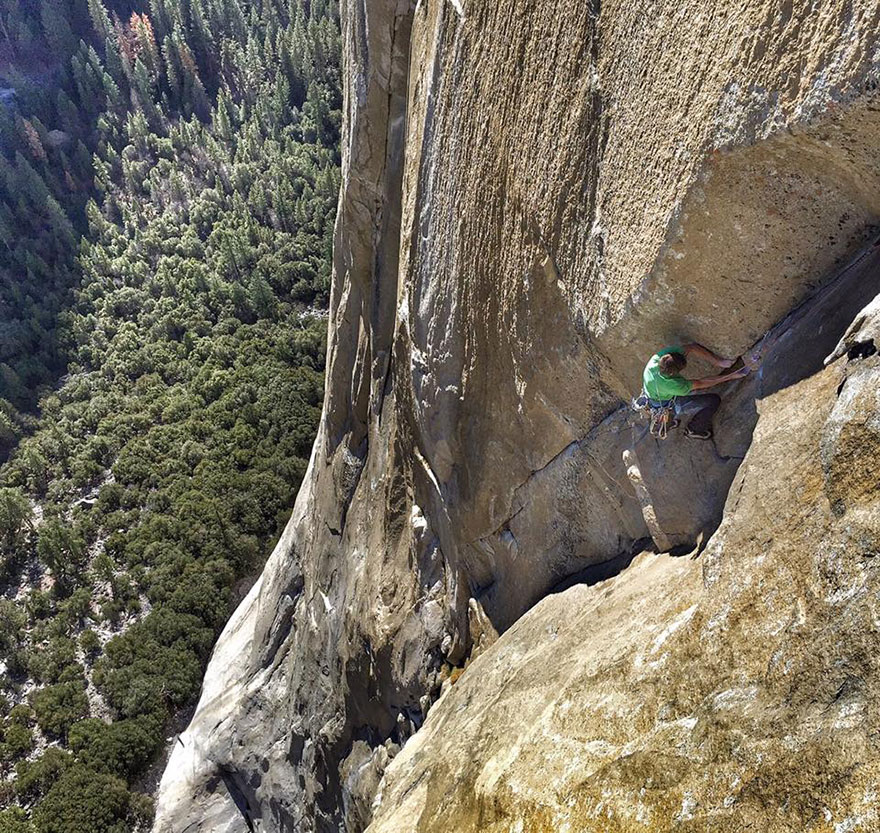
They prefer to do most of their climbing in the twilight hours of dusk and dawn, where it’s cold enough to keep their fingers from sweating. Regardless, the two have received multiple cuts on their fingers thanks to the razor-sharp rock edges, and have had to take days off to let their fingers heal.
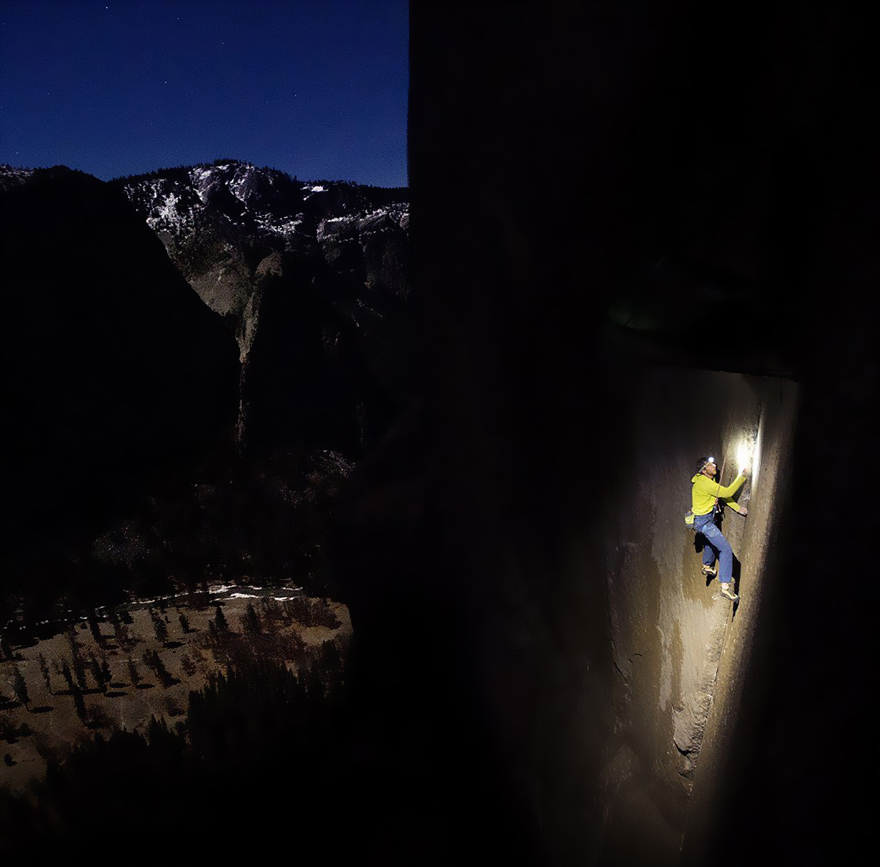
Jorgeson, with torn fingertips, has fallen behind Caldwell in recent days, but the two still plan on making the summit together.
All photos via Big UP Productions.
Matador Network's Blog

- Matador Network's profile
- 6 followers

