
Matador Network's Blog, page 1354
April 30, 2018
Thrill of finding gorillas
Dellene suddenly cried, “Oh My God!” and tried to climb my back. I looked to my left and saw an enormous gorilla bursting out of the thick foliage and charging toward us like an onrushing railroad boxcar.
***
There are four species of gorillas in Africa distinguished by habitat and slight differences in physiology. The mountain gorillas are the rarest of them all. According to the Karisoke Research Center in Rwanda, there are fewer than 880 of them left in the wild. Considered critically endangered, they live in the mountains of Rwanda, the Republic of Congo, and Uganda. The gorillas are protected by the Rwandan government, and visits to see them are carefully controlled. Martin, our safari leader, had organized our trip and made reservations more than a year ahead of time for our group to see these beautiful creatures.
***
The gorilla family we were to visit had been accustomed to the presence of humans by the primatologist and researcher Dian Fossey, who was murdered in 1985, three years prior to our visit. Fossey lived alone in the mountains near her gorillas and patrolled the Park trying to prevent poachers from capturing young gorillas and killing adult gorillas as they tried to protect their young. Although Fossey’s murder is officially unsolved, she was likely killed by poachers.
As good fortune would have it, the day before we were to see the gorillas, I happened to meet Rosamond Carr (Dian Fossey’s best friend in Africa and now deceased) in our hotel’s gift shop in Gisenyi. She graciously answered some of my questions about the gorillas that Fossey worked with. She explained that most of them were in good shape, but that a few had recently been taken by poachers. Poachers sometimes kill gorillas for bush meat or simply for trophies such as heads and hands that might be made into ashtrays and other gruesome trinkets.
***
When you set out to observe gorillas in their natural habitat, you must prepare carefully. At the Virunga National Park Headquarters, near the base of the volcanoes, we were given instructions on the proper behavior to exhibit in the presence of gorillas:
Do not stare at them; that could be taken as a challenge and you do not want to challenge a gorilla who weighs 400 pounds, has an arm-span of eight feet, and possesses the strength of ten men.
If a gorilla approaches you, stay close to the ground and make yourself small.
Do not touch the gorillas. Humans have immunity against diseases that might prove fatal to these remote animals.
After our gorilla education, our group split into two groups and we began our journey into the mountains. Each of our groups was with two Rwandan men, one serving as a tracker skilled at locating the gorillas, and the other armed with a rifle to protect the group against Cape buffalo and other dangerous creatures that might be encountered on the trek.
Leaving the visitor center, we hiked past farmland as we climbed the volcanic slope toward the boundary of Virunga National Park. A low rock wall marked the beginning of the park. As we stepped over it, we left behind cultivated fields and entered the jungle. We paused to tuck our pants legs into our socks and don gloves. Our guide warned us that we would be hiking through thick patches of nettles, tangles of vines, and head-high grass. We would likely encounter colonies of stinging ants as well.
Not far up the slope, we entered a forest of giant bamboo that shaded us from the fierce equatorial sun. The bamboo plants had stalks as big as our legs. The shade discouraged the growth of other vegetation, creating a forest floor that was relatively open and easy for hiking.
Our guides led visitors nearly every day, so they knew the general area in which the gorilla family we were seeking was likely to be found. However, it was first necessary to pick up the trail left by the gorillas as they foraged. That day, the gorillas made things difficult for us. We tracked them up and down the volcanic slope through a virtually impenetrable wilderness of bushes, trees, and vines. At times, we could see no more than a few feet ahead and lost sight of other members of our group. Underfoot was a deep layer of vines substantial enough for us to walk on, but occasionally, our feet would fall through the vines up to our knees. Trooping through the lush vegetation, brushing ants off our clothing, and extricating our legs from the vines was a struggle that exhausted us, especially in the thin air of ten or eleven thousand feet.
We had been informed at the park headquarters that locating the gorillas was not always easy, and if they were not located within a three-hour trek, we would return to the base camp. We made our way up and down the slope for two hours before we emerged into a relatively flat saddle between two volcano cones. Hiking was much easier there since the ground-level vegetation was sparse.
Our trek had taken us near the junction where Rwanda, the Democratic Republic of the Congo, and Uganda meet. Since the rainforest contains no boundary markers, the guides informed us that we may have crossed from Rwanda into DRC, or possibly Uganda.
The harsh journey sapped our energy. Yet, we could not stop to rest for more than a few seconds — our three-hour limit was nearly up. I became discouraged and began to rationalize having to return to base camp not having succeeded in finding the gorillas.
The gorillas’ tracks led into another stretch of thick vegetation. Suddenly our guides motioned for us to halt, crouch low, and remain silent. We could see nothing, but one of our guides pantomimed the word “gorillas”. The guides made grunting sounds to let the gorillas know of our presence. We approached the gorilla family slowly, having yet to see them through the vegetation. I happened to be the closest to our guides, and one of them pointed up the slope. I came up beside him and saw a dark shape ahead, barely visible through the foliage. It was a young female. As our group carefully made its way toward her, we could hear the sound of gorillas feeding on plants all around us — we were in the middle of the gorilla family.
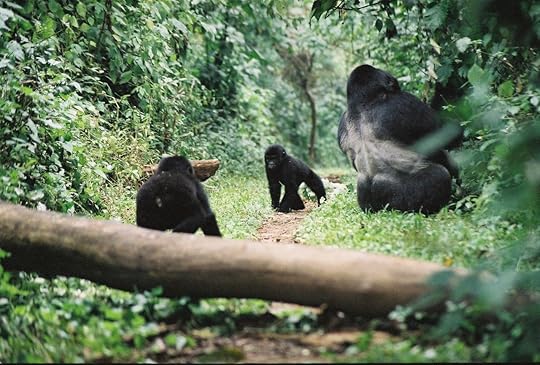
Photo: Cristoffer Crusell
Just ahead of me, I saw a baby gorilla climb a stalk of bamboo. He looked me over for a second or two before a big hand reached up and pulled him back down out of sight.
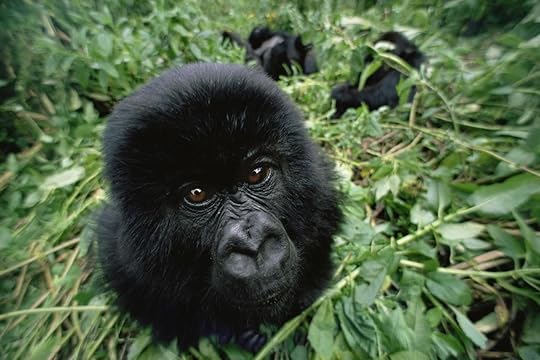
Photo: basketballnaturescience
Our group settled in a small clearing in sight of several gorillas who were chewing on vegetation about ten or fifteen feet away. Their coal-black fur glistened in shafts of sunlight. They seemed to pay us little attention as they ate and moved around. I remembered not to stare at them, and crouched low, with Dellene behind me.
At that moment, only a couple of minutes after we first found the gorillas, Dellene cried out and pushed against me. The large silverback male who led the gorilla family burst from the jungle and charged through our group. Dellene and I made ourselves small as the animal swept by and disappeared into the foliage on the other side of the clearing. My heart was pounding. I noticed that our guide up ahead was laughing. He explained that the gorilla was Ndume, the silverback male that ruled the family. He was “showing us the flag” to let us know he was the boss. We were not inclined to dispute it.
After some minutes, Ndume moved his family to another foraging location about 50 yards away. We followed. Ndume eventually returned to our group and settled into the grass by one of our guides. The silverback had caught his right hand in a poacher’s snare. His severe injury had forced the park veterinarian to amputate his hand. Ndume leaned close to the guide and stared into his face. A sign of recognition and trust.
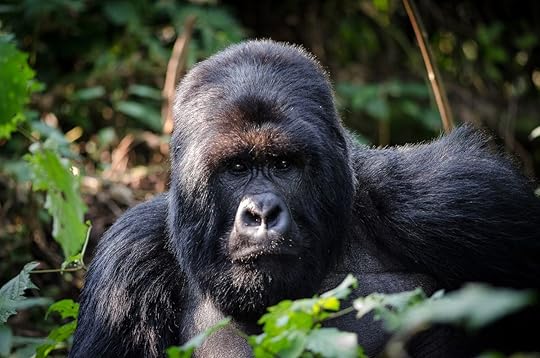
Photo: Henrik Summerfield
There was a sense of tranquility as we watched the gorilla family around us. There were likely ten or twelve of them. They kept feeding on vegetation, and occasionally glanced in our direction. To be that close to these majestic animals was mesmerizing.
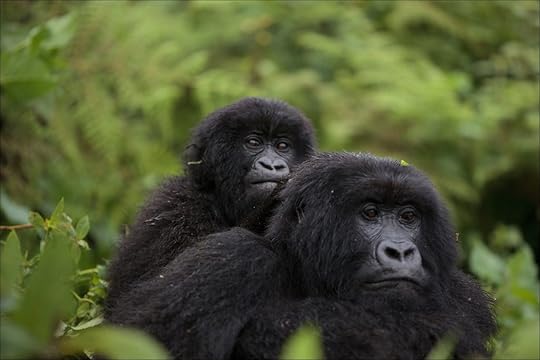
Photo: Ludovic Hirlimann
As I was crouched down photographing a pair of gorillas rambling along the trail ahead of me, I felt a hand on my shoulder. The guide behind me silently indicated that I should move to the side of the trail. I looked around and saw a large male gorilla behind me. He was stationary in the middle of the trail, staring at me, his deep-set eyes scarcely visible in the shade of his brows. I made myself small and leaned into the bushes beside the trail to give him room to pass. He ambled up beside me — and stopped. For at least a full minute, he stayed beside me, perfectly still, his body approximately six inches from me. For an instant, I was tempted to touch him, but quickly thought better of it as I recalled our instructions to avoid contact. I tried for a photo, but his bulk was too close to fit into my camera’s viewfinder.
It was clear to me that he was claiming the trail and reminding me who was in charge. I remembered that one of the staff at the park headquarters had told us that young male gorillas vied with each other to show their dominance and fitness in order to eventually displace the silverback as leader. He had explained, “So they are the ones most likely to cause trouble.” As we had let that thought sink in, he had added, “But that is unlikely to happen” and laughed. As I crouched beside the gorilla, I hoped he had spoken true. After a time, the animal sauntered on up the trail and followed the rest of the family.
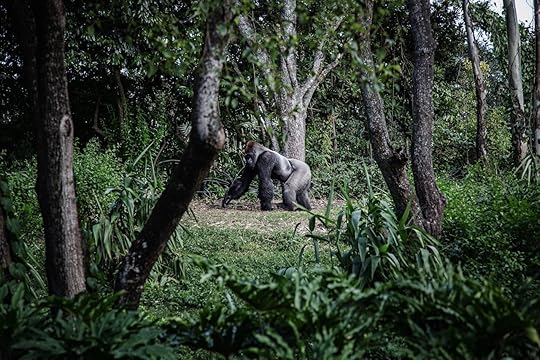
Photo: Mike Arney
To avoid interfering with the family’s foraging and other activities, as well as to avoid getting them too used to having humans around, we stayed with them for only an hour. When our time was up, the guides led us down the long slope back toward the park headquarters.
The trek down was long, and we were tired but I can’t recall ever being as exhilarated. 

More like this: How to see mountain gorillas in the wild in Uganda
The post The thrill of looking for and finding gorillas in Virunga National Park appeared first on Matador Network.


Shrines, shamans, no sarcasm in Bali
I finally caved and started reading Eat, Pray, Love. I had just been to the best yoga class of my life in a jungle-themed studio with rice fields views. We chanted incantations to Ganesh for 20 minutes before bending into pretzel-like poses while breathing in self-acceptance. Before class, four girls to my right hugged each other hello with such intensity, for a second, I thought they might be on Molly. Each had practiced with a string of japamala (Indian prayer beads) laid on the floor in front of her mat. After class, I chugged an entire coconut, had a gluten-free cookie and bought a book entitled I Am Amazing. Normally, coconut water makes me want to puke, so I’m taking this as a sign that my transformation is now complete.
We had initially scratched Bali off the list because of all the hype. I was convinced we were too late. The island has been ruined by the yoga retreats and the rowdy Australians who flock to the all-inclusive resorts in Kuta beach. Infinity pools may be Instagram bait, but they do not equal infinite happiness.
After almost a month here, I am no longer so sure.
We are in Ubud, a town smack in the middle of Bali, where you can’t walk down the street without tripping over deities, devotees, and… divorced women. Perhaps Elizabeth Gilbert is to blame for the latter. After Eat, Pray, Love, Bali must now be something therapists prescribe along with Prozac to anyone going through a difficult breakup. And I can totally see why. Heart-lifting slogans are everywhere. Stitched into tote bags, printed on t-shirts, even spelled out in marigolds on temple steps. “The Universe Is On Your Side,” “Trust Me You Are Lovely,” “Feel Good Everyday.” It’s like everyone on the island conspired to get me into a sarcasm detox. Only one shop tucked away on a quiet street pedals yoga wear embellished with a mean-spirited phrase that makes the New Yorker in me chuckle – “Namaste Bitches.” But I can’t bring myself to buy anything there. Here in Bali, you take your search for happiness and self-improvement very seriously. This is made clear when we attempt to order a beer at Seeds of Life, a restaurant across the street from the Ubud Palace. The waitress gives us a scornful look and declares that here they only serve vegan fare, implying we go elsewhere for our vices.
Initially, my impulse to mock the scene is strong. But two gong meditation sessions later I’m waltzing into Witches, a candle/book store, and am walking out with a book titled The Path of a Warrior Goddess. Fuck yeah, I want to be her.
I meet Lena at Fly High yoga where we’ve been swinging upside down, cocooned in strips of fabric hung from the ceiling for an hour. Turns out she is from Ukraine like me and we spend an afternoon chatting about our lives over smoothie bowls. She’s recently divorced (surprise!), has lived in Goa and in the Himalayas, and when I try to one-up her with tales of New York and Burning Man, she doesn’t flinch but takes it up a notch with how she once spent 21 days in a Buddhist monastery in Myanmar learning to meditate. I listen in total awe, overcome by envy. Now that’s what I’d call a once-in-a-lifetime experience worthy of writing home about. Why am I in Ubud again? She offers to give me a ride to my cottage on the back of her scooter. I hop on with no hesitations, and we glide through traffic without helmets, hair flapping in the wind. My jealousy skyrockets. I’m terrified of getting on a bicycle on these bumpy roads with no traffic lights. In this town with no sidewalks and uber-humid daytime temps, I’d kill for scooter-riding skills. At home, I drool over Lena’s Facebook pics. She’s likely a model. Her photos have great lighting and she’s wearing cool fringed leather outfits and has a far-away look in her emerald-colored eyes. She’s stunning and mysterious, posed against the backdrop of Indian deserts and temples and things I’ve only ever dreamed of seeing. I quickly scroll through my own pics to see how I measure up. Okay, I’ve got those skydiving ones from eight years ago and some Burning Man costumes and a few polaroids from Greece. I instantly regret my decision not to post any pictures of me and my boyfriend on our current round-the-world excursion.
And then it dawns on me and I laugh.
A year ago, I couldn’t have even imagined being here in Bali. I barely knew where Bali was on the map. I was 35 and single and I spent my time commiserating with my single girlfriends about how unfair life was. At my lowest point, I’d hate-read articles on Refinery29 by an ex-colleague who was posting about her year-long round-the-world honeymoon. She and her husband had gone to all the countries, done all the things, and had beautiful photos to prove it. Sure, she had written irritating paragraphs about “winning at life,” but more practical stories about how to pack a carry on for a year of travel were memorable. But she never got through the whole year. Refinery pulled the content after five posts. There were too many hateful comments on the blog to continue. The readers were appalled by the entitled couple with seemingly copious amounts of money who had gone and done that thing we all dream about but know we’ll never get to do. How dare they flaunt it? What right do they have to stick their happiness in our faces? I remember being gleefully satisfied when the blog was pulled and immediately going right back to Instagram to craft the public story of my own “amazing” life.
It’s incredible how vicious the cycle is. Surely there’s some woman right now sitting at her desk in a still-freezing New York or any other corporate city in the world hate-reading my streams of consciousness. Hi there. Trust me, I know how you feel. I was you. Hell, I’m still you. I may be in beautiful Bali, but I’m actively regretting my life choices to not be embarking on a silent meditation retreat in Myanmar.
To punish my insatiable mind, I tell it that I will not be going to any must-see tourist sites here for the rest of our stay. I tell it to be grateful for what it got — daily yoga, sunshine, an outdoor shower, THE FREAKING INFINITY POOL. But it’s not listening. It’s already planning a trip to Bhutan.
On the calendar, it’s April 10th. My three months of travel are up. I should be packing up bags now, flying back home and seamlessly reinserting myself into my real life. But that original plan has long ago been left in the dust. If I go back now, I’m afraid I’ll feel like I never even left.
It’s our last day here and to celebrate we join a big group meditation. At the start, 35 people sit in a circle and share their names and how they are feeling. Everyone’s either nervous or thankful, depending on how long they’ve been in Bali. We hold hands and close our eyes and the Indian guru guide walks us through a series of breathing exercises that make me dizzy and slightly nauseous. And then, maybe 30 minutes in, as we are exhaling together chakra by chakra, it happens. Energy surges through the circle with vicious speed. We grip hands. A woman screams, another starts to cry. The guru warned this could happen. He’s instructed us to just keep going, to stay with it. My hands are numb and feel like chicken feet, fingers all crooked and twisted. There’s turmoil and uncertainty in the monkey mind. But there’s also a new feeling that occasionally floats to the surface. It’s warm and cozy and it makes me feel cradled. I may not have a motorcycle license, but I have a US passport that lets me spend the next three months in Europe if I want to. There are no rules. The guru begins to chant. Like a lullaby, his Sanskrit slowly lulls the room back to a sense of serenity. We place our hands over our hearts and send love to ourselves and each other. When I open my eyes, for a fleeting second I believe with my whole heart that the universe really does have my back. Okay Bali, you win.
More like this: One week in Ubud
This article originally appeared on Medium.
The post Going Om: Shrines, shamans, and the lack of sarcasm in Bali appeared first on Matador Network.

Humiliate yourself in Alaska
Travelers the world over have no shortage of “not from here” blunders when stepping into unknown territory in a new place. Without a doubt, we’ve all fallen victim to this unfortunate phenomena at least once in our lives. And while the options for how to humiliate yourself in Alaska are pretty much endless, this list has whittled things down to a few classics.
1. Wear stilettos.
There’s nothing that broadcasts “no idea what I’m doing” louder than showing up on a hiking trail or bankside clad in heels. We know immediately that you didn’t read the “How to prepare for your trip” brochure that came with your holiday tour to Alaska package.
Granted, you’ll see Alaskan ladies wearing heels in the office, at school, church, special events, and out to dinner. The thing is, we rarely wear them outdoors. Most Alaskan ladies don sturdier, more Alaska-proof footwear for travel between home and our destination. We then change into our classy lady shoes after we’re inside our intended point of arrival. While there are occasional exceptions to this rule, it is by and far the norm.
The one thing that never changes is the unspoken rule against wearing “good” city girl shoes in very Alaskan places. Leave the mules, pumps, heels, wedges, and stilettos at home when on the trails. They just don’t work.
2. Mispronounce the word salmon.
This is one that makes Alaskans stop all conversation and stare in intense ire. Sometimes, it’s even possible to hear crickets in the long conversational pause before an annoyed correction is cast forth, “That’s not how you say it.” And we get to write the book on how to say it as Wild Alaska salmon is the most sought after among the Salmonidae family of finned, scale-covered, water-dwelling wonders the world over.
For the record: The “l” is silent. It’s never “sa-L-mon.” It’s always “sa-mon.” Got it? Now, go share the knowledge near and far. Alaskans everywhere will thank you and you’ll spare someone the humiliation of getting it wrong on their trip to the Last Frontier.
3. Say you’ve been to Alaska (but never leave Anchorage).
As blunders go, this is big. Especially for the hardcore tribe of Alaskans who live beyond the largest city in our great state. While about half of all Alaskans live in Anchorage and the vicinity, Anchorage is by no means an adequate measure of the authentic Alaska life.
To emphasize their point, many Alaskans call our largest city “Los Anchorage” as a cheeky reference to California’s highly populated urban sprawl — Los Angeles. They view Anchorage as the crowded place they must go a few times a year to stock up on supplies and for serious medical situations. Other Alaskans are known to quip, “Alaska is only twenty minutes away from Anchorage.” These sentiments should be enough to clue any visitor in on the reality that a truly Alaskan experience must extend beyond the borders of the Anchorage Borough.
4. Expect urbanized public transportation.
If you come to Alaska thinking you’re going to hop on a bus or a train to get around, you clearly didn’t do your research and are in for a shock.
By and large, we drive and when we don’t drive, we fly. And when we don’t fly, we take a boat and when we don’t do any of those, we’re partial to dog sleds, snow machines, and ATVs.
If you’re in Anchorage, Fairbanks, Juneau, or Eagle River (our four largest cities), there are a few options — namely the city bus system or taxis — but even those have limits. If you’re expecting transport like New York, London, Paris, or Tokyo, you might be better off not coming to Alaska at all and opting for something more city folk friendly.
5. Mention we’re not part of the continental United States.
For the love of all things Alaskan, this one drives us nuts. For the umpteenth time: Alaska is part of the continental United States. Yet many companies forget this specifically when trying to order things online or from catalogs and we get told by an ignorant salesperson or website, “We’re sorry, we only ship to the continental US. We don’t ship to Alaska.” Oi vey! Get it together, people.
6. Show up to river fish with a bright multi-colored bobber.
This one — just no. The only exception to this would be if you’re fishing in a glacier-fed, silt-filled river OR if you’re a kid age 12 or under. And even then, those are iffy. Bass fishing and fishing in Alaska are nothing alike.
7. Go for a wild animal selfie.
Or tell your kid to stand near a moose or a bear for a photo opp. Unless you’re angling for an entry in the annual Darwin Awards, just don’t. To quote Forrest Gump here, “Stupid is as stupid does.” And that’s about all there is to say about that.
8. Write AR instead of AK.
You could potentially be forgiven this blunder if you’ve just traveled to Arkansas and are recovering from jet lag or some other sickness that left you in a severe mental muddle. Otherwise, it’s AK on the address line. Writing AR will guarantee your mail gets sent to a totally different state.
9. Require a rescue because you had to see “that bus.”
So, you wanted to pay homage or play looky lou and go see what it was all about. Or heck, you love the outdoors and heard it’s a really great route to the middle of nowhere. Whatever the reason you went out there, calling for a rescue because you got lost or couldn’t cross the river to come back — this winds us up and screams “unprepared.” It also eats up our tax dollars and there’s lots more we’d rather do with the funds than rescue the unprepared, under-educated and (sorry to say) clueless.
10. Complain about the cost of a gallon of milk.
Yes, it really does cost that much. Yes, we really do pay it. And yes, it really is factored into the cost of living the Alaska life. Just be grateful you’re in a place that gets fresh milk in stock 24/7. Countless locations statewide still rock the powdered variety. What can we say — the Alaska life isn’t cheap and we don’t exactly expect it to be, either.
11. Thinking salmon fishing is an at-your-convenience activity.
Salmon fishing is a fickle, delicate thing. While it’s possible to fish rivers hoping to land one of our most prized and mythical creatures, at the end of the day, it all comes down to science and skill. Salmon come up the rivers in runs at very specific times of the year for a limited duration. To up your chances of catching just one, it’s essential to know when they will be where.
It’s also essential to show up to your river of choice with the mindset of a battle-tested soldier. We’re serious when we say “combat fishing” is a thing.
To shift things to the positive side, show up when the “reds” aren’t “in” and you’ll be the only one down on the rivers fishing. At least your humiliation will be semi-private and you’ll get plenty of casting practice in.
12. Expecting your mobile service to work.
This is Alaska after all. The Last Frontier… the place where there’s more wild than not. Planning your trip with the expectation that you’ll go paperless only relying on Google maps to get you where you’re going is a bad call. Especially if your itinerary includes anything outside an urban-ish locality.
Our main road system is not very complicated but it’s always a good idea to keep an old-school map handy for those “no signal” times of which there will be plenty.
If you’re really keen on going paperless, rent portable GPS or make sure your rental vehicle contract includes one.
13. Gush over the Alaskan cruise you took.
It was a once-in-a-lifetime dream trip and you had an incredible time. We get that. The thing is, most Alaskans don’t consider the cruise circuit a legitimate Alaskan experience. It’s considered a very polished, packaged Alaska. Granted, we’ll nod and smile politely and feign enthusiasm, but port hopping from Seattle, Vancouver, or San Francisco up the coast and along the Inside Passage is a lot like going on a zoo or aquarium guided tour — you get to look but not touch.
Now, we’re grateful for the cruise ship industry and we know it serves as an important source of commerce for our small-but-mighty seaside communities. And we’re happy to share our incredible state with anyone and everyone who is interested in spending time in the most beautiful place on earth. But we can’t swallow it when someone’s frame of reference for the Alaskan encounter begins and ends with the cruise ship. To truly claim an authentic Alaskan experience, you need to also have ventured further than the designated ports-of-call and tour bus routes.
The authentic Alaskan experience all but requires getting in the thick of it. Hike up a trail. Get some scrapes and blisters along the way. Go spend a night in the outdoors. Fish for something — anything. Eat where the locals do. Drive what the locals drive. In short: participate in Alaskan activities instead of spectating from the deck of a floating hotel or doing drive-bys from a cushy coach.
More like this: 8 superpowers you have if you’re from Alaska
The post How to humiliate yourself in Alaska appeared first on Matador Network.

Confuse a New Mexican
New Mexico is pretty awesome. We have green chile, beautiful sunsets, and a righteous sense of superiority over Texas and Arizona. But sometimes, when tourists or guests from out-of-town come to visit, there can be a bit of a culture clash. While all the little eccentricities of living here are just regular daily happenings for us, they sometimes throw off visitors and when they ask us questions about life here or question something, it weirds us out, like these 13 examples of how to confuse us New Mexicans.
1. Knowing how a 4 way stop works.
What is this sorcery, how do you know who goes first?!
2. Using a turn signal.
What is this blinking red light that seems to indicate which way I want to go?
3. Disliking spicy food.
We literally don’t know what to feed you now. You’ll just have to starve. Or just eat the iceberg lettuce and tomatoes on the side of our enchilada plate.
4. Showing up on time.
This is the Land of Manana, nerd. Why are you rushing?
5. Saying Colorado green chile is better than Hatch green chile.
To quote Miranda from The Devil Wears Prada, “did you fall down and smack your little head on the pavement?” Why on Earth would you believe this?
6. Actually, genuinely thinking that New Mexico is a part of Mexico.
This one both pisses us off and makes our brains explode because we can’t fathom how someone can be so stupid.
7. Not going out to watch the sunset.
Fine, sit inside and don’t look at the gorgeous colors.
8. Talking about professional sports.
“Did you watch the big game last night?” “The what?”
9. Ordering food without chile.
Just, why?!
10. Asking for a Coke.
Coke means any kind of soda here. Be specific.
11. Calling them luminarias.
They’re farolitos.
12. Asking if we can turn up the AC in the house.
The what now?
13. Saying that the weather is lovely.
Really? You think so? Wait five minutes, then you’ll see.
More like this: 15 phrases you heard growing up in New Mexico
The post How to confuse a New Mexican appeared first on Matador Network.

April 27, 2018
Rude things Americans do
Traveling to a foreign country for the first time can be a rough experience for some. Language barriers are intimidating and cultural differences abound, not to mention the fact that you are in a new place and have no idea where much of anything is located. It can be tough for anyone to remain calm and practice kindness in moments like this — and unfortunately, Americans aren’t always known as the best at doing so.
A lighthearted thread developed on Quora surrounding this topic, started by a self-conscious American reflecting on her first visit to Russia. A few common themes stood out in the comments. “Failing to try to speak the local language (even just a couple of basic words), and/or assuming that everyone there can and will speak to you in your own language,” as user Diana Arneson pointed out, is one theme that came up multiple times.
Diana went on to note that Americans often tend to view their country as superior and that this isn’t an acceptable behavior when abroad. Things tend to go awry when Americans begin “Boasting about your own country’s beauties and perceived superiority in some way,” she said. “We Americans don’t like it when foreigners come over here and turn up their noses at our achievements, claiming that those of their own country are superior. They don’t like it when we do it, either.”
Making assumptions about locals is another no-no, particularly when that preconception is made public. Theodora Gwatidzo, a Zimbabwean, found herself on a shuttle bus from an airport to a hotel in her home country when she was caught off-guard by such an instance. “We soon strike up a conversation with our nearest neighbours (the natives are friendly here ). A woman in the next seat interrupts and says, in baffled tones, “Your English is really good”, and her male companion adds, almost accusingly: “you sound educated!”
I cringed just reading this, but Theodora noted, “I don’t remember feeling offended, just mildly taken aback and amused at the level of unconscious presumptuousness.”
Stuff like asking locals about basic services like electricity and comparing everything to back home tends to show a lack of research on our end, something that many Americans seem to be guilty of. This tends to result in some awkward questions and bewildered stares. “In my experience, some Americans visit foreign countries with an attitude that is very often full of sincere wonder, but also often patronizing, as if they were visiting a theme park,” said Giorgio Anselmi.
It’s not all negative on our end, however. Many commenters noted that the majority of Americans are “the cool, friendly and fun tourists,” as put by Nikola Englová. The thread highlighted that Americans are generally a happy and outgoing bunch, even when our voices carry a bit too far. If there’s anything conclusive to draw from this thread, it’s that Americans can be really well received, as long as we view the places we visit through a level, respectful lense.
More like this: Why 64% of Americans have never left the US
The post The accidentally rude things Americans do in other countries without realizing it appeared first on Matador Network.

Bear watching in BC
A lodge in Bella Coola, B.C., Canada has officially proved that whale watching is so 2017. Tweedsmuir Park Lodge, a rustic retreat just outside of this tiny town in northern British Columbia, is inviting you to come up and spend a few days hanging out with bears this summer. Not just any bears, mind you, but Grizzlies.
The lodge offers a number of all-inclusive tour options that put you up close with them, all but guaranteeing you’ll have the most original Instagram photos of anyone you know.
We hear your concerns and are here to quell them. Bear watching is totally safe — we promise. Just like whale watching, you can head out in a boat, albeit on the Bella Coola River instead of the ocean. You first Instagram photo might look something like this:
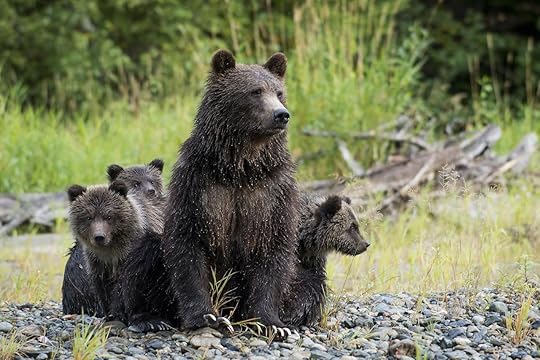
Photo: Tweedsmuir Park Lodge
There’s also this elevated wildlife viewing platform where you can watch the bears fish and feed their cubs:
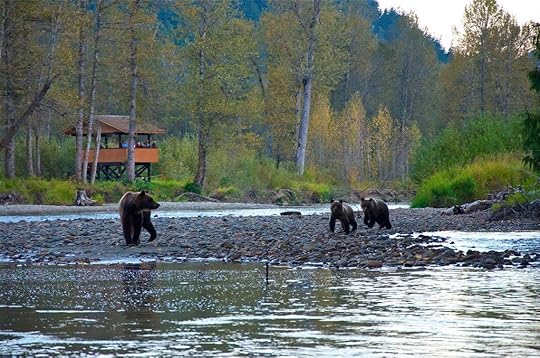
Photo: Tweedsmuir Park Lodge
If that’s still not close enough for you, jump on the canoe:
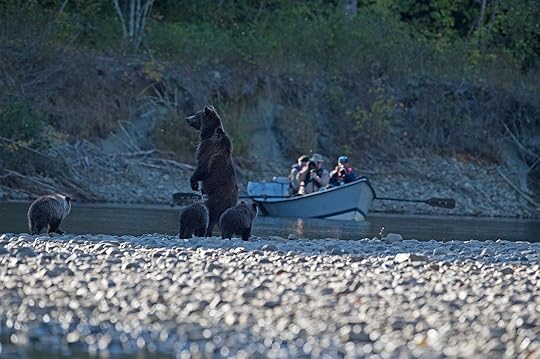
Photo: Tweedsmuir Park Lodge
If you and your crew want to come spend some quality time with the area’s resident Grizzlies this summer, the lodge is open for guests from July through mid-October. While the number of bears you’ll see is ultimately up to the bears themselves, most don’t have to go too far. They’re often chilling outside while you drink your morning coffee:
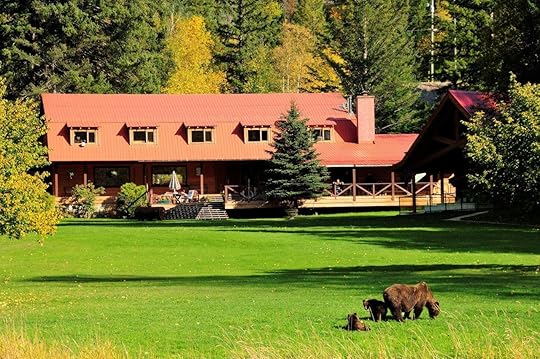
Photo: Tweedsmuir Park Lodge
The Grizzlies are the highlight, but the trip is also a perfect opportunity to get out into nature and spend the night in a luxurious all-inclusive retreat. It’s not hard to disconnect — the nearest stoplight is 400 miles away. Full-day hiking and sightseeing options are available as well. The staff and a guide are onhand for any tours that you embark on.and to cook hot meals throughout your stay. And check out these accommodations:
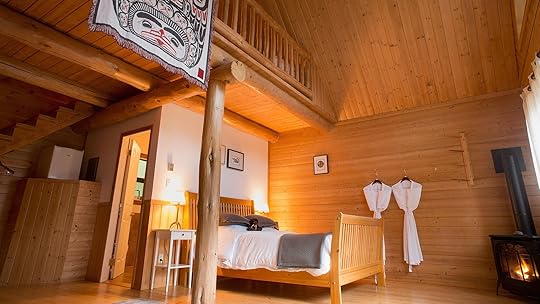
Photo: Tweedsmuir Park Lodge
Whether or not you rub shoulders with a Grizzly. the experience of getting up north far from a major city is a fine way to disconnect from society. How close you actually get to the bears depends on your own comfort level, but one thing’s for sure: no one’s going to accuse you of planning a boring summer vacation.
More like this: 17 powerful portraits of Alaska’s bears
The post Forget whale watching. Bear watching is our new favorite activity appeared first on Matador Network.

Visiting ancestral home
Ask me any day of the week, and I’ll tell you that Bergen, Norway, is the most beautiful city on the planet. It’s a metropolis squeezed into a glacial valley; a Viking-age port with the humble roots of fishermen; it is the gateway to the country’s iconic fjords. It’s been said that there is a completeness to where the mountains meet the sea, and if that’s true, then Bergen lacks nothing.
When I first went to Bergen a year ago, I felt an intense sense of home. These streets I had never walked, these smells my nose shouldn’t recognize, this terra incognita — it all seemed strangely familiar and comforting. But how is that possible? I have Norwegian heritage, sure, but generations back. What makes a foreign place feel like home?
And then I found my answer. I was futzing around Bryggen, the UNESCO World Heritage Site, scoping out the 14th-century merchant houses along the harbor. I traced out zigzags on the back-alley walkways between the old white houses and worked my way toward the water, inching toward the Bryggens Museum — I had heard they had Bergen’s oldest excavations there, and I needed to see it for myself.
I’ve been thinking about this day ever since. The temporary exhibit, “From Where Do You Hail?” turned everything I thought I knew about genealogy on its head and added a dash of kismet. Am I from here?
Is geography is in our bones?
***
Your bones keep a record of your air and water intake. Your molars — at six years — mark the spot you’re living at that time, give or take a few hundred kilometers. Checkpoint one. Your wisdom teeth in adolescence mark a second spot. Checkpoint two. And the rest of your skeleton changes every five to 15 years, keeping its own record of isotype composition. Checkpoints three, four, five, etc.
How is this possible? Air and water are vastly different in different areas, and the amount and type of isotypes they contain vary from place to place. Not just countries — mile to mile, inland to sea, mountain to prairie. If you were living in Arizona when you were six and living in Washington when you were fourteen, scientists would be able to tell if they were to have a look.
So, yes, geography is in your bones. Your geography. If we carry place with us, of course we can harbor strange, inexplicable connections. Maybe my ancestors really did shape where I’m from and where I love. I carry my geography; do I also carry theirs?
***
You carry your mother’s mitochondrial DNA, otherwise known as mtDNA. And your mother’s mother’s. And her mother’s mother’s, and so on and so on until the chain literally ends at Mitochondrial Eve, your great-grandma about 10,000 generations ago. And your mother’s mtDNA carries a very specific set of mutations that are bound by geography and time. If you’re a male, you also have Y-DNA carried on your Y chromosome. Women, you don’t have Y chromosomes, so taking a DNA test won’t tell you much about your patrilineage.
This is how Ancestry.com “knows” where your spit is “from.” Each group of mutations is generally found in a specific part of the world, and each group is called a “haplogroup.” Each haplogroup is a branch point on the “mitochondrial phylogenetic tree,” each group forming at different times. You get a random selection from mom and a random selection from dad, meaning two siblings’ test results could come to remarkably different conclusions — but usually they’ll be pretty similar.
Group H is a common one in Western Europe, for example, and H is believed to have originated in Southwest Asia about 20,000 years ago.
You read that right. A common haplogroup in Western Europe originated in Southwest Asia. Your ancestors had to be from somewhere, too.
So, yes, you carry your “geographical DNA,” and your ancestors’ geographical DNA, which carries bits about where they’re probably from, sort of. What it actually tells you is where DNA like yours is most common. You’d have to look at your specific ancestors’ bones to really truly know where you’re “from.”
And you could do that, theoretically, because their skeletons carry their own geography. But doing so probably wouldn’t tell you that your ancestors are French or Canadian or Spanish. Doing so would probably show you they moved to Trondheim from Copenhagen. To Copenhagen from Warsaw. To Warsaw from Saratov. To Saratov from Tashkent.
They were all on the move, just like I am. Just like you are. Just like we all are.
And with that, they are from nowhere.
And you are from nowhere.
***
On my most recent trip to Bergen, I departed on the Fjord Line to Stavanger. I spent hours on the open bow watching the mountains turn into islands turn into sea, wondering which rocks my ancestors had encoded into their molars. I spent hours wondering why they left, wondering if they preferred the subtler beauty of cornfields.
Cornfields. That’s what’s encoded into my molars. As I’m crossing the Boknafjorden, I can’t help but note that this is just about the antithesis of the endless open plains of Iowa, my home that took me years to see as beautiful.
But now, I can’t blame the cornfields for my restlessness. We’re all from nowhere, and the desire for new places is like the desire for new lovers: a human one. You and I are a result of people on the move. Norwegian, Pakistani, South African, haplogroups H, F, L. It is the moving that is important.
We are born to be restless. To escape the past. To intensify the present. To outrun death. To follow in the footsteps of our ancestors. To move. We are born to travel until there is a completeness to ourselves.
Much like the completeness of where the mountains meet the sea.
More like this: 7 reasons to explore your ancestry overseas
The post Why visiting your ancestral home feels so familiar: It’s literally in your bones. appeared first on Matador Network.

Robot pizza truck
There’s a new chef in town, mechanically programmed to deliver the perfect pizza every single time. California startup Zume Pizza brings robots into the kitchen and literally cooks your pizza while its en route to your home. The company’s slogan is “Baked on the Way,” and they’ve partnered with kitchen equipment company WelBilt to revolutionize the process of mobile cooking. The company’s trucks can now cook 120 pizzas per hour — two per minute.
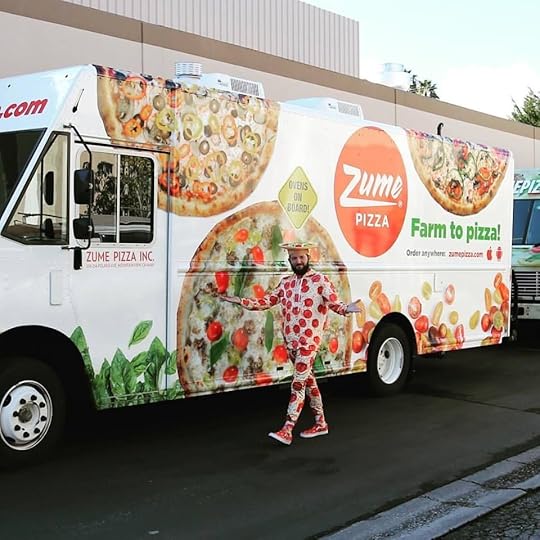
Photo: Zume Pizza
For some, the thought of a robot assembling a pizza, with the only human interaction being a bit of oversight or the push of a button, might conjure images of the 2006 movie Idiocracy, in which a character played by Luke Wilson wakes up in a dumb-downed future where even highly-skilled professions like airline pilots and doctors have been reduced to the level of simple button-pushing.
Then there’s the issue of losing the human touch. Is part of the satisfaction of eating a result of observing, critiquing, and enjoying the passionate work performed by someone else, or even yourself? If the chef working the kitchen line is a hunk of steel, the argument could be made that the meal then loses its personal touch.
But Zume CEO Alex Garden assures skeptics that the robots are merely meant to assist with the mundane parts of the job. “”Automation exists to improve the quality of human lives,” Garden told Mashable. “”We believe we should be leveraging automation to automate boring, dangerous, repetitive work.”
The chain hopes to add over two dozen delivery trucks by the end of the year, with hopes of vastly increasing its delivery area in the Bay Area and beyond. No matter your thoughts on having a robot make your pizza, one thing is for sure: the pie will still be piping hot when it arrives at your doorstep.
H/T Mashable
More like this: Robots are working as room service butlers at this hotel
The post This robot pizza truck can bake 120 pizzas while it’s driving appeared first on Matador Network.

Biggest culture shocks
You’re lost, standing baffled in new surroundings, unable to tell left from right, up from down, phone booths from trash cans or rip-off artists from friends. This is culture shock. The nuanced phenomenon can hit you as soon as you step foot in a new culture or take months to develop and thus overcome. Culture shock can be more than a surprise over new foods, foreign languages, or unfamiliar social norms. A recent thread at Quora, which asked people to share moments they faced the biggest culture shock, shed light on how often this manifests in simple daily interactions.
It’s perhaps no surprise that the experience of interacting for the first time with polite Canadians crops up often in threads. Quora user Taza comments: “Generally Canadians were and are still so damn polite. It was beautifully shocking how often they apologized. I’d say sorry is as dear to Canadians as beer, snow and hockey because Canadian say sorry every other minute! It’s super nice that they do this because it diffuses conflict or the possibility of conflict.”
In the same thread, Yahya Hararwala, shares his first experience visiting Pakistan as an Indian, “People in Pakistan are extremely friendly with wonderful hospitality.” He continues, “It was difficult to realize that this was the hospitality of the people of the country which is in a hostile political situation with India. In this visit, I realized that this hostility and the mindset is all only politically motivated, and does not actually exist on the ground.”
Whereas in Germany, many people have commented on the process assimilating to the rules of social interactions, specifically those of everyday chit-chat and the lack thereof. On Quora, Nicholas Corwin said that knowing how to socially interact in Germany is a difficult adjustment. “Not being able to chat up strangers at the bank, or on the train, etc., just to pass the time. I know, I know, that is a goofy American practice regarded with suspicion and disdain in many places, but it’s a deeply ingrained habit that I have trouble breaking.”
Rishabh Dev shares a little about his experience of coming to the US from India. “People smile at you and make small talk in elevators (that’s what Americans call a lift) all across America, so for someone who is new to this, keeping small talk ready for the next stranger becomes a task in itself. People smile and nod on the streets too.” He continues, “In India you can stare at the other person on the street till the person makes eye contact after which you look the other way and find someone else to stare at. But for all the friendliness, it is still difficult to make friends in the US.”
In comparison, Saya Madison from the US traveled to India had a different experience of friendship. She states: “Everyone in India goes out and plays with each other. Friends of my cousins would come over (uninvited) and ask my cousin if he wanted to go out and play, and then they would. In the US or Canada that would never happen. First off, everyone lives too far away from each other here, and secondly, it’s considered rude to come over to someone’s house uninvited. But it seemed to be a regular occurrence in India.”
On the topic of hospitality, Lyn Hacop shared her general impressions after visiting Armenia for the first time. She states: “I was treated like family every time I stepped into someone’s house or a restaurant. People were insanely nice and welcoming, even going as far as to offer to invite me over for Armenian barbeque and spread out a table with the finest appetizers and Armenian delicacies.”
For Joe Dawson, he was greeted with a bit too much Italian hospitality upon landing in Rome. “I sit down ready to try some of the famous Italian pasta that everyone talks about so much in the US. They integrate me into the Italian cuisine easily, starting out with Penne and Tomato sauce, simply ingredients… I clean up my plate and I’m ready to move on to whatever they usually do next. Suddenly I notice no one is leaving the table, no one is getting up to clean the table, and no one is leaving to do anything else as well. Suddenly the mother comes out with another dish of what I believe is supposed to be meatloaf with ham inside. Now, by this time I’m already pretty full so I’m not sure I really want to eat anything else. Of course, I don’t have the willpower to say no so I finish it up.” Dawson goes on to share that the meatloaf wasn’t even the end, but that it was followed up with a fruit course and a gelato course.
Swiss-born George Aliferis was pleasantly surprised at the savory breakfast he was given in South Korea. “I was awoken in the morning by a very strong smell of fish and spices. Half awake I couldn’t understand what was happening and why on earth someone would do that to me. It turned out that our hosts were cooking breakfast: a chilli fish stew with lots of garlic. I think of myself as well travelled and with a solid stomach but I will be honest my first thought was to run away, find an excuse to escape and try to find a croissant somewhere. Eventually I tried, reluctantly at first. But you know what? Chili wakes you up and can even replace coffee. It’s actually a really good dish to face the cold… I ended up asking for more and I now feel that all the rules that I grew up with in terms of food are habits, but are groundless.”
For Americans that are used to being handed the bill upon finishing their food so that the restaurant can turn the table, traveling abroad and not getting pressured to leave is often a shock. Dennis Hoffmann said: “Visiting Oslo, Norway earlier this year for the first time, I was in a restaurant having dinner my first night. Service was excellent, the food was great, and I was enjoying conversation with my son and an old friend who accompanied me. We ate and spent a lot of time talking about what we planned to do the next day. After dinner I waited for the server to bring the bill. And waited. And waited. And waited. Finally after having made eye contact with her several times but getting nothing but an occasional smile from her as she’d walk by, I got her attention and asked her for the bill, which she brought promptly. So, it turns out that in Norway, they don’t kick you out after you eat and don’t bring you the bill before you ask for it.”
Siddharth Sahu shared about the trusting nature of the people of Zurich. “I was completely bewildered here in Zurich when I found that in the COOP malls, there are self-service counters, where you scan the barcodes by yourself, deposit the amount to the cash machine, and pack the items in your bag. There are state of the art sensors and security systems to check theft, and no person does any verification physically. While buying vegetables too, you weigh them on the machine yourself, put a tag for the weight, and pay accordingly to the cash machine.” He continues “Furthermore, there has never been any checking for tickets in the buses and trams running within Zurich, in the two months I have been here.”
Similarly, Darian Binner noted the overall sense of safety in Japan. “My friend once lost a wallet with ~20,000 yen (150 euro, 180 USD) on the Yamanote line. He noticed it was gone, and he went to the police and he got his wallet back after 2 days (with the money). Seeing people reserve tables in Japan by putting their phones or wallets on the tables and then getting their food and leaving them alone is not an uncommon sight. If that were to happen in the USA, your wallet/phone will almost certainly get stolen.”
And of course, many people experience major culture shock in bathrooms around the world, from the bidets in Asia to the huge gaps in the stalls in the US. For Serbian native Milorad Botic, the biggest shock came while in the bathroom on a school trip in Dresden, Germany.
“Rotating toilet seats. Boy, was I scared when I pushed the button for it to flush.. As soon as I pushed the button I heard some robotic sound. I was terrified. I’m really bad with technology so I thought that I somehow broke it. Imagine my surprise when I saw that it was moving. Rotating precisely. I was dumbstruck. I just stood there watching it clean itself. WOW.”
If you are trying to overcome little nuances of culture shock here are a few tips to make it easier and help you better understand how culture shock manifests and thus how to overcome it.
The first step, of course, is to recognize that what you’re going through is culture shock. If you can come to terms with wild mood swings and sad times, and recognize they’re part of the inevitable process, it’s a lot easier to convince yourself that the bad feelings will pass. And they will.
Secondly, it’s crucial to learn the language as you go. Culture shock, at its simplest, is an inability to integrate, and the biggest barrier to that is generally language. The more able a traveler is to laugh, cry, and seek solace with the locals, the easier it is to deal with ups and downs.
Though it can be one of the toughest parts of traveling, culture shock is just as integral to the experience as food, people, and scenery. By recognizing it for what it is and doing your best to cope, you can easily prevent culture shock from ruining an otherwise fantastic journey.
More like this: Culture shock vs. reverse culture shock
The post Travelers reveal the biggest culture shocks they’ve ever faced abroad appeared first on Matador Network.

Go plastic-free while traveling
As world travelers, we carry a lot of baggage. In a literal sense, we lug around giant backpacks and suitcases. Metaphorically, we also have to cope with the emotional baggage that, although our hearts are in the right place, traveling and tourism, in general, are not very eco-friendly.
Long plane rides make our carbon footprint soar, hordes of tourists can severely damage the health of an ecosystem, and, of course, we produce waste. Lots of it. Specifically, plastic. And where does most of that plastic end up? In our oceans.
8 million tons of plastic are annually dumped into the ocean, and with 80% of international tourism related to coastal activities, one can infer that probably a fair amount of that ocean-bound waste — plastic and otherwise — comes from tourism. Which is why it’s on us travelers to step up and be more aware of our actions. There are plenty of ways to reduce our waste, like these five methods that will help you eliminate plastic while traveling.
1. Bring along reusable containers.
Getting your hands on a good reusable, eco-friendly water bottle (options range from stainless steel to BPA-free) is a no-brainer to using less plastic — recent reports show that a million plastic bottles are used per minute — but you can go further. Just a few examples: an all-in-one cutlery tool or utensil set comes in handy for eliminating plastic utensils usage; ditching your plastic toothbrush for a more sustainable (and stylish) bamboo one; using Tupperware instead of to-go boxes and bags; and bringing canvas tote bags instead of plastic ones. Another huge source of plastic waste is from plastic straws, with 5 million used per day in the US, so ditch those as well or bring along some stainless steel, paper, or bamboo alternatives. The options are endless, and most are easily-packable and won’t take up too much space or weight in your luggage.
2. Invest in a travel-sized water purifier.
While traveling, many people feel more comfortable drinking from plastic water bottles to protect themselves from ingesting unsafe or contaminated water. But that only contributes to the aforementioned million bottles a minute. So, what are your options if you want to be sure the water you’re drinking is safe, but don’t want to buy plastic bottles? Luckily, huge strides have been made in recent years developing easy-to-use but effective water purifiers for travelers that are lightweight, durable, and affordable. There are tons of great options, like LifeStraw or DrinkSafe Travel Tap, and most can filter within a few minutes, making it an easy alternative to plastic bottles.
3. Leave the free hotel shampoos where you found them.
We all love to nab those cute little bottles of shampoo, conditioner, body wash, and lotion from our hotel, but all those tiny bottles are a huge source of plastic waste in the hospitality industry, as many hotels just toss the half-used bottles away and they end up in landfills. Some chains like Mariott are starting to make a change with wall-mounted dispensers and recycling programs like Clean the World, but you can help spur the trend along by bringing your own shampoo and body wash in reusable containers in a dopp kit. Or, if you’re super thrifty, make your hygiene products like toothpaste or shampoo using baking soda or castile soap.
4. Don’t be afraid to say no.
If you are a guest, it can be difficult or embarrassing to turn something down or say “no”. But when it comes to eliminating plastic from your life, saying no to it in public interactions is just as important as how you personally eliminate it from your routine. Usually, it’s no more than saying “no straw, please,” or “I brought my own bag.” Even that, at times, can feel awkward to say to strangers in different countries or cultures. That said, more countries, such as Chile, are taking steps to ban plastic bags or straws and make citizens more aware of plastic usage. These days, most people will probably be open and accommodating to your request.
5. Make conscious choices.
When it comes to cutting out plastic while on the road, half the battle is just making the conscious choice to not use it, as one of the reasons plastic is so ubiquitous is because it’s so accessible and easy. To paraphrase the book The Life-Changing Magic of Tidying Up, try to ask yourself: do you need it? Is it really necessary? Can you get the same thing but maybe in a recyclable or reusable form? And expand this conscious thinking to your daily planning and organization: take a few extra minutes the night before to pack snacks in reusable bags; wash your reusable items; always stash a tote in your purse when you go out. Pretty soon, it’ll become a habit. Finally, be patient with yourself. Making the switch from using plastic to not using plastic at all is not a quick overnight change. It takes times, patience, and some creativity.
More like this: 7 easy things you can do to be a more sustainable traveler at hotels
The post 5 easy ways to go plastic-free while traveling appeared first on Matador Network.

Matador Network's Blog

- Matador Network's profile
- 6 followers

