
Ariel S. Winter's Blog, page 3
May 1, 2013
SYLVIA PLATH: MRS CHERRY'S KITCHEN
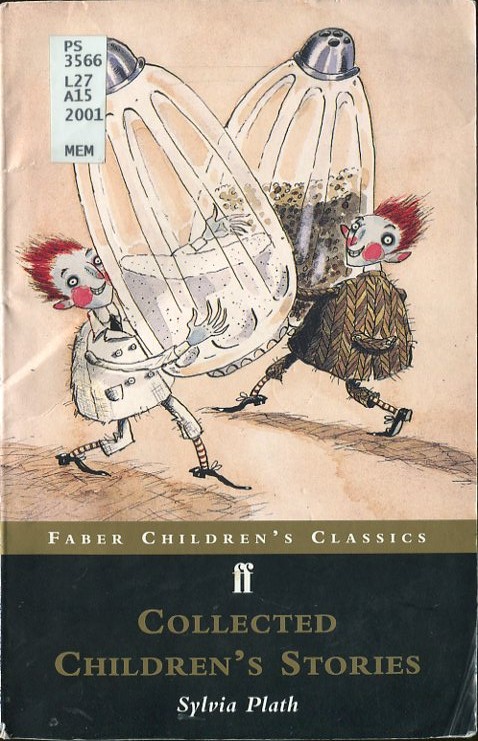 IN 2000, FABER & FABER launched Faber Children's Classics, a series of books with uniform trade dressings that included works such as The Complete Nonesense by Edward Lear, Old Possum's Book of Practical Cats by T. S. Eliot, and Peacock Pie by Walter de la Mare. In order to round out the list with some exclusive titles, Faber took advantage of the fact that some of its most well known writers had little known children's books. One of the first books in the series was Sylvia Plath's Collected Children's Stories, released in 2001.
The book is comprised of Plath's two previously released children's books, The Bed Book and The It-Doesn't-Matter Suit , along with a new story, Mrs. Cherry's Kitchen.
Mrs. Cherry's Kitchen was first sketched out in one of Plath's journal entries from either 1957 or 1958 (I have found conflicting dates, and can't find the quote in the 1982 release of Plath's published journals). As quoted by Lissa Paul in her 1995 Horn Book article on Plath's children's work:
Plath submitted the story to the children's magazine Jack and Jill, which had previously published one of her husband Ted Hughes's stories, but she didn't have much faith in it. It was with disappointment, but not surprise that she recorded in her journal on January 26, 1958 that the magazine had rejected the story."Suddenly, Ted & I looked at things from our unborn children's point of view. Take gadgets: a modern pot & kettle story. Shiny modern gadgets are overspecialized--long to do others tasks. Toaster, iron, waffle-maker, refrigerator, egg beater, electric fry-pan, blender. One midnight fairies or equivalent grant wish to change-about. Iron wants to make waffles, dips point for dents; refrigerator tired of foods, decides to freeze clothes, toaster tired of toast, wants to bake fancy cake..."

MRS. CHERRY IS A DOMESTIC GODDESS, who has a great appreciation for her modern appliances. She says things like, "'Thanks to our fine, shiny toaster...It's made us golden-bown toast each day without fail all these years.'" These kind of statements make her appliances proud, but it turns out it's not enough to keep them content. Each wants to do a job that another appliance does.
Unbeknownst to Mrs. Cherry, her kitchen is helped along in its daily tasks by two kitchen pixies with "long, unpronounceable names," who call themselves Salt and Pepper.
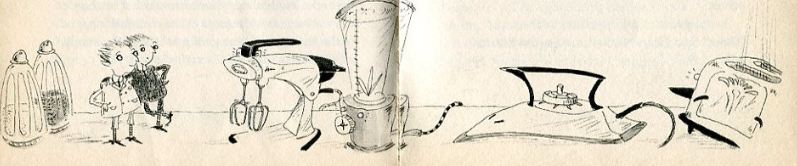
When the appliances come to Salt and Pepper and tell them of their dream to trade jobs, the pixies don't think it's such a great idea. "'It would mean a lot of extra work for us,'" they say to each other, but "'If we don't satisfy the kitchen folk, they may go on strike and stop work altogether. And then where would Mrs. Cherry be.'"
 So they give their consent. Of course, they have to wait for Mrs. Cherry to leave the kitchen, which she does rarely. At last, a little before lunch time on the day set for the change-about, Sunny and Bunny, the twins from next door, come to tell Mrs. Cherry that their cat Fudge Ripple has had kittens. Mrs. Cherry goes to see them.
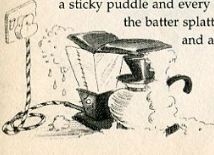
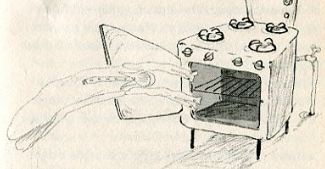
"And Whizz! Whirr! Bang! Clang!" The shirts go into the oven, unbaked plum tarts go into the icebox, the coffee percolator swallows ice cream, the iron tries making waffles. Unsurprisingly, they all fail miserably. What's worse, Mr. Cherry comes home for lunch unexpectedly, and sees all of the appliances going haywire. He runs out in a fright.
Salt and Pepper set to work making everything right, and by the time Mrs. Cherry has returned with Mr. Cherry, the mess is cleaned up and everything is as it should be.
DAVID ROBERTS'S ILLUSTRATIONS throughout the Collected Stories are excellent, as can be seen by the examples here. Unfortunately Mrs. Cherry's Kitchen is the weakest of the stories in the book, and it makes sense that it has never warranted a separate book on its own.
 The background information for this post came primarily from the Lissa Paul article, but also from the book Out of the Cradle Endlessly Rocking: Motherhood in Sylvia Plath's Works by Nephie Christodoulides. This post and yesterday's also owes much to http://www.sylviaplath.info/.
COMING SOON: Sylvia Plath's "The Bull of Bendylaw"
All images are copyrighted © and owned by their respective holders.


April 30, 2013
SYLVIA PLATH: THE IT-DOESN'T-MATTER SUIT
 THE THING ABOUT POSTHUMOUS WORKS is that it can be difficult to asses a "newly discovered" story in the appropriate context in a writer's career. A little over two weeks ago, I wrote about Sylvia Plath's "first" children's book,
The Bed Book
, which was written in 1959 but published in 1976. It was twenty years before Plath's second children's book, The It-Doesn't-Matter Suit was released in 1996, but that book was also written in 1959 in the few months that constitute Plath's "career" as a children's writer.
THE THING ABOUT POSTHUMOUS WORKS is that it can be difficult to asses a "newly discovered" story in the appropriate context in a writer's career. A little over two weeks ago, I wrote about Sylvia Plath's "first" children's book,
The Bed Book
, which was written in 1959 but published in 1976. It was twenty years before Plath's second children's book, The It-Doesn't-Matter Suit was released in 1996, but that book was also written in 1959 in the few months that constitute Plath's "career" as a children's writer.At that time, Plath did not yet have children of her own, although becoming a mother was very much on her mind. Her husband Ted Hughes had taken to writing for children on their honeymoon in 1956, and had started to publish children's stories in periodicals in 1958, which is what inspired Plath to try her hand at children's work as well. But while Plath tried to publish The Bed Book in her lifetime, her other stories were mostly tucked away.
It was not until a German publisher delved into Plath's papers at the Lilly Library at Indiana University in the hopes of putting together a new short story collection that The It-Doesn't-Matter Suit came to light. Plath's sister-in-law Olwyn Hughes brought the book to Plath's publisher Faber who immediately announced that they would bring it out as a book illustrated by Rotraut Susanne Berner.
THE IT-DOESN'T-MATTER SUIT TELLS THE STORY of seven year old Max Nix, the youngest of seven brothers, and his deepest wish: to own his own suit.


Max and his large family live in the mountain town of Winkleburg, and everyone has a suit except Max. "Now Max did not want a suit just for work (that would be too plain) or just for weddings (that would be too fancy) or just for skiing (that would be too hot) or just for summer (that would be too cool). He wanted a suit for All-Year-Round."
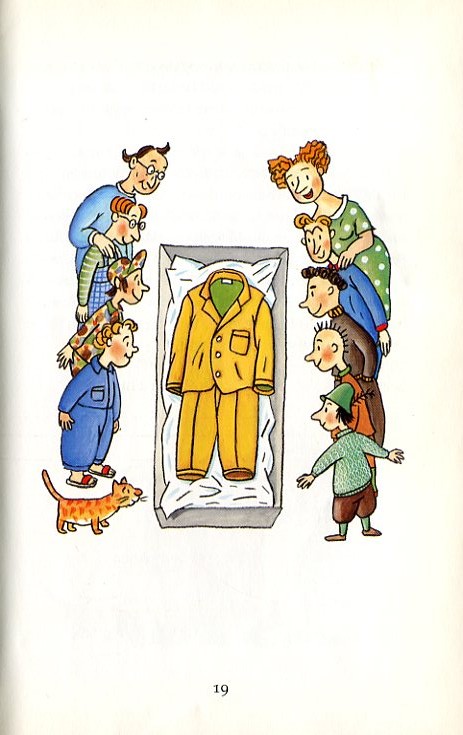 As the youngest of seven, however, Max is last in line for everything, and it doesn't look like his chances of acquiring a suit are all that good. Then one day, the postman delivers a box whose label has gotten wet, so that the only name legible was Nix. No one knows who the box is for, nor can they imagine what it contains. When at last it is opened, "there in the grey box with a wreath of white tissue paper around it lay a wooly whiskery brand-new mustard-yellow suit with three brass buttons."
 As per usual, Papa Nix gets first dibs. He is very excited, determined to wear the suit the next day to his job at the bank. "He thought how it would be to wear the woolly, whiskery, brand-new, mustard-yellow suit to work. Such a suit had never been seen before in all Winkleburg." However, as he thinks more about it, he decides it might not be professional to wear such a bright suit, and announces, "'I am too big to wear a mustard-yellow suit.'"
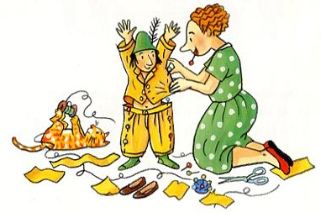 So it passes on to Paul. Mama Nix has to make some alterations, but "when she was through, the suit fitted Paul to a T. He decides to wear it the next day for skiing. "Such a suit had never been seen before in all Winkleburg." But none of his friends where a suit like that, and he decides, "I am too big to wear a mustard-yellow suit.
So it passes on to Emil who is going to sled in it, but thinks of his friends, and decides he is "too big to wear a mustard-yellow suit," as does Otto, and then Walter, and Hugo, and finally Johann. And so, at last, it passes to Max.
Max wears the suit the next day, and he doesn't care that no one in Winkleburg has ever seen a suit like it: IT DIDN'T MATTER. He goes on to wear the suit while doing a lot of the things his brother's felt they couldn't do in the suit: skiing, riding his bike in the rain, ice-fishing, sledding, fox-hunting. And as for the potential difficulties wearing the suit in those situations could create: IT DIDN'T MATTER.
In the end, all of the people in the town, even all of the animals in the town, admire Max's marvelous suit.
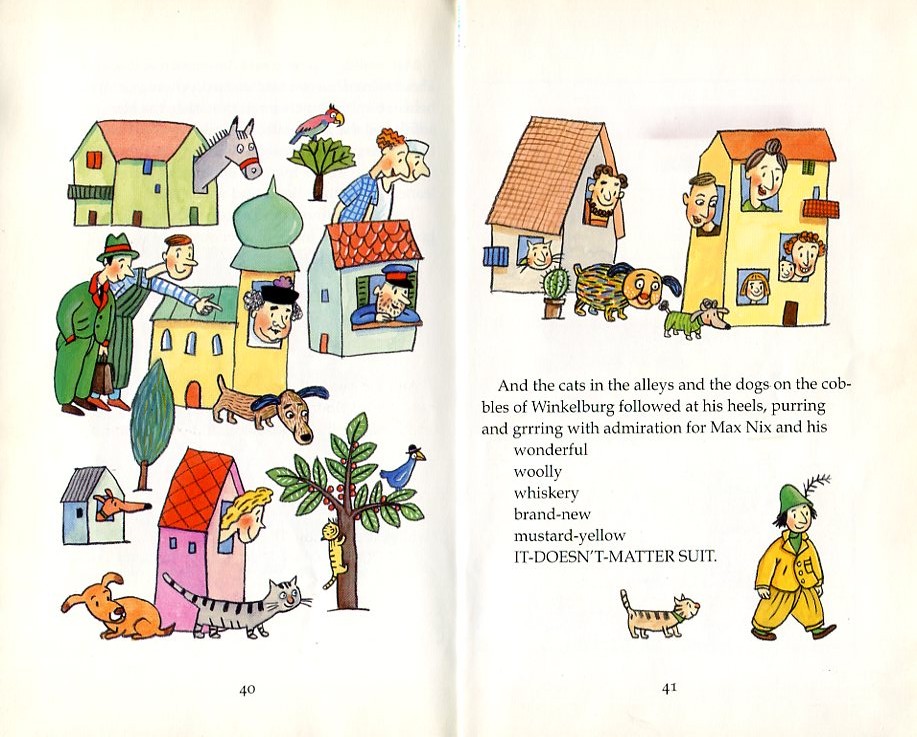
OUTSIDE OF THE UNBELIEVABLE PREMISE, that a seven year old boy would want a suit more than anything in the world, The It-Doesn't-Matter Suit is a delightful book. It contains many repetitious refrains, like "Such a suit had never been seen before in all Winkleburg, and "I am too big to wear a mustard-yellow suit," which I'm sure young children would enjoy.
The book is included in 2001's Collected Children's Stories with illustrations by David Roberts, the black and white illustrations in this post.
The little background material I found came from a 2005 Horn Book article by Lissa Paul, a 1995 article from the Daily Mail (London), and a 1995 announcement in The New York Times.
COMING SOON: Sylvia Plath's Mrs. Cherry's Kitchen.
All images are copyrighted © and owned by their respective holders.
April 19, 2013
THREE YEARS
 TODAY MARKS THE THREE-YEAR ANNIVERSARY of We Too Were Children, Mr. Barrie. The number of posts has gone down each year, but my commitment to the blog has never wavered. I'll be back with more Sylvia Plath in the next week or two. Today, I am in Los Angeles for the LA Times Book Awards, so keep your fingers crossed for me. If you are in the LA area, I will be at the LA Times Festival of the Books tomorrow, so come and say hi. Thanks for reading all this time.
April 11, 2013
SYLVIA PLATH: THE BED BOOK
 IT MAY BE HARD TO RECONCILE the idea of Sylvia Plath, the patron saint of suicide, the confessional chronicler of depression, with her children's books. That a woman who expressed so little happiness in all her other works had hidden away light, silly verses and stories is jarring. Perhaps that is why it was not until over a decade after her death that any of them appeared.
Written in 1959, but published in 1976, The Bed Book was the first of Plath's children's books to see print. Encouraged by Atlantic Monthly Press editor Emilie McLeod, Plath took the idea of fantastical beds, and composed an almost Seussian poem of imagination.
She wrote in her journal for May 3, 1959:
Emilie McLeod loved it, but she suggested removing the two children, Wide-Awake Will and Stay-Uppity Sue who had acted as a framing narrative. Plath rewrote the book within a week of receiving McLeod's edits, and was very optimistic that it would soon be accepted for publication. She dedicated it to her friend Marcia Plumer's adopted twins."I wrote a book yesterday. Maybe I'll write a postscript on top of this in the next month and say I've sold it. Yes, after half a year of procrastinating, bad feeling and paralysis, I got to it yesterday morning, having lines in my head here and there, and Wide-Awake Will and Stay-Uppity Sue very real, and bang. I chose ten beds out of the long list of too fancy and ingenious and abstract a list of beds, and once I'd begun I was away and didn't stop till I typed out and mailed it (8 double-spaced pages only!) to the Atlantic Press. The Bed Book, by Sylvia Plath. Funny how doing it freed me. It was a bat, a bad-conscience bat brooding in my head...A ready-made good idea and an editor writing to say she couldn't get the idea of it out of her head."

That Plath herself still had no children of her own (despite The New York Times's erroneous claim that The Bed Book had been written for Plath's children) was still a source of much anguish to the young poet. Her husband Ted Hughes had turned to writing children's books at the same time. (He went on to have a long successful career as a children's writer, a subject for a future We Too Were Children.) Writing in her journal of both his and her books, Plath mourned, "And no child, not even the beginnings or the hopes of one, to dedicate it to...My god. This is the one thing in the world I can't face. It is worse than a horrible disease."
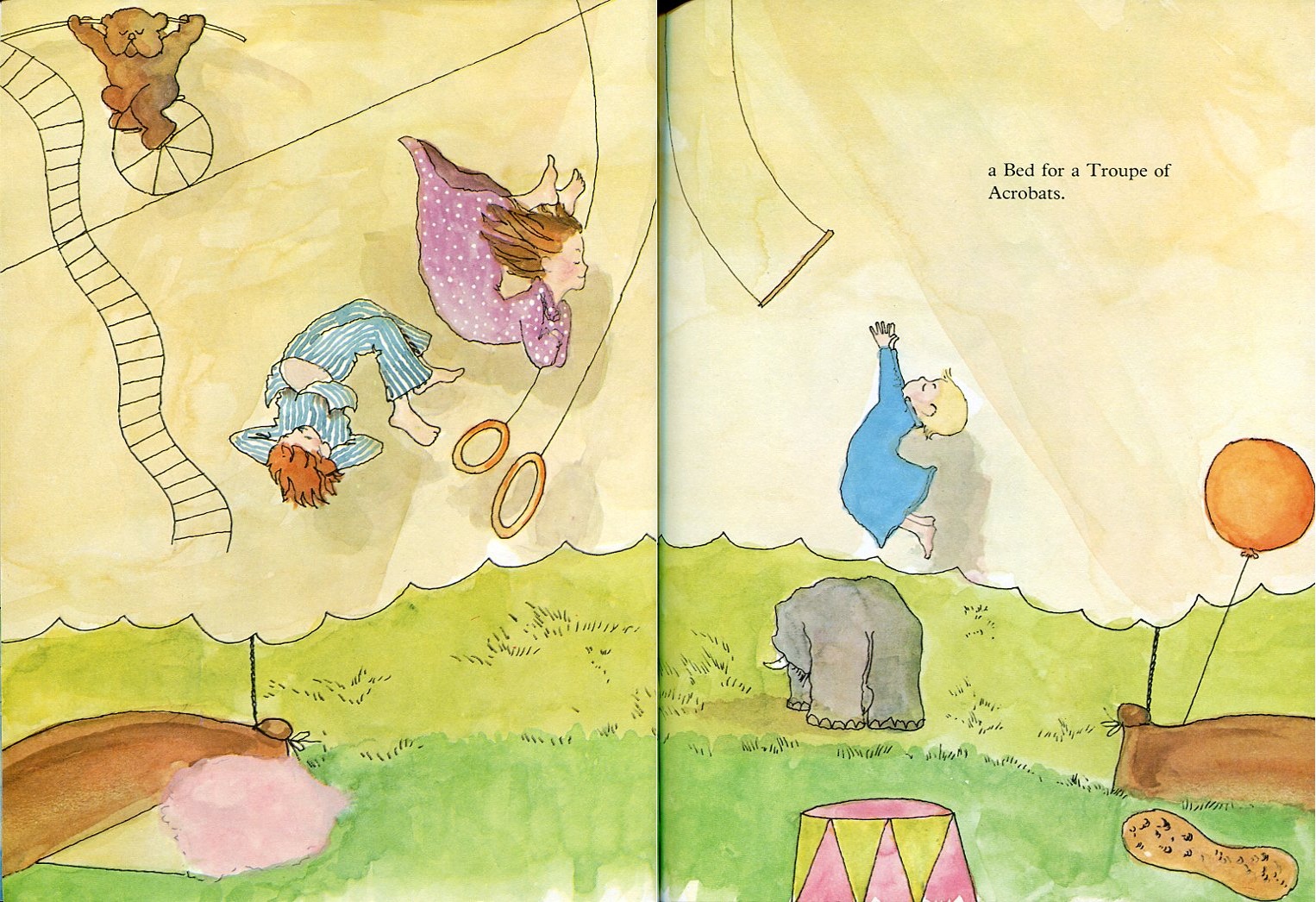
Plath had to wait until the middle of August until she got back definitive word about the fate of her book. Little, Brown, then the publisher of Atlantic Monthly Press books, felt "that the book is not simple and basic enough, that some of the beds are too farfetched, and that it has more appeal to adults than to children." At the time, while Plath had published many poems and stories in magazines, she had not yet published a book, and so could not rely on her name to carry the book through. Emilie McLeod was genuinely sorrowful that she had to pass on the bad news.
THE BED BOOK THAT EVENTUALLY DID APPEAR deserves none of Little, Brown's criticisms. It begins:
Plath said in her journal that she had chosen ten beds, but in the final book there seem to be a few more than that. Of course, she may have intended some of these beds to be the same bed. They are: a bed for fishing, a bed for cats, a bed for acrobats, a submarine bed, a jet-propelled bed, a snack bed, a spottable bed, a tank bed, a bird-watchers bed, a pocket-size bed, an elephant bed, and a North-Pole bed.Beds come in all sizes--
single or double,
cot-size or cradle,
king-size or trundle.
Most Beds are Beds
for sleeping or resting,
but the best Beds are much
more interesting!
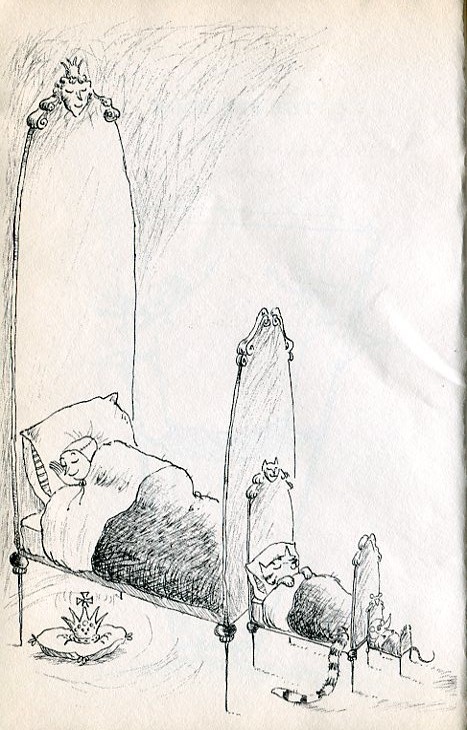
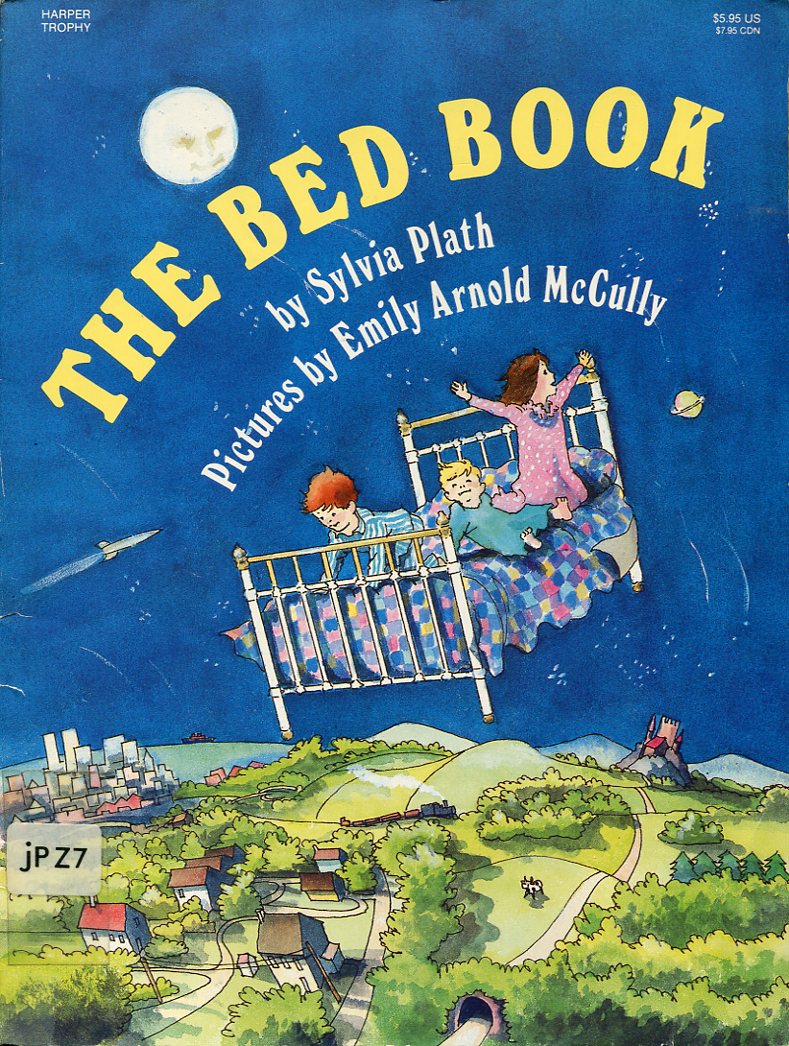
The Bed Book was later included in Plath's Collected Children's Stories with different illustrations. In the original book, illustrator Emily Arnold McCully infuses her pictures with warmth, depicting a sort of nostalgic idyll.
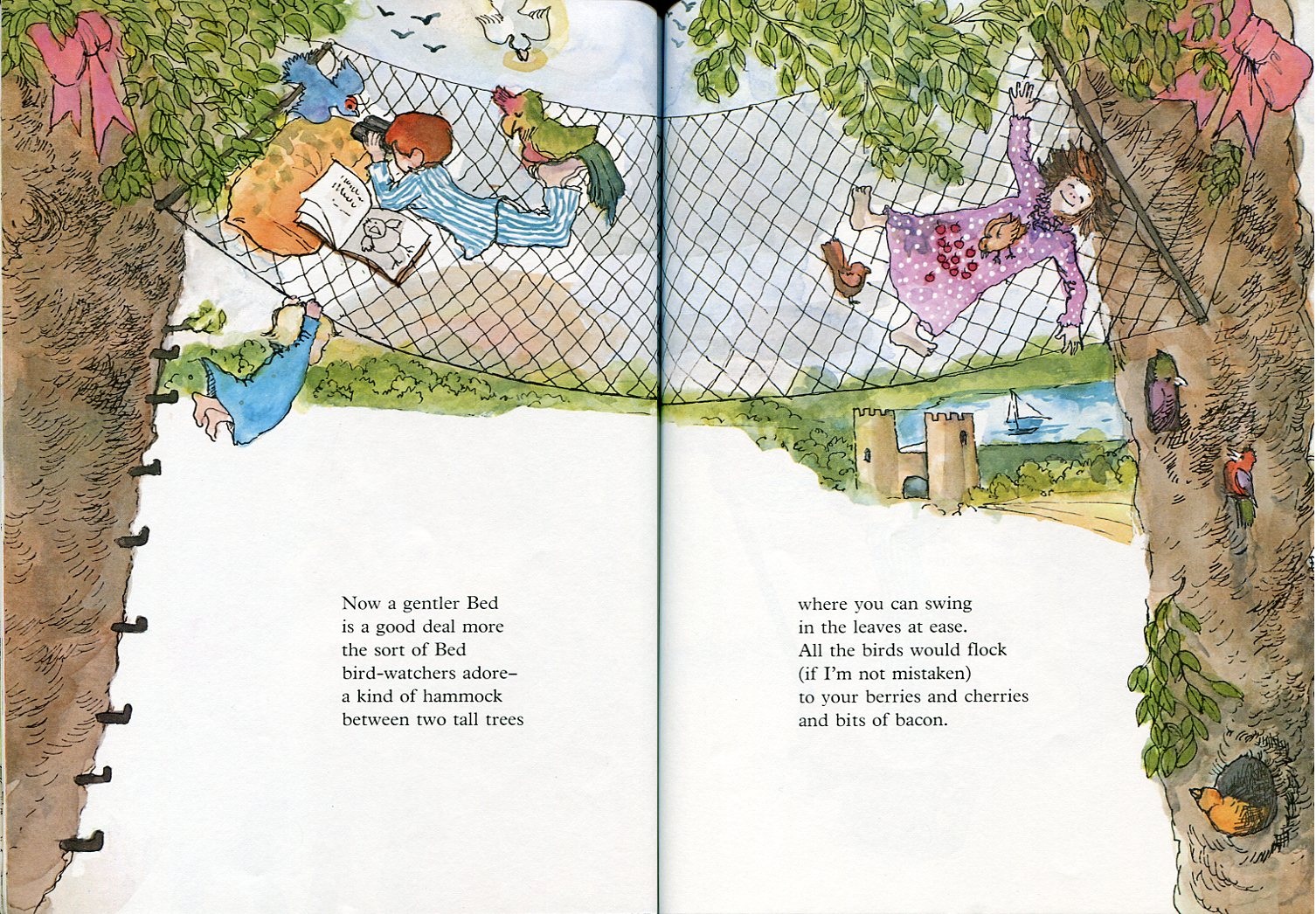
But the later pictures by David Roberts come closer to the zaniness the book intends.
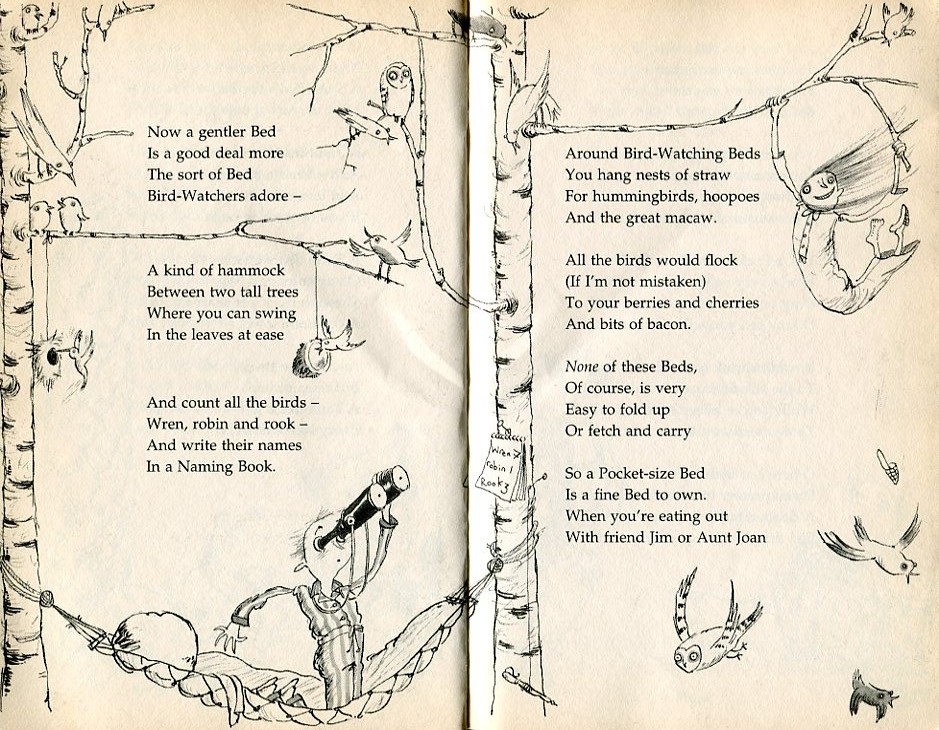
The collected version also retains additional verses that had been cut from the book's first appearance. Why those particular lines had been removed is unclear.
Jack Prelutsky included an excerpt from The Bed Book in The Random House Book of Poetry for Children, but the book itself fell out of print. It would be twenty years more before another one of Plath's children's works was published
In addition to Plath's own published journals, background information for this post came from Bitter Fame: A Life of Sylvia Plath by Anne Stevenson, and Rough Magic: A Biography of Sylvia Plath by Paul Alexander.
COMING SOON: The It-Doesn't-Matter Suit by Sylvia Plath
All images are copyrighted © and owned by their respective holders.
April 5, 2013
GUEST POST ON VKBMKL: SINNICKSON'S WIZARD OF OZ
 IN HONOR OF THE NEW OZ MOVIE, I've contributed this beautiful Wonder Books edition to the greatest kids' book blog there is, Vintage Kids' Books My Kid Loves. Click the link to check it out. Head on over to my Flickr to see the whole book.
All images are copyrighted © and owned by their respective holders.
March 11, 2013
CARSON MCCULLERS: SWEET AS A PICKLE AND CLEAN AS A PIG
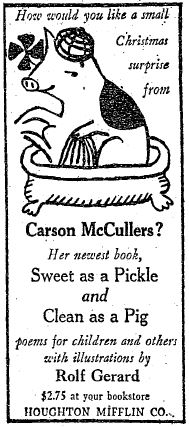 CARSON MCCULLERS WROTE ABOUT CHILDHOOD. Her two most famous works, the novels The Heart is a Lonely Hunter and Member of the Wedding (later adapted for the stage) both have as central protagonists young girls trying to navigate the borders between girlhood and adulthood. They are haunting and insightful portraits, but writing insightfully about childhood is not the same as understanding children, as McCullers revealed in her one publication intended for children, the book of poems Sweet as a Pickle and Clean as a Pig.
Written towards the end of her life, Sweet as a Pickle and Clean as a Pig was in many ways an exercise that allowed McCullers to write something, anything. Plagued with ill health all her life, writing became progressively harder in her later years, as pain and fatigue made prolonged writing sessions difficult. Light children's verse was a way to practice her vocation, and the idea that the poems might entertain the children of her friends only added to the pleasure. Published almost by chance, when the editor Joyce Hartman happened upon several of the poems and asked to see more, McCullers dedicated the book to Emily and Dara Altman, the children of her lawyer, and Tony Lantz, the son of her agent.

The book was not well received, and it's not hard to see why. The poems alternate between light nonsense verse in the vein of Mother Goose, and free verse observations and reminiscences tinged with melancholy.

It's hard to imagine what child would be drawn to such disparate work, especially since the poems are neither funny nor particularly rhythmic.

The crude illustrations were provided by Rolf Gérard, a painter and longtime set designer for the Metropolitan Opera in New York.
The book is a footnote to an illustrious career that leaves readers wishing McCullers's ability to evoke dreamlike realities had carried over to her work for children.
WHAT LITTLE INFORMATION I could find came predominantly from The Lonely Hunter: A Biography of Carson McCullers by Virginia Spencer Carr. I also consulted Carson McCullers: A Life by Josyane Savigneau. To see Sweet as a Pickle and Clean as a Pig in its entirety, go to my Flikr set here.
All images are copyrighted © and owned by their respective holders.
December 18, 2012
UPTON SINCLAIR: THE GNOMOBILE ILLUSTRATED BY MARCEL TILLARD
+-+001.jpg) I HAVE ALREADY WRITTEN extensively on both Upton Sinclair's novel
The Gnomobile
, and the Walt Disney movie it inspired. In my original post, I talked about the minor differences between Upton Sinclair's 1936 first edition and the 1962 reissue. There is, however, one major difference between the editions that I did not address: the illustrations.
I HAVE ALREADY WRITTEN extensively on both Upton Sinclair's novel
The Gnomobile
, and the Walt Disney movie it inspired. In my original post, I talked about the minor differences between Upton Sinclair's 1936 first edition and the 1962 reissue. There is, however, one major difference between the editions that I did not address: the illustrations.The Gnomobile was released in France in 1959 as En Gnomobile à travers l'Amérique with illustrations by Marcel Tillard. Tillard was a children's book illustrator and comic book artist who illustrated tales from the Brothers Grimm, Hans Christian Andersen, and Chinese tradition. There is very little information in English about Tillard, but based on what I gleaned from Google translation, he was born in Orleans in 1913, and studied Fine Arts in Tours and Paris. He started contributing illustrations to several different magazines in the early 1950s, and in 1955, he began a long collaboration with Jean-Pierre Chabrol on Le Barlafré, a comic book series that ran for 410 albums.
+-+003.jpg)
When Upton Sinclair reissued The Gnomobile in America in 1962, Tillard's illustrations were included. It was the only English-language work to sport Tillard's art.
+-+006.jpg)
+-+018.jpg)
The art alternates between four-color and two-color illustrations with four-color outnumbering two-color by two.
+-+010.jpg)
+-+015.jpg)
Tillard's work is stunning, reminiscent of classic Little Golden Books' illustrators such as Gustaf Tenggren and Tibor Gergely. He died in 1976, and the only work of his that is still in print in France is a book and CD set of Peter and the Wolf. It is a shame that his work is both out of print and unavailable in the U.S.
I have posted all of Marcel Tillard's illustrations for The Gnomobile on my Flickr, and other examples of his illustrations are available online here, here, and here.
All images are copyrighted © and owned by their respective holders.
December 11, 2012
J.R.R. TOLKIEN: THE FATHER CHRISTMAS LETTERS
 WITH THE HOBBIT COMING OUT IN THEATERS and Christmas only two weeks away, the time is right to bring out J.R.R. Tolkien's The Father Christmas Letters. Tolkien, in case you somehow have missed this, is the most important fantasy writer of all time. His Lord of the Rings defined high fantasy: an intricately detailed fictional world (Middle-Earth) and a heroic epic quest (Frodo's imperative to destroy the one ring). Tolkien, a professor at Oxford, spent much of his life chronicling Middle-Earth's history, creating whole new languages and alphabets, complicated mythology, and international politics. And since the books' release in the 1950s, billions of dollars in revenue from books, films, and merchandise have proven that almost everyone loves it.
Now imagine if the guy who did all that was your dad. What kind of cool bedtime stories would he tell? What would he say when you asked him if Santa Claus was real?
Tolkien had four children--John, Michael, Christopher, and Priscilla. Starting when John was three in 1920 and continuing for the next twenty-four years, Tolkien wrote and illustrated a personal letter from Father Christmas to his children each year. The letters were delivered to the house in envelopes bearing North Pole stamps and postal cancellations, except when they were marked "By Elf Messenger" or "by direct Reindeer Post." Father Christmas's handwriting was often shaky--he was "nineteen hundred and twenty-four, no! seven! years old on Christmas Day" 1923, and it was cold at the North Pole. Eventually his elfin secretary Ilbereth took over some of the writing duties in 1936.
But what did Father Christmas write about? Well his boon companion was the North Polar Bear, who had a way of getting himself into trouble. In 1925, he climbed the North Pole to retrieve Father Christmas's hood, and the North Pole broke, destroying Father Christmas's house in the process. In 1928 he fell down the stairs and in 1936 he fell asleep in the bath, flooding one of the gift sorting rooms.


Eventually, the cast of characters grew to include two of the North Polar Bear's nephew's, Pasku and Valkotukka, and countless unnamed Elves, Snow-Men, Red Gnomes, Green Gnomes, Cave-bears, and starting in 1932, Goblins.
Apparently, Father Christmas has been at war with the Goblins for centuries. In 1932, the North Polar Bear stumbles into one of their deserted underground caves, the walls covered with paintings, some by goblins, some by men. Soon, sensitive to the smell of Goblins, the North Polar Bear uncovers a system of tunnels that lead in to the kitchen of Father Christmas's old house. Father Christmas thought the goblins were taken care of after the trouble they caused in 1453, but with evidence of at least one hundred years of activity, Father Christmas knows he must take action. He smokes the Goblins out into the hands of the Red Gnomes who chase them out of the land. The threat has passed, although Father Christmas believes "they will crop up again in a century or so."

They crop up the next year, however, and the North Polar Bear in single combat takes down one hundred of them before the Gnomes arrive to handle the rest. This sets the Goblins back many years, but they spend that time rallying their forces. When World War II breaks out, and so much of the world is occupied with the conflict, the Goblins see this as their chance to mount another attack on the North Pole. They are, of course, defeated.
The Father Christmas Letters were published in 1976, three years after Tolkien's death. The original edition omitted many of the letters from the early 1920s, as those letters were short and lacked the narrative elements of the later letters. It also left out the letters from the early 1940s. A complete edition of the letters, along with scans of many of the envelopes and letters in addition to the illustrations, was published in 2004, a paperback of which is still in print.
While written for children, the letters from Father Christmas were written for a very specific group of children with the conceit that the letters were authentic, so the book might not be of that much interest to children today. But it is of great interest to any fan of Tolkien, a way to imagine what it was like to have a dad who invented Gandalf, Bilbo, and Frodo.
All images are copyrighted © and owned by their respective holders.

November 28, 2012
WALT DISNEY PRESENTS THE GNOME-MOBILE
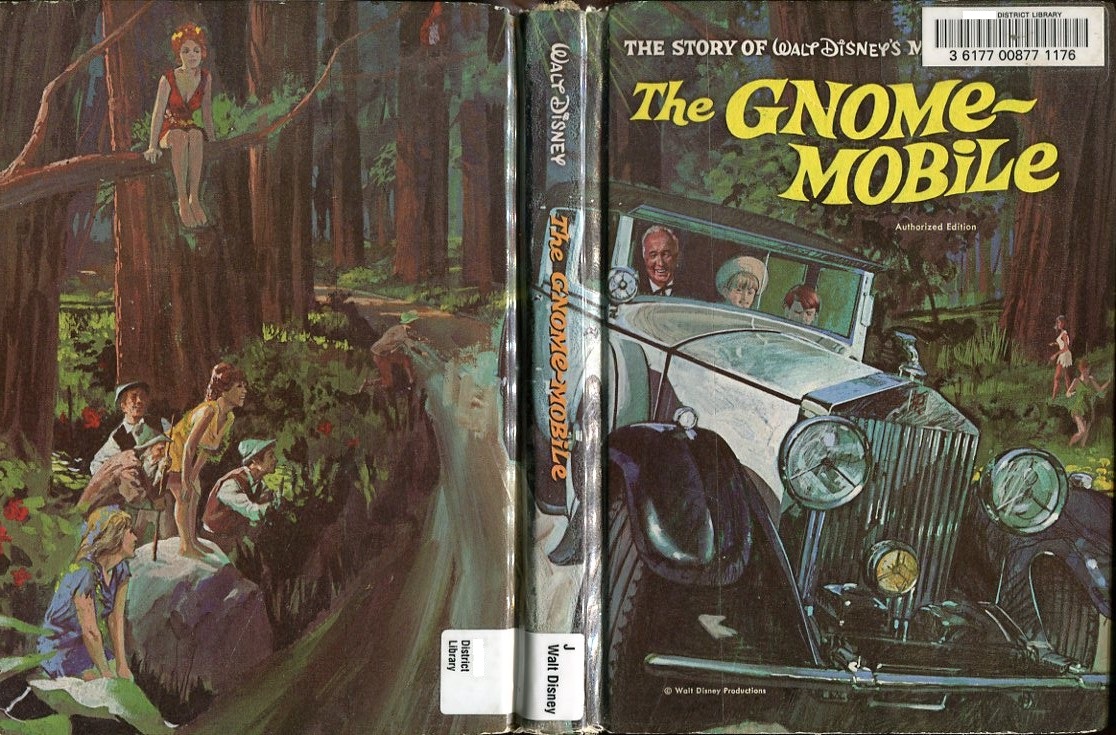
IF A CHILDREN'S BOOK by Upton Sinclair seems unlikely, then a Walt Disney movie based on an Upton Sinclair children's book seems almost impossible. But in 1967, thirty-one years after the book The Gnomobile was published, Walt Disney released the live-action film The Gnome-Mobile starring Walter Brennan "and those Mary Poppins kids," Matthew Garber and Karen Dotrice.
 Sinclair had had a tempestuous relationship with Hollywood over his long career. He at first believed that film could be a powerful tool in raising social awareness and reaching the populace. He produced (and made a cameo in) an adaptation of his most famous book The Jungle in 1914, which stayed faithful to his book. But the next major movie based on one of his books, The Money Changers, released in 1920, turned a novel about J. P. Morgan's involvement in the panic of 1907 into a movie about the Chinatown drug trade. Sinclair was furious, and was ready to write off Hollywood for good. But there was still some belief that the cinema could be made to serve social justice.
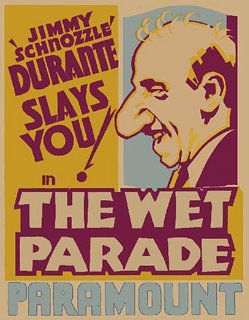 In 1932, his pro-Prohibition novel The Wet Parade was turned into a film by MGM for which he was paid $20,000. This time, the story in the book matched the story on the screen. This personal success allowed the socialist Sinclair to move to Beverly Hills, where he was soon hired by William Fox to write a book on Fox Corporation's Depression travails. The book was meant to be a publicity tool for Fox Corporation, but in Sinclair's hands it became an indictment of a movie studio attempting to form a monopoly. It did not make him popular in Hollywood.
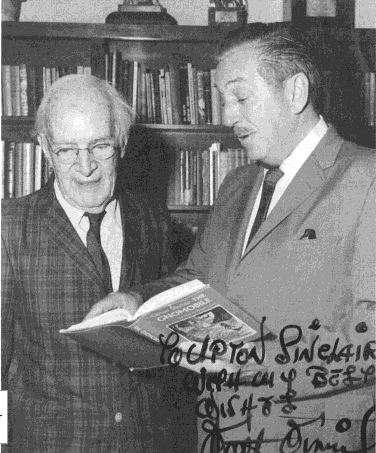 By the time Sinclair ran in the gubernatorial race of 1934, his socialist politics seemed such a threat to the Hollywood studios--especially Louis Mayer--that the studios churned out an active smear campaign, ensuring Sinclair's loss. It was because of this loss that Sinclair set out on a speaking tour in 1935 to recoup some of his campaign money, which took him through the redwoods and inspired the novel The Gnomobile.
Despite his status in Hollywood, when the book came out in 1936, Sinclair's friend Rob Wagner, publisher of the magazine The Script, introduced Sinclair to Walt Disney, suggesting that The Gnomobile might be suited for film. Disney didn't think it right for an animated movie, but said if he ever began making live-action films, he would consider it.
After Disney began making live-action features in 1950, Sinclair began to write occasional letters reminding Disney of his promise to turn The Gnomobile into a movie. Sinclair's hope was that he would see the book on the big screen before he died. Eventually Disney wrote back, and in 1967, Sinclair got his wish. Walt Disney, however, twenty-three years his junior, died before the movie's release. He watched footage of the film in progress in the last month of his life.
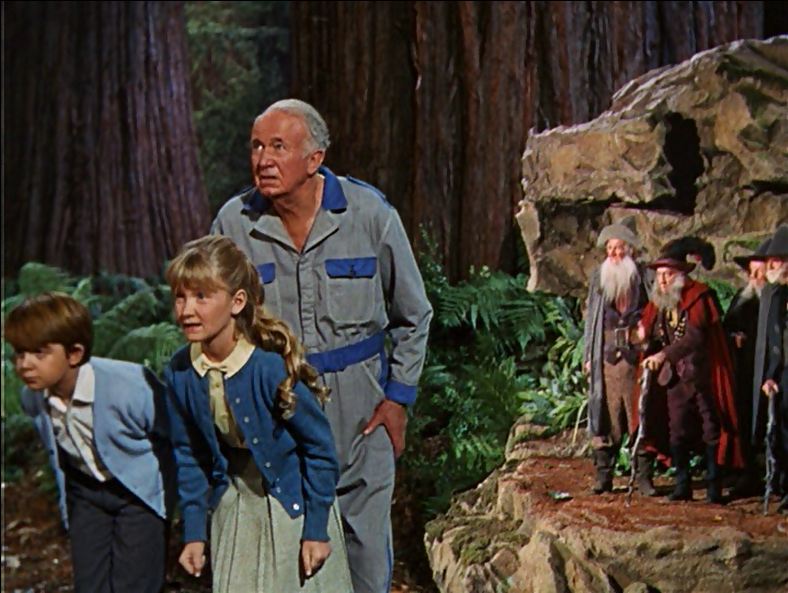
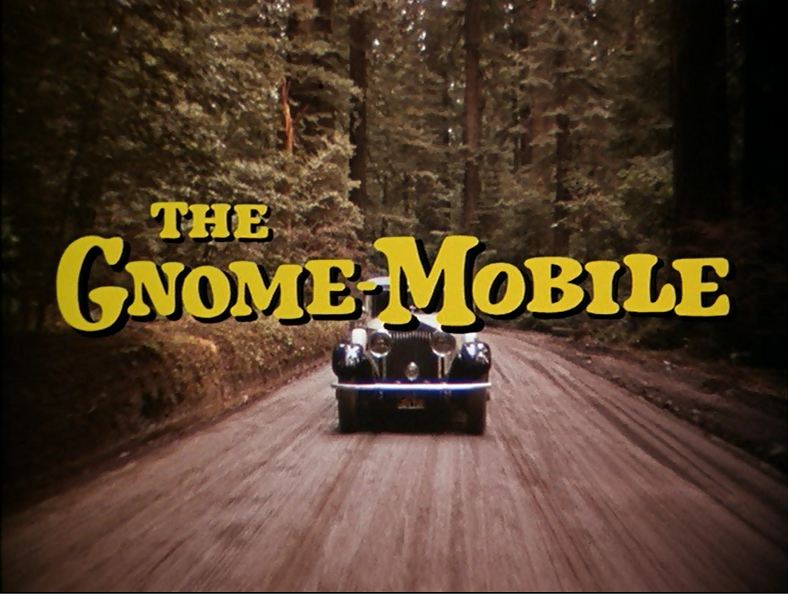 AS TO BE EXPECTED with a Disney adaptation, The Gnome-Mobile is very different from The Gnomobile, and it goes far beyond a change in title. First off is a change in protagonists. In Sinclair's book, the main characters are a young girl named Elizabeth and her uncle Rodney Sinsabow. In the movie, Rodney becomes Elizabeth's younger brother, and the adult along for the adventure is their grandfather D. J. Mulrooney, the lumber baron (played by Walter Brennan). This is significant because the disappearance of the gnomes is a direct result of heavy logging. Now, instead of trusting in a descendent of loggers with great disdain for his family's business, the gnomes must trust in their arch-nemesis himself.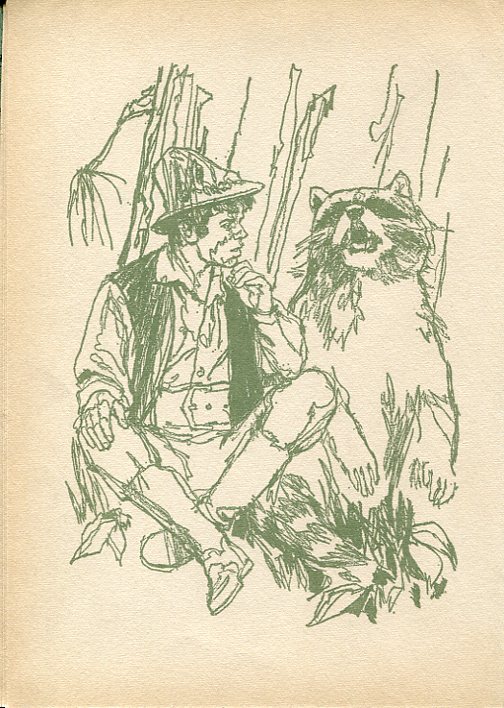
The gnomes go in for name changes as well. Bobo becomes Jasper, and his grandfather Glogo becomes Knobby. Since the arguably more loaded gnomic word Doo Deen (doodie anyone?) is introduced in the movie for regular-sized people--in the book, they're just called "big people"--it's not clear why these new name are preferable to the originals.
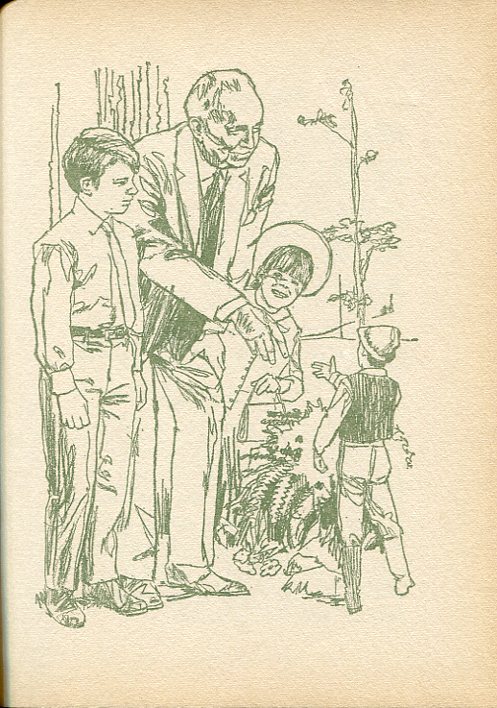 The movie opens with D. J. leaving the Mulrooney Lumber building in his Rolls Royce to pick up his grandchildren at the San Francisco airport. The plan is to drive up to Seattle to go yachting. Along the way, they stop for a picnic in Mulrooney Grove in Redwood National Park. D. J. explains, "All that sign means is, that I had the privilege of seeing they'll always be here." He's a lumber baron and a conservationist.
While D. J. and Rodney set up the picnic, Elizabeth wanders away into the forest. There we see Jasper conferring with his animatronic woodland friends about whether or not to address the Doo Deeen girl in hopes that she can help him with his problem. Against his friends' advice, he talks to her, and soon he has met the other Doo Deens as well.
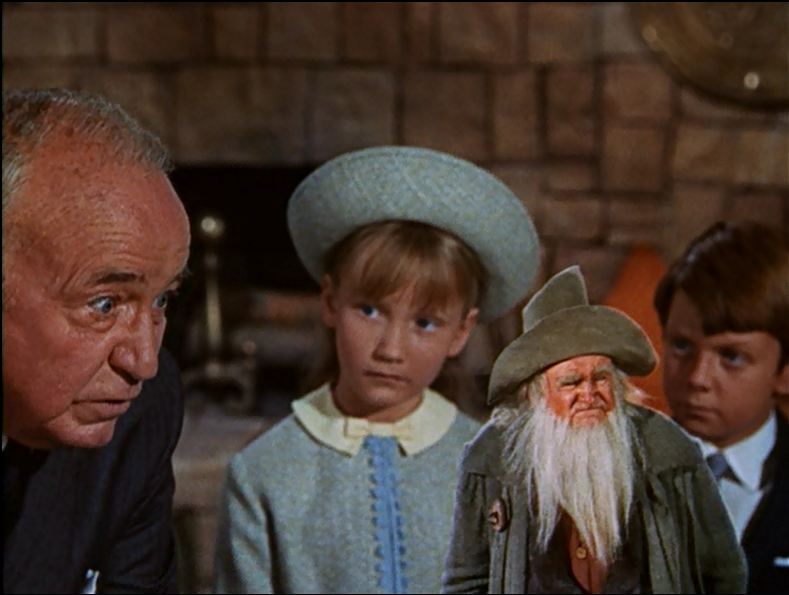 Jasper's problem is that his grandfather Knobby is going all "see-throughish," which means he has lost the will to live. "Grandpa's given up all hope of ever seeing me married and havin' young'uns of my own." (Apparently gnomes have a southern country accent. But then D. J. has a faint Irish accent and his grandchildren have English accents, so take your pick.)
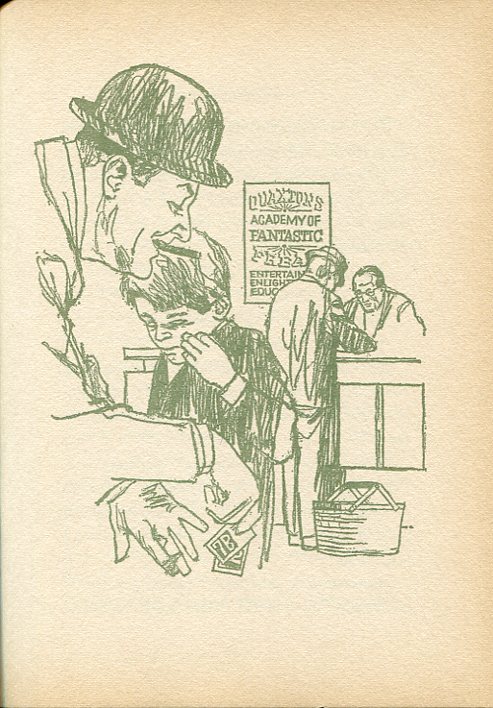 There are no more gnomes in this forest, although there are rumors of gnome colonies in other forests. After placating an irate anti-Doo-Deenic grandpa Knobby (also played by Walter Brennan), it is agreed that D. J. will take the gnomes in his car, which Elizabeth quickly dubs The Gnome-Mobile, to find other gnomes.
The trip will take more than a day, so they stop off at a motel, the gnomes safely hidden in the picnic basket. D. J. has managed to keep from the gnomes that he is the one responsible for cutting down the trees. However, when the desk clerk says his name aloud, Knobby throws a fit, which attracts the attention of Quaxton, purveyor of Quaxton's Academy of Fantastic Freaks, who happens to be putting up a poster in the hotel lobby.
In the hotel room, Knobby and D. J. have it out, and D. J. storms off with Rodney saying that he's taking the gnomes right back to their forest in the morning and be done with them. Quaxton, seeing two of the party leave, calls the room and tricks Elizabeth into abandoning her post as gnome-sitter. He then promptly purloins the gnomes.
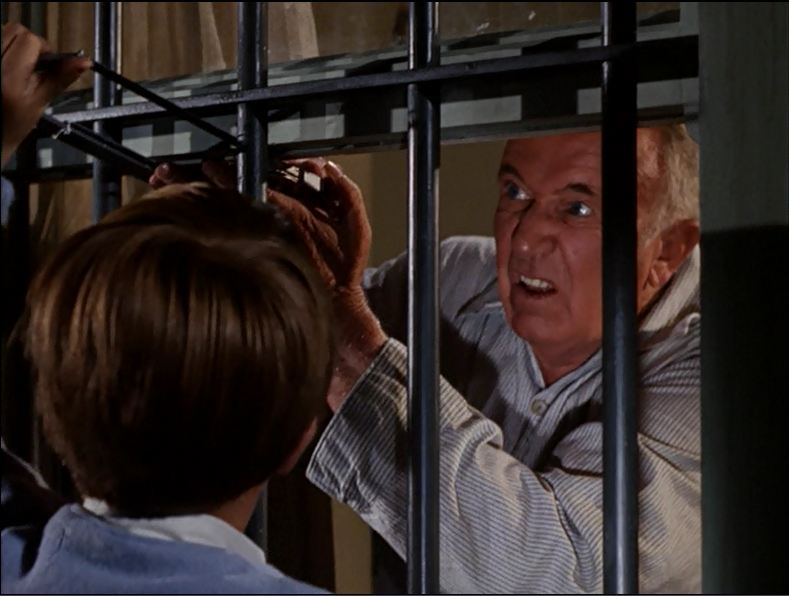 When D. J. finds out the gnomes have been stolen, he contacts his executive vice president Ralph Yarby to call in the company security team, knowing he can't go to the police without it becoming a news story. Yarby, however, thinks D. J. has gone crazy, so he flies up to where they are staying, and telling D. J. they are going to see a private detective, commits him to Five Oaks mental hospital, abandoning Sinclair's book completely.
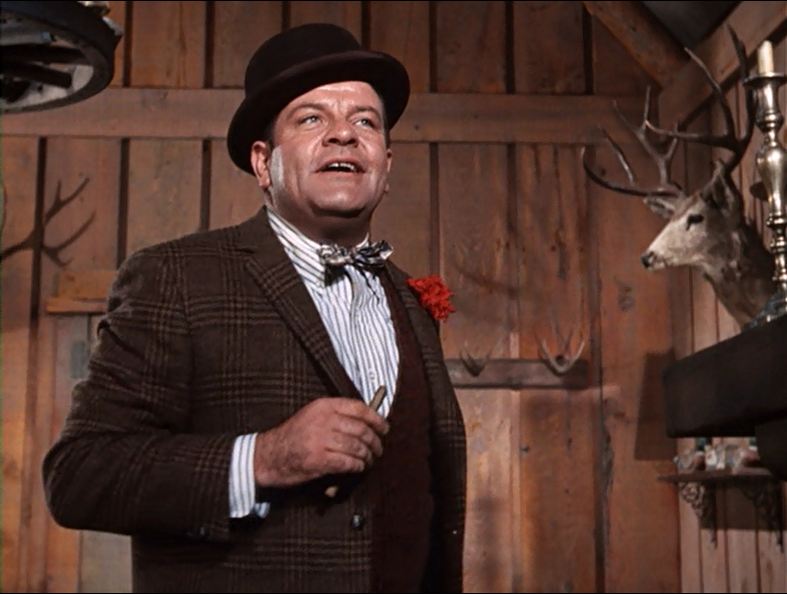 Elizabeth and Rodney then break D. J. out of the locked facility, but they're not sure what to do next. Rodney then remembers seeing Quaxton in the motel, so the three of them--D. J. in his Five Oaks nightgown--head for Quaxton's Academy of Fantastic Freaks.
At the freak academy, D. J. has a run-in with the caretakers who are in their pajamas, but armed with a shotgun. With the assistance of Rodney, he manages to get out of them that Quaxton has a cabin in the woods, and that he's probably there.
 At the cabin, Jasper breaks out of the picnic basket when Quaxton goes out to get food. He is in the process of getting Knobby out the window when Quaxton returns. Quaxton manages to prevent Jasper's escape, but D. J. and the children are soon upon him, and the three of them along with Jasper are soon on the road.
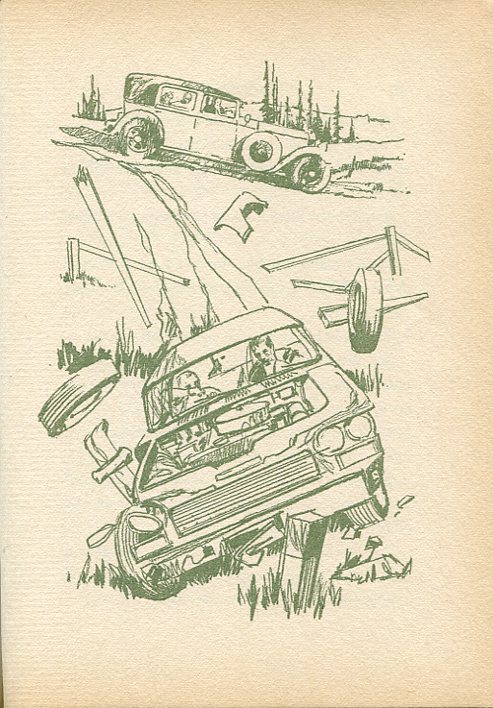
 Now, of course, since this a movie about a car, there needs to be a car chase. Yarby and two male nurses from Five Oaks are quickly on D. J.'s trail. D. J. swerves his vintage Rolls Royce off the road, and takes flight through the woods. The Rolls holds up fine, but the car that Yarby is in loses piece after piece as they bounce along, first the hood of the car and lastly the rear wheels. As D. J. pulls away, Yarby catches a glimpse of Jasper in the back of the car, and does a double take.
 The movie at this point, reaches new levels of silly. Knobby has found another colony of gnomes nearby. The Gnome-Mobile crew manages to pull off the road and find him immediately. He's in the company of Rufus, leader of the colony, played by the lord of silliness Ed Wynn in his final performance.
Rufus introduces some of the other gnomes, but they are all men, which leaves Jasper a bit disappointed. When D. J. points this out, Knobby says, "Of course, how stupid of me. Rufus has more girl gnomes here than he knows what to do with."
Rufus then yells, "Girls! Girls! Come on out girls! The eligible gnome is here!" and a bevy of girls in flowing dresses somewhere between a peasant dress and a mini-skirt comes flocking out of the underbrush. They line up. Jasper picks out the one he wants (Violet), only to be told "It's not the male that picks his mate, it's the she-male that picks the date."
Here's what's going to happen. Jasper is going to get lathered up in soap. Then whichever girl holds him to the count of seven gets to keep him. D. J. actually says, "It's like a greased pig chase back in Ireland." Watch.
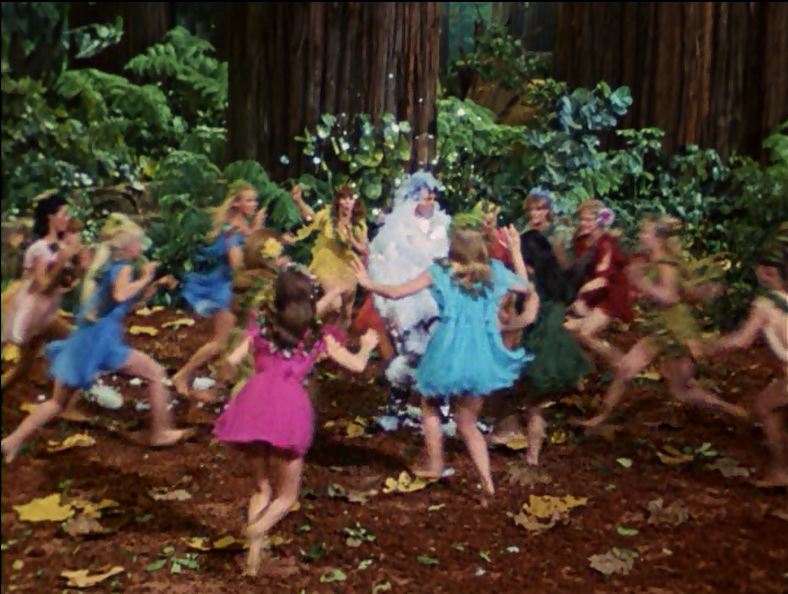
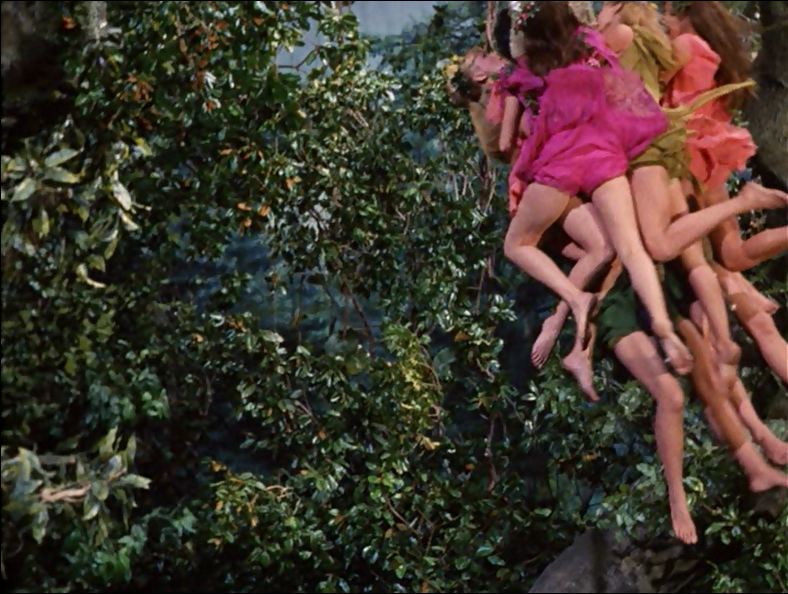

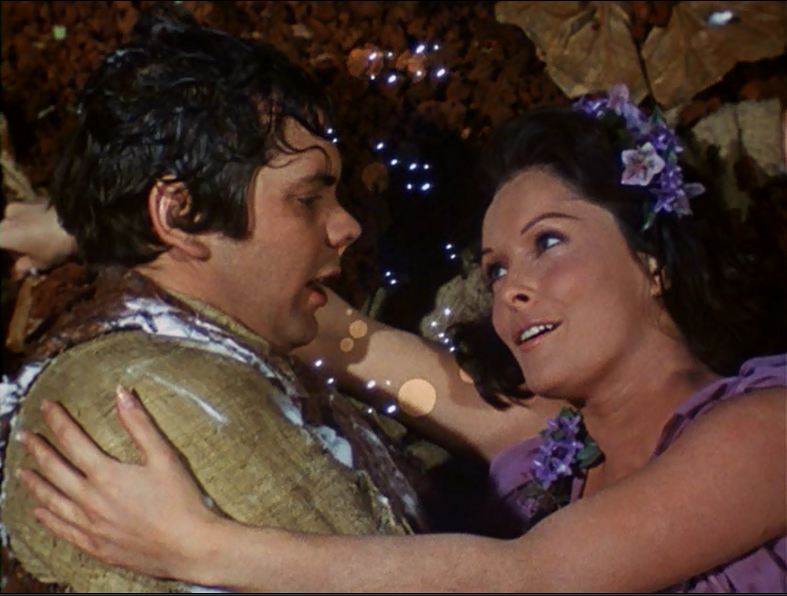
This chase goes on for six whole minutes.
In the end, Jasper marries Violet right then and there despite having said nothing more than "hello" to each other. D. J. announces that any gnomes who want to form a new colony are welcome to join him in the Gnome-Mobile. And they all sing a reprise of the song.
Right, I didn't mention the song. In addition to the Mary Poppins' kids, The Gnome-Mobile has the Mary Poppins' director Robert Stevenson, and one song from the Mary Poppins' song writers, the legendary Sherman brothers: 'In the Jauntin' Car/The Gnome-Mobile'.
In 1978, The Gnome-Mobile aired in two parts as part of Walt Disney's Wonderful World of Color.
THE CRITICS were rather dismissive of The Gnome-Mobile when it came out. Roger Ebert said, "Disney films are meant to please kids not critics. So now I go on Saturdays. Last Saturday the kids let me know that The Gnome-Mobile had some good parts in it."
The New York Times said, "A fine idea unquestionably, especially for the Disney technicians, who do very well in some beautiful but fleeting photography of the majestic backgrounds and in some of the whimsy...But the action and light-hearted spirit sag under a crisscross jumble of slapstick and broadly handled locomotion that flattens the fun."
The Los Angeles Times was a bit more austere, recognizing that The Gnome-Mobile was one of Walt Disney's last pictures and contained Ed Wynn's final performance. Still, "Mr. Disney always insisted that he didn't make children's pictures, he made family pictures, and more often than not, this was true enough. With The Gnome-Mobile, however, a slightly higher than usual quota of adult tolerance may be called for."
 The Los Angeles Times also included a photograph of Upton Sinclair standing with Walter Brennan and Ed Wynn in their gnome guises, which I have only seen as a scan of a microfilm. If anyone has a clear copy of that picture, please let me know so I can add it to this post.
One last note of interest, both the car used in the film and the oversized rear seat used to make grown people look like gnomes are housed in The Gilmour Car Museum in Hickory Corners, Michigan, making that museum one of the more esoteric Disney vacation destinations. If anyone has pictures from the museum, I'd be happy to add them as well.
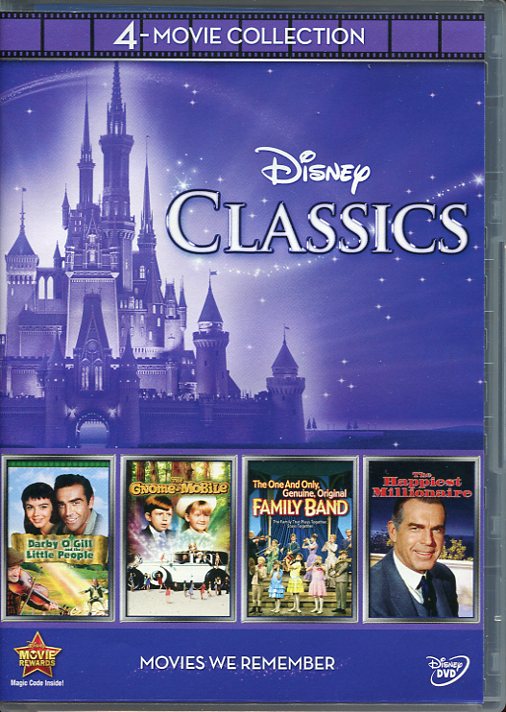
I DREW FROM many sources for this post. First and foremost was the movie itself, which is currently available as part of a four-movie collection (see right) that also includes Darby O'Gill and the Little People , The One and Only, Genuine, Original Family Band , and The Happiest Millionaire . These are the actual discs from the original single-movie DVD releases. I picked it up for about $13 at Wal-Mart.
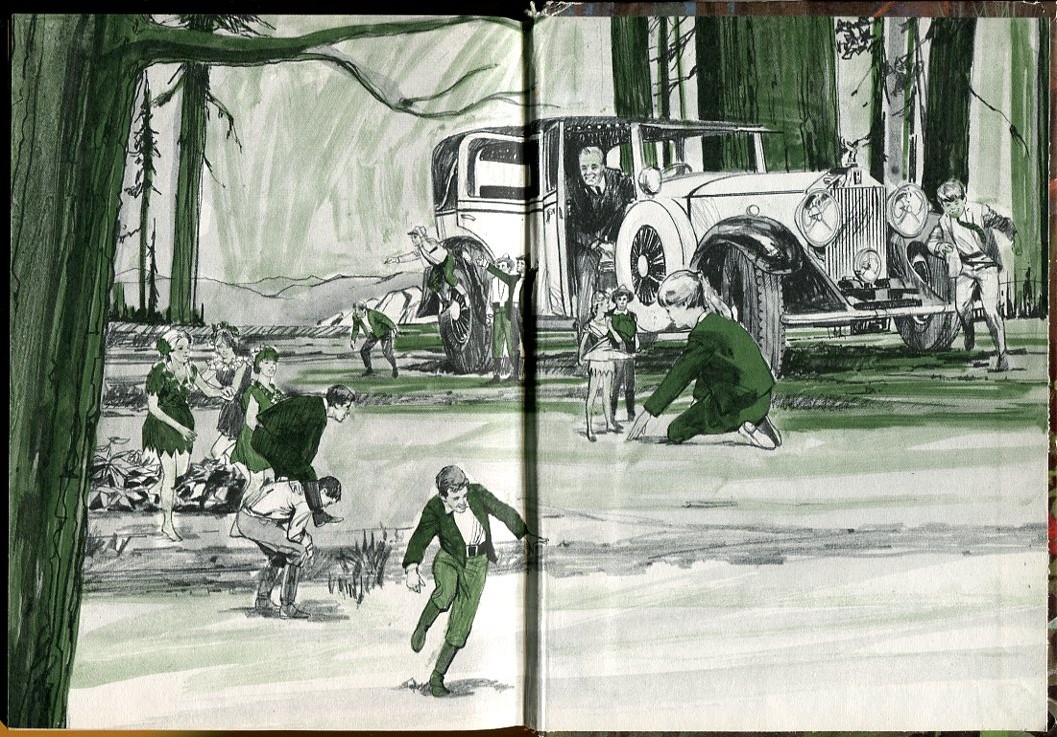
The posters for The Jungle and The Wet Parade came from Wikipedia. The information on Upton Sinclair's experiences with Hollywood came predominantly from Upton Sinclair and the Other American Century by Kevin Mattson. Information on Sinclair's experience specifically on The Gnome-Mobile came from Land of Orange Groves and Jails: Upton Sinclair's California edited by Lauren Coodley. The illustrations used in my synopsis of the film came from The Story of Walt Disney's Motion Picture The Gnome Mobile: Authorized Edition retold by Mary Carey with illustrations by John Solie.
The YouTube video I borrowed is a recording of side B of the Walt Disney Book and Record Read-Along 316 Gnome-Mobile. If anyone has this set in working order, I am interested in acquiring it for my daughter, who loves listening to book and records.
All images are copyrighted © and owned by their respective holders.

November 20, 2012
JOHN O'HARA COSGRAVE II: ILLUSTRATOR
 ACCORDING TO HIS ENTRY in Who Was Who in American Art 1564-1975, John O'Hara Cosgrave II, illustrator of Upton Sinclair's Gnomobile, was an illustrator, painter, graphic artist, writer, engraver, and cartoonist. It substantiates those claims with a long list of exhibitions from Paris, France to all over America, awards he has won, a selection of books he has illustrated, and the note that he did illustrations and covers for the magazines Life, Fortune, and Yachting.
Gale Biography In Context adds only slightly more personal information. Born October, 10, 1908 in San Francisco, California to Charles O'Malley and Margaret (Mahoney) Cosgrave. Reached the rank of staff sergeant in the United States Army, Office of Strategic Services during his wartime service, 1942-1945. Married Mary Silva, a children's book illustrator, November 21, 1952. Died May 9, 1968 in Pocasset, Massachussets.
This entry neglects to mention that Mary Silva was Cosgrave's second wife. His first wife, the portrait painter Esther Flack Cosgrave died June 26, 1952 at home in New Hampshire.
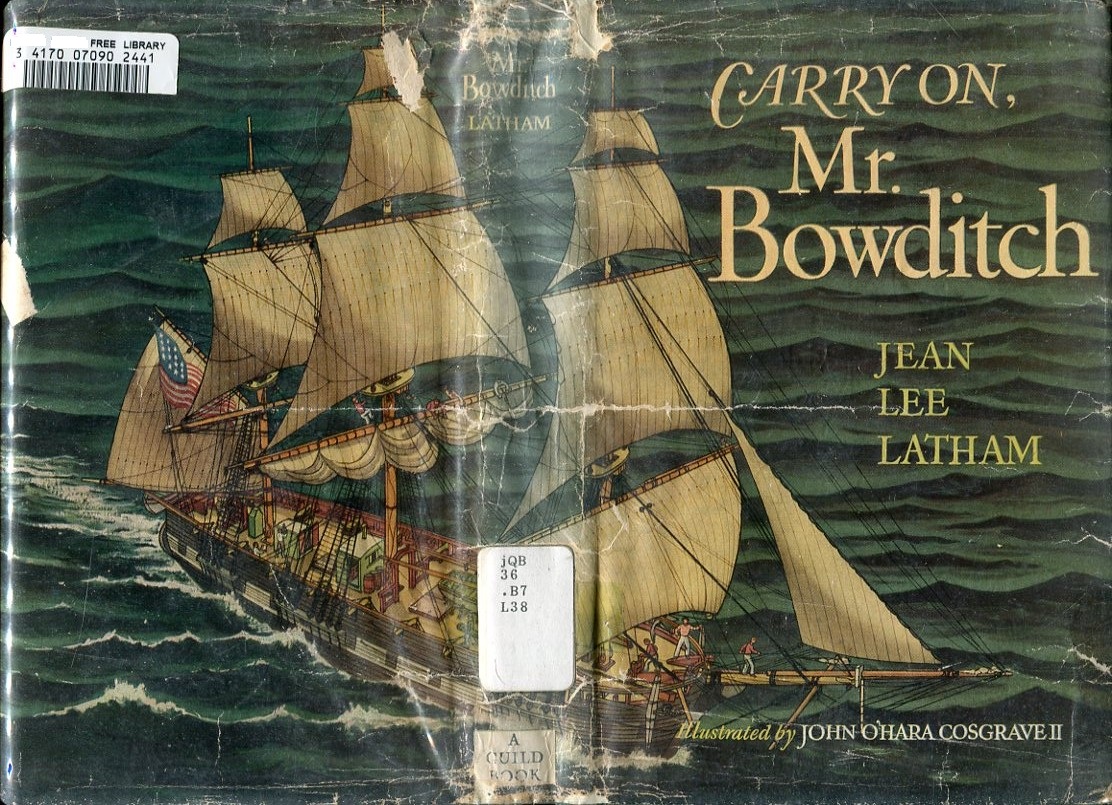
Even his obituary in The New York Times is scant on information. It highlights several of the books he illustrated: Bouquets and Bitters: A Gardner's Medley (1940) by Julian Meade, Pardon My Harvard Accent (1941) by William G. Morse, There Were Two Pirates (1946) by James Branch Cabell, and several others. But why these books were chosen as a representation of his work is unclear, as The Times chose to omit Gnomobile (1936) by Upton Sinclair, Wind, Sand, and Stars (1939) by Antoine de Saint Exupéry, and Come In and Other Poems (1943) by Robert Frost, all of which might have proven more interesting. It even leaves out Carry On, Mr. Bowditch (1955) by Jean Lee Latham, which won the Newbery Medal.
There is one thing that almost all sources mention, however, and that is that Cosgrave was the nephew of John O'Hara Cosgrave, who was the editor of The New York World's Sunday Magazine for fifteen years.
And that's about it. For a man who was so prolific, often in highly visible projects, it is surprisingly (and depressingly) little information. At the library, I retrieved books illustrated by Cosgrave from the Children's Department, the Humanities Department, the Social Science and History Department, and the Visual Arts Department. And every single one poured dust out on my scanner as I scanned from them. How could someone who left so many traces as an artist, leave so few traces as a man?
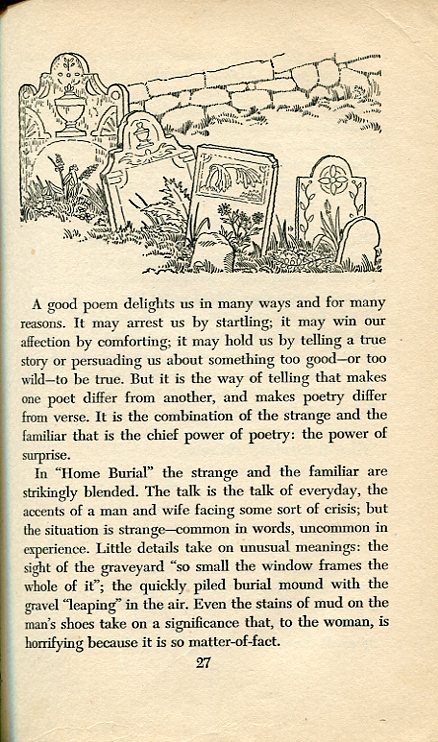
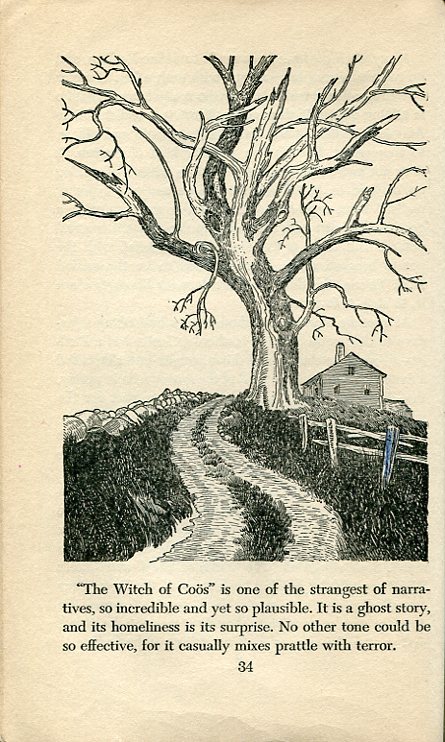

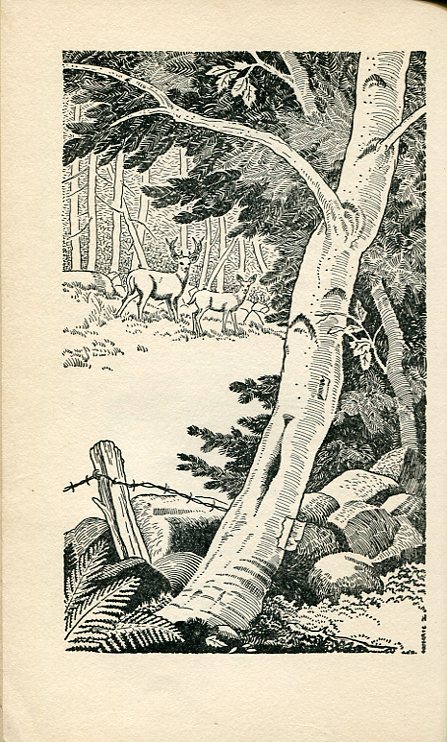 From Come In, and Other Poems (1943) by Robert Frost
Particularly frustrating to me is that there is no information on how Cosgrave got involved in Sinclair's Gnomobile. Sinclair's bios never give the book more than a paragraph, and none of them mention Cosgrave. Here are a few things I have noticed, however.
Cosgrave's first job in book illustration was for Sailer, Beware! (1933), published by Farrar and Rinehart. John C. Farrar of Farrar and Rhinehart was married to one of the inventors of the crossword puzzle, Margaret Petherbridge who had been secretary to John O'Hara Cosgrave I at The New York World. Perhaps then, it was through a favor to his uncle (who also published books with Farrar and Rhinehart) by his uncle's former secretary that Cosgrave II got his first illustration job.
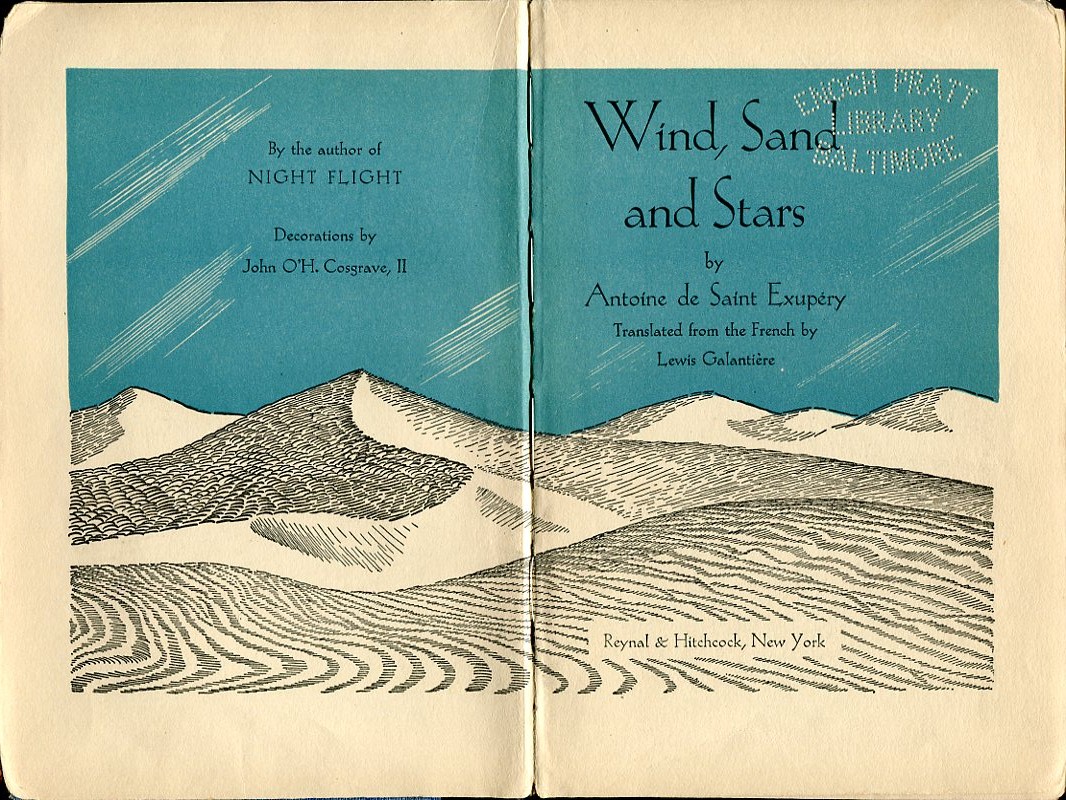
Three years later, Farrar and Rhinehart published The Gnomobile with Cosgrave's illustrations. He would do many other books for the publisher over the years, so perhaps it was simply through the publisher that Cosgrave got involved with Sinclair's book. However, the first edition of The Gnomobile actually appeared earlier in 1936 in an edition published by Sinclair himself with the Cosgrave illustrations already in place. So perhaps it had nothing to do with Farrar and Rhinehart.
After all, Cosgrave I had published articles by Upton Sinclair in The World and other magazines he worked on, so perhaps it was again through the younger Cosgrave's uncle that Cosgrave II illustrated Sinclair's book.
Or maybe it was for some other reason entirely.
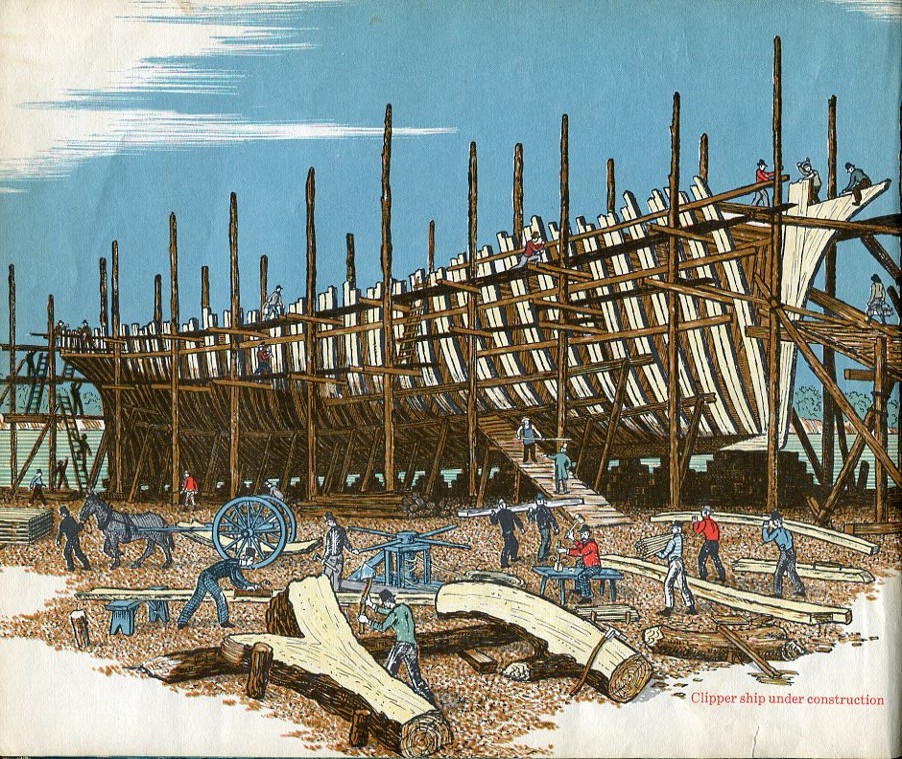
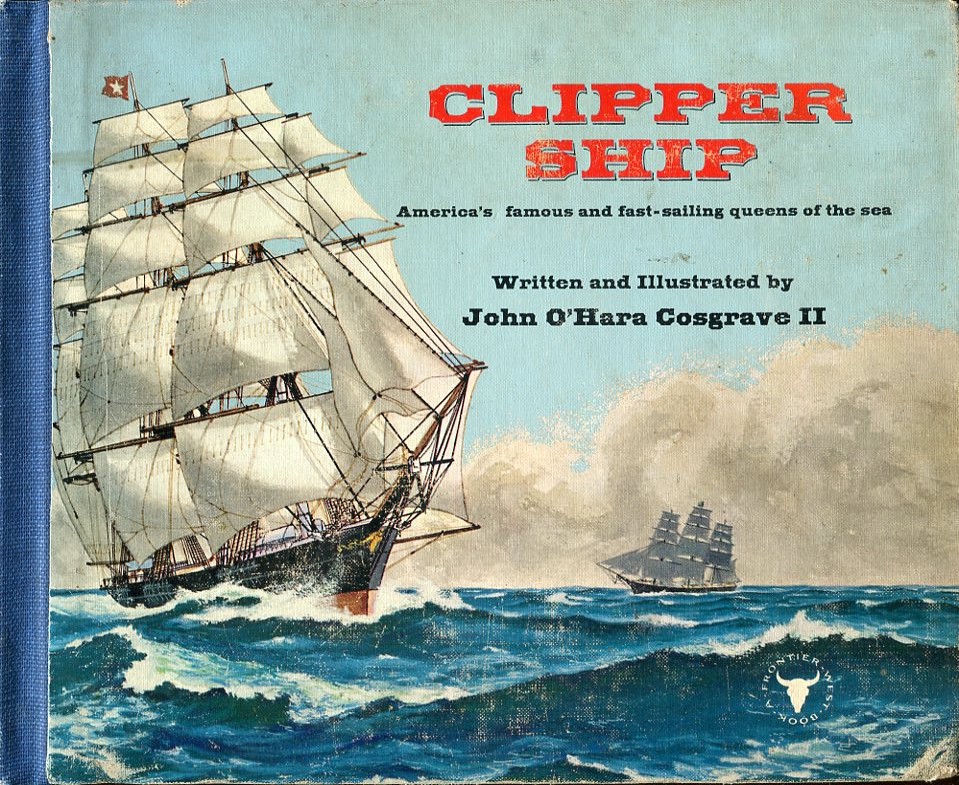
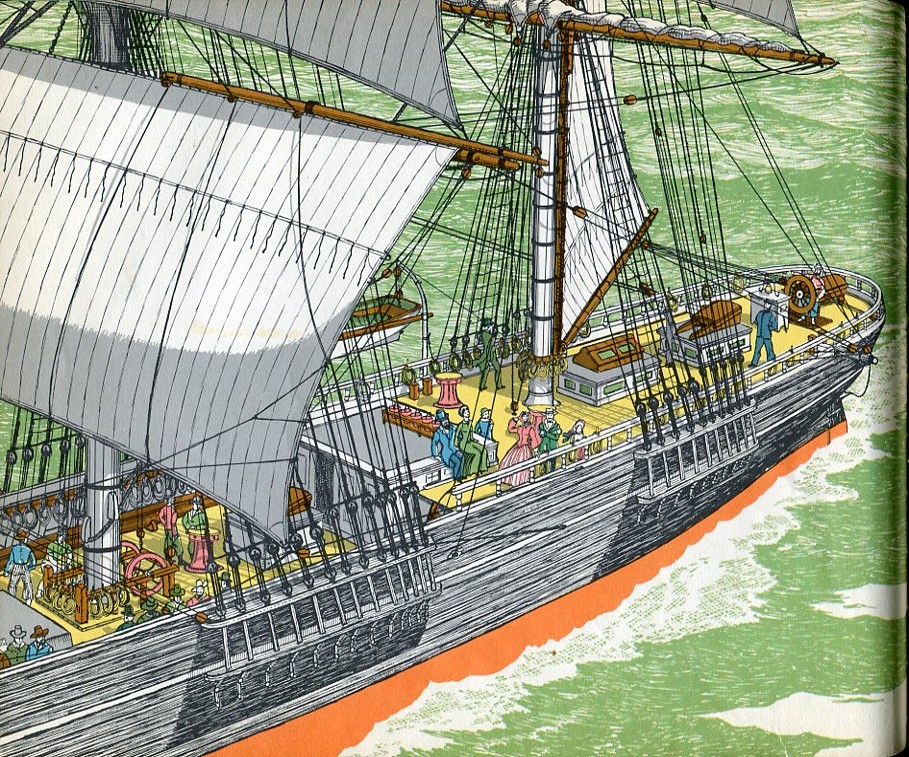 From Clipper Ship (1963) by John O'Hara Cosgrave II
One other thing that comes out in the various sources, but most obviously in the work he actually did was Cosgrave's love of boats and boating. For awhile, it seems, Cosgrave was one of the go to artists for boats and other maritime subjects. He authored several books on the subject as well.
The Cosgrave illustrations used throughout this post are from the following books, all of which link to the corresponding set on my Flickr account where a wider selection is available:
Wind, Sand and Stars (1939) by Antoine de Saint Exupéry
Come In, and Other Poems (1943) by Robert Frost
Carry On, Mr. Bowditch (1955) by Jean Lee Latham
Clipper Ship (1963) by John O'Hara Cosgrave II
If anyone has further information on John O'Hara Cosgrave II, please let me know, and I will add it to this post.
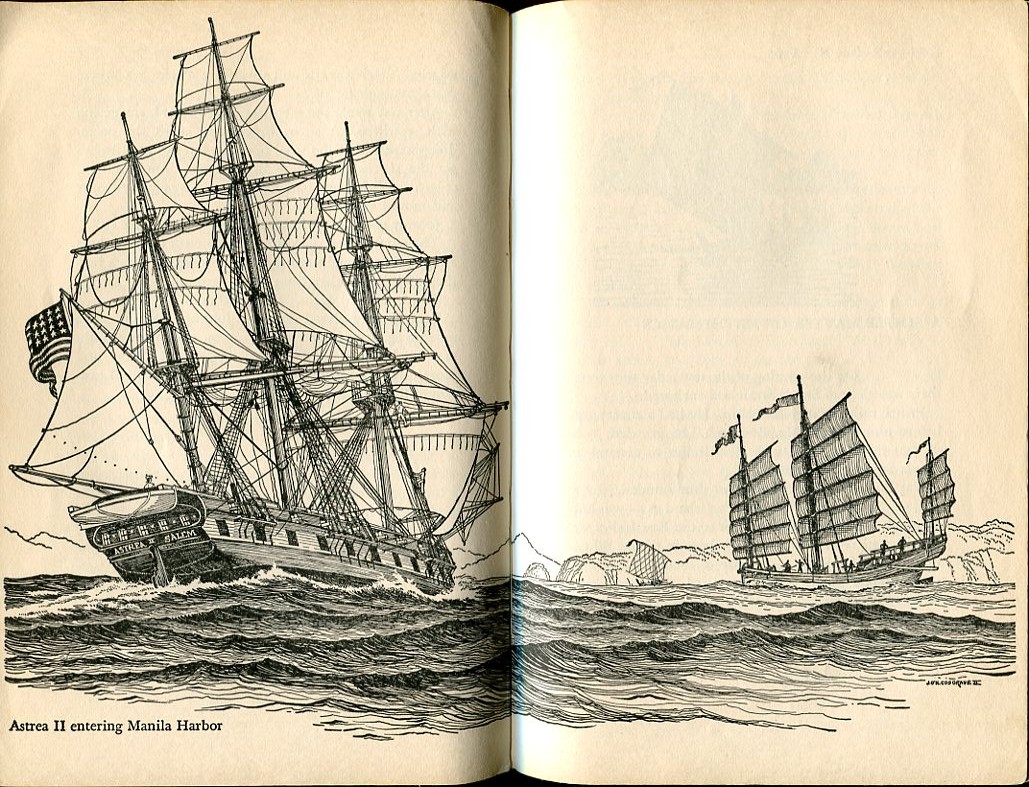 From Carry On, Mr. Bowditch (1955) by Jean Lee Latham
STILL COMING SOON: WALT DISNEY PRESENTS THE GNOME-MOBILE
All images are copyrighted © and owned by their respective holders.

Ariel S. Winter's Blog

- Ariel S. Winter's profile
- 67 followers
Ariel S. Winter isn't a Goodreads Author
(yet),
but they
do have a blog,
so here are some recent posts imported from
their feed.

