Michael Hyatt's Blog, page 24
January 28, 2020
4 Strategic Benefits of Having a Vision

As a leader, you know you’re responsible for the vision of your company. And you have one—sort of. It exists in the back of your head, but it’s really hard to get it down on paper. There never seems to be enough time to do it. And, when it comes right down to it, you’re not all that sure why it matters.
It’s hard enough to keep your business going from day to day. Who has time for navel gazing?






January 27, 2020
How to Leverage the L.E.A.P. Principle for Big Results
4 Simple Steps to Beat the Law of Diminishing Intent

The turn of the year is always a good time to evaluate what’s working in our lives, what’s not, and make any changes that will start us down a better path.
As we pause and reflect on where we’ve been and where we want to go, we normally have a sense of what to do. But that sense comes with a risk.
Even if it only represents an inkling of clarity about what to do, it’s imperative that you act immediately. If you don’t, you can fall prey to the Law of Diminishing Intent.
The Law of Diminishing Intent
I see this with people who set major goals for the year. Let’s say they want to lose weight, write a book, or start a new business. Dreaming up big results can be emotionally satisfying and intellectually stimulating.
But getting started requires action. And that can be tough, even risky. After all, how can you…
make room in your schedule for the gym?
find the hours it takes each week to sit and write?
know if your new product has enough demand in the marketplace?
Those are all good questions. And they’re important to answer. But they don’t encapsulate the real risk. They don’t even come close.
The real risk is this: When facing these sorts of challenges, instead of taking action, we can coast on the good feeling of the dream without taking the necessary steps to see it realized.
The Law of Diminishing Intent says, the longer you wait to take action, the less likely you will be to take it. Jim Rohn originally noticed this phenomenon and coined the term.
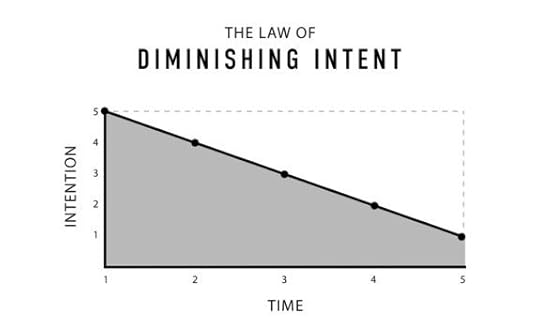
To counteract it, I recommend using the LEAP Principle: Never leave the scene of clarity without taking decisive action.
How to Beat the Law
If you want to see a big change, you must be willing to take a big LEAP. It’s as simple as four steps, one for each letter of the acronym:
Lean into the change with expectancy. When you notice that a change is desirable or necessary, that’s the trigger. Determine to follow through. That inkling is all you need to get going.
Engage with the concept until you achieve clarity. Don’t let the feeling pass. Work with it until you’ve got a sense of what to do. That nagging thought in the back of your mind might be the start of a whole new adventure—or the ladder you need to climb out of a deep rut.
Activate and do something—anything. Sometimes we wait to move until we have all the information. That’s a mistake. Clarity comes in degrees. And you only need enough light for the next step. Even if you get off on the wrong foot, the rest of the journey will become clearer as you go.
Pounce and do it now. Once you’ve determined your next step, take it. Don’t wait. Waiting feels safe, but waiting kills dreams.
LEAPing into Action
I’ve seen high-achievers leverage the LEAP Principle time and again.
At one of the first meetings of my Inner Circle Mastermind, one of the members realized he needed to quit a professional organization he was a member of. The commitment was chipping away at his resources and not providing enough return.
He didn’t take a note. He didn’t schedule it for later that week. That would have left the issue unresolved.
And the delay would have allowed his intent to diminish. As he built up the complications of quitting in his mind, he would have found reasons to stay on board.
Instead, he left the room at the very first break, made a phone call, and resigned. He took a LEAP.
What about you? Don’t defer your dreams. Don’t delay your goals. Don’t procrastinate on the one thing you need to do today to make meaningful progress in your personal or professional life.
Take a LEAP.


January 21, 2020
How to Solve Your Turnover Problem

To lead a growing business, you need a strong team. But finding and keeping talent is a challenge. Sometimes it seems that good people leave faster than you can hire them. You’ve added all the perks you can think of, but nothing will stop the revolving door.
Why does staffing have to be so hard?


January 20, 2020
5 Ways Reading Makes You a Better Leader
The Science Behind Reading and Influence

Pollsters say reading is in decline. As an author and former publishing executive, the statistics make me wince. But I’m optimistic for another reason.
Why? A readership crisis is really a leadership crisis. And for people who know how to respond, crisis is just another way of saying opportunity.
I’ve been a serious reader for decades: business and personal development, history, the Bible, current events, theology, philosophy, and even some fiction. I’m a content glutton. It’s part of who I am. And it’s also enabled me to become the leader I am.
I’m not alone. I know very few leaders who are uninterested in reading. And some CEOs are famous for their libraries and wide-ranging interests. Steve Jobs was, for one example, obsessed with the poet William Blake.
Readers are likely to be leaders. And with reading in decline, readers possess a comparative advantage in today’s business and political environments. How?
Here are five ways reading can uniquely develop and empower leaders:
1. Reading Makes us Better Thinkers
Reading is one of the most efficient ways to acquire information, and leaders need a lot of general information to keep perspective and seize opportunities. But reading does more than give us a toolbox of ideas. It actually upgrades our analytical tools, especially our judgment and problem-solving abilities.
Research by Anne E. Cunningham compared the general knowledge of readers and television watchers. The readers not only knew more, but they were also better at deciphering misinformation. In other words, reading improved their judgment.
Correctly sizing up a situation—often with incomplete information and limited time—is critical for being an effective leader. I have strong natural intuition, but I’m convinced that my reading has sharpened my edge when it comes to judgment.
These improved analytic tools also help us see patterns and make connections between seemingly random information. We’re not only improving our judgment, we’re also boosting our problem-solving abilities.
I’m always surprised when I’m working on an issue and some out-of-left-field analogy comes to mind from something I’ve read that helps me put all the pieces together. Wesley Hill even recommends what he calls “irrelevant reading,” going outside your field to spark new thoughts and make fresh connections.
2. Reading Improves Our People Skills
Sometimes we think of readers as antisocial introverts with the their nose in a book and ignoring the people around them. But reading can can actually improve a leader’s people skills.
Stories give us an opportunity to walk in other people’s shoes and see the world through their experiences and with their motivations—this is especially true for novels, biographies, and memoirs. When asked about the reading that helps her lead her business, one CEO said the insights about human nature in fiction and poetry has made all the difference in understanding and relating to her people.
And the physical act of reading is actually what makes these lessons stick. Brain scans show that as we relate to characters in stories we make neural connections that linger days after we put the book down on the nightstand.
What this tell us is that the experience of reading has the potential to help us boost our emotional IQ and better identify with people. And empathy is a vital leadership skill for creating alignment, understanding motivation, setting organizational goals, and more.
3. Reading Helps us Master Communication
When we read, especially widely and deeply, we pick up language proficiency that transfers across the board, including speaking and writing.
Reading uniquely expands our vocabulary. According to Cunningham, the books, magazines, and other written texts we read as adults use double and triple the number of rare words we hear on television.
This is important for leaders because an expanded vocabulary means not only greater precision in our communication, but with the improvement in emotional IQ we discussed in Way 2, we’ll also be able to choose words that are more persuasive and motivate the kind of behaviors we want.
We can leverage this across all of our communication. I can personally attest to the fact that this kind of skill transfers to both writing and public speaking. I’ve been doing both for years now, and can’t imagine succeeding without the mastery of language I’ve learned through books and other reading.
4. Reading Helps us Relax
An ongoing challenge every leader faces is managing stress. The great news is that while we’re reading and picking up the benefits of Ways 1, 2, and 3, we can simultaneously lower our stress levels.
One study compared reading to other stress relievers like walking, listening to music, or drinking a cup of tea. Reading was found the most effective, and it worked to lower heart rates and relieve tension in as few as six minutes.
“It really doesn’t matter what book you read,” according to the doctor who conducted the study. “By losing yourself in a thoroughly engrossing book you can escape from the worries and stresses of the everyday world.”
But it’s more than escape. Reading is “an active engaging of the imagination as the words on the printed page stimulate your creativity and cause you to enter what is essentially an altered state of consciousness.”
This is especially helpful before sleep and why reading something light is part of my nighttime ritual.
5. Reading Keeps us Young
I recently explained why older people make better entrepreneurs. They typically have advantages in experience, knowledge, and social networks.
It’s the same with leaders—and readers are especially positioned to leverage these advantages because reading has been shown in research by Keith E. Stanovich to keep us mentally sharp as we age. By exercising our brains with books and other reading we might even be able to prevent dementia in later years.
There are a lot of things we can do to position ourselves in the marketplace. Reading is probably not the first thing many will think of, but it’s one of the best in my experience.
In fact, I cannot think of any other single activity that can produce this list of positive effects. And given the decades-long decline in reading, being a serious reader is an increasingly unique way to develop the insights and qualities essential for leadership.
If you want to lead, you simply must read. It’s one of the surest ways to develop the qualities that will make you stand out and simultaneously equip you to lead as your influence grows.


January 14, 2020
3 Essentials for Executive Moms

As a leader, you thrive on the challenges of running your business. But if you also happen to be a wife and a mom, you feel pulled in another direction. It seems that whenever you’re at work, you’re thinking at home. And when you’re home, you don’t feel fully present either. You may wonder why you can’t seem to get it together, like so many “Super Moms.”


January 13, 2020
Four Questions to Sharpen Your Vision

Sometimes it’s hard to see something, even when you’re looking right at it. That’s partly because of the way our brains work, according to psychology professor Wendy Wood. “Our minds are designed to miss the forest for the trees,” she says in her book, Good Habits, Bad Habits “We are primed by cues [stimuli in our environment] and wind up not seeing the bigger picture, the world at large.”
In other words, the things in the foreground (business as usual, daily life, busyness) obscure the things on the horizon (your vision). The now-dead computer company Compaq provides a case in point.
The Case of Compaq
In 1982 three former Texas Instrument executives saw an opening in the emerging technology market. Just eight short months, they shipped the very first Compaq computer. I was an early adopter, one of many.
Compaq broke the record for the first-year sales of any company in American business history—$111 million. It went on to become the fastest company in history to cross the $1 billion sales threshold. By the mid-1990s, they were the undisputed leader in the market for desktop business computers.
Jumping in on the emerging personal computing market turned out to be a great choice. Those three founding executives had a clear vision. And when they saw an opportunity, they seized it. But what happened after that?
The short version is that the company started missing great opportunities and pursuing marginal ones. When home computing began to emerge, Compaq totally missed the boat. They doubled down on business computing, acquiring Digital Equipment Corporation in 1998 for $9.6 billion.
Meanwhile, Apple, Dell, and Gateway tapped into the surging home-computer market. Three years later, Dell passed Compaq as the industry leader in PC sales. Compaq pivoted—but too late. They never recovered and were acquired by Hewlett-Packard in 2002.
Their story shows how important it is to keep your vision in focus, no matter what’s happening in your business. Otherwise, you’re likely to miss great opportunities and jump at marginal ones.
Here are four questions that will ensure your short-term decisions line up with your long-range vision.
4 Questions to Sharpen Your Vision
1. What will success look like three years from now?
Your current success may keep you from seeing problems in your company. That’s what happened with Compaq. “Growth is the worst deodorant. It hides a lot of things,” said former vice president of North American marketing Gian Carlo Bisone.
When your bottom line is good, it’s easy to fixate on it. That’s a mistake. Celebrate, for sure. But keep moving your eyes back to the future.
The question is not “Are we successful?” but “What will success look like three years from now?”
2. What does this make possible?
When your business is in crisis, it’s hard to see any opportunities at all. Frankly, I’ve been in that position. In 2002, I took over leadership of the largest division in the company I was serving at the time. I’d known the division was in trouble, but I had no idea how bad things really were.
It was a total disaster.
I could have said, “Well, I don’t see how we can accomplish much this year. Let’s just try to break even. Maybe we can gain some ground by selling off obsolete inventory.” Honestly, it was hard to see what else could be done.
But I decided to start by looking to the future. So I took a personal retreat and developed an inspiring 10-point vision. When I announced it to the team, they were all in. Suddenly, everyone could see opportunity instead of crisis. Within 18 months, we’d turned the division around. Clear vision is critical for seeing beyond failure.
Good leaders go beyond asking “What went wrong?” to “What does this make possible?”
3. What business will we be in three to five years from now?
Your current product line may keep you from seeing the future of your industry. When he was a student at Stanford Business School, Seth Godin learned this lesson in a single day. In a meeting with the president of Activision Inc., a video game maker, Godin proposed that they branch out from cartridge-based games to produce games for the emerging PC market.
Was the executive impressed by Godin’s vision? Not so much. He “disagreed with my proposition and almost had me removed from his office by force,” recalled Godin. “He told me, ‘We’re in the cartridge business—and those machines use floppy disks. Forget it.’”
Talk about a missed opportunity. Whatever your product offering is today, it likely will be different in the future. The question is not “What business are we in?” but “What business will we be in three to five years from now?”
4. What can we do better, faster, or more profitably?
The way you do things now may keep you from seeing possibilities for improvement. In 1999 Nick Swinmurn got the crazy idea of selling shoes online. Investors thought it would never fly. Besides, the opportunity seemed miniscule. At the time the nearest comparison was mail-order shoe sales, which was a measly 5 percent of the market.
But Tony Hsieh heard something in Swinmurn’s pitch that made his ears perk. The mail-order business was only 5 percent of the market—but that market was 40 billion dollars! So Hsieh invested, and Zappos was born. When it was sold to Amazon a decade later, the company was worth $1.2 billion dollars.
Vision is critical for seeing beyond your current business model. The question is not “What’s working now?” but “What could we do faster, better, and more profitably?”
Clear vision is your best tool for identifying great opportunities and weeding out mediocre ones. Keep that vision sharply focused by consistently asking these four questions.


January 7, 2020
What’s Missing from Your Goal Achievement Toolbox?

High achievers thrive on goal setting. So you probably get revved up at the start of a new year or quarter. But the busyness of daily life can drain that enthusiasm quickly. You’re using all the tools you have to keep yourself focused and motivated. But sometimes, it just doesn’t seem to be enough. What’s the secret to staying focused and motivated all year long?


January 2, 2020
A 2020 Special Announcement
As a high achiever, you love reaching goals! But added on top of a busy life, goal achievement can seem a bit overwhelming. The Full Focus Planner puts it all into one handy system. Yet you may want a little help getting it up and running.


December 31, 2019
Encore Episode: How to Fix New Year’s Resolutions

All of us, especially leaders, want to make positive change in our lives. But we’ve tried and failed many times. We’ll show you why New Year’s resolutions are a flawed system, and how to set achievable personal goals instead. You can avoid that sick feeling every January, and create a new habit or achievement that will change your life for good.


December 30, 2019
The First Question Successful People Ask about Their Goals

Recently I had an idea for one of my coaching clients. It was a fundamental change to her business model that I knew would 10x her business and provide her with more personal margin to focus on her health and most important relationships.
As we talked, she got excited about the possibilities. But almost immediately, she started retreating from the idea. Why? Because she couldn’t see how it could be possible.
She voiced a litany of objections:
“I just don’t think I have the bandwidth to pull this off.”
“I’m not sure the technology is available to do that.”
“I think it would cost too much to implement.”
Her response was not unusual. She was voicing a mindset that’s common among entrepreneurs. It’s also one of the things that keeps them from taking their businesses and their lives to the next level. They get bogged down in how before they get clear on what.
The Mindset of Successful People
This is not, however, the mindset of the most accomplished among us. There would be no iPhone if Steve Jobs had started with how. His engineers repeatedly told him they couldn’t produce what he envisioned. But he just kept stating and restating the vision. The engineers eventually figured it out—especially after he told them he would find new engineers if they didn’t!
NASA would have never put a man on the moon if President Kennedy had started with how. On May 25, 1961, in a speech to a joint session of Congress. He said,
I believe that this nation should commit itself to achieving the goal, before this decade is out, of landing a man on the moon and returning him safely to the earth.
Only one problem: the technology didn’t exist. No one had a clue how it could be accomplished. And yet, just eight years later, Neil Armstrong and Buzz Aldrin landed on the moon and returned safely home.
To achieve anything significant, you have to start with what you want accomplish and suspend any discussion of how you will do it. That comes later. First, you must get clear on what.
Easier said than done, right? You might be surprised.
Seven Steps to a Bigger, Better Future
Leadership research confirms that transformational leaders create a stronger, more effective vision by presenting a positive view of the future and expressing confidence that it will be achieved. Here are seven steps for developing a crystal clear vision without talking yourself out of it before you start.
1. Set aside the how. This needs to be a deliberate, conscious decision. Say to yourself (or others, if they’re present), “Look, I know I’ll eventually have to figure out how I’m going to achieve this. But that’s a consideration for another time. For the next hour, I’m going to get clear on what I want.”
This takes discipline. You’ll be tempted to slip back into figuring out how you’ll pull it off. In fact, the bigger the vision, the greater the temptation. This is normal, especially if the vision scares you.
2. Stand in the future. Human beings are adept at being mentally detached from where they are. So let’s use this to our advantage.
Locate yourself at a point in time in the future. It can be a year, three years, or any future time you choose. The important thing is to choose a specific date, then mentally transport yourself to it.
3. Use your imagination. This is where it gets fun. Too often we use this ability in a negative way. We imagine a worse future and then worry about it. Or we imagine everything that could go wrong in the pursuit of a better future and begin listing the reasons we should be content where we are.
This is not the highest use of our imagination. To create a vision, we need to summon our best, most creative thinking to imagine a brighter, better future. This is where every improvement or breakthrough begins—in our thinking.
4. Employ all five senses. The more concrete you can make your vision, the more real it will seem and the more powerful it will be. One way to do that is to invoke each of your senses. For example,
What do you see? Describe it in vivid color.
What do you hear? Describe any sounds you hear as you envision your future.
What do you smell? Your olfactory system is one of your most sophisticated senses. Nothing triggers a memory faster than specific odors. Why not create a memory of the future?
What do you feel? Describe what you can touch in your vision?
What do you taste? This might not be applicable to every vision, but, if there’s a component you can taste, describe it.
5. Record what you see. Nothing creates clarity faster than forcing yourself to write it down. As the old adage goes, “Thoughts disentangle themselves passing over the lips and through pencil tips.”
Do this in two stages. First, just do a brain dump. This is the creative stage. Write down the vision as a series of bullets. Don’t worry about structure or even grammar. Just write. The goal is to get the vision out of your head.
Second, go back and fine-tune. This is the editing stage. Now is the time to rearrange what you have and clean up the grammar. Keep tweaking until you get it 90 percent done. (Don’t let perfection be your standard.)
6. Use the present tense. You might be tempted to write your vision in the future tense. After all, your vision is about the future. Don’t do it. Instead, write in the present tense. That way, it will seem more real. It will also help convince your brain that the vision is going to happen—it’s already a reality.
So for example, you might say,
“Our business generates $1 million a year in net income” rather than “our business will generate $1 million a year in net income.”
“We have 10,000 names on our mailing list” rather than “we will build a mailing list of 10,000 names.”
“Our membership site generates $20,000 a month in recurring revenue” rather than “Our membership site will generate $20,000 a month in recurring revenue.”
This is a simple tweak, but an important one.
7. Let it simmer.
In one sense, the vision is never done. Until you achieve it, you will be tweaking it. That’s because as you move toward it—and begin to see it taking shape—you’ll gain even more clarity. As your vision comes into even sharper focus, you can revise it.
At this stage, it’s also helpful to share the vision with your team or with people you trust. But be careful here. You don’t want to invite naysayers into the conversation, who will dismiss your vision out of hand. Instead, you want people who can offer honest feedback and help you get even greater clarity.
Try It!
To create a brighter, better future for yourself and the people you lead, you have to start with the vision—a clear, compelling view of the future. You can’t afford to let yourself get bogged down in how until you are clear about what.
If you discipline yourself and your teammates to follow this process, it will become a critical tool for transcending the status quo and scaling your business. This is where every important improvement starts: in your mind.