Michael Hyatt's Blog, page 23
March 2, 2020
The 3 Components of Job Satisfaction
How to Experience True Fulfillment in Your Work

A few years ago, a woman approached me after I finished a keynote presentation. In the speech, I had mentioned the importance of living with intention.
That point made an impression. She realized she had not been intentional, particularly as it related to her career.
As it turns out, she was a doctor with a very successful practice. She was extremely busy and making more money than she had dreamed possible. But she was deeply unsatisfied.
“If I’m honest, I think I became a doctor because my father was a doctor. It was expected. I didn’t think I had a choice,” she confessed. Then her eyes welled with tears.
“But I hate it,” she continued. “I only get to spend a few minutes with each patient. I feel like a factory worker on a conveyor belt. It’s all I can do to make myself go to work.”
She was good at what she did. Her practice was exploding. But she had lost her passion.
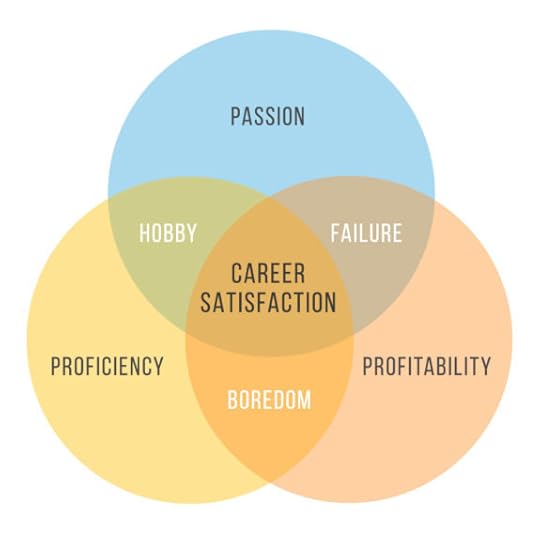
As I later reflected on her situation, I realized job satisfaction requires three components.
Passion. This is where it begins. What do you care about? What moves you? What problems do you want to solve or issues you want to address? If your heart is not in your work, you have a job but not a calling.
Proficiency. Passion alone is not enough. You have to be good at what you do. Being good enough will not give you the satisfaction you desire. You have to excel at your craft and be awesome. Mastery is the goal.
Profitability. To enjoy a successful career, people must be willing to pay you for what you do. You don’t have to get rich, but there must be a market for your product or service. Otherwise, your career is not sustainable.
If you have all three of these components, you can experience genuine career satisfaction. Few things in life are more rewarding.
I envision it as three overlapping circles. (Jim Collins has a similar model in Good to Great as it applies to companies.) At the intersection of all three is true success.
Be wary of only having two:
If you have passion and proficiency without profitability, you have a hobby. We all know people like this. Living in Nashville, I know musicians who love what they do, and are accomplished on their chosen instrument, but can’t pay the bills.
If you have passion and profitability without proficiency, you have failure . If you aren’t willing to put in the hours honing your craft, it will eventually catch up with you. You will struggle to get hired, or simply be flushed in the next round of layoffs.
If you have proficiency and profitability without passion, you have boredom. This was the doctor’s problem. On the surface she had it all. But in her heart, she was missing the one piece she needed to find satisfaction in her work.
You can get by for a time with only two of the three elements I have described. Sometimes, for instance, it takes a while to build proficiency. Other times we invest our best efforts believing that profitability will follow.
But that can’t work forever. If you want to succeed at the deepest level, you must eventually incorporate all three components.
“
Few things in life are more rewarding than marketable work fueled by passion and competence.
—MICHAEL HYATT

A while back I heard from a doctor in a similar situation as the one from before. She worked for a major corporate practice. It was like a factory with patients on a conveyor belt.
She hated it. She had zero passion for her job. So she quit!
She started a boutique family practice of her own. Instead of the constant pressure to see more patients each day than the last, she now has fewer patients and can spend more time with each.
And guess what? She’s reconnected with her passion and loving her work again. That’s the kind of difference being intentional about our careers can make.
Question: Do you possess all three of these components? Which is missing? What could you do to become more satisfied in your work?






February 25, 2020
How to Overcome Your Fear of Public Speaking

In this episode, we discuss something that’s very important for leadership—public speaking. Many leaders—probably most—are terrified of doing it. Unfortunately, as a leader, you really can’t avoid it.


February 24, 2020
Why You Need to Take Care of the People Who Take Care of You
Customers, Bosses, Boards, and Investors Matter—But They Can’t Come First

Some leaders believe that customers are their most important priority. Others believe their boss, their board, or their investors are their most important priority.
I’ve worked in companies where these philosophies were the cultural norm. But I don’t agree with them. I believe your teammates are your most important priority. If you take care of them, they will take care of everything else.
“
In business, your team takes priority. Take care of them and they’ll take care of the rest.
—MICHAEL HYATT
Why should your team be your top priority? Different people will have different reasons, but these three are foundational for understanding how business really works, and how companies can win big if they remember who comes first and why.
Without your team, you would have no product.
You may have a killer idea, but practically no business is truly a one-person show. However you define your product or service, it almost always takes a team to bring it to market. And that’s definitely true if you want a sizable footprint in the marketplace. From ideation to implementation, employees, contractors, and consultants help us pull our dreams out of the sky and turn them into real products. I’ve got fifty great ideas right now, but without a team I couldn’t get any more than one or two to market in any given year. With a team, I can marshal creativity, energy, and gifts I don’t have to grow my vision and make a bigger impact than I could on my own.
Without your team, you would have no customers. Other than the rare instance of a product being a pure solopreneur offering, it takes a team to interface with customers—not only finding and serving them, but interacting with them after the sale on the customer service side.These days, as I’ve said here before, customer service is marketing. If you’re not meeting expectations, you’re in trouble. A team not only lets you create product, but also enables you to connect that product with customers in an enriching way that will keep them happy and coming back for more.If you get that reversed, however, you can overburden your team with customer demands, create burnout and turnover, and ultimately sink your business. And that’s a bad day at the office. Team first, then customers.
Without products and customers, bosses, boards, and investors don’t matter. Bosses, boards, and investors exist to facilitate this team-product-customer interaction. If we put them first we run the risk of killing the thing that’s making everything possible in the first place. Bosses, boards, and investors may have values in sync with you, your team, and the customer base you’ve cultivated. But maybe not. I’ve seen boards do things in the name of the business that would have been catastrophic if it weren’t for the team taking the hit and still believing in what they do enough to stay the course.
“
Whatever your product or service, your team is what you’re really offering the world.
—MICHAEL HYATT
When it comes down to it, the truth is that your team is the product. Why do I say that? Because whatever you’re delivering, your team is what you have to offer the world. That’s why it’s critical you have the right people on the team. And that’s why it’s critical you don’t prioritize other things before your team.
If you have a great team, you can launch a great product and keep customers, bosses, boards, and investors happy. If you have poor team, you’ll probably launch a poor product and disappoint customers, bosses, boards, and investors.
What this means at the most practical level is simple: Put the team first because if you take care of your team, they’ll take care of you.
Question: What’s the best team you ever worked on? How did that experience affect your enjoyment of the work?


February 18, 2020
Michael and Megan Answer Your Questions

Leaders are expected to have all the answers. But sometimes they need to get insight from other leaders to stay on top of their game. In this episode, we reached out to our Instagram audience for their most pressing questions for Michael and Megan. They bring practical solutions to the problems many leaders face, based on more than 30 years of business experience.


February 17, 2020
People See, People Do
Leaders Affect Organizational Culture (Whether They Like it Or Not)

My dad was injured in the Korean War, a few years before I was born. Because of that injury, he walks with a limp to this day. As a young boy, I unconsciously emulated him. I just thought that was the way grown men walked.
When I was three or four, I remember Mom saying to me, “Michael, you don’t need to walk with a limp. Dad walks that way because he was hurt in the war.” I still walked that way for another year or so, simply because I wanted to be like my dad.
Law, in replicate
This was the “law of replication” in action. This law says that like begets like. Dogs beget dogs. Trees beget trees. And people beget people.
This law also applies to leadership. If you are a leader, like it or not, you will replicate yourself. Your followers will adopt your behaviors and habits. If you have a strong personality, they may even mimic your mannerisms without meaning to do so because of the human brain’s mirror system. The same goes for vision. If you are clear and communicate about your vision, you’ll develop leaders who do the same.

Years ago, I remember visiting one of our clients at his corporate headquarters. I was amused to see his staff imitating him, down to the cadence of his speech and the inflection of his voice. It was as if they were paid impersonators.
You set the tone
This has powerful implications for leadership. Unconsciously, your people will mimic you. This means:
If you are late to meetings, your people will be late to meetings.
If you consistently don’t follow through, your people will also lack follow through.
If you are angry and defensive when you get negative feedback, your people will be angry and defensive when they get negative feedback.
That’s bad news. Fortunately, they will copy your good behaviors too. This means:
If you are humble and grateful, your people will be humble and grateful.
If you are warm and engaging, your people will be warm and engaging.
If you are even-tempered and unflinching under fire, your people will strive to be even-tempered and unflinching under fire.
“
If you are a leader, like it or not, you will replicate yourself. Your followers will adopt your behaviors and habits.
—MICHAEL HYATT
Be the change
Gandhi said, “Be the change you want to see in the world.” I would add, “Be the change you want to see in your organization.”
If you don’t like the culture of your department, division, or company, start by changing yourself. Set a new standard. This is the most powerful thing you can do to change your world.
Remember, you are the prototype for your followers. Your actions speak far louder than your words will. You must pay careful attention to your own behavior, because you will replicate yourself through your organization.
If you are a living example of what it takes to go to the next level, then that’s where the folks under your supervision will ultimately go. And that is a very good place to be.
To learn more about pitfalls to avoid as a leader, I’ve created a free resource, 3 Leadership Pitfalls to Avoid in 2020. Claim your copy here.


February 11, 2020
How to Defuse Conflict Before It Begins

We don’t know anybody who loves interpersonal conflict. It’s uncomfortable, and it brings up a ton of negative emotions. Most of us try to avoid conflict whenever possible. Even as a leader, you may wonder, “Do I really have to have this hard conversation?”


How to Diffuse Conflict Before It Begins
We don’t know anybody who loves interpersonal conflict. It’s uncomfortable, and it brings up a ton of negative emotions. Most of us try to avoid conflict whenever possible. Even as a leader, you may wonder, “Do I really have to have this hard conversation?”
February 10, 2020
Why Vision Is More Important Than Strategy

Vision and strategy are both important. But there is a priority to them. Vision always comes first. Always. If you have a clear vision, you will eventually attract the right strategy. If you don’t have a clear vision, no strategy will save you.
I have seen this over and over again in my professional and personal life. Once I got clear on what I wanted, the how almost took care of itself. Let me give you an example.
In July of 2000, my boss suddenly resigned. I was already the Associate Publisher of the division, the second-in-command. With his departure, I was asked to take his job. I became the publisher of Nelson Books, one of the trade book divisions of Thomas Nelson.
I knew our division was in bad shape. But I didn’t know how bad things really were until I became the publisher. I took a deep breath and began to assess reality. Here’s what I found:
We were the least profitable division of fourteen in the Company. We had actually lost money the previous year. People in the other divisions were mumbling about our performance and how we had drug the whole company down.
Revenue growth had been basically flat for three years. In addition, we had just lost our single biggest author to a competing publishing company. This made revenue growth going forward even less likely.
As a percentage-of-revenue, inventory and royalty advances were the highest in the company. In other words, we were the least efficient users of working capital. We were consuming enormous corporate resources and providing virtually no return to our shareholders.
We were publishing about 125 new titles a year with ten people. Everyone was overworked and the quality of our output showed it. We simply had too much to do.
Honestly, things could not have been worse. However, as the new divisional executive, I recognized that things could not have been better for me. This was a great career opportunity. If I turned the division around, I would be a hero. If I didn’t, that would be okay, too. After all, the division was a mess when I inherited it. I couldn’t lose.
The first thing I did was to go off on a private retreat. I had one objective in mind. I wanted to get crystal clear on my vision. What did I want to see happen? What would the division look like in three years? I didn’t care about strategy; I was only concerned with vision.
Through the years, I had learned that if you think about strategy (the “how”) too early, it will actually inhibit your vision (the “what”) and block you from thinking as big as you need to think. What you need is a vision that is so big that it is compelling, not only to others, but to you. If it’s not compelling, you won’t have the motivation to stay the course and you won’t be able to recruit others to help you.
For example, if I had been strategic before I was visionary, I might have said, “Well, I don’t see how we can accomplish much. The situation is so dire. We don’t have many resources to work with. Let’s just try to get to break-even this next year. Maybe we can reduce our working capital some by selling off a little obsolete inventory. And, maybe we can sign a few new authors and get a little revenue growth.”
Do you think anyone would have gotten excited about this? Would this vision have attracted the right authors? Would it have retained the right employees? Would it have secured additional corporate resources? I don’t think so.
The problem is that people get stuck on the how. They don’t see how they could accomplish more, so they throttle back their vision, convinced that they must be “realistic.” And, what they expect becomes their new reality. This is simply faith applied negatively.
I didn’t take this approach. Instead, I developed a vision statement that I found compelling. If I couldn’t get excited about it, I couldn’t sell it to others. Instead, I gave myself permission to envision the perfect future. Here’s what I wrote down:
Vision Statement
Nelson Books is the world’s largest, most respected provider of inspirational books.
We have ten “franchise authors” whose new books sell at least 100,000 copies in the first 12 months.
We have ten “emerging authors” whose new books sell at least 50,000 copies in the first 12 months.
We are publishing 60 new titles a year.
Authors are soliciting other authors on our behalf because they are so excited to be working with us.
The top agents routinely bring us their best authors and proposals because of our reputation for success.
We place at least four books a year on the New York Times bestsellers list.
We consistently have more books on the Christian bestsellers list than our competitors.
We consistently exceed our budget in revenue and margin contribution.
Our employees consistently “max out” their bonus plans.
We are the fastest growing, most profitable division in our company.
Once I had this on paper, I came back to the office and called a meeting with my entire staff. I reviewed our current reality. I was brutally honest. The situation was dire, and I didn’t pull any punches.
I then shared the new reality—the vision—and described it in as much detail as I could. I was genuinely enthusiastic and committed. Because I found the vision compelling, most of the them did, too. Some were slow to get on-board, but in the end, even the most reluctant ones came around.
I personally read through this vision daily. I prayed over every part. I asked God to guide us. Little by little, He brought us the strategy and the resources. However, I spent way more time—probably ten-to-one—focused on the what rather than the how.
When people would ask, “How in the world are you going to accomplish this?”, I would just smile and say, “I’m not sure, but I am confident it is going to happen. Just watch.”
And, guess what? It happened. I thought my initial vision would take at least three years to accomplish. Amazingly, we had an almost complete turnaround in eighteen months. We exceeded almost every aspect of our vision.
Over the next six years, Nelson Books was consistently the fastest growing, most profitable division at Thomas Nelson. It had one bestseller after another. It was home to almost all of our company’s bestselling authors during that time.
This didn’t happen because we had a great business strategy. It happened because we had a clear vision of what we wanted to achieve. That’s where it started, and that’s where you have to start if you want to experience a different reality than the one you have now, you have to get clear on what you want. Everything begins with vision.
To help you get started on envisioning your future, I’ve created a free resource, 3 Leadership Pitfalls to Avoid in 2020. Claim your copy here.
Remember, everything begins with vision.


February 3, 2020
4 Steps to Generate Clear Vision

As a leader, you know you need a vision for your business. And you want to generate that vision so you can communicate it to your team. There’s just one problem. You don’t know how!


The Fastest Way to Get Clarity about Your Future
5 Simple Steps to Get Straight and Get Moving

Have you had this experience? You’re traveling in a new city, using your GPS to find your destination. But the route doesn’t seem to match reality. Suddenly, you’re in a strange place with cars buzzing by and no clarity about where to turn next.
How do you get where you want to go? Maybe you’re unsure about your plan, you’re not sure what to do, and it looks like your competition is flying by, leaving you in the dust.
Every leader faces this at one time or another. In fact, one of the top three challenges we face, according to my reader survey, is not having enough clarity to accomplish our goals.
So how can we find the clarity we need? It’s simpler than you might think.
A few years ago, I went through a period when I was second-guessing my brand direction and my entire mission. Getting a renewed sense of clarity was instrumental in the new blog redesign, and it really helped me grow my business.
What did I do to find my footing? Here’s the simple, five-step process that helped me regain my clarity and move forward.
Admit I am confused. It’s easy to deny when we’re directionless. We want to project confidence even when we don’t feel it. So it’s hard to admit we’re missing something. But that’s the first step toward clarity: admitting we don’t have it.My business had grown, and my focus was shifting along with it. It was a huge blessing, but expansion sometimes comes with confusion. When I admitted that I needed renewed clarity, I was ready—and able—to find it.
Ask my advisors for input. I am a firm believer in what Solomon says: “Without counsel plans fail, but with many advisers they succeed.”When I first started sharing my problem with my closest friends and colleagues, I received invaluable insight about the direction I should go. It wasn’t all rah-rah. I received both confirmation and pushback. But what emerged from the give-and-take was a clear sense of my message and mission.
Solicit my tribe’s feedback. I now wanted to see how that fit with my readers. As leaders, we don’t serve ourselves. If people are coming to me for help, my desire is to connect what I do as closely as I can to that need.The word they kept using to describe what I do was mentor. The great thing was that this validated what I was hearing from my advisors. I was on the right course.
Process the feedback. Now that I had feedback from the sources that matter most I needed to process it. Part of that process was to get alone, reflect, and journal. But I also included the core members of my team and Donald Miller’s StoryBrand team.As I described in my post about redesigning the blog, we created a brand script and refined our core value statement. What was first a little tentative and fuzzy was now as clear as print on a page.
Just start. Once we had our direction all that was left was to move toward it. The last step is practically the most important. Clarity is composed of knowing and doing.When you can’t read a sign you can: think more about what the sign might say; scrunch up your eyes to change your focus; buy high-powered glasses; or ask a friend to read it to you. But the best and easiest way to get more clarity is just move closer to the sign. Taking steps brings things into focus.
This last steps is incredibly liberating. We don’t have to see the whole thing at once. We probably can’t. And we waste a lot of time and worry trying. Using the first four steps we can all get enough clarity to identify our next action. As we make progress toward the goal, the clarity will come.
This is something I teach in 5 Days to Your Best Year Ever. Once we commit and start moving, the resources we need to complete our goals usually show up.
Once you’ve worked through the first four steps, don’t stall. People don’t want to commit, so they don’t move. But movement is the best way to find clarity.
We all find ourselves on the lost on the roadside from time to time or moving with only a vague sense of where we’re going. These five steps can give us the direction we need to find the right course and reach our goals.
Question: Do you struggle with clarity? Have you enlisted the help of your advisors and tribe?