Michael Hyatt's Blog, page 160
August 23, 2013
Why You Must Delegate Before You Automate
In Michael’s post on successful delegation, I left the comment:
“Sometimes in order to automate a task you might have to delegate it first, and then remove all the chinks before automating it…”

As Michael mentioned, delegation takes quite a bit of time and effort to setup, but in the long run it pays off.
In fact, nearly every single successful company is based on systems. Delegation is one aspect of setting up successful systems for your business.
If you’re still struggling with delegating tasks, I’d like to share a five-step system to reducing your workload and getting the right things done in your business!
Step 1: Eliminate
The first step in the system is to get rid of all recurring tasks currently being done in your business, which are not required for the business to function.
It would seem that email is an essential part of business today, but Thierry Breton, CEO of Atos, eliminated email communication within the company saying:
“Email is no longer the appropriate tool,” said Breton. “It is time to think differently.”
That’s a bold move, but a necessary one in Breton’s mind. He saw the move as a critical one in order for Atos to focus on what is most important for the business to succeed.
Business founder and investor Brad Feld does something similar and it’s actually improved his health and general well being.
Brad stopped checking email, news and Foursquare during certain periods. Eliminating these items made him more productive in his work and allowed him to enjoy life outside his business.
Mark, of Mark’s Daily Apple, does the same thing with email and electronic communication.
Action Plan: Identify the tasks to eliminate by listing every task that you perform during your workday. Prioritize the tasks by what is essential to running your business successfully. Also keep in mind your business goals and how each task contributes to achieving those goals.
The tasks that find their way to the bottom are the ones that you should eliminate altogether.
Step 2: Systemize
The second step is to document step-by-step how you currently handle tasks required for your business to function.
Tim Ferriss is famous for using virtual assistants. In order to make his relationship with a virtual assistant successful, he created systems.
One of the first tasks he systemized was email. In the previous example we saw how one company eliminated email and how others have eliminated the task during certain periods.
For Ferriss, email continues to be important, but he created an email system so he could delegate, which is the next step in our process.
Action Plan: Document the how, why and when for each of the tasks that are necessary for your business to function. If you are tired of doing all the tasks required for your business to function all by yourself, then use a tool like SweetProcess to document procedures for all those repetitive tasks that eat up your precious time, so you can grow your team and grow your business.
Step 3: Delegate
The third step is to properly hand over each required task to employees and/or virtual assistants and train them on how to execute each one successfully.
Michael has successful delegated certain aspects of his professional life. He documented the experience in the post, My Experience Using A Virtual Assistant.
Michael’s VA does these things and likely now does even more:
Screens Email
Makes Travel Arrangements
Makes Phome Calls
Calendar Management
Miscellaneous Projects
More recently, Michael has outsourced post-production of his podcast.
The key to delegation is finding people that know the functionality of essential tasks, but that also know how to follow specific procedures.
Action Plan: Delegate tasks which you have already documented procedures on to virtual assistants, freelancers and/or your employees.
Here are some reliable sources for virtual assistants and freelancers to delegate tasks to:
Virtual Assistants
eaHELP (the virtual assistant company Michael uses.)
VirtualAssistantAssistant (A third-party site like Yelp which collects and post real user reviews of virtual assistant companies)
Freelancers
Elance
Guru
Freelancer
oDesk
Step 4: Measure
For the fourth step, track the effectiveness of the results your employees deliver so you can spot areas to improve. Trust your team and verify the result!
One entrepreneur, Tristen O’Brien, The eBay Entrepreneur, uses sales to measure the effectiveness of his virtual assistants. Here is a direct quote:
Tristen used virtual assistants to handle resizing, cropping and optimizing for his eBay images. He calculated return on investment by the time he saved by having someone else doing this task. Overall, each task he had virtual assistant handle led to an increase in sales by 25% as mentioned above.
Action Plan: Keep track of your key business metrics and whenever you notice unfavorable results, it’s an opportunity for you to identify areas within your system that need improvements.
Step 5: Automate and/or Scale
Once you know that the tasks can be done flawlessly it is time to automate!
You may be eager to automate recurring tasks, but not every task can be automated.
After you understand an entire process and know it can be automated, you can consider a tool or machine to handle the task. As you search for tools you’ll need to confirm that the tool can perform the task, as you need. Going through these checks will ensure you won’t lose efficiency and accuracy.
A common task businesses are automating today is social media. Services like HootSuite allow companies to automatically send feeds from blogs, videos and other content sources to social media sites. Users can also schedule updates.
In order for this task to remain effective you must first understand the exact procedure for creating updates and ensure the tool can perform as effectively as a person does when doing the procedure manually. That is the important check when automating.
Additionally, once you have fully understood a process you can scale the process by adding more people to your business.
Businesses do this all the time as a way to grow.
A company like HootSuite, mentioned above, likely has salespeople. Those salespeople have exact procedures for contacting potential clients. Once the procedure is proven effective, HootSuite can hire additional sales team members and teach them how to perform the sales procedures allowing the company to grow by adding new customers.
Action Plan: Carefully examine your procedures. If you know a recurring task is operating at peak efficiency, consider adding a tool to automate the task or consider adding an additional resource such as a freelancer or virtual assistant, which will allow the business to scale.
Conclusion
You might be struggling with delegation or finding it hard to figure out how to relieve yourself of tasks; the good news is that when you follow the five steps which I have outlined above you will be able to reduce your daily workload and get the right things done.
For each item above you have a an Action Plan step. The first one is for you to list out every task that you do on a regular basis, prioritize them in order of importance to your business and eliminate the ones which are not required for your business to function. After this first step, you will be ready to tackle each of the other steps in the correct sequence.
Question: What are your experiences with delegation? What has worked for you and what hasn’t? You can leave a comment by clicking here.








Why You Have to Delegate Before You Automate
In Michael’s post on successful delegation, I left the comment:
“Sometimes in order to automate a task you might have to delegate it first, and then remove all the chinks before automating it…”
As Michael mentioned, delegation takes quite a bit of time and effort to setup, but in the long run it pays off.
In fact, nearly every single successful company is based on systems. Delegation is one aspect of setting up successful systems for your business.
If you’re still struggling with delegating tasks, I’d like to share a five-step system to reducing your workload and getting the right things done in your business!
Step 1: Eliminate
The first step in the system is to get rid of all recurring tasks currently being done in your business, which are not required for the business to function.
It would seem that email is an essential part of business today, but Thierry Breton, CEO of Atos, eliminated email communication within the company saying:
“Email is no longer the appropriate tool,” said Breton. “It is time to think differently.”
That’s a bold move, but a necessary one in Breton’s mind. He saw the move as a critical one in order for Atos to focus on what is most important for the business to succeed.
Business founder and investor Brad Feld does something similar and it’s actually improved his health and general well being.
Brad stopped checking email, news and Foursquare during certain periods. Eliminating these items made him more productive in his work and allowed him to enjoy life outside his business.
Mark, of Mark’s Daily Apple, does the same thing with email and electronic communication.
Action Plan: Identify the tasks to eliminate by listing every task that you perform during your workday. Prioritize the tasks by what is essential to running your business successfully. Also keep in mind your business goals and how each task contributes to achieving those goals.
The tasks that find their way to the bottom are the ones that you should eliminate altogether.
Step 2: Systemize
The second step is to document step-by-step how you currently handle tasks required for your business to function.
Tim Ferriss is famous for using virtual assistants. In order to make his relationship with a virtual assistant successful, he created systems.
One of the first tasks he systemized was email. In the previous example we saw how one company eliminated email and how others have eliminated the task during certain periods.
For Ferriss, email continues to be important, but he created an email system so he could delegate, which is the next step in our process.
Take Action: Document the how, why and when for each of the tasks that are necessary for your business to function. If you are tired of doing all the tasks required for your business to function all by yourself, then use a tool like SweetProcess to document procedures for all those repetitive tasks that eat up your precious time, so you can grow your team and grow your business.
Step 3: Delegate
The third step is to properly hand over each required task to employees and/or virtual assistants and train them on how to execute each one successfully.
Michael has successful delegated certain aspects of his professional life. He documented the experience in the post, My Experience Using A Virtual Assistant.
Michael’s VA does these things and likely now does even more:
Screens Email
Makes Travel Arrangements
Makes Phome Calls
Calendar Management
Miscellaneous Projects
More recently, Michael has outsourced post-production of his podcast.
The key to delegation is finding people that know the functionality of essential tasks, but that also know how to follow specific procedures.
Take Action: Delegate tasks which you have already documented procedures on to virtual assistants, freelancers and/or your employees.
Here are some reliable sources for virtual assistants and freelancers to delegate tasks to:
Virtual Assistants
eaHELP (the virtual assistant company Michael uses.)
VirtualAssistantAssistant (A third-party site like Yelp which collects and post real user reviews of virtual assistant companies)
Freelancers
Elance
Guru
Freelancer
oDesk
Step 4: Measure
For the fourth step, track the effectiveness of the results your employees deliver so you can spot areas to improve. Trust your team and verify the result!
One entrepreneur, Tristen O’Brien, The eBay Entrepreneur, uses sales to measure the effectiveness of his virtual assistants. Here is a direct quote:
Tristen used virtual assistants to handle resizing, cropping and optimizing for his eBay images. He calculated return on investment by the time he saved by having someone else doing this task. Overall, each task he had virtual assistant handle led to an increase in sales by 25% as mentioned above.
Take Action: Keep track of your key business metrics and whenever you notice unfavorable results, it’s an opportunity for you to identify areas within your system that need improvements.
Step 5: Automate and/or Scale
Once you know that the tasks can be done flawlessly it is time to automate!
You may be eager to automate recurring tasks, but not every task can be automated.
After you understand an entire process and know it can be automated, you can consider a tool or machine to handle the task. As you search for tools you’ll need to confirm that the tool can perform the task, as you need. Going through these checks will ensure you won’t lose efficiency and accuracy.
A common task businesses are automating today is social media. Services like HootSuite allow companies to automatically send feeds from blogs, videos and other content sources to social media sites. Users can also schedule updates.
In order for this task to remain effective you must first understand the exact procedure for creating updates and ensure the tool can perform as effectively as a person does when doing the procedure manually. That is the important check when automating.
Additionally, once you have fully understood a process you can scale the process by adding more people to your business.
Businesses do this all the time as a way to grow.
A company like HootSuite, mentioned above, likely has salespeople. Those salespeople have exact procedures for contacting potential clients. Once the procedure is proven effective, HootSuite can hire additional sales team members and teach them how to perform the sales procedures allowing the company to grow by adding new customers.
Take Action: Carefully examine your procedures. If you know a recurring task is operating at peak efficiency, consider adding a tool to automate the task or consider adding an additional resource such as a freelancer or virtual assistant, which will allow the business to scale.
Conclusion
You might be struggling with delegation or finding it hard to figure out how to relieve yourself of tasks; the good news is that when you follow the five steps which I have outlined above you will be able to reduce your daily workload and get the right things done.
For each item above you have a an Action Plan step. The first one is for you to list out every task that you do on a regular basis, prioritize them in order of importance to your business and eliminate the ones which are not required for your business to function. After this first step, you will be ready to tackle each of the other steps in the correct sequence.
Question: What are your experiences with delegation? What has worked for you and what hasn’t? You can leave a comment by clicking here.
August 22, 2013
The Shift To Visual Social Media [Slide]


 If you can’t see this slideshow in your RSS reader or email, then click here.
Social media is becoming more and more visual. Check out the above infographic to see how this shift occurred and how you can leverage this trend to build your brand.
Question: Have you incorporated images into your social media posts? If so, what has been the result? You can leave a comment by clicking here. 


August 21, 2013
#063: Watch Your Mouth: How Our Words Impact Others [Podcast]
Whether we realize it or not, our words carry enormous weight. In fact, you and I probably don’t have any tool more powerful—for good and for bad—than our words.

A verse in the Bible that says,
Let no unwholesome word proceed from your mouth, but only such a word as is good for edification according to the need of the moment, so that it will give grace to those who hear” (Ephesians 4:29, NASB)
This advice applies far beyond spiritual matters and goes straight to the heart of our leadership and our impact.
Click to Listen
Podcast: Subscribe in iTunes | Play in browser | Download
This verse provides three characteristics of wholesome speech.Characteristic #1: Wholesome words build people up.
Characteristic #2: Wholesome words are timely.
Characteristic #3: Wholesome words provide grace.
King Solomon said, “Death and life are in the power of the tongue” (Proverbs 18:21). Every day, we are shaping reality for someone by the words that we use with them. The choice is ours.
Listener Questions
Christopher Scott asked, “Do you have a Bible verse or a mantra that you repeat to yourself to control your thoughts?”
Jennifer Hester asked, “Do you have a specific action that you take to keep your words in check?”
Jon D. Harrison asked, “If words are only a reflection of our mindset, how much investment should we make in correcting our language?”
William Stonewall Monroe asked, “How do our words affect our ability to sell ourselves?”
Special Announcements
If you are considering launching your own platform—or just getting serious about it—you need to start with a self-hosted WordPress blog.
This is not as complicated as it sounds. In fact, I have put together a step-by-step screencast on exactly how to do it. You don’t need any technical knowledge. I walk you through the entire process in exactly 20 minutes.
This fall’s SCORRE Conference is filling up fast! My business partner Ken Davis, who originally developed the SCORRE Conference, and I will be hosting this next conference on October 14–17 at the beautiful Park Hyatt Beaver Creek Hotel in Vail, Colorado.
This Conference will sell out, so get your tickets today!
My next podcast will be on the topic of “Two Types of Thinkers: Which Are You?” If you have a question on this subject, please leave me a voicemail message. This is a terrific way to cross-promote your blog or website, because I will link to it, just like I did with the callers in this episode.
Tip of the Week
If you’re not careful, the apps that your computer launches on startup can eat up a ton of memory and affect the speed of your computer. On the other hand, it can be a huge time-saver to load automatically your most used applications.
Well, here’s a little program that can you manage all that. It’s called Startupizer. As far as I know, it’s only available for Mac. But, it allows you to have different startup configurations.
For example, when I am out speaking, I want the most minimal configuration possible. I really only want Apple Keynote loaded, so I have enough memory to run video and audio without the system choking.
Startupizer allows me to do that. I just hold down a modifier key (e.g., Ctrl or Option) to load an alternative startup configuration.
Episode Resources
In this episode I mentioned several resources, including:
Conference: The SCORRE Conference
Screencast: How to Launch a Self-Hosted WordPress Blog in 20 Minutes or Less
Software: Startupizer
Show Transcript
You can download a complete, word-for-word transcript of this episode here, courtesy of Ginger Schell, a professional transcriptionist, who handles all my transcription needs.
Subscription Links
If you have enjoyed this podcast, please subscribe:

iTunes

Zune

RSS
Your Feedback
If you have an idea for a podcast you would like to see or a question about an upcoming episode, e-mail me.
Also, if you enjoyed the show, please rate it on iTunes and write a brief review. That would help tremendously in getting the word out! Thanks.
Question: How have mere words positively or negatively impacted you? Share with us a story. You can leave a comment by clicking here.



August 20, 2013
Warren Buffett — Price vs. Value [Quote]

Price is what you pay. Value is what you get.
Warren Buffett



August 19, 2013
Do You Have the 5 Elements of a Powerful Personal Brand?
One of the most popular features at Platform University is our “Member Makeover.” Each month, Megan Miller, our dean, and I review the platform of one of our members, including their blog and social media presence. Then, in a screencast, we share our overall evaluation and specific recommendations.

After doing this now for several months, we find ourselves returning to the same basic framework. I thought it might be helpful to share this with you as you think about launching or taking your personal brand to the next level.
A strong personal brand has five elements:
A defined audience. When I first started blogging, it took me four years to attract more than one thousand unique visitors a month. Then in 2008, I hit an inflection point. My traffic exploded. I averaged twenty thousand visitors a month.
There were several reasons for this, but one of the main ones is that I shifted the focus from myself to my readers. This was subtle but conscious. I started deliberately thinking about them, their needs, and how I could serve them well.
Initially, I guessed. Then I decided to conduct a survey. I asked them specific demographic and psychographic questions and used SurveyMonkey to compile the results.
I boiled the results down to a reader profile. It looked like this:
My typical reader is a male (62%) between the ages of 31–50 (56%). He has at least a college degree (78%) and household income of $70,000 or more (53%). He lives in the U.S. (84%), most likely in the southeastern part of the country (35%). His faith is very important to him (92%).
This profile enabled me to write more laser-focused posts that had a higher probability of resonating with my readers.
As you are working to establish your brand, I suggest you start with your audience. Take the guesswork out of it. Use a tool like SurveyMonkey or PollDaddy to collect the results. I’ve did this for three years in a row and plan to do it again in the next week or two.
Action Plan: Create a Reader Survey and ask your current readers to participate. Collect responses for a week or two. Summarize your insights in a blog post like I did here.
A clear value proposition. Once you have identified your audience, it’s time to decide what you can offer them. What will you give in exchange for their valuable time and attention?
This may take a little experimentation. I cast around for years trying to figure it out.
Do I offer resources to help people work smarter (my first blog)?
Do I offer perspective on the fast-changing world of book publishing (my second attempt)?
Do I offer insights into leadership (my third attempt)?
Do I offer tools for building a personal platform (my fourth attempt)?
Do I offer a bit of all the above with some inspiration for personal development thrown in (my current attempt)?
To be honest, I didn’t really figure it out until a few months ago. It came to me while I was out running.
I help leaders leverage their influence.
This has become the organizing framework for everything I do. It is the foundation for all my work. Self-development, productivity, speaking, writing, and social media all enable leaders—the people I serve—to maximize their impact.
What is your value proposition? What do you offer or intend to offer to your audience?
Don’t be afraid to try different things out. You’ll know it when you finally land on the right one.
Action Plan: Develop a one-sentence value proposition. What do you uniquely offer your audience? Start by making a list of possibilities, then narrow it down to one.
A compelling brand slogan. We live in a busy, noisy world. People’s attention spans are growing shorter by the year. You only have a few minutes (if that long) to distill your value proposition into a slogan.
Here are some good ones:
“Making peace with an imperfect life” (Michele Cushatt)
“Go make something happen.” (Seth Godin)
“Tips, tricks, and downloads for getting things done” (Lifehacker)
“Work smarter, live larger” (Melanie Duncan)
“Experiments in lifestyle design” (Tim Ferriss)
“Your guide to the social media jungle” (Social Media Examiner)
“Prosperity with purpose” (Ray Edwards)
“I will teach you to be rich” (Ramit Sethi).
Some larger personal brands don’t have a brand slogan per se. They can get away with it, because their names are synonymous with what they represent. Until you get to that level, I recommend you come up with one and use it. It will help focus what you do.
Action Plan: Write a one-sentence brand slogan, using your value proposition and what you now know about your audience. Start with a verb or a gerund.
An engaging headshot. If you want to build a powerful platform, you need photos of yourself. Why? Because people want to connect with people not merely brands, products, or causes.
The right photo can help establish credibility, build trust, and promote engagement. These are at the heart of connecting in the world of social media and essential if you ever hope to sell someone on what you have to offer.
The key is in getting the right headshot. This is not about creating a Photoshopped, glamour photo (gag). It is about capturing the real, authentic you—just as the people who know you best experience you.
You don’t have to spend an arm and a leg to get a great headshot, but you should be prepared to spend something. You’ll save money if you know what you want and plan accordingly.
For example, in my last photo shoot, I told the photographer I wanted to communicate professionalism, approachability, and fun. That opened up a bunch of possibilities. Based on that, we got hundreds of shots in a variety of locations in less than two hours. It cost me $200. (Your mileage may vary.)
When you are done, pick one headshot you can use on your website and all your social media networks. This should become your default avatar. In addition, I would ask for shots that show you doing what you do. Here are some ideas:
Working at your computer
Analyzing your client’s data
Coaching one-on-one
Facilitating a small group meeting
Recording a podcast
Shooting a video
Speaking before a large crowd
Autographing your book at an event
I offer some additional tips in “9 Suggestions for Taking Better Headshots.”
Action Plan: Find a local photographer and schedule a two-hour photo shoot. Identify what you want your headshot to communicate, then create a list of action shots you want to take.
Simple graphic components. When I was the CEO of Thomas Nelson Publishers, I launched a re-banding initiative called “One Company.” Over time our brands had proliferated like bunny rabbits. We had scores of logos, colors, and fonts. Our customers were confused. We were confused!
So we set out to simplify things by reducing everything to a singular logo, color palette, and font selection. (Yes, there were a few exceptions.) This was hard work, but it made our lives easier and the business more profitable.
I strongly recommend you do this for your personal brand:
Commission a professionally-designed logo. You can hire a designer or use a service like 99Designs, CrowdSpring, or . I have used all three with great success.
Decide on a fixed color palette. There are some wonderful, free tools that help you do this, including
August 16, 2013
Six Psychological Secrets to Public Speaking
Regardless of your skill level, every platform builder can benefit from the six scientifically researched insights I’m about to share. I know my very good friend, Alisa, put these to great use.

Alisa is a vibrant, charming, whip-smart professional. However, when she’d stand in front of a group to share her brilliance, she would lock up and deliver a wooden presentation. It was extremely difficult to watch.
Knowing my love for presentations, Alisa asked me for some tips to help her improve. I shared six revelations about what goes on inside the mind of every audience member, each backed up by scientific research.
During her next presentation, her personality was set free like never before, because she better understood how people think, see, hear, and react.
Here are the six secrets:
We follow leaders. When you’re the presenter, you’re given authority. The audience wants and expects you to lead them. What you do next is vital so you don’t lose their allegiance. Become a leader from the start and own it. Stanley Milgram’s controversial experiments in the early 1960s showed it’s very hard for most of us to resist authority. We’re simply wired to follow leaders.
We instantly read people. Audience members size you up before you even speak, which makes it essential to carefully design your opening. A well-crafted introduction and confident body language inspire people to follow your lead throughout the presentation. The past 15 years of psychological study shows people make unconscious decisions about others in one second or less. Malcolm Gladwell explores this research in his book Blink: The Power of Thinking Without Thinking.
We assign meaning to body movement. Knowing how to stand, move, gesture, and deal with nervousness conveys leadership, passion, and openness. Stand straight, head upright, breathe deeply, and record yourself on camera when rehearsing. Intentional practice leads to confidence. A 2009 study conducted by Pablo Brinol revealed that by simply taking a posture of confidence, people feel more confident. In her 2011 book, The Silent Language of Leaders , Carol Kinsey Goman explains how physical gestures help us be effective leaders.
We pay attention to vocal tone. The way you say a phrase means as much or more as the words themselves. Great speakers have long utilized this secret to engage audiences through volume, modulation, articulation, and well-placed pauses. MIT professor Alex Pentland summarized his study of nonverbal communication in his 2008 book, Honest Signals and helped create a device called the Sociometer that monitors and predicts a person’s communication effectiveness.
We imitate emotions. Two highly contagious emotions are passion and nervousness. Think hard about what you’d like people to feel, then exhibit that emotion. Those feelings will be conveyed through your voice and body language. Mirror neurons in our brain allow us to literally experience what others experience. It’s believed these neurons help us empathize with someone. Neuroscientist V.S. Ramachandran’s 2012 book, The Tell-Tale Brain , details the significance of these neurons and how they work.
We sync brain patterns when listening. Our audience is more strongly affected by listening than by reading slides. Visuals should support what you’re saying, not interfere. Better to have people intently listening than distracted by bullet points and complex charts. A 2010 study by Greg Stephens put participants in an fMRI machine while listening to someone talking. The brain patterns of the listener began to sync with the speaker’s brain patterns. The longer this occurred, the deeper the comprehension.
Mastering these six secrets gives you the ability to effectively connect with any group of people when sharing your expertise.
Question: What do you think about these secrets—practical insights or psychological mumbo jumbo? You can leave a comment by clicking here.



August 15, 2013
Last Chance to Save on the SCORRE Conference
We’re only two months away from the SCORRE Conference in Vail, Colorado, but you can still register TODAY and save $200. But first …
If you can’t see this video in your RSS reader or email, then click here.
Have you dreamed of being a speaker, writer, or powerful communicator?
Do you have a message with the potential to change lives?
Are you passionate about speaking in a way that inspires people to action
If you answered Yes to any of these questions, the SCORRE Conference is for you.
You can be the communicator you’ve always wanted to be. We can help you get there. I guarantee it.
And, if you register before the end of the day today, August 15th, you can take $200 OFF the already-low Early Bird Discount.
Or read on to learn more …
I will be co-hosting the next SCORRE Conference with my business partner, Ken Davis, on October 14th–17th in Vail, Colorado at the beautiful Park Hyatt Resort. Students from around the world will gather to learn the art of effective communication.
With our 20 certified coaches and time-proven curriculum, the SCORRE Conference will give you all the tools you need to take your speaking to the next level. You will be shocked at how much you can improve in just a few days.
Here are just five benefits of attending:
Dramatically reduce your prep time.
Be more clear and focused in your presentation.
Overcome your fear of stepping on stage.
Learn how to connect emotionally with your audience.
Make your speeches impossible to forget.
Sounds pretty good, right? That’s just the beginning!
We have had literally thousands of students go through SCORRE over the years. (Watch some video testimonials here.) It has had a bigger impact on my career than any conference I have ever attended. It revolutionized my speaking and influenced every aspect of my communication, including my blogging and podcasting.
If you’ve been thinking of coming to the SCORRE Conference, now is the time. You will learn:
The six-part SCORRE framework, enabling you to hit a home run every time.
The secrets of effective eye contact and meaningful gestures.
The strategies for finding, tweaking, and using more powerful illustrations.
The techniques for inspiring your audience and calling them to action.
Tips for using the SCORRE method to take your writing to the next level.
You will learn how to prepare effective presentations for every possible situation: from the elevator speech, to the boardroom, to the pulpit, to the convention keynote address.
This is an investment in yourself, your future, and your improvement as a speaker. It will pay immediate dividends. I guarantee it.
Thousands around the world have already benefited from this one-of-a-kind conference. Now it’s your turn.
As a subscriber to my blog, I want to offer you a deal that is not available to the general public. Why? Because I want you there.
Register now and take an additional $200 off the Early Bird Rate.
To take advantage of this offer, use the coupon code HYATT when you register. BUT you must do so before the end of the day today, August 15th. After that, the price goes up!
This conference will sell out. (It always does.) Register today and be the speaker you’ve always wanted to be.
By the way, maybe you’re wondering how the SCORRE and Launch Conferences are different. SCORRE is about how to prepare and deliver powerful, unforgettable speeches. Launch is about how to build a sustainable business around your speaking.
Question: Have you attended the SCORRE Conference? What was your experience? You can leave a comment by clicking here.



August 14, 2013
#062: Dealing with High Maintenance Clients [Podcast]
If you have ever been in a service-oriented business, you have, I am sure, dealt with the “high maintenance client.” This is someone who not only has unreasonable expectations of you, but, very often, they are not happy with the work you do no matter how well it is done.

I have learned that these are clients that you simply cannot afford to have, no matter how great the opportunity appears to be.
Click to Listen
Podcast: Subscribe in iTunes | Play in browser | Download
In dealing with all kinds of clients, I have come to three conclusions:
Some people are just high maintenance. You will never going to please them. You will only deplete yourself trying.
High maintenance people are a distraction. They suck up more than their fair share of resources. You can end up spending all your time on trying to please them, rather than on delivering results.
They keep me from serving others. You are better off to say “no” and spend the time searching for low maintenance clients—or at least reasonable ones.
So, how do you deal with these clients? First, you must start with a client acquisition strategy. I want to share with you a simple model that I believe will make a huge difference as you build your business.
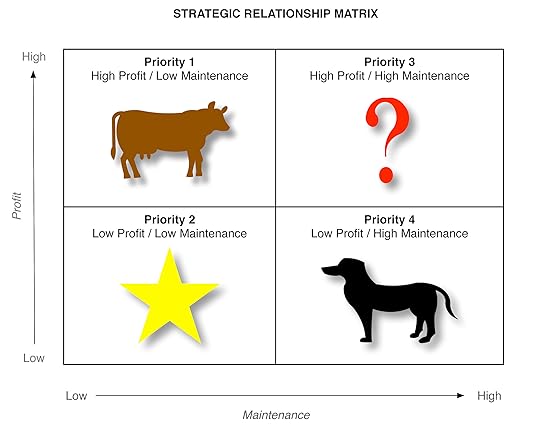
High-profit/Low-maintenance
Low-profit/Low-maintenance
High-profit/High maintenance
Low-profit/High maintenance
Getting rid of high-maintenance relationships will allow you to reclaim resources you can invest in finding or serving Priority 1 relationships. Once you exit the relationship, you’ll only wonder why you didn’t do it sooner.
How do you keep from getting into these relationships to begin with? The same way you keep from hiring the wrong people to work in your organization:
Hire Slow, Fire Fast.
In the courting phase, you should do the following:
Discuss expectations. Write them down. Repeat them to the prospective client.
Recognize the warning signs. For example, when it comes to my speaking, I get nervous when someone is:
Continually trying to negotiate me down on the price.
Attempting to add additional speaking sessions that we didn’t initially quote.
Trying to cut corners on expenses.
Failure to follow-through on initial communication.
Assess your capabilities. Make sure you can deliver on what they are asking.
Check references. See what their other vendors, suppliers, or service providers say.
Most of all, don’t be afraid to walk away if it’s not a fit.
The good news is that you can better at this over time, IF you have the right client acquisition model and will focus on high-profit, low-maintenance clients.
Listener Questions
Ken Davis asked, “Does a client ever become too high maintenance to deal with?”
Nick Pratt asked, “What do you do when the client doesn’t want the relationship to end?”
Shules Hersh asked, “Is there any time it is right to appease a high-profile, high maintenance client just to preserve your reputation?”
Timothy Moser asked, “How can you break your dependency on one large client?”
Travis Bowersock asked, “How do you let a high maintenance go and still leave the business relationship on good terms?”
Tip of the Week
Now let me leave you with one final tip when it comes to speeding up your iPhone. Is it running slow? Is the battery draining more quickly than you think it should?
Here’s what you can do to speed up your iPhone when it gets bogged down:
Delete all your text messages.
Shut down all open applications.
Reset your iPhone.
That’s it! Let me know if this works for you!
Special Announcements
If you are considering launching your own platform—or just getting serious about it—you need to start with a self-hosted WordPress blog.
This is not as complicated as it sounds. In fact, I have put together a step-by-step screencast on exactly how to do it.
You don’t need any technical knowledge. I walk you through the entire process in exactly 20 minutes.
This fall’s SCORRE Conference is filling up fast! My business partner Ken Davis, who originally developed the SCORRE Conference, and I will be hosting this next conference on October 14–17 at the beautiful Park Hyatt Beaver Creek Hotel in Vail, Colorado.
You can use the discount code HYATT and take $200 off the registration price. But this offer expires on August 15th, 2013, so you need to act quickly.
My next podcast will be on the topic of “ Watch Your Mouth: How Our Words Shape Reality.” If you have a question on this subject, please leave me a voicemail message.
This is a terrific way to cross-promote your blog or website, because I will link to it, just like I did with the callers in this episode.
Episode Resources
In this episode I mentioned several resources, including:
Conference: The SCORRE Conference
Screencast: How to Launch a Self-Hosted WorPress Blog in 20 Minutes or Less
Show Transcript
You can download a complete, word-for-word transcript of this episode here, courtesy of Ginger Schell, a professional transcriptionist, who handles all my transcription needs.
Subscription Links
If you have enjoyed this podcast, please subscribe:
iTunes
Zune
RSS
Your Feedback
If you have an idea for a podcast you would like to see or a question about an upcoming episode, e-mail me.
Also, if you enjoyed the show, please rate it on iTunes and write a brief review. That would help tremendously in getting the word out! Thanks.
Question: What’s your experience been with high maintenance clients? You can leave a comment by clicking here.



August 13, 2013
Excellence, Not Perfection [Quote]
Strive for excellence, not perfection.
H. Jackson Brown Jr.