
Brian Andrews's Blog, page 7
December 4, 2011
"Life is a suicide mission."
- Orson Scott Card


December 3, 2011
Happy Birthday Mark Twain!
reblogged from nypl:
"When I am king, they shall not have bread and shelter only, but also teachings out of books, for a full belly is little worth where the mind is starved."
November 28, 2011
Flap Copy
Here's the flap copy (aka jacket copy ) for the Advanced Reading Copy (ARC) of The Calypso Directive… would this make you want to read more if you grabbed the novel off the bookstore shelf?
An unprecedented genetic mutation, an underground think tank, and an unscrupulous pharmaceutical company collide in this dazzling debut thriller.
For one hundred and fifty-five days, Will Foster has been locked in medical quarantine without his consent. The doctors claim he is infected with a deadly virus, but this is a lie. Encoded in his DNA is a mutation that provides immunity from disease for all who possess it, source code that Vyrogen Pharmaceuticals aims to commercialize as a multi-billion dollar gene therapy.
Against all odds, Foster escapes his laboratory prison and steals a virulent strain of bubonic plague as insurance. To help him unravel the mystery inside him, Foster contacts the only person he can trust: a former lover and microbiologist living Vienna and the two become fugitives, hunted across the heart of Europe.
Under the guise of averting a plague pandemic, Vryogen hires an elite, underground Think Tank to track down Foster. But the brilliant team discovers something unexpected—the ugly side of multinational pharmaceutical competition—and must choose between serving their client and saving Foster.
With unflagging suspense, unforgettable characters, and riveting biomedical detail, The Calypso Directive deftly explores the issues of genetic exploitation and piracy. Captivating, controversial, and courageous, Andrews debut is sure to thrill and leave you wondering what secrets are locked in your DNA.
Please send me your comments!
November 18, 2011
Terraforming — Amazing Images!
Check out these amazing images of a planet being terraformed… but remember, there is no such thing as global climate change. Human beings can't possibly affect Nature.
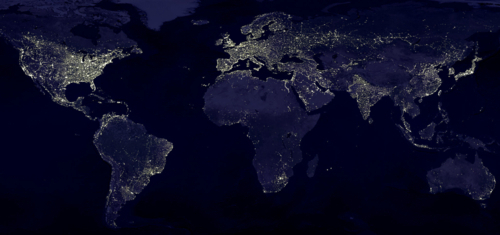
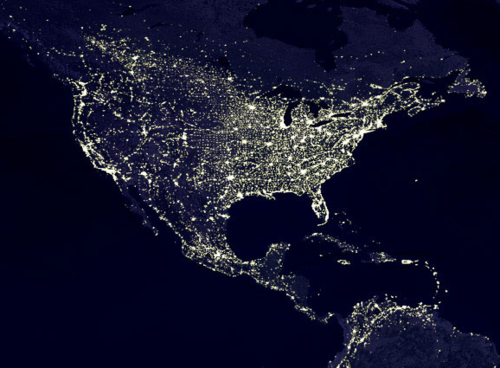


Credit: C. Mayhew & R.Simmon (NASA/GSFC), NOAA/NGDC, DMSP
November 15, 2011
25% of “you” is patented
25% of the Human Genome is patented by corporations and research institutions.
One of the central themes of THE CALYPSO DIRECTIVE is gene patenting. What are some of the concerns with gene patenting?
(1) Gene patents create gene monopolies. Once a gene is patented, medical tests and treatments associated with that gene are restricted. Patient’s rights are infringed upon because access to information (about one’s own body) and medical care is limited to options legally tied to the patent holder....
25% of "you" is patented
25% of the Human Genome is patented by corporations and research institutions.
One of the central themes of THE CALYPSO DIRECTIVE is gene patenting. What are some of the concerns with gene patenting?
(1) Gene patents create gene monopolies. Once a gene is patented, medical tests and treatments...
25% of "you" is patented...
25% of the Human Genome is patented by corporations and research institutions.
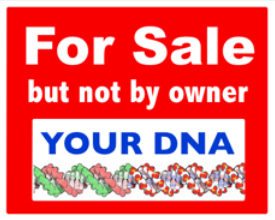
One of the central themes of THE CALYPSO DIRECTIVE is gene patenting. What are some of the concerns with gene patenting?
(1) Gene patents create gene monopolies. Once a gene is patented, medical tests and treatments associated with that gene are restricted. Patient's rights are infringed upon because access to information (about one's own body) and medical care is limited to options legally tied to the patent holder.
(2) Genes patenting impedes global scientific research by preventing researchers from freely pursuing genetic research and exchanging information about patented genes.
(3) The interpretation of existing US patent law has been twisted. Traditionally, patents have be granted to protect inventors and their inventions. Does identifying a specific individual gene in the human genome qualify as invention? Since existing genes are a product of nature, how can discovery possibly qualify as invention?
Gene patenting proponents (i.e., the companies, lawyers, and politicians who stand to make the most money from gene monopolies) argue that without gene patents, researchers will not be able to justify the expense of genetic research and the world will suffer—the development of tests, drugs, and gene therapies will be stymied. To this I say horse pucky. Patent protection is still available for any tests, drugs, and gene therapies developed pertaining to a particular gene… just not for the gene itself. Eliminating gene patents simply puts them in the same category as the rest of the world's scientists and inventors. Eli Whitney didn't deserve a patent on the process of picking cotton (or the cotton plant itself), he deserved a patent on the machine he invented to pick cotton.
One of the hottest cases involving gene patenting concerns the BRCA1 & BRCA2 genes (which are linked to breast cancer) and patent holder Myriad Genetics who owns a monopoly on genetic tests for these markers.
For more reading goto:
http://www.genomicslawreport.com/index.php/category/badges/myriad-gene-patent-litigation/
http://www.aclu.org/free-speech/brca-genes-and-patents
Double helix art courtesy of: http://www.flickr.com/photos/dullhunk/439737690/
November 14, 2011
"What wicked people dyers are. They begin with dipping their own souls in scarlet sin."
- Jane Austin in a letter to her sister Cassandra, 2 March 1814. I think she was writing tongue-in-cheek, but I love the alternative interpretation.
November 7, 2011
Hundreds of Trillions…
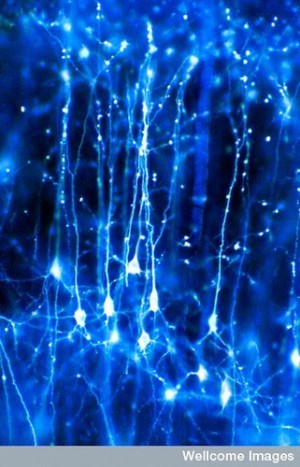 No, this post is not about the US Debt… researchers at Stanford have used advanced imaging technology to visualize neural connections in the brain. It turns out that a single neuron the cerebral cortex can make thousands (possibly tens of thousands) synaptic connections.
Since the human brain contains around 200 billion neurons, that means the number of connections in the human brain is in the hundreds of trillions of connections.
Image Credit: "Neurons in the Brain". 2003 Dr Jonathan Clarke...
Hundreds of Trillions...
No this post is not about the US Debt… researchers at Stanford have used advanced imaging technology to visualize neural connections in the brain. It turns out that a single neuron the cerebral cortex can make thousands (possibly tens of thousands) synaptic connections.
Since the human brain contains around 200 billion neurons, that means the number of connections in the human brain is in the hundreds of trillions of connections.
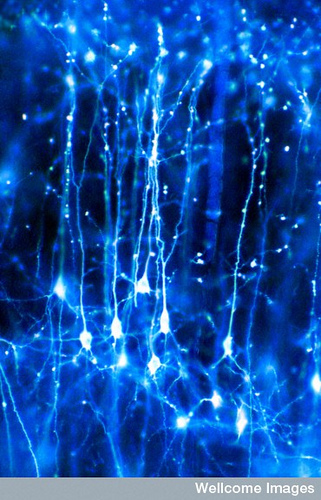
Image Credit: "Neurons in the Brain". 2003 Dr Jonathan Clarke. Rebecca-Lee Flikr.


