Virginia S. Anderson's Blog, page 35
March 4, 2016
Looking for Readers in all the right places …
I’m enjoying following Susan’s advice in reading in the genres of my current republished ebooks. Check out “Book Reviews for Horse Lovers”! I’ll post another new review this weekend. Check back to see if it sounds like one you’ll like!
 Books: Publishing, Reading, Writing
If you’ve written and published a book—and it doesn’t matter whether you’ve taken the traditional or self-published route—you’ll be anxious to find people who want to read that book . . . because that’s why you wrote it in the first place, right?
I’m not talking here about book sales and making money from what you’ve written, because as I’ve said many times before, most authors will be lucky to make enough from their writing to cover out-of-pocket cash expenses, let alone any kind of a profit at all. I’ve argued long and hard with those who express disappointment at the meagre return they’ve seen, if any, for all their labour, but I am going to repeat again here—money should not be the reason you write or publish. This is why I have also advocated for a “Most Read” list to determine a book’s success, rather than the…
View original post 1,819 more words


March 1, 2016
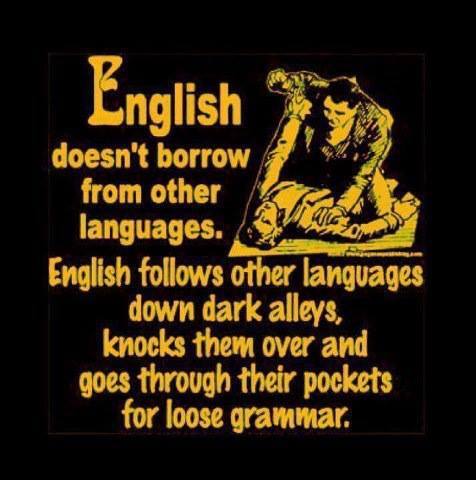
The English Language Meme…


February 28, 2016
Commas Control Emphasis. Here’s How!
I have been thinking about the inordinate power of commas. I intuitively understood this power from my own writing, but I credit Martha Kolln’s Rhetorical Grammar with making concrete what my instinctive ear told me: how such a simple little mark can help communicate precisely what we want readers to hear.
Grammar books and various grammar web sites, of course, lay down the kinds of apparently sacrosanct rules that drive real writers crazy. “You must, must, must put a comma there because the rules say so.”
 On the one hand, not necessarily. On the other, it’s important to understand how certain principles governing things like punctuation have consequences for writing. I’ve worked hard not to be the natural Grammar Curmudgeon I am, one who smacks other people’s writing around for rule-breaking, but by golly, punctuation is a tool!
We’ve all seen those fun exercises where simply moving a few little marks around completely changes meaning. A simple example is “Woman without her man is nothing,” which, with just a few tweaks, comes to mean its opposite. (Can you do it? Give it a try!)
But punctuation also controls rhythm and emphasis, and commas are tough little drill sergeants, lining up every word in its place.
Take emphasis. Read this sentence aloud:
There is in fact a reason for what happened.
 Now, in my view, whether or not we should set off the “interrupter” (“in fact”) with commas, as the grammar books instruct, is a judgment call. Leaving out the commas is fine. But when you add them, something happens. Listen:
There is, in fact, a reason for what happened.
To my ear, and Kolln substantiates this, the commas change the intonation and emphasis. In the first sentence, without the commas, I hear
There is in fact a REASON for what happened.
In the second sentence, the commas do what Kolln and my ear say they do, shifting the emphasis onto the words before the commas. So the sentence now reads
There IS, in FACT, a reason for what happened.
The meaning hasn’t particularly changed, but the way we hear it has. We shift our attention to the “facticity” of the claim. We get a beat on the FACT of this utterance.

But that’s not all that happens. The commas break up the flow of the sentence in ways that reinforce meter. In this case, it’s our old favorite, iambic pentameter, the most ubiquitous meter for English speakers (Shakespeare’s meter). And that change not only asks us to hit “is” and “fact” with extra emphasis, but also taps “REAson.” So that the sentence reads,
There IS, in FACT, a REAson for what happened.
 And as a bonus:
In addition to illustrating one of the functions of commas—to reposition emphasis—these examples also illustrate how breaking one of those apparently sacrosanct rules we all hear again and again can actually give you an additional tool to control emphasis. How many times has someone told you to strike out “there is” and “there are” every time they crop up? But if you try to get rid of the “there is’ in this sentence, the emphasis on “reason” that persists through all three versions withers. Compare
I can tell you a reason for what happened.
The facts reveal a reason for what happened.
Nothing wrong with these sentences. But their message—that what seemed random or accidental is actually the result of some cause that the speaker is about to explain—is flatter, more subtle. That’s fine. But if you want to be assertive, if you want to firmly refute the idea that the event is random, accidental, then “There IS, in FACT, a REAson” is your go-to choice.
And there is, in fact, a reason why.
Both the “there is/are” and “it is” force emphasis on the words that immediately follow them.
There is NO POINT in not liking asparagus.
It is TRUE that I liked asparagus when I was a child.
It is SAD that I don’t like asparagus now.
This effect holds for the contraction forms of these constructions —”it’s” and “there’s”—as well.
The bottom line: Punctuation and sentence structure choices give you more control over how readers “hear” what you write. Don’t ignore the rules; just recognize how understanding the flexibility they offer can leverage the power of your writing. Don’t want to emphasize ‘FACT”? Leave the commas out. Want to hit hard on “REAson”? Hang on to that much-maligned “There is.”

Do you have examples of how commas and sentence structure control emphasis in your own writing? Decisions you’ve made about how to re-organize sentences to take advantage of this little power tool?


February 23, 2016
Long List of Free Contests!

Most show 2015 deadlines, but these might be worth checking out for 2016. A very comprehensive list!


February 21, 2016
Is the Hypercorrectness Troll Gobbling Up Your Grammar?
 I remember one of the humorist Dave Barry’s satirical “Ask Mr. Language Person” columns years ago, in which the all-too-sure-of-himself Mr. Language Person opined that “‘me’ is always incorrect.” Barry was referring indirectly to an example of the phenomenon of “hypercorrectness,” which I’d argue leads to almost as many grammar slips as does its opposite, carelessness. I say “almost as many” because these slips are so common!
In a nutshell, a writer slips into hypercorrectness when he or she isn’t gut-sure about what is correct and inoculates him- or herself by making a grammatical choice that sounds just a teeny bit “fancy” and thus “must” be what an educated writer ought to opt for. 
As with all grammar choices, whether or not a hypercorrectness slip will hurt you with that editor or agent you hope to impress, or whether it will get your prose chewed up in red in your business report, depends on whether or not your particular audience knows the difference or, for that matter, cares. I’ve seen so many kinds of errors, including just plain careless ones, in so many “erudite” places that I know it can be a toss-up whether your slip costs you an acceptance or gets ignored.
But I argue that knowledge is the power to choose with confidence. The “correct” choice sounds funny to you, so you’d rather go with the “incorrect” one because it feels more natural? Go for it. But it’s really nice to make that choice because you know what you’re doing and why you want it that way.

The single most ubiquitous hypercorrectness error, as Barry recognized, may be the prejudice against poor little “me.” And the single most common example of that prejudice is “between you and I.”
What? That’s wrong? Well, if you’re a purist, yes—for the same reason it’s wrong to write “the zombies were chasing George and I.”
Why? Because, in both cases, the pronouns are “objects” and should be in the “objective case”: that is, “me.”
There’s really a simple test. Strip out or move the proper name or problematic pronoun and see what you have:
Between I and you
The zombies were chasing I
See?
Case two: Sometimes what sounds natural is better. E. g., the who/whom conundrum
I’ve suggested in a prior post that if choosing between these two options leaves you sweating, go with “who.” The situations in which “who” won’t work for almost all readers are rare: say, when you’re inverting the sentence or inserting the pronoun behind an actual preposition:
To whom are you speaking?
This is the person for whom I was waiting.
If you are writing Downton Abbey fan fiction, okay, you’ll have to master these forms. But in most cases
Who are you talking to?
That’s who I was waiting for.
will pass muster with almost everyone, even if they are technically incorrect. But as I wrote in my earlier post, the correct forms,
Whom are you talking to?
That’s whom I was waiting for.
 can actually sound more jarring in many contexts than the errors.
But the troll of hypercorrectness comes charging out from under the bridge when a writer gets paranoid and decides that “whom” sounds like what a smart person would say. Then we end up with
He didn’t say whom would be going to lunch.
Don’t give money to whomever asks for it.

In both cases, the correct choice—and the more unobtrusive choice regardless of what’s correct—is “who.” (For those who enjoy these kinds of things, the rule is that the case of the pronoun is governed by its role in its own clause, not the clause in which it’s embedded.) You can actually apply the same test as for the “I/me” choice: you wouldn’t write, ” He didn’t say her would be going to lunch.” It’s clear you need the subject case.
Case 3:
I came across this usage (though not this exact sentence) in a self-published book just the other day:
Our worries lied in the way he was behaving.

Obviously, I can’t know what prompted the writer to make this choice. But I suspect it’s another instance of hypercorrectness, based on the Mr.-Language-Person-type precept that, in this case, “‘lay’ is always incorrect.” We’ve heard and heard and heard that people don’t “lay,” chickens do. So it must follow that anywhere our uneducated ears order us to say “lay,” we must really need “lie.”
Uh, no.

There’s really no test or easy fix for this one. If you aren’t sure but really want to be, you have to look it up. I will say that the use of “lay” as in “I’m going to lay out in the sun for a while” has become so universal that many an otherwise persnickety person will read right past “lay” in this usage. They’ll probably read past “we laid out in the sun yesterday” (yes, “lay” is the correct past tense of “lie”). But I suspect that most readers would hiccup at “We lied out in the sun yesterday.”
Moral? Sometimes it’s better to be technically wrong than hypercorrect. If you really want to be correct, don’t guess. When in doubt, find out!



February 15, 2016
Don’t Let “Illogic” Suck Readers Out of Your Plot!
“Illogic” is my number one pet peeve as a reader.

Well, one of my number one pet peeves: it’s definitely one of the experiences that throws me right out of a story, like hitting a speed bump at 40.
So what do I mean by “illogic”? Well, the most common form of illogic that I see is:
a character behaving in a way that no normal or ordinary person would behave, not for some logic that the writer has deliberately and strategically built into the character, but because the writer needs the character to behave this way to further the plot.
Perhaps other readers don’t share my sensitivity to these bones of a writer’s process, but for me, they can be quite visible, and usually painfully so.

Now let me stop for a minute to assure you: as a writer, I’m not innocent of these glitches myself. Fortunately, my writing group pays attention. More than once, they’ve pulled me out of the path of my own rush to get to the next scene (thank you all yet again!).
One common form illogic seems to take: the information dump.
A writer needs to convey certain information to his readers. So the story slams to a halt and characters are plunked down in illogical situations that give them a chance to tell readers what the writer needs them to know.
Scenario I (details have been obfuscated):
A character has just undergone major, major surgery and has just been wheeled into the ICU. A second character manages to wheedle his way in for just a few minutes to—one would suppose—convey his well-wishes to the surely woozy patient.
But no. Because the next plot point requires the well-wisher to perform a particular action that needs some justification:
a) the recently anesthesized patient is able to carry on an extended (three-page) coherent conversation, using formal, complex syntax, without even an expression of discomfort;
b) the well-wisher lingers for these three pages exchanging complex information with the patient even after having been ordered from the room by a nurse;
c) the nurse conveniently twiddles her thumbs, giving the conversation exactly the time it needs to wind to the necessary close.
Sorry, I don’t buy it.

This scene could have been made more palatable by a simple recognition and acknowledgment of the limits of the situation. And a strategic use of them! A patient who must gasp out garbled instructions, a well-wisher who must struggle to make sense of the incoherent drug-slurred communications in the seconds (not minutes) before the nurse storms back in—now the well-wisher has more mental work to do, and the reader’s sense of mystery is deepened, not thrown off track.
A second common form of illogic is the coincidence, the accident that somehow sets up a vital scene—just a little too helpfully for my taste.
Scenario II (this is from a best-seller; you may even recognize this scene, or one like it):
The protagonist and her ally face a violent confrontation with the evil, evil and physically powerful villain. The ally pulls out his cell phone to call for help—and he’s forgotten to charge it. It’s dead.
Speaking of convenience.

Folks, cell phones have presented a whole new raft of challenges to mystery/suspense/thriller writers. Those of you who have grown up with cell phones will not recall the days when you could manipulate events by the simple act of preventing your character from finding a handy pay phone. And there were times when few people had answering machines and no one had caller ID. It was waaay easy to make sure someone missed out on an urgent message.
No more. And it’s not fair to exploit the plot devices of the old days by disabling the realities of the present.
Now, if a villain snatches a cell phone and smashes it, that’s one thing. If you must get rid of that phone (and I can certainly imagine, and have needed, scenes where that darn phone creates a real problem), have it happen that way. Or find some clever way to make the phone play a role in the deception.
Here’s my own biggest illogic temptation: in my mystery/suspense novels, it’s often really tough to keep the characters from simply going to the police. But if they go to the police and tell all, the story’s over! I admit to not always being completely convinced I’ve explained away a character’s decision to keep things to him- or herself so the plot will keep to its prescribed route. I’ve tried to build the decision into the characters’ ambivalences, their failures to be completely honest with themselves about their motives, and to make that ambivalence a driving force in the story. I think I’ve had mixed success.

What kinds of illogic throw you out of a story? What are your own most insidious temptations? How have you solved the need to pass along information or keep the suspense logical in your own work?


February 10, 2016
Terrific Post on Style for Writers!
Chuck Wendig responds to a reader who finds sentence fragments troublesome (they make writing “unreadable,” in the commenter’s view). If you haven’t met Chuck yet, you’re in for a ride, though you’d best leave your Sunday-go-to-meetin’ expectations at home. I envy his verbal energy!

What I love about this post is that it celebrates the incredible flexibility of language, all the ways that writers can whip it up and lay it down and make it their own (in the great tradition of Humpty Dumpty in Alice in Wonderland!). Wendig illustrates the power of the dreaded fragment with examples from some of the greatest of writers. He reminds us that rules are the groundwork but imagination and a writer’s ear are the scaffolding that builds palaces on those placid rules.
My own caveat is that when I was teaching, so many of my students had a tough time recognizing things like fragments. Especially fragments! The lack of some kind of internal sense of what “a sentence” is may not have handicapped those with the drive and verve to become creative writers; imagination and ear may have been enough.
But I argue (and Wendig cautions) that it’s vital to learn such “basics” of language because if you don’t, you can’t make choices. You can’t switch your verbal code to fit it to different contexts, for example, to a business setting where a lively fragment-sequined style will simply be out of place. You probably can’t write that query letter we all sweat over. At least you can’t write it with confidence that you can decide when to explode on the page and when to hold back.
So many of my students hoped to be great novelists. I couldn’t help worrying that without the ability to choose the linguistic strategies they needed in a given context, they would be handicapped if the whole great-novelist thing didn’t come off. As it so often doesn’t . . . at least not as fast as we’d like it to.
Do you agree with Wendig? What is your fragment strategy? Do you have a favorite “fragment passage” to pass on?


February 8, 2016
Against Outlines

Since my title is “Against Outlines,” you may suspect I’m going to argue against them.
Maybe, though, I’m not vehemently against outlines for writing novels.
In my brief career* as a romance novelists, for example, outlines were essential.
After all, these books were short, about 55,000 words, and I had to produce them in a matter of months. Writing one had to be like running a mini-marathon.

You were given a route and a clear finish line, and you had to run the same route as everybody else. You could throw in a leap or a flourish here and there—in fact, you were encouraged to, as long as you didn’t stumble off course or onto the sidewalk. You had to plan every character’s action and reaction so as to arrive at the essential alchemy of the ordained finish line. No characters allowed to stop and drift into quirky shops or down unmarked alleys. Eye on the prize!
Lest romance writers rightly take offense, let me be clear. Setting off on and finishing this course is no snap.

Planning at this level takes enormous discipline. To exploit a different metaphor, directing each scene so that each actor arrives at the mark for the scene to follow requires a well-honed sense of character motive and of how dialogue and action can deliver on that motive. And those flourishes: as I learned (metaphor shifts back again), to carve out a lane for yourself with all those thousands of others huffing along beside you, to be you without veering off course: that takes a brand of genius. Believe me, I was there. I know.
Outlines make such a demanding fictional endeavor doable. Each scene can be carefully slotted into the overall course. There’s a marked turn coming up; if the scene that propels the characters around it is missing, the gap will glare. Too many talky scenes in a row? The outline will flog you back on pace. And each checked-off block of the outline announces your progress. Three-quarters there? Do you have enough action to fill those last pages? The outline knows.
And of course, even if I were to inveigh against outlines in rabid, absolutist terms, I’d have to admit that we all need one thing outlines amply provide: a story arc.  Something’s going to change before the end of the story. You can’t write your final outline entry without knowing what that something is.
But. . .
A dear late colleague of mine used to say, “No surprise for the writer, no surprise for the reader.” That “surprise for the writer” is what an outline trades away.
Writing without an outline is more like setting out on a road trip than a marathon. 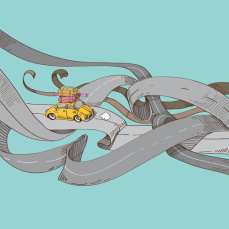 You do have a destination. You can see it, a glow on the horizon. But you’re not a hundred percent sure yet what’s giving off that glow. Oh, you have intimations. You’re packed your bag for many eventualities. But you really don’t completely know.
So off you go. Maybe you have a map, but it offers you many forks, and you can’t even tell which one is shortest, let alone which one you’ll most enjoy. Along each fork you choose you spot little side trips, where you park for a bit and wander to see what’s there. You find your characters in those quirky shops, down those murky alleys, picking up memories, fears, loves, trying them out like costumes to see what new selves they reveal. You didn’t know your character loves French movies even though he doesn’t understand any French, or that she loves cats even though they make her sneeze. Or that she fell out of a tree and nearly died when she was ten, did you? Oh! That explains her anger at the father who didn’t catch her. You didn’t know your character once loved a girl who dumped him; now you discover his struggles with trust.
Without the confines of an outline, you don’t tell characters what to do. You follow them and see what they do. It’s not like you tag along blindly. If they get too wild, you may abandon them, leave them to their own stories . . . though you may come back one day just to see where they ended up.
The fact of it is, without an outline, there’s a sense in which the story writes itself.
 Dangerous? Oh, my lord, yes. It takes much longer. It tempts complication, which can be a storyteller’s bane. You can’t afford to constantly wonder, “Why did we turn off here?” when you’re expected/hoping to write a book a year.
But it can save you grief as well. My one great, sad lesson from my Failed Novel was that once you set your thinly known characters loose in the world, talking to each other and finding unexpected doors to open, they create themselves—excuse the cliché: they take on a life of their own. And once that starts to happen, you must listen. The marathon route says turn right here; they say, “No, we don’t like that direction.” Boss characters you’ve found, not made, and they’ll punish you.
So maybe we need a middle ground. A marathon route for the directionally challenged for whom the trip is the joy? A road trip into delight and surprise for the writer-on-deadline who must get to that glow this week, not next year?

What strategies do you use to keep your novel on track without giving up the chance for surprise?
*(I had a two-book contract with a line opened by NAL in a short-lived attempt to bite off a piece of the Harlequin/Silhouette market. Their decision to close the line after only a few titles nudged me in a different direction. Otherwise . . . well, who knows.)


February 3, 2016
A Writer’s Guide to Defamation and Invasion of Privacy: Important Information!
Reblogged on WordPress.com
Source: A Writer’s Guide to Defamation and Invasion of Privacy
This is excellent information that clarifies many issues. One issue Amy Cook doesn’t address is the definition of (and handling of) “public figures.” Well-publicized lawsuits show they’re not totally fair game; is truthfulness the only line? When my novel King of the Roses first came out, I struggled with this issue since I drew on a horse-racing legend for my inspiration. Since I made him the hero and probably a little better than he was (he’s dead now), and since he never made any attempt to dodge the limelight, I was pretty well protected. But this is a dimension of the privacy/defamation issue with its own dangers.
Thanks to Chris the Story Reading Ape for another great share, this one from Tribalmystic stories!


January 31, 2016
Amazon Link Anatomy: What You Don’t Know Might Be Killing Your Reviews…
I’m going to check out this information! Seems not only useful but necessary, and may help solve some of those fears about removed reviews. If this works, I’ll be changing the links on my personal web site, virginiasanderson.com, to take readers on a better path to my books. Let me know if you have experience with this process, and whether it works for you!
 Chris The Story Reading Ape's Blog
To find out what you SHOULD be doing,
click on the link or image below:
amazon-search-url-isbn-ref/