Virginia S. Anderson's Blog, page 40
October 7, 2015
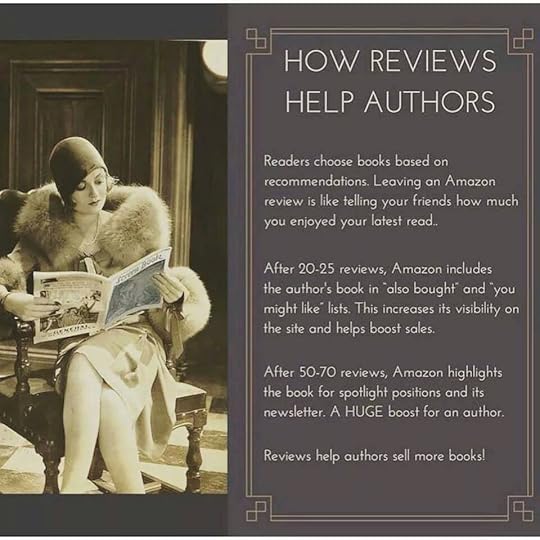
How reviews help writers… I didn’t know Amazon worked this way…

Apropos of this information (which I guessed but didn’t *know*), if you are interested in reviewing one of my books, let me know and I’ll send along a coupon for a free copy at Smashwords! (I think Amazon prefers “verified purchasers,” but I’d love a Goodreads review as well.)
 Originally posted on Kawanee's Korner:
I didn’t know Amazon worked this way… I sure could use the reviews. I know there’s enough people who bought it. Review review people!



October 5, 2015
Great Post from Writers in the Storm: 7 Mistakes on the Way to a Publishing Contract
Couldn’t reblog this from Colleen M. Story on Writers in the Storm (no button), but I wish I could. It’s a great post that really resonated with me and might with you.
(Can anybody tell me why some WordPress sites have reblog buttons and others don’t? Is thiis a choice the blogger makes? I HATE seeing good posts I can’t share in their entirety.)
In any case, this could so be me! I’m just now trying to decide whether to self-publish my way-outside-the-conventional-genres novel or to go on submitting to agents. I haven’t gone the small press route because I found myself thinking that if I have to do all the marketing, why share the net? But this post makes me realize that I’m probably thinking too short-term. Having a new novel picked up by a press (I published five with big presses before going back to school) would  be a gateway to new contacts and new opportunities.
Story’s thoughts on feedback also resonated. Having gone the beta-reader route as well as working with my writing group, I’ve decided not to tear up my work unless it’s for someone who has made a commitment to the book, for the very reasons Story states: six reviews, six different ideas as to what just has to be done. In my excellent writing group, I listen for consensus and a good argument that the advice is well-grounded. I often receive the kind of feedback Story praises, the kind that strikes me instinctively as valuable, sometimes pinpointing a problem I knew at heart needed attention but which I hadn’t quite identified.
Check out the post for her seven inspirational messages. They were a call to action for me, and might be for you.


October 2, 2015
CONTEST ANNOUNCEMENT: ENTER FOR A FREE REVIEW!
Entrada Book Reviews sent this announcement . It looks as if you need only fill out an online form to be eligible for a drawing for a free review of your book. Check it out!


September 27, 2015
Grammar Rules I’m on the Fence On. Are You?
 I’m curious what people think because I am on the fence. Unlike ending a sentence with a preposition, these are not nonsensical non-rules. And unlike using “who” when “whom” is technically called for, they’re not completely invisible—or are they? That’s my question: If you were advising a beginning indie author wanting to self-edit, would these go on your “must know” list?
In fact, very well-credentialed writers do ignore them. Is that enough to move them to “okay to ignore”?
I’ll start with one that seems to have been ripped up and stomped on:
The dangling modifier.
I recall the first time I heard a dangling construction on an episode of NPR’s Nova. What??!! Since then, I’ve seen so many of these that if I had a penny for every one, I could pave my driveway in copper.
The pattern’s ubiquitous.
“An accomplished author, her books have sold millions.”
“Long known for her steamy romances, her fans number in the millions.”
“His heart broken, the loss of his lover left him devastated.”
“Running across the street, a car almost hit me.”
Does only an ex-English teacher shrivel inside her arid little syntactical shell when the modifier doesn’t modify the noun or noun phrase that immediately follows? When it’s not her books that are an accomplished author? When it’s not her fans that are known for her books? When it’s not the car running across the street?
It’s not that readers can’t make out what goes with what. Is it only an ex-English teacher who shivers in delight when parts of sentences link together so precisely that they’re like the rocks in Inca walls—you couldn’t force a needle between them?
It’s amazing how obviously problematic these seem in isolation. Yet, zoomed over in texts, it can be hard to catch them. (Hah! See?)
But readers know what’s meant perfectly well, don’t they? So what’s the fuss?
Lie and Lay.

I just saw “laying” when it should have been “lying” in a book I deeply respected. Which editor’s job is it to catch this? Am I silly to care?
I’m going to make the radical claim that the English language has decided. “Lie” and “lay” in the progressive tenses (she was lying/laying, he is lying/laying) are interchangeable, as they are in the simple past (he lay/laid down). Let go of it, you hyperventilators! The distinction has deserted you.
Or has it? Is it worth fighting for?
 Incomplete comparisons.
If you look this one up online, you’ll be told that you “complete” a comparison by making sure to state what is being compared with what. In other words, it’s “incomplete” if you say that “Painkiller X is better.” You must say better than what. Nor can you say, “Product X has the most nutritious ingredients.” You must designate the category in which nutritious ingredients are being measured. The first hits in an online search tie such “incomplete comparisons” to misleading advertising. These hits are correct: We do hear claims like these all the time. But they’re fairly easy to spot if we’re looking.
However, here’s what seems to be a more subtle form of incomplete comparison, given how often it pops up:
1) Education in Europe is a lot cheaper than the United States.
2) The restaurants in Louisville are better than Cincinnati.
3) My friend’s grammar skills are better than some English teachers.
Here’s a sentence I read this morning in an academic journal (I have changed some relevant nouns lest some enterprising soul try to figure out where it came from):
My years as a low-wage employee have been a lot better than some others at many locations.
Now, one could make the case, given the exceptional level of literacy this writer demonstrates throughout the article, that “some others” here refers to “years,” not other, comparable employees. If the referent is “employee,” however, the sentence would have to read (with the “understood” parts in brackets):
My years as a low-wage employee have been a lot better than [they have been] FOR some others at many locations.
Would you have read this sentence as I did? Would you have revised it, possibly to clarify the referent? What about the others above (1-3)? Would they have jumped out at you if you weren’t looking for them?
And then there are these:
Each of these, in some camps, is wrong. Yet I bet we read over them as often as we catch them. So. . . if you were editing your own work or your critique partner’s, would you flag these?
Neither of us are going to be there.
The data explains why the theory is wrong.
McDonald’s raised their prices again.
None of us like making mistakes.
Verdicts? Let me know what you think!


September 22, 2015
Writing By Hand
I could have written this post! Deborah Lee Luskin sounds like my cognitive sister. I agree with many of the comments as well. An article by a famous college writing scholar, Janet Emig, made the case in the 1980s that one reason writing works so well as a learning tool is that it involves mind, eye, and hand/body, giving information more ways to connect throughout our neural pathways–and this is doubly true for handwriting. Also, the effect generated by slowing down–time for incubation and connections to kick in–fuels creativity. And I’ll add one thing I realized when I had to retype the 500-page ms. of King of the Roses, before computers: transferring text from handwritten notebook to machine gives you the most amazing extra edit, especially for an over-writer like me; when I have to retype it, it’s a lot easier to ask, “Do I really need this?” So when you’re stuck or when you just want to see what flows out, try writing by hand. Make sure you’re in a nice place, with a pen or pencil that allows your hand and mind to flow. Enjoy!
 Originally posted on Live to Write - Write to Live:
 When I don’t know what I want to say, when I’m stuck in an essay or a scene or a business letter, or even when I’ve just been away on vacation and need to settle back at my desk, I always rediscover my voice by writing by hand.
Handwriting is like a fingerprint, unique to each individual; my handwriting’s lousy.
My handwriting has deteriorated in direct proportion to my keyboarding skills, which are fierce – and fast. Writing by hand slows me down, which is a good way to find my way to the page.
Writing by hand grounds me. It keeps my eyes focused on my words and my mind trained on my ideas, holding them long enough to scrawl them in ink on narrow-lined paper. The problem is that the scrawl is sometimes quite hard to decipher – even for me, even within minutes of scribbling them down.
View original 309 more words


September 20, 2015
10 Learnings Over 4 Years of Publishing
 Originally posted on ...and then there was Sarah:
 I published my first book, St. Charles at Dusk, on September 26th, 2011. Four years have passed, and with them, more learnings than I could ever fully wrap my mind around. In those early days, I was a woman alone on an island, getting all my advice from Google. I didn’t know a single other author who had published their work.
Flash forward four years. I’m no longer a woman alone on an island, but one surrounded by hundreds of authors, thousands of readers, and years of experience (with many years still ahead). I have seventeen original titles out (and numerous boxed sets), and an endless quantity of ideas. I’ve been lauded by esteemed authors, and appeared on the USA Today Bestsellers list, twice. I’m nowhere near an expert, and far from perfect. I’ve had successes and setbacks, like any author, and I move forward knowing I’ll have more of both…
View original 1,642 more words


September 18, 2015


September 16, 2015
How to Reach Readers on Goodreads
I am just getting started on Goodreads. How do you use Goodreads? What advice do you have for getting an Author page noticed? I’m a complete novice, so let me know what you can add to this post from readers+writersjournal (which I reached through Chris the Story Reading Ape, as so often happens!).
 Originally posted on readers+writers journal:
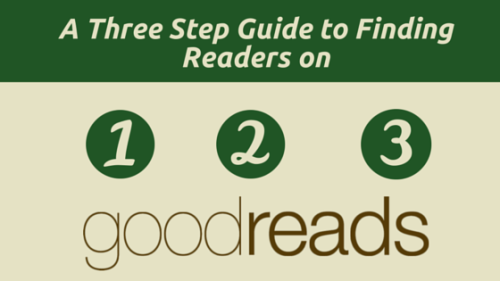 3 Steps to Connecting with Potential Readers
by Carmen Amato, via Book Marketing Tools
Serious readers live on Goodreads.com, the giant social reading site, and so should serious authors. Goodreads, which was acquired by Amazon in 2013, likely will integrate more with the big retailer this year. That means a new opportunity for authors.
The key to Goodreads for authors, which has had some unfortunate incidents of fake review bots and author bullying, is to establish and maintain a professional and polished author presence. Goodreads gives authors numerous opportunities to build that presence but the site is neither intuitive nor full of handy guides or tutorials. In addition, building your Goodreads author presence is best done on a computer. The site has a suite of apps for tablets and mobile devices but these don’t have the same range of options.
Here are my latest hot tips for finding your…
View original 604 more words


September 15, 2015
More on Singular “They” from Dennis Baron’s Web of Language
Looks as if many people are interested in the wonderfully time-saving and ink-saving solution represented by using “they” to refer to singular antecedents. Baron discusses some of the more complex implications as this rather time-honored practice is enlisted to address new challenges inherent in producing precise, inclusive language. The WOL doesn’t have a reblog button (and be aware, when I try to sign in to comment using Facebook or Google, I get an error message and so end up using my gmail account). But the blog is worth a look. The article on “they” is here.


September 13, 2015
Which Grammar Rules Do You Ignore?
 As I noted a few posts ago, in his article “The Phenomenology of Error,” Joseph Williams categorized errors by type. Among his more interesting categories, in my view, were those errors that the experts make even as telling us not to (and nobody notices). He also had a category of grammatically correct constructions that sound so odd when we use them that we generally prefer the error.
These categories change with time, since language and usage do, of course. But his discussion of them made me think about the kinds of errors we can and maybe should ignore and, in fact, the kinds of rules we should ignore.
Here are three of my “rules I can ignore” (if I want to). Do you agree with me on these? What are yours?
The “that/which” distinction.
Okay, I don’t ignore it, but from what I’ve seen, a whole lot of people do. It’s the one Jacques Barzun didn’t catch himself ignoring, as Williams documents. It depends on knowing the difference between a restrictive and nonrestrictive (or an essential versus nonessential) adjective clause (which you can read about here), and yes, I’m using “which” correctly here:
The house, which had just been painted and re-roofed, sat on a cozy cul-de-sac. (Nice info but you could lift if out and not miss it.)
The house that had the new paint and new roof was the best deal of the three. (Allows you to distinguish the best deal from the others; take it out and see how much is lost.)
The point is, only a very few termagants (like me) would even notice if you replaced the “that” in the second sentence with “which.”
The “whom” challenge.
I call this a challenge because the error is a lot less noticeable when people commit it than when they try to get it right and get it wrong. Simply speaking, only the above referenced termagant will rage if you just use ‘who” ninety-nine percent of the time.
After all, doesn’t it sound more natural to say, “Who did you give that to?” than “Whom did you give that to?” The “whom” in the second is correct because it’s the object of the preposition “to” and objects have to be in the objective case (like “him,” “her,” “us,” and “me”). But our minds these days just aren’t trained to worry about all such distinctions.
A sign of our downfall? Actually, putting that “m” on “who” is an “inflection,” and English has been discarding inflections when they don’t really add any information for centuries.
Actually, the only time most people will want the “whom” form is when it directly follows its preposition, and that usually happens in a question that’s been re-ordered: “To whom did you give it?” “With whom were you going?” “For whom did you buy that hat?” Do you have to write these particular sentences? In my view, not unless you feel compelled.
The problem arises when people assume that because “whom” sounds so much more formal, it is compelled whenever one wants to sound formal. So I’ve actually encountered sentences like “Whom is going with us?” Ouch, that really grates.
The messier—and understandably more confusing—situation occurs when the who/whom pair has to be sorted out at the beginning of a dependent clause acting as an object. The handbook rule is that you choose “who” or “whom” depending on what it’s doing in its own clause, not in the larger sentence.
“Did you say who is going with us?” (correct) and “Did you say whom the hat is for?” (again correct–note that little preposition “for” controlling the choice). But “hypercorrectness”—going gaga over sounding upmarket—leads to “Did you say whom is going with us?” As a sort of sub-termagant, I submit that more than a few of the erudite people writers hope to impress WILL notice that one (though I’m willing to be corrected).
In my view, you should go ahead and make the “mistake” of the perfectly natural-sounding “Did you say who the hat is for?” and just kick “whom” out of your vocabulary rather than sticking it where it doesn’t belong (here’s a wise soul who agrees!).
Singular “they.”
This one is a lost cause. It’s been a lost cause, according to Dennis Baron of the Web of Language, just about forever. English simply has no singular, gender-neutral pronoun—except “it,” of course; just try choosing “it” in this sentence: “Everybody should bring his/her/its lunch to the meeting.”
The conundrum, of course, is that “everybody” wants so badly to be singular; we say “everybody is,” not “everybody are.” Certain people who shall not be named think there’s really no problem. Just pick “his,” and who’ll care? After all, everybody is a “he,” n’est-ce pas?
For quite a while, “he” and “his” were the preferred options among those who got to do the published writing. Because more kinds of people get to do published writing now, the masculine singular won’t do. As Baron points out, efforts to creatively solve this problem of a singular “antecedent” with no acceptable gender-neutral singular pronoun have gone nowhere.
And “his or her” (or “her or his”), the only option that is even remotely close to acceptable, gets old in a hurry (“Everybody should open his or her notebook and take out his or her homework. . . .”). Baron writes that Vanderbilt University has actually declared singular “they” perfectly acceptable in its formal documents. So ignore this baby at will.
Those are a few of the rules I think we should ignore a) because people notice them less and less and often never; and b) trying to follow them results in sentences that will offend even people with certified tin ears.
So what are your rules to ignore?