Quinn McDonald's Blog, page 41
April 13, 2014
The Bent Frame
Not even clear how it happened, but my glasses frames got bent. They are very light frames, so the damage was total. No way they could be worn. While my distance vision is fine, my near vision needs to be corrected with glasses. To make matters just a bit more tense, on Monday I’m leaving on a business trip to teach, so I need to see clearly.

These aren’t my glasses. Mine look a lot worse. But you can get the idea.
My first impulse was to grab a pair of pliers and bend the glasses back into shape. But I don’t have jeweler’s tools anymore.
My second realization was that the place I bought the glasses is closed on Sunday.
My third thought was . . . to think of a simple solution, one not connected to panic. That was not quite as easy, because the impulse was to use my fingers to straighten the glasses. The frames are so light. But I know about metal fatigue–and that overeager “fixing” can cause more damage than leaving it alone. I’ve done a lot of home repairs that way–first I “saved money by doing the job myself,” and then I paid a lot more to a professional to fix what I made worse and then do the repair correctly.
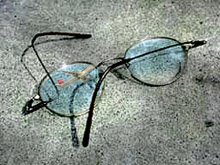
These aren’t mine, either, but they don’t look much worse than mine.
After all that, the answer is pretty simple–I take the glasses to a shop in the mall tomorrow and have them fix it with professional tools. It meant no reading tonight. That was a big departure.
What I found interesting was the problem-solving process. It followed so many other problem-solving steps: first, astonishment at how the damage got so serious. Second, disbelief and anger. Even a flash of “why does this kind of thing have to happen to me when I am about to teach at an important out-of-town client?” This was starting to look like a personality test more than a decision what to do with broken glasses.
Finally, a solution based on mistakes made in the past. Don’t try things without the tools you need if you don’t have the time or replacement pieces yourself. Leave the delicate work to the people with trained, specialized small-muscle control.
It’s how I approach creative problems, too. First a bit of panic, anger, and crankiness that I ruined a piece. Maybe a flash of inner critic telling me that other artists don’t make these mistakes. Then the recognition that I have the tools and the ability, but I have to use past mistakes to make the current piece I’m working on come to a satisfying conclusion.
That means admitting to past mistakes, figuring out what worked well and what did not, and repeat the thinking that brings out a simple, elegant solution. A creative lesson in a pair of bent glasses frames. Not such a bad price to pay.
–-Quinn McDonald is glad she learned touch-typing at an early age, as she can’t see what she’s typing.
Filed under: In My Life Tagged: learning from mistakes, making mistakes, problem solving


April 12, 2014
Saturday Creative Clip (Apr.12.14)
This Saturday, we are taking a look at paper artists who do precise and interesting work. Meg Hitchock creates collages that capture sacred texts by cutting up other sacred texts.
 “Art is the true religion,” Meg said in an interview on the Daily Art Muse. The piece above is made of individual letters cut out of the Bible, Koran, and Kabbalah.

Detail of the above piece.
Details of the winding type that makes up the page. The Brooklyn artists says, (via the bio on her website):
“In my series Mantras & Meditations, I examine and deconstruct the word of God as interpreted through the world religions. I select passages from holy books and cut the letters from one passage to form the text of another. For example, I may cut up a passage from the Old Testament of the Bible and reassemble it as a passage from the Bhagavad Gita, or I may use type from the Torah to recreate an ancient Tantric text. A continuous line of text forms the words and sentences in a run-on manner, without spaces or punctuation, creating a visual mantra of devotion.”
The patience it must take to create these pieces is astonishing. So are the results.
Rogan Brown cuts images from paper. Another work of patience and precision. His work comes from the natural world. Below is the 2013 work, “Kernel.”
 Brown is fascinated with both repetitive patterns and scales that vary, “from the microscopic to the macroscopic, from individual cells to large scale geological formations.”

“Swirl” © Rogan Brown
His individual works take months to creative.
Annie Vought cuts paper letters. Not one at a time, but she cuts epistolary art–whole letters, written in the fast-vanishing penmanship, and cut out.

Image from: http://inthemake.com/annie-vought/
“I believe handwritten records are fragments of individual histories… A letter is physical confirmation of who we were at the moment it was written, or all we have left of a person or a period of time.” –Annie Vought. She also uses texts, letters, and emails she has received to make her art.
Have a creative weekend!
–Quinn McDonald admires thepatience and vision of paper artists
Filed under: Links, resources, idea boosts Tagged: collage, cut paper, paper artists 

April 10, 2014
Being Yourself
We want to work like a CEO, delegate like the managing partner of a law firm, produce wonderful art like whoever is popular right now and smile like a Orbits chewing gum commercial.
 We rarely want to be just like ourselves. Flawed, working hard, trying to be better is wonderful. It keeps us busy and mindful of change. But when we always aspire to be better, smarter, cooler, and other-than-us, we don’t get to be ourselves very much.
“Sometimes you have to play a long time to be able to play like yourself,” Miles Davis said.
It takes time to discover all the parts of you, sort them out, and make something of them. The best way to do that is to focus on the parts of you, instead of comparing the parts to someone else and falling short. Focusing on the you that exists already helps you discover who you are, what you like, what you want to do with your talent. Comparing yourself to others shows you what you are not, what you lack.
And lack is the home of the inner critic. Bring out The Assembler of the Pieces of You as an inner hero and celebrate all the parts of you that are marvelous.
–Quinn McDonald is the author of The Inner Hero Creative Art Journal. She’s happy she wrote the book. It’s not a fast-riser on the New York Times best-seller list, but the reviews on amazon.com are amazingly thoughtful. People are being themselves when they comment. Nothing could be better.
Filed under: Coaching, Inner Critic, Inner Hero/Inner Critic Tagged: being who you are, creativity coaching, Inner Hero Art Journal


April 9, 2014
The (Almost) Lost Art of Polite
Leaving the bank, I sensed someone behind me. I walked through the heavy door, then held it open for an elderly man who was slowly making his way toward the door. “I’m not helpless,” he groused. “Of course not,” I replied, “I’m just being polite.”
 Polite isn’t popular anymore. A friend who observed by husband opening the car door for me, as he has for decades, sniffed, “Are you so weak you can’t open that door yourself?” If my husband didn’t have the keylock, I would have reached across and unlocked his door for him, too.
It’s kind to help people who have mobility issues, but the small acts that make up being polite are truly an art that makes the world a bit shinier and easier to manage.
Polite is hard to explain to small children. They stare at the handicapped, ask intrusive questions, and are sticklers for the “truth” as they see it. If we are lucky, they get socialized and develop the habit of being polite. But it’s slipping away, faster and faster.
When I bump into anything–even inanimate objects, I say, “Excuse me,” or “I’m sorry,” as a force of habit. A teen looked at me in the grocery store when I apologized to a grocery cart and muttered, “Dude, it’s like a thing! It can’t hear you.” True. But it might have been a person.
I let pregnant women ahead of me in line because I remember what it felt like to stand on swollen feet. When I was in D.C. two weeks ago, no one looked up from the seats clearly marked “for Senior Citizens and the handicapped,” and I did not have the nerve to pull out their headphones so I could ask for the seat. Why not? Because I didn’t think they would move.
Being polite means saying that an ugly baby is adorable, sending thank-you cards, and attending funerals of people you don’t know well. It’s saying “thank you” to a cashier who isn’t polite. Not walking three abreast down a sidewalk and forcing other people to step into the street. If you are a bicyclist, it’s stopping at signs and lights instead of blowing through them or yelling “on your left” when someone is using the sidewalk for walking, then passing them at top speed, just nipping their elbow.
Polite is not throwing your co-working under the bus just because you can and no one will stand up to you. Bring back polite, and the whole concept of bullying shrinks and vanishes. Best of all, it doesn’t cost a thing and takes little effort.
-–Quinn McDonald still says “you’re welcome” when someone says, “thank you.” She doesn’t want them to think for a minute that they might have been a problem.
Image: LAmag.com
Filed under: Creativity, In My Life, Opinion Tagged: being polite, manners


April 8, 2014
The New Logo
We outgrow our clothes, we suddenly like a different color palette, our hair and shoes change. The time has come to change my logo and the business cards I still use. (Turns out that in a digital age, a business card is a good reminder of who it is we’ve met and what they do.)
I value companies that never change their logos. And for big companies, it is important to retain a corporate image to keep their brand recognition high.
 The logo above is what I’ve been using for the last five years. Now that QuinnCreative is growing into a new direction, it’s time for some changes. (I am bringing creativity and innovation back into the corporate world. In a time where innovation and change are major themes, creativity is a necessity, not a nice extra.)
I will always use pencils, and love them. When you own the company, you depend on name recognition, and I needed a card with my full name on the front. To make it easy for people to remember who I am. QuinnCreative will always be the name of the company, but to find the book on amazon.com you have to know my last name is McDonald.
I wanted an identity that was clean, simple and strong. So I turned to Michael Noyes, an old friend, graphic designer and calligrapher to develop a theme. We looked at several typefaces, and I wanted one with a well-developed “Q.” One of them looked like a computer on/off button, and Michael used it to create my new logotype:
 It will replace the pencil point on my website, blog, Twitter, Facebook, and other social media. The front of the business card:
 For some people, it will be important to know I’m a writer. Michael created a “tool kit” card that showed all the numbers, letters and punctuation marks–my tool kit.
 Both card backs have my contact information on them.
So what do you think of the new image?
-–Quinn McDonald combines words and color in collage and helps people thrive through change.
Filed under: Coaching, Creativity, The Writing Life Tagged: creativity coach, logo, logotype, QuinnCreative


April 7, 2014
You Do Have a Choice–and it’s Yours
“I didn’t have a choice.” It’s something I hear all the time, particularly in TV shows and on Facebook, as a shrug to the inevitable. Yet the person then makes some sort of choice.

Image from Favething.com
We all have choices all the time. Good choices, not-so-good choices, really bad choices. All ours to own. All ours to make, evaluate and love. Or correct. Even if you think, “the other thing isn’t really a choice,” the other choice is a thing to reject, and that makes choosing easier. Without a bad choice, there can’t be a good choice.
Owning your choice is another important step. For the past week, I haven’t walked. Walking conflicted with early-morning classes, and my stalling in getting out of the house. Big mistake. If I don’t walk early, I don’t walk. Life begins to whiz by, calls need to be answered, and walking gets pushed later and later until it’s the time of day where I’m too tired to walk. That’s a choice I make.
Choice is based on priority–what is important, what is on deadline, what needs to be done. The choice you make today may not be the same one as tomorrow. That’s fine. Situations change. But even between a rock and a hard place, there is a choice. Don’t hand your choice over with a shrug and a helpless feeling. Even a bad choice is a learning experience worth living through.
-–Quinn McDonald is going back to walking. Her brains seem to be connected to her feet.
Filed under: Coaching, Creativity, Inner Hero/Inner Critic Tagged: creativity coaching, decision making, responsibility


April 5, 2014
Making it Mine
When I take a class, I follow the same rule that Cooking Man does when he experiments with a new recipe. First, do it exactly the way the recipe says to do it, even if you have a better idea. Once you have tasted it, you can make changes that make sense to you. But unless you follow instructions first, you will not be sure of what went wrong. Or right.
In the collage class I took, we received clear, explicit directions. I followed them as I heard them. Then, when the class was over, I went into the studio and made the information mine and made collages using the information, but making it with my esthetic.
Here are three collages I made in class:
 We were told to cut five figures. I interpreted this as figurative, although they were supposed to be random. After we pasted them down, an additional step was to add five more, using different colors. Because I had made a figurative piece, the result was quite busy.
 This was the homework piece. We were to create a collage titled “tree” using only items found in our kitchens. This posed an interesting problem, as I was staying in a hotel. I used a paper grocery bag, a coffee filter (using the pleated seam) and a Lipton tea bag to create the leaves. I cut the bag to size and had a large seam right through the middle. That didn’t work for me visually, so I cut two more pieces (OK, tore them with a straight edge) and placed one over the seam and another near the bottom to create balance.
 Using the works of Robert Motherwell, we were to take the idea of the piece and create our own faux-Motherwell. I wanted to use a limited palate, and fretted a lot about the lines (and my old nemesis, the straight line). If the first piece was too busy, this one was a bit spare, but I can live with spare.
Once I got home, I wanted to explore the idea of the bird in the first image, rather than the whole, busy composition.
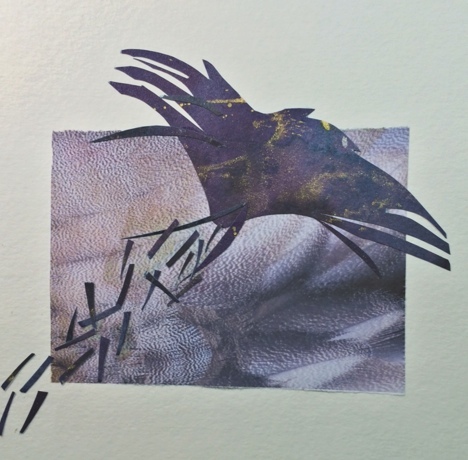 Using a photograph of bird feathers from art quilter and book contributor Diane Becka, and a piece of Monsoon Paper, I created a different kind of collage.
 The original figure in the busy collage intrigued me. I wanted to explore it some more. So I created a collage using both the figure and the piece I cut out of the figure, leaving the meaning to be interpreted by the viewer.
 I can see this idea developing into a series, so I did another, also on Monsoon Paper. This is called “Shadow.” I’m liking this enough to create a serious series of figures under the Moon and Sun.
–-Quinn McDonald is exploring Monsoon Papers and collage. She’s a writer, but these have, as yet, no words to go with them. Visual literacy is its own kind of vocabulary.
Filed under: Art in Progress, Journal Pages, Links, resources, idea boosts Tagged: collage, creativity coach, making your own art, originality


Taking a Collage Class from David Addix
Every artist should take art classes; every teacher should take classes, too. I did both this week by taking David Adix’s fun and interesting collage class in Tucson.

Adix shows a basket made of found pieces of wire and metal.
David is a collage and assemblage artist, and he brought a lot of his work for us to see. I was absolutely taken by his assemblage “Chancel,” and his sculpture of a human figure made of telephone wire. (Take a peek at his website and the process video to see more of his work.)
He started class by leading us through seven warm-up exercises, each one exploring an aspect of collage: positive and negative space, torn and cut paper, color, and composition. I found myself wanting to follow directions more than do something that was pleasing to my aesthetic. That was a surprise. I also followed directions too strictly–David said move out of your color comfort zone and I moved so far I had no idea what to do with the colors I chose. Lesson learned: it’s fine to explore beyond your comfort zone, but if you move into a zip code with colors you loathe, you won’t make art, you’ll feel you visited cruel and unusual punishment on yourself.
 A fun exercise was to create our own table name tags using only torn letters. The two “Ns” at the end of my name always leads to scrutiny when I do table tents, so I used an upper case and lower case. Doing anything with people’s names is a smart idea–people have given a lot of thought to their names and are familiar with them. Great place to start.
 In this exercise, we studied deliberate and random elements. Cutting up the colored strips and letting them fall created an eye-pleasing result.
After a lot of interesting challenges and some deep work, we spent most of the second day doing design work. My favorite segment was creating a spatial design out of our initials–we could rotate them, make them upper- or lower-case, and any size relationship. The only rules were cutting them out of black paper and arranging them on an envelope we had previously glued down. We then added a color to one of the negative spaces.

From left to right, the letters are LKP, PKM, and QCM.
The variety of the results was wonderful and inventive.
 The work, lined up against a wall, looked ready for an exhibition.
This class was not only time well spent, it was challenging, interesting and a perfect break in a hectic schedule. Thanks, David!
--Quinn McDonald is returning to collage as her art medium. And she’s doing it with more information and learning.
Filed under: Art in Progress, Links, resources, idea boosts Tagged: art classes, artist in Tucson, collage, David Adix, learning art


April 3, 2014
Reading and the Clean Plate Club
If you had parents who grew up in the Depression, or went through other hardships, you remember the “Clean Plate Club.” You cleaned up your plate at every meal. Hungry or not, you ate. You finished your meal.  Somehow, I translated that to reading books.
I find it almost impossible to abandon a book I’ve started, no matter how unsatisfactory. I keep reading, even when the plot is weak, the characters uninteresting, or the premise vague. There is no good reason I do this. But I do.
I just finished an audiobook, and when the female protagonist (a flighty, timid, weak soul who is always “rooted to the spot in fear,” “numb with indecision,” or ”quavering with hesitant hope”) gets into yet another scrape, I begin to root for the villain to do her in. When the writing is weak, I keep hoping for a change.
Maybe the next chapter will pick up. At some point, I should know better. It’s not patience, it’s not tolerance. It is a good lesson in the difference between patience and endurance.
There comes a time in every situation when the excuses are used up, the reasons for staying the course unclear. That’s the time to stop listening, stop eating, and look for another source of satisfaction. If satisfaction is not found in what you are dealing with, it time to stack the plate, put the CD back in the case, and start the search for more satisfaction.
–Quinn Mcdonald has moved on to another book. A far better one.
Filed under: Book Reviews, Creativity, Life as Metaphor Tagged: abandoned books, life lessons, reading


April 2, 2014
Reading Isn’t Believing
As a blog omnivore, I read a lot of advice, thoughts, and beliefs of other writers and artists. It’s a big world, populated by writers of every emotional and spiritual stripe (and rant).
 The last two days, I’ve been reading about other people’s success stories about blogging and book promoting. (I have a tendency to read about what’s on my plate). Interesting what happens in my brain (maybe yours, too) when we read something new that we don’t agree with. The other person must be smarter. Particularly if we don’t know them. Because no matter what our experience is, surely the other person is smarter, richer, wiser, and a better all-around human being. (Inner critic alert).
I’m amazed at my own gullibility. “Content is no longer king,” says one blogger, and I gobble up his article, afraid that one of my basic truths has vanished. “The reader is king!” he proudly proclaims, “content doesn’t really matter.” Oh. And what is King Reader reading? Content. And why will King Reader read the content? Because it is interesting to King Reader. So, finish the circle, content is still king.
“If you are still doing book signings, you are over 60 and a dinosaur,” says another blogger. Her idea is that everything is virtual, and social networking is the only action that sells books.
I don’t think so. I’m pretty sure people buy books for lots of reasons, and a good reason is to meet the person who wrote it and talk to them if they are available. And that means I want to make myself available. Because people who are satisfied tell others. (Not as many as people who are unsatisfied, which is motivation enough.) But can’t I do both? The Inner Hero book had two launches (one in California and one locally in Phoenix) and is having a fun run on several people’s blogs.
Before you believe everything you read (I call this “the last person I talked to is an expert” syndrome) run it through your value-meter. I’ve been writing for a long time, and content matters. If an article is cheap starchy filler, I leave faster than a barefoot pedestrian crosses a freshly-tarred street.
 My value-meter knows that meeting people face to face and hearing their stories is what made me write my book in the first place. I heard so many people say, “I’m not really good at anything” while hungering to make meaning in life, it was impossible for me not to write the book.
Of course, I also learn a lot from reading blogs. I’m happy to explore new ideas, and I’m a big fan of change. But change for change’s sake rarely sticks. Change is fueled by current failure, pain, or general misery. What makes change possible is that the current plan isn’t working.
What works for someone else might not work for me. And if it doesn’t match what I know to be true from my own life, it’s probably not true for me. My life is a big circle, and I invite a lot of people in. But it doesn’t mean I have to follow them around in circles.
–Quinn McDonald is a writer, life- and creativity coach whose coaching practice is based on working with deeply-held values and, well, change.
Filed under: Coaching, Creativity, The Writing Life Tagged: believing what you read, change, creativity coaching, Opinion