
Quinn McDonald's Blog, page 45
February 21, 2014
Creative Jaunt
Anila Quayayum Agha is a photograph with a big shadow. And a big dream. Agha is an artist with a political bent and looks for “truth” in her artwork.
 She created a 6-1/2-foot cube (2 meters) and pierced it with geometric patterns that represent various religions and cultures. Then she illuminated the inside of the cube, allowing it to through 35-foot shadows. “This project is meant to uncover the contradictory nature of all intersections; which are simultaneously boundaries and also points of meeting,” Agha explains.
Nature is the artist in this next photo.
 You are looking at Yellowstone National Park’s Grand Prismatic Spring. Google Earth is both an encyclopedia and a great way to get a view from on top that we would never otherwise notice. There are 49 more amazing sites here, each one with a GPS location. You can cut and paste the numbers into Google Earth, and you’ll see the same wonders and weirdnesses in the world.
Have a creative weekend!
Quinn McDonald is packing to film a DVD. She’s not worried about what to wear, but she is amassing what projects to show.
Filed under: Links, resources, idea boosts Tagged: earth, light, shadow, yellowstone


February 19, 2014
Another Book Launch
Tonight and 7 p.m., for the second time in three years, I’ll launch a book at Changing Hands independent book store. Yes, I did a book signing at CHA in Anaheim. But doing the first signing in your own town is the real launching of any book. Two of the contributors, Traci Paxton Johnson and Rosaland Hannibal with be with me to help people find their inner hero and to sign the books.
 The Inner Hero Creative Art Journal is ready to go out in the world and stand on its own. I’m proud of it, and proud that I finished it. Several times while writing it, I didn’t think I had the courage to say the things I wanted to say.
Tomorrow night, I might feel that same fear. Just because you write about the inner critic doesn’t mean you got over your own. I just got to know him better.
But here is what I do know: without the encouraging, brave, funny, and imaginative group of people who read this blog, leave encouraging comments and help me solve problems, there wouldn’t have been a book. So to all of you who stop by here–thank you so very much for supporting my inner heroes.
If you live in the Phoenix area, stop by Changing Hands at 7 p.m. tonight. There will be chocolate chip cookies for snack lovers and seedy bars for diabetics and gluten-free patrons, fruit spears for vegans, too. Changing Hands is on the Northwest corner of Guadalupe and McClintock in Tempe.
We’re going to do fun exercises to call out our inner heroes. Original art from the book will be there, too. I’m so happy I finished the book. Because it’s a whole new beginning for outsider art and courage.
—Quinn McDonald never imagined there would be people stopping by to chat every day. She’s glad for the company. Writing can be lonely.
Filed under: Inner Hero/Inner Critic Tagged: creativity coach, Inner Hero Art Journal


February 18, 2014
Book Review: No Excuses Art Journaling
And yes, there is a giveaway of a signed book. But first, about the book.
Before I met Gina Rossi Armfield, her book, No Excuses Art Journaling, had me hooked. After I met her at CHA (Craft and Hobby Association Convention in Anaheim), I felt I’d met someone I’d known for a long time and crossed paths with again. She’s warm and happy to share her ideas. Over dinner, I got hooked on her style of art journaling and am having a lot of fun doing a “No-Excuses” journal of my own.

Cover of the No Excuses Art Journal.
Her book is a flat-out, ingenious way to journal. There are easy step-by-step instructions. Take a book-size calendar, weekly preferable. Convert the datebook into a journal by adding the journaling program (a free download) by taping it into the datebook. Add envelopes in each month, to store snippets you will want to use as you go along.
Gina also gives you monthly theme pages with quotes, ideas and prompts to put in the calendar for each month. You then add watercolor paper so you can draw, collage or paint, as you decide.
That’s just the beginning. Each month has a theme, there are tasks for each week. Feeling overwhelmed? No need. She just wants to make sure you aren’t bored. You can do as much or as little as you want.

I decided to use a watercolor sketch book and added sticky-note weekly calendar pages. This page shows some envelopes I made to hold painted leaves and feathers.
To help you stay interested, she teaches you some techniques: how to carve your own rubber stamp, how to create collages, how to do contour drawings (so you can create sketches, which you also learn.

Jennifer Joanou’s pages on seasons.
There are hints to work with photo strips, the color of the day, getting in touch with your emotions and drawing the weather. Just when you think you are going to pop if you don’t grab a journal and get started, she gives examples of her own and from guest artists like Jenny Doh, Jennifer Joanou, Traci Lyn Huskamp, LK Ludwig, Susan Elliott–one for each month of the year.
[image error]
“Nice Pair” watercolor marker and Gelli plate collage. © Quinn McDonald, 2014
Each artist chose a color palette to work with and answered a set of interview questions. You get an intimate look at each included artist and a view of their interpretation of the assignments.
The book is cheerful and peripatetic. You will want to use it as a reference, as a guide, as an inspiration.
Gina has offered to sign a book as a giveaway. Leave a comment, letting me know why her book would help you, and I’ll have a random drawing. Winner will be announced on Sunday–make sure you check in to see if you won.
This book will show you a fresh new way to create a fat, interesting journal while exploring your own seasons and landscapes. Oh, and Gina’s giving away the Inner Hero book today, too.
Quinn McDonald loves to read other artist’s journaling ideas.
Filed under: Book Reviews, Book Reviews, Journal Pages, Links, resources, idea boosts Tagged: art journaling, art journaling inspiration, No Excuses journaling


February 17, 2014
Aging Out. . .
How I know I am getting old:
 1. I RSVP when asked to. I can’t understand why you don’t. What part of Respondez, s’il vous plait do you not understand?
2. Don’t leave a voice mail? I won’t phone you back. I know your number is in my “recent” file. But you could have butt dialed by accident. If you leave a message, I know what you want and will phone you back with an update, not a “so why did you call?”
3. If I send you three times we can meet and you do not reply, I will book others into the spots. If you are surprised that I didn’t hold all spots for you until you make up your mind, you are too young to understand the practicality of time management.
4. If you think posting to my timeline on Facebook is a way to communicate with me about an important, personal subject, we need to talk. Talking is something old people do before texting and tweeting.
5. The answer to “Thank You” is “You’re Welcome.” Not, “No Problem,” because that means you thought I was going to be a problem and you grudgingly changed your mind but had to let me know I was a potential problem.
 6. I do not understand, nor care to, the word “Juicy” stitched in bright pink, bold letters, with glitter, across your butt on your too-tight leggings. Whether you are a size double zero or a 2X, I’ve worked really hard on feminist issues like equal pay and you are turning back the clock on my hard work on your behalf.
—Quinn McDonald is beginning to think about the “good old days” and muttering “git off my lawn” at kids.
Filed under: In My Life Tagged: fashion gone wrong, getting older, manners


February 16, 2014
The Pull of Inner Critic and Inner Hero
It’s hard to admit that after writing the Inner Hero book, I’m still bedeviled by my Inner Critic. People expect me to be over it by now. Sadly, not. I’ll have to face down my Inner Critic many times in the coming years. If I’m lucky, I’ll get good at facing him down. Why won’t he go away? Because I’ve got faults, and he’s an expert at noticing them, showing them to me, and then helping me believe I am that fault, and am helpless in the face of it. Oh, and while I’m worthless, I might as well destroy all my art, too. And toss in the writing for good measure.
Which brings me to something I said in the comments yesterday, and which keeps coming up with my creativity coaching clients: Your faults are your strengths turned up too loud.
Image from The Music Ninja.
Turn up your favorite music too loud and your sternum shakes and all you can hear is a base beat and distorted sound. You can’t make sense of it. You just want to get away from it. It’s not music, it’s ear-splitting noise.
Your strengths and faults work in much the same way. Let’s say a strength is a good sense of humor. Great. Helps you get through the tough patches in life, helps you not take yourself so seriously, helps you be easy on yourself as you make learning mistakes.
Turn up that sense of humor too loud and it is easy to be insensitive, even obnoxious. Your friends can’t hear you making life easier, all they can hear is the jarring noise of not-caring.

Image from InnerFidelity.com
Maybe your strength is teaching others life skills. Wonderful. Your guidance helps people find what skill they need to work on, focus on it, practice it while you help them see and avoid the pitfalls until they get good at the skill.
Turn that up too loud and you are micro-managing, pointing to all they do wrong, insisting on your way as the only way to to be “right,” suffocating any ability to learn by making mistakes. Too much advice, and they lose the freedom of making their own choices and learning from the results.
I often ask my creativity coaching clients to make two lists: three characteristics you are really proud of, that you are good at. The second list is three characteristics of faults you have. Failings you feel bad about. (Just three, not 10). Now compare them. Almost always, the client sees how the fine characteristic can get too big, too loud, too jarring, and turn into a fault.
Still, faults need to be worked on. We can’t just say, “well, that’s my authentic self, it’s the me you get, like it or not,” and continue on our way, pleased that we are being”real.” Our authentic self is our self-realized self. Flawed, but aware and working on it.
When we pull our out faults by the roots, we also pull out the very ability that is a strength. Best not to try too hard to discard those faults, they contain the possibility of change. Instead, try dialing them back until they talk to you, sound resonant and useful. That’s your Inner Hero, holding the space where you do good work.
* * * This week is the local launch of The Inner Hero Creative Art Journal. (If you are in the Phoenix area, it’s at Changing Hands independent book store on Thursday, Feb. 20 at 7 p.m. Bring a pen, we’re going on an Inner Hero hunt!)
Note: Congratulations to Jeff (@fernseeds), winner of Get It Done by Sam Bennett. Congratulations, Jeff! Send me a note at QuinnCreative [at] Yahoo [dot] com with your mailing address and the book will be on the way!
–Quinn McDonald is busy turning down the volume so she can hear the Inner Hero better.
Filed under: Coaching, Creativity, Inner Critic, Inner Hero/Inner Critic Tagged: inner critic, inner hero, inner hero creative art journal, overcoming the inner critic


February 15, 2014
Leading With the Left Hand
A comment on the last blog reminded me of something and that led to another jump and. . .a blog post.
I’m left-handed. Born that way. In a time when being left-handed was not acceptable. As was quite common in the years when I was growing up, my mother took the pen from my left hand and put it in my right hand. There were some shaming words that accompanied it. In seventh grade, it became Sister Michael Augustine’s goal to turn me into a right-hander. Skip forward several decades.
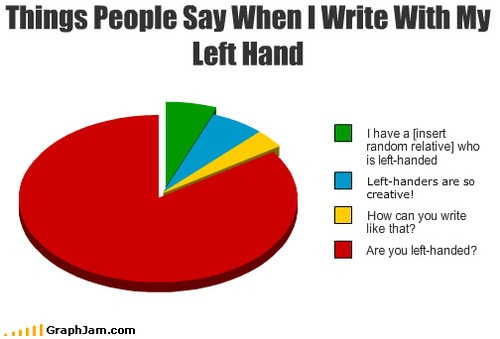 I’m still left-handed. But I write right-handed. Except when I write on a flip chart of white board–a task I took up as an adult. And I write on flip charts and white boards left-handed. Unapologetically.
Part of what I learned as a left-handed person is that I was not good enough, and that I was flawed. To prove to others (and, of course, myself) that I was good enough, I fell into the habit of overwork. Now that I own my own business, it looks great to work hard. A 70-hour week is one in which I’m coasting.
Today, when I came home from teaching a fun class, I was exhausted. It was warm out, and instead of sitting down for a few minutes, I assessed the yard work that had to be done and began to fret about the DVD project which has to be planned. Samples made. Projects half-made to save time on the set.
The only one who can slow me down is . . . me. Taking a break feels exactly like being lazy. So I sat down with my Inner Hero called “Left-Hand” (I’m not one for fancy names) and did some artwork. Listened to what she had to say. Did not talk back. Here’s what she said:
“There will never be less work. When there is too much work, you worry. When there is not enough work, you make more work and worry more. So just for tonight, close the computer, grab those art books you want to read, and put your feet up. No one will do the work for you. It will still be there tomorrow. But you will be rested. And bolder. And begin to think with your left-hand first. Because that is the sign of bravery for you.”
Good idea. How will you free yourself from destructive noodling and step into a healthier mindset today?
—Quinn McDonald has nut bread in the oven and a DVD ready to run.
Filed under: Coaching, Inner Critic, Inner Hero/Inner Critic, Recovering Perfectionists Tagged: creativity coach, Inner Hero Art Journal, seeking the inner hero


February 13, 2014
Get It Done: Book Review (and a Giveaway)
What better day than Valentine’s Day to love yourself enough to give yourself the creative help you need to finish your work? Creative people are wired differently and see the world a bit differently–but the one thing they have in common with every other person is a lack of time to work on projects that are due, projects that sound like fun, and projects that need to be explored.
 Sam Bennett created the Organized Artist Company and she wrote a book that is part coaching, part time management, and part kick in the butt. Get It Done, from Procrastination to Creative Genius in 15 Minutes a Day is a book with suggestions, how-tos, and clever ideas to help anyone (but especially artists) choose their work, get their work done in a time frame (by working 15 concentrated minutes a day), and complete their work.
Here’s are some chapter titles:
Procrastination is Genius in Disguise
Which of Your 37 Projects to Tackle First
Overcoming Perfectionism
How to Do Your Could-Do List
Where Will You Find the Time?
Organizing Your Space
Why Is It So Awful When Everyone Thinks You are So Wonderful?
Do You Quit When You’re Almost Done?
When you read Bennett’s book, you know she is an artist, has been in your shoes, and can teach you how to dance in them–backwards–to success. Her worksheets are realistic, her steps doable and her process powerful.
 The book is a fast read but one you will want to concentrate on to overcome perfectionism and the destructive procrastination that goes hand-in-hand with it. She’s knows art is important to culture, supports the necessity for excellent work, but won’t let you ruin your success with senselessly chasing perfection.
It’s 204 pages that are packed with good advice, success stories, and real help.
I’ll be giving away this copy. so leave a comment for a chance to win. The drawing will be random. And the winner will be announced on Monday’s blog. Stop by and see if you were the lucky one!
–Quinn McDonald is a creativity coach who will be using some of the ideas in this book in combination with the ideas in The Inner Hero Creative Art Journal.
Filed under: Book Reviews, Coaching, Creativity, Inner Critic, Recovering Perfectionists Tagged: creative work, creativity coaching, getting your work down, inner critic, Sam Bennett


February 11, 2014
The Powerful Placebo of Creativity
Say the word placebo and people’s noses wrinkle up. A placebo is a pill that doesn’t do anything, doesn’t cure anything, contains no drugs. And yet, between 35 percent and 75 percent of people who are given placebos experience the same cure as people in the group that were given the real drug. If the doctor who hands out a placebo is optimistic and assures the patient the pill is the real thing, the cure rate is on the higher side of the statistics.
How do placebos work? They trigger the powerful body-mind connection we all have. They give the mind permission to do the healing work, and the body follows along. Not bad for a blank pill.
When I do book signings, I sometimes ask the people in the audience to make permission slips. I bring blank watercolor postcards, pens, colored pencils, markers, and glitter glue. As we make permission slips, I encourage people to give themselves permission to be creative, to let the housework slide, to take time to daydream.
Some people ask me to sign the slip. I encourage them to sign their own slip, as each person needs to give him- or herself permission to let go of their old beliefs. The Inner Hero is not a new person–it’s the authentic you, the person you wish you might be someday. But you already are, but have trouble admitting it. Heroes have a lot of responsibility.
Occasionally, I do sign the permission slip. I look the person in the eye and say, “This is powerful, and you have to work an hour every day to make it work.” I’ve begun to hear back from people, who have discovered that their permission slip has power.
Like a placebo, the permission slip takes away excuses and replaces it with possibility. The chance that ideas will come, that creativity will flicker and catch pushes reluctance aside, and leaves space for acting as an Inner Hero. When success gets breathing room, it expands. The people who write me to say their permission slip worked–they always were creative. What they needed was the permission to believe it and act on it.
What would you like to take a pill for if it gave you what you were hoping for?
--Quinn McDonald is the author of The Inner Hero Creative Art Journal. She will be signing books and encouraging people to discover their Inner Hero on February 20 at Changing Hands bookstore in Tempe, Arizona. 7 p.m. Come join in!
Filed under: Inner Critic, Inner Hero/Inner Critic Tagged: creative placebo, creativity coaching, Inner Hero Art Journal


February 10, 2014
We’re all Stitchers
In art, all materials are grist for the mill. When I was at SAS Fabric Superstore the other day, I saw some sage burlap and decided it had potential. I’ve seen over-dyed pink and yellow burlap, but the sage color was new, so it came back to the studio.
Tonight, I decided to work with it–no expectations, no project in mind. Just working to see what I can do with it, using what I know how to do.
 Digging through my stash, I found some thread and some embroidery floss that worked well with the burlap. I cut a piece about 10 inches by 4 inches. To make the edges even, I pulled some of the woven threads out to create a fringed edge. Eventually, the edge will have to be sewn so it won’t unravel, but that’s not now.
 Threading the blue embroidery thread, I followed a thread across the fabric, weaving under and over, adding a thread to the loose weave. It’s quite easy.
Another piece of embroidery thread is run through, this one is joined with a piece of orange thread. The blue thread was put in first. Then I used a double thread and wove it on either side of the blue. Because the space is getting filled, I pull out a burlap thread to make room for the weaving.
I continued doing this, making sure that I don’t try to do very precise patterns, because burlap isn’t a precise materials.
 To give the piece more interest and a less stripey look, I pull some pearl cotton mixed with orange thread through in the other direction. I love this look, because it has a lot of potential. It’s geometric, and fun.
We are all weavers of our own lives. Our lives are seldom tightly woven, complete when we get them. And if they are, they fray and wear, until there are holes in them. Older folks remember the darning egg. We dropped it into a sock or elbow of a sweater and carefully wove back and forth, weaving from the edges to the center until the fabric was whole again. The patch would show, but that was all right. It was wearable. That’s what we do with lives. Take what we have and mend it to cover the bare spots. Or use a needle and decorative memories to make the loose weave pretty.
This might be a journal cover. Or just a reminder of a life that’s still loose enough to be decorated.
As always, I’m open to all clever suggestions.
–Quinn McDonald is having fun with non-paper materials. She’s astonished at herself.
Filed under: Art in Progress, Life as Metaphor Tagged: burlap, creativity coaching, weaving life, weaving stories, wip


February 9, 2014
Philip Seymour Hoffman and Risking It
The clamor has died down about the drug overdose of Philip Seymour Hoffman. The fact that keeps repeating in my head is that he was clean for 23 years and then, in 2012, began taking pain pills and then more.
 The risk of every recovering alcoholic, drug addict, or person who controls a restricted diet through willpower is a single motion of hand to mouth. A single drink, a quick pill, a forbidden food can change a life. And the lives around that life. It’s the Butterfly Effect of evil.
It seems trivial, but one of the difficulties of my choice to lose weight and stick to a strict diet is that there is no medicine at hand if I eat something I shouldn’t. My only choice is not to eat the foods I should not. No mistakes allowed. Despite the urgings of friends and strangers with assurances that “everyone needs a little treat,” or “you have to have one day that rules don’t apply,” for me they do.
There is a risk of failure. But there is also the possibility of success. Each day without medication is a day away from the debilitating effects of long-term medication. The trick, of course, is not to put the hand to mouth, filled with the wrong stuff. That’s always the point, isn’t it?
In the distance, I hear the flap of a butterfly’s wing.
—Quinn McDonald’s creative manifesto starts with self-care. It’s less fun than she imagined. On the other hand, she will teach at the Minneapolis Book Center in April.
Filed under: Coaching, Inner Critic Tagged: butterfly effect, creativity coaching, self-care





![[image error]](http://quinncreative.files.wordpress.com/2014/02/gina_rabbit.jpg)