Anne Lyle's Blog, page 17
April 3, 2012
How to tell you’re Elizabethan
Way back in the early days of the internet, one of my favourite sites was Mark Rosenfelder’s Metaverse. Drawn there by the Language Construction Kit, I stayed for the geeky fun, which included a series of “culture tests“. It started with “How to tell you’re American”, but soon expanded to many other nationalities. In the spirit of internet continuity, but mostly because it’s a lot of fun, here’s my Elizabethan version…
If you’re Elizabethan…
You believe in the Divine Right of Kings and the authority of Queen Elizabeth, albeit advised by the lords of the realm and a parliament of commoners (after all, she’s only a woman!).
You’re familiar with Christopher Marlowe, William Shakespeare, Sir Walter Raleigh, Sir Francis Drake, Edward Alleyne, Will Kemp, Robin Hood and King Arthur.
You know how kicking camp and skittles are played. If you’re a member of the upper classes, you may also be able to argue the finer points of cricket or tennis.
You count yourself fortunate if you get Saturday afternoons off work. No-one works on the Lord’s Day.
If you died tonight…
You believe in both God and the Devil, but only those pesky Papists believe in saints.
You think of oysters and beer as cheap food.
Your place might not be heated in the winter and probably has an outdoor privy. You send your laundry to the laundress. You don’t kill your own food, unless you’re a member of the upper classes with a large estate. You might have a dirt floor; even if there are floorboards or tiles, you still put rushes down. You eat at a table, sitting on benches or stools (though the children might have to stand). You don’t consider insects, dogs, cats, monkeys, or guinea pigs to be food.
Between “black” and “white” there are no other races. Someone with one black and one white parent looks black to you (not that you’ve ever seen a black person, unless you live in London).
You respect someone who speaks Latin because they’re better educated than you, but anyone who speaks French–or worse still, Spanish–is probably a spy for the Papists.
You don’t take a strong court system for granted. You know that if you commit treason (or are merely suspected of it) you can legally be tortured, and the sentence if found guilty is to be hanged, drawn and quartered.
School isn’t free, but your nearest town’s grammar school may offer scholarships to bright boys. You can go to university (Oxford or Cambridge) as young as 12, but 15 or 16 is more usual. If you’re a Catholic, you can attend university but not graduate; if you’re a girl and your father is progressive, you might have a private tutor since you’re not allowed to be educated alongside boys.
Everybody knows that
Mustard comes as seeds or powder; milk comes in buckets from the milkmaid
The date cometh first, and may be measured in terms of the current monarch’s reign: xxviij day of July, in the thirtieth year of her glorious Majesty Queen Elizabeth’s reign (and you know what happened on that date).
If a man has sex with another man, he is a sodomite and liable to prosecution (but nobody really worries about that sort of thing unless minors are involved).
If you’re a woman, you don’t go out in public with your hair uncovered unless you’re young and unmarried.
Marriages are made for practical reasons like having a helpmeet and siring an heir; love matches are all very well in plays but they don’t put bread on the table. Only very rich people marry before their twenties, and then only for dynastic reasons.
Marriages are normally conducted in church, although in theory you can just exchange vows before witnesses and then live together
Giving gifts to important people is an accepted way of oiling the wheels of state, not bribery and corruption
Contributions to world civilisation
You’ve given the world Shakespeare – what more does it want? (although you prefer the city comedies of Middleton, Dekker and Jonson).
Your navy is the envy of Europe, although mostly the other countries accuse your captains of being nothing more than pirates.
The Queen’s father invented the Church of England and her brother turned it into a thoroughly Protestant sect, though not as extreme as those strange fellows in Switzerland and Germany.
You’re the only country in Europe ruled by a woman, which also puzzles the foreigners. The Pope has declared her a heretic, which only makes you hate Catholics all the more.
Your capital, London, is the largest city in northern Europe and one of the fastest growing.
Your country hasn’t been conquered by a foreign nation for over five hundred years.
There are no police, only poorly paid, elderly watchmen who patrol the streets after curfew. If you’re a man, you carry a weapon for self-defence, most likely a cudgel (a stout stick about three feet long) or a dagger, or both. If rich, you might wear a rapier, but if the blade is more than forty inches long the city guards will break off the excess before allowing you into London. Of course you can always bribe them not to…
The biggest meal of the day is dinner, eaten around noon (or a bit later if you’re upper class).
If a woman is plumper than average, it doesn’t harm her looks. But gentlemen definitely prefer blondes – or redheads like the Queen. Only peasants have suntans.
Outside London
You’re probably a farmer; if not, you’re a shopkeeper or artisan.
You care very much which family someone comes from, although it’s possible for a clever man of humble birth to rise to the highest (non-royal) offices in the land.
You’re used to limited choices in what you can buy, and you probably make a lot of items at home, particularly shirts and underlinens.
If you fall ill, you’re probably safer if you’re poor; the local cunning man or woman knows a lot about herbal cures. Doctors are expensive and as likely to kill as cure you.
The normal thing when a couple dies is for the entire property to go to the eldest son.
You’ve probably never ventured more than a few miles from your home town. Anyone wandering the Queen’s highway without an official warrant can be arrested for vagrancy. If you wanted to travel overseas, you’d need to apply to the Privy Council for a passport.
Travel is horrible anyway; the roads are dreadful, and carriages with proper suspension are a new-fangled foreign idea that hasn’t really caught on yet. If you have to travel and you don’t own a horse, you might resort to hiring one from a livery stable.
Christmas is in the winter; if you’re a Puritan, you don’t celebrate it. There are no Jews, as they were expelled from England in the Middle Ages.
There certainly are a lot of lawyers.


How to tell you're Elizabethan
Way back in the early days of the internet, one of my favourite sites was Mark Rosenfelder's Metaverse. Drawn there by the Language Construction Kit, I stayed for the geeky fun, which included a series of "culture tests". It started with "How to tell you're American", but soon expanded to many other nationalities. In the spirit of internet continuity, but mostly because it's a lot of fun, here's my Elizabethan version…
If you're Elizabethan…
You believe in the Divine Right of Kings and the authority of Queen Elizabeth, albeit advised by the lords of the realm and a parliament of commoners (after all, she's only a woman!).
You're familiar with Christopher Marlowe, William Shakespeare, Sir Walter Raleigh, Sir Francis Drake, Edward Alleyne, Will Kemp, Robin Hood and King Arthur.
You know how kicking camp and skittles are played. If you're a member of the upper classes, you may also be able to argue the finer points of cricket or tennis.
You count yourself fortunate if you get Saturday afternoons off work. No-one works on the Lord's Day.
If you died tonight…
You believe in both God and the Devil, but only those pesky Papists believe in saints.
You think of oysters and beer as cheap food.
Your place might not be heated in the winter and probably has an outdoor privy. You send your laundry to the laundress. You don't kill your own food, unless you're a member of the upper classes with a large estate. You might have a dirt floor; even if there are floorboards or tiles, you still put rushes down. You eat at a table, sitting on benches or stools (though the children might have to stand). You don't consider insects, dogs, cats, monkeys, or guinea pigs to be food.
Between "black" and "white" there are no other races. Someone with one black and one white parent looks black to you (not that you've ever seen a black person, unless you live in London).
You respect someone who speaks Latin because they're better educated than you, but anyone who speaks French–or worse still, Spanish–is probably a spy for the Papists.
You don't take a strong court system for granted. You know that if you commit treason (or are merely suspected of it) you can legally be tortured, and the sentence if found guilty is to be hanged, drawn and quartered.
School isn't free, but your nearest town's grammar school may offer scholarships to bright boys. You can go to university (Oxford or Cambridge) as young as 12, but 15 or 16 is more usual. If you're a Catholic, you can attend university but not graduate; if you're a girl and your father is progressive, you might have a private tutor since you're not allowed to be educated alongside boys.
Everybody knows that
Mustard comes as seeds or powder; milk comes in buckets from the milkmaid
The date cometh first, and may be measured in terms of the current monarch's reign: xxviij day of July, in the thirtieth year of her glorious Majesty Queen Elizabeth's reign (and you know what happened on that date).
If a man has sex with another man, he is a sodomite and liable to prosecution (but nobody really worries about that sort of thing unless minors are involved).
If you're a woman, you don't go out in public with your hair uncovered unless you're young and unmarried.
Marriages are made for practical reasons like having a helpmeet and siring an heir; love matches are all very well in plays but they don't put bread on the table. Only very rich people marry before their twenties, and then only for dynastic reasons.
Marriages are normally conducted in church, although in theory you can just exchange vows before witnesses and then live together
Giving gifts to important people is an accepted way of oiling the wheels of state, not bribery and corruption
Contributions to world civilisation
You've given the world Shakespeare – what more does it want? (although you prefer the city comedies of Middleton, Dekker and Jonson).
Your navy is the envy of Europe, although mostly the other countries accuse your captains of being nothing more than pirates.
The Queen's father invented the Church of England and her brother turned it into a thoroughly Protestant sect, though not as extreme as those strange fellows in Switzerland and Germany.
You're the only country in Europe ruled by a woman, which also puzzles the foreigners. The Pope has declared her a heretic, which only makes you hate Catholics all the more.
Your capital, London, is the largest city in northern Europe and one of the fastest growing.
Your country hasn't been conquered by a foreign nation for over five hundred years.
There are no police, only poorly paid, elderly watchmen who patrol the streets after curfew. If you're a man, you carry a weapon for self-defence, most likely a cudgel (a stout stick about three feet long) or a dagger, or both. If rich, you might wear a rapier, but if the blade is more than forty inches long the city guards will break off the excess before allowing you into London. Of course you can always bribe them not to…
The biggest meal of the day is dinner, eaten around noon (or a bit later if you're upper class).
If a woman is plumper than average, it doesn't harm her looks. But gentlemen definitely prefer blondes – or redheads like the Queen. Only peasants have suntans.
Outside London
You're probably a farmer; if not, you're a shopkeeper or artisan.
You care very much which family someone comes from, although it's possible for a clever man of humble birth to rise to the highest (non-royal) offices in the land.
You're used to limited choices in what you can buy, and you probably make a lot of items at home, particularly shirts and underlinens.
If you fall ill, you're probably safer if you're poor; the local cunning man or woman knows a lot about herbal cures. Doctors are expensive and as likely to kill as cure you.
The normal thing when a couple dies is for the entire property to go to the eldest son.
You've probably never ventured more than a few miles from your home town. Anyone wandering the Queen's highway without an official warrant can be arrested for vagrancy. If you wanted to travel overseas, you'd need to apply to the Privy Council for a passport.
Travel is horrible anyway; the roads are dreadful, and carriages with proper suspension are a new-fangled foreign idea that hasn't really caught on yet. If you have to travel and you don't own a horse, you might resort to hiring one from a livery stable.
Christmas is in the winter; if you're a Puritan, you don't celebrate it. There are no Jews, as they were expelled from England in the Middle Ages.
There certainly are a lot of lawyers.
March 27, 2012
Publication day!
 It's not often you achieve a lifetime goal – I think the last time I could say that, hand on heart, was when I graduated – but today is one of those days. The novel that I laboured over for more than four years has finally gone out into the world, or at least those parts of it that own Kindles or are within reach of my publishers' North American distribution chain.
It's been a funny old day so far. I was warned not to expect anything terribly exciting or life-changing, and to be honest it hasn't been much different from any of the other days in the run-up to release. Some of my friends have congratulated me on Twitter; Lee Harris at Angry Robot showed off a photo of this month's new titles, hot off the presses; and my guest post on John Scalzi's The Big Idea went live. However both paperback and Kindle are now trending upwards on Amazon.com, which is nice (the UK version of Author Central isn't showing any stats for the Kindle edition, so I have no idea how well that's going).
I guess it won't feel quite real until Saturday, when I attend my first signing in Waterstones in Manchester, and then of course there's the official launch party at Heffer's in Cambridge on April 5th (tickets still available if you can make it!). I'll probably have to make a speech at the latter, but in case I have a fit of nerves and fluff my lines:
"A published novel is not the work of one person, even if it is less of a collaborative work than a movie. There's all the editorial, production work and promotion work (handled by the lovely chaps at Angry Robot Books) and of course the beautiful cover art (by Larry Rostant), without which this novel would not be reaching you in such a desirable form. Anyway, thank you, guys, for all the hard work!"
Right, back to outlining The Prince of Lies. These books don't write themselves, more's the pity…
March 24, 2012
Eastercon 2012 schedule
I've been awake since 4am this morning, because I made the mistake of checking my Twitter feed instead of going back to sleep. Not only was the Eastercon schedule announced late last night, but it seems they've put me on a panel with some bloke called George Martin…
Anyway, here's my schedule for the weekend:
Saturday, 11am: How Pseudo Do You Like Your Medieval? with George R R Martin, Anne Perry, Kari Sperring and Jacey Bedford
Saturday, 1pm: reading, followed by book signing
Saturday, 7pm: Worldbuilding (when, how and how much?) with Suzanne Macleod, Robert VS Redick, Simon Spanton and Chris Wooding
Sunday, 11am: The Fantasy of William Shakespeare with Claire Brialey, Jennifer A McGowan, Erin Horakova and Grant Watson
I think after that lot I'll be having a quiet Sunday afternoon in the bar 
March 20, 2012
Homosexuality in Elizabethan England
One of the issues that keeps coming up in reviews of The Alchemist of Souls is my portrayal of the non-straight characters. Readers who know the period praise the authenticity, whilst those who know little about Elizabethan culture seem surprised by it. Rather than comment directly on individual reviews (which seldom reflects well on the writer), I decided to discuss it here.
Partly it was a deliberate choice to play down any homophobia – I didn't set out to write an LGBTQ novel, so I didn't want that aspect to overshadow the plot. However the more I researched the topic, the more convinced I became that it would not be a big issue for my characters, for several reasons.

Just good friends?
Firstly, there's the matter of differing social mores. Nowadays men and women are more-or-less equals, but they remain differentiated by expectations of how they conduct platonic relationships. Women's friendships are expected to be affectionate, and it is acceptable for such feelings to be displayed in public with no assumption that the relationship in sexual in nature; in comparison, men are expected to be emotionally distant, and any physical contact is limited to horseplay.
Elizabethan men, by contrast, were legally superior to women and had very different expectations from women as to their role in society, but the social behaviour of the two sexes was less well differentiated; strong, emotionally deep friendships between men (based on ideals from both medieval chivalry and the Bible) were considered quite normal, and male friends could walk arm-in-arm or even kiss without any sexual connotation. Also, in this period a brief kiss on the mouth was a normal social greeting, no more sexual than a peck on the cheek. Hence I considered it entirely plausible for my gay male characters to express their affection for one another without social approbation, as long as they weren't too blatant.

A different image of masculinity: Henry Wriothesley, 3rd Earl of Southampton, as a teenager
In this period, male and female dress was distinguished by cut, not by the fabrics used. Silk, lace, embroidery and jewels were markers of status, not gender, giving rich Elizabethan men a decidedly effeminate appearance to modern eyes. Portraits of young men and women can be hard to tell apart!
Perhaps under the influence of Greek literature, homosexuality in this period was conflated with pederasty. In both the poetry of the time and the legal cases that have come to light, the relationship under scrutiny was nearly always that of an adult male and an adolescent boy. The sexualisation of boys was further entrenched in English urban culture by the theatrical practice of having female roles played by boys and young men.
Until relatively recently homosexuality was not seen as a permanent orientation, equivalent to heterosexuality, but as a pattern of temporary behaviour and an indicator of moral degeneracy. Satirists described the fashionable bachelor as spending the afternoon with his mistress and the evening with his catamite; both relationships were considered equally unmanly and foppish, transgressing normal, respectable standards of behaviour.

Ponte de le Tette, Venice (photograph by Paolo Steffan)
An additional factor was surely that this was a highly segregated society where female virginity had both moral and monetary value, and where formal education and most professions were male-only. As in modern-day boarding schools and prisons, many men must have resorted to homosexual practices as a physical outlet. As a result, a Renaissance man who had sex with another man didn't consider himself gay, any more than does the guy in prison who makes you his bitch.
Indeed the Venetian authorities were so worried about the proliferation of sodomy that they decreed that prostitutes should bare their breasts in an effort to persuade young men to part with their money! The bridge where the prostitutes displayed themselves is still known as the Ponte de le Tette (above).
Given all these factors, I imagined a culture where gay relationships between adults could slip under the radar, or even be tolerated in certain circles: amongst the more intellectual coteries at court, for example, and most likely amongst the theatre fraternity, which has always attracted outsiders. In other words, exactly the social circles that my characters move in.
I attempted to include some dissenting voices, through characters who openly disapprove of Ned and Gabriel's relationship as well as through Mal's ambivalence about his own dealings with Ned, but perhaps between subtlety on my part and lack of historical context on the readers', I have perhaps not struck the perfect balance. This is always a problem for the writer of historical fiction – how to portray people from another era, whose attitudes were in many ways alien to ours, in a way that readers can relate to. But if the past was just like the present day, where would be the fun in writing about it?
Homosexuality in Elizabethan England
One of the issues that keeps coming up in reviews of The Alchemist of Souls is my portrayal of the non-straight characters. Readers who know the period praise the authenticity, whilst those who know little about Elizabethan culture seem surprised by it. Rather than comment directly on individual reviews (which seldom reflects well on the writer), I decided to discuss it here.
Partly it was a deliberate choice to play down any homophobia – I didn’t set out to write an LGBTQ novel, so I didn’t want that aspect to overshadow the plot. However the more I researched the topic, the more convinced I became that it would not be a big issue for my characters, for several reasons.
 Just good friends?
Firstly, there’s the matter of differing social mores. Nowadays men and women are more-or-less equals, but they remain differentiated by expectations of how they conduct platonic relationships. Women’s friendships are expected to be affectionate, and it is acceptable for such feelings to be displayed in public with no assumption that the relationship in sexual in nature; in comparison, men are expected to be emotionally distant, and any physical contact is limited to horseplay.
Elizabethan men, by contrast, were legally superior to women and had very different expectations from women as to their role in society, but the social behaviour of the two sexes was less well differentiated; strong, emotionally deep friendships between men (based on ideals from both medieval chivalry and the Bible) were considered quite normal, and male friends could walk arm-in-arm or even kiss without any sexual connotation. Also, in this period a brief kiss on the mouth was a normal social greeting, no more sexual than a peck on the cheek. Hence I considered it entirely plausible for my gay male characters to express their affection for one another without social approbation, as long as they weren’t too blatant.
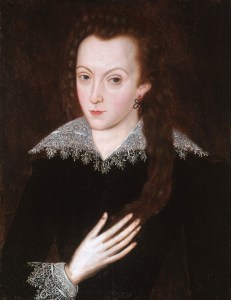 A different image of masculinity: Henry Wriothesley, 3rd Earl of Southampton, as a teenager
In this period, male and female dress was distinguished by cut, not by the fabrics used. Silk, lace, embroidery and jewels were markers of status, not gender, giving rich Elizabethan men a decidedly effeminate appearance to modern eyes. Portraits of young men and women can be hard to tell apart!
Perhaps under the influence of Greek literature, homosexuality in this period was conflated with pederasty. In both the poetry of the time and the legal cases that have come to light, the relationship under scrutiny was nearly always that of an adult male and an adolescent boy. The sexualisation of boys was further entrenched in English urban culture by the theatrical practice of having female roles played by boys and young men.
Until relatively recently, homosexuality was not seen as a permanent orientation, equivalent to heterosexuality, but as a pattern of temporary behaviour and an indicator of moral degeneracy. Satirists described the fashionable bachelor as spending the afternoon with his mistress and the evening with his catamite; both relationships were considered equally unmanly and foppish, transgressing normal, respectable standards of behaviour.
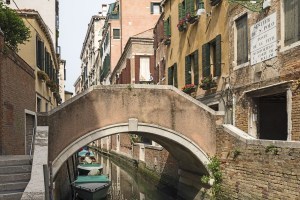 Ponte delle Tette, Venice (photo by Didier Descouens)
An additional factor was surely that this was a highly segregated society, where female virginity had both moral and monetary value and where formal education and most professions were male-only. As in modern-day boarding schools and prisons, many men must have resorted to homosexual practices as a physical outlet. As a result, a Renaissance man who had sex with another man didn’t consider himself gay, any more than does the guy in prison who makes you his bitch.
Indeed the Venetian authorities were so worried about the proliferation of sodomy that they decreed that prostitutes should bare their breasts in an effort to persuade young men to part with their money! The bridge where the prostitutes displayed themselves is still known as the Ponte delle Tette (in fact there are two of them, as I recently discovered).
Given all these factors, I imagined a culture where gay relationships between adults could slip under the radar, or even be tolerated in certain circles: amongst the more intellectual coteries at court, for example, and most likely amongst the theatre fraternity, which has always attracted outsiders. In other words, exactly the social circles that my characters move in.
I attempted to include some dissenting voices, through characters who openly disapprove of Ned and Gabriel’s relationship, as well as through Mal’s ambivalence about his own dealings with Ned, but perhaps between subtlety on my part and lack of historical context on the readers’, I have perhaps not struck the perfect balance. This is always a problem for the writer of historical fiction – how to portray people from another era, whose attitudes were in many ways alien to ours, in a way that readers can relate to. But if the past was just like the present day, where would be the fun in writing about it?
March 13, 2012
Alchemist of Souls – the official wallpaper
A lot of people have complimented me on the cover art for The Alchemist of Souls; indeed I liked it so much myself that I made the draft artwork into a desktop wallpaper so that I would feel inspired whenever I sat down to write. It seemed a shame to keep it to myself, though, so I got permission from Angry Robot to create an official version for wider consumption.
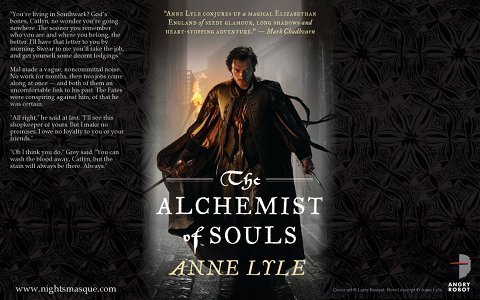
So, now you too can have mean'n'moody Mal Catlyn on your desktop to drool over, ahem, I mean admire! I've created two versions, one widescreen (8:5) and one standard proportion (4:3), both in sizes large enough for all but the biggest monitors.
1600 x 1000[image error] | 1280 x 960[image error]
Enjoy!
Full credits
Cover art © Larry Rostant at Artist Partners
Background texture by Marc Gascoigne
Angry Robot logo © Angry Robot Books
Design and novel excerpt © 2012 Anne Lyle
March 6, 2012
Book review: The White Road, by Lynn Flewelling
 The White Road is the fifth installment in Lynn Flewelling's Nightrunner series, and concludes the story arc begun in Shadows Return. Having escaped the clutches of Plenimaran alchemist Charis Yakhobin, Alec and Seregil are faced with the problem of what to do about Sebrahn, the child-like alchemical being who can kill as well as heal. The paperback edition features another beautiful character illustration (right) by Michael Komarck, this time of Alec – appropriately enough, since this time he is the one making the difficult choices.
I have to admit that I found the first half of this book rather slow. It mostly consists of Alec and Seregil travelling back to Aurenan and encountering a mixed welcome from various 'faie communities. The only real tension came from the occasional scenes from the bad guys' point of view, revealing that Alec and Seregil will not be safe for long.
It didn't help – and this is purely a pet peeve – that for a while the story revolved around dragons. I trust Flewelling to stick to the intrigue and action that I read this series for, and not to wander off into cheesy Pernesque territory, and she didn't let me down this time – but it was touch and go there for a moment!
By the middle of the book, however, the pace picks up and accelerates towards an action-packed finale. Once or twice the suspense was punctured, rather than heightened, by the fact that we the readers can see what all sides are up to, but on the whole it worked well. There was one plot thread that wasn't tied up, but maybe Flewelling is saving that for the next book?
Overall, a solid addition to the series that nonetheless for me fell a little short of the emotionally satisfying heights of Shadows Return. Still, I'm looking forward to Book 6, The Casket of Souls, due out this summer. It's about time our boys got back to some serious nightrunning!
February 28, 2012
Tracking word count with Scrivener
It's been a while since I did a techie post, but this is a topic that came up on Twitter the other day in conversation with my fellow Angry Robot author Matt Forbeck. We're both using the word-count tracking features of Scrivener but in slightly different ways, so here for Matt's edification (and anyone else's!) is a quick tour of how I use it.
I like tracking word count. Writing is such a slog sometimes, and it's good to see yourself making actual progress. I guess it all dates back to my first NaNoWriMo in 2006 – the whole point is to hit a word count target (in this case, 50k) and not worry too much about quality because, heck, you can edit it later. However I now find word count tracking to be even more useful in the revision phase of a project, helping me keep an eye on scene length and pacing.
Scrivener has a number of word count tools:
A live word count at the bottom of the main document screen, that increments as you type
A per-document word count target, set using the target icon in the bottom left of the same screen
A Project Statistics window, showing total word counts, pages, etc for the whole draft and for the selected document(s)
and probably some other features I haven't found yet!
I used to use spreadsheets, which had to be manually updated by copying the word counts from each document's total. They were fun, but time-consuming to maintain, especially if I was juggling scenes around. A few months ago I realised I needed something that was less hassle and most importantly, didn't take valuable time away from the actual writing. I poked around in Scrivener and almost by accident discovered that not only could you show word counts and targets in Scrivener's outline view, but it would create cumulative totals for each folder. It did almost everything my spreadsheet could do, with zero extra work on my part. I was hooked!
In the picture below you can see my outliner setup for The Merchant of Dreams, the second book in the Nights Masque trilogy (note that I've blurred out the scene titles to avoid spoilers!).

Clickety-click to enlarge!
I got this view as follows:
In the menu bar, go to Group Mode and select the lefthand option to show the Outliner
On the far right of the column headers you'll see a double arrow symbol (>>) – click on that and select 'Word Count', 'Total Word Count', 'Target', 'Total Target' and 'Total Progress'.
Voila! You now have a "spreadsheet" view of your manuscript, totalled by folder. Note however that if you want to see the total for the whole draft, you'll need to insert a dummy top-level folder and drag all your existing folders into it – if you look at the Binder in the screenshot, you'll see there's a 'Draft' folder inside the 'Manuscript' one. This is because the outliner can only show documents inside another folder, not the folder itself.
The outliner preserves its state independent of other views and hierarchies, so you can flip back and forth between editing individual scenes in the normal document view, opening up your folders in the Binder, etc, and still come back to exactly the same view when you click on the Outliner button.
So there you have it, Scrivener fans – how to obsessively manage your word counts without resorting to spreadsheets. Enjoy!
February 21, 2012
The Alchemist of Souls: deleted scenes
One of the perils of being a discovery writer is that you tend to wander off the beaten track and write scenes that really don't need to be in the book (or worse still, entire plotlines that have to be pulled out because they're irrelevant). During the course of drafting The Alchemist of Souls I must have written at least two books' worth of words – for starters, I changed the plot completely, from a murder mystery to a political thriller! It would be a shame, though, to let all that work languish on my hard drive, so in the run-up to the release of The Alchemist of Souls, I'm going to be epublishing a selection of these scenes – for free – via this website.
 I've selected a number of episodes from the early part of the books, most of which were cut because, although interesting to write, they didn't move the plot forward quickly enough. That's often the case when you start writing new characters; you need time to get to know them and their story, and end up writing a lot of "throat-clearing" chapters that don't make it into the finished work.
First up is a sequence of short scenes between Mal, Ned, and one of Mal's old college friends, Piers Ingram. It was intended to give an opportunity to reveal some of Mal's background history, but I discovered I didn't really have a role for Ingram in the rest of the book so I cut this section, merged him into another character, and dropped bits of information about Mal into other scenes.
You can download the sample in a selection of formats or read it online.
Note that I'm releasing them under a Creative Commons licence, whereby you are free to distribute these files provided you don't remove the attribution information. Do let me know if you encounter any problems with the files.
Further samples will be released weekly during March – please see my Twitter feed for announcements!