Anne Lyle's Blog, page 16
June 12, 2012
Book review: The Spirit Thief, by Rachel Aaron

Omnibus edition of the first three Eli Monpress novels
Eli Monpress is the greatest and most infamous thief in the world. At least, that’s his ambition. The bigger the theft, the higher the bounty on his wanted poster – and what could be higher profile than stealing a king? Unfortunately the kidnapped king’s absence leaves a power vacuum in the wizard-hating kingdom of Mellinor and sets off a chain of events that even Eli’s charm can’t easily get him out of.
I confess that I started reading this book under the misapprehension that it was YA – I’m not sure why, maybe the lovely new cover art for the omnibus edition (right)? However it took me some time to realise my mistake, perhaps because between the “clean rating” (no swearing or sex, very little violence), the girl mage who rides a giant telepathic wolf, and the wryly humorous style, it reminded me of a cross between The Princess Bride and an intelligent Disney cartoon. Of course the fact that the previous book I read was The Steel Remains by Richard Morgan probably made the contrast even more striking! At any rate, this is one of those books that is likely to appeal to – and be suitable for – a wide age range of readers, from young teens upwards.
Towards the end it becomes somewhat darker, as Eli confronts a particularly nasty wizard bent on taking over the kingdom, and I’m told that later books continue in this vein (I have the omnibus edition, so I’ll no doubt be reading them at some point). However the overall flavour is definitely slanted towards the light, epitomised by master swordsman Joseph, who walks around covered in unfeasibly large amounts of edged steel but is really only interested in fighting opponents worthy of his skill.
If you’re not keen on the “gritty” type of epic/adventure fantasy, or just want a break from all the raping and pillaging, I heartily recommend you check out this book. Eli’s reputation depends on it!


June 5, 2012
The Alchemist of Souls – now in audiobook!
 June is Audiobook Month, so I’m delighted to be able to contribute with my own slice of aurul entertainment. You can now wrap your lugholes around the adventures of Mal, Coby and friends with the latest co-production between Angry Robot Books and Brilliance Audio. Read by Michael Page, award-winning narrator of Scott Lynch’s The Lies of Locke Lamora, this is an unabridged edition of The Alchemist of Souls. That’s 15 whole hours of Elizabethan intrigue, romance and action – enough to entertain you through quite a few commutes.
I’ve been listening to it myself the past few days, partly to find out how Michael got on with the skrayling names and languages, and partly to try and absorb the rhythm of my own prose when read by a great narrator. Of course there’s the small problem that I do occasionally wince and wish I’d written a sentence better, but that’s part of the learning process 
What’s particularly interesting about the narrator is that he’s a professor of theatre with a particular interest in Shakespeare – I do hope he enjoyed reading the theatrical sections and didn’t find my made-up play too terrible! He certainly does a good range of accents and voices, and does a creditable job of pronouncing all the skrayling stuff despite not having had a pronunciation guide from me (I guess my orthography was a success, then!). In some respects he pronounces it better than I do, since I’m rubbish at a trilled ‘r’; he does speak it rather slower than the skraylings would, but that’s perfectly understandable. At some point I shall post a pronunciation guide on my website, and perhaps a bit of background information about the languages, for the delectation of the conlangers out there.
All in all I’m delighted with the end result, and hope you enjoy it too. The audiobook is available from Audible, Amazon and the iTunes Store – see my Alchemist of Souls webpage for links. For more about Audiobook Month, search for the #JIAM2012 hashtag on Twitter or see the link at the top of the page.
May 28, 2012
The Merchant of Dreams: publication date confirmed
I’m very happy to announce the publication date of the second book in the Night’s Masque trilogy, The Merchant of Dreams.
 Ebook & US paperback: 18 December 2012
UK paperback: 3 January 2013
Now, before you grumble that the US is getting the paperback edition ages before the UK, the explanation is simple. Usually the US publication date is near the end of the month, but that means a Christmas Day launch date, which is less than ideal! So, the US date has been brought forward a week, whilst the UK date has to remain where it is to, again, prevent a clash with Christmas. All clear? Awesome.
Below is the (draft) back cover text:
Exiled from the court of Queen Elizabeth for accusing a powerful nobleman of treason, swordsman-turned-spy Mal Catlyn has been living in France with his young valet Coby Hendricks for the past year. But Mal harbours a darker secret: he and his twin brother share a soul that once belonged to a skrayling, one of the mystical creatures from the New World.
When Mal’s dream about a skrayling shipwreck in the Mediterranean proves reality, it sets him on a path to the beautiful, treacherous city of Venice—and a conflict of loyalties that will place Mal and his friends in greater danger than ever.
So, all I need to do now is finish writing the damned thing! Wish me luck…
May 21, 2012
Why I read reviews
The other day a question came up on Twitter: what value do you get out of reading reviews? I’d been thinking of writing about this topic anyway, so I thought it was time to put my thoughts in writing…
A lot of writers refuse to read reviews of their own books, on the grounds that if they read the good ones, they are honour-bound to read the bad ones, and they find the latter too painful. I can understand that attitude, and if that’s how you roll, you have my sympathy. Writing is hard enough, without getting stressed out about the things you can’t control—like reader reaction.
 So why read reviews at all? Clearly you have to have a thick skin (or be a masochist), but I think they can be useful if you approach them in the right way. For me, it’s a kind of market research. We’re constantly being told that, as 21st century writers, we need to be aware of our audience—our market, to put it in even more commercial terms. But who is that market?
Some writers have an instinctive feel for it, like Jack Sheffield, who spoke at the Winchester Writers’ Conference a few years ago. He uses his experiences as a headteacher to write novels set in a fictional primary school in the 1970s, and he targets readers in their 40s who were at school in that period. Nostalgia, pure and simple. Maybe I’m just not commercially minded enough, but I don’t have a clear demographic in mind for my books. I simply write books of the kind that I would enjoy reading, and hope to appeal to the fans of authors whose books I enjoy: Lynn Flewelling, Tim Powers and so on. Hence, reading reviews by book bloggers and other fantasy fans helps me to find out who is reading my books and what they enjoy about them.
I should also point out that for these purposes I focus on the positive reviews and ignore the negative ones. Not because I’m looking for an ego-boost, but because if someone doesn’t connect with my books, they are by definition not my target audience. Of course if the majority of your readers are dissatisfied, you have some serious work to do, but if the critics are in the minority, you’ll just be shooting yourself in the foot by trying to please them.
Most importantly, it’s not about individual opinions so much as trends. The more reviews you read, the more you realise how idiosyncratic an individual’s response to a book is. One person may love Character A and find Character B annoying, another feels the exact opposite. Some reviewers say they find The Alchemist of Souls slow-paced, others that they couldn’t put it down. They can’t all be “right”, in the sense of providing objective criticism! So, I’m looking for a consensus, of the “this was a great book apart from…” variety. For example, I have to admit that the “slow” comment crops up quite a bit, so I have to at least consider whether I can up the pace a little in the next book without throwing away its other virtues.
I’m also on the lookout for comments of the “I love X and would like to see more” variety, where X is something I enjoy writing, and particularly where no-one else singles out X as something they hate. That’s a no-brainer for the writer, really. Sometimes you’re just too close to the writing to see what needs bringing out, so this kind of feedback is invaluable. Yes, a good editor may also provide this kind of feedback, but editors are individuals too and they can sometimes overlook the elements that really click with the audience.
One last word on negative reviews: never, EVER respond. It doesn’t matter how justified your complaint—baring your ego in public is not pretty, and will not win you any respect. If an Amazon review is offensive or totally irrelevant, you can ask Amazon to delete it, but for the love of God do not comment in person, or ask your friends to comment on your behalf. You chose to put your writing out into the world, and the reader is entitled to their opinion, however wrong-headed.
The only thing that really gets under my skin is when a reader accuses me of factual inaccuracy—and is wrong. I try not to over-explain everything in my novels, with the result that some readers will miss connections and go with their gut reaction. Still, I bite my tongue and hope that other potential readers seeing these reviews will also know that the reviewer is wrong. I know for sure that a comment from me will only hurt my case. If the topic is big enough, though, I might blog about it (as I did about homosexuality in Elizabeth England); that way I can have my say without attacking individuals.
What it comes down is that whatever you write, not everyone is going to “get” it—and you’re going to have to live with that. Either you stay away from reviews altogether, or you discipline yourself to take the rough with the smooth and learn from it, like with the rest of life. Your choice. Just choose wisely…
May 8, 2012
Book giveaway: signed copies of The Alchemist of Souls
Would you like a signed paperback of The Alchemist of Souls? Of course you would!
This month I’m giving away 3 copies to readers in the UK/EU only (there’ll be another giveaway in the summer for North American readers, never fear).
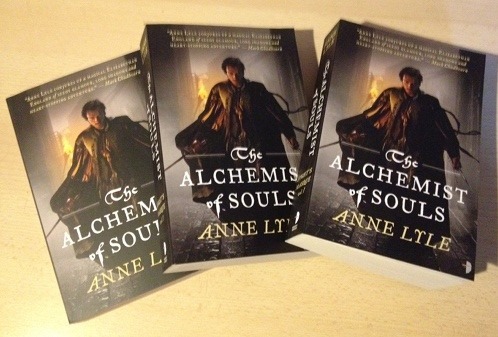
All you have to do to be in with a chance is to leave a comment on this post. If you win, you will receive a brand new copy of the UK paperback edition of The Alchemist of Souls, signed by yours truly!
Please note that comments are moderated to reduce spam, so don’t panic if yours doesn’t appear right away.
Rules:
You must live in the EU to enter (sorry – worldwide postage gets expensive)
One comment per entrant, please – multiple commenters will be disqualified.
For security reasons, please don’t leave contact details in your comment – there’s a space in the comment form for your email address, I’ll use that to get hold of you.
Closing date for entries is noon UK time on Tuesday 15th May. Any comments posted after that deadline will be deleted.
I will be picking three separate winners (using a random number generator), to receive one copy of the book each.
Selected winners must respond to the confirmation email by Thursday 31st May, so that I can get the books out in a timely manner.
If a winner does not respond by the stated deadline or cannot supply an EU postal address, I reserve the right to select a replacement.
Good luck!
May 4, 2012
The Merchant of Dreams: finished cover
Last week I got my first glimpse of the gorgeous cover art for Book 2 of the Night’s Masque trilogy, and thanks to some hard work by artist Larry Rostant and Angry Robot supremo Marc Gascoigne, I’m now able to reveal the finished article:
As you can see it features Mal Catlyn’s partner in crime, Jacomina “Coby” Hendricks, ready for action on the murky streets of a certain Italian city…
I’m particularly pleased with this cover, as I really wanted Coby to feature on it since she again plays a significant role in the book. I gave Marc a detailed brief of what I envisaged, and he and Larry have translated that perfectly. The timing is also ideal, as I’ve just started work on the final revisions, and this image is really going to help focus my imagination on the atmosphere I want for the book.
The Merchant of Dreams is due to be published in spring 2013 – watch this space for more news!
May 2, 2012
History at the Movies: Shakespeare in Love
I have a love-hate relationship with movies set in my favourite historical periods. On the one hand, I adore the visuals, but the scripts in particular can be horribly anachronistic or just plain annoying! Just for fun, I thought I’d pick apart a few films set in the Elizabethan period, starting with a well-known example: Shakespeare in Love. I chose this film because, although one obviously can’t hold a frothy romantic comedy up to the same standards as a historical epic, it’s surprisingly faithful to the period.
*** SPOILER WARNING *** In order to discuss historical accuracy, I have to give away the plot. However this movie is over a decade old, so…
The Story
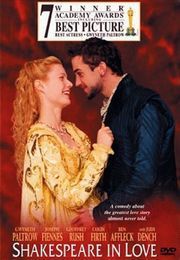 Enthusiastic young playwright Will Shakespeare (Joseph Fiennes) is struggling with ideas for his latest play, Romeo and Ethel the Pirate’s Daughter, until he encounters the lovely Viola de Lesseps (Gwyneth Paltrow), far above him on the social scale. Viola, meanwhile, is no shrinking violet; betrothed to a pompous nobleman (Colin Firth), she tries to escape the strictures of her life by disguising herself as a young man and auditioning for a part in the new play.
Hilarity ensues (as they say), as Viola struggles to keep the two sides of her life separate and secret. She falls madly in love with Will, only to discover he has been keeping a secret of his own: he’s married. Realising that they can never be together, she gives him up, but they never forget one another, and Shakespeare eventually immortalises her as one of his pluckiest cross-dressing heroines, Viola in Twelfth Night.
Historical basis
Obviously there’s not going to be a lot of this in a romantic comedy, but just for the record, the real events included in the film are:
Shakespeare’s writing of Romeo and Juliet, probably in the early 1590s (it was first published in 1597, and this usually only happened after a play had been performed many times)
the murder of Christopher Marlowe in the early summer of 1593 (supposedly in a quarrel over a dinner bill, but since Marlowe was a spy, the motive behind it was probably political)
Also, Shakespeare was 29 in 1593 (and actor Joseph Fiennes was 28 when the film was made), hence the romance plot fits into Shakespeare’s life very plausibly.
Many of the background details are pretty accurate. Shakespeare is shown stripping the barbs from his quills when preparing to write, and Bankside is portrayed as suitably muddy and semi-rural. There are little touches of social history, too, like Shakespeare walking in on Burbage and his whore and not being the slightest bit embarrassed, or the nurse rocking noisily in her chair to drown out the sounds of Will and Viola’s lovemaking, which give a real feel for how little privacy Elizabethan people had.
Deliberate fictions
Pretty obviously, Shakespeare’s working title for Romeo and Juliet never involved a pirate’s daughter; that’s just a bit of fun, to prepare the ground for the change that his love for Viola brings to his writing. And Viola herself is a fictional character, though judging by Shakespeare’s sonnets he was by no means celibate when he lived in London, hundreds of miles from his wife! Viola’s fiancé, the Duke of Wessex, is equally fictional, though he is a typical Elizabethan nobleman, hot-tempered and proud.
Being a comedy, the film has a lot of fun with anachronisms, from the “priest of Psyche” on whose couch Will confesses his performance anxiety, to the wherryman who talks exactly like a London cabbie: “I had that Christopher Marlowe in the back of my boat, once…”. However these little touches help to connect a modern audience with the past, and they are in the spirit of the era, if not the letter.
Historical “errors”
It’s fairly certain that Shakespeare never wrote a play for Philip Henslowe (played by Geoffrey Rush in the movie). No payments to Shakespeare are listed in Henslowe’s surviving account books – a fact which some have used as “proof” that Shakespeare wrote none of the plays attributed to him. However Shakespeare was a member of a theatre company based on the other side of London, and from 1599 he was a sharer in that company, so the absence of payments to Henslowe isn’t that surprising.
The story about Queen Elizabeth and the cloak over the puddle is almost certainly fiction; it probably originated with 17th-century historian Thomas Fuller, who was inclined to embroider the facts with fanciful incidents, and was perpetuated by Sir Walter Scott in his Elizabethan romance Kenilworth.
Conclusion
Overall I give this movie 6/10 for historical accuracy – the plot may be pure fiction, but it’s played out against a background that puts many a more serious film to shame.
April 24, 2012
Book Review: The Steel Remains, by Richard Morgan
 Ringil Eskiath, hero of Gallows Gap, is called from retirement when a distant cousin is sold into slavery to cover her husband’s debts. All perfectly legal, but the Eskiath family honour demands that she be rescued, and although Gil’s homosexuality has made him an outcast in polite society, he is the only family member with the skills and connections for the job.
Egar Dragonbane fought alongside Gil, but after the war he returned to his steppe homeland to lead his tribe. Travel has broadened his mind, however, and he is a misfit amongst the nomads, despised by his conservative younger brothers for his soft southern ways.
Archeth Indamaninarmal is the last of the Kiriath, her kinfolk having departed into the bowels of the earth in steampunk-esque iron ships. Another veteran of the wars, she now acts as advisor to the Yelteth emperor, trying to control his worst excesses whilst avoiding his wrath.
These three heroes’ paths will cross again in a time of crisis, when creatures out of ancient legend return to disturb the decade-long peace…
This is a book I acquired as a convention freebie a few years ago, mislaid, bought in ebook format, changed ebook readers and couldn’t transfer the ebook without cracking the DRM, and finally relocated my paperback copy…so my reading of it was somewhat delayed. This is may be a good thing, since it gave me a chance to cut my teeth on a few other so-called gritty fantasies first. ”Bold, brutal and making no compromises”, says the Joe Abercrombie blurb on the cover of my copy, and I have to agree with the verdict. This is not a book for the squeamish – but it rewards perseverance.
For starters, I love Ringil as a protagonist. He’s foul-mouthed and revels in violence, yet at the same time is intelligent and has a wry sense of humour. His high social status enables him to be defiantly gay in a culture that punishes such behaviour with sickening brutality, but he bears deep emotional scars as a result. He’s about as unromantic a hero as you could imagine, and very, very real.
Morgan makes a bold choice with his language and dialogue, not only throwing the f-word around with abandon but using modern idiom such as “okay” and even an occasional “whatever”. I have to admit that on occasion it did jar with me a little, but I was willing to cut Morgan some slack since after all this is not a historical setting, merely a low-tech one. Except that it isn’t.
Although marketed as fantasy, there are strong hints that what the human characters see as magic is merely technology advanced beyond mortal comprehension. We are given glimpses of vast stretches of time, and it seemed to me there was even the possibility that this could be a far-future Earth; the night sky is lit by a band of light – a planetary ring – that used to be a moon much like our own.
I really don’t have much more to say than that if you like your fantasy somewhat epic and dark-edged but with a good dollop of sword-and-sorcery panache, you should read this book. Now.
April 18, 2012
AltFiction 2012
 One of my favourite UK conventions is AltFiction, a relatively small event based in the East Midlands and focusing more than most on writing and writers. I first attended last year, when it took place in Derby, but this year it moved to what I understand will be its regular venue in future, the Phoenix Arts Centre in Leicester. The convention is a day and a half long (all day Saturday, plus Sunday morning), with a packed programme of events.
My first day at the convention was pretty quiet – I had no panels or other appearances booked for Saturday – so I was free to mooch around, attend a couple of talks, and most importantly, catch up with a bunch of friends I had missed at Eastercon. In fact it was surprising how many Eastercon attendees managed to make it to another convention only a week later, especially given that many of them had been adamant a few weeks before that they couldn’t possibly do two conventions in a row! I think it’s a testament to the affection in which AltFiction is held that people turn up when they could be have a well-earned weekend at home.
The first panel I attended was “Not another f*cking elf!”, in which Paul Cornell, Emma Newman, Adrian Tchaikovsky and Jenni Hill debated the well-worn fantasy races and how attitudes to them had changed over the years. It was entertaining and occasionally quite erudite, and the only downside was that many people had to be turned away as it was held in a tiny room with only about two dozen chairs. This turned out to be a significant problem of the venue – the huge size difference in rooms meant that the large one might be sparsely populated whilst the small one was overflowing. I’m sure the organisers tried to predict which panels would be most popular, but people can be contrary!
The afternoon panels were less successful. I went to one on genre TV which mostly discussed one-off mini-series that I’d never seen, pretty much ignoring all the big-name shows. Whilst I appreciate that shows like Doctor Who may have been discussed to death in other conventions, a panel that focused on British SFF shows and their mainstream appeal, and then totally ignored the success of Life on Mars and Being Human in favour of obscure titles, failed in my opinion to entertain – and I have to say that I blame the moderator, Steve Volk, for the narrow focus of the discussion. The other panel, writing as a day-job, was equally off-topic, in that none of the panelists earned a living as a writer, they simply didn’t have a day-job (for various reasons, such as unemployment). Anyone hoping to quit their day-job would have been better off going to Mark Chadbourn’s “workshop” (really a talk) on the business of writing, but numbers were limited and you had to sign up for it.
The evening passed in usual convention style, i.e. a bit of milling around whilst you and your friends sort out which restaurant you’re going to for dinner, followed by dinner itself (in our case, a good but unremarkable curry) and then back to the hotel bar. Most of us were staying at the Ramada Encore, only a few minutes’ walk from the venue – it was modern, clean and not too expensive, although the tea (at breakfast and in the bedrooms) was as terrible as one usually expects from a three-star hotel. Much better tea – and very reasonably-priced, good quality food – was available at the venue itself.
Although there were few book stalls, and none selling The Alchemist of Souls, I was asked to sign a few copies that had been brought along by friends. It was great to finally get to meet people I’d previously only known online, including book blogger Erik Lundqvist and my newest beta reader, Fatihah Iman.
The convention resumed late on Sunday morning, and I had a panel at noon on diversity in fantasy, with Mark Charan Newton, Adrian Tchaikovsky and Sarah Cawkwell. Mark was our moderator and came well-prepared with a long list of notes and questions on his iPad, and under his guidance our discussion covered a whole gamut of topics – gender, sexuality and race – with regard to the books themselves, the authors and the fans. The panel was well-attended and seemed to go down well with the audience, and for me made a satisfying end to a short but sweet convention.
Next year, thankfully, AltFiction will be in late May, thus avoiding butting up against Eastercon, which will make it even more of a must-do convention. See you there?
As an aside, the Discover Festival that was due to take place in Coalville in May has been cancelled by the organiser, so I won’t be in the Midlands again until Edge-Lit in Derby, in July.
April 10, 2012
Eastercon 2012
 This weekend I was at Olympus 2012, the 63rd annual convention of the British Science Fiction Association, affectionately known as Eastercon. Mostly I was there to promote my newly published novel The Alchemist of Souls, but thanks to guest of honour George R R Martin it turned into somewhat of a Game of Thrones fan-fest!
I arrived around midday on Good Friday to find the convention already well underway and my book selling like hot cakes on the Angry Robot stall. I was determined to take it easy, as I had a busy schedule on Saturday, so I spent the afternoon catching up with friends and drinking as little alcohol as I could get away with (well, I could hardly refuse the champagne that Lee from AR bought to toast my book publication, could I?). I took myself off to bed early and was up equally early next morning, ready to face the world. Literally.

Hmm, where shall I conquer next?
First up was the biggest event of the weekend, for me at least: a panel called How Pseudo Do You Like Your Medieval? with none other than George R R Martin himself. I met him in the green room, and he proved to be very friendly and easy-going – the farthest from a primadonna author that you can imagine. The other panelists were Juliet E McKenna, whom I've known for several years, and Jacey Bedford, who carried herself with aplomb despite this being her first ever convention panel. We were ably moderated by Anne C Perry, better known as co-founder of Pornokitsch and the SFF literary award The Kitschies, and I soon forgot that we were being filmed and live-streamed over the internet.
After all that excitement it was time for a quick lunch before my reading. I'd managed to forget to sync a copy of my book to my iPad, so I had to borrow a paperback from the Angry Robot stall. Fortunately I did this before my panel, as they were rapidly selling out. In fact, by the time I went back down to the dealers' room to do my signing, the only copy left was the one I had read from! A great result, although Lee is probably kicking himself for not taking twice as many copies…
The afternoon was enlivened by an extra session, not featured in the original programme – an hour with cast and crew members from A Game of Thrones. First up was a fight demonstration by Jo Playford, aided by Miltos Yerolemou (Syrio Forel) and volunteers from the audience. Of course it was all about how to make a fight look good whilst remaining safe – rather the opposite of what I try to achieve in my fiction! – but nonetheless interesting to watch (and Miltos was very funny, ad-libbing to the audience). After that was an interview with John Bradley-West, who plays Samwell Tarly. John hung around afterwards and I got to chat to him in the bar that evening. Well, I did say it was a bit of a fan-fest

The Radisson Edwardian - a typical convention hotel
My final duty of the day was a panel on world-building with Chris Wooding, Simon Spanton, Suzanne McLeod and Robert VS Redick. Thankfully that was in one of the smaller rooms, though still well-attended, and we had a good discussion comparing real-world and secondary world fantasy. The evening was a social whirl, meeting lots of new people as well as hanging out with big-name authors like Joe Abercrombie and the aforementioned Mr Martin, and by Sunday I was exhausted! On Sunday morning I just managed to get to my final panel, on fantasy in Shakespeare, then retired to my hotel room to nap and follow the convention on Twitter.
Monday morning was spent catching up with friends once more, and of course the obligatory photo perched on the Iron Throne (above), which had been set up in the hotel reception. My husband collected me around noon, and we headed home to Cambridge, via lunch at Carluccio's in Chiswick. All in all, a fantastic if exhausting convention – I'm just glad that AltFiction, this coming weekend, is a much smaller event!
A final thanks to all my friends, of whom there are far too many to mention, though I will give special shout-outs to Mike Shevdon, Tom Pollock, Laura Lam and Kim Curran, all of whom have books out in the next twelve months. Here's hoping you guys sell out too!