Anne Lyle's Blog, page 15
August 3, 2012
Friday Reads: Sharps, by K J Parker
I’ve been meaning to try K J Parker’s work for some time, based on my own love of historical fantasy and the urging of friends whose opinions I respect, so when I heard there would be a standalone novel about a fencing tournament, I immediately resolved to buy it. By happy chance I managed to win a copy of the paperback in a Twitter giveaway before the ebook came out, and devoured it in under a fortnight (which is fast, given how little reading time I can spare these days).
 Sharps is the story of a motley group of fencers sent on a tour of a neighbouring country in an effort to foster friendly relations in the aftermath of a war. Each has his or her reason for going—or more accurately, for being coerced into going—and initially they are very much at loggerheads with one another, always bickering and complaining about the shoddy treatment they get from both their own government and their foreign hosts. Parker’s characters aren’t your typical fantasy heroes; apart from the ex-soldier and professional fencer Suidas Deutzel, they’re mostly pampered middle/upper-class youngsters who are completely out of their depth in the cut-and-thrust world of international politics.
The central characters are well-rounded and engaging, which is fortunate since Parker throws you in at the deep end, dropping in the names of political factions and historical events with no explanation, at least when in the point-of-view of characters who don’t really care about such details. After a few pages I decided to trust Parker to explain the important stuff in due course, and let the rest of it just drift over my head. There’s a lot of this world that’s alluded to but never seen or described in detail, and I’m interested to see how this connects with Parker’s other books (apparently some of the characters appear in earlier novels).
If there’s one word that sums up this book it’s schadenfreude. I’ve seen complaints that Parker’s writing style is emotionally detached but honestly, that’s the only sensible approach to this kind of biting satire. If you didn’t laugh at the absurdity as disaster piles upon disaster, you’d weep for the poor characters caught in the middle of it all. It’s been quite some time since I’ve smiled (and even laughed out loud) so much whilst reading a book.
Sharps has no discernable magic and no non-human or supernatural beings; the only thing that makes it fantasy is that this is a wholly invented world (although with its Western and Eastern Empires that use Latin and Greek respectively, and a religion based on worship of the Unconquered Sun, it almost feels more like alternate history). If the thought of having to read about politics and (God help us) banking in between the action scenes sends you running, this may not be the book for you. If, on the other hand, Nightwatch and Monstrous Regiment are amongst your favourite Terry Pratchett novels but you fancy something rather more gritty and cynical for a change, I strongly recommend you give it a try.


July 31, 2012
Chapter 1 of The Merchant of Dreams
 Last week, the first chapter of my forthcoming novel The Merchant of Dreams premiered on Staffer’s Musings. In case you missed it, or more to the point would like to read it offline, I’m posting it here as various downloadable formats. No doubt there will be a longer excerpt available in a few months, just before the book comes out!
ePub Download Kindle Download PDF Download
HTML (on Justin’s blog)
(Please note that the text has undergone minor edits since I sent it to Justin. Nothing significant, just a few words here and there.)
July 24, 2012
Lyle’s Three Laws of Magic
Yesterday I came across an article about creating a magic system for your novel, and on impulse tweeted to say that I disliked the phrase “magic system” when applied to written fiction. This sparked a lively debate, and afterwards I thought it would be fun to codify my conclusions in a set of rules.
OK, they’re not so much rules, more what you’d call…guidelines 

"The Wizard", by Sean McGrath
I think most writers (and readers) understand this one. If magic can do anything, there’s no narrative tension, because there’s no problem it cannot solve. There must be at least some hard limits on what it can do. Popular limits include: only some people can perform magic; they have specific talents and can only do certain types of magic; powerful magic comes with a high cost. Many fantasy worlds combine all three, but it doesn’t really matter what you choose as long as it stops magic from being a “get out of gaol free” card.
You don’t have to define down to the last detail what magic can do, but you really, really need to know what it can’t do.
2. Magic that’s too logical becomes scienceThis is a more controversial one, and the point that provoked the Twitter discussion. As someone pointed out, this is the inverse of Clarke’s Law, i.e. “any sufficiently advanced magic system is indistinguishable from technology”.
I know there are some readers who love the Brandon Sanderson approach, i.e. highly detailed rules of magic, but to me all that does is make magic an extension of the science of your universe. Not that there’s anything wrong with that – I’m often tempted to create a fantasy setting that, like Discworld, is literally how pre-modern people believed their universe to be – but I think you as a writer need to be aware that that’s what you’re doing.
More to the point, as I said on Twitter, the reader shouldn’t be able to hear the rattle of a ghostly D20 or envisage a “magic points gauge” falling. Don’t make your magic so mundane and mechanistic that it reads like a poorly written RPG novelisation!
3. Magic should tend towards entropyWhat I mean by this is that, whilst your character may think of magic as a tool that can get him out of trouble, you as the writer should be thinking of ways to use it to get him into trouble
A lot of fantasy worlds do this in a very simplistic way, by making magic illegal, which is fine if that fits your setting. It can also be used for comic effect, e.g. the archetypal inept apprentice who tries to light a candle but instead makes it explode! However it can also be done more subtly, by setting up unintended consequences. That thunderstorm spell over the battlefield might break the ranks of the enemy, but the resultant rain could easily cause the nearby river to flood and wash away the bridge the characters were relying on to get to the castle in time to stop the usurping prince from slaughtering the rest of the royal family.
You can also have magic be just plain unreliable. The reason that so many humans throughout history have believed in the reality of magic is the same reason that gambling is addictive: it works just often enough, and with sufficiently gratifying results, that our optimistic brains overlook all the failures. You don’t want to go too far with this, though. If your magic randomly fails at a crucial moment, it can feel as clunky as a story in which the hero’s mobile phone batteries go flat just when he needs to make that vital call. At the risk of contradicting rule 2, failure needs to be logical or at least plausible, rather than completely random.
So, there you have it – my three laws of magic for fantasy writers. Go ahead and break them if you want to, though – after all, it’s your universe!
July 17, 2012
Ask Me (and 9 other debut authors) Anything!
Justin Landon of Staffer’s Musings is holding a special blog event this July, Debut Authorpalooza, which will showcase the work of ten debut fantasy authors from 2011/12, including yours truly. Visit Staffer’s Musings on the dates below to read about the trials of writing the second novel in a series, read exclusive extracts from forthcoming novels, and enter giveaways. Yep, that’s the first public release of Chapter One of The Merchant of Dreams, plus a chance to win copies of my books!
There will also be an Ask Me Anything session on Reddit on the evening of July 19th (7pm CST, i.e. 1am the following morning UK time), where you can ask us all questions. Since it’s at a crazy time on this side of the Pond, I’m not sure if I’ll be around during the actual session, but will definitely drop by as soon as I get up the next morning to answer any questions. So, fire away!
The ten authors will be contributing guest posts as follows:
7/16: Mark Lawrence
7/17: Kameron Hurley
7/18: Elspeth Cooper
7/19: Courtney Schafer
7/20: Stina Leicht
7/23: Teresa Frohock
7/24: Mazarkis Williams
7/25: Bradley Beaulieu
7/26: Anne Lyle
7/27: Doug Hulick
So, don’t forget to drop by Justin’s blog and Reddit to find out more, and good luck!
July 13, 2012
Friday Reads: Casket of Souls, by Lynn Flewelling
 Casket of Souls is the sixth installment in Lynn Flewelling’s long-running Nightrunner series of fantasy novels set in a roughly 17th/18th-century-esque milieu. Whilst recent books have seen protagonists Seregil and Alec travelling widely, Casket of Souls finds them back on familiar territory in the city of Rhiminee, and back to their old ways. Seregil, a very minor nobleman distantly related to the royal family, is an accomplished spy and cat-burglar and, with his young companion and lover Alec, has served the crown loyally for years. However with a war dragging on and food shortages in the city, tensions are running high, and it’s not long before the two young men find themselves in the midst of a conspiracy to usurp the throne. And as old friends of one of the rival claimants, if they don’t find solid evidence of the traitors’ plans they could be arrested themselves.
Added to their problems is a sudden, mysterious plague afflicting the poorer parts of the city; a plague with no known cause or cure. Most of the victims are children, a fact which especially touches the gentle heart of Alec. As the deaths mount up, Seregil and Alec find their loyalties torn between unmasking the conspirators and protecting the city’s children from the plague; even the best nightrunners can’t be in two places at once.
Casket of Souls marks a return to the intrigue and derring-do of the earliest Nightrunner books, as well as the unpleasant magics that are a trademark of Flewelling’s world. The first half unfolds quite slowly, as is somewhat inevitable in this kind of plot where all the pieces have to be put in place before they can make their moves, but the pace picks up as the net tightens around Seregil, Alec and their friends.
It’s not all deadly serious, thank goodness. There’s a particularly fun scene in a gambling house (let’s just say it will please the fangirls no end!), and though a number of characters die, the story lacks the angst and bleakness of recent outings.
The conspiracy plot is perhaps wrapped up a little too hastily, but that may just be because I read the last third of the book so fast! Even though you know it’s all going to work out OK in the end (Flewelling has more sense than to kill off characters with such an ardent following), there are enough deaths that the threat to our heroes is palpable and you have to keep reading to be absolutely sure.
Overall I think this may be my favourite book of the series so far. Such a pity then that there will only be one more!
AfterwordWhen I found out the title of this latest book, I couldn’t quite believe my eyes. Lynn had already blurbed my own novel The Alchemist of Souls, which seemed coincidence enough. However it seems there’s some kind of psychic bond going on between us, because although the particulars are very different, there are an awful lot of parallel elements between the two books, from the conspiracy plotline to the acting troupe with their new theatre, and of course the magic hinted at by the title. What’s more, I know Lynn had just about finished revising her own book when I sent her mine, so any similarities are entirely coincidental, honest!
July 10, 2012
Tech review: Aeon Timeline
One of the trickiest things to keep track of when writing a novel can be the passage of time, especially if you have two or more concurrent plotlines. Tolkien was apparently very good at this; I read somewhere that if you compare his published timeline to the text, you’ll find that not only does it all match up but that things like the phases of the moon are correct. Now, most of us writers are never going to have fans rabid enough to go into this level of detail, but I work on the principle that if I get it wrong, someone might just notice and lose their faith in my control over the story.
Of course you can plan your novel’s timeline on paper, and with Night’s Masque I’ve done some of that, particularly in the early stages, but software can make the task a bit easier and the results a lot neater. The best program I’ve found for Mac OSX, and the only one (as far as I know) written with fantasy and SF writers in mind, is Aeon Timeline from Scribblecode. I’ve been using this program since an early beta was posted on the Scrivener forums, but version 1 is now complete and available to buy (there’s a 30-day free trial as well).
On first startup the program looks rather intimidating, and I have to say that the video tutorial on the website isn’t much help – there’s no sound, and it runs too fast to really take in. However the user manual is fairly comprehensive and the program isn’t that complex once you get your head around it.
The core concepts are Events, Entities and Arcs. Events are pretty self-explanatory; they can be anything with a time duration, from the birth of a character to a war lasting many years. Entities are things that span multiple events; the default entity type is a person, but entities can also be places, objects, organisations, and so on.
Events and entities thus potentially intersect, and the program calculates the entity’s age at the intersection point. Note that you have to manually assign these intersection points; after all, not all events will affect all entities, and vice versa.
For example, my hero Mal Catlyn fought in the siege of Bergen-op-Zoom in 1588, so I added an intersection point for that (click on the screenshot to enlarge it, and look for the blue line across the middle of the screen). The program then worked out that he would have been 20 at the time. Ages are automatically recalculated if you move the starting point of an entity or the date of an event. You can also hide the ages if they’re not relevant to your usage or are cluttering up the display.

Spoiler-free screenshot of part of the Night's Masque alternate history timeline
Sets of events can be further divided up into arcs for clarity. I use three arcs in this overall timeline: one to track the history of the Tudor dynasty (my main alternate history element), one for other historical events that impinge upon the characters’ lives, and one for the characters themselves and events within the books.
One of the most useful features from an SFF writer’s perspective is the ability to define custom calendars. For Night’s Masque I use a tweaked version of the standard calendar, because England was still using the old Julian calendar in the sixteenth century; if I were to use the modern Gregorian one, the days of the week wouldn’t be right for the dates. However you’re not limited to minor changes like this. You can create an entirely fictional calendar for a fantasy world or an alien planet, with as many hours in the day and days in the year as you please, and of course with custom names.
When you’ve completed your timeline, you can export it in a number of formats, including an HTML table (great for putting on your website!) and also synchronise the file with Scrivener. I haven’t tried out this latter feature yet, as I’m mainly using Aeon for a higher level view of my story world, but I can see how it might be useful.
Aeon Timeline has lots of other cool features that I’m just finding my way around, like the ability to label events (similar to the Label field in Scrivener) and then filter by that label; hide selected entities and arcs (which I did when creating my screenshot, to avoid spoilers); and lock events so that they can’t be accidentally altered. As this is the first full version, I expect new features to be added with time, but even in its current state it’s perfectly useable.
In conclusion, this is a hugely useful program for any writer planning a complex novel, and I strongly recommend you give it a try!
July 3, 2012
Revising your novel in 10 easy steps
Writing a novel is hard work, but for many aspiring authors the much harder part is revising that first draft into something fit to send out into the wide world. Since I’ve just finished revising The Merchant of Dreams, I thought it might be useful to document how I went about it.
[Note: the process I describe below is distilled from what I've learnt through the online workshops and courses given by fantasy author Holly Lisle, particularly How to Revise Your Novel. However this is my own personal take on the process, based on what works for me. YMMV.]
N.B. Since this is rather a long post, I’m hiding most of it behind a “more” tag…
Step 0: Solicit feedbackThis initial step isn’t really part of the revision process itself, but you need to do it before you’re ready to revise. Having written the first draft, you’re undoubtedly too close to it to see its flaws clearly. In an ideal world you’ll have an experienced agent or editor to bounce ideas off, but if you don’t (and, honestly, even if you do), it’s a good idea to seek feedback from others. How to find good alpha/beta-readers is a whole topic in itself, so I’ll just say this: find some, and make sure you let them know how grateful you are!
Even (and especially) if you can’t get hold of any beta-readers, you’ll need to let the book rest before you try to revise it, so that you can come to it with fresh eyes. I recommend a week at the bare minimum, preferable a month or longer. You can always work on something else in the meantime – like your next novel.
Step 1: PreparationI use a mixture of electronic and paper-based editing, as I find that switching between the two keeps things fresh, but you can adapt the mix to your personal preference.
Here’s a comprehensive list of supplies:
Notebook – I like to use spiral-bound reporter’s notebooks, but choose whatever size and format you’re most comfortable with Pens – plenty of black ballpoint/gel pens for note-taking, plus coloured pens (especially red!) for editorial markup Index cards – coloured and white, lined Hole punch A binder ring or treasury tag, to keep the index cards in orderFor the initial steps, I use my iPad, but if you don’t have an ereader that allows annotation of documents, I recommend printing out your manuscript, so you will also need:
Enough printer paper for the whole draft (probably the best part of a ream) Lever arch files to store the processed draft (at least two) Sticky notes
Mmm, stationery!
Step 2: Novel summaryOn the first page of my notebook, I write a one-sentence summary of the plot – what Holly calls The Sentence. It needs to include the protagonist and antagonist, the conflict between them, and the twist – what makes this plot cool and interesting. Note that this is not quite the same as your pitch/tag line. You’re not trying to sell the book, you’re trying to capture the essence of the story to use as a yardstick against which your manuscript will be measured.
Next, I re-read the synopsis that my editor approved, and make a bullet point list of the main elements that I want to carry through into the final draft. I put asterisks against the “candy bar” elements – the really cool stuff that I’m sure helped sell the synopsis (and usually the stuff I have most fun writing) – because they’re the elements I want to protect most fiercely from changes during the revision process.
If you don’t have an editor or agent guiding you, do the same with your beta-readers’ feedback – but make sure you don’t let them influence you too much. It’s your book and your ideas, so if any of their suggestions chime false, do feel free to put them aside. (Even with editor’s suggestions, I’ll try and negotiate. I don’t think you should ever put out a book you’re not happy to have your name on.)
Step 3: The Read-throughNext you need a reading copy of your manuscript. I prefer to do this on my iPad, as it’s closer to the experience of actually reading a book. If you do it this way, you’ll need an ereader that allows you to annotate a document, and preferably a dedicated app – I’m told that although you can use iBooks, for example, it tends to slow down horribly once you have more than a few dozen annotations in there. I use iAnnotate on the iPad – with a stylus, it’s almost like working on a paper manuscript.
If you don’t have an ereader or prefer to switch to paper at this point, print out the whole book. You have two choices: print it out double-spaced so you can use it again when line-editing, or print it single-spaced to save paper if you intend to line-edit in your word processor. Your call! However if you’re going to do the former, I recommend inserting page breaks between scenes if you can, as it makes rearranging them a whole lot easier!
Either way, you want to sit down with the manuscript and your revisions notebook, and start reading at page 1. In this step, please resist the temptation to fiddle with the prose (that’s why you’re using a reading copy, not the original document). Holly Lisle, who is an ex-ER nurse, likens the revision process to hospital triage: you have to make sure your patient is a) breathing and b) not bleeding out, before you worry about splinting broken bones and patching up scrapes and bruises!
What you’re focusing on with this step is the story. You have to read like a reader, not like a writer. Every time you find yourself being pulled out of the story by anything other than clunky sentences, make a note. Mark the manuscript with a number, and add a similarly-numbered explanation in your notebook – or use sticky notes if you prefer. You’re looking for:
Plot holes Coincidences and too-convenient leaps of logic Poorly developed or extraneous characters Characters who act out-of-character without any prior hint of changed motivation Long, rambling conversations that don’t advance the plot or reveal character Pacing that’s leisurely when it needs to be breakneck – or vice versaIn other words, all the things that tick you off when you’re reading someone else’s book. (Confession time: I’ve found all of these in my own rough drafts. It’s easy to commit storytelling sins in the rush to get the ideas down on paper.)
Step 4: Identify your plots and subplotsPretty much every novel has subplots – without them, your story is going to feel thin and under-developed. You might have a romance subplot, a character story arc that’s separate from the main plot, or a parallel plot that is linked thematically with the main plot. All of these will add richness to your story. However you might discover that you have a subplot that’s completely unrelated and keeps dragging the story off course. These will need to be either cut or changed.
A plot or subplot can be identified as being a conflict between two characters (or one character and a situation) that extends over a substantial section of the book. If the conflict only takes up a scene or two, it’s probably an obstacle in a larger plotline, rather than a subplot. Identify them all, and make a list; you should end up with around 3-6, depending on the complexity of your story. Give each one a short name, so that you can jot it down in your notes later: Main Plot, Romance, Hero Arc, etc.
As you can see, a conflict doesn’t necessarily mean aggressive opposition. It could be two characters who want different things (often the case in romance), or a character in conflict with himself because he’s trying to overcome a weakness. However each conflict has to be resolved in the course of the book, or at least reach an equilibrium, otherwise the reader is going to feel frustrated.
Step 5: (Re)outlineIn order to get a bird’s-eye view of the whole book, it’s essential to have an outline. Even if you never use an outline whilst creating your first draft, it’s invaluable in the revision stage, because it’s damned hard to hold 100,000+ words of prose in your head. Hence, the next stage is to go through the manuscript and create one index card per scene.
You can use index card software if you prefer, but I enjoy the messiness of real cards. It’s also very satisfying to see the “revised” pile grow, and the “unrevised” pile shrink during Step 7. If using real cards, I recommend that you hole-punch them (I put a sticker on my hole-punch to mark the ideal position) and fasten them together with a binder ring or treasury tag. If you write long, multi-PoV novels like mine, you’re probably going to need treasury tags, as binder rings can only hold a few dozen cards.
An aside about scenes: if you’ve done HTRYN or read any of Holly’s other plot-related workshops, you’ll know that she defines a scene as having a protagonist, an antagonist, a setting, a conflict and a “twist” (a change that moves the plot forward). This is not how I define a scene for the purpose of making index cards. I use the more “cinematic” definition, that is, a new scene starts when there is a change of place, time or viewpoint. By convention, scenes of this kind are separated by a double line break (or a chapter break), and Scrivener makes it easy to automate this if you create each scene as a separate document. Therefore each index card in my outline represents a Scrivener document. To keep things clear, I’ll refer to my index cards as scenes and to Holly’s type of “scene” as a narrative unit.
Sometimes the individual scenes will be complete narrative units in themselves, sometimes (if I’m switching between two viewpoint characters involved in the same event) they will be fragments of a larger narrative unit, and sometimes there might be two or more narrative units in a scene because they are in the same viewpoint and follow one another without a break in time and space. Regardless of the narrative structure, my aim at this stage is simply to record the principle action of each scene as briefly as possible.
On the front of each card I write:
The scene number (vital in case you drop them!) – if the draft is divided into chapters, then I’ll number them by chapter and scene, e.g. 2.3 A brief description of what happens – just a couple of sentences Name of PoV character (not needed if you’re writing a single PoV) Target word count (I’m a bit obsessive about this – you can ignore it if word counts don’t interest you) A list of named characters present Which plotlines are covered in this scene Step 6: Listing the story elementsOnce the current draft has been mapped onto index cards, I go through the manuscript again, this time identifying every notable character and location (including ships, if sea travel is part of the story), and their first appearance in the book. I highlight them in the manuscript and put a number in the margin, and list these same details in my notebook.
This can be a very revealing process: I might discover that I haven’t actually introduced a significant character because I took his existence for granted or, having written the draft out of chronological order, I’ve introduced him later in the book than his actual first appearance. It’s also a good way to spot characters with similar names that might confuse the reader.
Step 7: Fixing the plotNow comes the fun part – playing with the index cards! With my read-through notes to hand, I go through the cards and assess whether each scene is pulling its weight. Hopefully the scene is basically sound but maybe needs a minor plot-point fixed or the pace needs tightening, or perhaps it would work better in a different PoV. In the worse case I may need to drop it altogether – and if so, should I write a new scene in its place? Are the chapter breaks in the right places? Do I need other new scenes to conclude plot lines that trailed off, or to beef up under-developed conflicts (see Step 4)?

Index cards for "The Merchant of Dreams" final draft
I “correct” the contents of existing cards in coloured pen and scribble longer notes on the back, and of course make out new cards for brand-new scenes. These latter I use coloured cards for, just for my own amusement – see photo, right, where I used pink cards for new scenes. You can use whatever combination of coloured pens, coloured cards, sticky notes, etc gets your juices flowing and helps you to get a handle on the story. Often it’s useful to divide up the cards by plot line and make sure that each one progresses logically to a satisfying conclusion – again, numbering your cards is vital for enabling you to reassemble them in the final order.
Personally, I tend to leave creating new scenes until I get to them, especially in the second half of the book. The trouble with being a discovery writer is that new ideas are likely to crop up during revisions, so you can’t be too rigid. If however you’re a hardcore outliner, go ahead and create your final outline now.
Step 8: Revising for storyThis is the meat of the work. Now it’s just a process of slogging through the manuscript, chapter by chapter, implementing the changes you planned in Step 7. I find that occasionally I’ll have to backtrack slightly and tweak a revised scene to set up or foreshadow a new plot twist that just occurred to me, but the emphasis is on moving steadily forward.
The previous steps will only take me a few days altogether but since I also have a day-job, rewriting a 120k+ novel usually takes me 7-8 weeks (providing the book’s not disastrously broken). If, as usually happens nowadays, I’m working to an editor’s deadline, I map out a schedule on my wall calendar (see my earlier post about completing the previous draft of The Merchant of Dreams) and make sure I stick to it.
When you’ve finished this step, you probably want to step away for a couple of days and give your brain a rest (if your deadline allows) – if not, it’s back into the fray for the final pass!
Step 9: Polishing the proseThis is the editing step that most people are familiar with: fixing typos and continuity errors (like a character’s eye colour changing from one chapter to the next), rewriting clunky dialogue, cutting or expanding descriptions. There are plenty of books that cover the nuts and bolts of editing; I recommend “The First Five Pages” by Noah Lukeman and “Self-editing for Fiction Writers” by Renni Browne and Dave King. It’s a good idea to read each scene aloud, if you can, as it really does help to highlight sentences that no normal person would ever say!
If I have time, I do a polishing pass on the manuscript itself, then a final proofread on the iPad. Tip: if you’re not an experienced proofreader, go through your manuscript in reverse page order. That way you’re less likely to get caught up in the story and can focus on the actual words in front of you.
You can (and should) run a spellchecker at this point, but be aware that even the best spellcheckers miss errors. If you’re going to submit this draft to an agent, get an eagle-eyed friend to at least proofread the first three chapters for you. Unless you have a problem such as dyslexia, however, a thorough self-edit should be enough to get your work into submittable condition. There’s “perfect enough”, and then there’s perfectionism used to justify procrastination…
Step 10: Aaand…relax!Seriously, reward yourself for all that hard work. You now have a much stronger manuscript than when you started this process, and you deserve to celebrate it.
I hope this article has taken some of the mystique out of how to revise a novel-length manuscript, and given you the courage to have a go. Best of luck with your own endeavours!
June 29, 2012
Friday Reads: The Emperor’s Knife, by Mazarkis Williams
Since I’m trying to read more books this year, I’ve decided to take these book reviews out of my weekly schedule (in which posts go out every Tuesday) and post them on an irregular Friday schedule as and when I finish a book. Hopefully that’ll be at least monthly, but it’s likely to vary.
 The Emperor’s Knife is one of a flush of Middle-Eastern-inspired fantasies that came out in 2011 – an encouraging trend, since that milieu has been sadly neglected in the genre despite being a rich source of myth and story formerly very popular in the West. The setting is a secondary world rather than the historical Middle East, but with its deserts, grand viziers and palace intrigue it manages to capture an Arabian Nights feel whilst allowing Williams a broader palette for storytelling.
The central conceit of the book is the Pattern, a magical analogue of the elaborate pattern of a Persian rug. The Pattern is generally believed to be a disease: once it appears on a victim’s skin (somewhat like a tattoo), the person either dies or becomes a kind of zombie, physically alive but with their old personality gone. However there’s literally much more to the Pattern than meets the eye, and the characters of The Emperor’s Knife became enmeshed in it in ways they never imagined.
Four main characters carry the narrative: Prince Sarmin, who has been kept locked in a tower since childhood as a secret backup in case his brother the emperor fails to produce an heir; Eyul, the emperor’s Knife, i.e. assassin; Tuvaini, the obligatory scheming grand vizier; and Mesema, daughter of a nomad chieftain and intended bride of Sarmin. These four offer very different and often opposing perspectives on events, and the frequent switches between the four helps to keep the story moving along even when not much is happening in an individual’s timeline.
The narrative pace did sag somewhat in the second quarter; it felt like Williams was struggling to fill the time whilst all the pieces moved into position, resulting in several scenes where characters had long conversations that didn’t amount to much. It didn’t help that some of these conversations were almost too realistic, wandering around a topic that neither character wanted to discuss—or even think about—directly, and in one case I was left very confused as to what was actually going on. However once everyone got back to the capital city the pace started to pick up and I read the second half of the book in a couple of days.
Also, whilst the characters were generally interesting and well-developed, I felt that the assassin Eyul lacked something. Maybe it was just a combination of the aforementioned confusing scenes, Eyul’s own repressed personality and my being unwell whilst reading the book, but his emotional arc didn’t quite work for me.
Flaws aside, though, there’s a lot to enjoy in this book. Prince Sarmin is a delightfully gender-reversed Rapunzel, spurred into action by unexpected visits to his lonely tower, and Mesema is the kind of strong female character I love to read about: not a “kickass warrior babe” male fantasy but a resourceful young woman coping admirably with the scary new world she’s been thrown into. Also, the magic of the Pattern is pleasingly organic, woven into the fabric of the world, its mysteries unrolling before the reader like a…(OK, enough with the Persian rug metaphors! Ed.) *ahem*
In summary, if you’re looking for an action-packed fantasy epic you’re going to be disappointed by this book. If on the other hand you enjoy a character-driven tale of political intrigue as subtle and intricate as the Pattern itself, I can strongly recommend it. It’s a solid debut, and I’ll certainly be picking up the next book in the series.
A tiny gripe about the ebook edition (at least, the one I have): there are no asterisks or similar symbols marking scene breaks, which given the frequent point-of-view switches makes for a slightly uneven reading experience. I appreciate that ebook formatting is still something of a dark art and that inconsistency across platforms is inevitable, but there’s really no excuse for omitting such a simple but vital typographical feature. Publishers, take note!
June 26, 2012
Research trip: Hampton Court Palace
One of the fun things about writing historical fantasy is that it’s a great excuse to visit (or revisit) historic locations. Sadly, most of the Tudor palaces that appear in the Night’s Masque trilogy are long gone, but one of the best—Hampton Court—survives, albeit with some 18th-century modifications. Hampton Court Palace makes only a brief appearance in The Merchant of Dreams but I wanted to make it as authentic as possible, and since I hadn’t been in at least fifteen years I thought another visit was in order.

The anteroom to Henry VIII's Great Hall, where food was brought up from the nearby kitchens
Rather than do the tourist thing of following itineraries, my main aim was to orient myself within the sprawling palace complex and try to imagine where my characters might have found themselves. I therefore wandered around taking lots of not-very-artistic photos, designed more to jog my memory than to show off the palaces’s finer features. Unfortunately my camera battery, which had appeared to be half-charged when I left home, decided to conk out after a handful of photos, so I had to take the rest with my phone.

A Tudor rose garden
Although a fair amount of Henry VIII’s palace remains intact, particularly the public places, most of the private apartments were pulled down and rebuilt by William III and Mary II, and the gardens were extensively remodelled. However the Tudor gardens have been recreated in miniature in Chapel Court, complete with heraldic beasts on striped poles. Old-fashioned red and white roses fill half the garden, whilst the other half is given over to herbs: mint, thyme, marigolds and a number of others I had trouble identifying. All the beds were edged round with heirloom strawberry plants, and the temptation to pick and eat one of the tiny fruits was almost overwhelming!
 No visit to a historic location would be complete without souvenirs, but so much of what is sold is cheap tat aimed at tourists. I searched the kitchen shop for a book on Tudor cooking to no avail, which seems a dreadful oversight given that Henry VIII’s kitchens are a major exhibit. In the end I selected a more general book—the heavily-illustrated official history of the palace, in the same series as the Tower of London history I bought last year—and a rather handsome pewter cup (right). The latter is pleasingly plain, with just a simple inscription around the base: “Make goode cheere who wyshes: Faicte bonne chere quy vouldra”. I look forward to drinking wine from it whilst working on the final book in the trilogy!
June 19, 2012
Web Presence 101.6 – Facebook
It’s been a while since one of these posts, since spring was such a busy time for me, but with new social networks cropping up I thought I should get the ball rolling again.
 Facebook is still (in 2012) the biggest and best-known social media site. There are two main kinds of Facebook content stream: individual user accounts, which is what most people are familiar with, and Pages, which are a bit like micro-websites within Facebook. You’ll need the former to use Facebook at all, and when you get close to being published, the latter is a good idea too.
I’ll admit right now that I’m not a big fan of Facebook, and don’t use it much, but it’s impossible to ignore, particularly as they have started creating “community pages” (read, “content sucked in from Wikipedia”) about every topic under the sun; presumably including any author with a Wikipedia page about them. Like it or not, unless you create your own Facebook page about yourself, someone else will probably do so—and you won’t control that content.
User accountsI won’t say much about user accounts except: be careful! Don’t friend all and sundry, and don’t be tempted to fill in all the information fields just because they’re there. There was a very disturbing story doing the rounds a few months ago, about a smartphone app that combined social media content to produce what was in effect the perfect stalking tool. Keep an eye on the privacy setting, or better still don’t put anything into your profile that you wouldn’t want made public. There have been plenty of articles published on the subject, and I invite you to check them out. Suffice to say that I post as little personal information on FB as I can get away with!
Pages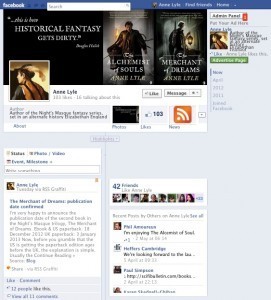 It might seem egocentric to have a “fan page” about yourself when you’re not even published yet, but really it’s just a handy way around the “mutual friending” structure of Facebook. If you don’t have a fan page, you will have to friend every single reader who wants to follow you – which means they get access to all the personal stuff you post! Much better—and safer—to set up a page they can Like. There’s also the advantage that Facebook pages are visible to the wider internet, including search engines, whereas your ordinary Facebook account is not.
Also, as mentioned above, once you are big enough to merit a Wikipedia page, Facebook will create a Page about you that you don’t control, so it’s worth getting in on the ground floor and attracting a following. That will push your Page above the automated one in any search results and ensure than anyone on Facebook who’s looking for you will find real, fresh information, not a bunch of third-hand, rarely updated stuff.
As you can see from the screenshot of my own page, the new “timeline” view allows, nay encourages, you to add an image to the top of your page. The size is fixed and a bit weird, so you may have to do some fiddling around with your chosen image to get something suitable.
I populate the page with my blog feed via RSS, and check back once or twice a day to see if anyone’s left a message. I also post the occasional bit of unique content, usually if I have some news that isn’t significant enough for a blog post but is too long for a tweet. Because I mostly post on here rather than my personal account, my friends who follow me aren’t swamped with content.
That’s really all I have to say about Facebook. If you love it you may find it a great promotional tool, but for me it’s just a way to reach a few more fans, particularly who don’t use Twitter.
My facebook pageIn the next post I’ll look at Goodreads, which is a social media site specifically for book-lovers – just what every writer wants!