Anne Lyle's Blog, page 14
September 21, 2012
Friday Reads: Waiting Room, by Emma Newman
This week, instead of the usual book review I am delighted to be hosting a free short story by fellow Angry Roboteer Emma Newman. Take it away, Emma!
Waiting Room“This is the twenty-ninth tale in a year and a day of weekly short stories set in The Split Worlds. If you would like me to read it to you instead, you can listen here. This story is part of the build-up to the release of the first Split Worlds novel “Between Two Thorns” in March 2013. Every week a new story is released. You can find links to all the other stories, and the new ones as they are released here, where you can also sign up to receive each story free in your inbox every week (starting at the very first one).”
When the woman with the nail through her hand left the waiting room Ben fidgeted. His arm was aching from keeping his left hand up in the air. And he looked like a dick.
His Mum tutted. “If you’d actually done what you were told, we wouldn’t be here now.”
“Everybody else does it.”
“That doesn’t make it a good idea. I thought you were more sensible than that.” When he didn’t answer she kissed the top of his head. “Is it hurting a lot?”
He shrugged. “Will they put a cast on it?” When Tim broke his leg everyone signed his cast and gave him tonnes of chocolate. Ben smirked as he remembered what he’d drawn on the back of the ankle. It had been worth the punch he got once Tim saw it on the removed cast.
“If it’s broken, probably.”
“Please be broken,” he whispered to it. If it was just a sprain he’d never live it down.
A man stumbled in, sweating and clutching a piece of cloth over his mouth like he was about to throw up. Ben picked out the three people who looked the most likely to be vomited on. He wished Tim was there so they could bet.
The man went to the desk and spoke through the cloth. The nurse, unimpressed, sent him to the waiting area. The man scanned the few empty chairs and then sat himself down opposite Ben. He still looked like he was about to throw up.
Mum shifted her feet to one side as she looked for another place to sit but there were no pairs of chairs free. “I’ll get you a drink darling,” she leaned over and added, “Tuck your feet under the chair in case that man is sick. And don’t bother him, he looks a bit weird.”
Ben took a proper look at the guy once his mother was gone. His right eye was badly bloodshot and his hands were covered in gravel burn. His t-shirt sported the new gold and red Flip logo, the same one Ben had got for his birthday.
“Did you have an accident?” Ben asked, pointing at the t-shirt with his good hand. “I got a Flip ‘board, that’s how I bust my wrist.”
“I came off my bike.” He was still speaking through the cloth.
Now he was closer Ben could see the cloth was a bandana. It was black with tiny skull and crossbones all over it. “Did you bust your teeth up or something?”
“No,” the man coughed. “I swallowed… something.”
“A fly?” The man didn’t reply. “Was it a-”
“You won’t believe me, so leave it, alright?”
“Tell me. Go on.”
“I think I swallowed a… fairy.”
“Eh?” It was the last thing Ben expected him to say. “Don’t be daft.”
“You ever had a fly in your eye?”
“Yeah.”
“Did the fly look massive?”
Ben nodded, remembering it well. When the tiny bug filled his vision the veins in its wings looked as thick as pencils.
“This twat stepped out into the road a bit ahead of me and got hit by a car and this thing he was carrying – it was jar or a lamp or something – it smashed. Those… things flew out of it. I swallowed one and it’s stuck,” he paused to cough. “But another went in my eye and it looked like a girl with wings and it was shining really bright, like a-”
“Sorry, is he bothering you?”
Ben jumped at the sound of his mother’s voice.
“No,” the man said, “it’s cool.”
“Benjamin Stephens,” a nurse called and Ben was ushered away.
Throughout the doctor’s assessment Ben thought about the man in the waiting room. Why say something like that? He probably liked winding kids up. Or he was tripping his ass off like Tim’s older brother did at weekends.
He whooped when he found out his wrist was broken. After a few days in a splint, once the swelling was down, he’d have a cast and all the chocolate he could want.
The man was still there when they went back out to reception with the cloth still over his mouth. Ben wanted to speak to him but his mother was steering him towards the exit.
“Mrs Stephens,” the nurse called her back. “I just need to go over a bit of paperwork with you.”
Ben waited until she was engrossed. “So I was thinking,” he said to the man. “If you did swallow a fairy, why are you keeping that bandana over your mouth?”
“I need the doctor to tell me if it’s really there. Otherwise I might be, you know, mental or something.”
“I can tell you,” Ben said.
The man shrugged. “Sod it. I’m sick of sitting here. You ready?”
Ben crouched in front of him and gave an eager nod. The bandana was pulled down and the man’s open mouth revealed.
“There’s something in there!”
The flap of skin at the back of the man’s throat was illuminated from behind, like he’d swallowed an LED and it had got stuck there. Ben could smell coffee on the man’s breath. The light got brighter as something emerged from the behind the skin but the source was too small to see properly. It shot out of the man’s mouth and zipped to the nearest window where it flew outside. Ben, who’d snapped his head back to avoid it, fell backwards into the chair behind him.
“Did you see it?” The man demanded.
Ben cradled his wrist to his chest, trying not to cry. His Mum rushed over and pulled him up by his good hand. She glared at the man. “Come on, we’re going home.”
“But what did you see!” the man said, but Ben didn’t know what to say.
“What was he talking about?” His Mum asked as they left.
“Nothing,” Ben glanced at the man as they passed the window. “He was just some weirdo.”
“Thanks for hosting, Anne!”


September 18, 2012
Human computer interface: digitising your handwritten prose
 Like pretty much every writer nowadays, I do most of my writing via a keyboard, whether that’s on my laptop, on the bluetooth keyboard tethered to my iPad, or (occasionally) using the software keyboard on my iPhone. However anything big enough to comfortably touch-type on is also too big to slip into my everyday shoulder bag, so I’ve been looking for alternative solutions. There’s also the issue that whilst I’ve long since become accustomed to writing the stories themselves on a keyboard, I still prefer to do background note-taking (world-building, plot brainstorming, etc) in longhand; it just feels more natural and organic. Unfortunately this means I end up with a lot of paper notebooks, which are difficult to search through!
There seem to be two major strategies for solving this problem: digitising your handwriting as you do it, and digitising the image of the handwritten text using OCR. Either way, the usefulness of the end result depends a great deal on both how neat your handwriting is, and how good the software is at recognition. If humans can barely read your handwriting, a computer isn’t going to have a snowball’s chance in Hell—and a garbled file full of nonsense words mixed with random characters is unlikely to be of much use to you.
With that caveat, here are my thoughts on the various hardware and software solutions I’ve tried.
On-screen handwriting recognitionThis is the type of digitisation I was most familiar with for years. As a long-time user of the Palm series of PDAs, I became fluent in Graffiti, their stylised “handwriting” that allowed direct digital input using letters handwritten on the device’s screen with a stylus. As a result, I’ve spent a long time looking for an equivalent for iOS (I have several styli, as they come in handy in cold weather when I need to wear gloves), and I have to say that I’m deeply disappointed. All the apps I’ve tested assume that you’ll want to use your normal handwriting, and so they put a lot of processing power into full handwriting recognition, which makes the app painfully slow even on an iPhone 4S. I’ve yet to find one that, like Graffiti, expects you to learn a simplified alphabet which the computer can easily recognise, which is highly frustrating for me. If you know of such an app, please, please let me know!
Optical character recognition (OCR)OCR has been around for quite a while, and is often used for digitising printed books that were never released in an electronic version. As software has become more powerful, however, it is now possible to digitise handwritten text as well.
The traditional method is to scan a document page-by-page using either a flat-bed scanner (necessary if your pages are bound into a book) or a more compact feed-through scanner. The latter takes up less desk space, but if you’re like me and mostly write in bound notebooks, a flat-bed scanner is your only option. Or rather it was, until very recently. The advent of smartphones with relatively high resolution cameras means you effectively have a portable scanner in your pocket—a fact that has now been exploited by popular note-taking app Evernote. Using the Page Camera option (available on the Add Note screen), you can take snaps of your notebook pages and slurp them into Evernote. They are even teaming up with Moleskine to create “smart notebooks” that make scanning more accurate. Naturally these don’t come cheap, but they might make a nice addition to your Christmas list!
The desktop version of Evernote also has basic handwriting OCR built in, so you can search the images of your notebook pages, but at the moment it doesn’t offer full digital conversion of text. Hence it’s no use for content that you need to put into a word processor, so you can’t handwrite your novel and then use Evernote to transfer it into, say, Scrivener. Also, I’ve tried using Evernote and Page Camera on my project notebook, but its handwriting recognition isn’t all that great unless you write very neatly, which I tend not to do in the heat of inspiration!
Finally, large high-resolution images use up a lot of bandwidth, which means that if you have more than a few notes, you’ll be obliged to pay for Evernote’s premium service (they cunningly include 3 months’ free subscription with the smart notebook) and presumably also consume more bandwidth on your mobile devices. If Evernote introduces the ability to do reasonably accurate OCR on files and then archive the actual images, I think it might be worth scanning in more of my notes, but right now it’s not a complete solution.
Smartpens This is the latest, most high-tech solution: you write on real paper with an electronic pen, and the image produced by your writing movements can be uploaded to your computer and then run through OCR software to produce a digital version. There are two main kinds of smartpen: one requires special paper marked with a grid of dots, the other uses normal paper but relies on a receiver unit to detect the pen’s movements. I own one of the latter type, an IRISnotes Executive, and I have to say that it’s pretty nifty. I’ll review it in detail next week, but so far I’m impressed by its handwriting recognition capabilities, at least when it comes to non-fiction. Of course smartpens are pretty expensive (prices start around $100) and require more practice to get right than using a normal pen and paper and then scanning the page. On the other hand they’re lightweight and don’t require you to buy (or find room on your desk for) a scanner.
In summary, there are now a number of ways to get your handwritten text into your computer, but there’s no one-size-fits-all solution. Still, they offer a potential bridge between paper and screen for those of us who still enjoy writing the old-fashioned way!
September 11, 2012
I need a hero: feminism, escapism and the female gaze
At WorldCon last week I attended a panel where one of the participants, Catherine Lundoff, announced she had just written a book called Silver Moon about a woman who becomes a werewolf when she goes through menopause. Several audience members reacted with “ooh, I’d love to read that!”, but I was not one of them. Don’t get me wrong; on an intellectual level, I appreciate that women, and especially older women, are too seldom the protagonists in SFF and that this is A Bad Thing, and yet…the premise didn’t exactly set me on fire. I much prefer books with male protagonists, or a mix of male and female. And of course that got me wondering why.

Adonis, by Bertel Thorvaldsen (Wikimedia Commons)
At first I thought it was because some readers prefer their protagonists to be much like themselves, whereas others (presumably including myself) prefer those who are different, in order to experience lives they can never have. That’s a big part of it, I think—escaping into a life that’s far more interesting than the real world—but there are plenty of strong, active female characters around these days, especially in contemporary fantasy. And yet they still don’t interest me as much as the men.
It’s well known that girls are more open to reading about male characters than vice versa, but what does that say about one individual’s preferences? Do I prefer reading about men because that’s what society has inculcated in me? Or because I don’t identify—and never have—with (stereo)typical female behaviour and hence my self-image is somewhat gender-neutral? Or maybe it’s something else entirely…
Back in April I was on a panel at AltFiction on the hoary old topic of diversity in fantasy, and made a quip about “the female gaze” as an explanation of why I enjoy writing (and reading) about male protagonists. More recently, Foz Meadows has written a very insightful article for the Huffington Post titled “Sex, Desire and Fan Fiction”, pointing out that a high percentage of fan fiction is written by and for women to cater to female readers’ appetite for erotic entertainment in the context of a relationship, in contrast with pornography for men, which isolates sex from relationships.
Reflecting on these points in relation to the issue of female protagonists made me realise that, regardless of whether there is any romance in a book, I want to fall in love with the protagonist—and for me that perforce requires a male character, preferably on the young side. (But not a teenager *shudders*) This habit is so ingrained in me that I can even fall in love with someone like Sand dan Glokta from Joe Abercrombie’s First Law trilogy, because despite his many flaws he’s intelligent and funny and heartbreakingly tragic. Yes, he’s also described as physically repulsive, but then so was Severus Snape—and who was cast in that role? Alan Rickman of the oh-so-sexy voice, guaranteed to make all the adult women in the audience swoon. The great thing about books is that you get to supply your own visuals.
So, I can only issue an apology to my sisters, and a heartfelt wish that you get all the female protagonists you want to read about. Me, I’m going to stick with writing about hot men 
Finally, going back to the title of this post, am I the only one old enough to remember this short-lived 80s TV show about a special agent who goes undercover as a male model? Warning: 80s big hair alert!
September 6, 2012
Chicon 7 (Worldcon 2012)

Chicago skyline from the south (seen from terrace of Field Museum)
A few days ago I flew out to Chicago for my first US convention, Chicon 7 (aka Worldcon 2012), the 70th World Science Fiction Convention. I was very excited about it, mainly because it was a chance to finally meet a whole bunch of writer friends from the other side of the Pond, as well as being only my second trip to the States. For starters, I got to meet fellow Angry Robot authors Chuck Wendig, Madeline Ashby, Lee Collins, Matt Forbeck and Wesley Chu; Wes is a local, so he took us along to a restaurant for the obligatory Chicago-style deep-dish pizza (though I have to confess I much prefer New York style thin crust).
I had a busy schedule at the convention: reading and signing sessions, as well as three panels. The first panel, on Writing Gender Roles in Science Fiction (and fantasy – we didn’t confine ourselves to SF) was at 9am on Friday morning, and I was feeling both jetlagged and hungover—the latter a result of staying up late drinking scotch and chatting with Doug Hulick and a bunch of fencers. I was therefore not really on top form, especially when it came to giving examples of good gender writing in fantasy; indeed my main interest in the topic is down to the paucity of same, particularly in epic fantasy. That’s not to say that epic fantasy is uniformly bad in this respect, but picking out books worth recommending is another matter entirely.
My second panel, on Constructed Languages in Science Fiction and Fantasy, was rather less stressful, and it was awesome to find myself sitting next to moderator David Peterson, who created the Dothraki language for the Game of Thrones TV show. I only wish I had had time to talk linguistics with David outside the panel, as he chose to focus on general advice for writers rather than a technical discussion of language design. Finally I did a panel on Saturday morning called Why I Love My Editor. Since I only have one book out, I didn’t have any horror stories of errors that made it into print, but I was able to talk about my own editing process and of course about the pleasures of working with Marc and Lee of Angry Robot.

Panel on “Violence in Fantasy”. From left to right: D H Aire, Scott Lynch, Douglas Hulick, James Enge
In addition to sitting on panels I also attended a few. Violence in Fantasy, moderated by Scott Lynch, was entertaining and sometimes thought-provoking, as was Vivid Character Building. The latter panel’s members (Kay Kenyon, Carol Berg, Brian Thomas Schmidt, Teresa Frohock and Randy Henderson) had a wide variety of approaches to the topic, which is always helpful. I only wish I’d made more notes! The other really good event I attended was a one-man talk by Ramez Naam, one of Angry Robot’s newest authors, on Merging Mind and Machine. This was a look at past research, current technologies and possibilities for the future—all utterly fascinating.

Playing “Apples to Apples”: Mur Lafferty, Chuck Wendig and Paul Cornell
Of course conventions aren’t just about the formal programme. For new authors like myself, they’re a great opportunity to meet one’s peer group and network informally, particularly in the bar! Mostly it’s just sitting around drinking and talking, but one night I did get roped into a silly card game called “Apples to Apples”. I won my first round out of sheer beginner’s luck, but Mur won the game overall. (Apologies for the terrible photo, which was taken with my phone.)One of the most awesome parts of networking is getting to meet so many people who, until now, were just names on book spines. For example, the night after I saw him on a panel, I met Scott Lynch and just about managed to rein in my fan-girl reaction when he said that my book was on his TBR list! And in addition to Mur Lafferty, I got to meet a couple of other favourite podcasters: Howard Tayler and Mary Robinette Kowal of Writing Excuses. I also spoke to Elizabeth Bear, Carol Berg, Saladin Ahmed…the list just goes on.
As well as these famous names, I hung out a good deal with fellow debut authors Doug Hulick, Mike Cole, Kameron Hurley, Teresa Frohock, Courtney Shafer, Brad Beaulieu and Mazarkis Williams, drank some more whisky and ate dried crickets and mealworms at the Night Shade Books room party. It was all Kameron’s idea, since her book has bugs in; you were challenged to eat a bug in order to get a free book. I didn’t need any more books, but I ate some of the bugs anyone, just out of curiosity. For the record, the cricket was very dry and felt like it stuck in the back of my throat, but the mealworms were quite nice.
No convention would be complete without a tour of the dealers’ room. I’m afraid I went a bit mad and ended up with three t-shirts, two books (a secondhand paperback of Shadowspawn by Andrew Offutt and a personalised signed copy of Shades of Milk and Honey by Mary Robinette Kowal), two necklace-and-earring sets and a steampunk pocket watch! I could easily have spent twice as much, but I didn’t want to over-stuff my suitcase and get charged for it.

A cheeky squirrel in Grant Park
On Sunday I took a day off from the convention to spend time with my husband (who came to Chicago but didn’t want to attend the con). We had a lie-in and a late breakfast, then walked through Grant Park in search of entertainment and culture. On the way I spotted a remarkably russet-coloured grey squirrel; like most urban park squirrels he was quite tame and came closer when called. Not too close, however, especially once he worked out we didn’t have any food for him!
We were going to go to the Chicago Institute of Art, but there was a horrendously long queue and it was a hot sticky day so we ventured further south. Eventually we reached the Field Museum, which specialises in anthropology and zoology—two of my favourite topics! The museum is enormous, and I could happily have spent at least a day looking around it, probably more. Sadly the Genghis Khan exhibition was sold out, but there was plenty to see in the extensive Native American galleries. All the major cultures of the Americas are covered, with artefacts ranging from Aztec gold and jade to woven baskets from the Pacific Northwest, and even replica houses.

A tiny hand-carved fetish – a fox or maybe a badger?
At the museum shop I bought a book about pre-Columbian America and a hand-carved stone fetish. This little fellow now has pride of place on my desk, and I hope he will bring me some fox-like cunning to aid my storytelling 
Sadly I was too exhausted from my tourist day to attend the Hugo awards, so I didn’t get to meet Neil Gaiman. Still, I did meet nearly everyone else I had hoped to, and more besides. All in all it was a fantastic convention, possibly the best I’ve attended so far, with a great programme of events and an amazing guest lineup. Apologies to anyone whose name I have omitted; there were just too many to list.
We flew back to England on Tuesday; I was happy to be going home, but sad to be saying goodbye to so many new friends. However World Fantasy is in Brighton next year and, better yet, London has won the bid to host Worldcon 2014, which hopefully means that some of them will be coming over to visit. I know I can’t wait…
August 25, 2012
Mal’s tattoo in the flesh – literally
Back when I was writing the pre-submission draft of The Alchemist of Souls, I rashly promised myself that if I ever sold the book, as a memento I’d get a copy done of the tattoo Mal is given during the course of the story. It felt particularly appropriate since Ambassador Kiiren says that it’s “for remembering”…
The manuscript did indeed sell, and a lot quicker than I expected! However it also happened just before one of the big SFF conventions of the year, so I put off getting the tattoo until I had time between events for it to heal. Weeks turned into months, and logical delays into procrastination (a bit like writing!). I found myself making excuses: I needed someone to design it for me…not true (I’ve worked as an illustrator, I can design a simple tattoo, for heaven’s sake!); this was a serious decision…well yes, but when did that ever stop me from doing rash things before?
A couple of months ago I realised that if I didn’t get it done ASAP, there wouldn’t be time for it to heal before WorldCon, and then I’d have to put it off—again!—until the end of the 2012 convention season. So, I sat down with sketchpad and pencil and drew a design. Here’s the description from The Alchemist of Souls: “…a knot of thorns surrounded by five-petalled flowers”. At the time of writing I wasn’t exactly sure what it looked like, only that it was meant to represent white hawthorn, a North American species similar to our native English hawthorns. On reflection I decided it was probably a stylised, symmetrical image similar to a Japanese mon (a type of heraldic emblem). I really wasn’t happy with the first attempt and I nearly gave up, but I knew I’d kick myself if I did. Instead I did some research online, looking at real tattoo designs similar to what I had in mind, and tried again.

The initial pencil sketch – thank goodness for protractors!
The second sketch (right) was 1000% better, so I went ahead and drew up a final version in black ink. The hardest part was summoning the courage to phone a local tattoo parlour (recommended to me by a friend) and enquire about appointments. As it happened they were all booked up, but they do drop-in sessions on Saturdays. I duly turned up as soon as they opened on Saturday morning, and thankfully they were able to do it there and then, since it was a small straightforward design. Having made my decision, signed the consent form and handed over payment, I felt a lot calmer—the only way to get out of it now meant making an utter fool of myself!
Thankfully tattoo parlours have come a long way from the grubby backstreet establishments of my youth. The basement of Tattoo Crazy is spotlessly clean and looks like a cross between an art supplies shop and a physiotherapy clinic, with big adjustable reclining chairs down one side of the room and boxes of marker pens and layout paper on the other. In the window, watching over proceedings, is a two-foot-tall wooden statue of the Teaching Buddha with, appropriately enough, earlobes stretched from wearing plugs.

The finished tattoo, a few days later
The procedure took a little over an hour. To begin with it was a lot less painful than I expected—it felt a lot like being drawn on with a very fine fibre tip pen—but towards the end it did get rather uncomfortable, as my arm and neck were stiff and Thomas (my tattoo artist) was going over areas that had already been done, filling in gaps and generally tidying up the design. I was thus very glad when it was over, but also thrilled with the finished tattoo. In tracing the design for transfer, Thomas had tidied up my rather wobbly flowers but left the more meticulously drawn thorns as-is; as a result, the design is superficially symmetrical but not so rigidly so as to look like it was drawn by a computer. Which is fortunate, since it’s supposed to have been drawn freehand by a skrayling!
I’m told that tattoos are addictive and it’s rare for people to have just one, but this one is so personal that a second tattoo would have to be something pretty special to merit a place alongside Mal’s hawthorn.
August 24, 2012
Friday Reads: The Whitefire Crossing, by Courtney Schafer
 Dev is an outrider: a talented mountaineer who helps scout out potential rockslides and avalanches for merchant convoys crossing the Whitefire Mountains. He also has a nice sideline smuggling illegal magical items from the mage city of Ninavel across the border into Alathia. But when he’s asked to smuggle a person across the border—a young man named Kiran who turns out to be an apprentice mage fleeing his abusive master—Dev finds himself having to risk his own life and those of his friends, or face breaking the promise he made to his dying mentor: to save a young girl from being sold into prostitution.
I confess that the main reason I picked this book up is that Schafer was one of the other debut authors on the recent blog extravaganza that I was involved in. I tend to prefer my fantasy low on magic, and I’ve also found that I don’t enjoy descriptions of wilderness travel that much, so the premise of this book didn’t set me afire. However I’m glad I didn’t let my prejudices stop me, as it turned out to be an enjoyable read—to the point of being difficult to put down!
For one thing, Schafer has a light touch with detail and resists the temptation to which many writers succumb, of being so in love with their specialist subject that they do the literary equivalent of cornering you at a party and boring your socks off. There are some descriptions of climbing, and a lot of obvious knowledge of mountain conditions, but for the most part these are merely the framework for the human story of Dev and Kiran’s desperate flight from Kiran’s master.
As for the magic, I’m no aficionado but it didn’t seem all that different from what I’ve seen in countless other fantasy books. However as with the climbing it wasn’t wrapped up in too much jargon or described in obsessive detail, so it didn’t get in the way of my enjoyment of the story. The jargon that is used has a distinctively Russian flavour, though it was hard to tell if this was specific to the small group of mages using it or a wider aspect of the worldbuilding. Still, it made a refreshing change from the usual Latin-based magical vocabulary, which has seriously worn out its welcome thanks to Harry Potter. Also, the master mages are deliciously psychopathic in a way that makes complete sense, so that they are at once utterly despicable villains and yet chillingly believable people.
What sold the book for me, though, was the combination of two charming lead characters and a plot that never lets up the tension for long. Dev’s passages are told in first person, in a laconic, fairly modern idiom that soon had me hearing Jensen Ackles as his voice! Because of his well-developed character, his inner conflicts didn’t come over as whiny or angsty (as they can so often do), but as the voice of a man embittered and frustrated by the unfairness of life. By contrast, Kiran’s scenes are told in third person, with the result that his voice doesn’t come out as strongly as Dev’s. I’m not clear on the reason for the different approach, though it may be that Schafer needed a certain detachment from Kiran in order to make him more morally ambiguous, or possibly to avoid any whininess and excessive self-pity, since he’s both less sassy and street-smart than Dev and a survivor of far worse childhood abuse.
As for the plot…at the beginning of the book, Dev and Kiran don’t trust one another at all, leading to a lot of interpersonal conflict to spice up what could otherwise be a somewhat dull travelogue. And even when they do reach a measure of mutual friendship, that’s torn apart again by the complex scheming of the mages and smugglers, all of whom are trying to take advantage of Kiran’s flight over the border. I confess I didn’t see the final twist at the book’s climax coming, and yet Schafer had set it up nicely. The pace slackens towards the end, as the consequences of Dev and Kiran’s actions are played out, but the denouement also serves to introduce an interesting new character whom I hope will appear again.
One minor gripe I had was that in addition to the very welcome asterisks between scenes (I read this in ebook format), PoV switches were marked by the character’s name in brackets as a header. I didn’t feel this was necessary, given we have only two PoVs and they are pretty distinctive. Also, because PoV breaks often happen mid-chapter, it just looks less elegant than George R R Martin’s chapter-named-after-PoV approach. There seems to be a definite trend on the other side of the Pond for editors to want to simplify things as much as possible for readers—c.f. Jon Courtenay Grimwood’s recent account on SF Signal of the combined UK/US edit of his book—so I don’t know whether the headings were in the original manuscript or added by the publisher, but I for one felt patronised by the device.
Overall: a very entertaining and assured debut, and I’m looking forward to reading the sequel, The Tainted City, which is due out in October. Although looking at my TBR pile and my writing deadlines, I may have to wait rather longer than that…
August 21, 2012
Web presence 101.7 – Goodreads
 Goodreads is an online reading community that’s grown rapidly in the past couple of years, easily outstripping LibraryThing and other rivals. You can use it to help manage your book collection, post reviews and ratings, and join in online bookclubs. And if you’re a writer, once you have a book out (whether self-published or through a conventional publishing house), you can upgrade your account to “Goodreads Author”, which makes it easier to find out what your readers think of your book!
As I don’t get a lot of time for reading these days, I don’t have much experience of the reading side of Goodreads. I’ve added a selection of books from my shelves, though it’s by no means comprehensive, and I use it to maintain my to-read list. If you do want to add books to Goodreads and have a smartphone, they do a great app that includes a barcode scanner—it only works with fairly recent books that have the long ISBN numbers, but it speeds up the process considerably.
Once you have an author account, you’ll get a dashboard that gives you easy access to all your books as well as a bunch of widgets to use on your website plus other promotional tools.
Reader reviews I’ve written elsewhere about why I read reviews, but whether or not you choose to read them I think Goodreads deserves a special caveat: do not trust the numbers! Because it’s a large busy site, they cache a lot of the statistics (total numbers of reviews and ratings, average ratings, etc) and you will soon discover that these numbers differ on different parts of your dashboard. At the time of writing, my dashboard says I have 77 text reviews but I can find only 75. Sometimes this is because people write comments in the ‘review’ field before they’ve finished and rated a book, and Goodreads doesn’t filter these out. And if a reader changes their mind about a rating, both values may be listed for a day or two. For the sake of your sanity, take the figures as a rough guide only!
Also, as with all reviews, don’t let the lower ratings get you down. You can’t please all the people even some of the time, and I’m sure you know of plenty of well-written and/or popular books that you didn’t enjoy, so cut your readers some slack. And sometimes those 1-star ratings are from people who haven’t even read your book—they may for example be attempting to “train” the suggestion algorithm by downgrading books that don’t look interesting. No fun for you, but luckily these people are in a minority.
WidgetsGoodreads have created a range of buttons and widgets that you can incorporate into your own website, such as the “Read reviews on Goodreads” button that I use in my little promo box in the margin of my blog. I advise caution when it comes to the interactive widgets, however; Goodreads is down quite often, which means your widget will be empty or even slightly broken-looking whenever that happens.
Other promotional toolsIf you have physical copies of your book, you can arrange a giveaway before it comes out or up to six months after publication. In my case my publisher did it for me, in the US at least, and nearly 900 people signed up! Of course a great many of these unlisted my book when they didn’t win, but around a third still have it listed as to-read, so it’s definitely an effective promotional tool. Note that you can’t give away ebooks; I don’t know if this is to prevent the system being swamped with self-published titles (since most self-pubs are ebook only), or whether the abundance of free ebooks means they aren’t seen as a valued promo, but either way you’re limited to print copies and the expense of postage that entails.
Free tools include a Facebook fan page app and the ability to set up a Q&A group, but I’ve never managed to get the former to work and I have yet to try the latter. I guess I’m worried that, being a debut author, no-one would turn up, and it would just be me and the tumbleweed!
If you’re self-published you might also want to consider advertising your book, but I know nothing about this side of Goodreads.
In summary, Goodreads is a great site to connect with readers—just don’t let yourself get obsessed with the numbers!
Next time I shall look at the new kid on the block, Pinterest. If a picture paints a thousand words, does a writer need a virtual pinboard?
August 17, 2012
Chicon 7 Schedule
An unexpected post today, as I belatedly* received my Worldcon schedule this morning!
Thursday 30th August
4.30-6pm Signing
Friday 31st August
9-10.30am Panel: Writing gender roles in science fiction
1.30-3pm Panel: “To Be” or not “To Be”: constructed languages in SF&F
Saturday 1st September
10.30am-12pm Panel: Why I love my editor
6.30-7pm Reading
So, a busy couple of days at first, then I’ll be chilling out on Sunday so that I can enjoy the rest of the con without collapsing in a heap!
* I didn’t receive my confirmation email at the same time as everyone else – must have been lost in the ether, or perhaps caught in a spam trap? – so on impulse I contacted the organisers yesterday, just in case. So glad I did!
August 14, 2012
Failing the Bechdel Test gracefully

“Two women” by Hokusai
The Bechdel Test is a well-known yardstick used by writers and critics to assess the feminist credentials of a narrative. Taking its name from an episode in Alison Bechdel’s comic strip Dykes to Watch Out For, the basic principle is that in order to pass the test, there must be at least one scene in which two women talk about a topic other than men.
Some people define it very strictly, in that the conversation shouldn’t mention male characters at all, but this is (IMHO) an impractically tight definition that excludes a lot of films, TV and books with positive portrayals of women. Taken to extremes, it means that a scene where two female cops discuss their strategy for taking down a male criminal doesn’t count, whereas one where they talk about shoes means a pass (and one could even say that the latter is far less feminist* for being focused on sexual attractiveness, not professional competence). Personally, I prefer a more liberal interpretation: the conversation doesn’t have to avoid all mention of men and relationships, but they should be incidental to the topic rather than the topic itself. For example, if two women talk about their favourite books, should the scene fail just because they don’t restrict the conversation to female authors? Personally I’d say no, not unless the conversation turns to which of the male writers is more attractive!
At any rate, it’s something I’ve thought about a lot whilst writing my Night’s Masque series, because gender plays an important role in the story. But do my books pass?
I chose to write a novel set in the Elizabethan period for many reasons—the plays and poetry, the gorgeous costumes, and the extraordinary parallels with our own times, for a start—but in doing so I’ve saddled myself with the decidedly un-PC attitudes of the times as well. Elizabethan society was pretty well segregated along social lines, in that a respectable woman had few opportunities to socialise with men outside her own family and her husband’s social circle.
I was therefore faced with a choice between an all-male core cast or trying to fit a female character into the story without totally violating Elizabethan mores. I decided to attempt the latter, not because I felt obliged to include a token female but because I wanted a diversity of point-of-view characters for my own satisfaction as a writer. The character who eventually became Coby started out as a respectable young widow, but as I wrote and revised the early chapters I found it increasingly difficult to believe in her as someone who would run around Southwark with a bunch of, frankly, disreputable young men. So, I decided she was an orphan who had disguised herself as a boy to get a proper job (i.e. anything but prostitution).
All well and good—and nicely Shakespearean!—but as a result, in all of Coby’s scenes with women they are acting on their belief that she’s a boy, at which point I guess the Bechdel test goes out of the window! On those grounds, The Alchemist of Souls is a big Fail. And honestly, I don’t care. The only way to make it pass would have been to write a completely different book.
In The Merchant of Dreams, which has just gone off to my editor, Coby gets to spend some time in female guise at last, and the book just about squeaks a pass as a result. She doesn’t have many conversations with women, and the ones she does have are often limited by language barriers, but as the revisions went on I found myself coming up with more and more opportunities to introduce female characters for her to interact with. It wasn’t a conscious decision; looking back, I think it’s simply that Coby now has a much wider range of options than any other character in the book because she can present as either male or female, and in this historical milieu that opens up more storytelling possibilities than confining myself to one sex.
I’m therefore interested to see how things will work out in the final volume, The Prince of Lies. Whilst I do my best to create an outline for a book before I start writing, it tends to be a rough sketch rather than a blueprint, and new ideas occur to me right up to the last draft. What happens next for Coby is still up in the air, and my focus is on staying true to her story, wherever that might take me. For me, respecting your characters means letting their story arcs develop at the right pace and in a direction that’s believable, not imposing arbitrary rules.
* For a sharply satirical look at the extremes of feminism, I strongly recommend Is This Feminist? (thanks to Emma Jane Davies for alerting me to this hilarious Tumblr blog)
August 7, 2012
US book giveaway: signed copies of The Alchemist of Souls
My patient North American fans will be glad to know I’m planning a US/Canada book giveaway this month!
3 personalised signed copies will be up for grabs – note that these will be the (slightly larger) UK edition, not the US mass market paperback.
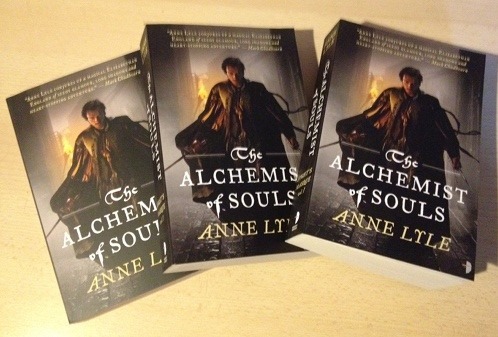
All you have to do to be in with a chance is to leave a comment on this post. If you win, you will receive a brand new copy of the UK paperback edition of The Alchemist of Souls, signed by yours truly!
Please note that comments are moderated to reduce spam, so don’t panic if yours doesn’t appear right away.
Rules:
You must live in the US or Canada to enter (sorry – worldwide postage gets expensive) One comment per entrant, please – multiple commenters will be disqualified. For security reasons, please don’t leave contact details in your comment – there’s a space in the comment form for your email address, I’ll use that to get hold of you. Closing date for entries is noon PST time on Tuesday 14th August. Any comments posted after that deadline will be deleted. I will be picking three separate winners (using a random number generator), to receive one copy of the book each. Selected winners must respond to the confirmation email by Sunday 26th August, so that I can pack the books and bring them with me to Chicago (saves on postage ) If a winner does not respond by the stated deadline or cannot supply a US or Canadian postal address, I reserve the right to select a replacement. Good luck!