Cameron Cooper's Blog, page 3
March 12, 2025
Murderbot is Coming to TV: Excitement, Anxiety, and a Few Questions
Like many fans of The Murderbot Diaries, I was both thrilled and deeply wary when I heard that Apple TV+ was adapting Martha Wells’ beloved series. On one hand, more Murderbot! On the other… well, adaptations are tricky, aren’t they? They can capture the heart of the source material (The Expanse), fumble it (Wheel of Time), or turn it into something unrecognizable (Foundation—which, to be fair, I ended up loving once I let go of my expectations).
So, how will Murderbot fare? Will it be faithful to the books? Will it alienate fans? And what about the casting choice that threw me for a loop?
Murderbot’s Snark and Humor—Can TV Capture It?One of the greatest joys of the Murderbot Diaries is Murderbot’s voice—snarky, self-deprecating, socially anxious, and filled with dry, dry humor. The books succeed because we’re in Murderbot’s head. That’s where the magic happens.
How will the show pull this off?
Will there be a voiceover narration? (Risky, but it’s worked before.)Will we get some clever on-screen text of Murderbot’s internal thoughts?Or will they try to make Murderbot’s inner turmoil visible through acting alone? (That’s asking a lot of an actor, even one as talented as Alexander Skarsgård.)It’s a tough challenge, and I hope the production team understands that Murderbot’s charm doesn’t just come from action scenes—it comes from their personality.
The Skarsgård Question: Wait, That Guy?!Speaking of Murderbot’s personality… let’s talk about casting.
When I first heard that Alexander Skarsgård was playing Murderbot, I was stunned. I know him best as the incredibly male, intensely sexual vampire Eric Northman from True Blood, and that is not how I pictured Murderbot.
Which is interesting, because Murderbot doesn’t really have a gender. They don’t care about gender, don’t perform it, don’t think about it. And yet, somewhere along the way, I must have unconsciously imagined them as vaguely feminine—perhaps because Martha Wells is a woman? Maybe? I didn’t realize my own bias until Skarsgård was announced.
Now, I’ve seen a few images of him in the role, and they do seem to have gone for a more androgynous look—which is the right call. But is it androgynous enough? Time will tell.
And I have to ask: Did they consider casting a woman? Or someone non-binary? I can’t help but feel that this was a missed opportunity.
Adaptation Anxiety: Will They Get It Right?Book-to-screen adaptations always walk a fine line between staying faithful to the original and making changes to suit a different medium. Some (The Expanse, Dune) manage to respect the spirit of the story even when making significant changes. Others (Wheel of Time, The Golden Compass) have struggled, often alienating fans.
Apple TV+ has already taken on a sci-fi behemoth with Foundation, and while it was visually stunning and narratively ambitious, it was not a faithful adaptation. (I got over it, but many fans didn’t.)
Will Murderbot get the same treatment? Will the showrunners keep what makes it Murderbot, or will they Hollywood-ize it, turning our anxious, TV-loving, reluctant hero into something more traditionally “heroic”?
I’m both excited and nervous to find out.
The Bottom Line: Cautiously OptimisticAt the end of the day, I want this adaptation to be good. I love these books. I love Murderbot’s voice, their reluctant found-family dynamics, their sarcastic but deeply caring nature. I want the show to do them justice.
But I’m also bracing myself for the possibility that it won’t. That the nuances of Murderbot’s identity might get flattened. That the humor might not translate. That they’ll turn it into a generic action-packed sci-fi thriller instead of the deeply character-driven, introspective, and often hilarious story that it is.
So I’m preparing for that first episode with a mix of excitement and dread. Here’s hoping Apple TV+ gets it right.
What do you think? Are you excited? Nervous? How did you picture Murderbot before the casting was announced? Let’s discuss in the comments!
Now available for pre-order:
Solar Whisper
Latest releases:
Ptolemy Lane Tales Omnibus
Galactic Reflections
The Return of the Peacemaker


March 5, 2025
How to Hack BookFunnel Promos for Maximum Reading Gain
Last week, I talked about author email lists, free books, and how to handle them in a way that benefits both readers and authors. This week, as promised, I’m diving into BookFunnel promotions—one of the biggest and best ways to load up your e-reader with fantastic books, discover new authors, and grab deals you won’t find anywhere else.
If you’re not familiar with BookFunnel, here’s a quick rundown:
It started as a service for authors to deliver ebooks directly to readers—whether for free downloads, review copies, or sales.Over time, it became a powerhouse for group promotions, where multiple authors team up to showcase their books in one place.These promos are mostly hidden from the general public—you typically have to be on an author’s email list to hear about them.So why should you care? Because BookFunnel promos are an absolute goldmine for readers who know how to use them right.
Why You Should Pay Attention to BookFunnel PromosBookFunnel promotions give you access to:
New and new-to-you authors—discover writers you may not have found otherwise.Updates on your favorite series—find books that might not be widely promoted elsewhere.Freebies and heavily discounted books—get full-price books for free or at a deep discount.Exclusive deals—some sales and giveaways are only available through BookFunnel.Samples and excerpts—some books offer previews, so you can check them out before committing.In short, BookFunnel lets you stuff your e-reader for very little money—or for free. But you have to know where to look and how to use it effectively.
The Two Types of BookFunnel PromosThere are two main kinds of BookFunnel promotions:
1. Giveaways (Free Books)How they work:
Books in these promos are 100% free, but you usually need to sign up for the author’s email list to get them.Some giveaways include full novels that are normally paid books.Others offer short stories, novellas, or series previews—a great way to try out a new author without committing to a full book.Some books are “partials”—a significant chunk of the book, often 10+ chapters, but not the full story. This is a great way to get an extended preview before deciding if you want to continue.How to use giveaways wisely:
Download books from your favorite authors—you might find paid books offered for free here.Use them to test new authors before buying their other books.See last week’s post about handling author email lists—if you’re not ready to read the book yet, unsubscribe.2. Sales PromotionsHow they work:
These promos showcase books that are on sale, but you purchase them from external retailers (Amazon, Kobo, etc.).Sales can focus on specific themes or formats, such as:Kobo Plus (where books are free for subscribers)Boxed sets and anthologiesPre-orders and upcoming releasesNew releasesRetailer-specific discounts (Amazon-only, Google-only, etc.)Direct sales from an author’s own bookstoreImportant tip: Even though these are called “sales,” some books in the promo might still be free—so always check.
Hacks to Make the Most of BookFunnel Promos1. Don’t get overwhelmed by the book covers.When you open a BookFunnel promo, you’ll see a massive grid of book covers. That can be intimidating. Here’s what to do:
Click on any book cover to open its full details page.Read the blurb, price, reviews, and check for discounts or excerpts.Hit your right arrow key—this moves you to the next book’s details page without going back to the main grid. (Or swipe to the right or left on mobile devices.)Much easier than clicking back and forth.
2. Use the BookFunnel BookshelfEvery book you download through BookFunnel is stored in your personal BookFunnel Bookshelf:
https://My.BookFunnel.com
If you lose the download email, can’t find the link, or just want to grab the book later, it’ll still be there waiting for you. No more lost books.
3. Read Books Directly on BookFunnelDid you know that you don’t even need an e-reader to read books from BookFunnel?
Most books can be read right in your browser using BookFunnel’s built-in reader. This means you can start reading instantly—no downloads required.
4. Get the BookFunnel AppIf you use BookFunnel a lot, download their app.
This makes downloading books much smoother, especially if you have multiple devices.
5. Stuck? BookFunnel’s Customer Support Is AmazingUnlike big retailers, BookFunnel actually has helpful customer service—and their entire job is to make sure you get your books.
If you can’t get a book onto your device, click the “Get Help” link at the top right of any BookFunnel page.
Or email them directly: Help@BookFunnel.com
They will walk you through the process, no matter what kind of device you use.
6. BookFunnel Promos Aren’t Just for Ebooks—They Include Audiobooks, TooIf you love audiobooks, keep an eye out for BookFunnel promos that include them! Some authors offer full audiobooks, exclusive previews, or special discounts.
Final ThoughtsBookFunnel is one of the best reader resources out there, but a lot of people aren’t using it to its full potential. By understanding how giveaways and sales work—and using the hacks I outlined—you can get the most out of every promo while keeping your e-reader stocked with books you actually want to read.
Latest releases:
Ptolemy Lane Tales Omnibus
Galactic Reflections
The Return of the Peacemaker
He Really Meant It
February 26, 2025
Getting Free Books – Some Controversial Thoughts
Free books are everywhere. You can find them on every major retail platform, on author websites, in BookFunnel and StoryOrigin giveaways, at signings, in newsletters, and beyond. Readers can easily fill their e-readers with thousands of books without spending a dime. I know this because I’ve done it myself.
But here’s where things get interesting: Readers are increasingly frustrated when an author asks them to sign up for an email list in exchange for a free book. I’ve heard readers say they feel like they “should” be able to get the book with no strings attached. That signing up is a hassle. That they don’t want “more emails.”
Let’s unpack that a little.
The Reality of Writing a BookFirst, let’s look at the actual investment an author puts into a book. Writing isn’t just a hobby; it’s work. And even for those who write quickly, it’s time-intensive:
A fast writer can churn out 1,500 words per hour.The average writer manages 1,000 words per hour.A slow writer? About 500 words per hour.A standard-length novel takes 75 hours to draft if you’re writing at an average pace. Then there’s plotting, which, conservatively, adds another 75 hours. That’s 150 hours before the book is even ready for editing.
And we’re not done. There’s:
Editing (and proofing).Cover design.Formatting and distribution.Basic marketing (just letting readers know the book exists).These tasks easily add another 50 hours, bringing the total to 200+ hours per book. If you value an author’s time at $35.43 USD per hour (according to the U.S. Bureau of Labor Statistics), that’s $7,086 USD of labor alone. Add a low-end estimate of $250 for a cover and $750 for editing, and you’re looking at an $8,000+ investment.
And then… they give it away for free.
Why Do Authors Give Books Away?Because readers expect it.
Many readers have been trained to assume that at least the first book in a series should be free. I’ve even had angry emails from people upset that my first-in-series book isn’t free. But the reason authors do this isn’t just generosity—it’s strategy.
Free books let readers sample an author’s work.The hope is that, if you enjoy the free book, you’ll buy the next one in the series.Free books are also a way to introduce readers to the author, their world, and their writing style.And asking for an email sign-up in return? That’s a way for an author to build a relationship with readers, not just toss books into the void.
The Problem with Free BooksHere’s the truth: Most authors would rather you read their book than just collect it.
But let’s be honest. Most people who download free books don’t read them right away. Some won’t read them at all. I know readers who have confessed to having 5,000+ unread books on their e-readers. (I might have a few myself…)
That’s fine! Life is busy, and books are long. But here’s my controversial opinion:
If you’re not going to read the free book right away, don’t stay on the author’s email list.
Why?
Authors pay for their email list subscribers. It’s not free for them.You don’t know if you like their writing yet, so their emails won’t mean much to you.You might end up resenting the emails and marking them as spam—which, frankly, is rude. You signed up for them.A better approach?
A Smarter Way to Handle Free BooksDownload the book.If you’re not going to read it right away, unsubscribe from the author’s email list.Don’t clog your inbox with emails from an author you don’t know yet.Save the spot for authors you genuinely enjoy.Actually read the book.If you don’t like it? Delete it.If you enjoy it? Buy the next book in the series.Once you’ve read and liked the author’s work, then join their email list.Now their emails will be relevant and interesting to you.The author will appreciate having engaged readers instead of passive subscribers.This way, both you and the author win. You get books you’re actually excited about, and they get readers who genuinely want to hear from them.
Coming Up Next…Now that you know how to handle free books in a way that benefits both you and the author, next week, we’ll talk about how to maximize one of the biggest resources for free books: BookFunnel promos. Stay tuned!
February 19, 2025
The Return of the Sail—On Earth and Among the Stars
 Oceanbird. How cargo ships could look in the near future.
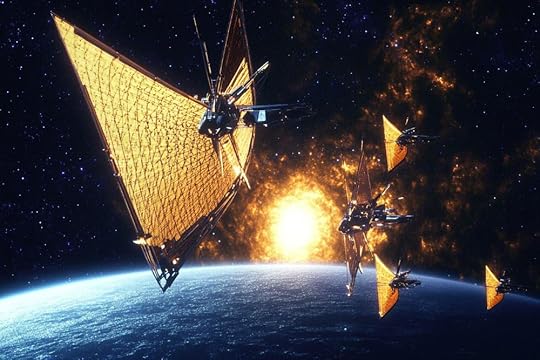
Out in the deep, where the stars burn cold and distant, and many years from now, old space dogs who miss the silence and loneliness of deep space race their solar yachts, harnessing the silent power of starlight to propel them through the void. No combustion, no fuel—just the delicate physics of light pressure on vast, shimmering sails. It’s a vision of the future, one where humanity reaches beyond, moving not with brute force, but with elegance and efficiency.
Yet even as solar sails become a reality in the speculative realms of science fiction, something fascinating is happening here on Earth: sails are making a comeback. Not the billowing sheets of the Age of Exploration, but sleek, high-tech rotor sails—spinning cylinders that generate propulsion through the Magnus effect. When these tall, rotating cylinders interact with the wind, they create a pressure difference that generates thrust, much like how a spinning baseball curves through the air. This allows massive cargo ships to harness wind power in a way that is both futuristic and deeply rooted in physics.
It’s the ultimate full-circle moment.
For centuries, the wind drove human exploration. Then steam and diesel engines took over, relegating sails to nostalgia. But now, as we stare down the realities of climate change and fuel scarcity, the old technology—refined and modernized—is proving to be the way forward. The cargo industry, responsible for a staggering amount of global emissions, is looking to sails to reduce its carbon footprint. High-tech versions of wind-assisted propulsion, like the rotor sails being trialed on freighters, are already demonstrating real fuel savings.
What makes this so compelling is that the same principle—using the forces of nature rather than brute mechanical energy—applies to deep space travel. In Solar Whisper, the solar yacht racers rely on the same kind of ingenuity, catching the faint but relentless push of photons against their ultrathin sails. They navigate the void much like sailors once read the winds, trimming their sails, adjusting their angles, and outmaneuvering each other in a dance of light and motion.
The connection is undeniable: whether at sea or among the stars, harnessing natural forces rather than overpowering them is the future. Technology often feels like a straight march forward, discarding the old for the new, but sometimes the past holds the key to progress.
The return of the sail—on Earth and in the vastness beyond—is a reminder that innovation is not just about what’s next. Sometimes, it’s about looking back and seeing the wisdom in what came before.
Wouldn’t it be something if, centuries from now, people look at solar sails the way we’re now looking at rotor sails? A return, a refinement, a revolution.
Maybe the solar yacht captains in Solar Whisper are onto something.
Latest releases:
Ptolemy Lane Tales Omnibus
Galactic Reflections
The Return of the Peacemaker
He Really Meant It
February 12, 2025
Why Every Sci-Fi Fan Should Try Stargazing (and the Apps That Make It Easy)
There’s nothing like staring up at a clear night sky to remind you just how tiny—and totally amazing—our little blue marble really is. It’s one thing to read about the vastness of space in a sci-fi novel, but it’s another thing entirely to step outside, look up, and actually see it for yourself. The planets, the constellations, the ghostly smudges of distant nebulae—they’re all up there, waiting for you to notice.
And the best part? You don’t need a telescope or a degree in astrophysics to get started. All you need is a decent stargazing app, and your phone will do the rest.
Turn Your Phone Into a Personal PlanetariumOnce upon a time, figuring out which twinkly dot was which meant digging out a star chart, fumbling with a flashlight, and squinting at tiny print in the dark. Thankfully, technology has caught up. These days, you can just point your phone at the sky, and boom—instant cosmic tour guide.
Here are some of the best stargazing apps to try:
Star Walk 2 – One of the most popular and visually stunning apps out there. Just hold your phone up, and it’ll map out the constellations, planets, and even passing satellites. Available for Android and iOS.
SkyView Lite – A great free option with an easy-to-use interface. It overlays constellation info on your camera view, and even lets you track the ISS. Available for Android and iOS.
Stellarium Mobile – A more detailed app for those who want to go a little deeper. It’s like having a pocket-sized observatory. Available for Android and iOS.
SkySafari 7 Pro – The Cadillac of stargazing apps. Tons of info, telescope compatibility, and a massive celestial database. If you’re serious about space, this one’s worth the price. iOS Only..
Why Every Sci-Fi Fan Should Try ThisIf you love sci-fi, stargazing is like stepping into the first chapter of every space adventure ever written. It makes everything feel real. That planet you’re looking at? Maybe it’s where the next great space opera is set. That nebula? Maybe it’s the birthplace of an alien civilization. Even if you’re just standing in your backyard, staring up at the sky, it connects you to something bigger.
So go on. Download an app, step outside, and let your imagination run wild. The universe is waiting.
Latest releases:
Ptolemy Lane Tales Omnibus
Galactic Reflections
The Return of the Peacemaker
He Really Meant It
February 5, 2025
89 Seconds to Midnight: How Close Are We to the End?
The Doomsday Clock just moved forward again. We’re now at 89 seconds to midnight—the closest humanity has ever been to self-inflicted oblivion.
This symbolic clock, maintained by the Bulletin of the Atomic Scientists, has been ticking away since 1947, measuring how close we are to catastrophe. It started as a nuclear warning. Now, it reflects all the threats we’ve cooked up—climate disasters, biological weapons, rogue AI, and geopolitical chaos.
This year’s shift? It’s just one second forward, but that second speaks volumes.
Why Did the Clock Move?In short: the world is a mess.
Wars and nuclear tension – Russia’s war in Ukraine, nuclear posturing, and crumbling arms agreements make for a deadly mix.AI and tech risks – Artificial intelligence, deepfakes, and autonomous weapons could rewrite warfare and destabilize truth itself.Climate change – Disasters are getting worse, and global action isn’t keeping up.The clock is a warning, but it’s also a mirror—showing us just how much we’re flirting with disaster. There’s a report that goes with the shift, that outlines all the concerns that impact the clock’s setting.
Has It Ever Been This Bad?No. This is the closest we’ve ever been.
The furthest? 1991—when the Cold War ended, and the world took a collective deep breath at 17 minutes to midnight. Since then, we’ve been creeping toward catastrophe, one crisis at a time.
A visual dive into the clock’s history? Check this out: A History of the Doomsday Clock in 4 Minutes
What Does This Mean for Us?For sci-fi lovers, futurists, and anyone who enjoys imagining the world just before it falls apart—this is familiar territory. We write about it. We read about it. But we’re also living it.
If the Doomsday Clock were a novel, we’d be in the final act—the part where the characters make one last choice before everything either collapses… or finds a way forward.
Which way do you think we’re headed?
Latest releases:
Ptolemy Lane Tales Omnibus
Galactic Reflections
The Return of the Peacemaker
He Really Meant It
January 29, 2025
Amazing Stories: Join the Mission to Bring It Back—One Fan at a Time
As I’ve mentioned before, Amazing Stories is in the middle of an effort to revive the iconic science fiction magazine. After sharing the news about their commitment-based pre-order model, the team has made progress—but they’re asking for a little extra push to reach their next milestone.
Currently, 50 fans have signed on to the program—an incredible start, given the daunting odds for such initiatives in the modern publishing world. For perspective, this is already the kind of turnout you’d see at a lively convention panel or a packed bookstore reading. But they need more momentum to truly bring Amazing Stories back to its former glory.
The next goal? 100 supporters. That’s it—just doubling the current count will bring them another step closer to relaunching the historic publication.
What You Can DoIf you’ve already signed on, great! Now, Amazing Stories is asking for just one more effort to help spread the word:
Bring a friend aboard. If everyone who’s already committed gets one more sci-fi fan to sign up, we’ll hit that 100-supporter mark in no time. Share the project with fellow readers, friends, or anyone who loves science fiction.Here’s the link for them to join:Committed to Bringing Amazing Stories Back to PublicationWrite about it. Have a blog, website, or even a social media page? A short post sharing your enthusiasm for Amazing Stories could go a long way in building awareness.Interact online. Visit the Amazing Stories website, comment on posts, and join their Facebook group. Sharing and engaging with these resources is a quick and easy way to amplify the program.Review their past work. Amazing Stories’ back catalog has plenty to offer. Consider posting a review of one of their issues, either online or on social media, and include a mention of the revival effort.Why This Matters
Science fiction is built on community. For nearly a century, Amazing Stories brought the community together, showcasing groundbreaking authors, inspiring future creators, and keeping the genre alive and thriving. By helping this program succeed, you’re not just backing a magazine—you’re supporting authors, artists, and the future of speculative fiction.
Amazing Stories isn’t about big corporate funding or high-pressure campaigns. It’s about passionate fans and creators coming together to preserve and expand a legacy.
Keep the Momentum GoingAs Steve Davidson, the program’s leader, reminds us: this isn’t about “threatening people at blaster point” (we all know those don’t work). Instead, it’s about letting the sci-fi community know that we have the power to make this happen.
So, let’s spread the word, bring a friend on board, and keep moving toward the next goal. Together, we can help Amazing Stories take off once more.
Ready to join the mission? Email Committed@AmazingStories.com with “I’m in” in the subject line and be part of sci-fi history!
Latest releases:
Ptolemy Lane Tales Omnibus
Galactic Reflections
The Return of the Peacemaker
He Really Meant It
January 22, 2025
Where’s the Muse? Probably Hiding Under the Laundry Pile
C.S. Lewis, who wrote the Narnia books that start with The Lion, the Witch, and the Wardrobe (complete with Oxford Comma!), is also a science fiction author known among true aficionados of the genre.
Yeah, that’s me. I’ve actually read all his SF, too. Go ahead. Say it. I’m a geek.
What you might not know about Lewis, though, is that he and J.R.R. Tolkien had a bet. One of them had to write a space travel story. One had to write a time travel story.
Lewis won the bet by writing The Space Trilogy. Tolkien never did write the time travel story, which makes me sigh with regret for what might have been.
There are some equally odd stories behind the origins of other famous books out there.
Suzanne Collins got her idea for The Hunger Games when she was sleeplessly flipping TV channels one night and switched from a reality TV show to footage of the Iraq War. She married the two together and came up with a culture that glorified violence.
Stephen King got the idea for Carrie when he was teaching high school and watched one of the outcast students get ground down into complete submission. He went on to write the story in a drug-induced haze, figured it was no good, and tossed it in the trash can. His wife, Tabitha, retrieved it and told him to submit it. The rest is history.
There are a lot of stories out there about how authors get their ideas — from Newton’s apple dropping on his head, to movie versions of a writer being struck by a novel idea, whole and complete, in a single instant, then going home to hammer it out in five days of sweat on an old Imperial typewriter to produce a best seller… because the idea just came to him.
Why am I mentioning all this?
Because the reality is very different.
Oh, sure, there are some authors who get struck blind by a blazing story, whole and complete. It’s even happened to me. I’ve had entire story ideas come to me in a flash.
But it doesn’t happen very often.
Most of the time, writing a novel is about building a story layer by layer — slow, incremental, and sometimes downright stubborn.
Which brings me to Hammer Down — my next series.
This one is the third series featuring Danny Andela, who (apparently) you all can’t get enough of. The demand for more Danny stories has been loud and clear… and let me tell you, that only adds to the pressure!
I’ve got the titles locked in, the framework mapped out, and the big picture in place. Here’s what it looks like so far:
Solar WhisperRogue StarTotal EclipseDawn’s CrucibleHypernovaIt sounds pretty solid, right? I should be cranking out the pages by now. But the truth?
I’m stuck.
And not just because the story is taking its time coming together. It’s more than that.
The muse seems to have packed her bags and taken an extended vacation. And I suspect she’s hiding under my laundry pile, because… well, life is chaotic right now.
I don’t talk about personal stuff often, but here’s the reality: my husband is recovering from cancer surgery. He can’t work, can’t lift anything heavy, can’t do anything too energetic — so I’m doing everything.
And by “everything,” I mean all the household stuff, all the life admin, and still somehow trying to write books. Oh, and I’m also building and editing two magazines at the same time.
With a deadline looming.
Let’s just say, life is not exactly leaving me much room to sit quietly and daydream about Danny’s next adventure.
But here’s what I’ve learned after writing over a hundred novels:
The muse isn’t a magical creature who shows up on command with a fully formed idea in hand. She has to be coaxed out — word by word, idea by idea, layer by layer.
And that’s what I’m doing with Solar Whisper. I’m building the story in small increments.
One scene at a time.
One plot thread at a time.
It’s slow going, but it’s going.
And that’s how Hammer Down will come together.
So, if you’re out there struggling to balance creativity and life, I see you. The stories will come. They may not arrive in a flash of inspiration.
But if we keep showing up, even in small ways, we’ll find them.
And sooner or later, my muse will crawl out from under that laundry pile, dust herself off, and help me finish Danny Andela’s next adventure.
After all, space adventures don’t happen without a little turbulence first.
Latest releases:
Ptolemy Lane Tales Omnibus
Galactic Reflections
The Return of the Peacemaker
He Really Meant It
January 15, 2025
The Galilean Moons
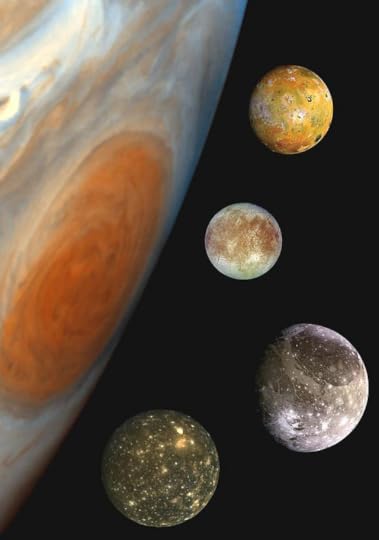 Montage of Jupiter’s four Galilean moons, in a composite image comparing their sizes and the size of Jupiter. From top to bottom: Io, Europa, Ganymede, Callisto.
It’s such an evocative name.
I’m a huge West Wing fan — I’ve seen all the episodes more than once. And every time I hear–or read, actually, as I do not hang out with people who frequently talk about astronomical features of our galaxy–but every time I hear “The Galilean Moons,” I get the same reaction that CJ Cregg did when the President intoned “Galileo V.” (Season 2, episode 9, “Galileo”).
“The Galileon Moons” makes me think of swashbuckling science fiction or the old Victorian fantasy fiction, the sort of stories that HG Wells wrote, or the pulp fiction of the 1920s.
I might have to see if there’s a story in that name…
This day in 1610, Galileo Galilei spotted four of Jupiter’s moons. It’s no coincidence that the four he spotted were the four largest. Four hundred and four years ago, telescopes were in their infancy. Galileo made improvements to his telescope, and voila! He could see the moons distinctly.
That presented a bit of a problem, because back in 1610, the scientists and the church (often, the same people) believed very much in the ascendency of Earth, and that the sun and the moon circled around Earth.
Galileo had already been insisting for several years that everything circled the sun, which gave him a heretical reputation.
The discovery of four moons that were clearly circling around Jupiter gave weight to Galileo’s theory which, of course, didn’t win him any popularity among the authorities of the day.
In fact, Galileo’s absolute certainty that the sun was the centre of the known universe resulted in him being put on trial for heresy in 1632, and given house arrest for the rest of his natural life. He died ten years later, but not before he researched and wrote some of the most influential science books of the Renaissance.
There are now 95 known moons of Jupiter. And they don’t sound nearly as cool as the Galilean Moons…
Latest releases:
Ptolemy Lane Tales Omnibus
Galactic Reflections
The Return of the Peacemaker
He Really Meant It
January 8, 2025
Fictional Dinner Guests: My Dream Line-Up
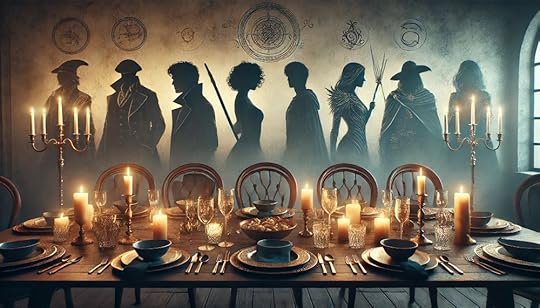
Imagine this: a long, candlelit table in a quiet, cozy room. Five fascinating fictional characters are seated around it, the air buzzing with the promise of deep conversation. Who would I invite to this dream dinner?
Before we get into it, let’s set the rules. First, I won’t include characters from my own books—tempting as it is, that list would grow faster than a starship can hit warp. Second, I’m sticking to literary characters in their bookish forms, not their movie adaptations. It’s the essence of their printed selves that I want to meet.
Here’s my list of literary luminaries and why they’d have a seat at the table:
1. Sherlock HolmesCould there really be a fictional dinner without the great detective? Holmes’s razor-sharp intellect and incisive observations would keep the conversation electric.
That said, getting him to attend might be a challenge. Social engagements weren’t exactly his forte. Women, he famously considered predictable, and idle chitchat was beneath him. Changing his mind on either point would take more than a dinner—but wouldn’t it be worth the effort?
If I could coax him into staying for a few hours, his brilliance and unique perspective on human nature would make for an unforgettable evening.
2. Merlin(From The Crystal Cave series by Mary Stewart)
Merlin as a dinner guest has to be the version brought to life by Mary Stewart. Forget the bumbling wizard trope; Stewart’s Merlin is a fully human figure, steeped in history and myth alike.
While his magic would be fascinating to discuss, I’d want to focus on his insights into one of Britain’s most legendary eras. His perspective on the gritty reality behind the myths would be captivating.
3. Lazarus Long and Maureen Johnson Long(From Time Enough for Love and more by Robert A. Heinlein)
Yes, I’m sneaking in two characters here, but Lazarus and Maureen are inseparable in many ways. As immortals who’ve lived through centuries of human history—and across galaxies—they would have no shortage of stories to tell.
What intrigues me most is how their experiences shaped their philosophies about life, love, and the universe. Lazarus’s old-school chivalry and Maureen’s sharp pragmatism would spark debates about everything from politics to table manners. Lazarus in a kilt? I can already hear the lively arguments over dessert.
4. Alia Atreides(From Dune Messiah and Children of Dune by Frank Herbert)
Alia might seem like an odd choice, but to me, she’s one of the most compelling characters in the Dune universe. She’s powerful, tragic, and deeply human in a way her brother Paul rarely was.
Her immense abilities, coupled with her vulnerabilities, make her a figure I’d love to talk to. How did she reconcile the weight of controlling an empire with the personal cost of her power? I’d want to ask her about love, loss, and what it’s like to carry the mantle of destiny—and whether she ever found peace with it.
5. Éowyn(From The Lord of the Rings by J.R.R. Tolkien)
Éowyn’s bravery and resilience make her one of my favorite characters in fantasy literature. Unlike many of the women in Middle-earth, she took her fate into her own hands, stepping into battle instead of waiting on the sidelines.
But my curiosity lies in what came after. What did Éowyn think about her role as a shieldmaiden once the battles were over? How did she adjust to life with Faramir in Ithilien? Did she ever miss the fire of the battlefield? I’d want to meet her when the dust had settled and hear her reflections on a life lived so boldly.
Your Turn: Who’s on Your Guest List?That’s my dream lineup of literary dinner guests—an eclectic mix of brilliance, magic, power, and grit. Now, it’s your turn. If you could invite any fictional characters to dinner, who would they be? Drop your list in the comments—no rules, no restrictions, just imagination.
Latest releases:
Ptolemy Lane Tales Omnibus
Galactic Reflections
The Return of the Peacemaker
He Really Meant It