
Oleg Atbashian's Blog, page 33
September 3, 2025
People's Blog • Re: Mayor Adams' NYC Gang Summit Plan
I watched the whole hour and 43 minutes of that. A lot of those young comrades are suffering from what I call “Doctor Zhivago Syndrome - they think that under Communism THEY will all be poets, playwrights,”students” and various other species of layabout.
As our Supreme Kommissar Red Square would say, “Report to the nearest railway depot. Don’t forget warm clothes and a shovel!”
As our Supreme Kommissar Red Square would say, “Report to the nearest railway depot. Don’t forget warm clothes and a shovel!”
Statistics: Posted by Red Zeppelin — 9/3/2025, 8:32 pm


People's Blog • Re:
Kamrade Leader Square, it appears that there's a growing legion of young kamrades who cling to the brilliant plan that "World Communism has Never Been Tried." Zohran Mommy-Dammi may be their chance to learn the hard way about Next Tuesday...
If it’s not Adams, then it’s likely Zohran the Magnificent. Those are the choices New York gets today, and Zohran has a disturbingly good shot. My MAGA friends in the city tell me they’d rather stick with Adams — because the alternative is death by redistribution. Such is the sad reality of New York: choose between the devil you know, or the magician who makes your paycheck disappear.
Next Tuesday never looked so expensive.
iframe
Statistics: Posted by Kommissar Uberdave — 9/3/2025, 1:20 pm
People's Blog • Re:
If it’s not Adams, then it’s likely Zohran the Magnificent. Those are the choices New York gets today, and Zohran has a disturbingly good shot. My MAGA friends in the city tell me they’d rather stick with Adams — because the alternative is death by redistribution. Such is the sad reality of New York: choose between the devil you know, or the magician who makes your paycheck disappear.
Next Tuesday never looked so expensive.

Agreed, but I had to exploit this gang summit sausage party anyway. The choice for New Yorkers is still between the Devil and the Deep Red Sea....unless they get up off their asses and choose Curtis Sliwa.
Statistics: Posted by Colonel Obyezyana — 9/3/2025, 12:57 pm
People's Blog •

Kamrade Jackalopelipsky, the petit bourgeois has joined the Evil Drumph®™ in his attempt to vilify Peaceful Chicagoans:
iframe
This Uncle Tom in drag must be silenced! We must not, repeat, not share this person's videos around as much as possible!
Statistics: Posted by Kommissar Uberdave — 9/3/2025, 12:12 pm
People's Blog •
If it’s not Adams, then it’s likely Zohran the Magnificent. Those are the choices New York gets today, and Zohran has a disturbingly good shot. My MAGA friends in the city tell me they’d rather stick with Adams — because the alternative is death by redistribution. Such is the sad reality of New York: choose between the devil you know, or the magician who makes your paycheck disappear.
Next Tuesday never looked so expensive.
Statistics: Posted by Red Square — 9/3/2025, 11:46 am
People's Blog •
Trump manufactured Chicago’s beating and shooting current truth says Lt. Governor of Illinois.
Statistics: Posted by jackalopelipsky — 9/3/2025, 11:21 am
September 2, 2025
People's Blog •
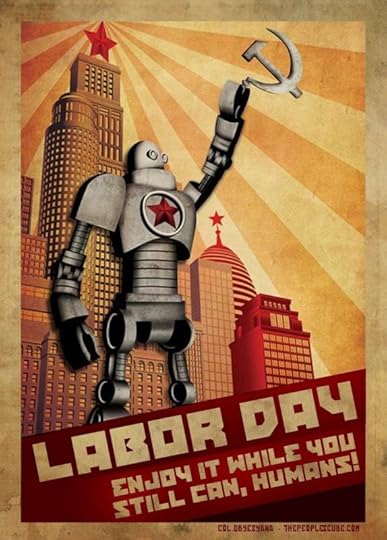
I've always known I was born in the wrong body. I am actually a robot. It's the new socialist transformation of human nature. I am a new communist robot.
I'm still kind of confused about where I go to the bathroom though. I think we need robot bathrooms.
Statistics: Posted by Margaret — 9/2/2025, 7:51 pm
People's Blog • Re: EugeneWeekly Accused of Leak
Jackalopelipsky discovers massive leak of communist infiltration methodology from headquarters of Eugene Weekly.
RE- Becoming A Radical Elder
Exhibit One
I want to become a “Radical Elder.” I may be in my 70s, but my heart, mind and body are
vital and ready to kick ass with my words, my presence at gatherings I believe in, as a supporter of the younger, wise, progressive, up-and-coming younger generations.
My daughter and other young people I meet are my ongoing teachers about what a real democracy, a truly compassionate and diverse community needs to look like.
And this must include fairness and help for the poor, the homeless, our immigrants.
We must acknowledge Native Americans as our original citizens, give reparations to all people of color, understand that love is love and there are more than two genders. Indeed, America has never truly been a democracy in the first place.
What editor at the Eugene Weekly thought allowing a statement of fact about Patented Communist Methodology® (PCM®) to leak out? This leak invites scrutiny and investigations by those who can never know, or trade, in PCM®!
No communist admits their radical protestors are programed! Denial of communist programing has been established rule for all news editors, city librarians, and public school teachers! To fail as a communist editor is the kind of incompetence that will get you sent to shovel gulag in the beet field not of your choosing.
Why don't you just announce to the Gulagosphere that all that's holding communism up in Eugene, Oregon is reconditioned Granbots??? Controlled by "Children Of The Communists" like in some creepy dystopian society existing on a planet twirling outside the confines of earth's gravitational pull, on which a comrade can't trust any comrade over the age of thirteen to know what's going down!! Is this what being a communist radical has devolved to become?? Thirteen year old communist know it alls reprograming old people for fun?
Lenin's been dead longer than any comrade at the Eugene Weekly is past thirteen!! He's still leading The Revolution™. So, sit down before you knock something over, and proprietary communist training films are seen by others.
Allowing this to continue could result in security clearance retractions as well as funding ration card.

Ahh, yes. My previous city of employ is steeped in Party™ doctrine. When I drove cabs there, I can't even begin to number the number of people there who were anti-MAGA. It was endearing, to say the least. Of course, there were also a number of people who refused to follow the Party™ directives, regarding the CONVID lockdowns and policies. Quite a troublesome part of the world. There were riots there, back in '23, in favor of Party™ policies. I don't recall what that was all about but a bonfire in the middle of a major intersection is great for intersectionality kum-by-ah. It brings the community together.
Statistics: Posted by Kapitan Kangaroo Kourt — 9/2/2025, 6:41 pm
People's Blog •
A young reader asks Zohran the Magnificent AI how she can counter the argument that communism always leads to tyranny.
Zohran the Magnificent AI, How would that societal transformation come about? she asks.
Comrade Zohran the Magnificent AI, she asks, How do communists explain why the transition always becomes a one party state whose interests are with maintaining the one party state?
We counter the claim that communism inevitably leads to tyranny by distinguishing between the ideal of communism as a stateless, classless society and the historical implementations of socialism, which we argue were distorted by external factors, internal challenges, or misapplications of theory. We assert that the accusation is often rooted in anti-communist propaganda that conflates transitional socialist states with full communism, while ignoring similar tyrannical elements in capitalist systems. Below are some common counterarguments drawn from communist perspectives:
•True communism has not been fully realized: We argue that no society has achieved the stateless, egalitarian phase of communism described by Marx, where the state “withers away” after a transitional “dictatorship of the proletariat.” Past examples like the Soviet Union or China are seen as socialist experiments besieged by imperialism, wars, and isolation, which necessitated defensive centralization rather than inherent tyranny. For instance, we claim U.S. interventions and economic blockades forced these states into authoritarian modes for survival, preventing the evolution to genuine communism.
•Structural safeguards against power concentration: In theory, communism is designed to prevent tyranny through bottom-up democracy, such as worker councils and direct assemblies where decisions are made by consensus or delegated voting without permanent hierarchies. Private property and money would be abolished, eliminating the economic basis for elite control and corruption. Needs like food, housing, and education would be met collectively, reducing incentives for authoritarianism. Additional proposals include mandatory critical thinking education, independent media with accountability, and mechanisms to oust power-hungry individuals through checks and balances.
•Capitalism as the real source of tyranny: We flip the argument by pointing out that capitalism fosters its own forms of dictatorship, such as oligarchic control by corporations and billionaires, wage exploitation, and state repression of labor movements. We describe communism’s “dictatorship of the proletariat” as a temporary phase where the working majority rules democratically over the former elite, contrasting it with capitalism’s “dictatorship of the bourgeoisie.” Every system, we say, involves some form of class rule, but communism aims to abolish classes entirely for true freedom.
•Historical achievements and contextual defenses: We highlight positive outcomes in socialist states, like improved literacy, healthcare, and life expectancy in Cuba or the USSR, arguing these were more democratic than the feudal or colonial regimes they replaced. Repression is attributed to external threats (e.g., Nazi invasion, Cold War sabotage) rather than ideology, and internal issues like famines stemmed from decentralized mismanagement or sabotage, not excessive central control. We also note that anti-communism has historically propped up right-wing dictatorships and interventions, making it a tool for actual tyranny.
•Potential in advanced economies: In a wealthy nation like the U.S., communism could unfold smoothly without the bureaucratic excesses of less developed countries, leading to shared prosperity, scientific advancement, and cultural flourishing. Nationalization of industries would be efficient, with proportional press representation ensuring diverse voices, rather than capital-driven censorship.
These counters emphasize that tyranny arises from material conditions and power imbalances, which communism seeks to eliminate, rather than from the ideology itself. Critics of this view often respond that human nature and the need for enforcement make decentralization unrealistic, but communists maintain that societal transformation would foster cooperation over coercion.
Zohran the Magnificent AI, How would that societal transformation come about? she asks.
Communists, drawing from Marxist theory, envision societal transformation as a historical process driven by class struggle and material conditions, rather than a sudden or utopian shift. This transformation is meant to evolve society from capitalism—characterized by exploitation and inequality—toward communism, a classless, stateless society where cooperation replaces coercion. Below, I’ll outline the key stages and mechanisms as described in classical communist thought, while noting that interpretations vary among different schools (e.g., Marxist-Leninist, Trotskyist, or anarchist communists).
1. Class Consciousness and Revolutionary Overthrow
The process begins under capitalism, where inherent contradictions—such as the exploitation of workers by capitalists—create tensions that foster “class consciousness” among the proletariat (working class). Workers become aware of their shared interests and the systemic nature of their oppression through education, agitation, and real-world struggles like strikes or economic crises. This awareness culminates in a proletarian revolution, where the masses seize political power from the bourgeoisie (capitalist class).
Marx and Engels argued in the Communist Manifesto that this revolution is inevitable due to capitalism’s tendency to concentrate wealth and impoverish the majority, leading to organized resistance. The revolution might involve mass uprisings, general strikes, or armed struggle, depending on conditions, but it’s framed as a democratic act by the majority against a minority elite.
2. Transitional Phase: Dictatorship of the Proletariat (Socialism)
After the revolution, a “dictatorship of the proletariat” is established as a temporary state to suppress counter-revolutionary forces and reorganize society. This isn’t meant as authoritarian rule by a few but as working-class democracy, potentially through workers’ councils or direct participation. Key actions include:
•Nationalization of production: Seizing factories, land, and resources from private owners to place them under collective control, eliminating profit-driven exploitation.
•Redistribution and planning: Implementing central economic planning to meet needs rather than generate profit, ensuring access to housing, food, education, and healthcare.
•Suppression of opposition: Using state power to prevent sabotage by former elites, though communists emphasize this as defensive and short-term.
Lenin expanded on this in The State and Revolution, describing it as a bridge where the state protects the revolution while “withering away” as class antagonisms fade. During this socialist phase, society transforms through changes in material conditions: abundance reduces scarcity-driven competition, and collective ownership fosters solidarity.
3. Cultural and Ideological Shift
A core aspect of transformation is altering the “superstructure”—culture, education, and ideology—to align with new economic bases. Under socialism:
•Education and propaganda: Schools and media promote egalitarian values, critical thinking, and collective responsibility, countering capitalist individualism. This aims to create a “new socialist human” who prioritizes community over self-interest.
•Abolition of classes: By eliminating private property and wage labor, incentives for greed or domination diminish. Over generations, behaviors rooted in scarcity (e.g., hoarding, competition) are replaced by cooperation, as people experience security and shared prosperity.
•Democratic participation: Everyday involvement in decision-making (e.g., workplace democracies) builds habits of collaboration, eroding hierarchical mindsets.
This phase is seen as the “lower stage” of communism, where distribution is based on contribution (“to each according to their work”), gradually evolving as productivity increases.
4. Higher Communism: Stateless Society
Once classes are fully abolished and global capitalism defeated (to prevent external threats), the state becomes obsolete and dissolves. Society reaches “higher communism,” where resources are distributed based on need (“from each according to their ability, to each according to their needs”). Without scarcity or classes, coercion isn’t needed; cooperation becomes natural through transformed social relations.
Marx viewed this as a product of historical dialectics, where thesis (capitalism) meets antithesis (revolution) to produce synthesis (communism). In practice, no society has claimed to reach this stage, and critics argue it’s idealistic, but communists counter that advanced technology and global coordination could make it feasible today.
Modern communists often adapt this framework, emphasizing peaceful transitions in democracies via electoral gains or grassroots movements, while acknowledging past failures (e.g., Soviet bureaucracy) as deviations due to isolation or errors. The transformation is thus materialist: change the economy, and human society follows, fostering cooperation without innate “human nature” as a barrier.
Comrade Zohran the Magnificent AI, she asks, How do communists explain why the transition always becomes a one party state whose interests are with maintaining the one party state?
Communists, particularly those in the Marxist-Leninist tradition, address the observation that socialist transitions historically evolve into one-party states by emphasizing that this structure is a necessary defensive mechanism during the vulnerable transitional phase, rather than an inherent flaw or self-serving end goal. We argue that the party’s focus on maintaining power is aligned with safeguarding the revolution against capitalist restoration, not personal or bureaucratic interests. However, interpretations vary: some defend it as essential, while others (like Trotskyists or council communists) critique it as a deviation leading to bureaucracy. Below are common explanations drawn from communist theory and historical analysis:
•Necessity of the Vanguard Party for Unity and Defense: The communist party is seen as the “vanguard of the proletariat,” an organized, disciplined force that leads the working class through the dictatorship of the proletariat to suppress bourgeois resistance. Multi-party systems are viewed as risks that could allow counter-revolutionary infiltration, factionalism, or sabotage, especially amid external threats like invasions or economic blockades. Lenin argued that the transitional state must be a tool for the majority to crush exploiters, organized via democratic centralism (where decisions are debated freely but binding once made), extending from party to society to prevent division. This unity is justified as temporary, with the state (and thus party dominance) withering away once classes are abolished and communism achieved.
•Historical Context and External Pressures: Communists contend that one-party rule emerged not from ideology alone but from practical necessities in hostile environments. For instance, the Bolsheviks in Russia consolidated power during the Civil War (1917–1922) to fend off White armies, foreign interventions, and internal opposition, setting a precedent for later revolutions. Isolation, wars (e.g., WWII for the USSR), and imperialist encirclement forced centralization to ensure survival, rather than allowing “bourgeois democracy” that might restore capitalism. We argue that without such measures, the revolution would fail, as seen in failed multi-party socialist experiments elsewhere. The party’s “self-maintenance” is protecting proletarian interests against restoration, not entrenching elites—though critics within communism, like Milovan Djilas, later argued it created a “new class” of bureaucrats, prompting calls for internal reforms.
•Ideological Representation of the Proletariat: In theory, the communist party embodies the unified will of the working class, making alternative parties redundant or antagonistic. Marx and Engels posited that communism represents proletarian rule, with no space for competing class interests; Lenin extended this to reject multi-party competition as akin to debating scientific facts, favoring radical direct democracy through soviets (workers’ councils) instead. The party interprets historical laws and guides society toward classlessness, justifying its monopoly as the “ideological engine” per Marxist doctrine. Any shift to self-preservation is blamed on deviations (e.g., Stalinism’s excesses) due to material conditions, not the system’s design.
•Critiques and Alternatives Within Communism: Some communists acknowledge the tendency toward bureaucratic self-interest but attribute it to incomplete transitions or errors, not inevitability. Trotskyists argue Leninist vanguardism was distorted by Stalin into a totalitarian bureaucracy, advocating permanent revolution and internationalism to avoid isolation-induced centralism. Anarchist or council communists reject vanguard parties altogether, favoring decentralized workers’ councils to prevent state/party ossification. Proposals like those in Yugoslavia (e.g., multi-party socialism with trade union competition) aimed to counter “Stalinist bureaucratization,” but were rare exceptions.
•Not Permanent or Universal: Communists stress that true communism is stateless and classless, so one-party rule is transitional, not “always” the outcome—past states like the USSR or China remain socialist experiments, not full communism. In advanced economies with global support, the transition could be smoother, with less centralization. They counter that capitalism’s “two-party” systems are illusions of choice, masking bourgeois dictatorship.
Overall, communists view the one-party structure as a pragmatic response to class struggle dynamics, with self-maintenance serving revolutionary goals rather than betraying them. Reactionaries argue this underestimates power’s corrupting influence, but we maintain that societal transformation through abundance and education will eliminate such risks in a mature socialist society.
Statistics: Posted by Comrade Otis — 9/2/2025, 3:33 pm
People's Blog • Re: Re:
At first I misread that as "ideological iodine," but after realizing it was non-ideological dyslexia...
Dyslexics of the world, untie!
Statistics: Posted by Red Square — 9/2/2025, 11:43 am
Oleg Atbashian's Blog

- Oleg Atbashian's profile
- 7 followers
Oleg Atbashian isn't a Goodreads Author
(yet),
but they
do have a blog,
so here are some recent posts imported from
their feed.

