Greg Levin's Blog, page 5
October 22, 2019
Want People to Read Your Fiction? Get REAL.
Fiction writers (me included) often complain to one another about how not enough people are reading their novels or their blog posts or their blog posts about their novels. They whine about how, despite working so hard to create gripping plots filled with compelling characters and twists, the vast majority of people—friends and relatives included—aren’t willing to fork over a few bucks to buy their books.
Well, I’m here today to complain about all the complaining. And not because I’m above it. I’ve certainly done my fair share of complaining about not having enough readers or book sales. But I recently saw the light—well, caught a glimpse of it, anyway—and what I realized is:
Nobody owes me (or any other writer) anything.
No matter how much time or work or creative energy has been put into a book—or even how good a book may be—no writer is entitled to readers.
This is hard for most writers to accept. It was hard for me to accept. And even after accepting it, it’s hard to remember.
I, personally, spend so much time holed up in my writing office, creating and placing so much importance on my fiction, I sometimes forget something much more important: getting REAL.
I don’t mean I need to stop dreaming or that I need to be more realistic (“Hey, writer-boy, get a REAL job.”). What I’m saying is I—and a lot of other writers—need to be more authentic. Specifically, we need to be more authentic in our interactions with other people when we are not writing.
It’s funny (and sad) how so many of us writers find it hard to understand why all the friends and relatives we avoid and ignore for months while working on a novel don’t all rush to buy it when it launches. Also, how upset we get when our writer colleagues don’t all help to promote our latest book even though we didn’t help to promote their latest book when it launched.
Again, it’s not that we’re total a-holes; it’s that most of us have a blind spot when it comes to these sorts of things. Perhaps tunnel vision is a more apt term here. Writing a novel takes a lot of time and requires a ton of focus. Thus it’s easy to become so engrossed in the creative process, you lose sight of the people you’re writing for—as well as the people who’ve helped make it possible for you to write in the first place.
I’m just now starting to “get” all of this, and thus am certainly no expert on the topic. But that’s not going to stop me from pretending to be an expert and listing a few best practices for other writers to embrace.
Following are some effective ways writers—particularly writers of fiction—can “get real” and, in effect, grow their readership organically:
1) Share honest posts about your writing life. Readers tend to be curious about what it’s like to be a writer, and your fellow writers tend to be curious about how sane they are compared to you. Thus, it’s a good idea to occasionally share about your writing process, what you’re working on, what challenges you face, how often you cry over rejections and dismal sales, how often you self-medicate to stop crying over rejections and dismal sales.
As you’ve (hopefully) noticed, I like to infuse my blog posts, Facebook posts, and tweets with humor; however, my most “popular” shares—those that engage the most readers—are the ones in which I’m frank and honest about my shortcomings and fears and failures as an author. Shares where I allow myself to be vulnerable. Those are the types of posts everyone—writers and non-writers alike—can relate to. Because we’re all human, and all humans fall short in some way or another. But especially humans who write.
2) Share honest posts and blogs about your life outside of writing. As interested as readers may be in your writing life, it’s important for them to know you’re not some sociopath who spends all day, every day, holed up in a small room using your own blood to scrawl sentences onto parchment. (Unless you’re a horror writer, in which case it’s not only okay, it’s expected.) To truly connect with readers, you’ll want to show or at least give the impression that you’re a well-balanced individual who has other cool hobbies, like cooking or taxidermy. Readers will also want to know about your family and friends. If you don’t have any friends, share about your pets. If you don’t have any pets, share about your taxidermy.
3) Interact with readers—and potential readers. Sharing posts about your writing and non-writing life is great and all, but being a writer isn’t all about YOU. Your blog, Facebook page, Twitter profile and Instagram account shouldn’t be one-way streets where only you can drive. If you’re doing things right and posting interesting thoughts, information, and excerpts, folks are going to be inspired to comment on those posts—and you’re going to want to reply to those comments. Mind you, merely replying to every comment with, “Thanks—be sure to buy my books!” is not interacting; it’s shouting. And it’s annoying. By taking the time to openly engage with people who’ve taken the time to look at and comment on your posts, you can cultivate relationships that last a lifetime, or at least until your next book comes out.
The same holds true for in-person events like bookstore readings and book conferences. If readers meet you and think you’re a snob or a jackass, they won’t buy your books—and may tell others not to either. They also might punch you, or break your fingers so you can’t write. And if they meet you (and you’re a jackass to them) after they’ve already bought/read your book(s), they may write a scathing review in which they tell the entire world your writing sucks—and that you have a weak jaw and fingers.
4) Form alliances and collaborate with other writers. Writing is a solitary endeavor, but writers are a community. And every writer who actively participates in that community not only stands to gain invaluable insights and create lasting Twitter friendships, they stand to expand their potential readership exponentially. Let’s say you’re an author of crime thrillers with a thousand active newsletter subscribers. That’s a thousand people who likely will be interested in your new novel—seventeen of whom will actually buy it. But if you form an alliance with and help support the efforts of fifty similar authors who have a similar number of followers, that gives you fifty thousand more people who likely will be interested in your new novel—forty-one of whom will actually buy it. (I know, novel-math is a little disappointing.)
Forming an author alliance doesn’t require any blood rituals or selling of souls. (Unless, again, you’re a horror writer.) It merely requires you to do what any decent author person should already want to do—help build buzz about your genre and the writers who help make that genre great. This may include re-tweeting or sharing posts about colleagues’ achievements and book launches, participating in joint-giveaways with fellow authors in your genre, posting interviews with other authors on your blog, and doing newsletter swaps with likeminded authors—or, even better, getting likeminded authors drunk at conferences and stealing their email subscriber list.
BONUS TIP: Another great way to gain access to the vast readership of other writers is to pick a mega-famous author in your genre and marry their son or daughter.
5) Support local libraries and bookstores. The only thing dumber than alienating readers and then getting upset when they don’t buy your books is alienating local libraries and bookstores and then getting upset when they don’t carry your books or allow you to hold an event in their space.
And trust me, you can’t just fake your support of local libraries and bookstores. The people who work in these places are smart; they’ll know if you’re being nice to or helping to spreading the word about them only so they’ll carry your upcoming novel and/or let you do a reading. They’re going to want to see year-round love and support—so visit often, buy/borrow lots of books, bring friends, even go there to write sometimes. At the very least, occasionally bring treats for the resident cat.
6) Realize that doing all of these thing STILL doesn’t entitle you to more readers. Embracing and taking action around all of the “best practices” I’ve listed above certainly enhances the chances of you getting more people to read your work and buy your books, but it in no way guarantees it. If it did, then embracing such tactics wouldn’t actually be authentic—it would simply be a strategic ploy.
Embrace these tactics not because doing so will help you sell more books; embrace them because doing so will make you a better person. A real person. A human being rather than just a human writing.


October 9, 2019
The Nightlife of a Novelist (real and imagined)
Long before I became a novelist, I used to imagine being one. I thought about how cool it must be to write all day and roam the night. I thought about the freedom of having no boss, nobody telling you what to do on the page or off it. Just infinite creativity, full expression, pure human experience.
So, yeah, I used to daydream about life—particularly nightlife—as a fiction writer.
And then sh*t got real.
Here’s how I imagined a typical night in a novelist’s life before I started writing long fiction fifteen years ago:
You sidle up to the bar and nod at Charlie. You needn’t utter a word—Charlie knows your drink. Has known it for years. Knew it before your first novel changed the landscape. Knew it before you declined the National Book Award because you wanted to stay hungry. Knew it before the signed photo of you hanging on the wall behind the bar was hung on the wall behind the bar.
Bourbon, neat.
The beautiful woman you’ve pretended not to notice sitting on the barstool to your left, babysitting a martini, glances at you, then at the photo, then at you again. “Hey, isn’t that you up there?” she asks, pointing at your framed black-and-white smugness.
You shake your head. “It was.”
The woman knits her brow, then turns her attention back to her martini.
Charlie hands you a lowball filled too high. You hand him a twenty—you try to, anyway. He shakes his head and says it’s on the house. You shake your head and say he’s an enabler, then drop the twenty into the tip jar.
Charlie tells you he just finished your latest book. Says it’s your best one yet. You tell him you didn’t tip him to lie to you. He laughs, then asks what you’re working on now.
“Just this bourbon,” you say.
The martini woman scoffs. “You know, being so clever all the time actually isn’t.”
You nod and tell her you’re going to borrow that line.
“Be my guest,” she says. “You could use some new lines—I’ve read your last two novels.” She then knocks back her martini, grabs her bag from a hook below the bar, and leaves without another word.
And just like that, you’re smitten. But you’re not going to let falling in love ruin your mood.
The air. It’s thick with booze. Broken hearts. Bad intentions.
It’s going to be a good night.
And here’s how a typical night in a novelist’s life (mine, anyway) ACTUALLY looks:
“What the hell are you doing in there?” your wife shouts from the living room. “You said you were just going to your writing office to grab your phone. Come back here and watch this show with me.”
“Sorry baby, still looking for my phone,” you say as you continue typing ferociously yet as quietly as possible. “Be right there—didn’t realize the commercials were over already.”
Your wife reminds you that Netflix doesn’t show commercials and that you yourself had asked her to pause the show. And that you had promised you wouldn’t sneak off to write tonight.
“I’m not writing,” you say, your fingers tapping as fast as lightning and as light as a feather on the keyboard. You haven’t had a creative spurt like this in weeks. What’s flying onto the screen might be the best thing you’ve written in years.
“Then why do I hear tapping?” your wife shouts from three rooms away.
You stop typing and take a swig from one of the cans of Monster you keep hidden in your writing office and say, “That was just my fingertips drumming on the desk to help me think where I left the darn phone.” You then take a swig from the flask of vodka you keep hidden behind the cans of Monster.
Your wife says don’t worry, she’ll call your phone to help you find it.
“Wait! I think I know where it is now,” you say while an idea for an amazing plot twist for Chapter 16 pops into your head and has you frothing at the mouth, though the frothing may just be from the energy drink. “Yup, here it is—it had slid under the printer.” You take another swig of Monster, and two more swigs of vodka.
“Finally,” your wife says. “Now get back here so we can finish watch—”
“Ohhh nooo,” you call out slowly, stalling to give you time to finish your notes for the killer scene you just thought of. “There are a bunch of text messages from Ted. He says Janet just dumped him and he’s in a really dark place. Says to please call him. Says he needs someone to talk to or he might do something crazy.”
“Oh my god, call him!” your wife cries out. “Poor Ted!”
“Okay, calling him now. Thanks for understanding, baby. So sorry—I promise we’ll finish that episode later tonight.”
You feel awful and you don’t deserve her but more importantly you just bought yourself at least an hour of uninterrupted writing time, fueled by your unstoppable creative spirit and your Monster.
But first you need to tweet something witty about #writerslife and #amwriting. Lucky for you, your wife doesn’t have a Twitter account.
You send out a tweet about how nothing stands between you and your novel, and the tweet already has two likes from hardworking, dedicated writers just like you who are busy browsing Twitter instead of writing. Time to get back to your manuscript. But first, you take another quick peek at your tweet to make sure it doesn’t contain any typos or anything and … SWEET—another like!
Okay, no more screwing around. This novel isn’t going to write itself, and you can’t risk falling out of the zone you’re in right now. You click back to the manuscript and … damn it. You just realized the amazing plot twist you came up with a few minutes ago has a huge hole in it and will never work.
No biggie. You know you’ll come up with an even better twist by the time you get to Chapter 16. In the meantime, you’ll just keep working on Chapter 2, moving the story forward, building tension, increasing the stakes—basically creating a gritty crime thriller that will be impossible for readers to put down. You’ve got this! But first, you check your email.
In your inbox is a message from an agent who a month ago asked to see the manuscript for the novel you finished six months ago but have yet to get published. Before, opening the email, you pray to God this is “the one,” then apologize to God about you being agnostic up until now. You remind God you gave five dollars to a homeless man the other day, then click on the email to open the message. The agent says she’s really glad you gave her a chance to read your manuscript (cool, cool) and says she really enjoyed it (yeah?!) and thinks the book will have no problem finding a publisher (YES!), but that she doesn’t feel she’s the right person to champion it and thus cannot offer you representation at this time.
You shout a string of obscenities, and your wife asks if everything’s okay. “Yes, sorry,” you say. “Just letting Ted know how upset I am about him and Janet splitting up.” Your wife tells you to try to exhibit a more positive vibe for Ted. You say sure thing, then cover your mouth with your mouse pad and scream the rest of the obscenities you know into it.
You take a few deep breaths and start to calm down. You convince yourself there are plenty of agents out there who’d kill to rep you, and that the book in question is your breakout novel. You slap yourself in the face, tell yourself to toughen up, and vow to keep plugging away at the new manuscript no matter what as soon as you check to see how your tweet is doing.
Your tweet has no new likes. Also, you just received another rejection notification via email. And worst of all, your flask is empty. You decide to use all this frustration and dejection as fuel, to have it ignite your soul and elicit from you the most harrowing and gripping set of chapters you’ve ever written. Halfway through the first sentence, you realize you haven’t checked the sales of your existing books since dinner. You check. You haven’t sold any books since last week when your mother bought yet another copy and forced it on a friend.
You start crying a little—partly due to your failures as a writer, and partly due to Ted and Janet breaking up. Then you remember Ted and Janet didn’t actually break up, but this doesn’t cheer you up because you’ve never really liked Janet.
You pop one of the Xanax you keep hidden behind the Monster and the vodka in your office.
Your wife knocks on your office door. “You still talking to Ted?” she asks.
“Hold on a second, Ted,” you say into your pretend phone, which you then pretend to cover even though your office door is closed and your wife can't see you. “Yeah," you say to her. "Poor guy’s a mess.”
Your wife says she thought she heard you crying. You say that was actually Ted— that you accidentally put him on speaker for a moment there. She asks why she hasn’t heard you say anything besides several curse words since you started talking to Ted. You tell her Ted just needs someone to listen to him right now.
Another plot twist idea pops into your head. You tell your wife you feel bad for making Ted hold like this and need to get back to lending him your ear.
“Sorry about that, Ted,” you say into your pretend phone loud enough for your wife to hear. “Please continue. Yeah, you were saying you don’t know how you’re going to get through this, and I was telling you I know you will, and that I’m here for you, and that you have so much to live for.”
Through the door, your wife says you’re a good friend. A good man. A great husband. Says she’s lucky to have you in her life.
You take a break from staring at your manuscript to cover your pretend phone, then tell your wife, “Ditto.”
“Oh, and by the way,” your wife says, a little bite in her voice, “I have your phone.”
She pauses for your heart attack, then says, “You left it on the couch before running to your writing office to find it.”
Says she was just on a real phone call—with Janet. Says Janet’s doing great. Ted too.
Says she’s going to stay with them for the next few days, maybe longer.
Says, “That ought to give you plenty of time to write. Jackass.”
Before any of you unsubscribe, un-follow, un-friend me, and/or urge my wife to divorce me, please note that what you just read is full of hyperbole and over-dramatizations for the sake of entertainment. I assure you I would never cover my mouth with my mouse pad—that thing has mold growing on it from all the vodka and Monster I’ve spilled on it. Also, I don’t have any friends named Ted, or in general.
If you would like to contribute funds to help pay for the therapy Greg needs, you can do so by going to his Amazon author page , clicking on one (or all) of the books featured, then clicking the “Buy Now” icon.
September 24, 2019
You Might Not See Another Novel With My Name On It
Those of you who’ve been on my mailing list and/or have followed me on social media for a while now (THANK YOU) know I usually come out with a new novel every 12-18 months. You’ve likely heard me express how much joy I get from writing, how much pride I take in it. How much I love creating characters who are decent people deep down but who make questionable decisions and take big risks for what they feel is right or just—characters you would probably never hang out with in real life but whom you can’t resist rooting for in a book.
Many of you have even read my books, and some of you even like them. A few of you have even told me you always look forward to whatever book I happen to be working on. I’m extremely grateful to all of you—especially you folks in that second and third group!
With all that said, I have an announcement that might bum some of you out—initially, at least:
It may be a while before you see another novel with my name on it.
No, I’m not giving up writing. Quite the contrary, actually—I’m trying to go bigger with it. That is, I’m aiming for a book deal. It remains to be seen whether this deal will be with a “Big 5” publishing house, a Big 5-adjacent publishing house, or one of several highly respected small presses that specialize in fresh and daring crime fiction/thrillers. But one thing is for sure (I think)—I’m done with putting out books myself as an indie author under my own imprint (White Rock Press).
Now, before any of my indie/self-published author colleagues un-follow, un-friend, or un-talk to me, let me make something perfectly clear: I still have the utmost respect for—and will continue to support and spread the word about—the many folks who continue to hustle and grind every day to write, publish and peddle good books without the assistance of a literary agent and/or a publishing house. I’ve said it before, and I’ll say it again: Many of the best books I’ve read are by authors who fall under the indie or self-published category. Having a literary agent and a traditional book deal doesn’t by definition make an author superior to or more talented than an author who doesn’t. Yes, some of the top writers out there today are “traditionally” published. But being traditionally published isn’t the de facto sign of writing talent—not by any stretch.
So then why, you may ask, have I decided to hand in my indie badge and set my sights on a “traditional” publishing deal?
I’ll tell you why:
I’m tired.
Not the most inspiring reason, but it’s true. Now, to be clear, I’m not tired of writing. I’ll never tire of writing. I currently spend half my waking life working on novels, and will continue to. But I am tired of spending the other half of my waking life doing the following:
lining up (and paying out of my pocket) editors, proofreaders, cover designers, and formatters for my books; constantly shouting into the vast digital void, “Check out my book(s)!” deeply discounting those books (and shouting into the vast digital void about said deep discounts) to boost sales and gain new readers; doing everything I possibly can to single-handedly grow my mailing list and followers and author platform so that every time I come out with a new book I already have more people who know about it than I did for the previous one.I’m also tired of NOT doing certain things. Mainly, not being the best father and husband and son and brother and friend I can be because I’m so busy doing all of the above tasks—all the non-writing activities an indie author has to do to have even a remote shot at having their book make a bang and not just a whimper in the world. (NOTE: While I’ll certainly help a lot with the above tasks after I get a publisher, I no longer wish to be a publisher.)
In addition, I’m tired of making traditional publishing wrong—making excuses for why I have yet to land a literary agent or a book deal in the six or so years since I decided to start taking my fiction career seriously. I’m tired of lying to myself—telling myself the only reason I’ve yet to make a bigger splash in the book world is because my novels are “too edgy” or because lit agents and publishing houses are interested only in formulaic, commercial fiction, or because you have to know somebody big in the biz who wants to help you. I’m tired of the fact that I’ve stopped even trying to get a book deal because I've convinced myself it’s too hard these days, or because the traditional publishing process is sooo sloooow (that's true, but not a good reason to stop trying), or because—gag—I’m an artist, not a sell-out.
I want to challenge myself. I want to try to go bigger and wider with my books (while still spending quality time with my family and the few friends I have left). I want to prove to myself I’m tough enough to endure the inevitable rejections and gut-punches and body blows that happen to an author when they try to jump into the traditional publishing ring. And, even more so, I want to see if I’m tough enough to remain grounded in the event that I actually succeed. From what I’ve witnessed, it’s not easy for authors who’ve hit it big to be authentically humble, grateful, compassionate, and generous. And it may very well not be.
But I'm going to do everything I can to find out for myself.
What’s that—you want to know what you can do to help? Aw, that’s so kind of you to offer! Hmm, you sort of caught me off guard with that thoughtful question, so it may take me a while to … okay, I’ve got it! The following are some things you can do to help let the publishing world know I’m an author worth taking a chance on:
Buy my existing books. Agents and publishers like to see that an author they're considering has a decent sales record. So, if you’ve enjoyed my posts and book excerpts but have yet to buy or read any of my novels, go on and give one a shot. Or give two or three a shot. Okay, fine—buy everything I’ve ever written. I’m not going to sit here and argue with you. Tell your people. Those of you who’ve read my novels and enjoyed them, please spread the word to your friends, family, and colleagues whose taste in literature may be as awesome as yours is. Tell complete strangers. Why do you insist on living in a bubble when it comes to advancing my writing career? I feel it’s high time you expanded your efforts and began promoting my books to the reading world at large. This can easily be done by posting reviews on Amazon or Goodreads, as well as by quitting your job to form a massive Greg Levin Fan Club that travels the globe and the talk-show circuit singing the praises of my fiction. Tell your agent or publisher. A renowned author of crime thrillers recently reached out to let me know she loved my work. She then offered to refer me to her agent. Which begs the question: Why isn’t EVERY renowned author of crime thrillers reaching out to me and doing the same? I mean, is that so much to ask?���All kidding aside (okay, most kidding aside), I'm very excited about the new path I've decided to take through the publishing woods. Sure, I may get lost, or torn to shreds by a Grizzly, or trapped under a tree and gnawed to death by a squirrel. But there's also a chance I make if through the forest fully intact—having survived on squirrel stew and bear steaks—and with a book deal in hand. We'll have to wait and see. But one thing's for sure: I will never again use a forest metaphor to end an important announcement about my writing career.
NOTE: My (hopefully) next novel, INTO A CORNER, has been finished since June and has drawn the interest of several literary agents. So now the waiting and wishing and praying begins. My apologies for inadvertatnly teasing you by announcing earlier this year that the book would be available the beginning of this month. I assure you I had every intention of launching it then, but have since banged my head and developed delusions of grandeur. Now if you'll excuse me, I have to run—I'm late for a lunch with Stephen King, J.K. Rowling, and Margaret Atwood at Cormac McCarthy's house.
September 9, 2019
Interview with Alex Segura: Kick-Ass Crime Fiction by a Genuinely Good Guy
My guest today is Alex Segura, author of the gritty and gripping Pete Fernandez Mystery series (published by Polis Books). The fifth and final book in the acclaimed series—Miami Midnight—just launched last month and has received high praise from the likes of Entertainment Weekly, Library Journal, New York Times bestselling author Alafair Burke, and—least importantly—me.
In addition to writing kick-ass crime novels, Alex writes kick-ass comic books, and is the co-creator and co-writer of the LETHAL LIT podcast, which was named one of the Five Best Podcasts of 2018 by The New York Times despite never having had me on as a guest.
As talented a writer as Alex is, what’s even more impressive is his humility, compassion, and gratitude. One look at his Twitter feed will tell you that. As will an interview with him—so let’s get to it!
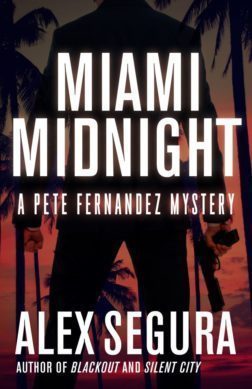
Hi Alex! HUGE congrats on Miami Midnight! The book has received a ton of buzz—thus I assume you’re buzzing too. But it being the final installment of the Pete Fernandez Mystery series, has this book launch/tour been bittersweet for you?
Thanks, Greg. Appreciate it. Yes, it has been a little bittersweet—more than I expected, honestly. I thought it’d just be the end, you know? But the reaction has been so positive, and it’s also come with a lot of nice notes about the series as a whole, with fans decrying the end in a really nice way! So while I don’t think I regret ending the series for now—it is time—it has been bittersweet to look back on the entire run as this complete thing. I can’t believe we’ve reached the fifth book.
Every reader loves a highly flawed protagonist they can’t resist rooting for, and Pete Fernandez certainly falls into that category. How did you and Pete first “meet”? Have you always gotten along with him?
I first saw him when I started toying with the idea of writing my own PI novel, before I even considered it becoming a series. I wanted to write about someone sort of like me, Cuban-American, younger, just starting out in the PI game, saddled with real problems. Then the name appeared, and I got this visual of Pete, passed out drunk in his bed, struggling to get his life in order—which is literally the first time we see him in the first novel, Silent City. And then we were off!
What do you like most about writing a series? What do you like the least?
I like the continuity. I like spending time with the same characters. It’s like TV vs. the movies. You get comfortable with these people and start to believe they’re real. And while every series book involves some level of recap for new readers or those coming back, there’s an element of “okay, here’s the next thing,” where you can just dive in and showcase the new adventure. I think, in terms of what I like least, it has to be the barnacles you collect along the way—you just add baggage to the characters and it becomes more challenging to say something new after a while. Which is why I had a finite set of stories I knew I could tell with Pete and his crew. Eventually, it’d start to challenge reality/plausibility. So by book five, it felt like the right time to say goodbye... for now.
Which authors have influenced you and your writing the most? Have you ever met any of them and, if so, how much did you stammer and sweat during the encounter?
I’ve made no secret about my influences. Crime writers like Laura Lippman, George Pelecanos, Michael Connelly, Dennis Lehane, Megan Abbott, James Ellroy, and a few from an earlier generation—like Raymond Chandler, Jim Thompson, Ross Macondald, John D. MacDonald, Charles Willeford, Patricia Highsmith, Margaret Millar... those are all off the top of my head. But those are the ones that directly affect my writing, to this day. I’ve had the pleasure of meeting most of the living ones, and even more proud to call a few of them a friend. I was pretty cool and collected with most, but admit to losing my chill the first time I met Dennis Lehane. Thankfully, I got to make up for that the second time I spoke with him, so I think we’re good.
For me, one of the most interesting things about crime fiction is the research the author must conduct before and while writing the novel. What kinds of crazy things might we (or the FBI) find in your browser history? (Assuming you haven’t cleared it.)
All my research is on the page—I spent a lot of time reading about cults and political assassinations for my fourth novel, Blackout, for example. For Miami Midnight, it was more about what I was enjoying as a reader and listener—so, jazz, the Cuban mob, true crime memoirs and stuff like that. I’m pretty transparent. I don’t do much “homework reading” when it comes to my novels. Whatever I’m reading for pleasure becomes what I write about because it feels more natural that way.
When did you first realize you wanted to be a crime novelist? What are some key things you know now that you wish you’d known when you first started?
I always wanted to write, as far back as I can remember. Whether it was comics, sci-fi, literary fiction, or what-have-you, but the crime aspect hit me in my late twenties, when I started reading more modern takes on the PI novel—and that’s when it crystallized for me that I might be able to add my voice to that chorus.
What’s the last book you read? Are you currently reading anything now, and, if so, how the hell do you find the time in the middle of your launch/tour?
I just finished rereading Rob Hart’s fantastic The Warehouse. Everyone is rightfully talking about this novel, which will be sticking with me for a long time. I’m currently finishing up J. Michael Straczynski’s memoir, Becoming Superman, which is heartbreaking, intense and thoughtful. I’m also reading Alison Gaylin’s Never Look Back next, which I’m excited to dive into. In terms of time, well, reading is important! If I’m not reading all the time, I shouldn’t be writing.
Got another book in the works? Or do you, like me, need a couple months of therapy and/or binge drinking before resuming the madness of novel writing?
Well, I don’t drink, and I’m not sure what a break is! I tend to start the next thing while revising or copyediting the last one, so I’m about a quarter into a new standalone that I’m really excited about.
Ooh, now I’m excited, too… as I’m sure all your readers are. Thanks a ton for taking the time to chat with me, Alex. Here’s to your continued success with Miami Midnight, and beyond!
Thank you for having me, Greg!
To learn more about Alex Segura and his highly compelling crime fiction—and you totally SHOULD—check out his website, Amazon author page, and Twitter.
August 20, 2019
How to Write a Horrible Query Letter
Those of you who aren’t writers (you lucky bastards) may not be familiar with what a query letter is (you lucky bastards). And those of you who are writers probably aren’t even reading this post right now because you got triggered by the words “Query Letter” in the title and ran off to break things.
In essence, a query letter is the first step a writer must take to get rejected … er, I mean to get their manuscript published by a traditional book publisher. It is a formal letter—often an email these days—a writer sends to a literary agent in hopes of getting the agent excited enough to ask to read the writer's manuscript. If the agent asks to read the manuscript, and they like it and believe in its salability, they will offer to represent the author and shop the manuscript around to various publishing houses with the aim of landing a solid book deal.
Simple, right?
HA! (Sorry, I didn’t mean to shout-laugh with such anger and bitterness and scorn.)
Depending on whom you ask, literary agents reject between 96% and 110% of the submissions they receive. That means only about 4% to negative 10% of writers ever land an agent. And without an agent, a writer stands between a 0% and a negative 522% chance of being offered a book deal by a large, reputable publisher. I’m not trying to discourage anyone—I’m merely stating totally accurate math I definitely didn’t make up.
Such stark statistics are why you often see aspiring authors sobbing at cafés and in bars and on subways and atop suspension bridges. Such statistics are also why, if you’re a writer seeking a traditional publishing deal, you have to totally nail your query letter.
But here’s the thing: Even if you nail your query letter, you’re still unlikely to land a literary agent. Agents receive hundreds if not thousands of query letters each month, and unless J.K. Rowling or Stephen King is referring you, your query will barely be skimmed. Even if an agent reads your query and likes it and asks to read your manuscript, they likely won’t offer you representation unless your manuscript was ghostwritten by J.K. Rowling or Stephen King. I’m not trying to discourage anyone—I’m merely stating totally accurate facts completely free of any frustration or bitterness or scorn on my part.
So, if you’re a writer seeking an agent, you have two choices: 1) You can spend weeks perfecting your query letter and then a few more weeks personalizing it for each agent you want to query, and then a couple of months stressing out while waiting to receive each agent’s rejection notification, assuming they take the time to send one; OR 2) You can spend about ten minutes writing a horrible query letter and sending it out to all the agents at once without personalizing it, thus saving you months of emotional anguish and freeing you up to do what you truly love: writing another novel nobody will represent or publish.
I highly recommend option two. And am here to help.
To write a truly horrible query letter, you first need to know what constitutes a truly great query letter and then do the exact opposite when writing yours. Following is a list of what top literary agents and other experts in publishing typically cite as essential attributes of a query letter that works:
The agent is formally and properly addressed. The book’s genre is clearly stated and one that the agent has expressed interest in. No tpyos or grammatical. Errors. Strong hook. The book’s appeal isn’t exaggerated. The bio section provides only the most relevant info about the author. The submission guidelines are followed to a T.Now, using the above bulleted items (or, more accurately, not using them) we are ready to quickly compose a monumentally bad query letter—one that won’t cause you or the writer in your life to bang your/their head against your/their laptop while crying out “Why? Why?” once the rejections start rolling in.
My Darling Gatekeeper/Dream-Maker:
I am seeking representation for my contemporary upmarket(ish)/literary neo-noir suspense psychological thriller sci-fi fantasy novel. It does not yet have a title—I figured you could come up with a better one than I can. The book is complete at 75,000 words or 100,000 words, depending on whether I decide to keep the chapter at the end that describes how the main character has been dead the whole time. The book, which will appeal to everybody who likes the best books, can be described as Gone Girl meets The Hunger Games meets The Martian meets The Girl with the Dragon Tattoo.
Based on your interest in and huge success selling commercial romance fiction, I think it’s time you faced your conscience and starting handling much better books that are more like mine. I’m going to grab your attention now with the hook:
In a world where nothing is as it seems, former private investigator Jock Janson comes out of retirement to take on one last case before going back into retirement for good—unless another really intriguing case presents itself later.
Jock’s client, Ms. X, says she’ll pay Jock triple his normal rate if he can find out who murdered her husband. Jock assures her he can and will. There’s just one problem: Jock interrupted Ms. X before she could explain that she’s from the future and her husband was murdered fifty years from now. But if there’s one thing Jock needs even more than learning to stop interrupting clients, it’s money, so he takes the case. There’s just one more problem: Jock’s been dead the whole time. Or not. What do you think—should I have him be dead the whole time?
I’m going to move into the bio section of this query letter now so you can learn a little about me.
A little about me: I’m an author of contemporary upmarket(ish)/literary neo-noir suspense thriller sci-fi fantasy fiction who’s not very good at deciding on book titles or endings. I was the recipient of over 100 gold stars from my fourth grade English teacher. And while I have never won any official writing awards as an adult, my entry forms and fees have been accepted by top award sponsors on many occasions. I also like ping-pong.
Rather than paste the first ten pages of my manuscript into the body of this email as you specifically request on your website, I have attached the entire manuscript. This way you can read the whole thing before making any decisions about representation. Smart, right?
Thank you very much for taking the time to review my work. Don’t forget to come up with a great title.
Catch ya on the flipside.
Sincerely,
The Next Big Thing
That’s it. That’s how it’s done. Horrible query letters like the one above not only eliminate the months of “will they or won’t they” angst that come with querying literary agents these days; such letters also help writers release years of frustration in a lighthearted and almost healthy way. And who knows—maybe one of the agents who receives the letter will have an affinity for satire and career suicide, and thus may acutally end up offering representation based solely on the writer's hubris.
But probably definitely not.
On a completely unrelated and blatantly capitalistic not e, my novel THE EXIT MAN—which was optioned by both HBO and Showtime for development into a TV series—is now available for the embarrassingly low price of $0.99 at the following retail sites:
Amazon US Amazon Canada Amazon UK Amazon Australia Kobo US Kobo Canada Kobo UK Kobo Australia Apple iBooks
July 30, 2019
Sneak a Peek at INTO A CORNER
Today’s post is a big one, as I have some good news, some bad news, and some more good news to announce—before I even get to the meat of the post.
The first piece of good news is today you’ll get a(nother) sneak-peek at my upcoming novel, Into a Corner. Of course, you probably already figured that out based on the title of this post. (Hey, I never said it was amazing news.)
Now for the bad (but not horrible) news: Into a Corner will not be launching in early September, as planned.
[pause for you to grieve]
The reason for the delay is—and here comes the second piece of good news—the manuscript has recently drawn interest from some book people in high places, which might significantly alter the publishing path of my novel. Or not. Bottom line is I need to wait and see how things play out. But rest assured, Into a Corner will be published—I just don’t know exactly when or by whom at this point. My apologies for the vagueness and uncertainty. In my defense, I’ve never been one to know a whole lot about anything. Also, publishing’s weird.
Okay, now that I’ve thoroughly muddied the waters, let’s get back to the first piece of good news I mentioned above. Following is the latest sneak-peek at Into a Corner—coming to bookstores (or not) and Amazons near you soon(ish). Enjoy!
Warning: Adult language ahead.
(from Chapter 3 of INTO A CORNER)
A roll of toilet paper makes for a better pillow than you’d think. Someone was kind enough to slip a roll under my head, saving me from one hell of a stiff neck and from having my face touch whatever’s growing on this sorry excuse for a mattress. Must have been one of the guards, or maybe one of the dozen or so women in here with me. Not sure what they’re all cackling and laughing about right now. This isn’t a slumber party. I can tell by the stench of urine and vomit. And by what must be a hatchet wound running down the center of my skull.
The toilet paper pillow is nice and all, but what I could really use is an icepack. Also an eye mask, nose plugs, and a couple of Mama’s silicone ear thingies.
I feel around for my phone, but of course it isn’t on me. Hopefully I got my one call last night and used it wisely. And hopefully the guards are taking as good of care of my purse as they are my phone.
Trying to sit up, I don’t.
Another go, and nope.
My struggle catches the eye of one of my new roommates standing tall and wiry in the opposite corner, her back against the iron bars housing us. She points at me and laughs out of her burlap bag of a face.
A miniature thirty-something redhead sitting a few feet away from Burlap tells her to fuck off, then stands up and walks toward me. She looks sort of familiar, all four foot ten of her. She motions for me to take it easy as I fight my way to a seated upright position, my hands planted not so firmly on the edge of the cot, my feet planted even less so on the concrete floor.
“You probably shouldn’t jostle ’round like that,” says Little Red. “You had a rough night.”
Squinting at her paleness and freckles, then around at the rest of the women in the cell, I mutter, “Didn’t we all?” The taste in my mouth tells me toothpaste wasn’t involved.
Little Red says, “Yeah, but you in particular.”
With my eyes opened a bit more, Little Red was there last night. At Ricochet—the bar in Montrose that Griff made me accompany him to after we killed the Wild Turkey in my kitchen. The rest of the night is like my vision right now.
“Care to fill me in?” I ask Little Red.
“I can try,” she says, “but keep in mind I’m in here, too. So, you know, I can’t promise you nothin’ crystal clear.”
“Well, whatever you’ve got is better than a blackout,” I say, massaging the bridge of my nose, eyes shut tight. When will I ever learn what my favorite professor tried to teach me twenty-five years ago: paint fumes before liquor, never sicker.
Burlap and a few of the other women shuffle from their corner of the cell toward ours, stopping somewhere in the middle. What appears at first glance to be instigation or eavesdropping is actually them distancing themselves from a pretty little blonde thing all sweat and groans and about to erupt all over her Delta Zeta sweatshirt. From the looks of it, the sweatshirt already needs to be washed. Separately.
“So,” Little Red says to me, “you really don’t remember nothin’ from last night?”
I go, “Well,” and close my eyes to search for clues.
There’s me keeping my head down while pulling Griff through the raucous crowd at Ricochet. There’s me reaching the bar and asking Griff if he wants a whiskey. There’s Griff saying, “No, a light beer or Chardonnay.” And there’s me smiling and nodding, then ordering him a whiskey.
I open my eyes and, to Little Red, reply, “Not nothing, but not much.”
“It’s okay, hun,” she says, patting my shoulder. “We’ve all been there.”
That’s the nice thing about drunk-tank friends. No judgment.
“Sort of remember seeing you at Ricochet,” I say, more like a question than a statement.
Little Red nods and gives me a grin, then extends her hand. “I’m Tanner.”
I shake her tiny mitt and ask, “That your first name or last?” and Tanner goes, “Yes.”
I tell her my name and she says, “Oh, I know. Your humongous friend yelled it at least ten times last night.”
My face crinkles like amnesia.
“I was sitting at a table next to where you and your friend were sitting,” says Tanner. “Off in the corner near the restrooms.”
I nod, taking her word for it. No reason to suspect she’s lying—it’s very like me to hide in corners when out in public.
Tanner looks down at the floor and cracks her knuckles while recollecting. “You two were loud as hell, shouting and laughing and shouting some more. Was hard to tell if you were having a blast or an argument.”
I tell her probably both.
She snickers, then goes, “So what’s the deal with his finger?”
I tell her the same lie Griff and I tell everyone who asks—that he was born without it. Very few people can get their head around the truth behind Griff’s missing digit, and most of them are psychiatrists. Even if I took the time to explain Griff’s rare condition—how he’s obsessed with amputating one of his own limbs because he feels it doesn’t actually belong to him, how he screwed up and lost only a finger while going for his whole arm—it would likely elicit too many follow-up questions from these ladies.
“That sucks,” says Tanner, gazing at her own hands with a new appreciation. “Anyway, my friend was practically passed out at our table, so I was bored. Scooted my chair over a bit and leaned in to give you guys a better listen.”
“Hear anything good?” I ask.
And Tanner starts telling me things I don’t remember but already know. She says my humongous friend was giving me a ton of shit for destroying another of my own paintings. She says he was yelling about how art was all I had left and that I couldn’t let Buck take that away from me because Buck had already taken enough.
Tanner interrupts herself to ask, “Just curious … who’s Buck?”
“My dead husband,” I say. “And it’s not Buck, it’s Fuck. But really it’s Wayne.”
Tanner snorts, then covers her mouth. All serious, she goes, “Your husband’s … dead? So sorry, hun.”
I say thanks but that it’s okay to stick with her initial reaction. And to please continue.
Tanner tells me how at Ricochet I just kept drinking my whiskey and the whiskey of my humongous friend while he was busy commanding me to sell all of Fuck’s things and to use the cash to buy art supplies, and to use the art supplies to paint a giant mural in the middle of Houston, and to promise that the giant mural would feature Fuck being disemboweled.
“So,” says Tanner, fingering a few strands of her shoulder-length ginger hair, “you’re like, an artist and shit?”
I nod and go, “Emphasis on ‘shit.’”
“Do people buy your paintings?” Tanner asks.
“They used to.”
My finger draws a couple of please continue and hurry loops in the air. “Sorry,” I say to Tanner. “It’s just I’m dying to hear about the rest of last night.”
“Let me think,” she says, her eyelids fluttering. “Oh, yeah, your humongous friend, he said he had to piss and would be right back. As soon as he was up and out of sight, this dude comes up to you and—”
“Brown leather jacket?” I ask, grimacing.
Tanner nods.
Face in my hands, I go, “Fuuuck,” as the previous evening’s events unfold.
There’s me saying no thanks to Brown Leather Jacket’s offer to buy me a drink.
There’s Brown Leather Jacket going, “Aw man, you a lesbian?” and me going, “Right at this moment, yes.”
There’s Brown Leather Jacket saying, “C’mon, just one drink,” and me saying, “C’mon, just get lost,” and BLJ telling me I don’t need to be a bitch about it and that he hopes I have fun with all the fags and dykes.
Tanner pauses the slideshow with a tap on my shoulder. “Odessa, hun, you okay?”
“Yup,” I say into my palms. “Just reliving my night of glory.”
Tanner tells me not to sweat it. Says the asshole had it coming.
A deep sigh and there’s me telling BLJ if he has a problem with fags and dykes then he should probably stay out of bars built for fags and dykes. Also, that he should stop calling fags and dykes fags and dykes. Lastly, that he should never call me a bitch again, not if he wants to keep his teeth.
There’s BLJ shaking his head, then turning to his friend and muttering either, “Crazy bitch” or “Maybe switch.”
There’s me not giving him the benefit of the doubt. There’s me standing up, shooting what’s left of the whiskey in Griff’s lowball, and smashing the empty glass against the back of BLJ’s head.
And here come the screams and the shards and the drops of blood—the latter from a small cut on my pinky, not from any gash in BLJ’s solid melon. And there’s BLJ, woozy from the blow, being held up by his friend, who steps toward and glares at me.
Ah, and there she is. Tanner. Face redder than her hair, cursing at BLJ’s friend who’s cursing at me who’s cursing at BLJ and the bouncer who’s got me by the collar of the same shirt I’m wearing right now. The one Tanner’s now rubbing the back of, saying, “Chin up, hun. All we’re really facing is a drunk and disorderly. The dude you clocked didn’t press no charges. Management neither.”
“That’s good to know,” I say, peeking at Tanner through my fingers, then closing my eyes again to go back and find Griff.
There he is, returning from the bathroom, his python-thick arms up in the air, all nine of his fingers flared. There’s the bouncer barking at Griff, telling him to back off. And there’s me settling the hell down so Griff will do the same, telling him it’s my fault and that I’ll be fine and to just go to my house and make sure Mama’s asleep and okay.
“Don’t worry, hun,” says Tanner, still rubbing my back. “Your friend said he’d come and get you as soon as possible, no matter where, no matter what. Remember?”
Vaguely.
Tanner adds, “Said he’d get the money to pay whatever’s needed.”
I move my hands from my face and look at her. “Any idea how much the bail might be?”
Tanner tilts her head and purses her lips. “Aw, drunk-tank virgins like you are always so adorable,” she says. “Drunk and disorderly’s just a misdemeanor—there ain’t no bail for misdemeanors, only a fine. And in Texas, the max is just five hundred bucks.”
By the look in her eyes, Tanner can see the look in mine.
“Aw, hun, don’t panic,” she says while brushing two fingers across my cheek. “You don’t gotta have the cash to get sprung from here. They gotta let you go as soon as you sober up enough to not puke on your way out.”
My gaze moves from Tanner’s freckles to the handful of inmates chatting and laughing a few feet from us, then back to Tanner’s freckles. “So what are you and the others still doing in here?” I ask. “Most of you look okay enough to bounce.”
Tanner gives me another patronizing “aww” and head tilt. “We’re sticking around for the free coffee and breakfast, hun,” she says. “By law, the guards gotta give us some.”
More bile burps from Delta Zeta move Burlap and her posse close enough to make Tanner and me a part of it. The posse smells worse than Delta Zeta. Like onions and Thunderbird.
“So, why does your friend—Griff?—why does he hate your dead husband so much?”
I tell Tanner—and our new friends who are now all ears—it’s a long story and not one worth sharing.
“What, the bastard cheat on ya or something?” Tanner asks.
“Abuse you?” asks Burlap.
“Leave you in debt?” asks another posse member all height and girth and piercings and tattoos.
I look away from everyone, then shake my head and answer all their questions at once. “Yes.”
Assuming you didn’t just skip ahead to this closing note, THANK YOU VERY MUCH much for reading the above excerpt. Hopefully it has left you eager for more (that is, excited to buy the book once it’s out). If you missed or want to revisit the previous two excerpts from Into a Corner, here’s a link to the first one, and to the second one. Thanks again—I’ll keep you posted on the book’s weird and wild journey to publication!
July 9, 2019
Interview with Lenny Kleinfeld: Let's Make Crime Fiction Fun Again
I first learned who Lenny Kleinfeld was a couple of months ago when his novel Shooting Lessons stumbled into my inbox via a “new releases” newsletter I received. (Every week I like to peek at the latest crime/noir novels so I can panic and punish myself over not having published a book since late 2017.) I opened the aforementioned email, and one book stood out among the others listed. I could tell by the cover and the plot description that the author was definitely insane and probably wanted by authorities in multiple states. That’s when I knew I’d found my new best friend.
Mr. Kleinfeld and I have since become close virtual pen pals—just not close enough for me to use his first name or look him directly in the sunglasses. Now, I could say a lot of great things about this author, but I’ve got an interview to get to below so I’ll just rip some highlights from his bio: Kleinfeld’s first novel, Shooters and Chasers, was called “A spellbinding debut” by Kirkus Reviews. His second novel, Some Dead Genius, was one of NPR’s Best Books of 2014, and named “Thriller of the Month” by e���Thriller.com. Shooting Lessons is Kleinfeld’s latest novel, which critics say is very gritty, very hilarious and very good. One reader—me—agrees wholeheartedly, and has described Kleinfeld’s unique style of crime fiction as “gun-in-cheek.”
Now, on to the interview!
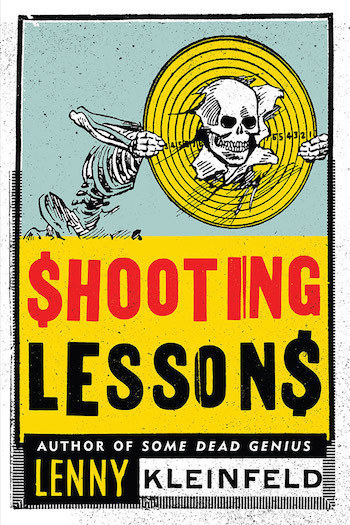
Congrats on the recent release of Shooting Lessons. There are two things I absolutely love about this book: 1) The use of dollar signs in place of the letter “S” in the title on the cover; and 2) everything else. So my question is, what sparked this darkly hilarious crime novel? More importantly, please don’t steal all my readers from me—I worked very hard for all 26 of them.
Thank you. The $ for S artwork is by the great Stewart A. Williams. Since everybody does judge a book by its cover, I think it's worth the investment to have an ingenious eye-catching one that says, This is a professional-grade novel. Then you have to hope reading the sample chapters doesn't demolish that impression. Though officially I just blame Stewart every time someone doesn't buy a copy.
The spark for the book was the usual: I remembered we have a mortgage. Then I banged my head against the keyboard until a plot fell out that wasn't awful and I could see opportunities where I could have fun. In this case, it was having fun with some especially deranged, despicable lobbying techniques employed by a major gun rights organization.
And don’t worry, I won't steal your 26 readers. We can share 25 of them. And that one guy who reads only one book a year and it's always yours—I'd never steal him, that'd be really rude. And I'm the politest guy ever. (My wife will confirm this. Just don't ask her when she's drunk. Or sober.)
There are some folks who feel “good” crime fiction can’t (or shouldn’t) be humorous. What do you have to say to such folks? What do you say we team up and fight them?
I tell those folks not to worry; if they don't have a sense of humor they can read my novels without any danger of being amused.
And no, I'm not teaming up with you to fight them. I'm old. It's your job to fight them. It's my job to criticize your hand-to-hand combat technique.
Who are your biggest influences as an author? Have you ever been fortunate enough to meet any of them? Have you ever been unfortunate enough to meet any of them?
My biggest influences are everyone who's written anything I liked and could steal from.
My stories aren't who-dunnits, they're how-dunnits. Written in a third-person POV—with lots of shifts between the good guys, bad guys and tangential guys. And any opportunity for humor is shamelessly exploited. Some reviewers and crime fiction fans have noticed a resemblance to the writing of Elmore Leonard and Carl Hiaasen.
I try not to meet authors whose work I like, because if they've read anything of mine, they might recognize what I stole and hit me during some careless moment when you, Greg, weren’t around to sacrifice your body in my defense, as any decent human would for someone as old as me.
Do you have any peculiar writing habits, aside from being a peculiar writer?
Yes.
I recently wrote a piece about some of the more memorable sources/subject matter experts I’ve interviewed to help me get away with murder (in my books— mostly). What’s one of the most interesting/disturbing conversations you’ve had as part of your research for a novel?
The murders in my books are simple ones that don't require research to write or arcane forensics to decipher. Most are gunshot-related. There's also a strangulation with a garrote, a neck broken, a smothering with a pillow, and a head-bashing with a fireplace poker.
However, once upon a time, in the 1960s, I was a teenager whose father was a police officer. He once told me about the good old days—the 1950s—when almost no cop-killer was tried for murder, due to their remarkably consistent tendency to die while resisting arrest. For example, when police located one young man who offed a cop, a senior officer went along to supervise the bust. The suspect ran. The senior officer was middle-aged but had been on his college track team. He chased the perp, caught up and, in full stride, raised his weapon and shot him in the head. I asked if the bullet to the back of the head of a fleeing suspect made it difficult to classify the incident as resisting arrest. I was informed the coroner's report may have contained a slight mistake, in which he may have reversed the position of the entry and exit wounds.
How did your upbringing influence you as a writer? If you could have a conversation with younger you about writing, what one or two pieces of advice would you give him?
The big literary influence during my upbringing was my grandfather. When I was in sixth grade he gave me a typewriter, after which my stuff became legible enough for people, including me, to read.
I'd give the young me the same advice I give any young writer:
a) Be talented.
b) Be born with a trust fund.
c) That thing you're working on that's finally done, through, finished, complete—shut the f*ck up and make it shorter.
Who and what are you currently reading? Can you please put that book down now and pay attention to my questions?
Michelle Obama's autobiography. And no.
Can we expect another novel from you soon, or do you need a long nap to recover from Shooting Lessons? If you do have a new work-in-progress, can you give us the skinny on it?
What's soon? I'm not familiar with that word.
The skinny on my work-in-progress is it's very, very skinny.
Is there anything you were hoping I’d ask but didn’t? Are you regretting having ever replied to my initial email?
My lack of imagination prevents me from answering your first question. My legendary politeness (see above) prevents me from answering your second. Don't worry, if this interview fails to spark a surge in sales of my new book, I'll stick with tradition and blame Stewart A. Williams, not you.
Fortunately, my detachment from reality and inability to pick up on obvious social cues has me feeling this interview went very well, and that you were happy to participate. So thank you for playing, and best of luck with the latest book—as well as with all the others!
Speaking of Lenny Kleinfeld’s books, his “Vacation Escapist Reading Sale” begins today and runs through midnight, July 16th:
Some Dead Genius—99¢
Shooting Lessons—$2.99
To learn more about Lenny Kleinfeld and his snark … uh, I mean work … visit his website , or check him out on Amazon or Twitter .
June 12, 2019
Willing Accomplices: The People Who've Helped Me Get Away with Crime [Fiction]
You know how, when you call the homicide division of your local police department to ask for assistance with a murder you have in mind, and they put you on hold for a good five or ten minutes and tell you to stay put?
No?
Oops, my mistake. I forgot most of you are respectable citizens with respectable jobs—not crime novelists.
It’s okay. I’m not judging.
I will say, though, it’s too bad you don’t get to experience the adrenaline rush that comes from having disturbing conversations with important people who possess the dark, gruesome knowledge you need to get your lies right.
The best part is, it’s a symbiotic relationship: The cop or FBI agent or medical examiner you chat with gets an intriguing diversion from the stark realities they live and work in each day, and you get the excitement of causing serious concern among total strangers.
I’m very fortunate to have a mind twisted enough to keep me from being able to hold down a real job, but not so twisted that I need to be locked up and prohibited from contacting as many authority figures in the medical and law enforcement communities as I want.
Following are some of the more notable subject matter experts I’ve spoken to, without whom none of my novels would have ever come to fruition. So you have them to thank or blame.
Dr. Patricia Rosen. Dr. Rosen is an experienced toxicologist who provided me with ample amounts of expert info on cyanide and other deadly poisons featured in my novel, Sick to Death. Truth is, when I contacted her and told her the plot of the book, she expressed a little too much interest in helping me. Naturally, I made sure to cite her on the Acknowledgements page—she’s not the kind of person you want to forget to thank.
A party supply store manager (whose name I forgot to jot down). The knowledge and insight I gleaned from this manager—whom I interviewed as part of my research for The Exit Man—was so indispensible and eye-opening, I can’t tell you who he was or where he worked. I got so busy and excited scribbling down his answers to my questions about balloons and party tents and helium tank rentals, I completely forgot to jot down his name. I do, however, remember his friendly customer service tone changing dramatically when I asked what size tank would supply enough helium to kill a man. Nevertheless, I went easy on him and didn’t bother to write a negative review on Yelp. I couldn’t—I didn’t know the name of the store.
Deputy C. Williams. The anonymous party supply guy above wasn’t the only expert who helped make my fiction true in The Exit Man. Deputy Williams of the Travis County Sheriff’s Department (in Austin, TX) spent a good half hour on the phone with me verifying the accuracy and plausibility of the police work depicted in the book. He then probably spent a good couple of days creating a task force to track my activity and make sure I wasn’t seen with any helium tanks in my possession.
Radd Berrett. Radd is the guy on whom the protagonist from my novel In Wolves’ Clothing is loosely based. Radd spent over two years putting his life at risk while traveling the world to help rescue victims of child sex trafficking. He’s both a badass and a sweetheart, and my interviews with him—in addition to being heartbreaking and terrifying—were invaluable. And considering he has the strength to bench-press my entire family, there was no way I was going to leave him out of this blog post.
A thoracic surgeon. While In Wolves’ Clothing doesn’t contain any major plot holes, there’s a gaping hole in the main character’s torso—a bullet wound that occurs midway through the book. To make sure that recovering from such trauma wasn’t D.O.A. from a feasibility standpoint, I spoke to a thoracic surgeon (who requested anonymity) before writing the scene. And I can’t tell you how thrilled I was when the surgeon told me I could totally get away with shooting my protagonist in the solar plexus at point-blank range. Happy day!
Andrea Perez. Andrea is an attorney specializing in art law, and has been an amazing resource in helping me keep my upcoming novel Into a Corner (launching in September!) from jumping the shark. Andrea has not only answered my many questions regarding art forgery and the legal ramifications surrounding it, she’s provided me with some very interesting facts and tidbits about the underbelly of the art world. I’ve incorporated much of this info into the book, resulting in a more captivating narrative and even a wild plot twist or two. Best of all, she offered her assistance pro-bono. That said, when I asked if she would represent me pro-bono—in the event I got caught committing some of the crimes featured in the book for research purposes—she laughed at me and hung up.
An organic biochemist from the University of Texas. When I called the Department of Chemistry at UT a couple of months ago to ask about the proper way to dissolve a human body (for a scene in Into a Corner), I got put on hold and passed around so many times, I lost count. Hopefully the organic biochemist I ended up speaking with actually was an organic biochemist and not a janitor posing as one. Nothing against janitors, it’s just, I’d like to be certain the morbid science in my novel makes sense. More importantly, I’d like to be certain there isn’t a janitor running around UT with intricate knowledge of how to dissolve a body.
For you fiction writers out there, what’s the weirdest/darkest/creepiest conversation YOU’VE ever had with a subject matter expert? Actually, I’m even more interested in having those of you who AREN’T fiction writers answer that question.
May 21, 2019
Interview with E.A. Aymar: An Easy Choice for Fans of Hard-Boiled Thrillers
E.A. Aymar has been described as “one of the most promising and talented hard-boiled crime writers of his generation.”
I’d like to add “hardest-working” to that description. In addition to recently launching his latest critically acclaimed crime thriller, The Unrepentant (Down & Out Books, March 2019), Aymar’s writes the monthly column “Decisions and Revisions” for the Washington Independent Review of Books, and serves as the Managing Editor of The Thrill Begins—the International Thriller Writers' online resource for aspiring and debut thriller authors.
Add to all that the fact that Aymar also runs the Noir at the Bar series in the Washington, D.C. area and is often invited to speak at a variety of crime fiction/writing events nationwide, and you begin to wonder how in the hell he had any time to speak to me for the following interview:
Welcome, E.A.—great to virtually speak to you!
Thank you for interviewing me, Greg! A few people have recommended I read your work, and I’ve since started (more on that later), and I’m really pleased we’ve had the chance to meet.
Cool, and ditto! Now let’s jump right in:
Many would consider humor and sex trafficking to be oxymoronic (trust me, I know), and yet your new novel, The Unrepentant, has garnered much critical acclaim in spite of—or perhaps due to—it’s bold blending of humor with unspeakable crimes. What compelled you to write this book in such a way?
I think it needed the humor, you know? It was such a dark topic and, in the early drafts, a dark book. One of the early readers was the writer Alan Orloff, and his first note back to me was, “Well, that’s depressing.” Which is a very Alan Orloff thing to say.
But he was right, and that was helpful. Because I’d forgotten an important element of writing—the reader. I wanted to create a no-holds-barred story, and I included moments of graphic violence, but those instincts originally overwhelmed me. We don’t read fiction for an exhaustive portrayal of unforgivable actions—and, even if I’m wrong about that, it’s not what I want to write. You need to include hope.
I keep thinking of this book as a dark canvas, but one cut with moments of light. Humor offers light.
When someone in an elevator hears you have a new book out and asks you what The Unrepentant is about, what’s your quick pitch to get them hooked and to keep them from calling security?
“A young woman escapes a group of criminals and realizes, to fully free herself, she needs to kill them all. If you liked Kill Bill but didn’t think it went far enough, you’d like this book! …Wait, why are you getting out of the elevator here? This isn’t even your floor.”
Spending months researching and writing about dangerous topics can be emotionally and psychologically taxing. Do you, like me, self-medicate and watch rom-coms to cope with it all, or have you found healthier outlets (meditation? yoga? a sensory deprivation chamber?) to help you endure the darkness you put on pages?
What I wrote was nothing compared to what I read, or the experiences that were relayed to me. And that helped a great deal. My job was much easier than the men and women who work with victims of trauma, and I never forgot that.
But there are always the scarring images or stories, or the things you hear and realize you won’t forget. And that can be very tough to deal with. I can usually distance myself emotionally from that, but I know a lot of writers who can’t. Particularly if they’ve experienced a similar trauma in their lives.
But it does help to realize that the horrors you’re writing about are never as bad as the horrors people experienced. And it becomes a duty to relay them, as best as you can. I’ve said before that I think writers have a duty not to look away, but that depends on what you write about, of course. I managed to gaze at this issue steadily…even though there were times when my gaze broke.
I saw that one of the stops on your current book tour was your old high school. That’s pretty cool. But what kind of principal brings an author of a book like yours in to speak to an auditorium filled with raging hormones and not-yet fully-developed frontal lobes? More importantly, did the cool kids from the school invite you to sit at their cafeteria table afterward?
It was a lot of fun! And I invited myself—a teacher at the school is a friend, and I reached out to her about the idea. Joe Clifford had recommended it, and I took his advice…and it was bad advice. Why did I ever listen to Joe Clifford?
Actually, it wasn’t a bad experience at all, but it was an exhausting one. I talked to groups of about 60-80 kids for the entire day, and I was WORN when it was over. The thing that surprised me was that the kids actually asked questions afterward. I thought they’d sit there, kind of sullen and bored, but they were really engaged. And their questions were sharp! Do I worry about a likable protagonist? What were the steps I took to having a published book? How do you know when to curtail violence?
The principal actually did a show up for one of the talks, and she walked out. And I didn’t swear or anything! But that’s okay. It seems like a very “writer” thing for a figure of authority to disapprove of you, right?
And, no, the cool kids barely acknowledged me. Which, to be fair, is also a very writer thing.
When not busy writing and traveling around corrupting young minds, you serve on the board of the International Thriller Writers (ITW), are the managing editor of The Thrill Begins (ITW’s awesome online resource), and run the Noir at the Bar series for the D.C. area. So my question is, do you rely on caffeine, amphetamines and/or some other performance-enhancing substance to get everything done?
You know, I do drink too much caffeine. I’m really trying to get better about that.
Right now it’s all fine. Everything I do is something I enjoy doing, and that helps a lot. If I didn’t like it, it’d truly be a burden. But I love writing columns for the Independent and working with ITW and running the N@Bs for D.C.
It took me a long time to get published. I started writing seriously in 1997, finished my first book in 2003, and my first book was published in 2013. And The Unrepentant is the first book I’ve written to be widely reviewed and read. So this is all wonderful for me. I’m forever grateful, and excited to call writers I long admired peers and friends. It’s never tiring.
What authors have been your biggest influences as a writer? In what ways, if any, has your Panamanian heritage informed your writing?
The two biggest influences are probably Anne Tyler and John Updike. They’re not the most likely candidates for crime fiction, but I loved their use of prose and domestic drama.
And then, for crime fiction, I love Lawrence Block and Megan Abbott. I can’t think of two other authors I have such urgency to read, or who continually put out wonderful work.
I was born in Panama, and half my family lives there. I went there a lot growing up, and it’s important for me that my son has those same experiences. But Panama as a country doesn’t factor into my writing; rather, the experience of being mixed, or a minority, does.
Because of my mixed race, I’ve always been cast just outside or barely inside social or racial circles, and that relationship has given me a good perspective on people…and I think good training as a writer. I’ve never really belonged somewhere, and that used to be an isolating feeling. That’s changed. I go to malls nowadays, and I see interracial couples everywhere. It’s lovely, and gives me hope that my son (himself Asian and Latin) will never feel that type of isolation.
But for me, that “outsider” status has never left, and it continually informs my characters. Often in ways I’m not conscious of, which I think is helpful.
Who are you currently reading? Are there any up-and-coming authors of crime/noir/thrillers you are especially excited about and see a big future for? What do you mean I’m not one of them?!
Right now I’m reading Jeffery Deaver because I’m moderating a panel he’s going to be on, and I need to get my shit together.
But there are a lot of writers nowadays that mean a lot to me. Gabino Iglesias, Nik Korpon, Sujata Massey, Eryk Pruitt, Jen Conley, Sarah M. Chen, Jennifer Hillier, Shannon Kirk, Tom Sweterlitsch, J.J. Hensley (really anyone who contributes to The Thrill Begins as one of our regular bloggers is a writer I hold in high regard, which is why I chose them)…I could easily go on.
And, honestly, as I mentioned earlier, I’m reading your novel In Wolves’ Clothing and digging it! I had to stop to read Deaver for this panel at the Washington Writers Conference, but I’m excited to come back to your work. The only reason I haven’t finished it is Deaver. Blame him.
Care to tell us a little about what you’re working on next?
I got a new thriller in the works, but my next thing will be a sequel (of sorts) to The Night of the Flood. Sarah M. Chen and I are working on the edits right now and it’s exhausting and, even worse, she doesn’t seem willing to do most of the work this time. But that will hopefully be out in 2020. It all depends on how much I can convince Sarah to do everything and give me all the credit. Fingers crossed!
Well, Sarah and I are virtual friends (and she was part of a feature on this blog a couple of years ago), so I’ll see if I can help convince her to carry all the weight again. But don’t get your hopes up—I’m not very convincing, plus Sarah’s too wise to ever listen to me.
Okay, time to wrap this up. Thank you very much, E.A., for taking time out of your insane schedule to chat. (It’s rare, and possibly even illegal, for two men who’ve written novels about sex trafficking to converse.) Here’s to the continued success of The Unrepentant, and to you claiming a seat at the cool kids table sometime soon!
To learn more about E.A. Aymar and his work, visit his website, or check him out on Amazon or Twitter.
April 30, 2019
I Almost Robbed My Protagonist of Her Race and Gender
Odessa Scott, the main character in my upcoming novel Into a Corner (yes, I changed the title again), has been through a lot. In addition to her husband running off with all their money and dying in a car crash with his girlfriend six months ago, Odessa's been dealing with chronic agoraphobia, her recent decline as an artist, and trying to help her mother fight the initial stages of dementia.
There’s only so much a person can take.
Which is why Odessa—a biracial woman—threatened to kill me when I considered turning her into a white male.
I totally understood her outrage. I mean, everything had been going great. Sure, Odessa’s life was in shambles. Sure, she was in so much debt she committed art forgery in hopes of landing herself and her mother in a comfy prison. But other than that, things were groovy. She was totally cool with the plot and the pace and the writing. She’d given me total creative freedom.
So why did I go and nearly ruin everything? Why did I come so dangerously close to robbing Odessa of her gender and race, her name and her past, her identity?
I’ll tell you why. Fear.
It’s not that I was afraid I’d chosen the wrong gender and race for the protagonist of my novel. Quite the contrary—I knew Odessa was exactly how I had written her. I knew this because she, herself, has been telling me who she is ever since she first whispered the story idea to me months before I’d written a word of it.
So no, I wasn’t afraid Odessa was the wrong character.
I was afraid I was the wrong author.
You see, I do my best writing in the first-person present point-of-view—a tense in which a writer basically embodies their main character and converses, describes and thinks as that person, in “real” time. Now, if you’ve ever met me or seen my photo, you may have guessed I’m not only not a woman, I’m not a biracial one raised by a black mother and white father.
So where in the hell do I get off writing a main character like Odessa?
That’s the question that kept bouncing around in my brainpan midway through writing the first draft. It’s the question that had me thinking how much easier it would be for me to just stay in my lane and make the protagonist a white guy. Someone just like me. Someone just like all my other protagonists.
It’s also the question that caused Odessa to slap me in the face and shout, “Don’t you DARE make me a white dude!” (She wasn’t too thrilled about me making her mother white, either. Nor was her mother, who figures prominently in the book.) This is not to demean white people. It’s just, Odessa and her mother aren’t white. They never have been, and never will be—regardless of any doubts or insecurities I may have had about my ability to write them as they are.
There are some fiction writers who cling tightly to the old “write what you know” rule (if you can even call it a rule). I’m not one of those writers. First of all, writing only what you know stifles creativity and the imagination. Secondly, much of what you don’t know, you can learn. (That’s why I’ve been able to publish novels about things like underground mercy killers, terminally ill vigilantes, and sex trafficking sting operations. If you actually think I know about those things from personal life experience, and you’re still a fan, then I guess I should start being more nervous at book signings and other public appearances!)
Now, that all said, I don’t dare claim to have learned to be biracial or a woman. But I have learned to listen to my characters, and to trust my instincts as much as my characters trust me with their literary lives. It helps that I have a diverse range of friends and beta readers representing various ethnicities and races. It also helps that I’m married to a biracial woman—one who never hesitates to tell me whenever I’ve blown a scene or gotten a female character’s behavior, actions or speech all wrong.
So, I’m sticking with Odessa and the original plan. And not just because Odessa’s someone I don’t want to piss off. (Did I mention she has anger issues and is proficient in Krav Maga?) No, the main reason I’m not changing Odessa Scott to Scott Odessa is that doing so would be much worse than taking an artistic risk and failing. Doing so would be an act of cowardice, one that would almost certainly sap the story of much of its power, authenticity and significance. I won’t go into more details as to why that is—that would take too long for this blog—so I guess you’ll just have to read the book when it comes out in a few months. (“A brilliant marketing ploy, Greg!”)
The main point of all of this is, I wanted to challenge myself as a writer by respecting the origin and identity of my protagonist. I wanted to tell a gritty yet humanistic story of someone who doesn’t look or think just like I do. I wanted to embrace diversity without stereotyping or pandering or patronizing.
Do I think I’ve succeeded? I don’t know. Do I like what I’ve written? Very much so—but that’s not the same as succeeding, especially with a book like this one. Especially with a character like Odessa Scott.
But here’s the thing: It doesn’t really matter if I succeeded. I'm not saying I don't care if people get offended by the book, though I don't think they will, as the story itself isn't really about race or gender issues, nor does it try to push people's buttons in those areas. What I mean by "it doesn't really matter if I succeeded" is, it's okay if I get shelled by some readers and critics for pushing past my comfort zone and going where they feel I shouldn’t have gone as a white, male author. I can live with that. What I can’t live with is continuing to play it safe and write inside a bubble so familiar, I never get to explore—or try to understand—anything new or different.
How about you? What’s your take on authors writing “outside” their race, gender and/or ethnicity? (And if your answer is “it depends” [which is a perfectly understandable reply], upon what do you feel it depends?) I look forward to you sharing your thoughts and opinions.
On a completely unrelated and totally self-promotional note, today’s the LAST DAY to get the Kindle edition of one of my previous novels—SICK TO DEATH—for just 99 cents! (Amazon US and Amazon UK only.)