Greg Levin's Blog, page 16
November 4, 2014
How to Be a Failed Novelist
 Failing as a novelist goes far beyond merely writing a bad book. If all it took was an inane plot, one-dimensional characters and piss-poor writing, many of today’s best-selling authors would be receiving welfare checks.
 To truly fail as a novelist today, you need to do all or most of the following things:
Refuse to succumb to social media. Continue to view Twitter as a time-waster, Facebook as foolish and blogging as bullshit, and you’ll be well on your way to being a failed novelist. When I first became an author, I scoffed at social media as a marketing/engagement tool, and as a result I had tremendous success with poor sales. Since then, I’ve sold my soul to the social devil, and have subsequently seen my success with poor sales start to wither.
Write just one book. To help ensure your failure as a novelist, be careful not to be prolific. I’ve seen many authors fail to fail by continuing to write and publish viable fiction on a regular basis. Instead, go with the one-and-done approach. Sure, you might get unlucky and have your failure marred by having your lone book soar to the top of the bestseller list, but the chances of that happening are Salinger to none – especially if you follow the rest of the action (or inaction) items featured in this post.
Talk only about your book. One of the best ways to become a failed novelist is to get all up in everyone’s grill about how they simply must buy your book. Pressure your family and your friends, and your friends’ family and friends. Turn every conversation toward your book. And while I earlier noted how embracing social media is frowned upon if you want to fail as a writer, using it with the sole purpose of flagrantly promoting your book is actually recommended. Don’t share compelling info written by others on Facebook or Twitter, and don’t write intriguing blog posts that may captivate people – such actions increase the risk of attracting readers and having them become genuinely interested in who you are and what you’ve written. That can doom your success as a failed novelist.
Be an island unto yourself. Whatever you do, do not hang out with other writers or attend writing/publishing conferences if you have any hopes of achieving a high level of failure as a novelist. Networking and exchanging ideas with others in the writing and publishing field will only help to provide you with insight and open doors that may very well lead to you being successful. Top failed novelists spend all or most of the day at home or in the basement of their parents’ house, holding on to the notion that they are an undiscovered literary genius.
Get publicly pissed at critics. Received an unfavorable review from a book reviewer, blogger or regular reader? By all means lash out at the culprit publicly – directly on the webpage where they left the review. Let them know how they missed the whole point of your novel and how they aren’t mentally equipped to grasp your overarching themes and unique literary style. This will ensure as many people as possible see you are not a writer to mess with. Many will be so scared of not liking your book, they’ll play it safe and not even bother to buy it.
Quit reading. All reading does is take you away from your own writing and provide you with new ways of developing characters and plot – ways that put you in danger of improving your writing to the point of greatly increasing your appeal to readers and burdening you with big sales numbers. A true failed novelist keeps all the books they once read – or had planned to read – in a prominently displayed bookshelf in their house to show family and friends how smart the failed novelist thinks he or she is. However, he or she never cracks open any of those books or any of the new ones he or she buys to bolster the collection, which, as mentioned, is now all for show.
NOTE: Having already succeeded as a failed novelist, I recently decided to explore new horizons and shoot for actual literary success. And while I‘ve already made some progress down that path, I still have a long way to go. You can help! All you need to do is make a small donation to the Amazon, Kindle or Nook page featuring my latest novel – The Exit Man. (In other words, buy the damn book.) A portion of your donation will go directly toward helping me buy liquor.


October 22, 2014
Some Reasons Why I Might Kill You... in a Book
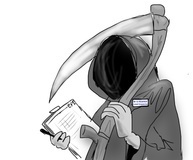 As an author of fiction, it’s often necessary to kill. I can do it with just a few taps on my laptop keyboard. While literary killing is simple from a tactical standpoint, sometimes it’s just as painful for the writer as it is for the character who’s getting offed. I’ve had to destroy characters I love and whom I know some of my readers love. Committing murder can be a real bitch.
 It can also be a ton of fun and highly cathartic. We writers have the sadistic and twisted tendency to occasionally base a character – however minor – on someone in real life who pissed us off enough to get shot, stabbed, run over or beaten to death on the printed page. And the best part is, we always get away with it.
Here are just a few reasons (there are plenty more) why one day I might just have to kill you in a book:
You make me miss a light because you were texting in your car. I’m stopped at a red light, three or four cars back, certain to make it through the next green light. However, you’re in one of the cars in front of me – too busy texting your friend about how much you hate traffic, and you fail to realize it’s time to accelerate. By the time you do, the light has rapidly moved to yellow and then to red, as has my complexion. Rather than honk you to death, I decide to make your demise more painful and public by literally (albeit literarily) eviscerating you in some future chapter.
You don’t bother to hold the door open for me in an obvious hold-the-door-open situation. I’m walking mere steps behind you heading into the gym, but you feel that the minor physical effort required to keep the door ajar for a stranger might ever so slightly hinder your performance in your Pilates class. Thus, you scoot through and allow the door to shut in my face, thereby sealing your fate. Maybe if you had known I was a writer – one with anger management issues to boot – you would have displayed some common courtesy and, as a result, would not now be staring certain fictional death in the face.
Every time you see me, you tell me you want to buy my book… but never do. The first rule of not buying my book is don’t talk about buying my book. I get it, deep down (or maybe even straight up) you don’t like me and/or my writing, or you don’t have time to or know how to read. Fine. Then just do us a both a favor and don’t even mention my novel. I won’t be the slightest bit irked or offended. If you don’t actually look forward to reading what I’ve written, just shhhhhh. Or die in my next book.
You break my daughter’s heart. It’s really such a shame – the boy who recently and callously broke up with my 14 year-old daughter had his whole life ahead of him. And he’ll probably die twice, as my daughter is quite the budding writer herself.
You bring 20 items to the “10 items or less” lane. This is an act that, while rather common and seemingly innocuous, cannot continue to go unpunished. Before we know it, express lane grocery clerks will start to turn a blind eye to 30 items and then to 40 items, at which point society as we know it will inevitably crumble. I’ll let you go as far as 15 items, but after that, you greatly increase your risk of dying in a sudden explosion I force into one of my plots.
The grammar and punctuation featured in your Facebook posts are atrocious. And since you post far too often, you’re constantly burning a hole into my retinas and my soul with your improper use of “its” and it’s” and “your” and you’re” and “their,” “there” and “they’re” – not to mention your total disregard for commas and periods. Sure, I could just de-friend you, but it’s much more satisfying to make you suffer an untimely demise at the hands of one of my more sinister characters.
You’re my neighbor and do nothing to stop your dog’s incessant barking. Your canine hates you for keeping him chained to a tree all day and night. Luckily for you, your dog doesn’t have the ability to write. Unluckily for you, I do – and I have every intention of creating a world in which your dog – now rabid from a raccoon bite – goes Cujo on your ass. In this world I create, your neighbors all come running to your backyard… not to rescue you, rather to stand behind the fence and cheer on the mad dog.
Please note the above blurbs are not just idle threats of fictional killing. I’m currently working on a dystopian novel (set slightly in the future) about a man who works for a secret US agency in charge of population control, and whose job is to help “thin the herd” on a daily basis. He’s constantly on the lookout for common citizens behaving badly. And thus so am I. (Insert sound of maniacal author laughter here.)
October 6, 2014
5 Reasons NOT to Buy My Latest Novel
 Naturally, every author wants everyone to read everything they’ve ever written – or at least everything they’ve ever written that’s for sale. And while I certainly want as many people as possible to buy and read my latest novel, The Exit Man, I don’t want anyone with an elevated risk of not enjoying the book to waste their time and money. I’m thoughtful and noble like that.
So, rather than brag about how incredibly unique and captivating and intriguing and entertaining The Exit Man is, I’ve made a list of reasons why you may NOT want to buy my amazing book:
1) There’s not a single zombie, vampire, wizard, werewolf or overly explicit erotic scene. There were tons, but they all got edited out during the final proofing process since it was decided they did little to advance the plot.
2) The book is 99.9% text. Considering we now live in a Facebook/Instagram/Pinterest-centric society, I’m not sure WHAT I was thinking creating an almost entirely text-based piece of work – and a rather lengthy one at that. Like 300,000 characters long. I guess it’s true what they say – writers be crazy. That all said, the book does feature a cover image and even a few cool tone-setting pics that precede the start of the actual story, but after that, it’s all letters and words and paragraphs.
3) There is no audio book version available. Trust me, I get it. You have a job and kids and a drinking problem and a Facebook and Instagram and Pinterest account – all of which demand your attention for most of your waking life. You have neither the time nor energy to read. Unfortunately, reading is currently the only way to experience my novel, unless your significant other or hired escort doesn’t mind reading you to sleep each night. I have considered making my novel available as an audio book, but James Earl Jones charges way too much for his voice services, and Dame Judy Dench’s people have yet to return my calls. There is still hope though, as I am currently in talks with Gilbert Gottfried’s agent.
4) You are a little unstable, and the book mentions suicide a lot. I’m not judging – all humans, by their very nature, are a quite unstable… with the exception of Ryan Gosling, who really seems to have his sh*t together. We are the only creatures completely conscious of our inevitable death. That kind of knowledge will mess a person up, for sure. The protagonist of my novel is a rogue euthanasia specialist (is there any other kind?) who utilizes a very clean and painless method to help his terminally ill clients exit this world humanely and with dignity. If you, the reader, are suffering from any kind of existential angst or psychosis – and you are – this book might end up being a lot more suggestive than intended. I don’t have time for any legal battles with the surviving members of your family – I’m too busy writing my next disturbing yet poignant dark comedy.
5) I’ll probably just spend the money on drugs. Years of sitting on my ass writing has been hell on my lower back, and decades of being fully conscious of my imminent death has been hell on my hypothalamus. Thus, any funds earned from my latest novel will likely go toward muscle relaxants, pain pills and/or anti-anxiety meds. So, unless you are okay with supporting my dangerous habits (narcotics AND writing), better just to stay away from my book. Or just wait until it's available for free or at a severely discounted price after I’m institutionalized.
I realize many of you don’t like doing what you’re told and will go ahead and buy my novel despite my above disclaimers. Well, far be it from me to stand in your way. Hell, I’ll even be a good sport about it and provide you with a link to the book’s Amazon page .
September 23, 2014
Continuing to Create When Not Feeling Continuously Creative
 A question I'm commonly asked is, “How do you stay inspired to write?” or something similar – e.g., “What do you do to stay motivated?” or “Wouldn’t you sometimes just rather die than have to come up with the right words?” I understand why folks ask such questions, and only occasionally do these queries send me spiraling into an existential crisis.
There’s no denying that continuing to create when you’re not feeling continuously creative can be challenging. That said, I’ve never been one to easily succumb to writer’s block. Those who know me well or who have ever gotten stuck talking to me at a party or on a plane know that I’m rarely at a loss for words. Now, whether those words are worth reading (or listening to) is another matter entirely. But that’s not what we’re discussing here. We’re talking about simply creating – not necessarily creating a masterpiece or even something that someone besides my own mother would enjoy.
Now, this is not to suggest that, as a writer, it’s okay to continuously bombard readers with unreadable drivel. If it were, I would dedicate 100% of my time to blogging. What’s important is realizing and accepting that not every word or paragraph or page you create will be brilliant. When you realize and accept that, it takes the pressure off and frees you up to let things flow. And it’s then that good things can happen. Readable things. Maybe even a masterpiece or something that someone besides your own mother would enjoy.
Of course, merely telling yourself to lighten up and relax to avoid writer’s block or creative stagnation is easier said than done. Following are a few unique things I do (or have done) to continue to create even when every atom inside me beckons me to call it quits and become a full-time alcoholic. If you are a writer (or some other creative type), feel free to borrow or steal any of these (or modify them to suit your activity/purpose):
Hang a sign on the wall of your writing area that reads, “Every day you don’t write, a puppy contracts the Ebola virus.” This one is enough to get anybody writing… unless they themselves are a sick puppy – which, conveniently, lends itself to great writing.
Put the exquisite pain of your writer’s block in writing. Charles Bukowski said, “It’s better to write about writer’s block than to not write at all.” And then he died alone, but famous and very widely read.
Reward yourself with a special treat for each completed paragraph, page, chapter, etc. For example, whenever you write a compelling paragraph, treat yourself to a bit of chocolate. Whenever you dash off a whole page, treat yourself to a small glass of wine. Whenever you complete a full chapter, treat yourself to some more chocolate AND a larger glass of wine. And whenever you finish your book, get treated for diabetes and cirrhosis.
Rig your writing chair or keyboard with an electroshock mechanism. Program it to zap you every 20 minutes you sit at your computer without writing a full and coherent sentence. (Please note that for this one you may have to bring in an inventive electrician, or a sadistic IT guy.)
Keep a list of really bad best sellers near your writing desk at all times. Being constantly reminded that such crap can sell millions of copies will piss you off enough to make you want to bring something of true literary quality into the world. Just be sure what you create is not of TOO high quality, otherwise it will have little chance of commercial success.
What kinds of kooky things do YOU do to inspire yourself to keep writing or creating whatever it is you write or create? Feel free to share them in the “Comments” section below.
September 9, 2014
The Author's Glossary
 There's no need for a lengthy preamble to this post. The title is pretty self-explanatory. There is, however, a need for a light warning...
Warning: The following content may be unsuitable for those who are sensitive to snark, bothered by barbs, or allergic to acidic quips.
agent: One of a handful of people on this planet permitted to enter the office of, make eye contact with, and occasionally even speak directly to an actual publisher.
Amazon. An immensely successful business that is wanted for the murder of thousands of innocent bookstores.
author (of fiction): A writer who is much more comfortable with imaginary people than with people who take up actual physical space and oxygen.
author (of nonfiction): A writer who is at least somewhat in touch with reality but who has a strange perversion for creating proposals and outlines.
bestseller: A book that contains one or more of the following characters: a zombie, a vampire, a werewolf, a wizard, a warlock, a nymphomaniac, a mass murderer, a hitman, an international spy – and preferably one character who is all of these things. Or, any book written by an A-list celebrity. Or, any book written by a B-list or C-list or D-list celebrity who recently released a sex tape.
book: A small rectangular or square object comprised of pages filled with text intended to help people forget about the devastating things they see on reality TV.
classic: A word that authors gleefully mutter whenever they witness a renowned colleague tripping on stage while accepting the Pen Faulkner Award.
crime fiction: A genre of writing that provides a somewhat healthy outlet for authors who would otherwise be institutionalized.
draft: The cold rush of air felt by a writer upon first reading the manuscript edits provided by his or her editor.
ebook: A reading implement designed for people who have a severe aversion to paper cuts, dog-ears and bookshelves.
erotica: A genre of writing that features more than one climax.
fantasy: What anyone who thinks they can make a living as an author is stuck in.
fiction: What every writer creates whenever answering the question, “How are sales of your book going?”
graphic novel: A comic book for people who have matured beyond comic books.
historical fiction: A genre of writing that prominently highlights events nobody really cared about even back when they actually happened.
horror: A word that commonly follows the words “oh the” after an author receives his or her first royalty check.
indie author: Just like an indie musician but with a larger vocabulary, fewer fans and no skinny jeans.
literary fiction: What ALL fiction used to be back when authors wrote at real writing desks rather than at Starbucks’ tables, and when they drank scotch rather than Caramel Ribbon Crunch Frappucinos.
literature: The pamphlets that desperate authors pass out on the street and in coffee shops in hopes of getting someone to buy their damn book.
manuscript: What writers burn to stay warm once their heat is turned off.
mystery: The only way to describe the huge success of E L James and Stephenie Meyer.
non-fiction: The truth as misremembered by a writer.
novel: Something writers claim to be working on in order to justify their current lack of productivity and success in any other area of their lives.
publisher: A gatekeeper to the literary world, which, oddly enough, no longer even has a fence around it.
query letter: An author’s formal written request for a rejection notification.
rejection notification: Official proof that a literary agent or publisher has acknowledged a writer’s existence but not his or her ability.
royalty. 1. Money that is spent a thousand times over before a writer receives it. 2. What you have to be in order to get a decent book deal these days.
science fiction: Writing that becomes historical fiction after enough time has passed.
self-publishing: A bold and daring way for zealous authors to release books for their parents to read.
short story: A novel that isn’t tall enough to ride this ride.
thriller: A genre of writing that substitutes plot with pistol play, character development with car chases, and eloquence with explosions.
true crime: The fact that traditionally published authors get to keep only 10% of the earnings from the sales of a book they wrote 100% by themselves.
writer: A person who, along with an actor, is the driving force behind the waiting and bartending fields.
YA: The best way to define YA (pronounced 'why a') is to use it in a sentence: “YA book has to be written for tots, tweens and teens to have a snowball’s chance in hell of succeeding these days is beyond me.”
NOTE: This glossary is a living, growing entity – unlike most authors’ careers. Feel free to add some of your own relevant and devilish definitions in the “Comments” area below.
August 26, 2014
What Was I Thinking? How My Latest Book Was Born
 When people ask me, “What’s your new novel about”, I tell them, “It’s a dark comedy about a party supply storeowner who helps terminally ill people end their lives with grace and dignity.”
That’s when the people invariably knit their brow and ask: “You wrote a comedy about suicide?”
“Of course not,” I respond. “What kind of insensitive jerk do you think I am? I wrote a comedy about mercy killing."
And for the record, my new novel – The Exit Man – is more of a dramedy than a comedy. I’m really not such a bad guy. Neither is my protagonist, Eli.
Another very common follow-up question I receive from the few people who aren’t afraid to continue talking to me is: “How did you come up with that?”
Well, like many writers and other sensitive creative types, I often think about suicide whenever the slightest thing doesn’t go my way. (Now, before any of you offer me a hotline number to call or recommend I seek psychiatric help, let me point out that, while I may often think about suicide, I don’t often think about committing suicide. Thank you, though, for your imagined concern.)
So, one day, after something horrible happened to me (I couldn’t find my favorite pen), I started thinking about what would be the easiest, most humane and least messy way to end it all. That, of course, led to a Google search where, after a little bit of digital digging, I discovered that the steady and controlled inhalation of helium – via a tank, a tube and a plastic bag over the head – was the method of choice among many right-to-die advocates.
Fortunately I have ADHD, so I soon forgot that I was upset about my misplaced pen and became very intrigued by what I was reading. I saw the spark of a potentially good story. An original story.
Like most people, when I think of helium I think of party balloons (and squeaky voices). So when fleshing out my story, I got to thinking how interesting it would be to have a regular schmoe who owns a party supply store somehow get involved in euthanasia. I didn’t want to have an evil and sadistic protagonist, however, so I was careful to craft a set of circumstances that would make the party supply guy’s indoctrination into mercy killing not only believable but noble (no helium pun intended). A sort of 'Dexter meets Dr. Kevorkian' kind of tale.
I want to point out that The Exit Man in no way makes light of suicide or terminal illness. The book is certainly a dark comedy (at least I hope it elicits some laughter); however, the humor in the book stems not from death or suffering. Rather, the humor comes from the complicated predicaments that Eli continuously finds himself in. And also from the stark contrast of Eli’s day job with his secret underground operation. Selling party favors one minute and taking a life the next – plenty of room for black humor there, don’t you think?
While making readers chuckle was definitely part of my original plan with this novel, laughter was not all I was after. I had hoped to engage readers and elicit lively discussions about voluntary euthanasia – all while providing plenty of suspense and intrigue.
So, now that you know what I was thinking when I created The Exit Man, I’d love for you to check out the book and then let me know what YOU think!
August 12, 2014
The Writer's Wardrobe
 The old idiom “Clothes make the man” doesn’t really apply to professional writers, most of whom spend the majority of their time holed up in their house working in their pajamas or underwear – or less.
Still and all, every writer – and aspiring writer – needs to pay attention to their wardrobe and make sure they have in their possession certain critical clothing items and accessories. Failure to do so could lead to complete and utter failure. True, most writers are already accustomed to complete and utter failure, but it’s a damn shame when it’s their wardrobe that’s to blame.
The following pieces should be found in every writer’s closet or, if you live like I do, laundry basket:
One stylish/expensive suit or dress. Despite the fact that only your parents, your partner and some guy you went to middle school with have purchased your book, you still have to dress like a best-selling, award-winning author whenever you attend writers’ conferences and other industry events. Sporting something by Calvin Klein or Donna Karan will usually be enough to get you into the good conference cocktail parties and after-parties, where you can schmooze with the big agents and publishers who, hopefully, will be shitfaced enough to believe that your book they never heard of is selling like Fifty Shades of Grey based on the duds you’re wearing.
Note: If not even your parents are buying your book, then don’t worry about spending a bunch on a suit/dress or conferences. Instead, put the money toward some writing classes, or a ghostwriter... or nursing school.
A helmet. Every year, hundreds of writers suffer moderate to severe brain trauma caused by repeatedly banging their heads against walls, desks and literary agents. Nobody can expect writers to simply stop banging their noggins against things – that’s simply unreasonable. Thus all authors and even serious bloggers should be required to wear a helmet.
To date, only one US state has a helmet law in place for writers – Alabama – but that law is more to protect writers from local citizens who shoot at people for using “them big college words.”
Moisture-wicking shirts and underwear. When you spend all day creating intriguing and compelling prose, developing captivating plots and characters, and banging your head against things, you tend to work up a sweat. Very few writers can write well when wet – only Hemingway and Bukowski managed to pull it off on occasion. (Hemingway was often damp from the sea; Bukowski from beer and vomit.) It is therefore essential that every writer own at least three shirts and three pairs of underwear made of Capilene or some similar high-tech material designed to wick moisture away from the skin. This will enable writers to stay warm and dry enough to focus sharply on why they ever even started the book they’re working on.
Note that moisture-wicking clothing helps not only with sweat but also tears. This added benefit makes such apparel even more of a must-have for women and men of letters.
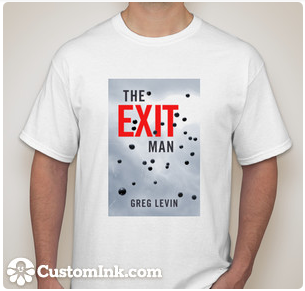
A tee shirt displaying the title of your book. This piece of apparel is really only of value to writers who still leave the house on occasion. If you are a complete and utter recluse, wearing such a tee shirt isn’t going to lead to many conversations about or sales of your book – unless you are Catholic or a Mormon and thus have dozens of blood relatives and/or wives living under your roof.
Assuming you are among the 28% of writers who are not recluses, donning a shirt displaying your book title (see mine below) is a great way to get complete strangers at grocery stores, bars, restaurants, bookstores (huh?) and the unemployment line to ask about your pride and joy. Be sure to hand anyone who does ask about your book a business card containing info about where to find it… then hand them your phone or tablet with the screen already displaying the “add to cart” feature on your Amazon page.
On days when everyone you do this with refuses to buy your book (and there will be many such days), just go home, continue working on your new book, and, most importantly, put on your helmet.
July 29, 2014
'The Gal in the Blue Mask' Interviews Yours Truly
 One of the coolest things about being an author (along with the vintage tweed blazers and the delusions of grandeur) is that occasionally people in the book world want to interview you. Whenever somebody who not only knows how to read but actually enjoys it and has a job related to it shows an interest in you, it makes you feel as if all those days and nights you spent slaving over your story and pulling your hair out were almost worth it.
Below is a my recent interview with a very smart and very cool book blogger named Meghan, who goes by the handle of 'The Gal in the Blue Mask.' (This interview originally ran on her blog a week ago, and Meghan was kind enough to let me share it with you on mine.)
Hi, Greg. Welcome to The Gal. Let's start off easy with you telling us a little bit about yourself.
Ooh, a dangerous way to start – don't you know the risk you run by inviting a writer to talk about himself? That's how unwanted biographies are born. I'll be kind and spare the readers the info-dump. Besides, by answering the other questions you pose below, the readers will learn more than a little about myself. Some of it they might even find the slightest bit interesting. But I'm not promising that.
What are 5 things about you that most people don't know?
1. My novels. (I'm hoping that will change soon.)
2. I was well on my way toward becoming a Physician's Assistant in the mid 1990s until I decided I wanted to be a professional writer. (I can still hear my mother sobbing.)
3. I lost my sense of smell for three years following a concussion in 2004.
4. I can freestyle rap about virtually any topic I'm given. I'm not even that bad at it.
5. I lived in Spain for four years (2000-2004).
What is the first book you remember reading?
As a young boy I loved reading, so that's a hard one. I'll say the first book I really remember reading – over and over – was Curious George Goes to the Hospital, by Margaret Rey and H.A. Rey. I adored that sweet, trouble-making monkey. I no longer have the book in my possession, but I occasionally visit a copy at the bookstore or look at the cover on Amazon. Each time I do, I tear up. Next question please, before I start to cry.
What made you decide to begin writing?
As my mini-bio says on the back cover of my new novel, "Greg Levin was born with the innate inability to shut up, and thus became a writer to provide a (somewhat) healthy outlet for all his words." Sounds like I'm just being glib, but there is a fair amount of truth in that blurb. When I was very young, I was a chatterbox. Soon I learned to draw to express myself. However, as I got older and realized I sucked at drawing, I became a chatterbox again. Not long thereafter I realized most people get really annoyed by chatterboxes, so I turned to writing in order to not go completely insane. It almost worked.
Do you have any quirks or processes that you go through when you write?
Not really. As long as I drink the blood of a sparrow every morning and take a break every three hours to pray to my picture of Franz Kafka, the creative juices and words just keep flowing. I mean, if you want to get technical, I guess you could call those things quirky…
Do you have a special place you like to write?
I wouldn't call it special – my writing office/nook at home. I'm not the kind of person who can write at a café or in a cabin in the woods. I'm getting old, and thus my back and butt need the comfort of my awesomely ergonomic Aeron knock-off chair. I also need my special ergonomic keyboard that I use with my laptop, and I'd look pretty ridiculous lugging that thing with me to cafes. As long as my back, butt and wrists are comfortable, I can write for hours. Having my bed nearby for a nap is also nice. As is having my freezer nearby, which is always stocked with vodka to help me deal with the stress of storytelling crises.
Is there anything about writing you find most challenging?
Yes – sitting still for any significant length of time. I've always been full of energy and need to move around a lot. Taking walks every 30 minutes isn't exactly the recipe for being a prolific author. I should probably invest in one of those treadmill workstations that enables you to write as you walk, but I'd imagine that would lead to a hell of a lot of typos.
Another challenge I've worked hard to overcome is writing authentic, natural-sounding dialogue. I've always been a pretty good narrative writer, but writing strong dialogue doesn't come as easily to me. Real dialogue happens quickly, on the spot, but when writing dialogue, we writers tend to think too much about the perfect word or phrase, so there's a real risk of the conversation sounding too polished or sterile, or even too witty. I've learned to write dialogue much more spontaneously, to try to really capture the heart and the grit of the conversation between characters – and to make sure that the words being spoken by each character are truly reflective of that character's traits and personality. Worst thing is when every character sounds just like the author!
What do you think makes a good story?
There's certainly no magic formula. In general, I'd say you have to have a highly compelling protagonist and main characters. They don't all have to be likeable, but they do all have to be interesting. And you need your protagonist to be up against something big, to have a fight of some kind on his or her hands – something that forces them to overcome adversity and take bold action. And of course you need zombies. Lots of zombies. I'm concerned about how well my new novel is going to do because I forgot to incorporate even a single zombie.
What book(s) has/have most influenced you?
I'm going to cheat a little, if I may, and take a snippet from a blog post I wrote several months ago in which I touched on my favorite authors:
If my house ever caught on fire, after saving my wife and my daughter and my cat and my vodka, I would risk my live to save my books by Dostoevsky, Camus, Kafka and Nabokov. I would risk second-degree burns to save my books by Vonnegut, Palahniuk, Chabon, Delillo, Bukowski and (Cormac) McCarthy. I would risk first-degree burns to save my books by Faulkner, Joyce, Roth, Sartre, Nietzswche and Seuss. And I would risk getting a little smoke on my clothes to save Woody Allen's short stories.
Where do the ideas for your books come from?
Hours and days and months and sometimes years of sitting around letting the gears in my head grind around in an attempt to produce even a single spectacular spark. Such sparks don't occur very often, but when one does, all I can focus on is building a raging bonfire. Sometimes I think it'd be easier to write non-fiction since there are so many amazing true stories to tell about the people, places and events in this world. But I guess I like the grinding, the searching, the sense of pure invention.
Which of your characters do you think is the most like you?
There certainly is a lot of me in Eli Edelmann – the protagonist of The Exit Man. We both have a rather sardonic sense of humor and a fair amount of neurosis, though he is a lot cooler and calmer than I am. If you were to put me in Eli's place in some of the more dramatic and suspenseful scenes of the book, I'd very likely have a stroke, or at least suffer a major panic attack. Even after simply writing some of those scenes, I had to pop a Xanax.
What have you learned creating [The Exit Man]?
I learned that first-person narrative is probably my strong suit. I really enjoyed and felt I was in my element writing the book from Eli's point of view, rather than from that of an omniscient narrator. Given the unique premise of the book – a party supply storeowner who ends up leading a double life as a mercy killer – I think it’s fun and exciting for the reader to experience everything just as the character experiences it.
I also learned that you can find humor in even the darkest of places without forcing anything or being distasteful. In fact, humor is actually necessary to survive in those dark places.
What do you think your readers will take away from this book?
I think the book will entertain readers and elicit some laughter – it is a dark comic novel, after all – but I think it will also make readers think. The book is brimming with black humor and sardonic wordplay, but it never makes light of terminal illness or suicide. I'm hoping the story opens readers' eyes and sparks lively discussions about voluntary euthanasia – all while providing plenty of fun and intrigue. Think Dr. Kevorkian meets Dexter.
What makes your book different than others that fall under this genre?
That's just it, The Exit Man doesn't really fit neatly into any distinct genre. It has elements you'll find in suspense novels and thrillers, but I wouldn't say it's a straight suspense novel or a straight thriller – or even a hybrid of those two genres. I wish "dark comedy" or "dark dramedy" were recognized as genres, then I could slap a label on my book! Regardless of genre, what I feel makes my book different is its overarching topic – euthanasia and the right to die with dignity. The book brings a lot of humor, heart and wit to an extremely controversial topic. It's dark for sure, but I purposely poked plenty of holes in the box so that bright beams of light could shoot through.
What can we expect from you in the future?
Hopefully many more dark comic novels. Fiction writing is pretty much a full-time gig now. Thank goodness my wife has a REAL job.
I've started working on three or four novels since I finished The Exit Man, but I keep falling in and out of love with each. Haven't fully committed to any one story yet. I guess I'm just not ready for literary monogamy. It's not the books; it's me. Regardless of which one I choose, I'm sure the other stories and I can still be friends.
Where can we find you?
I'm a rather social fellow, so in addition to my author website (www.greglevin.com) you can find me on:
· · Goodreads
Thanks, Greg. Let me know when you publish the next book. You're more than welcome to come back to The Gal :)
This has been a lot of fun – thanks for letting me ramble on about myself. I hope you'll all check out The Exit Man soon!
I’m happy to answer any questions you, the reader, might have – unless it’s about money I owe you. Just post your questions in the “Comments” section below.
And be sure to check out The Gal in the Blue Mask’s website – including her glowing review of The Exit Man here!
July 15, 2014
An Ode to Indie Authors
This poem is dedicated to all the authors who have decided to eschew the traditional publishing channels in order to create, publish and market a book on their own terms – and keep the lion’s share of the earnings. It’s also for all the authors who had no other choice but to self-publish because all the literary agents and publishing houses laughed in their manuscript’s face.
You work without an agent and you work without a ‘house’
Your book was edited by friends, your sister and your spouse
You chose the cover of the book; in fact, you helped design it
A couple dozen fans have even asked if you could sign it
The team in charge of marketing consists of you alone
Better you than someone who is just a corporate drone
A corporate drone will push your book for just a couple weeks
And once the sales begin to slow, it’s chucked upon a heap
When you go the indie route, great sales can come in waves
If you play the social game and tweet and blog and rave
Get in the news and good reviews and you just might take off, sir
But if it’s riches that you’re after, why become an author?
Signing with an agent or a house won’t make you great.
They are just the entities that like to guard the gate
But times they are a changin’, and in order to go far
No longer do you have to kiss the ass of any guard.
What you have to do is write – often and superbly
If you tell me otherwise, you’ll certainly perturb me
And you don’t want to do that, see, cause I’ll give you the hook
Remember I’m a writer, too – I’ll kill you in a book
Ode to the indie author – I celebrate your spirit
I celebrate your novel, too, although might not go near it
Your book may be unreadable, but I respect your pluck
But really, here’s to indie scribes whose books don’t even suck.
Speaking of books that don’t suck, my new dark comic suspense novel, THE EXIT MAN, is currently being featured on a weeklong virtual book tour. You can check out the tour schedule by going HERE. (Once you’re on the tour page, scroll down toward the bottom to see the tour dates and info.)
June 27, 2014
Enter 'The Exit Man' - My New Novel Is NOW AVAILABLE
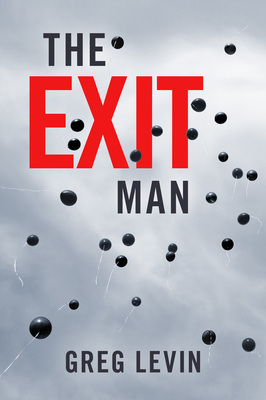 Greetings, readers!
This is the moment I have fooled myself into thinking you’ve all been waiting for…
…my new dark comic suspense novel, The Exit Man, is NOW AVAILABLE!
Once you stop trembling from joy and excitement over this news, I hope you’ll go and order a copy on Amazon. For those of you who love the smell of books and the sting of papercuts, you can order the paperback edition. And for you e-book junkies, there's the Kindle edition . (The novel will be available in various other e-book formats – Nook, Kobo, et. al. – very soon.)
Don’t know what The Exit Man is about? Find out here.
Need a little more convincing before buying the book? Call my mother… and/or read some excerpts and reader testimonials. You can also join my mailing list to immediately receive a free copy of Chapter 1 of The Exit Man.
If – I mean when – you order a copy, be sure to later write a review of the book on the aforementioned Amazon page, as well as on Goodreads. (Unless you end up disliking the book, in which case just forget I said anything. Forget you read anything.)
That’s it for now – get yourself a copy , and enjoy!
NOTE: No humans or animals were harmed in the making of The Exit Man; however, numerous author brain cells were destroyed.