Rachel Maddow's Blog, page 3374
July 11, 2013
Senate inches closer to 'nuclear' showdown
Associated Press
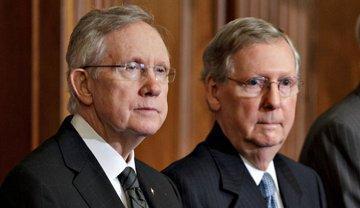
In January, Senate Majority Leader Harry Reid (D-Nev.) and Senate Minority Leader Mitch McConnell (R-Ky.) reached a rather laughable agreement on filibuster reform that did not actually reform the filibuster. Reid hoped that the minor changes would help the chamber be marginally more efficient, but it wasn't long before GOP abuses actually made matters worse.
As the year progressed, and the demands for more meaningful reforms grew louder, Reid and his members talked openly about revisiting the issue, but kept pushing off the fight. Today, the dispute is very much back on the front burner.
Majority Leader Harry Reid (D-NV) launched a barn-burner of a speech Thursday on the Senate floor, excoriating Minority Leader Mitch McConnell (R-KY) for continued obstruction when it comes to presidential nominees.
"Senator McConnell broke his word," Reid said. "The Republican leader has failed to live up to his commitments. He's failed to do what he said he would do -- move nominations by regular order except in extraordinary circumstances. I refuse to unilaterally surrender my right to respond to this breach of faith."
The choice of words is important, because the Senate minority has said in recent weeks that pursuit of the so-called "nuclear option" would be a betrayal -- Reid promised in January that such a sweeping move would effectively be taken off the table by the agreed-upon compromise. What Reid is now saying is that Republicans haven't left him with much of a choice -- McConnell & Co. didn't hold up their end of the bargain.
"I'm not going to wait another month, another few weeks, another year," Reid added, "for Congress to take action on the things we have been doing for almost 240 years."
McConnell, not surprisingly, expressed outrage at the possibility of reforms, and suggested the Senate is functioning relatively well. Reid, he said, is only weighing changes because "the far-left and Big Labor are leaning hard on Democrats."
So, what happens now?
The Majority Leader has been in talks lately with reform-minded Democrats, most notably Sen. Jeff Merkley (D-Ore.), about what, if anything, should be done. We'll know more later today, but Roll Call reports that Reid has an incremental step in mind.
Could senators eliminate filibusters of executive branch nominees without affecting judges or legislation?
Procedurally, it might well be possible, but critics of the plan that Senate Majority Leader Harry Reid, D-Nev., appears ready to bring to his caucus Thursday afternoon are already raising that question.
This would certainly be a modest-but-significant step in the right direction -- allowing the minority to filibuster bills and judicial nominees, but not executive branch nominees -- but it's unclear if the change is procedurally possible, whether it has the Democratic votes it needs, and how severe the "nuclear" blowback would be.
Here's what to watch: Senate Democrats will have their weekly meeting today and the leadership will gauge the caucus' attitudes. In the meantime, Reid will file cloture today on a series of nominations, setting up votes for next week, and effectively daring Republicans to block confirmation votes. [Update: Republicans are conceding that EPA nominee Gina McCarthy and Labor Department nominee Tom Perez will be confirmed. This means the real fight will be over the nominees for the Consumer Financial Protection Bureau and the National Labor Relations Board.]
To be sure, some of you are probably thinking, "Reid always seems to back down on this before there's real action," and it's certainly a fair point. But I also think it's fair to say the showdown hasn't progressed to this serious a level up -- at least since Democrats reclaiming the majority in 2007.
It's about to get interesting. In fact, Reid has started a process today that will probably make a showdown inevitable early next week. If you've waited for a real showdown on this issue, the train has left the station, and probably can't be called back.


'I am furloughing in place'

The USS George H.W. Bush
The effects of the truly stupid sequestration policy on the Pentagon are already apparent: 680,000 Pentagon employees have received furlough notices and are taking a steep pay cut over the summer, all because of a policy that was designed to hurt the country on purpose, which Congress won't turn off.
In an eight-page letter issued yesterday, Defense Secretary Chuck Hagel reminded lawmakers that if these unnecessary spending cuts are not lifted by October, this will get considerably worse, and the effectiveness of jet fighter wings, ground combat units, and even Special Operations forces would plummet.
How absurd are the effects of this policy on the military? Politico had an item from onboard the USS George H.W. Bush.
Sequestration was definitely on a lot of minds aboard the USS Bush as it was underway yesterday, Ewing reports. Crewmembers grumbled that they have little certainty about when their ship will next deploy. And X-47B team members aboard the carrier acknowledged they were dealing with furloughs even as their baby was set to make its first arrested landing.
Deputy program manager Don Blottenberger said over lunch in the wardroom that some of his team members had gotten permission to postpone their furloughs until after this week's test. As for Blottenberger, however, he said he had no choice but to bank some hours even at sea aboard the carrier -- "I am furloughing in place," he said.
"I am furloughing in place" is one of those lines that really helps capture the absurdity of the situation. When a public employee is furloughed, he or she is supposed to go home without pay -- not because of poor on-the-job performance, but because of budgetary issues.
But when you're on an aircraft carrier, you can't just hop in the car and head home -- you're left to "furlough in place."
Note, Congress could turn the sequester off, helping these military personnel, the economy, children in Head Start centers, the federal courts, and even efforts to combat wildfires. But so far, Republican lawmakers have refused to even consider stopping the policy or finding a compromise to replace it.
Why 20-week abortion bans matter

As Republican policymakers nationwide push new restrictions on reproductive rights, it's amazing how multi-faceted the crusade has become. We're seeing trap laws intended to close health clinics and mandates for medically-unnecessary ultrasounds and requirements that doctors tell lies written by politicians to their patients and more.
But it's the 20-week abortion ban that seems to have become especially popular on the right. Of all the various measures, it's the only one to generate attention at the state and federal level -- the U.S. House already passed its version, and Sen. Marco Rubio (R-Fla.) reportedly intends to do the same in the U.S. Senate, though there's some evidence he's getting cold feet.
I can imagine for some, this proposal may not seem as offensive as, say, mandatory trans-vaginal ultrasounds that women neither want nor need. After all, the argument goes, what's the big deal if the cut-off point shifts from 24 weeks to 20 weeks?
Andrew Rosenthal had a good piece answering that question.
The way the Catholic Association mentions "late-term" abortions, you might think the only women who had them were lazy and callous, just waiting around until the last second for no good reason.
But as Cecile Richards, the head of Planned Parenthood, told me in an email, nearly 99 percent of abortions occur before 21 weeks; abortions later on often involve rare, severe fetal abnormalities and real threats to a woman's health. In many cases, women are facing the need to terminate a desired pregnancy, not an unwanted one.
Ms. Richards cited the case of a woman in Nebraska, Danielle Deaver, whose water broke at 22 weeks, depriving her baby of most of the amniotic fluid. "Her doctor told her that the fetus could not develop or survive," Ms. Richards said. "Despite this, she was forced to live through 10 excruciating days waiting to give birth, because her doctors feared prosecution under her state's 20-week abortion ban."
It's exactly why medical associations consider these measures so dangerous.
Indeed, just this week, the American Congress of Obstetricians and Gynecologists (ACOG) published a letter to state lawmakers in Texas, where a 20-week ban is nearing passage, urging them to "get out of exam rooms."
While we can agree to disagree about abortion on ideological grounds, we must draw a hard line against insidious legislation that threatens women's health like Texas HB2 (House Bill 2) and SB1 (Senate Bill 1). That's why we're speaking to the false and misleading underlying assumptions of this and other legislation like it: These bills are as much about interfering with the practice of medicine and the relationship a patient has with her physician as they are about restricting women's access to abortion. The fact is that these bills will not help protect the health of any woman in Texas. Instead, these bills will harm women's health in very clear ways.
We're setting the record straight, loudly and unequivocally, with these simple messages to all politicians: Get Out of Our Exam Rooms.
The letter is well worth your time.
When you receive an all-caps email from your uncle who watches Fox News, demanding to know what's wrong with these proposals, keep this information in mind.
ENDA's opponents fall silent

We talked yesterday about a key Senate committee easily approving the Employment Non-Discrimination Act (ENDA). Though the final vote was 15 to 7, the bill enjoyed bipartisan support.
For those who support civil rights and oppose discrimination, the vote offered new hope that ENDA might have enough support to overcome a Republican filibuster on the Senate floor. But while we wait for that, Chris Geidner noted something interesting about the developments in committee yesterday.
The opposition to LGBT rights, a regular part of politics in the not-so-distant past, was given no voice as a Senate committee voted 15-7 in favor of legislation that would ban anti-LGBT job discrimination by most employers across the country.
There remain wide swaths of the country where virulent anti-LGBT attitudes control the dialogue, but the Senate's Health, Education, Labor, and Pensions Committee provided an unexpected view Wednesday into what the next phase of LGBT rights battle could look like.
No one spoke in opposition to the bill....
If you've been to a committee vote or watched one on C-SPAN, you know this is pretty unusual. Ordinarily, unless a bill has unanimous support, opponents offer some kind of rationale to explain why they don't like the legislation. On culture-war measures, we generally hear quite a bit of rhetoric about social mores and the decline of civilization.
But yesterday, there was total silence from the right. There were seven Republican votes to allow anti-gay employment discrimination to continue, but it appears the arguments against ENDA are so poor, they were not shared publicly. (Republican Sen. Lamar Alexander was the only ENDA opponent to attend the vote; he brought six proxy votes with him against the bill.)
This only leaves us to speculate as to why there was so much GOP opposition to the anti-discrimination measure. Maybe it's simple anti-gay animus; perhaps there's some odd federalism argument lurking somewhere; maybe Republicans are terrified of criticism from the party's extremist base.
Regardless, I'm glad to see ENDA pass, and I'm heartened by the fact that nary a discouraging word was uttered about the proposal. When anti-gay voices literally fall silent on Capitol Hill, and no one is there to push their views, it's a positive development.
House, Senate prepare new attacks on federal health care law
Getty Images
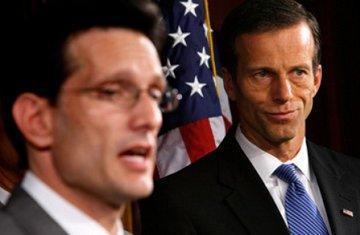
Rep. Eric Cantor (R-Va.) and Sen .John Thune (R-S.D.)
It was just two months ago that House Republicans voted for the 37th time to repeal all or part of the Affordable Care Act. Soon after, Speaker John Boehner (R-Ohio) told reporters that Americans should expect more of the same from his party for the indefinite future. "We're going to keep the focus on Obamacare," he said.
He really wasn't kidding. Here's what we saw from the House GOP yesterday...
Majority Leader Eric Cantor (R-VA) announced Wednesday that the House will vote in July to delay Obamacare's individual mandate for one year, a move that comes in response to the Obama administration's decision to delay the employer mandate for a year.
...and here's what we saw from the Senate GOP yesterday.
Senate Republicans are launching another effort to defund parts of President Barack Obama's health care law, including what their campaign chairman referred to Wednesday as "the death panel."
All 46 Republican senators signed on to a letter spearheaded by Sen. John Thune, R-S.D., that calls for a permanent delay of the health care law.
At a news conference unveiling the letter, Sen. Jerry Moran (R-Kan.) said he and his far-right colleagues would push measures intended to block enforcement -- apparently forever -- of the employer and individual mandates. Moran added that he would "offer an amendment that will defund IPAB, the so-called death panel."
Yes, more than three years after the Affordable Care Act became law, we still have confused Republican senators making "death panel" references in public.
Also yesterday, Sen. Mike Lee (R-Utah) said Congress should shut down the government rather than allow spending in the federal budget for funding the health care system. Because that's just the kind of guy he is.
I suppose many political observers have come to expect this kind of nonsense, but it's worth pausing to appreciate the degree to which these antics are stark raving mad.
Will any of these anti-health care measures pass? No. Are Republican lawmakers prepared to offer alternate policy solutions to the measures they disapprove of? No. Do GOP lawmakers see the irony of them whining incessantly about a delay of a provision they themselves oppose? No.
Does any of this matter? Apparently not.
Shortly after the 2012 elections, House Speaker John Boehner (R-Ohio) suggested his party's crusade to destroy the Affordable Care Act had run its course, and it was time to move on. Noting the election results, Boehner declared, "Obamacare is the law of the land."
But hysterical congressional Republicans had other ideas. They have a choice between governing and these ridiculous antics, and they clearly prefer the latter.
Keep in mind, there is no precedent in American history for this. Countless measures have passed over the objections of one party or the other, but we've never seen a political dynamic in which one radicalized, unhinged party casts literally dozens of pointless repeal votes while actively, shamelessly trying to sabotage existing federal law.
Jobless claims jump, reach two-month high
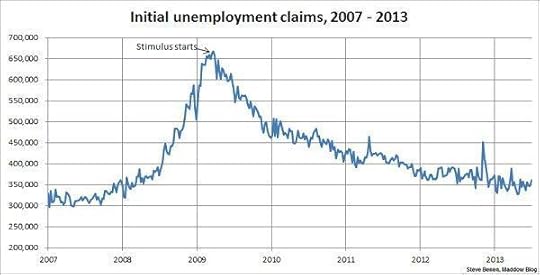
For those who keep an eye on initial unemployment claims, the news this morning was clearly discouraging, though the seasonal caveats matter.
The number of people who applied for unemployment benefits in the first week of July jumped by 16,000 to a seasonally adjusted 360,000, marking the highest level in two months, the Labor Department said Thursday. Economists polled by MarketWatch had expected claims -- a proxy for layoffs -- to rise to 349,000 in the week ended July 6 from a slightly revised 344,000 in the prior week. The claims report often seesaws in July because of shutdowns at auto plants for retooling and temporary layoffs related to the end of the regular school year. The July 4 holiday can also skew the data.
To reiterate the point I make every Thursday morning, it's worth remembering that week-to-week results can vary widely, and it's best not to read too much significance into any one report.
In terms of metrics, when jobless claims fall below the 400,000 threshold, it's considered evidence of an improving jobs landscape, and when the number drops below 370,000, it suggests jobs are being created rather quickly. We've been below the 370,000 threshold 27 of the last 30 weeks, and below 350,000 in 9 of the last 14 weeks.
Above you'll find the chart showing weekly, initial unemployment claims going back to the beginning of 2007. (Remember, unlike the monthly jobs chart, a lower number is good news.) For context, I've added an arrow to show the point at which President Obama's Recovery Act began spending money.
House GOP pushes immigration reform to the brink
Associated Press
House Republicans have found themselves in an awkward position on the signature policy dispute of this Congress. A bipartisan Senate coalition has approved a popular immigration reform bill that enjoys the enthusiastic backing of President Obama, business leaders, GOP strategists, leaders from the Latino community, and a clear majority of the country.
The problem, of course, is that House Republicans, for reasons that range from mysterious to dumb, hate the bill and are eager to kill it.
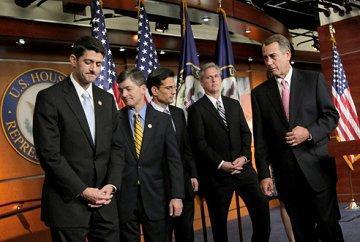
So, what's a House majority caucus to do? GOP leaders and members met in a Capitol Hill basement yesterday afternoon for two-and-a-half hours in the hopes of figuring something out. They didn't come up with much, but they did reach one firm conclusion: House Republicans have no intention of even considering comprehensive immigration reform.
Meeting for the first time as a group to hash out their approach to immigration, House Republicans on Wednesday came down overwhelmingly against a comprehensive overhaul of the nation's immigration laws, putting in jeopardy the future of sweeping legislation that includes a path to citizenship for undocumented immigrants.
Despite the resistance, Speaker John A. Boehner warned about the steep price of inaction, telling House Republicans that they would be in a weaker political position against a bipartisan Senate coalition and President Obama if they did nothing to answer the immigration measure passed by the Senate last month.
You'll notice a certain incongruity between those two paragraphs. On the one hand, House Republicans believe they have to do something on immigration. On the other, House Republicans believe they must destroy the popular Senate legislation.
That the Senate bill would probably pass the House if it were brought up for a vote -- and then become law -- is apparently an inconvenient detail that the political world no longer feels compelled to mention.
Complicating matters, House Republicans know what they loathe, but have no alternative solution. Indeed, nothing is even on the horizon -- Roll Call noted that after the lengthy, behind-closed-doors discussion, "lawmakers said they were no closer to setting a timetable for action, formulating a strategy or building consensus on how to deal with a pathway to citizenship for the nation's roughly 11 million undocumented immigrants."
And that's where this gets a little tricky.
What House GOP leaders apparently now hope to do is abandon comprehensive reform altogether, and instead pursue a piecemeal approach -- one bill on an e-verify system, one bill on border security, one bill for Dream Act kids, etc.
Boehner has reportedly already reached out to Democrats to see if they might be willing to go along with this. Because they are not idiots, Democratic leaders don't seem especially fond of the approach -- they realize, of course, that this would guarantee the failure of a pathway to citizenship for undocumented immigrants already in the United States.
As the process slowly implodes, House GOP leaders issued this joint statement, apparently intended to serve as a nail in the coffin.
"Today House Republicans affirmed that rather than take up the flawed legislation rushed through the Senate, House committees will continue their work on a step-by-step, common-sense approach to fixing what has long been a broken system. The American people want our border secured, our laws enforced, and the problems in our immigration system fixed to strengthen our economy.
"But they don't trust a Democratic-controlled Washington, and they're alarmed by the president's ongoing insistence on enacting a single, massive, Obamacare-like bill rather than pursuing a step-by-step, common-sense approach to actually fix the problem. The president has also demonstrated he is willing to unilaterally delay or ignore significant portions of laws he himself has signed, raising concerns among Americans that this administration cannot be trusted to deliver on its promises to secure the border and enforce laws as part of a single, massive bill like the one passed by the Senate."
By any fair measure, the statement is demonstrably ridiculous, and predicated on the assumption that the public is easily fooled by garbage talking points.
Americans "don't trust a Democratic-controlled Washington"? I'm sorry, did House Republicans lose their majority last night when I wasn't looking? Did Boehner hand over the Speaker's gavel to Nancy Pelosi while I was sleeping? Because if Democrats controlled Washington, immigration reform would pass.
The Obama administration "cannot be trusted to deliver on its promises"? This is not only a stupid argument, which has already been discredited, but it also suggests House Republicans will oppose literally any bill on any subject the president endorses, since they do not trust him to faithfully execute the laws of the country.
This is no small thing. Republicans have largely abandoned substantive arguments and policy concerns, and have instead been reduced to, "We don't trust the president." That's their right, of course, but it's worth noting that (a) the policies outlined in this legislation will be in place long after President Obama leaves office; and (b) no matter how much contempt GOP lawmakers feel towards the president, in five years, he's never negotiated in bad faith and he's never lied to them.
What are we left with? A House majority that won't compromise and isn't interested in governing. It suggests immigration reform may ultimately be impossible so long as Republicans control congressional levers of power.
Morning Maddow: July 11
A TX Senate committee takes up the abortion bill today. And the North Carolina House takes up its bill this morning.
Of Khalid Sheikh Mohammed, CIA "black sites" and vacuum cleaners.
The NY Times connects some dots between Tamerlan Tsarnaev and an unsolved 2011 triple homicide.
Expect Benghazi questions at Victoria Nuland's confirmation hearing today.
The Obama Admin initiative to predict future leakers won't work, experts say.
The U.S. is going ahead with delivery of fighter jets to Egypt.
July 10, 2013
The Republican blitz to shut down abortion-providing clinics is a national story
The various state-level Republican battles in the national Republican war on women are typically regarded individually. Even among activists, the focus is on discrete instances: individual bills like Wisconsin's recent #SB206, a spotlighted state like #StandwithTXwomen, or distinctive local features, like today's #MotorcycleVagina from North Carolina.
But taken collectively, the national significance of state-level Republican anti-abortion legislative activism is clear. Where American women nationally voted overwhelmingly (55% to 44%, with the largest gender gap in Gallup poll history) against the Republican candidate who said he would be "delighted" to sign a federal abortion ban into law, what American women in Republican controlled states are actually getting since the 2012 election is a drastic dismantling of their reproductive rights.
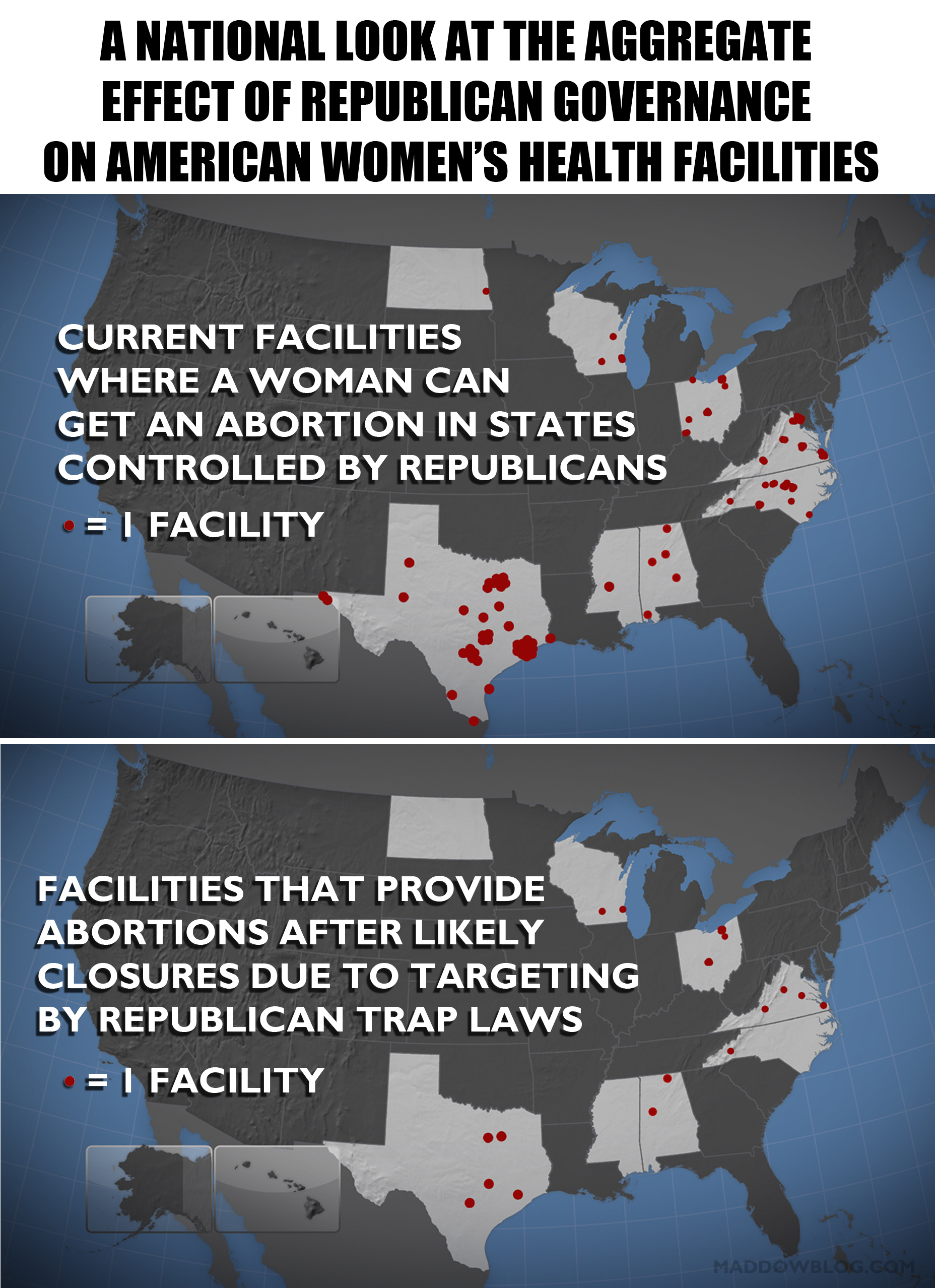
Click for larger version
Video: State GOP war on women undermines national American will
July 9, 2013
The IRS 'scandal' may have ended, but the partisan vendetta did not

Getty Images
Remember the IRS "scandal"? The one the political world took extremely seriously for about six weeks, right up until the entire thing devolved into a big nothingburger? Conservatives who had high hopes for the story have been forced to concede there just isn't much left, and every allegation raised by Republicans from the outset has been discredited.
But the right's contempt for the IRS hasn't diminished in the slightest, and GOP lawmakers' vendetta against the tax agency is just getting started.
House Republicans are pushing legislation that would slash the IRS's budget by $3 billion for its "inappropriate actions" in targeting political groups.
The bill would place several additional restrictions on spending at the embattled agency and prohibit employees from implementing the individual mandate in ObamaCare.
These are actually two related-but-distinct ideas that are being put into one "We Hate The IRS" piece of legislation. The former, punishing the IRS for "inappropriate actions" by slashing its budget really doesn't make any sense, since there's no evidence the tax agency actually targeted anyone for partisan or ideological reasons.
The latter is arguably more interesting, since it's long been a demand pushed by some of the more unhinged Tea Party activists -- GOP lawmakers can still sabotage the federal health care system if they'd only prohibit the IRS from enforcing the individual mandate. (Jonathan Cohn recently explained why this is "laughable.")
The same bill, incidentally, includes a variety of related punishments, including empowering Americans to secretly record phone conversations with IRS employees, as a way of discouraging officials from saying something inappropriate.
But the larger point to keep in mind is the House Republicans' punish-the-IRS bill won't become law anyway. It, like the party's culture-war proposals, is intended to give the right warm and fuzzy feelings, even though GOP officials realize it can't pass. In this case, it also serves the purpose of trying to breathe life into a discredited "scandal," with Republicans hoping the public hasn't heard that the IRS controversy has already evaporated into meaninglessness.
It's reached the point at which fans of the former "scandal" can't even hide their desperation.
In an interview with Breitbart News published on Sunday, [Republican Rep. Mike Kelly of Pennsylvania], a member of the House Ways and Means Committee, which has been investigating the agency, said he expected the leak of applications for tax-exempt status will become the "deeper part" of the story.
"I think what we're going to find out and I think that the deeper part is not so much the Tea Party and the 'Patriot' and those people who were targeted, but the information that has been leaked," Kelly said.
This is what the controversy has been reduced to. Groups weren't targeted, the IRS wasn't being used as a political weapon, there were no enemies lists, everything Republicans said for six weeks turned out to be wrong, but according to Rep. Mike Kelly, the "deeper part" of the story is that some of the tax-exempt applications came to the public's attention.
Remember, 2013 is, in theory, supposed to be a governing year -- it follows a national election, with midterms still over a year away. But when post-policy lawmakers dominate the House, governing remains a pipe dream.