
Yanis Varoufakis's Blog, page 68
March 8, 2020
Coronavirus has sparked a perfect storm of nationalism and financial speculation – THE GUARDIAN
Nationalism and speculation have seldom had a better opportunity to combine forces as the one riding today on the coattails of Covid-19, known as the coronavirus. When Covid-19 leapfrogged from China to Italy, even ardent Europeanists normally appreciative of open borders joined the deafening calls to end freedom of movement across Europe’s national borders – a longstanding demand of nationalists. Meanwhile, the money men speculating on government debt are performing a classic flight from Italian to German government bonds, seeking the financial safety that only the continent’s hegemon can offer during any crisis. As if in a bid to remind us of the great contradiction of our times, Covid-19 is illuminating gloriously the freedom of money to transcend a borderless financial universe while humans remain as fenced in as ever.
Meanwhile in the United States, President Trump is combining his standard call for taller walls with a fresh instruction to moneymen to “buy the dip” in Wall Street, rather than to follow their natural instinct to seek refuge in the boring but safe bond markets. A great deal will depend on whether financiers believe Mr Trump or not, and not just because this is an election year.
If speculators do believe the American president, Wall Street will recover swiftly even before the epidemic subsides. The forces of xenophobic financialisation will then have triumphed and America’s progressives will face an uphill struggle on every political front. As for the European Union, ruling elites will breathe a sigh of relief that a new depression was avoided and return to managing as best as they can the economic stagnation of recent times, tinged this time with a large dose of additional, coronavirus-reinforced, xenophobia.
Will Wall Street follow Mr Trump’s advice to “buy the dip”? For now, the large players are in two minds. The drop in the stock market does not worry them as such. Their concern is that the recent bull market was running on increasingly suspect debt and that Covid-19 may have pricked a bubble that was going to burst anyway. Similarly in Europe, the worst spectre hovering over investors’ heads is that large corporations, relying for too long on free money from the European Central Bank, may be downgraded from investment to junk-grade – especially so at a time of stagnant domestic demand and a collapsed Chinese import market.
Taking a leaf out of the aftermath of the crash of 2008, and the Eurozone crisis that followed, bullish speculators are looking at their central banks, primarily the Fed and the ECB, to do, once again, “whatever it takes” to re-float their flagging fortunes. Two questions keep them up at night: will the central banks oblige? And if they do, will it be enough?
The first question is easy to answer: governments are impotent on both sides of the Atlantic. In the United States the federal budget deficit is already at a historic high, especially in the context of a tight labour market, while the Eurozone remains in the straightjacket of its fiscal compact. Therefore the central banks will be forced, whether they like it or not, to step up to the mark. Already we have seen announcements of lower interest rates, even of Japanese-style semi-direct purchases of government and private debt by the monetary authorities.
But will it be enough for the central banks to throw more money at the Covid-19-infected money markets? Will the economy go back to where we were a month ago if enough liquidity is pumped into the system? Or will it resemble a slow puncture that demands increasing pump-priming to stay inflated? Moreover, will the new wall of public money push back the wall of xenophobia? The sad answer to the last question is instructive about the economic ones too.
When a border closes down, it does not open again easily even if the conditions that caused its closure are largely reversed. This is a safe lesson from Europe’s recent experience. Take, for example, Austria, which closed its border with Italy following the rise of refugee arrivals in the summer of 2015. For a couple of years after that refugee wave had died out, the borders remained shut. Similarly with the borders along the Western Balkans. Why is this relevant to the question of whether increased central bank liquidity will ameliorate the effects of Covid-19 on the economy? To answer, we need to remind ourselves of what happened after the crash of 2008.
There were two responses to the 2008 crisis that saved capitalism from total collapse: the gigantic injection of liquidity into the economy by central banks, the Fed above all else; and China, whose government took it upon itself intentionally to build up the greatest private credit bubble in history to replace the lost export demand by a stupendous investment boost. The Fed’s and China’s intervention succeeded in re-floating global finance and putting stock markets onto the path of their longest growth spurt. However, the world did not go back to its pre-2008 ways.
Before 2008, Wall Street played a crucial role in recycling non-US surpluses that were the repercussion of American deficits into global investment funding. After 2008, the refloated Wall Street could not perform that task, channelling much of the abundant liquidity not to fixed capital investment but to share buy-backs and other asset purchases. The result was that the post-2008 economy is characterised by savings being permanently in excess of capital goods investment. Since savings are the supply of money and investment its demand, the permanent excess supply of money explains the permanently low, or negative, interest rates. It also explains the downward pressure on median wages against a background of rising asset prices causing unbearable inequality and thus producing the political triumphs of xenophobic nationalism.
In precisely the same way that the increased liquidity after 2008 failed to rebalance savings and investment globally, so will any renewed monetary “easing” to counter the ill effects of Covid-19 fail to return the global economy to its pre-February state. Of course, as happened after 2008, speculators will make a mint and nationalist forces will milk the ensuing discontent for all its worth.
Meanwhile in the United States, President Trump is combining his standard call for taller walls with a fresh instruction to moneymen to “buy the dip” in Wall Street, rather than to follow their natural instinct to seek refuge in the boring but safe bond markets. A great deal will depend on whether financiers believe Mr Trump or not, and not just because this is an election year.
If speculators do believe the American president, Wall Street will recover swiftly even before the epidemic subsides. The forces of xenophobic financialisation will then have triumphed and America’s progressives will face an uphill struggle on every political front. As for the European Union, ruling elites will breathe a sigh of relief that a new depression was avoided and return to managing as best as they can the economic stagnation of recent times, tinged this time with a large dose of additional, coronavirus-reinforced, xenophobia.
Speculators will make a mint and nationalist forces will milk the ensuing discontent for all its worth
Will Wall Street follow Mr Trump’s advice to “buy the dip”? For now, the large players are in two minds. The drop in the stock market does not worry them as such. Their concern is that the recent bull market was running on increasingly suspect debt and that Covid-19 may have pricked a bubble that was going to burst anyway. Similarly in Europe, the worst spectre hovering over investors’ heads is that large corporations, relying for too long on free money from the European Central Bank, may be downgraded from investment to junk-grade – especially so at a time of stagnant domestic demand and a collapsed Chinese import market.
Taking a leaf out of the aftermath of the crash of 2008, and the Eurozone crisis that followed, bullish speculators are looking at their central banks, primarily the Fed and the ECB, to do, once again, “whatever it takes” to re-float their flagging fortunes. Two questions keep them up at night: will the central banks oblige? And if they do, will it be enough?
The first question is easy to answer: governments are impotent on both sides of the Atlantic. In the United States the federal budget deficit is already at a historic high, especially in the context of a tight labour market, while the Eurozone remains in the straightjacket of its fiscal compact. Therefore the central banks will be forced, whether they like it or not, to step up to the mark. Already we have seen announcements of lower interest rates, even of Japanese-style semi-direct purchases of government and private debt by the monetary authorities.
But will it be enough for the central banks to throw more money at the Covid-19-infected money markets? Will the economy go back to where we were a month ago if enough liquidity is pumped into the system? Or will it resemble a slow puncture that demands increasing pump-priming to stay inflated? Moreover, will the new wall of public money push back the wall of xenophobia? The sad answer to the last question is instructive about the economic ones too.
When a border closes down, it does not open again easily even if the conditions that caused its closure are largely reversed. This is a safe lesson from Europe’s recent experience. Take, for example, Austria, which closed its border with Italy following the rise of refugee arrivals in the summer of 2015. For a couple of years after that refugee wave had died out, the borders remained shut. Similarly with the borders along the Western Balkans. Why is this relevant to the question of whether increased central bank liquidity will ameliorate the effects of Covid-19 on the economy? To answer, we need to remind ourselves of what happened after the crash of 2008.
There were two responses to the 2008 crisis that saved capitalism from total collapse: the gigantic injection of liquidity into the economy by central banks, the Fed above all else; and China, whose government took it upon itself intentionally to build up the greatest private credit bubble in history to replace the lost export demand by a stupendous investment boost. The Fed’s and China’s intervention succeeded in re-floating global finance and putting stock markets onto the path of their longest growth spurt. However, the world did not go back to its pre-2008 ways.
Before 2008, Wall Street played a crucial role in recycling non-US surpluses that were the repercussion of American deficits into global investment funding. After 2008, the refloated Wall Street could not perform that task, channelling much of the abundant liquidity not to fixed capital investment but to share buy-backs and other asset purchases. The result was that the post-2008 economy is characterised by savings being permanently in excess of capital goods investment. Since savings are the supply of money and investment its demand, the permanent excess supply of money explains the permanently low, or negative, interest rates. It also explains the downward pressure on median wages against a background of rising asset prices causing unbearable inequality and thus producing the political triumphs of xenophobic nationalism.
In precisely the same way that the increased liquidity after 2008 failed to rebalance savings and investment globally, so will any renewed monetary “easing” to counter the ill effects of Covid-19 fail to return the global economy to its pre-February state. Of course, as happened after 2008, speculators will make a mint and nationalist forces will milk the ensuing discontent for all its worth.
For The Guardian’s site click here


March 4, 2020
Oligarchy & Xenophobia: The only beneficiaries of Greece’s economic ‘recovery’ – The Guardian
Spring is already in the air across Greece. Even in the bleakest of times, nature’s renaissance renders hope irrepressible. But this one is proving a cruel spring for a people caught up in a decade-old crisis yielding one ritual humiliation after another.
Costas runs a small bookshop in my central Athens neighbourhood. Although jovial by constitution, he finds it difficult to hide the worry lines multiplying on his face. Fifteen years ago he put his flat up as collateral for a business loan to spruce up the bookshop. When the Greek debt crisis wreaked its havoc, it was impossible to service that loan.
Today, Costas is one of hundreds of thousands facing foreclosures by funds that have purchased debt like his from the banks at bargain basement prices. The bailiff and the auctioneer are circling above distressed homeowners and small business people such as Costas.
Intriguingly, he talks little about this, caught up in the media frenzy over the 30,000 or so refugees whom President Recep Tayyip Erdoğan of Turkey released from the camps in which they had been held and allowed them to attempt crossing into Greece. “We can barely feed ourselves. How can we help these wretched souls?” Costas laments. His predicament captures nicely how Greece’s crisis has spawned a rule of fear: the muted fear of the bailiff and the brash fear of the “other”.
Readers of the international press, which for two years has been celebrating Greece’s alleged economic recovery, will be tempted to dismiss Costas’s story as unrepresentative. They will retort that investors who bought Greek debt or shares a few years ago have banked returns that no other market has provided. What’s more, Greece’s government has been borrowing for 10 years at less than 1% interest rates. Surely being able to refinance its debt at such low interest rates is evidence of recovery?
Paradox is a Greek word for good reason: today’s Greece proves that it is perfectly possible for the state and for the majority of citizens to be sinking deeper into insolvency while the oligarchy makes a mint from trading in their assets. But why would investors lend to the Greek government cheaply if it remains bankrupt?
The reason is that the troika of Greece’s creditors – the EU, European Central Bank and the IMF – have taken 85% of government debt out of the money markets and placed it squarely on the shoulders of Europe’s taxpayers. They also deferred all repayments until after 2032 and extended another €30bn (£26bn) of official loans to the Greek government to cover its repayments to privateers. So why not lend to the Greek government at a small, yet positive, interest rate when the alternative is to lend to the German or the Dutch governments at the current negative interest rates? As long as the Greek government remains the troika’s model prisoner, lending to Greece’s insolvent state at minuscule rates is lucrative. Paradox solved!
Turning to Greece’s private sector, how can investors profit from it if it too is bankrupt? With great ease is the answer, as Costas’s case illustrates. His loan of €100,000 was sold on by his bank to a hedge fund for €8,000. If the fund auctions off his flat for €20,000, its profit rate will hit an astonishing 250%. The fact that Costas will lose both his home and his bookshop, with detrimental effects on the state’s taxes and outlays (as he begins to draw unemployment benefit), does not even appear on the radar of the hedge fund or the international media.
During the first phase of Greece’s crisis, all social classes, with the exception of the top 0.1%, found themselves in dire straits. But, from 2018, three social groups fared differently. By far the largest group, to which Costa belongs, continue to languish in debtor’s prison and to sink deeper in hopelessness. A middle group has bottomed out, living in terribly diminished albeit more stable circumstances. Finally, a small group is doing incredibly well: buoyed up by fire sales of public assets, connected to the hedge funds profiting from trades in loans like Costas’s, and linked to EU-sourced funding.
Greece’s new government, led by Kyriakos Mitsotakis, is an interesting coalition of figures from within his New Democracy party. One faction, close to the prime minister’s circle, represents the interests of the neoliberally-minded oligarchy determined to continue with the troika’s austerity and fire sales policies from which they have benefited so magnificently. A second ultra-rightist, fully xenophobic nationalist faction is the local branch of what I refer to as the nationalist international (which includes Donald Trump, Matteo Salvini, Viktor Orbán, Marine Le Pen, Narendra Modi, Jair Bolsonaro).
This fragile coalition of neoliberals and racist conservatives is kept together by a combination of free-marketeer “solutions” favouring the oligarchy (for instance, the sale of Costas’s loan and the privatisation of public assets), a domestic authoritarian drive (armed police entering universities to confront protesting students), and a Trumpian approach to migrants. The Nazi Golden Dawn party was, mercifully, kicked out of parliament, but tragically its racist narrative is now in government.
When, sooner or later, the narrative of economic recovery is exposed as a cruel lie, this government will exploit the little people’s concerns over migration to keep those like Costas placid while, for good measure, deploying the authoritarian apparatus currently under construction to liquidate their few remaining assets.
Most recently, television screens relayed a scene that reveals the continuing capacity of the Greek crisis to symbolise Europe’s conundrum: a visit to the Greek-Turkish border by a Greek prime minister who, like his predecessors, had previously surrendered fully to Chancellor Angela Merkel accompanied by Ursula von der Leyen – who was promoted by Merkel as the European commission’s new president, but who would not have been elected without Orbán’s support in the European parliament.
What were they doing? They were defending the policy, pioneered by Orbán, of violating the right that international law affords refugees to enter one’s territory to apply for asylum. In essence, they were sealing the demise of Merkel’s project of keeping the xenophobic hard right at bay. Additionally, they were unwittingly proving that Greece remains the canary in the mine.
Costas runs a small bookshop in my central Athens neighbourhood. Although jovial by constitution, he finds it difficult to hide the worry lines multiplying on his face. Fifteen years ago he put his flat up as collateral for a business loan to spruce up the bookshop. When the Greek debt crisis wreaked its havoc, it was impossible to service that loan.
Today, Costas is one of hundreds of thousands facing foreclosures by funds that have purchased debt like his from the banks at bargain basement prices. The bailiff and the auctioneer are circling above distressed homeowners and small business people such as Costas.
Intriguingly, he talks little about this, caught up in the media frenzy over the 30,000 or so refugees whom President Recep Tayyip Erdoğan of Turkey released from the camps in which they had been held and allowed them to attempt crossing into Greece. “We can barely feed ourselves. How can we help these wretched souls?” Costas laments. His predicament captures nicely how Greece’s crisis has spawned a rule of fear: the muted fear of the bailiff and the brash fear of the “other”.
Readers of the international press, which for two years has been celebrating Greece’s alleged economic recovery, will be tempted to dismiss Costas’s story as unrepresentative. They will retort that investors who bought Greek debt or shares a few years ago have banked returns that no other market has provided. What’s more, Greece’s government has been borrowing for 10 years at less than 1% interest rates. Surely being able to refinance its debt at such low interest rates is evidence of recovery?
Paradox is a Greek word for good reason: today’s Greece proves that it is perfectly possible for the state and for the majority of citizens to be sinking deeper into insolvency while the oligarchy makes a mint from trading in their assets. But why would investors lend to the Greek government cheaply if it remains bankrupt?
The reason is that the troika of Greece’s creditors – the EU, European Central Bank and the IMF – have taken 85% of government debt out of the money markets and placed it squarely on the shoulders of Europe’s taxpayers. They also deferred all repayments until after 2032 and extended another €30bn (£26bn) of official loans to the Greek government to cover its repayments to privateers. So why not lend to the Greek government at a small, yet positive, interest rate when the alternative is to lend to the German or the Dutch governments at the current negative interest rates? As long as the Greek government remains the troika’s model prisoner, lending to Greece’s insolvent state at minuscule rates is lucrative. Paradox solved!
Turning to Greece’s private sector, how can investors profit from it if it too is bankrupt? With great ease is the answer, as Costas’s case illustrates. His loan of €100,000 was sold on by his bank to a hedge fund for €8,000. If the fund auctions off his flat for €20,000, its profit rate will hit an astonishing 250%. The fact that Costas will lose both his home and his bookshop, with detrimental effects on the state’s taxes and outlays (as he begins to draw unemployment benefit), does not even appear on the radar of the hedge fund or the international media.
During the first phase of Greece’s crisis, all social classes, with the exception of the top 0.1%, found themselves in dire straits. But, from 2018, three social groups fared differently. By far the largest group, to which Costa belongs, continue to languish in debtor’s prison and to sink deeper in hopelessness. A middle group has bottomed out, living in terribly diminished albeit more stable circumstances. Finally, a small group is doing incredibly well: buoyed up by fire sales of public assets, connected to the hedge funds profiting from trades in loans like Costas’s, and linked to EU-sourced funding.
Greece’s new government, led by Kyriakos Mitsotakis, is an interesting coalition of figures from within his New Democracy party. One faction, close to the prime minister’s circle, represents the interests of the neoliberally-minded oligarchy determined to continue with the troika’s austerity and fire sales policies from which they have benefited so magnificently. A second ultra-rightist, fully xenophobic nationalist faction is the local branch of what I refer to as the nationalist international (which includes Donald Trump, Matteo Salvini, Viktor Orbán, Marine Le Pen, Narendra Modi, Jair Bolsonaro).
This fragile coalition of neoliberals and racist conservatives is kept together by a combination of free-marketeer “solutions” favouring the oligarchy (for instance, the sale of Costas’s loan and the privatisation of public assets), a domestic authoritarian drive (armed police entering universities to confront protesting students), and a Trumpian approach to migrants. The Nazi Golden Dawn party was, mercifully, kicked out of parliament, but tragically its racist narrative is now in government.
When, sooner or later, the narrative of economic recovery is exposed as a cruel lie, this government will exploit the little people’s concerns over migration to keep those like Costas placid while, for good measure, deploying the authoritarian apparatus currently under construction to liquidate their few remaining assets.
Most recently, television screens relayed a scene that reveals the continuing capacity of the Greek crisis to symbolise Europe’s conundrum: a visit to the Greek-Turkish border by a Greek prime minister who, like his predecessors, had previously surrendered fully to Chancellor Angela Merkel accompanied by Ursula von der Leyen – who was promoted by Merkel as the European commission’s new president, but who would not have been elected without Orbán’s support in the European parliament.
What were they doing? They were defending the policy, pioneered by Orbán, of violating the right that international law affords refugees to enter one’s territory to apply for asylum. In essence, they were sealing the demise of Merkel’s project of keeping the xenophobic hard right at bay. Additionally, they were unwittingly proving that Greece remains the canary in the mine.
For The Guardian’s site click here
March 2, 2020
March 1, 2020
DiEM25: Resisting the militarisation of the Greek-Turkish border under a Paneuropean cloud of xenophobic hysteria
DiEM25 condemns the militarisation of the Greek-Turkish border, the European Union’s violation of every principle of Humanism, the instrumentalisation of refugees both by the Turkish regime and Brussels, the abandonment of Greek islanders to their own devices – the list goes on and on.
DiEM25 calls for an immediate opening of all borders. The Greek-Turkish one and, more importantly, all borders within the EU. It is the only way the humanitarian crisis can be dealt with rationally and humanely, without resorting to military solutions under a cloud of hysteria.
MeRA25 ON THE SITUATION ON THE GREEK-TURKISH BORDER
A virus and the inevitable escalation of refugee inflows from Turkey were enough to heighten xenophobia and cause the right-wing Greek government to embark upon a large-scale campaign of disorienting Greece’s public opinion – so as to mask the reality that the much heralded economic recovery was a mirage given the continuing troika program of attacking labour, fiscal austerity and fire sales of public property.
The fear of others’, be it the Chinese or the wretched refugees, is being instrumentalised so that the people of Greece can no longer discern the true causes of their continuing asphyxiation – that is, the continuing surrender to the troika policies and the permanent subjugation to the EU’s irrational and inhumane policies regarding refugees, the EU-Turkey, EU-Libya relations etc.
Yes, the COVID-19 epidemic is a worry. Yes, the exploitation by President Erdogan of Turkey of refugees as part of his geostrategic gaming (i.e. varying the number of refugees to cross to Greece with a view to increasing pressure on the EU to side with him in Syria) constitutes a violation of basic human rights. However, neither COVID-19 nor the refugees justify the motivated hysteria that Greece’s troika-run regime is cultivating so as to escape its responsibility for the decade-long asphyxiation they have brought to the people of Greece.
MeRA25-DiEM25 will not allow this new Troika-Nationalist Alliance to pull the wool over our people and to bolster xenophobia – whose end result will be to worsen the Greek’s circumstances and rob Greece of its capacity to appeal to progressives across the world.
MeRA25-DiEM25 will not allow the Greek government to legitimise the Golden Dawn – Greek Solution racist narrative that casts the hapless refugees as an “organised invasion force” that Greece’s “heroic” government is facing down on the Greek-Turkish border.
Precisely like the economic crisis that erupted in 2010, so too now refugees and COVID-19 are ridiculing the notion that electrified border fences can solve the problem of ‘contagion’ – whether it is the financial crisis contagion, COVID-19 or refugee flows. That walls and border fences provide security is not only a lie but also a dangerous delusion.
MeRA25-DiEM25 will continue to point the way to the only road to security with prosperity: Radical Internationalism. Our transnational getting together based on a common understanding that all epidemics (economic, financial) and all mass movements of human beings struggling to live are transnational in nature and, thus demand transnational solutions. Solutions that will only come through our constructive disobedience: Resistance to the policies of austerity, militarisation and xenophobia. And constructive, transnational, humanist policies to replace them with.
DiEM25 calls for an immediate opening of all borders. The Greek-Turkish one and, more importantly, all borders within the EU. It is the only way the humanitarian crisis can be dealt with rationally and humanely, without resorting to military solutions under a cloud of hysteria.
MeRA25 ON THE SITUATION ON THE GREEK-TURKISH BORDER
A virus and the inevitable escalation of refugee inflows from Turkey were enough to heighten xenophobia and cause the right-wing Greek government to embark upon a large-scale campaign of disorienting Greece’s public opinion – so as to mask the reality that the much heralded economic recovery was a mirage given the continuing troika program of attacking labour, fiscal austerity and fire sales of public property.
The fear of others’, be it the Chinese or the wretched refugees, is being instrumentalised so that the people of Greece can no longer discern the true causes of their continuing asphyxiation – that is, the continuing surrender to the troika policies and the permanent subjugation to the EU’s irrational and inhumane policies regarding refugees, the EU-Turkey, EU-Libya relations etc.
Yes, the COVID-19 epidemic is a worry. Yes, the exploitation by President Erdogan of Turkey of refugees as part of his geostrategic gaming (i.e. varying the number of refugees to cross to Greece with a view to increasing pressure on the EU to side with him in Syria) constitutes a violation of basic human rights. However, neither COVID-19 nor the refugees justify the motivated hysteria that Greece’s troika-run regime is cultivating so as to escape its responsibility for the decade-long asphyxiation they have brought to the people of Greece.
MeRA25-DiEM25 will not allow this new Troika-Nationalist Alliance to pull the wool over our people and to bolster xenophobia – whose end result will be to worsen the Greek’s circumstances and rob Greece of its capacity to appeal to progressives across the world.
MeRA25-DiEM25 will not allow the Greek government to legitimise the Golden Dawn – Greek Solution racist narrative that casts the hapless refugees as an “organised invasion force” that Greece’s “heroic” government is facing down on the Greek-Turkish border.
Precisely like the economic crisis that erupted in 2010, so too now refugees and COVID-19 are ridiculing the notion that electrified border fences can solve the problem of ‘contagion’ – whether it is the financial crisis contagion, COVID-19 or refugee flows. That walls and border fences provide security is not only a lie but also a dangerous delusion.
MeRA25-DiEM25 will continue to point the way to the only road to security with prosperity: Radical Internationalism. Our transnational getting together based on a common understanding that all epidemics (economic, financial) and all mass movements of human beings struggling to live are transnational in nature and, thus demand transnational solutions. Solutions that will only come through our constructive disobedience: Resistance to the policies of austerity, militarisation and xenophobia. And constructive, transnational, humanist policies to replace them with.
THIS IS THE “ORGANISED INVASION ARMY” THAT THE GREEK GOVERNMENT IS INVOKING
TO JUSTIFY MILITARISING THE GREEK-TURKISH BORDER
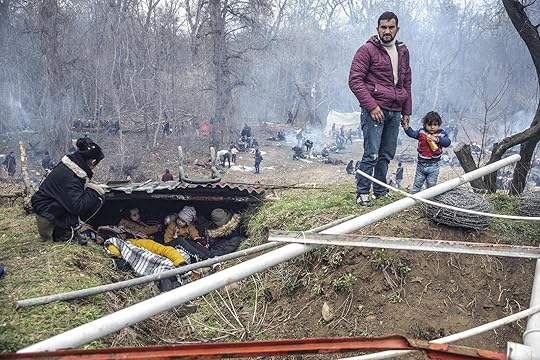
ΜέΡΑ25: Όχι στην στρατιωτικοποίηση, τα τείχη, την εθνική υστερία. Ανθρωπιά και πραγματική εθνική αξιοπρέπεια
Το ΜέΡΑ25 καταδικάζει την στρατιωτικοποίηση, τα τείχη, την εθνική υστερία. Καταδικάζει την εργαλειοποίηση ανθρώπων είτε γίνεται από τον Ερντογάν είτε από την Ευρωπαϊκή Ένωση. Το ΜέΡΑ25 απαιτεί ανθρωπιά παντού. Αν η Ευρωπαϊκή Ένωση επιμένει να συμπεριφέρεται απολίτιστα απέναντι σε Έλληνες και μετανάστες, το ΜέΡΑ25 απαιτεί άσυλο σε όλους τους κατατρεγμένους και ΒΕΤΟ σε όλες τις αποφάσεις (όχι μόνο για το προσφυγικό) της Ευρωπαϊκής Ένωσης έως ότου οι Βρυξέλλες συμμορφωθούν με τον Δυτ. Ανθρωπισμό
Το ΜέΡΑ25 παρακολουθεί με ψυχραιμία, αλλά και αποφασιστικότητα να εμποδίσει, την πρόσφατη έξαρση του Διακομματικού Μνημονιακού Εθνικισμού.
Ένας ιός και μια αναμενόμενη αύξηση των μεταναστευτικών ροών ήταν αρκετά ώστε να κορυφωθεί η ξενοφοβία και να φτάσει στο ζενίθ η επιχείρηση των κυβερνώντων να αποπροσανατολίσουν τους πολίτες.
Ο φόβος των «άλλων», είτε είναι Κινέζοι είτε κατατρεγμένοι φυγάδες, εργαλειοποιείται ώστε ο λαός μας να μην μπορεί πλέον να διακρίνει τα πραγματικά αίτια της συνεχιζόμενης ασφυξίας του – που δεν είναι άλλη από τις πολιτικές λιτότητας της τρόικας εξωτερικού και εσωτερικού και το «ΝΑΙ ΣΕ ΟΛΑ» προς τους ισχυρούς (π.χ. Συμφωνία Μέρκελ_ερντογάν, ΝΑΤΟ).
Ναι, η επιδημία είναι ανησυχητική. Ναι, η χρησιμοποίηση από τον Ερντογάν των απελπισμένων φυγάδων (τους οποίους πότε εγκλείει σε στρατόπεδα και πότε προωθεί προς τα σύνορα) αποτελεί παραβίαση βασικών ανθρωπίνων δικαιωμάτων. Όμως, ούτε ο COVID-019 ούτε αυτοί οι κατατρεγμένοι άνθρωποι στον Έβρο δεν δικαιολογούν την υστερία που επιτήδεια εργαλειοποιεί ο Διακομματικός Μνημονιακός Εθνικισμός για να αποποιηθεί τις ευθύνες του για την δεκαετή ασφυξία που έχει φέρει στις ελληνίδες και τους έλληνες.
Το ΜέΡΑ25 δεν θα επιτρέψει στον Διακομματικό Μνημονιακό Εθνικισμό αυτό τον αποπροσανατολισμό των πολιτών και την καλλιέργεια της ξενοφοβίας που, με μαθηματική ακρίβεια, θα κάνει τα πράγματα χειρότερα και θα στερήσει ό,τι ερείσματα έχουν απομείνει στην Ελλάδα στους κύκλους των προοδευτικών δυνάμεων ανά τον κόσμο.
Το ΜεΡΑ25 δεν θα επιτρέψει στην κυβέρνηση να νομιμοποιήσει το αφήγημα της Χρυσής Αυγής, της Ελληνικής Λύσης και λοιπών ρατσιστικών δυνάμεων μέσα από ανόητες τοποθετήσεις όπως, π.χ., περί «οργανωμένης, μαζικής, παράνομης απόπειρας παραβίασης των συνόρων» την οποία η «ηρωική» κυβέρνηση της Νέας Δημοκρατίας «απέκρουσε».
Το ΜέΡΑ25 δεν θα επιτρέψει στον Διακομματικό Μνημονιακό Εθνικισμό να παρουσιάσει τους κατατρεγμένους στον Έβρο ως στρατό εισβολής. Ούτε και να εργαλειοποιήσει έναν ιό στο πλαίσιο του δόγματος «Ελλάς-Φρούριο».
Όπως και η οικονομική κρίση που ξέσπασε το 2010 έτσι και ο ιός COVID-019 κουρελιάζουν κάθε έννοια συνόρων. Η ψευδαίσθηση που καλλιεργεί ο Διακομματικός Μνημονιακός Εθνικισμός ότι μπορούν να «θωρακίσουν» οποιαδήποτε επικράτεια, είτε είναι ο Έβρος είτε η Ευρωζώνη, αποτελεί όχι μόνο ψεύδος αλλά και κίνδυνο για την χώρα και τους πολίτες της.
Το ΜέΡΑ25 θα συνεχίσει να καταδεικνύει τον μόνο δρόμο προς την προστασία και ευημερία των πολιτών: Τον ριζοσπαστικό διεθνισμό που κατανοεί ότι οι επιδημίες (οικονομικές, βιολογικές και μεταναστευτικές) είναι διακρατικά προβλήματα και, συνεπώς, ότι διακρατικές πρέπει να είναι και οι λύσεις. Λύσεις για τις οποίες προαπαιτούμενο είναι το τέλος στο «ΝΑΙ ΣΕ ΟΛΑ» πάνω στο οποίο χτίζει την δυστυχία των ανθρώπων μας (ελλήνων και μεταναστών) ο Διακομματικός Μνημονιακός Εθνικισμός.
Το ΜέΡΑ25 παρακολουθεί με ψυχραιμία, αλλά και αποφασιστικότητα να εμποδίσει, την πρόσφατη έξαρση του Διακομματικού Μνημονιακού Εθνικισμού.
Ένας ιός και μια αναμενόμενη αύξηση των μεταναστευτικών ροών ήταν αρκετά ώστε να κορυφωθεί η ξενοφοβία και να φτάσει στο ζενίθ η επιχείρηση των κυβερνώντων να αποπροσανατολίσουν τους πολίτες.
Ο φόβος των «άλλων», είτε είναι Κινέζοι είτε κατατρεγμένοι φυγάδες, εργαλειοποιείται ώστε ο λαός μας να μην μπορεί πλέον να διακρίνει τα πραγματικά αίτια της συνεχιζόμενης ασφυξίας του – που δεν είναι άλλη από τις πολιτικές λιτότητας της τρόικας εξωτερικού και εσωτερικού και το «ΝΑΙ ΣΕ ΟΛΑ» προς τους ισχυρούς (π.χ. Συμφωνία Μέρκελ_ερντογάν, ΝΑΤΟ).
Ναι, η επιδημία είναι ανησυχητική. Ναι, η χρησιμοποίηση από τον Ερντογάν των απελπισμένων φυγάδων (τους οποίους πότε εγκλείει σε στρατόπεδα και πότε προωθεί προς τα σύνορα) αποτελεί παραβίαση βασικών ανθρωπίνων δικαιωμάτων. Όμως, ούτε ο COVID-019 ούτε αυτοί οι κατατρεγμένοι άνθρωποι στον Έβρο δεν δικαιολογούν την υστερία που επιτήδεια εργαλειοποιεί ο Διακομματικός Μνημονιακός Εθνικισμός για να αποποιηθεί τις ευθύνες του για την δεκαετή ασφυξία που έχει φέρει στις ελληνίδες και τους έλληνες.
Το ΜέΡΑ25 δεν θα επιτρέψει στον Διακομματικό Μνημονιακό Εθνικισμό αυτό τον αποπροσανατολισμό των πολιτών και την καλλιέργεια της ξενοφοβίας που, με μαθηματική ακρίβεια, θα κάνει τα πράγματα χειρότερα και θα στερήσει ό,τι ερείσματα έχουν απομείνει στην Ελλάδα στους κύκλους των προοδευτικών δυνάμεων ανά τον κόσμο.
Το ΜεΡΑ25 δεν θα επιτρέψει στην κυβέρνηση να νομιμοποιήσει το αφήγημα της Χρυσής Αυγής, της Ελληνικής Λύσης και λοιπών ρατσιστικών δυνάμεων μέσα από ανόητες τοποθετήσεις όπως, π.χ., περί «οργανωμένης, μαζικής, παράνομης απόπειρας παραβίασης των συνόρων» την οποία η «ηρωική» κυβέρνηση της Νέας Δημοκρατίας «απέκρουσε».
Το ΜέΡΑ25 δεν θα επιτρέψει στον Διακομματικό Μνημονιακό Εθνικισμό να παρουσιάσει τους κατατρεγμένους στον Έβρο ως στρατό εισβολής. Ούτε και να εργαλειοποιήσει έναν ιό στο πλαίσιο του δόγματος «Ελλάς-Φρούριο».
Όπως και η οικονομική κρίση που ξέσπασε το 2010 έτσι και ο ιός COVID-019 κουρελιάζουν κάθε έννοια συνόρων. Η ψευδαίσθηση που καλλιεργεί ο Διακομματικός Μνημονιακός Εθνικισμός ότι μπορούν να «θωρακίσουν» οποιαδήποτε επικράτεια, είτε είναι ο Έβρος είτε η Ευρωζώνη, αποτελεί όχι μόνο ψεύδος αλλά και κίνδυνο για την χώρα και τους πολίτες της.
Το ΜέΡΑ25 θα συνεχίσει να καταδεικνύει τον μόνο δρόμο προς την προστασία και ευημερία των πολιτών: Τον ριζοσπαστικό διεθνισμό που κατανοεί ότι οι επιδημίες (οικονομικές, βιολογικές και μεταναστευτικές) είναι διακρατικά προβλήματα και, συνεπώς, ότι διακρατικές πρέπει να είναι και οι λύσεις. Λύσεις για τις οποίες προαπαιτούμενο είναι το τέλος στο «ΝΑΙ ΣΕ ΟΛΑ» πάνω στο οποίο χτίζει την δυστυχία των ανθρώπων μας (ελλήνων και μεταναστών) ο Διακομματικός Μνημονιακός Εθνικισμός.
ΙΔΟΥ Ο “ΣΤΡΑΤΟΣ ΕΙΣΒΟΛΗΣ” ΠΑΝΩ ΣΤΟΝ ΟΠΟΙΟ Η ΚΥΒΕΡΝΗΤΙΚΗ ΥΣΤΕΡΙΑ ΧΤΙΖΕΙ ΤΗΝ ΜΙΛΙΤΑΡΙΣΤΙΚΗ ΤΗΣ ΠΡΟΣΕΓΓΙΣΗ
February 26, 2020
February 23, 2020
Πρώτα ήρθαν για τον Τζούλιαν… – Ομιλία στο Λονδίνο εναντίον της έκδοσης του Ασάνζ
Τίποτα δεν τιμωρεί πιο βάναυσα η εξουσία από τη διαρροή των ένοχων μυστικών της. Και κανένας δεν αντιμετωπίζει μακρύτερη ποινή από τον Τζούλιαν Ασάνζ.
Ο Τζούλιαν κέρδισε το δικαίωμα να δανειστεί τη φράση ενός άλλου φυλακισμένου, ενός άλλου εχθρού της Αυτοκρατορίας – του Μαχάτμα Γκάντι. Όπως ο Γκάντι, ο Τζούλιαν θα μπορούσε να πει: Μπορείτε να με αλυσοδέσετε, να με βασανίσετε, ακόμα και να τσακίσετε το κορμί μου, αλλά ποτέ δεν θα μπορέσετε να φυλακίσετε το νου μου.»
Μπορεί να το πει αυτό κάλλιστα.
Όμως εμείς δεν δικαιούμαστε να συμφωνήσουμε.
Εμείς δεν πρέπει να τους αφήσουμε να τσακίσουν το κορμί του.
Εμείς πρέπει να θέσουμε τέλος στον βασανισμό του.
Κι αυτό γιατί πρώτα ήρθαν για τον Τζούλιαν. Μετά θα έρθουν για τους συνοδοιπόρους μας. Μετά για τους φίλους μας. Κατόπιν για τα παιδιά μας. Τέλος, για τους δημοσιογράφους που δεν κινητοποιήθηκαν υπέρ του Τζούλιαν. Έρχονται για κάθε άνθρωπο που αρνήθηκε να υποταχθεί στους ισχυρούς που εγκληματούν εναντίον της ανθρωπότητας στο όνομά μας και χωρίς εμείς να το γνωρίζουμε.
Ο Μάικ Πομπέο, πρώτος διευθυντής της CIA που διόρισε ο Τραμπ και σήμερα Υπουργός Εξωτερικών των ΗΠΑ, χαρακτήρισε τα Wikileaks «μη κυβερνητική εχθρική προς το κράτος υπηρεσία πληροφοριών». Πολύ σωστά. Τα Wikileaks είναι πράγματι μια «μη κυβερνητική εχθρική προς το κράτος υπηρεσία πληροφοριών». Όπως θα έπρεπε να είναι όλα τα μέσα ενημέρωσης, η κάθε εφημερίδα, το κάθε κανάλι ή ραδιόφωνο.
Ο Νταν Έλσπεργκ και ο Νόαμ Τσόμσκι προειδοποίησαν τους δημοσιογράφους που απέχουν από την εναντίωση στην απέλαση του Ασάνζ στις ΗΠΑ: Είστε οι επόμενοι στον κατάλογο των καταζητούμενων ενός Προέδρου που σας θεωρεί «εχθρούς του λαού». Όταν αποστρέφετε το βλέμμα από τον βασανισμό του Τζούλιαν συναινείτε με την δική σας δίωξη!
Βέβαια, εσείς που βρίσκεστε εδώ σήμερα, στην Πλατεία του Βρετανικού Κοινοβουλίου, έχετε ήδη αποδείξει ότι το γνωρίζετε αυτό. Ότι όλοι μας το γνωρίζουμε. Και πως εσείς, εμείς, έχουμε αποδεχθεί το χρέος μας να το καταστήσουμε γνωστό σε εκείνους που δεν το ξέρουν.
Βλέπετε, ο πιο ορκισμένος εχθρός του Τζούλιαν, ο μεγαλύτερος εχθρός της ελευθερίας, δεν είναι κάποιοι κακοί άνθρωποι που συνωμοτούν σε κρυφά δωμάτια γεμάτα καπνό. Όχι, η συνειδητή, ορθολογικά σχεδιασμένη κακία δεν είναι ο μεγαλύτερος εχθρός. Ο μέγιστος εχθρός είναι η ΑΠΑΘΕΙΑ. Η ΑΒΑΣΤΑΚΤΗ ΣΙΩΠΗ καλών ανθρώπων. Κουρασμένων ανθρώπων πολύ εξαντλημένων και απογοητευμένων για να έχουν την ενέργεια να διαδηλώσουν. Η ΚΟΥΡΑΣΗ είναι ο εχθρός, ο καλύτερος σύμμαχος των ολιγαρχών.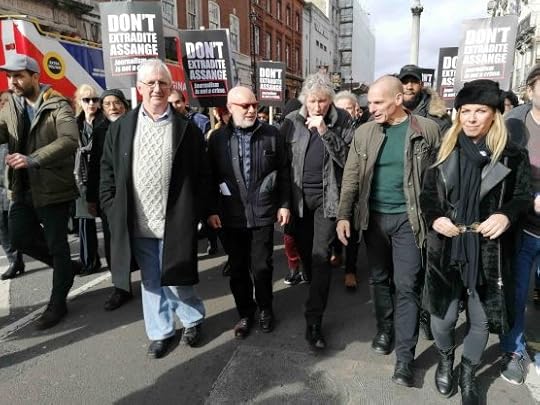
Τον Τζούλιαν τον γνώρισα το 2015 όταν εκείνος ενδιαφέρθηκε για μένα ως κάποιος που ξεμπρόστιασε τους υπουργούς οικονομικών της ευρωζώνης οι οποίοι, κεκλεισμένων των θυρών, σε πλήρες σκότος, αποφάσιζαν εναντίον των συμφερόντων των πολιτών που εκπροσωπούσαν. Το κοινό μας πρότζεκ που ξεκίνησε από τότε κορυφώνεται τώρα, στις 10 Μαρτίου, με την παρουσίαση των Euroleaks.
Λίγο μετά, τον Φεβρουάριο του 2016, μαζί με τον Μπράιαν Ίνο, τον Νόαμ Τσόμσκι και δεκάδες χιλιάδες προοδευτικούς ευρωπαίους ιδρύσαμε στο Βερολίνο το Κίνημα για τη Δημοκρατία στην Ευρώπη, το. DiEM25, με τον Τζούλιαν να συμμετέχει μέσω τηλεδιάσκεψης.
Σήμερα, στέκομαι δίπλα σας μεταφέροντάς σας την αλληλεγγύη που έρχεται από κάθε γωνιά της ευρωπαϊκής ηπείρου. Από τη Γερμανία. Από την Πορτογαλία, την Ισπανία, τα Βαλκάνια, της Ανατολική Ευρώπη, τη Νότια Ευρώπη, τη Σκανδιναβία, την Τουρκία. Μπορεί να είστε πλέον εκτός Ευρωπαϊκής Ένωσης αλλά θα παραμείνετε για πάντα στο κέντρο του ευρωπαϊκού κινήματος προοδευτικών για πάντα.
Αύριο, θα επισκεφτώ τον Τζούλιαν στη φυλακή, μαζί με τον Τζον – τον υπέροχο πατέρα του. Θα κάνω ό,τι μπορώ για να του μεταφέρω το πνεύμα σας, το πνεύμα των μελών του DiEM απ΄ όλη την Ευρώπη, τις ευχές των βουλευτών μας. – του ΜέΡΑ25 – κι όλων όσων διαδηλώνουν αυτή τη στιγμή έξω από την Βρετανική Πρεσβεία στην Αθήνα αυτή τη στιγμή.
Το μήνυμα όλων είναι απλό: Είμαστε όλοι Wikileaks. Ο καθένας μας είναι ένα τοσοδούλι MeLeaks που πασχίζει να ξεσκεπάσει την κατάχρηση εξουσίας και να ρίξει μια μικρή αχτίδα φωτός οπουδήποτε η εξουσία προσπαθεί να γιγαντωθεί υπό την κάλυψη του σκοταδιού που την κάνει θηριώδη, άσχημη, μισανθρωπική.
Όπως είπε πρόσφατα ο φίλος μου Φίλιπ Ανταμς, και φίλος του Τζούλιαν, δεν θα τους επιτρέψουμε να μετατρέψουν τον Τζούλιαν στον μοντέρνο Άνθρωπο με τη Σιδερένια Μάσκα, στον Άνθρωπο που ζει ξεχασμένος σε κάποιο Σιδερένια Κελί.
Οπότε, βρείτε το κουράγιο. Είμαστε εδώ ώστε ο εγκλεισμός του Τζούλιαν να κλείσει κι η άοπλη, η γυμνή αλήθεια να έχει την τελευταία λέξη.
Ο Τζούλιαν κέρδισε το δικαίωμα να δανειστεί τη φράση ενός άλλου φυλακισμένου, ενός άλλου εχθρού της Αυτοκρατορίας – του Μαχάτμα Γκάντι. Όπως ο Γκάντι, ο Τζούλιαν θα μπορούσε να πει: Μπορείτε να με αλυσοδέσετε, να με βασανίσετε, ακόμα και να τσακίσετε το κορμί μου, αλλά ποτέ δεν θα μπορέσετε να φυλακίσετε το νου μου.»
Μπορεί να το πει αυτό κάλλιστα.
Όμως εμείς δεν δικαιούμαστε να συμφωνήσουμε.
Εμείς δεν πρέπει να τους αφήσουμε να τσακίσουν το κορμί του.
Εμείς πρέπει να θέσουμε τέλος στον βασανισμό του.
Κι αυτό γιατί πρώτα ήρθαν για τον Τζούλιαν. Μετά θα έρθουν για τους συνοδοιπόρους μας. Μετά για τους φίλους μας. Κατόπιν για τα παιδιά μας. Τέλος, για τους δημοσιογράφους που δεν κινητοποιήθηκαν υπέρ του Τζούλιαν. Έρχονται για κάθε άνθρωπο που αρνήθηκε να υποταχθεί στους ισχυρούς που εγκληματούν εναντίον της ανθρωπότητας στο όνομά μας και χωρίς εμείς να το γνωρίζουμε.
Ο Μάικ Πομπέο, πρώτος διευθυντής της CIA που διόρισε ο Τραμπ και σήμερα Υπουργός Εξωτερικών των ΗΠΑ, χαρακτήρισε τα Wikileaks «μη κυβερνητική εχθρική προς το κράτος υπηρεσία πληροφοριών». Πολύ σωστά. Τα Wikileaks είναι πράγματι μια «μη κυβερνητική εχθρική προς το κράτος υπηρεσία πληροφοριών». Όπως θα έπρεπε να είναι όλα τα μέσα ενημέρωσης, η κάθε εφημερίδα, το κάθε κανάλι ή ραδιόφωνο.
Ο Νταν Έλσπεργκ και ο Νόαμ Τσόμσκι προειδοποίησαν τους δημοσιογράφους που απέχουν από την εναντίωση στην απέλαση του Ασάνζ στις ΗΠΑ: Είστε οι επόμενοι στον κατάλογο των καταζητούμενων ενός Προέδρου που σας θεωρεί «εχθρούς του λαού». Όταν αποστρέφετε το βλέμμα από τον βασανισμό του Τζούλιαν συναινείτε με την δική σας δίωξη!
Βέβαια, εσείς που βρίσκεστε εδώ σήμερα, στην Πλατεία του Βρετανικού Κοινοβουλίου, έχετε ήδη αποδείξει ότι το γνωρίζετε αυτό. Ότι όλοι μας το γνωρίζουμε. Και πως εσείς, εμείς, έχουμε αποδεχθεί το χρέος μας να το καταστήσουμε γνωστό σε εκείνους που δεν το ξέρουν.
Βλέπετε, ο πιο ορκισμένος εχθρός του Τζούλιαν, ο μεγαλύτερος εχθρός της ελευθερίας, δεν είναι κάποιοι κακοί άνθρωποι που συνωμοτούν σε κρυφά δωμάτια γεμάτα καπνό. Όχι, η συνειδητή, ορθολογικά σχεδιασμένη κακία δεν είναι ο μεγαλύτερος εχθρός. Ο μέγιστος εχθρός είναι η ΑΠΑΘΕΙΑ. Η ΑΒΑΣΤΑΚΤΗ ΣΙΩΠΗ καλών ανθρώπων. Κουρασμένων ανθρώπων πολύ εξαντλημένων και απογοητευμένων για να έχουν την ενέργεια να διαδηλώσουν. Η ΚΟΥΡΑΣΗ είναι ο εχθρός, ο καλύτερος σύμμαχος των ολιγαρχών.
Τον Τζούλιαν τον γνώρισα το 2015 όταν εκείνος ενδιαφέρθηκε για μένα ως κάποιος που ξεμπρόστιασε τους υπουργούς οικονομικών της ευρωζώνης οι οποίοι, κεκλεισμένων των θυρών, σε πλήρες σκότος, αποφάσιζαν εναντίον των συμφερόντων των πολιτών που εκπροσωπούσαν. Το κοινό μας πρότζεκ που ξεκίνησε από τότε κορυφώνεται τώρα, στις 10 Μαρτίου, με την παρουσίαση των Euroleaks.
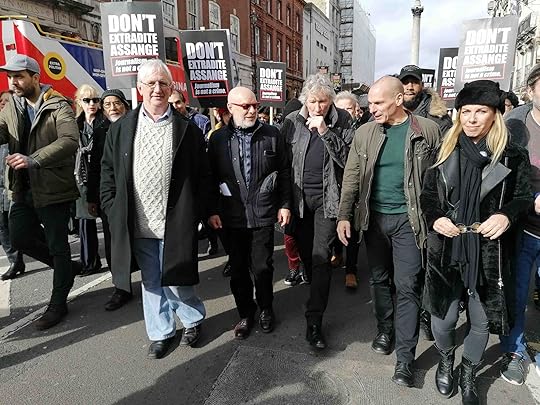
[Με τον Roger Waters και τον Brian Eno στην πορεία προς την Πλατεία Κοινοβουλίου]
Λίγο μετά, τον Φεβρουάριο του 2016, μαζί με τον Μπράιαν Ίνο, τον Νόαμ Τσόμσκι και δεκάδες χιλιάδες προοδευτικούς ευρωπαίους ιδρύσαμε στο Βερολίνο το Κίνημα για τη Δημοκρατία στην Ευρώπη, το. DiEM25, με τον Τζούλιαν να συμμετέχει μέσω τηλεδιάσκεψης.
Σήμερα, στέκομαι δίπλα σας μεταφέροντάς σας την αλληλεγγύη που έρχεται από κάθε γωνιά της ευρωπαϊκής ηπείρου. Από τη Γερμανία. Από την Πορτογαλία, την Ισπανία, τα Βαλκάνια, της Ανατολική Ευρώπη, τη Νότια Ευρώπη, τη Σκανδιναβία, την Τουρκία. Μπορεί να είστε πλέον εκτός Ευρωπαϊκής Ένωσης αλλά θα παραμείνετε για πάντα στο κέντρο του ευρωπαϊκού κινήματος προοδευτικών για πάντα.
Αύριο, θα επισκεφτώ τον Τζούλιαν στη φυλακή, μαζί με τον Τζον – τον υπέροχο πατέρα του. Θα κάνω ό,τι μπορώ για να του μεταφέρω το πνεύμα σας, το πνεύμα των μελών του DiEM απ΄ όλη την Ευρώπη, τις ευχές των βουλευτών μας. – του ΜέΡΑ25 – κι όλων όσων διαδηλώνουν αυτή τη στιγμή έξω από την Βρετανική Πρεσβεία στην Αθήνα αυτή τη στιγμή.
Το μήνυμα όλων είναι απλό: Είμαστε όλοι Wikileaks. Ο καθένας μας είναι ένα τοσοδούλι MeLeaks που πασχίζει να ξεσκεπάσει την κατάχρηση εξουσίας και να ρίξει μια μικρή αχτίδα φωτός οπουδήποτε η εξουσία προσπαθεί να γιγαντωθεί υπό την κάλυψη του σκοταδιού που την κάνει θηριώδη, άσχημη, μισανθρωπική.
Όπως είπε πρόσφατα ο φίλος μου Φίλιπ Ανταμς, και φίλος του Τζούλιαν, δεν θα τους επιτρέψουμε να μετατρέψουν τον Τζούλιαν στον μοντέρνο Άνθρωπο με τη Σιδερένια Μάσκα, στον Άνθρωπο που ζει ξεχασμένος σε κάποιο Σιδερένια Κελί.
Οπότε, βρείτε το κουράγιο. Είμαστε εδώ ώστε ο εγκλεισμός του Τζούλιαν να κλείσει κι η άοπλη, η γυμνή αλήθεια να έχει την τελευταία λέξη.
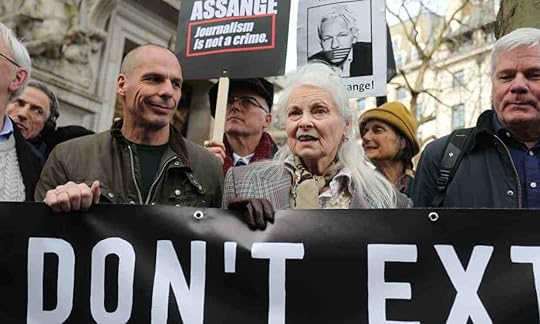
“We are here so that unarmed truth has the final word” – speech at Julian Assange London rally 22-2-2020
Leaking the Guilty Secrets of Power is not a Phrase, it is a Sentence. And no one is facing a longer one today than JA.
Julian has GAINED the right to quote another past prisoner, another enemy of Empire, Mahatma Ghandi. Like Ghandi Julian could say: “You can chain me, you can torture me, you can even destroy this body, but you will never imprison my mind.”
He may very well say that.
But WE don’t have the right to agree.
We must NOT let THEM destroy his body.
WE must END his torture.
Because first they came for Julian. Then they will come for our comrades. Then our friends. Then our children. Then the good people working for the Guardian, the BBC – anyone who does not submit to the right of the powerful to carry out crimes against humanity in OUR name and without OUR knowledge.
Mike Pompeo, Trump’s first CIA director and now US Secretary of State, described WikiLeaks as “a non-state hostile intelligence service.” That’s exactly right. Wikileaks IS a non-state hostile intelligence service. Exactly what EVERY self-respecting news outlet OUGHT to be.
Dan Ellsberg and Noam Chomsky have warned journalists who fail to oppose Assange’s extradition to the US: You are next on the hit list of a President who considers you the “enemy of the people.” When you turn a blind eye to Julian’s torture you consent to your own emasculation!
Of course, by being here you have already proven that you know all this. That WE know all this. It also means that you, we, have accepted the duty to let into the secret those who are not here.
You see, Julian’s greatest enemy, the greatest enemy of freedom, does not come from evil men in smoke filled rooms plotting against good people. No, rational, self-conscious evil is not the worst enemy. The worst enemy is APATHY. It is the APPALLING SILENCE OF GOOD PEOPLE. Of tired people too exhausted and disheartened to have the energy to campaign for others. FATIGUE is the enemy, the oligarchs’ greatest ally. Along with BANALITY – with people in some authority, neither good nor bad, yet too banal to act.
I got to know Julian back in 2015 when he took an interest in me because I had exposed the way Europe’s finance ministers conspire against the interests of the people they represent behind closed doors. One of our common projects will see the light of day on 10th March – watch out for Euroleaks.
Soon after we met, in February 2016, together with tens of thousands of European progressives, Brian Eno and Noam Chomsky included, we created the D in E Movement – DiEM25.
Today, I stand here to convey to you their solidarity from every nook and cranny of the European continent. From Germany. From Portugal, Spain, France, the Balkans, Eastern Europe, Southern Europe, Scandinavia. You may be out of the EU but we consider you more deeply embedded in Europe’s progressive movement than ever.
Tomorrow I shall be visiting Julian in prison, alongside John – his remarkable father. I shall do my best to convey to him your spirit, the spirit of DiEMers from across Europe, the good wishes of our Greek members of parliament and our party members who are staging a demonstration outside Britain’s embassy in Athens right now.
Their message to Julian is: We are all Wikileaks. Each one of us is a tiny MeLeaks exposing abuse of power and letting light in wherever power seeks to grow in the darkness that makes it monstrous, hideous, misanthropic.
As my friend, and Julian’s friend, Phillip Adams said recently, we shall not let them turn Julian into a latter-day Man in the Iron Mask, into the Man forgotten in an Iron Cell.
So, stiffen your upper lip folks. We are here so that unarmed truth has the final word. So that Julian’s sentence ends neither neither with a bang nor with a whimper – but with a majestic, a marvellous full stop.
Julian has GAINED the right to quote another past prisoner, another enemy of Empire, Mahatma Ghandi. Like Ghandi Julian could say: “You can chain me, you can torture me, you can even destroy this body, but you will never imprison my mind.”
He may very well say that.
But WE don’t have the right to agree.
We must NOT let THEM destroy his body.
WE must END his torture.
Because first they came for Julian. Then they will come for our comrades. Then our friends. Then our children. Then the good people working for the Guardian, the BBC – anyone who does not submit to the right of the powerful to carry out crimes against humanity in OUR name and without OUR knowledge.
Mike Pompeo, Trump’s first CIA director and now US Secretary of State, described WikiLeaks as “a non-state hostile intelligence service.” That’s exactly right. Wikileaks IS a non-state hostile intelligence service. Exactly what EVERY self-respecting news outlet OUGHT to be.
Dan Ellsberg and Noam Chomsky have warned journalists who fail to oppose Assange’s extradition to the US: You are next on the hit list of a President who considers you the “enemy of the people.” When you turn a blind eye to Julian’s torture you consent to your own emasculation!
Of course, by being here you have already proven that you know all this. That WE know all this. It also means that you, we, have accepted the duty to let into the secret those who are not here.
You see, Julian’s greatest enemy, the greatest enemy of freedom, does not come from evil men in smoke filled rooms plotting against good people. No, rational, self-conscious evil is not the worst enemy. The worst enemy is APATHY. It is the APPALLING SILENCE OF GOOD PEOPLE. Of tired people too exhausted and disheartened to have the energy to campaign for others. FATIGUE is the enemy, the oligarchs’ greatest ally. Along with BANALITY – with people in some authority, neither good nor bad, yet too banal to act.
Marching with Roger Waters and Brian Eno toward Parliament Square
I got to know Julian back in 2015 when he took an interest in me because I had exposed the way Europe’s finance ministers conspire against the interests of the people they represent behind closed doors. One of our common projects will see the light of day on 10th March – watch out for Euroleaks.
Soon after we met, in February 2016, together with tens of thousands of European progressives, Brian Eno and Noam Chomsky included, we created the D in E Movement – DiEM25.
Today, I stand here to convey to you their solidarity from every nook and cranny of the European continent. From Germany. From Portugal, Spain, France, the Balkans, Eastern Europe, Southern Europe, Scandinavia. You may be out of the EU but we consider you more deeply embedded in Europe’s progressive movement than ever.
Tomorrow I shall be visiting Julian in prison, alongside John – his remarkable father. I shall do my best to convey to him your spirit, the spirit of DiEMers from across Europe, the good wishes of our Greek members of parliament and our party members who are staging a demonstration outside Britain’s embassy in Athens right now.
Their message to Julian is: We are all Wikileaks. Each one of us is a tiny MeLeaks exposing abuse of power and letting light in wherever power seeks to grow in the darkness that makes it monstrous, hideous, misanthropic.
As my friend, and Julian’s friend, Phillip Adams said recently, we shall not let them turn Julian into a latter-day Man in the Iron Mask, into the Man forgotten in an Iron Cell.
So, stiffen your upper lip folks. We are here so that unarmed truth has the final word. So that Julian’s sentence ends neither neither with a bang nor with a whimper – but with a majestic, a marvellous full stop.
February 20, 2020
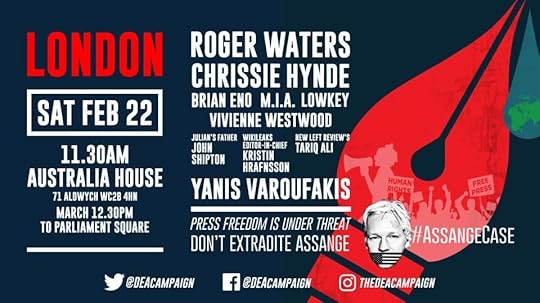
This Saturday we demonstrate in London against Julian’s deportation and in support of your right to know
Where: Australia House, London | When: This Saturday at 11.30 | Why: Marching to Parliament Square to defend your right to know by protesting Julian Assange’s extradition to the United States
Parliament Square Speakers (13:30 15:30)
Roger Waters
Yanis Varoufakis
Chrissie Hynde
Brian Eno
M.I.A.
Lowkey
Kristinn Hrafnsson – editor in chief of WikiLeaks
Vivienne Westwood
John Shipton – Julian Assange’s father
Parliament Square Speakers (13:30 15:30)
Roger Waters
Yanis Varoufakis
Chrissie Hynde
Brian Eno
M.I.A.
Lowkey
Kristinn Hrafnsson – editor in chief of WikiLeaks
Vivienne Westwood
John Shipton – Julian Assange’s father
February 18, 2020
Η εύλογη λύπη του κ. Ρέγκλιγκ
O Κλάους Ρέγκλιγκ «λυπάται πολύ» για την «παραβίαση του απορρήτου» που συνιστούν οι ηχητικές καταγραφές των Eurogroup από τον Γιάνη Βαρουφάκη. Προφανώς και λυπάται καθώς, αν οι πολίτες μπορούσαν να ακούσουν και να δουν τί έλεγε και τί έπραττε, ο κ. Ρέγκλιγκ δεν θα μπορούσε να σταθεί ούτε καν στη χώρα του.
Αν ήταν σε κοινή θέα, θα τόλμαγε ποτέ να προτρέψει υπουργό οικονομικών ευρωπαϊκής χώρας να κάνει πλήρη στάση πληρωμών σε όλους τους… συνταξιούχους έτσι ώστε να αποπληρωθεί μια δόση στο ΔΝΤ;
Αν ήταν σε κοινή θέα, θα ξέφευγε της αντίληψης των ευρωπαίων πολιτών ότι «στελέχη» όπως ο κ. Ρέγκλιγκ δεν είναι απλά κυνικοί γραφειοκράτες αλλά και τεχνοκρατικά ανεπαρκείς;
Όταν μιλά εκτός κειμένου, ακόμα κι όταν ξέρει ότι η κάμερα είναι στραμμένη πάνω του, ο κ. Ρέγκλιγκ διαπράττει στοιχειώδη τεχνικά λάθη. Π.χ. όταν στο πρόσφατο ντοκιμαντέρ του Γιώργου Αυγερόπουλου, ΑΓΟΡΑ ΙΙ, είπε πως η Ιταλία ή το Βέλγιο κατάφεραν να πετύχουν πρωτογενή πλεονάσματα πάνω από 3% κάθε χρόνο για δεκαετίες – κάτι που, με ελάχιστη έρευνα, ο σκηνοθέτης του ντοκιμαντέρ ξεσκέπασε ως ψέμα.
Αυτός είναι ο λόγος που δρώντες όπως ο κ. Ρέγκλιγκ τρέμουν τα μάτια και τα αυτιά των πολιτών – τον δημόσιο έλεγχο.
Αυτός είναι ο λόγος που στο Eurogroup δεν κρατάνε πρακτικά.
Αυτός είναι ο λόγος που, όταν ο Κώστας Γαβράς ανακοίνωσε ότι θα γυρίσει ταινία βασισμένη στο ΑΝΙΚΗΤΟΙ ΗΤΤΗΜΕΝΟΙ (Adults in the Room) του Γιάνη Βαρουφάκη, ο κ. Ρέγκλιγκ πανικοβλήθηκε αρκετά ώστε να αιτηθεί συνάντηση με τον Γαβρά. Ένα αίτημα στο οποίο ο Γαβράς ανταποκρίθηκε προσκαλώντας τον σε γεύμα εργασίας στο Παρίσι.
Στη διάρκεια του γεύματος, σύμφωνα με τον Κώστα Γαβρά, ο κ. Ρέγκλιγκ προσπάθησε να αποτρέψει τον σκηνοθέτη από το να γυρίσει το ADULTS IN THE ROOM ισχυριζόμενος ότι οι αναφορές στο βιβλίο του Βαρουφάκη στις συζητήσεις του Eurogroup ήταν ανακριβείς. Ο Γαβράς, αφού τον άκουσε προσεκτικά, του απάντησε: «Ο λόγος που πιστεύω στο βιβλίο του Βαρουφάκη είναι ότι έκανα αντιπαραβολή της περιγραφής του σχετικά με τα τεκταινόμενα στα Eurogroup με τα μαγνητοφωνημένα αρχεία που μου επέτρεψαν, ανεξάρτητα, να ακούσω τί λέγατε εσείς και οι συνάδελφοί σας κ. Ρέγκλιγκ».
Η συζήτηση βέβαια έληξε εκεί. Ο κ. Ρέγκλιγκ δεν επανήλθε. Μέχρι τώρα, που εξέφρασε τη λύπη του ότι οι πολίτες της Ευρώπης θα μάθουν την αλήθεια.
ΥΓ. Τον λογαριασμό του μεσημεριανού τον πλήρωσε ο Κώστας Γαβράς. Τον λογαριασμό του κ. Ρέγκλιγκ των πληρώνουν καθημερινά οι ευρωπαίοι, ιδίως οι έλληνες
Αν ήταν σε κοινή θέα, θα τόλμαγε ποτέ να προτρέψει υπουργό οικονομικών ευρωπαϊκής χώρας να κάνει πλήρη στάση πληρωμών σε όλους τους… συνταξιούχους έτσι ώστε να αποπληρωθεί μια δόση στο ΔΝΤ;
Αν ήταν σε κοινή θέα, θα ξέφευγε της αντίληψης των ευρωπαίων πολιτών ότι «στελέχη» όπως ο κ. Ρέγκλιγκ δεν είναι απλά κυνικοί γραφειοκράτες αλλά και τεχνοκρατικά ανεπαρκείς;
Όταν μιλά εκτός κειμένου, ακόμα κι όταν ξέρει ότι η κάμερα είναι στραμμένη πάνω του, ο κ. Ρέγκλιγκ διαπράττει στοιχειώδη τεχνικά λάθη. Π.χ. όταν στο πρόσφατο ντοκιμαντέρ του Γιώργου Αυγερόπουλου, ΑΓΟΡΑ ΙΙ, είπε πως η Ιταλία ή το Βέλγιο κατάφεραν να πετύχουν πρωτογενή πλεονάσματα πάνω από 3% κάθε χρόνο για δεκαετίες – κάτι που, με ελάχιστη έρευνα, ο σκηνοθέτης του ντοκιμαντέρ ξεσκέπασε ως ψέμα.
Αυτός είναι ο λόγος που δρώντες όπως ο κ. Ρέγκλιγκ τρέμουν τα μάτια και τα αυτιά των πολιτών – τον δημόσιο έλεγχο.
Αυτός είναι ο λόγος που στο Eurogroup δεν κρατάνε πρακτικά.
Αυτός είναι ο λόγος που, όταν ο Κώστας Γαβράς ανακοίνωσε ότι θα γυρίσει ταινία βασισμένη στο ΑΝΙΚΗΤΟΙ ΗΤΤΗΜΕΝΟΙ (Adults in the Room) του Γιάνη Βαρουφάκη, ο κ. Ρέγκλιγκ πανικοβλήθηκε αρκετά ώστε να αιτηθεί συνάντηση με τον Γαβρά. Ένα αίτημα στο οποίο ο Γαβράς ανταποκρίθηκε προσκαλώντας τον σε γεύμα εργασίας στο Παρίσι.
Στη διάρκεια του γεύματος, σύμφωνα με τον Κώστα Γαβρά, ο κ. Ρέγκλιγκ προσπάθησε να αποτρέψει τον σκηνοθέτη από το να γυρίσει το ADULTS IN THE ROOM ισχυριζόμενος ότι οι αναφορές στο βιβλίο του Βαρουφάκη στις συζητήσεις του Eurogroup ήταν ανακριβείς. Ο Γαβράς, αφού τον άκουσε προσεκτικά, του απάντησε: «Ο λόγος που πιστεύω στο βιβλίο του Βαρουφάκη είναι ότι έκανα αντιπαραβολή της περιγραφής του σχετικά με τα τεκταινόμενα στα Eurogroup με τα μαγνητοφωνημένα αρχεία που μου επέτρεψαν, ανεξάρτητα, να ακούσω τί λέγατε εσείς και οι συνάδελφοί σας κ. Ρέγκλιγκ».
Η συζήτηση βέβαια έληξε εκεί. Ο κ. Ρέγκλιγκ δεν επανήλθε. Μέχρι τώρα, που εξέφρασε τη λύπη του ότι οι πολίτες της Ευρώπης θα μάθουν την αλήθεια.
ΥΓ. Τον λογαριασμό του μεσημεριανού τον πλήρωσε ο Κώστας Γαβράς. Τον λογαριασμό του κ. Ρέγκλιγκ των πληρώνουν καθημερινά οι ευρωπαίοι, ιδίως οι έλληνες
Yanis Varoufakis's Blog

- Yanis Varoufakis's profile
- 2450 followers
Yanis Varoufakis isn't a Goodreads Author
(yet),
but they
do have a blog,
so here are some recent posts imported from
their feed.

