
Veronica Roth's Blog, page 2
October 4, 2024
Be Patient
At some point in the last seven or so years, all my writing advice became life advice. Oh, I still have some practical tips about brainstorming or writing action scenes or how I go about revising. But when people say “what’s one piece of advice you have for a young writer/writer who wants to be traditionally published/debut author/etc.?” I’ve started to automatically express something deeper, something about values or priorities or personal growth.
People’s eyes then tend to glaze over; they weren’t asking me to teach them about being human, and you know what? That’s fair. But at a certain point, I realized no amount of practical advice was going to ease people through the actual challenges of writing. People mostly learn about the particulars of writing books by…writing books. And they don’t really need me for that; they need themselves. They need to show up for themselves every single goddamn day. And I can’t give them a handy trick for that.
My actual advice? Learn patience.
Thanks for reading Veronica Roth! Subscribe for free to receive new posts and support my work.
Patience is not sexy. It’s not a cool trick. It doesn’t feel good. It’s not going to get people to share this newsletter far and wide, praising its helpfulness. It is, however, the thing you need. I need. We all need. So I’m going to try to talk about patience in a new way—in the way that I understand it. And maybe that will help.
COURSE-CORRECTION
I used to drive a Honda Civic. It was a fantastic car. In the decade that I drove it, the only maintenance it required was a brake pad replacement. But it had its quirks—for example, it was so lightweight that at speeds greater than forty miles per hour, any amount of wind pushed it off course, so I had to learn to steer against the wind. It’s not a big deal. Just a little tug at the wheel every few seconds.
I think about it whenever I sit down to meditate, which I try to do somewhat regularly, not because I enjoy it (I do not), but because I have an anxiety disorder and I’m told it helps (I resent this). The expectation that I can force my brain to stay present feels absurd, yet I’ve come to learn that blankness is not actually the goal of meditation. Instead, it’s the steering of thoughts. You find yourself thinking about that thing you said earlier— nope, go back to the breath. You’re worried about what’s going to happen later— back to the breath. Just a little tug at the wheel every few seconds.
BE PRESENT, NOT PERFECT
My sister once got my stepdad a Cubs t-shirt (or maybe he got it for her? I can’t remember) that said this once. Be present, not perfect. I don’t think we can credit Joe Maddon with the quote, exactly, but it was his philosophy in coaching and it really stuck in my head. I’m thinking of it this morning as I try to practice patience.
I’m waiting to hear back from several people about several important things, work-related and not, right now. Some of them are on vacation; some are on leave; some are just taking a reasonable amount of time to get back to me. On some level, my body registers this as frustrating. I feel agitated. I’ve been mad at the dog for days (don’t worry, I’m still being nice to her).
You might not call this patience just to look at it. I’m obviously on edge. But I don’t think of “patience” as a state of utter calm. I think of it as the struggle to be present. At this very moment, my task is to write this newsletter. Every few seconds my mind wanders in its agitation. Every few seconds I tug the wheel, return to the present, write another few sentences. Over and over again.
Patience is tedious. Patience is repetitive. Patience is being present.
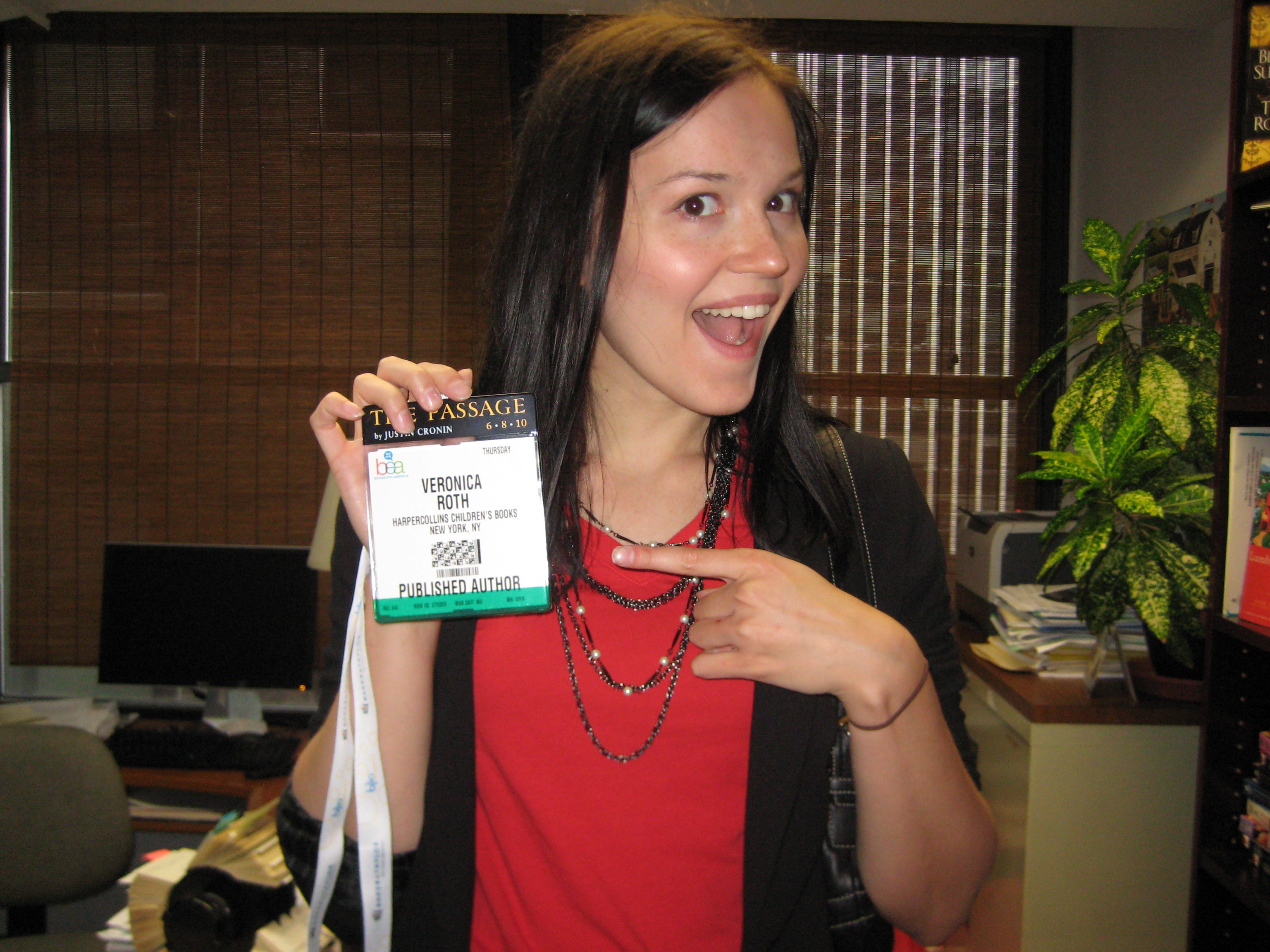 the first time I was ever referred to as a “published author”
LET THE PAST DIE…
My actual philosophy is, and I really mean this: fuck dreams. I don’t tell people this very often. It’s personal, for one thing, not something I think everyone needs to adopt. And for another thing, I know what they’ll say. It’s important to have dreams! Sure, fine, I guess. Is it, though?
If you’re a dreamer, good for you. I recognize that I have walked a very particular path and it’s only because of the privileges that path has afforded me that I can even say “fuck dreams” with a straight face. So as I said, it’s not like…a recommendation. But I’ll tell you about it anyway.
The strangest thing about my career trajectory has been how, when Divergent came out and became successful, I achieved a long list of writer dreams all at once. Bestseller lists and sales records and multiple movie adaptations and big important interviews and absurdly fancy parties. I was on national television and on a red carpet in a designer dress and on a movie set having a chat with Tony Goldwyn about his kids. Like, really, and I cannot emphasize this enough: whoa.
On its face: very cool. Beneath the surface: I was terrified and naive and in many ways innocent to the way the industry worked and so uncomfortable surrounded by super attractive, well-known people that I could barely eat. Like, ever. (It’s an anxiety thing. It’s not great.) I remember standing at one of the aforementioned fancy parties and thinking, this is it. This is the dream. Only I didn’t mean it in that starry-eyed “wow I appreciate the wonder of all this” way. I meant it like: oh. This is what people dream about, and I have it, and I feel out of place and wrong and scared and hungry and this dream doesn’t feel good.
In those moments, in the nicest clothes I’d ever worn, surrounded by a big ol’ pile of hotties, having achieved all those dreams, I realized only this: I truly, desperately, and deeply wanted to go home. Home, to my sweet little dog and my happy marriage and…my writing.
To me, dreams are often like this. This glossy, idealized version of a thing that, when you achieve it, lets you down because the reality of it simply can’t measure up. But you know what’s pretty great in my reality? Husband. Dog. Friends. Family. Writing. I like my work. I like my life. I like myself. That’s the dream, realized.
Bestseller lists, movie adaptations, sales records, don’t get me wrong, they’re great. But it’s important to keep them in their proper place. They didn’t make me happy, they didn’t make me hotter or more special or more loved. They were great because they helped me build the everyday life I am fervently grateful for. Full stop.
I guess I do have dreams now, but my dreams are ordinary.
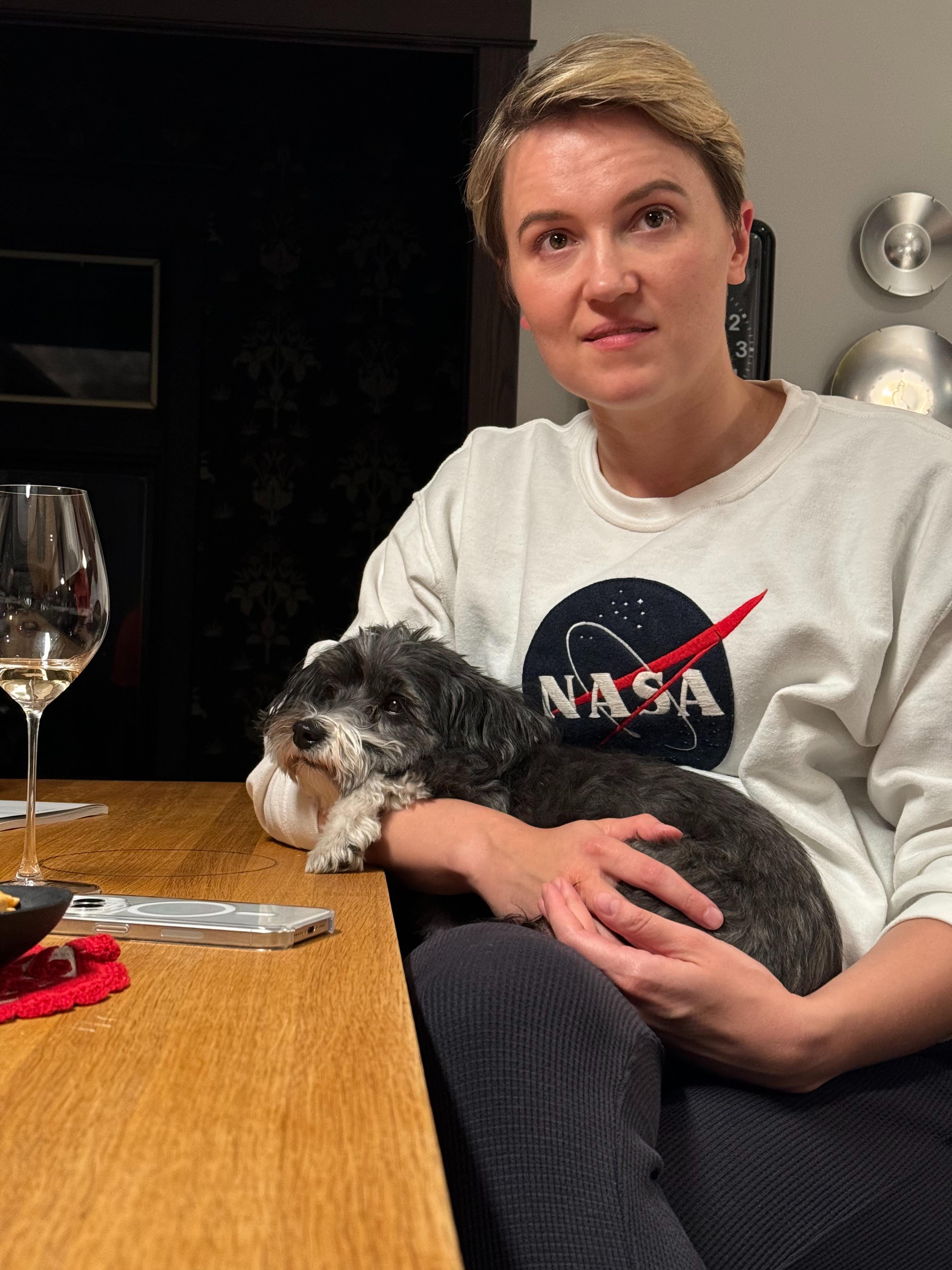 living the dream
…KILL IT IF YOU HAVE TO.
I’m aware that none of this is relatable. But I swear I have a point. Those fancy, glitzy party dreams are a lot like your dreams of what your book can be when it’s finished. You can spend a lot of time, in your mind, with the imagined success of your book. Its beautiful cover and its face-out bookstore promotion and its stellar reviews and all the wonderful things readers will say about it. You can also spend a lot of time with the idea of what your story will be when it’s done. How it will explore this theme or that theme, how it will have this or that kind of polished, beautiful prose, how it will introduce a whole new subgenre of whatever.
OR…hear me out: you can meet your book where it is. Look at what it is. What’s working? What isn’t? What is it actually saying, vs. what you dreamed it would say?
Patience is this: the commitment to wrestling with your book to make it the best version of itself, not the glossy, idealized dream of what you wanted it to be at the start.
Patience is this: the commitment to wrestling with yourself as you realize the ways in which your subconscious has leaked out onto the page in ways you didn’t anticipate. As you accept what kind of writer you are and what kind of writer you aren’t. As you decide what the difference is between pushing yourself to grow and trying to force yourself into a mold that doesn’t suit you. Set big goals for yourself, but know yourself.
Patience is wrestling. Patience is being aware of the end goal without fixating on it. Patience is looking at what is instead of what isn’t real. Patience is being present—not perfect.
PRESENCE
On days when I’m not patient, I’m refreshing. The inbox, the social media, my messages. Over and over again, the lab rat pushing the lever.
On days when I’m patient, I still check things. The inbox, the social media, the messages. I’m only human. But then I tug the steering wheel, open up my draft, and write. And in those moments, I’m not thinking about my word count or my chapter goal for the day or letting the pressure of what I hope this book can become crush me. I’m with the characters in the story, earnestly trying to figure out the best way to tell it.
What will my career be, now, tomorrow, in five years? What will this book become? Or the next one? Or the next one? Do I have dreams for those things? Sort of. I can’t help it, I guess. But I let those dreams stay blurry and far away from me.
Mostly, I’m here. And I’m patient.
Thanks for reading Veronica Roth! Subscribe for free to receive new posts and support my work.


August 30, 2024
Let It Get Awkward (And Other Lessons from Media Training)
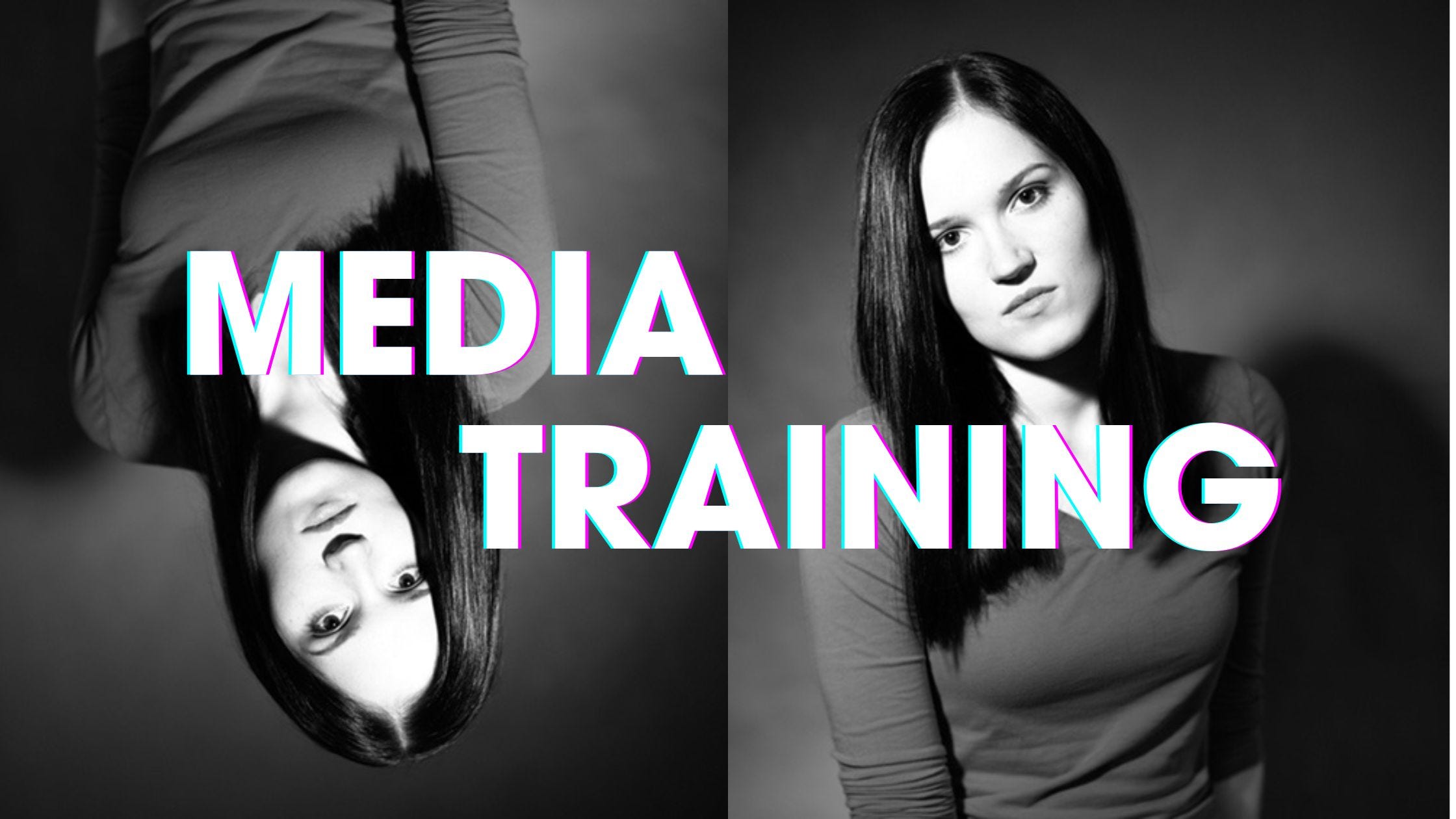 BABY’S FIRST HEADSHOT (by Nelson Fitch)
Recently I realized I’m not a beginner anymore. Shocking, I know. I’ve published seven novels, two short story collections, and two novellas; I’ve had three books adapted to film; and thanks to the incredibly weird and occasionally wonderful time that was having the Divergent books become so successful so quickly, I’ve attended a crapload (that’s the technical term, right?) of professional conferences and conventions. I can pack for a two-week tour in a carry-on, I’ve been on the Today show twice (three times?), and every so often I have a conversation about some media personality with friends and I get to say something annoying like, “Oh, I’ve met them!”
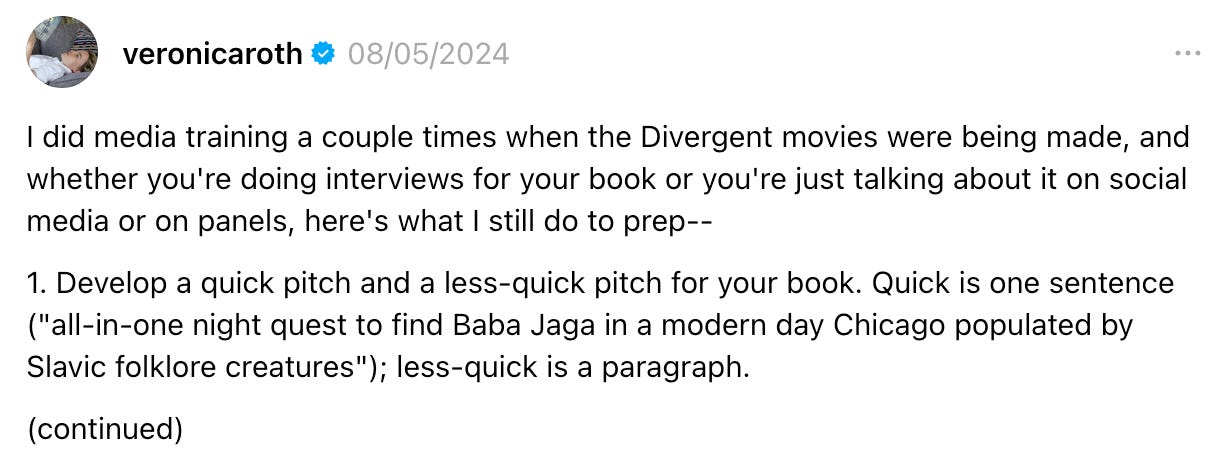
So with that in mind, I offered some quick tips about media training on Threads that I want to expand on here. Let’s start at the beginning, though…
Thanks for reading Veronica Roth! Subscribe for free to receive new posts and support my work.
WTF even is “media training”?Have you ever done an on-camera interview? For a long time my mom didn’t really believe me that they were difficult to get used to. Then I brought her to the Divergent set, and the on-set publicist asked her if she would answer a couple questions with me. She said yes. Lapel microphone went on. Camera went up. Mom’s mind went completely blank. You just don’t know how it feels until you do it, man.
So, how hard can it be? I mean, not as hard as open-heart surgery or making a functional spreadsheet, but— harder than it looks, for sure.
Media training is intended to prepare you as much as possible for that experience. When I did it the first time, it was in advance of an interview with Ryan Seacrest wherein we revealed the cover of Allegiant. I was in my early twenties, and everyone just wanted to make sure that I would do a decent job, and that meant preparation, and that meant media training.
The media trainer started by giving me a primer on what to expect from different types of media, such as: print journalists give the toughest interviews, because they need to engage readers for a longer period of time; television, on the other hand, because they get such a limited time and books are usually featured on daytime or more “upbeat” programming, is usually easier and more straightforward, but tricky because you have to think about how you’re presenting yourself physically. (My favorite interviews, by the way? Audio only. You don’t have to think about what your face is doing, but you’re still in control of how you present yourself— not true of print media.)
Then the media trainer conducted some pretend interviews with me. Some of them were basic questions and some of them were a little harder, like “we all know Ryan Seacrest is not going to grill you about [insert controversial topic], but just in case—let’s see how you handle it.”
She recorded me answering her questions, and then we watched the footage, which— if you asked me which activity I’d prefer, cleaning up my dog’s food bowl when it was infested with thousands of tiny ants, or watching myself on video, I’d choose the ants every time. But it was helpful. She pointed out things like, “you lick your lips a lot” (pro tip: if you put vaseline on your teeth before the interview, you are less likely to get dry lips! who knew), or “you make an actual grimacing face for a second when people ask you something you don’t want to answer,” or “absolutely do not repeat the negative thing someone says about you even if you’re denying it” (the Nixon mistake— “I am not a crook!”). All those things were good to know and I do recommend watching yourself on camera at least once so you can be aware of your posture and presentation, even if you’re just practicing for a job interview.
Anyway, that’s media training. Pretty simple.
My fun notes about Ryan Seacrest? He was extremely professional and good at his job. Good on the fly and understood the assignment. I did have to wear flat shoes so I wouldn’t tower over him in the shot. (I’m six feet tall; he is not.)
Don’t Waste Opportunities, BroThe thing about being an author is, the dynamic is not the same as the one between a journalist and a celebrity, or a journalist and a politician. The stakes are just different for us. When you’re an author, you and the journalist have the same mission: make a conversation about books interesting. So media training, for me, was not about filing down my edges— I don’t have edges! I am someone who volunteered enthusiastically to spend an entire year of my life alone in front of a word processor!— it was actually about teaching me to be clear, concise, and to take advantage of the opportunities I was being offered.
And that’s the important thing here: every interview, every time your voice is featured in public, is an opportunity. I encounter far too many authors who don’t see it that way, and they kind of blow off a panel discussion because they don’t like the topic, or avoid talking about their books like “that’s boring, no one wants to hear that”…without remembering that every audience is new and just wants to know what your books are like, and that it’s your job to promote your work. That doesn’t mean you can’t be a person or have a personality, but no one is ABOVE promotion, and why are you wasting your time on that panel or in that interview if you’re not there to accomplish an actual goal, which is, bare minimum, “tell them what your book is about.”
The truth is, very few people will read your book just because they like your personality. They read your book because the book sounds interesting to them. And they’ll never know if it sounds interesting or not if you refuse to pitch it to them. So writers, authors, whoever— put on your professional pants and show up.
I was recently in conversation with Brandon Sanderson at C2E2, and it rattled me to my core (see? Now I’ve hooked you)— I was in a moment of my career where I’d gotten a little complacent, I was so used to panels and so comfortable with public speaking that I forgot one crucial thing: you have to offer people something of value. And Brandon Sanderson seems to understand that. He was immediately giving a master class on worldbuilding from the first moment of that panel. Every single question was an opportunity to share something meaningful about himself, his books, or his process. I literally sat up straighter. I thought, I have to step up my game if I want this to be a good conversation instead of just “Brando Sando and that lame-o who was sitting next to him, what was her name again?” It was a great conversation, thank you to Brandon for reminding me that when you’re talking to people about your work, it’s an opportunity and a privilege, and you should make the most of every second.
Since then I’ve changed the way I do things— I’ve been going back to the process I learned in media training.
And That Process is What, Exactly?BUCKETS
The media trainer basically asked me this: what is it that you want to get across? And this is related to the whole “opportunity” thing. You need to have goals. Authors who have not had to chase down interviews for themselves, who have had them arranged by publicists or whoever, sometimes agree to them begrudgingly, like fine I’ll do it if I have to. And when that’s the case, they treat the interview (or the panel, or the conversation) like something they need to survive and endure instead of really contribute to.
What is it that you want to get across? is a question that asks you to define your contribution. With any book I write, what I want to get across is that my work is interesting and that I’m more than just the author of Divergent. (SEVEN NOVELS, PEOPLE. READ THEM, PLEASE.) So when I’m ready to start promoting a book, I try to define what’s interesting about that book.
Usually this is obvious. Poster Girl, my book about a woman who was the face of a surveillance state’s propaganda and was imprisoned after that state collapsed, had a few “buckets,” if you will. One of them was “post-dystopia”—writing about the aftermath of a fallen regime, especially given that my most famous work is about what comes before that. One of them was “social media break”—I took six months off social media when I was writing Poster Girl, for many reasons, but one of them was that I wanted to experience the same sudden loss of connection that my main character experiences in the story. One of them was “mystery”—the book was my first mystery, centered around the search for a missing girl, and I wanted to talk about how tremendously hard it is to write mysteries. You get the idea.
What you have to do is figure out what makes your book distinct. None of us are out here writing stories that are wholly unique, but there’s a reason why you gravitated toward your story in particular, why you chose to write it in exactly the way you did. Were you inspired by something, someone, or some other creative work? Did you love a certain kind of story growing up and always wanted to write one? Why? What did you have to say that wasn’t already being said?
If I was promoting Divergent now for the first time, I would talk about my first dystopia (The Giver); I would talk about first love, exaggerated by dark circumstance; I would talk about my fondness for personality tests and sorting paradigms in fiction; I would talk about Chicago as a dystopian playground. See what I mean? Divergent isn’t going to shock you with its uniqueness, that was never its job. It’s a love letter to what was (The Giver), that speaks to the experience of being a teenager (wanting to belong but feeling like you can’t; the fantasy of the popular guy who actually sees you and finds you interesting; the sudden awareness that the world you looked at with rose-colored glasses is actually broken), set in a city that is well-known but not always focused on. That’s what I want to get across: I’m not reinventing the wheel here but this book will interest you, engage you, and speak to you if you, like me, love these things in fiction.
So before you start talking about your book anywhere— online, on panels, in interviews, whatever— sit down and figure out what your “buckets” are. What are the things you want to talk about when you talk about this book? Know what they are. Write them down.
PITCHES
It’s worth your time to develop a quick pitch and a less-quick pitch for your book. A quick pitch is one line. I mean it— ONE LINE. This is why you hear “this meets that” so often (When Among Crows is “The Witcher meets Wizard of Oz”)— it’s fast and it works. Sorry if you’re annoyed by it, but we’re all going to keep doing it, god bless and godspeed.
A less-quick pitch is SLIGHTLY MORE THAN ONE LINE. A paragraph, guys, and not a big chunky paragraph. Truly, if I get nothing else across to you in this blog, it should be this: say something interesting, and also SAY LESS. Authors do tend to ramble, and I am including myself in that. When Among Crows is, this book is about a mysterious man on a mission to find Baba Jaga in a Chicago populated by creatures from Polish folklore. Or it’s: this book is about a mysterious man who comes to a mysterious woman with a deal— he’ll help her break the curse that’s killing her if she helps him find legendary witch Baba Jaga. The only problem is, he comes from a holy order of monster hunters…and she’s a monster.
Write these two pitches out. Practice them a kabillion times—out loud. Pat yourself on the back.
NEVER STOP PREPARING FOR SHIT
Often an interviewer or moderator will send questions in advance of a panel or conversation. If you’re lucky enough to be in that position, take some time to free-write your answers. You don’t have to (and shouldn’t) read them verbatim later, but you got into this business because you’re a writer, and we often do our best thinking while writing, not talking. Free-write, and then while you’re in the shower or doing your nighttime stretches or whatever, practice some responses out loud. Get used to organizing your thoughts for the purpose of speaking, rather than for the purpose of writing— those are two different skills.
AGAIN, SAY LESS
Get used to editing your thoughts. No one wants to hear you ramble for over sixty seconds about literally anything. Seriously. Know what the point is (that’s what all that other stuff ^ was for), get to that point, and then stop talking. You don’t need a denouement.
PUT IT ALL IN A GOOGLE DOC
Or wherever. Just somewhere you can access it. Then, before you do your interview or panel or video or whatever, read over your notes to keep them fresh in your mind.
Also in your google doc? Put some book recs. We all know the feeling when someone asks you for book recs and your mind goes totally blank. So just come up with a few and put them in your notes.
LET IT GET AWKWARD
Remember what I said earlier about how you just need to stop talking at the end of a thought? The reason people don’t do that is that it feels weird. You stop abruptly and there’s this horrible silence as the interviewer realizes, oh, she’s done, I gotta ask a follow-up. Here’s the thing, though: you do get used to that silence, and rambling means you’re more likely to be misquoted, misunderstood, or that that section of the interview will be totally omitted. So learn how to deal with the minor discomfort of silence. You won’t regret it.
Also, usually at an interview they’ll ask at the end “anything I missed?” or “anything you want to add?” and at that point you’ll be like oh thank god, I’m almost out of here. And you’ll want to say “no, we’re all good!” and bolt and maybe stick your head in your freezer, if you’re at home. But what you should do instead is think back to your buckets, your pitch, your goals— and just bring up a topic you missed. Yes: out of nowhere! When you are pretty sure your interviewer just wants to be done! Bring it up! Make it weird! If you say something good, it’ll be worth it, I promise, and if they’re a decent interviewer they’ll recognize that. And if they don’t decide to include it in the final piece, whatever, at least you tried. The stakes are low. Let it get awkward.
I recently saw a clip of Kamala Harris giving public speaking advice to some youths, and she basically said, if you were on the Titanic and you knew it was sinking, would you let fear of how you look or how you sound stop you from warning people about it? No! You’d be more worried about the urgency of your message. Now, we’re talking about books here, not life-saving messages, but the basic premise I’m suggesting is the same: if you define your goals at the outset, that should create clarity and urgency for you in every interview. Here are the things I want to get across. And you can let that urgency carry you through the awkward moments, because you’re focused on your goal, which is to tell people about your work in a way that will make them want to connect with it.
The main takeaway here is: talking about your work is a skill you can and should develop, whether you’re a writer or not. Maybe you’re not naturally gifted at it, maybe you’re not funny or particularly entertaining, but clarity is a goal that we can all achieve, whether we’re good at it or not. And honestly, friends, clarity is all you need— but it starts with you. You, having clarity about why you wrote your book. You, having clarity about what your book is and why it’s interesting. You, defining clear goals and showing up for yourself.
So, you know. Get out there and maul.
:)
-V
Thanks for reading Veronica Roth! Subscribe for free to receive new posts and support my work.
August 1, 2024
"Defect, She Said."
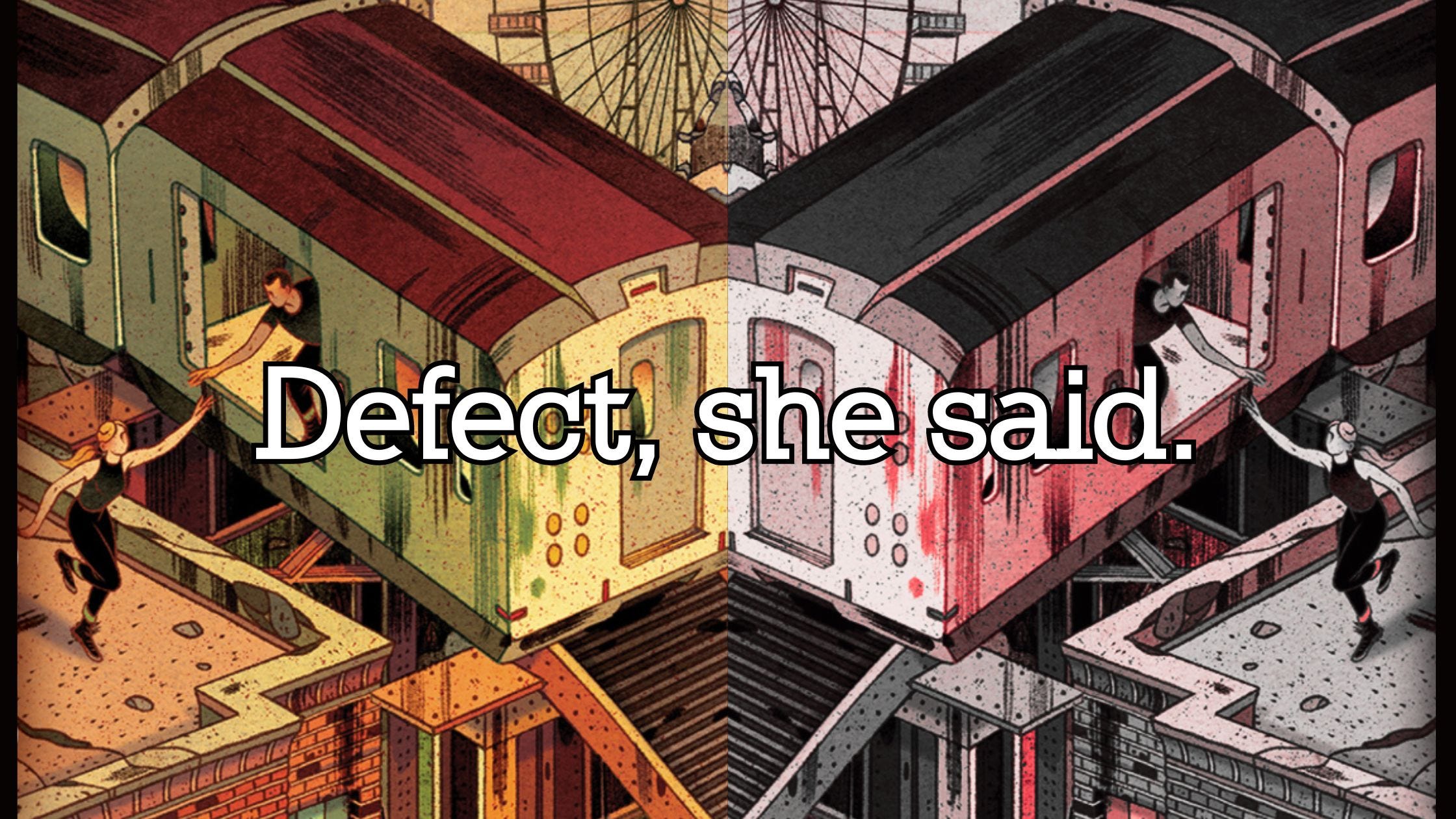 original cover art by Victo Ngai
Whenever I moderate a conversation with another author, the question I find myself returning to, no matter who it is, is: why did you tell the story this way and not another way? I ask that because there are always the choices you didn’t make, even if you were so committed to one story that you didn’t even see them. And the choices writers do make, in the face of so many options, reveal a great deal about their priorities, their interests, and the worlds they’re building.
I think about this often, and that’s why I decided to do this experiment. Below is a scene from a Divergent that never was—that never could have been, because I had to write it one way. Readers often ask me, why did you have Tris choose Dauntless? And for awhile that felt like a nonsense question— she chooses Dauntless because that’s the only way the story could exist.
But now that the story does exist— now that I’ve written it the way I needed to— I can see the choices I didn’t make, and I’m interested in exploring them, to see how they change the story and the characters and the world. So here’s 3,500 words of the Tris who chose Abnegation, instead.

As much as the factionless insist that our former allegiances have no place among them, they can’t seem to let them go. Case in point: they still ask me to be the one to look out for the new kid. I’m the Stiff, after all. The only one here.
Other than Evelyn, that is.
I guess I can’t blame them for struggling to unlearn everything they were taught. After all, when they ask me to do it, I still say yes. Yes, I’ll help the one-eyed failed Dauntless transfer. Yes, I’ll bring him soup—hot, but still in the can—and sit with him while he eats it. Yes, I’ll help the medic change his bandages.
I doubt most Abnegation pepper the medic with questions the way I do, though. Why do doctors do stitches with a hooked needle, what will happen to the socket now that the eye is gone, what will it look like if it gets infected. Edward told me, the first day, that it was better to know than not to know, so he doesn’t object to me asking questions about his missing eye. He seems bothered, though, when the medic isn’t able to answer all of them. She only studied medicine for a few years before she became factionless.
“You might consider studying with our best doctor,” the medic says to me, when she’s done putting a clean bandage on Edward’s eye. “He works out of Sparrow House.”
All the factionless safehouses have bird names. Sparrow, Eagle, Crow, Robin, Falcon—those are the main ones. We’re in Robin House now, which is a red-brick warehouse not far from Abnegation headquarters, on a street lined with overgrown trees. When robins have to defend their nests, I was told when I got here, they make a ruckus so other robins will flock to them. When you don’t have the talons of a predator, you have to find strength in numbers.
It may as well be the factionless motto.
“I didn’t know I could do something like that,” I say to the medic. “Learn a trade here, I mean.”
“Did you think we all just shuffle around the city driving trains and begging for food?” The medic pulls off her latex gloves with a snap. “We’ve got our own ways of doing things. We just have to be…scrappy about it.”
One thing I’ve learned since defecting from Abnegation a few months ago is that the factionless are good at putting on a show. On the surface, they’re unruly, unstable, unpredictable. But the deeper I go into the new society they’ve made right under the old society’s nose, the more I see…organization. Education. Dedication.
“I’ll put in a good word for you,” the medic says. “Anyone who looks at a fresh enucleation without wincing is a good candidate.”
I grin, and hold out the paper bag we’re using for medical waste. She drops some gauze scraps into it, but keeps the gloves to sanitize later. It’s not like we’ve got gloves to spare.
I’m just coming back from washing my hands—there’s just a faucet sticking out of the wall in the corner, the sink that once supported it long gone by now—when I see her.
Tall, curly-haired, sharp-eyed. Brown Amity boots laced tight, all the way up her calves. Evelyn Eaton.
#
After I chose Abnegation in the Choosing Ceremony, I knew right away I’d made a mistake. I felt it in my stomach. Aching. Heavy. And with each element of the Abnegation initiation ritual that followed—my mother sitting me down to wash my feet, my neighbor serving me dinner, an older classmate whispering a prayer in my ear—I got even heavier. I thought it would let up eventually, as I committed myself to the choice I’d made. I went through the motions of my month of service, my hands and feet obeying where my heart wouldn’t. And it seemed like I was fooling everyone else, but I couldn’t fool myself.
As it turned out, I couldn’t fool my mother, either. I wasn’t supposed to talk to her until I completed initiation, not after that first night, but she found me trudging home from volunteering at the hospital one day and beckoned for me to follow her into some half-collapsed building. She told me she could tell I regretted my choice, but there was one path left open to me if I had the courage to choose it. One path that would let me help her save the city from certain destruction.
Defect, she said.
And when I asked why, when I asked what—what destruction, what danger is the city in, what what what—she said she couldn’t answer.
Defect, she said, and I didn’t do it because she told me to, because I had learned my lesson about doing things just to please my parents after the Choosing Ceremony. I defected because the idea of remaining in Abnegation, doing all the choreography of selflessness without any of the conviction, made me want to scream.
My mother helped me get out. I’m given to understand it wasn’t her first time. She stood with me on the train platform in the dead of night, a bag of clothes and supplies slung across my back, and taught me how to run alongside the second-to-last car while it slowed. She did it first, and then grabbed my hand to lift me inside, and I asked myself how she knew these things, I asked myself where she came from, for the first time.
Evelyn Eaton was standing inside the car, half-hidden in shadow. She didn’t speak to me directly.
“Your daughter?” Evelyn said.
“She chose Abnegation,” my mother replied. “But it wasn’t right for her.”
“What a shock.” Evelyn’s voice was sour and dark. Like pumpernickel bread or the black coffee a Candor offered me a sip of on the bus once, just to laugh at me when I hated it. Too strong for you, Stiff?
“You’ll take her in,” my mother said, and it wasn’t a question, it was a command. “You’ll take care of her. And I’ll consider your debt to me repaid.”
Evelyn finally looked at me, and I wondered what she saw. Little blonde girl with her neat Abnegation bun, her loose Abnegation grays. Small and quiet and nothing special.
“What’s the faction you should have chosen?” Evelyn asked me. “Or do you even know?”
The answer came easily. “Dauntless.”
“Like mother, like daughter, I guess.” Evelyn laughed. And to my mother, she said, “You’d better get off at the next station.”
I didn’t get the chance to ask my mother if she grew up in Dauntless, though I already knew the answer. I didn’t get to ask her what it was like there, and why she left it at her Choosing Ceremony. She just gave me a funny little smile—wry and crooked, not like her usual smile—and jumped off on the next platform. I watched her disappear into the dark.
“Guess we’ll find out what you’re made of, Beatrice,” Evelyn said.
“Don’t call me that,” I said, and I’m not sure what gave me the audacity. Maybe it was the bitterness in Evelyn’s voice—it gave me permission to be bitter, too.
“Pick another name, then,” she said, and I did.
#
“There you are,” Evelyn says to me, beckoning. “Come with me, we need to talk.”
She walks me up the stairs to a courtyard surrounded by columns and hemmed in by red brick. All I can see above us is the bright blue sky. It’s hot out, too hot for spring, though we’re inching toward summer by the minute. I’m still not comfortable showing too much skin, but I went from a long-sleeved gray shirt to a short-sleeved one—Candor white—just a few days ago.
“I need your help with something,” she says.
My first thought surprises me. Oh, sure. Ask the Abnegation girl, she’ll help. But I’m not quite bold enough to say something like that out loud, especially not to Evelyn Eaton. That sharpness in her eyes reminds me of a fox that wandered through the Abnegation sector when I was a kid. Not rabid, my father said, but wild and hungry.
Evelyn is hungry, too.
“My help?” I say, instead. “With what?”
“A recruit.” Evelyn folds her arms, which is my first sign that there’s more to this than she’s saying.
I’ve gotten to know Evelyn the past few months. The first day I woke up in Robin House, she gave me a knife, then sent me to an ex-Dauntless named Gretchen to learn how to use it. Gretchen made me practice drawing it so many times it started to feel easy, and only then did she talk to me about fighting with it.
That was how my time with Evelyn always went, after that. She would show up at Robin House, look me over, and then send me to someone else to learn something new. A lithe, quick man everyone called “T,” who taught me how to get on and off the train. Gretchen, for the knife. The Mender, “for clothes that don’t make you look like such a goddamn Stiff,” as she put it. A man named Blank who made me ride the train all night looking for oddities—including the ever-bright lights of the Erudite sector. Bit by bit, I learned about the city from beneath, instead of from above, and I observed Evelyn Eaton, former Abnegation and now undisputed leader of the factionless.
She doesn’t cross her arms unless she thinks you’re getting too close to something. So whoever this recruit is, it’s more personal than she’s letting on.
“I don’t know if I’m a good poster child for the factionless,” I say.
“Better that you aren’t a poster child, with this one.” She looks away. “He’s former Abnegation. Chose Dauntless but I don’t think his heart’s really in it anymore.”
“It seems like you’d be able to relate to someone who came from Abnegation,” I say. “And you know what to say to someone who might want to leave their faction. Better than I do, anyway.”
“You should have left this irritating self-deprecating streak behind when you defected.” Her teeth come together with a click. She looks away.
I don’t know what to say to that, though my face probably says it for me. My cheeks are burning but I know better than to lash out at the leader of the factionless in anger.
“This particular recruit…has made his distaste for me well known,” Evelyn says, without looking at me.
“Oh,” I say. And then: “Oh.”
Which is how I figure out the “recruit” in question is her son.
#
I don’t know how they’re communicating with someone in Dauntless, how they tell him where and when to meet. But when I go with Evelyn to Falcon House, in the city center, I see all sorts of sly, quick-handed, light-footed people. That’s where they live: right in the middle of the city, so it’s easy to get anywhere they need to go.
Falcon House is underground, a system of tile-walled tunnels that used to offer shelter from the harsh winter. The trains used to go underground here, too, though the factionless can’t use those pathways much anymore, thanks to cave-ins and blockages. I hear a rumor when I’m in line for dinner that some people are working to clear out the tunnels so it will be easier for the factionless to sneak around undetected, but I’m well-trained to ignore rumors. My father always said gossip was self-indulgent, and I still hear his voice in my head at every turn.
I didn’t say goodbye to my father when I left. I didn’t think I could stomach it. He was so proud of me when I joined Abnegation, his eyes glittering and his smile so broad it looked like a grimace of pain. And the way he sounded when he introduced me to the Council Leader. This is my daughter.
I wince, thinking of him now.
It’s dark, the moon is high, and I’m waiting for the right train. I can see it coming now, gliding along in the distance. Its light isn’t on—that would draw too much attention, but I can see the moonlight reflected on its metal side as it moves. It churns and pounds closer, and I start jogging. I can feel it behind me, its heat and its energy, and I break into a sprint so I won’t run out of ground.
Then I throw myself to the left, grabbing the handle and stepping up into the train car in one fluid motion. I’m not good as a knife fighter—Gretchen keeps telling me to stop being so hesitant—but I’m fast and nimble. Sometimes it’s good to be small.
The recruit is already on the train. I knew he would be, but somehow I was unprepared for…this.
For him.
He’s standing in a sliver of moonlight, and that’s how I see his eyes. Blue, but not bright like morning; dark blue, like dreaming, sleeping, waiting. I stare at him, suddenly tongue-tied, and the train starts to turn, shuddering on its rails as it switches to the elevated track. I lose my balance, and his hand stretches out to steady me. I stare at his fingers wrapped around my bare, pale forearm. His knuckles are callused.
This isn’t how I’m supposed to be, so easily distracted. Like some kid with a crush instead of someone who’s made hard choices, someone who’s doing something important.
I get my feet under me and clear my throat.
“Thanks,” I say, to Tobias Eaton.
He’s only two years older than me, so I saw him around when we were younger. I must have, anyway; I don’t remember it now. And I think I would remember meeting someone like this, who looks at me with a focus so absolute I wonder if he ever gets distracted by anything at all. Someone with the kind of face that makes me feel aware of every inch of my body in a new way.
Evelyn told me very little to prepare me for this meeting, but she said the Council Leader—no, she said Marcus, and she spat his name like it was a dirty word, which lit up all the parts of me that love puzzles—liked to keep his family away from everyone else, all in the name of privacy. I’m beginning to realize that when an Abnegation says “privacy,” what they mean is “secrecy.” So I wonder what secrets Marcus Eaton was keeping.
Tobias is wearing all black, but I don’t see any piercings, any tattoos, any signs of the ostentatious Dauntlessness that I’m expecting. There’s black ink creeping over the collar of his jacket, but just a hint of it. I think of curling a finger over the neck of the t-shirt to tug it down; I think I probably have a better chance of my hand spontaneously catching on fire.
“I thought Evelyn was the one who requested this meeting,” he says, his voice low and clear.
“She was,” I say. “She…wanted me to come instead.”
“Oh really.” If he didn’t look so much like her, I would know he was her son by that tone—that sour, bitter way of talking they both have. “And who the hell are you?”
“Tris,” I say, at first, because that’s the name I’ve been clinging to since I got here. Just hoping that one day, it will feel like it belongs to me more than my Abnegation name.
But then I remember why I’m here.
“Beatrice Prior, actually,” I amend, and Tobias Eaton is already shaking his head.
“No. Absolutely not.” He paces away from me. “I know why she sent you, and I’m not interested.”
“Why did she send me? I really don’t know.”
“Because she—” He cuts himself off. “No. I’m not doing that, either.”
“Doing what?”
“This…thing where just because we came from the same place, you pretend to know what I’m going through!”
We’re between stations right now, but I bet if we weren’t he would throw himself off this train and I would have to chase him down the street. Or maybe I wouldn’t bother. I don’t really care if Evelyn Eaton’s son joins the factionless. Do I?
“Well, let me guess what you’re going through,” I say. “And you tell me if I’m right. And if I’m not, you’ll get off at the next stop.”
“That gives you about twenty seconds.”
My throat feels tight. I decide I have nothing to lose.
“You chose the wrong faction, or you think you did,” I say. “You don’t quite fit no matter where you are. And the more you learn about the world, about this city, about all the things you were told, the more confused you feel about where to go, what to do. You think maybe no one feels right, anywhere, and they’re all just pretending. Or maybe you have to think that, because the alternative—that you’re the one who’s broken—is too much to bear.”
The train slows as it approaches the next station.
Tobias Eaton stands in the middle of the empty train car, his hands loose at his sides. He’s not holding on to anything, despite the sway of the train; his boots are planted and his body shifts this way and that, by fractions, to keep him steady. I’m pretty sure Gretchen would love Tobias Eaton; she wouldn’t yell at him for not knowing where his feet are. He’s probably fantastic with a knife.
I really shouldn’t find that so appealing.
The station comes and goes. Tobias doesn’t jump off.
“Why did you join them?” he asks me, voice softer now.
I’m ready for this question, but all the answers I had prepared to persuade him—because that’s why Evelyn sent me here, isn’t it?—feel small and meaningless now. I open my mouth to offer one of them, it doesn’t matter which one, and what comes out instead…is brand new.
“I couldn’t stay where I was,” I say. “And someone told me…that something is coming. Something bad. Something I might be able to do something about, if I’m better positioned to. And…I figured that if I’m going to feel this way, if I’m going to feel wrong all the time, it may as well mean something. It may as well do something.”
Tobias nods. He walks over so he’s standing across from me, the gap of a doorway between us. I’m not afraid of standing so close to the edge anymore, no matter how the train tilts as it turns, but he stands a pace away. Wary.
“And you just…left everyone you care about behind?” he says. “Because that’s what she wants me to do.”
I look out at the city. We’re high up, now, close to the entrance to Dauntless headquarters, though I’ve still never seen it. The marsh is behind us, and before us, the dark uneven shapes of buildings, the straight lines of cracked and broken streets, the arc of the fence that hems us all in.
And beyond it…who knows?
“I think caring about them doesn’t mean I owe them a version of myself that isn’t real,” I say.
It’s not something I’ve ever articulated to myself before, but saying it feels right. The only person I really left behind was my father, but knowing that he’s out there, shamed by my absence, disappointed in me, maybe even pretending he doesn’t have a daughter anymore—it aches somewhere deep that I couldn’t reach to soothe, even if I knew how. But when I think about what I owe him, in exchange for giving me life, I come up empty. I didn’t ask to be born. I never promised to stay the same as I used to be. No one can promise that anyway.
“Do you know why she sent you?” Tobias says, his voice lower now that he’s closer. He’s been staring at me, I realize, since I spoke last. Like he didn’t know what to make of me, or like—like he’s bothered by what he sees, the way a person is bothered by a question they once knew the answer to but can’t now recall.
I shake my head.
“Because.” He laughs a little. “Because she knows you’re just my type.”
The train is slowing again. Tobias grabs the handle next to the door while I’m still too stunned to respond.
“Tell her I’ll think about it,” he says to me, without looking back. Then he throws himself out of the train car, lands on light feet on the platform, and disappears from sight as the train turns.

Thanks for reading! If you had fun with this, let me know— I might consider putting more of this kind of exploratory writing in the newsletter if people enjoy reading it.
-V
May 21, 2024
When Among Crows! Is! Out!
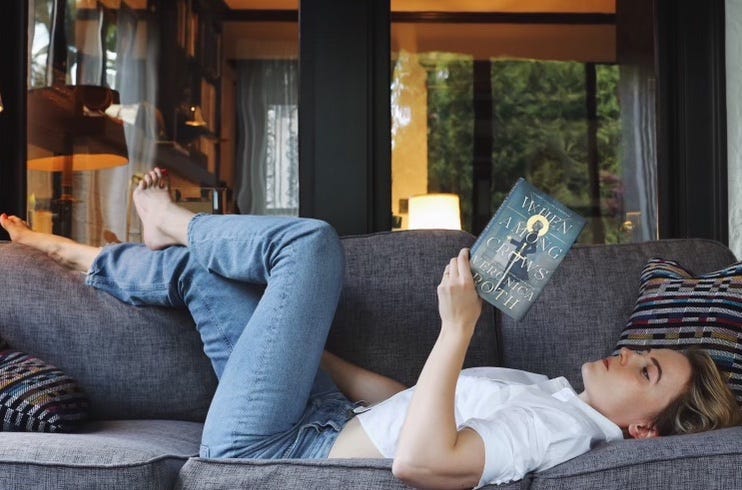
Okay, technically When Among Crows came out last week here in the States (and slightly later in the UK), but given the contents of this newsletter, I thought it might be better to wait until the book had some time to settle in before sending it out.
When I turned in the rough draft of When Among Crows, it started one scene earlier than it does in the final draft. I realized I could just start with Dymitr trying to pick the mythical fern flower, instead of starting with a wiła* and otherworldly blessings, as I do below. So if you haven’t read the book yet, don’t worry, this scene won’t spoil you— call it a prologue, if you like.
*you may be more familiar with this creature as a “vila” or “veela"; wiła is the Polish spellingThanks for reading Veronica Roth! Subscribe for free to receive new posts and support my work.
Before I get to that, though, I want to call your attention to some other goodies that have popped up in the last week:
There’s a When Among Crows playlist up on Largehearted Boy, with my commentary.
I recorded two episodes with the SFF Addicts podcast, one that’s more of a regular interview and one that’s a little class on outlining for disorganized people (“sloppy outlining,” I call it).
When Among Crows got a starred review from Booklist, a great review from the Associated Press, and it’s an Indie Next List pick for June! Hooray!
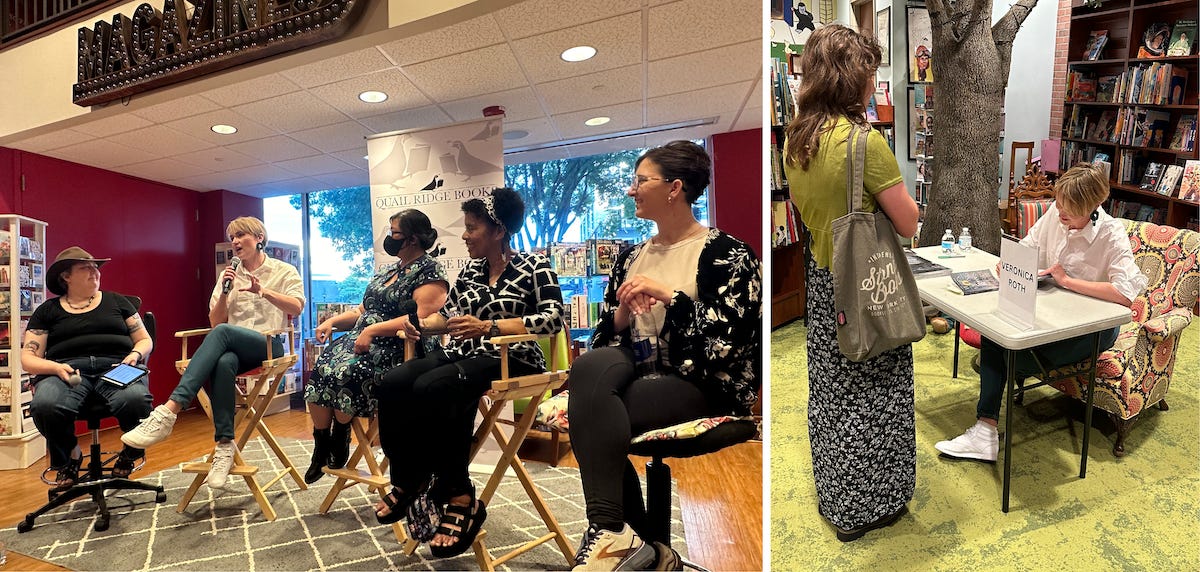
Also, a huge thank you to everyone who came out to the events last week with me, Andrea Hairston, Nghi Vo, and Rebecca Thorne. They were all such special experiences and conversations— with amazing moderators in TJ Klune, Jacqueline Carey, Christopher Buehlman, T. Kingfisher, and P. Djeli Clark— and we had a wonderful time meeting all of you.
Okay! Prologue time! Enjoy!
In Edgebrook Woods, about a half-hour's drive from the Loop, a group of wiły links arms and trips, laughing, around a fire.
Their voices, raised in song, are unearthly, echoing again and again even here in the open air of the forest preserve, and if there were mortals anywhere near, the sound would give them the sudden urge to get as far away as possible — but there are no mortals anywhere near, at least not any that weren't invited.
Not at 10:30PM on Kupala Night.
As a general rule, wiły don't care one way or another about humanity, but sometimes humans provide useful entertainment, particularly when enchanted. So the sight of a tall man walking in the shadows behind the linked elbows, just out of reach of the firelight, doesn't draw any particular attention.
They're near a pond, which means there are rusałki, too, sallow-faced and greenish cousins of the wiły; and they're hemmed in by trees — oak and pine and maple — which means a leszy, stag horns casting odd shadows on the forest floor and even, lingering in the trees with her wings folded back, a shy alkonost.
The wiły closest to the man separate, the more youthful of the two smiling at him and gesturing him toward the fire.
"Prove your worth," she says to him. "Leap over the flames."
Her voice is teasing, and it also isn't. Whim brings mortals to the wiła fire on Kupala Night, and whim can just as easily send them away. The man seems to understand this. He bends his head to her, a smile curling his mouth, and as the song swells to a spine-shivering crescendo, he does as he's told: he breaks into a run and launches himself over the bonfire. He is young and strong, but the flames still lick the soles of his boots on his descent.
 photo by: Valentyn Ogirenkocourtesy of: Reuters/The Atlantic
Still, he lands on light feet on the other side. When he turns back to look at the wiła who bade him jump, she's smiling.
"Well done," she says, as her sisters sing that haunting melody. "Now you may dance with me."
She presents it like a privilege, though it's a curse. She's a wiła, which means her dancing is a trap to the short-lived and the ordinary.
She appears to be younger than the others, with her full cheeks kissed by the sun, her fine strawberry blonde hair brushing her elbows, her crown of leaves and flowers hanging heavy over her brow—but when she raises her hands to him, the rest of the group pairs off to dance even though their singing continues, as if she's their leader. The leszy joins in the revelry, finding a wiła to box step stiffly with, though he's so tall that he has to reach down to clasp her hands. The alkonost, high on her perch, taps a drum with her taloned toes.
The mortal man takes the wiła's hands, and lets her lead him in a dance. His hands are sure, his fingers laced with hers, and his feet find the steps in time, driven not by his own knowledge or grace but by the force of her magic. He will be bound to these steps until she chooses to release him.
"You aren't afraid?" she says, passing a cold hand over his brow.
He offers her the same small smile he gave when she told him to leap over the fire. "Should I be?"
"Greater men than you have died dancing on this very night."
"I don't believe you wish me dead.”
She laughs, a deep, echoing laugh that reveals more of her age than her freckled face.
"Tell me, you who presumes to know my wishes," she says. "What is it I want from you?"
He shrugs a little, and the firelight plays over his face. His eyes— a gentle gray, the color of silver brunia — catch the flames.
"I think you'd like me to seek the fern flower," he says. "Rumored to be carried from our homeland to these woods, long ago."
"Not so long ago, to those who aren't bound by time." She tilts her head, and turns them, swiftly, to dizzy him. "But it's an easy guess. Most mortals who come to this fire wish to find the fern flower, and my kind are forbidden to look for it."
He inclines his head in acknowledgment. "But am I correct?"
"A mortal can have more than one use," she says, and a cruel smile twists her mouth — a little too wide and a little too sharp, making her resemble her rusałki cousins more than usual. "I will enjoy watching you dance yourself exhausted, first."
He's bewitched. It's the only way to account for the slow, lazy smile that returns her own; the way he reacts to the strangeness in her face without alarm.
"Since I am to be useful to you, my lady," he says. "Maybe you would consider giving me a gift."
She continues to steer him around the fire. Over his shoulder, she sees the silhouette of the alkonost's wings against the moon. She sees the leszy's antlers catching a wiła's tight curl as he bends to watch their feet.
"A gift of what?" she says.
"A simple token," he replies. "A sprig of wild wormwood from your crown."
 photo by: tengyartcourtesy of: Unsplash
Her eyes sharpen, but it's a simple enough request, one that won't take anything dear from her. And she'd rather have him caught up in revelry than soured by rejection. So she pinches the plain weed flower where it tangles with fern leaves and daisies in her heavy crown. She tugs it free, and tucks it behind his ear, so it hangs over his cheekbone, pale and delicate.
His answering grin is a flash of teeth in the dark.
And then his feet still, and he releases her, of his own accord.
She catches him by the wrist before he can move away, gripping him with inhuman strength.
"What are you?" she demands, in a deep voice like the rumble of the earth. "Why did you come here?"
"I came for the blessing of the flames," he says. "And the free gift of protective wormwood. That's all."
He brings his wrist — and her hand — to his lips, to lay a kiss on her knuckles.
"Thank you for your generosity," he says.
"It is unwise to anger a wiła," she replies, sharply.
"Oh, I know," he says. "But it's hardly the least wise thing I will do tonight."
He clamps his free hand around her arm, and with inhuman strength to match hers, forces her to release him.
Then he disappears into the shadows of the forest preserve, and he's gone.
Get your copy of When Among Crows and follow Dymitr’s journey from Kupala Night and beyond.
Thanks for reading Veronica Roth! Subscribe for free to receive new posts and support my work.
March 15, 2024
WHEN AMONG CROWS Event Dates!
When Divergent first came out back in 2011, my publisher sent me on a tour with four other authors who were also publishing YA science fiction and fantasy, and it was great. Not only did I get to spend some time with my (brand new!) peers, but the events were so much fun— they introduced a few books at once to curious readers, and generated interesting discussions about writing and genre and craft that were distinct in each city we visited.
So trust me when I say I’m pretty damn thrilled to be touring with other authors again— this time three fantastic (see what I did there) fantasy authors: Andrea Hairston, Rebecca Thorne, and Nghi Vo, for the VOYAGE INTO GENRE LIVE TOUR! And we’re joined by some pretty spectacular moderators, too.
 THE STOPS
✨ May 13 - SEATTLE, WA - 7:00 PM • RSVP Here
Third Place Books @ Lake Forest Park location
Moderated by TJ Klune (Somewhere Beyond the Sea)
✨ May 14 - GRAND RAPIDS, MI - 6:30 PM • RSVP Here
Schuler Books
Moderated by Jacqueline Carey (Cassiel’s Servant)
✨ May 15 - CINCINNATI, OH - 7:00 PM • RSVP Here
Joseph-Beth Booksellers
Moderated by Christopher Buehlman (The Daughters’ War)
✨ May 16 - RALEIGH, NC - 7:00 PM • RSVP Here
Quail Ridge Books
Moderated by T. Kingfisher (A Sorceress Comes to Call)
✨ May 17 - NEW YORK, NY - 7:30 PM • RSVP Here
Greenlight Books @ St. Joseph’s College
Moderator: P. Djèlí Clark (The Dead Cat Tail Assassins)
Presented by Tor Publishing Group and Literary Hub.
THE BOOKS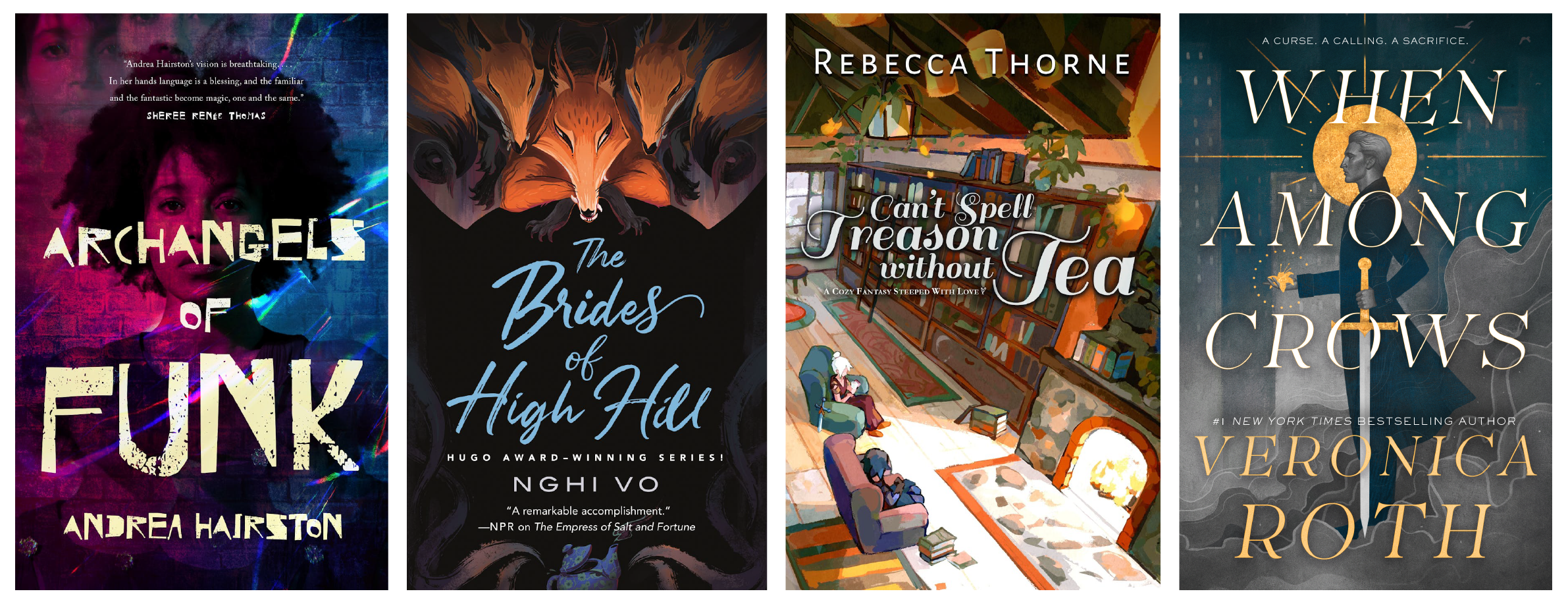
Andrea Hairston’s ARCHANGELS OF FUNK,
Nghi Vo’s THE BRIDES OF HIGH HILL,
Rebecca Thorne’s CAN’T SPELL TREASON WITHOUT TEA,
And from yours truly, WHEN AMONG CROWS.
The beauty of it all is that I don’t know what we’re going to talk about just yet– you’ll have to come and see! (And I believe at least one event will be recorded, so if you don’t live anywhere near these stops, you may still get to eavesdrop on one– more on that later.) But I do know that for my part, I will likely be talking about the following:
Swords!
Polish folklore and the Baba Jaga of it all
The allure of contemporary fantasy
Chicago vibes, again, but this time with magic
The saddest man in the world AKA Dymitr, the main character of When Among Crows
If you can’t make it to any of the events, you can still pre-order WHEN AMONG CROWS at Bookshop.org, Barnes & Noble, Books-A-Million, or Amazon.
Hope to see you in May!
-V
December 7, 2023
Book Recs for Very Specific Moods
I read some books this year. Here are some of my favorites.
*Where marked, what I actually read this year was the sequel or even the entire series, but I’m just recommending the first book because I’m assuming you’re not gonna start in the middle.Just Tell Me What’s Good for MeDon’t ask questions, just read these and thank me later.
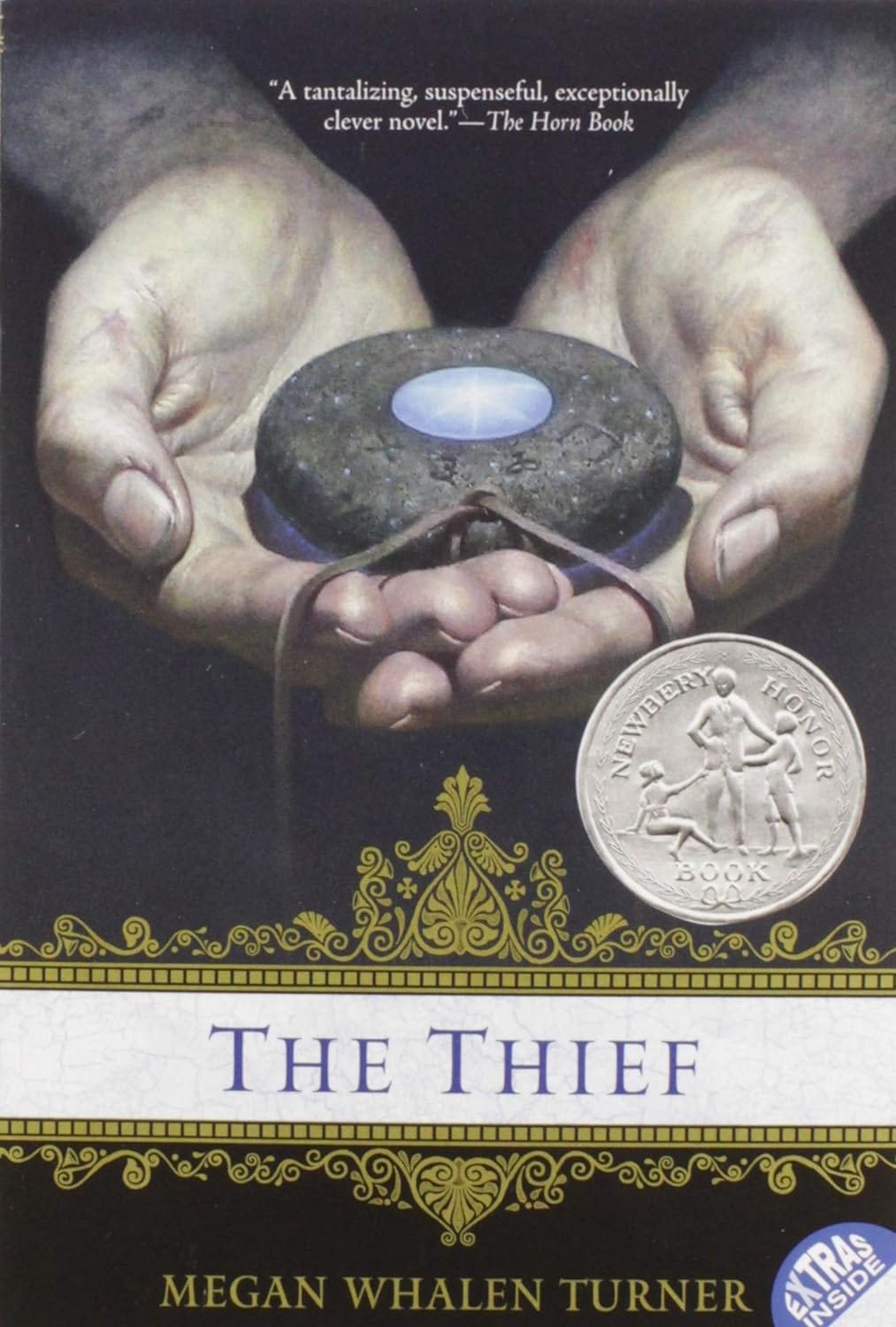
The Thief by Megan Whalen Turner
The king’s scholar, the magus, believes he knows the site of an ancient treasure. To attain it for his king, he needs a skillful thief, and he selects Gen from the king’s prison. The magus is interested only in the thief’s abilities. What Gen is interested in is anyone’s guess. Their journey toward the treasure is both dangerous and difficult, lightened only imperceptibly by the tales they tell of the old gods and goddesses.If you’ve been paying attention to social media you know these books made me lose my shit. This year for Christmas I’m giving them to a fourteen-year-old girl and a woman in her thirties and I feel sure they will both love them.
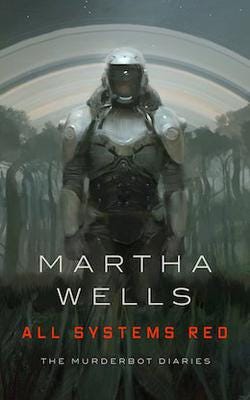
*The Murderbot Diaries (series of novellas) by Martha Wells
In a corporate-dominated space-faring future, planetary missions must be approved and supplied by the Company. For their own safety, exploratory teams are accompanied by Company-supplied security androids. But in a society where contracts are awarded to the lowest bidder, safety isn’t a primary concern.On a distant planet, a team of scientists is conducting surface tests, shadowed by their Company-supplied ‘droid--a self-aware SecUnit that has hacked its own governor module and refers to itself (though never out loud) as “Murderbot.” Scornful of humans, Murderbot wants is to be left alone long enough to figure out who it is, but when a neighboring mission goes dark, it's up to the scientists and Murderbot to get to the truth.
Recommending these books is like recommending ice cream; I almost don’t feel like I need to do it because duh, who doesn’t like ice cream? (I know, I know, some people don’t. But we do not speak of them here.) Anyway they’re excellent, funny, sometimes heart-breaking (poor Murderbot!) and the audiobooks are particularly good.
I Just Really Want to Spend Time ThereNot sure how a book can feel cozy when people are getting murdered or there are literal monsters afoot, but these do.
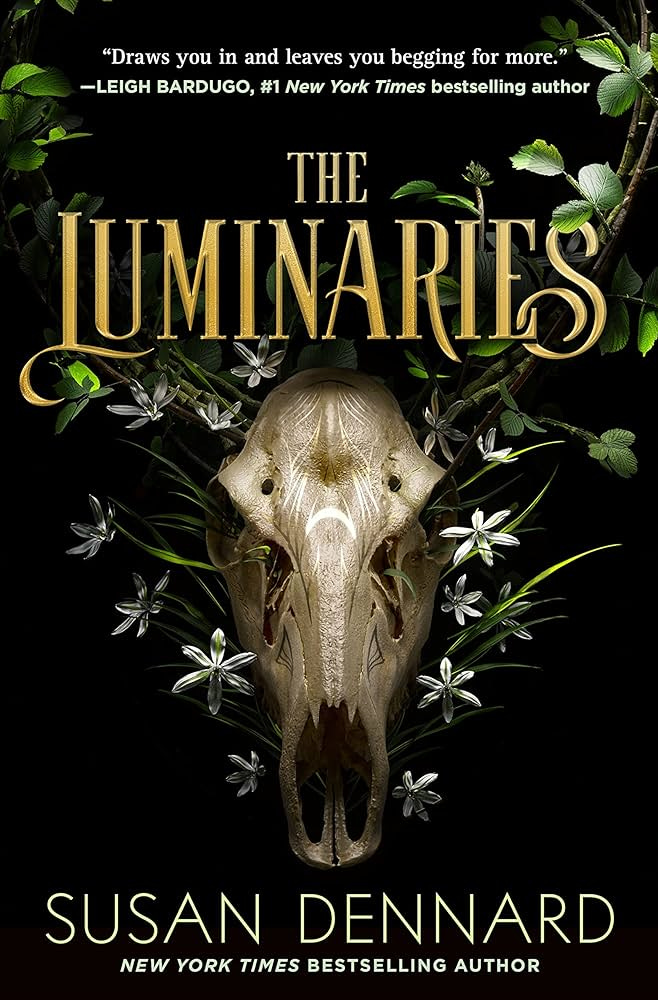
*The Luminaries by Susan Dennard
Hemlock Falls isn't like other towns. You won't find it on a map, your phone won't work here, and the forest outside town might just kill you.Winnie Wednesday wants nothing more than to join the Luminaries, the ancient order that protects Winnie's town—and the rest of humanity—from the monsters and nightmares that rise in the forest of Hemlock Falls every night.
Ever since her father was exposed as a witch and a traitor, Winnie and her family have been shunned. But on her sixteenth birthday, she can take the deadly Luminary hunter trials and prove herself true and loyal—and restore her family's good name. Or die trying.
But in order to survive, Winnie enlists the help of the one person who can help her train: Jay Friday, resident bad boy and Winnie’s ex-best friend. While Jay might be the most promising new hunter in Hemlock Falls, he also seems to know more about the nightmares of the forest than he should. Together, he and Winnie will discover a danger lurking in the forest no one in Hemlock Falls is prepared for.
These books are set in a fictional town that’s very insular, so there’s a kind of warm, lived-in feeling to them despite the constant creep of danger. Also the “a long time ago, we used to be friends” vibe of Winnie and her ex-friends contributes to that feeling of history. Kudos to Susan Dennard, because building that kind of feeling— that a place has existed long before the first page of the story— is not easy.
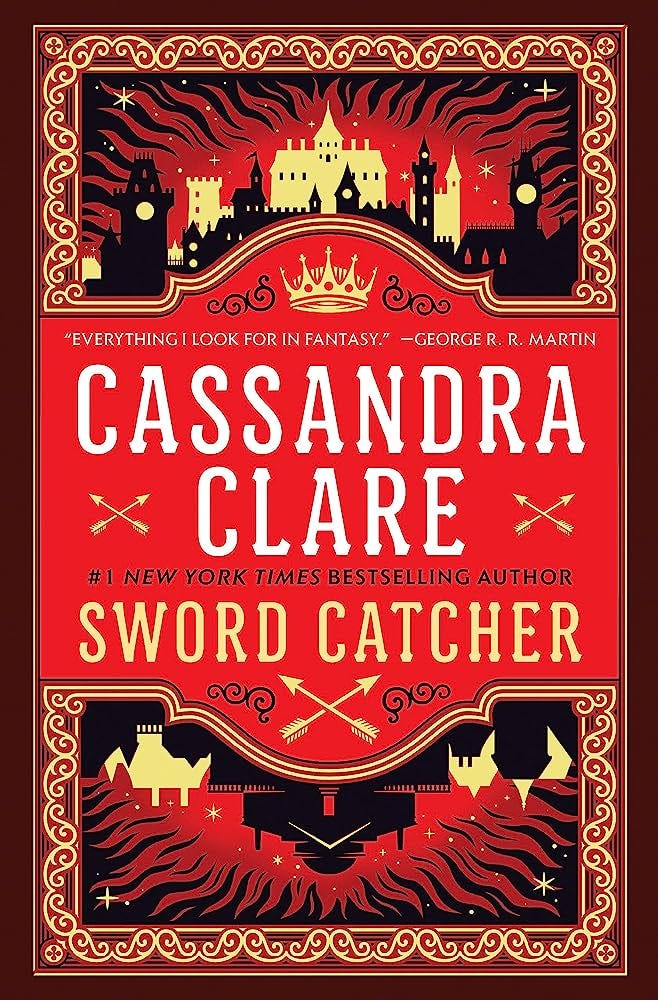
Sword Catcher by Cassandra Clare
Kel is an orphan, stolen from the life he knew to become the Sword Catcher—the body double of a royal heir, Prince Conor Aurelian. He has been raised alongside the prince, trained in every aspect of combat and statecraft. He and Conor are as close as brothers, but Kel knows that his destiny is to die for Conor. No other future is possible.Lin Caster is one of the Ashkar, a small community whose members still possess magical abilities. By law, they must live behind walls within the city, but Lin, a physician, ventures out to tend to the sick and dying of Castellane. Despite her skills, she cannot heal her best friend without access to forbidden knowledge.
After a failed assassination attempt brings Lin and Kel together, they are drawn into the web of the mysterious Ragpicker King, the criminal ruler of Castellane’s underworld. He offers them each what they want most; but as they descend into his world of intrigue and shadow, they discover a conspiracy of corruption that reaches from the darkest gutters of Castellane to the highest tower of its palaces.
One of the nice things about an author transitioning from YA works to adult is that they tend to give themselves permission to settle into a world a lot more; this one is lush and I really enjoyed being there. It was like that whole section of the Witcher 3 where you first get to Novigrad, aka my favorite section.
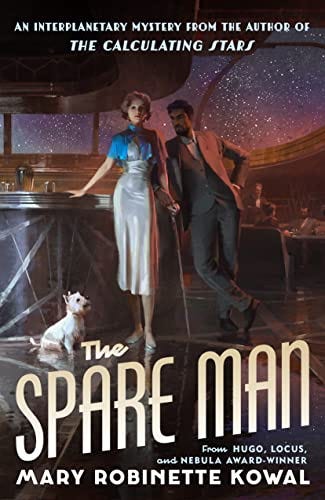
The Spare Man by Mary Robinette Kowal
Tesla Crane, a brilliant inventor and an heiress, is on her honeymoon on an interplanetary space liner, cruising between the Moon and Mars. She’s traveling incognito and is reveling in her anonymity. Then someone is murdered and the festering chowderheads who run security have the audacity to arrest her spouse. Armed with banter, martinis and her small service dog, Tesla is determined to solve the crime so that the newlyweds can get back to canoodling—and keep the real killer from striking again.CAN WE PLEASE GET A CRUISE THROUGH SPACE IN MY LIFETIME. I will see you all at the pool. But I guess in the meantime, this book will let me go there in my mind. It’s a murder mystery, it’s in space, there are cocktail recipes scattered throughout— this book is a puzzle set in a place you’ll wish existed.
Thanks for reading Veronica Roth! Subscribe for free to receive new posts and support my work.
Earth Is Trash, Space Sounds NiceDo I really need to explain this sentiment?
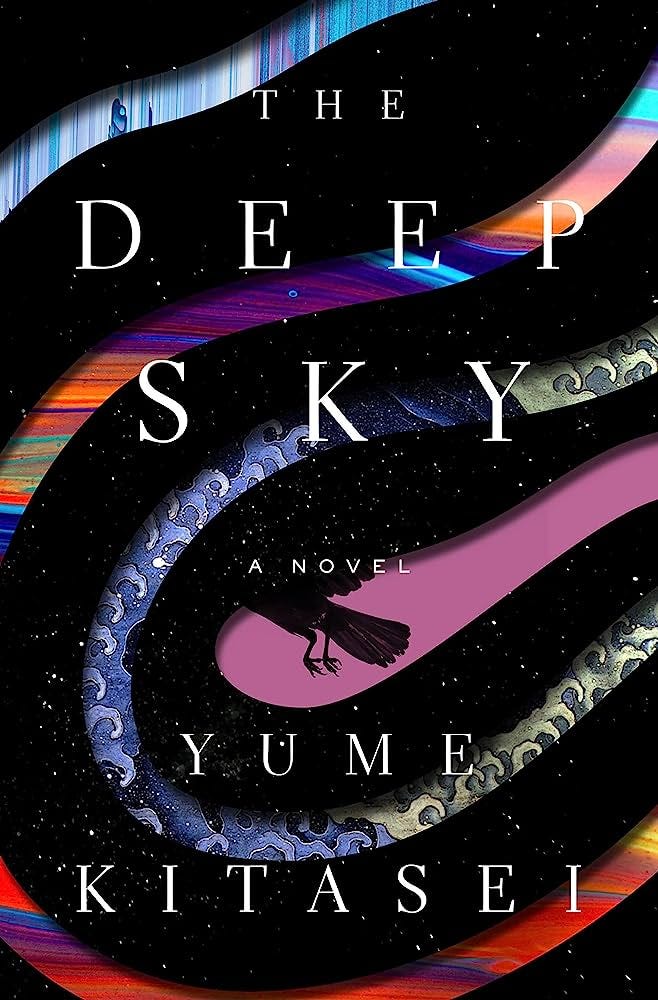 They left Earth to save humanity. They’ll have to save themselves first.
It is the eve of Earth’s environmental collapse. A single ship carries humanity’s last hope: eighty elite graduates of a competitive program, who will give birth to a generation of children in deep space. But halfway to a distant but livable planet, a lethal bomb kills three of the crew and knocks The Phoenix off course. Asuka, the only surviving witness, is an immediate suspect.
Asuka already felt like an impostor before the explosion. She was the last picked for the mission, she struggled during training back on Earth, and she was chosen to represent Japan, a country she only partly knows as a half-Japanese girl raised in America. But estranged from her mother back home, The Phoenix is all she has left.
With the crew turning on each other, Asuka is determined to find the culprit before they all lose faith in the mission—or worse, the bomber strikes again.
The best kind of locked-room mystery is the one where, outside of said “locked room,” you will lit’rally die in the vacuum of space. I actually had to stop listening to this on audiobook and rustle up an old ARC because the audio just was not fast enough.
 The Divide.
It’s the edge of the universe.
Now it’s collapsing—and taking everyone and everything with it.
The only ones who can stop it are the Sentinels—the recruits, exiles, and court-martialed dregs of the military.
At the Divide, Adequin Rake commands the Argus. She has no resources, no comms—nothing, except for the soldiers that no one wanted. Her ace in the hole could be Cavalon Mercer--genius, asshole, and exiled prince who nuked his grandfather's genetic facility for “reasons.”
She knows they’re humanity's last chance.
I’m sure J.S. Dewes is tired of this comparison, but if you ever played Mass Effect and loved it and wished you could just kind of live in that story forever, these books will scratch that itch without being too similar. It was action-packed with lovable characters and I pretty much immediately read the second one after the first was done, which is rare for me.
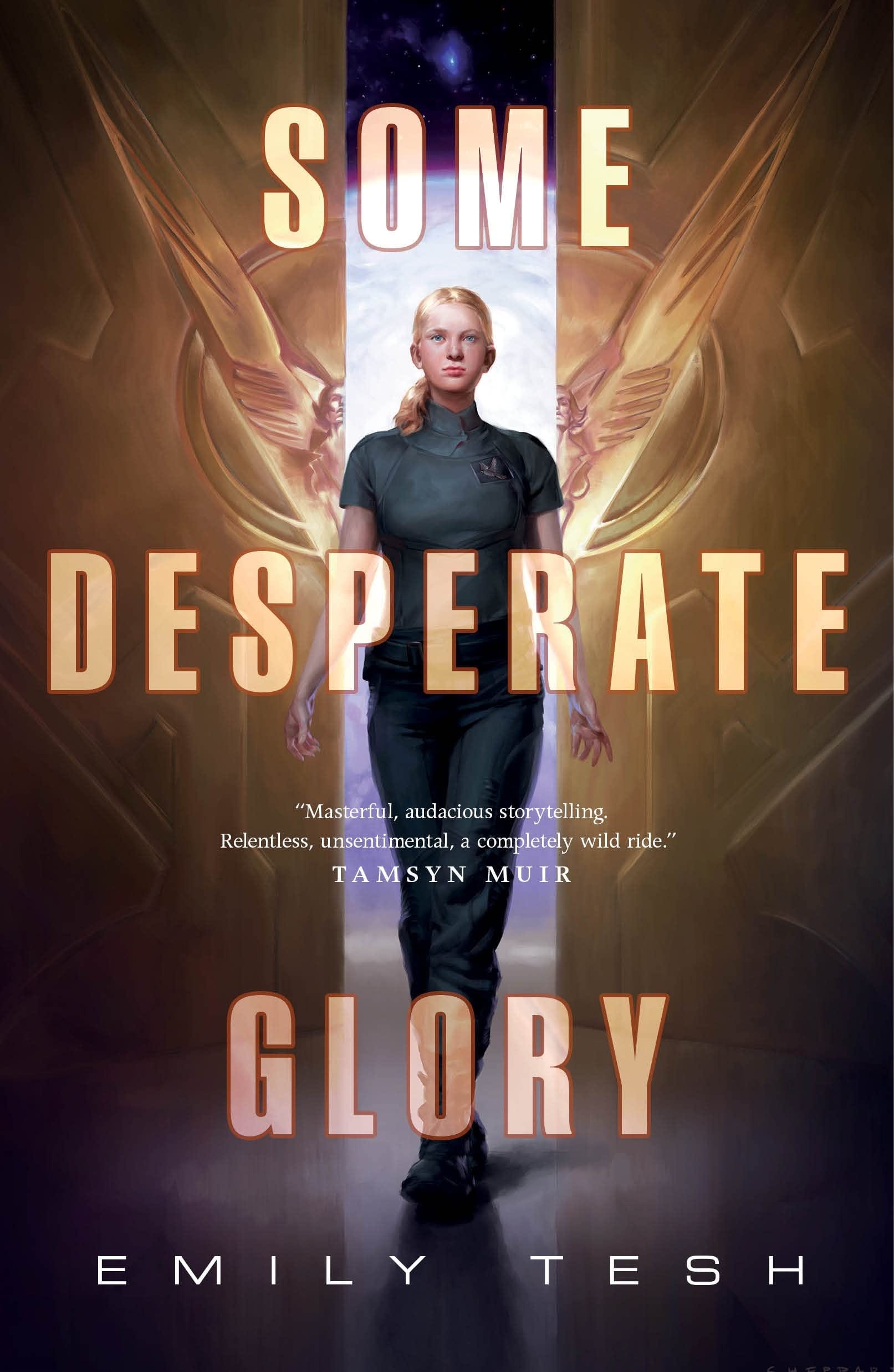
Some Desperate Glory by Emily Tesh
All her life Kyr has trained for the day she can avenge the murder of planet Earth. Raised in the bowels of Gaea Station alongside the last scraps of humanity, she readies herself to face the Wisdom, the all-powerful, reality-shaping weapon that gave the Majoda their victory over humanity.They are what’s left. They are what must survive. Kyr is one of the best warriors of her generation, the sword of a dead planet. But when Command assigns her brother to certain death and relegates her to the nursery to bear sons until she dies trying, she knows she must take humanity’s revenge into her own hands.
Alongside her brother’s brilliant but seditious friend and a lonely, captive alien, she escapes from everything she’s ever known into a universe far more complicated than she was taught and far more wondrous than she could have imagined.
This book is about someone getting out of a cult, basically, only the cult is in space and is wrapped around the worship of Earth. Kyr’s POV is claustrophobic in the best way, and I enjoyed watching her see through the haze in her mind more and more as the story progressed.
I Just Want to Watch A Good Person Do WellAnd if a part of you is like “goblins, though?” just tell that part to stfu.
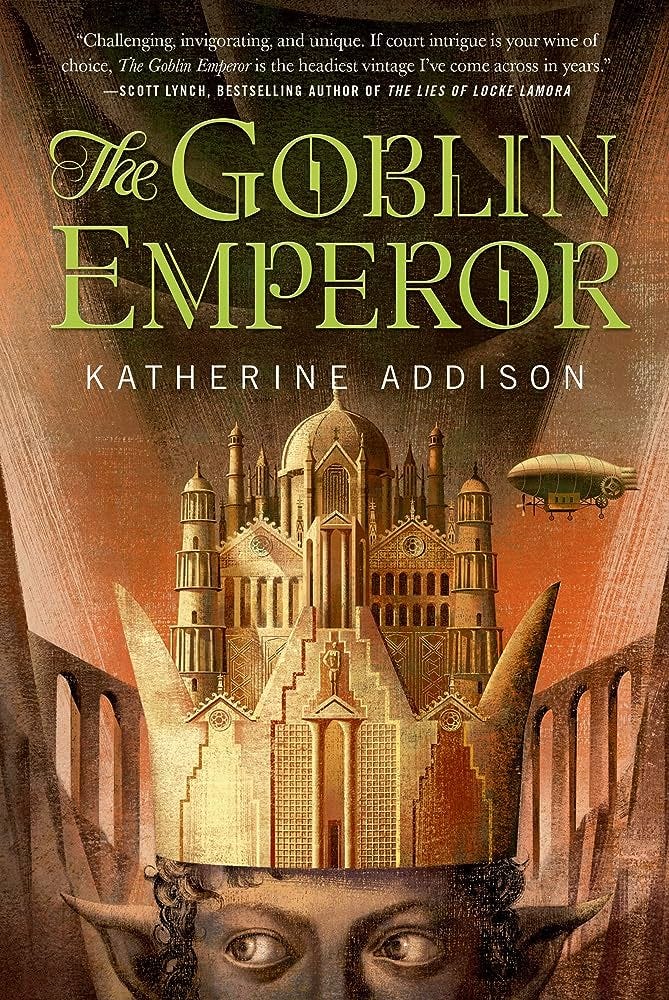
Goblin Emperor by Katherine Addison
The youngest, half-goblin son of the Emperor has lived his entire life in exile, distant from the Imperial Court and the deadly intrigue that suffuses it. But when his father and three sons in line for the throne are killed in an "accident," he has no choice but to take his place as the only surviving rightful heir.Entirely unschooled in the art of court politics, he has no friends, no advisors, and the sure knowledge that whoever assassinated his father and brothers could make an attempt on his life at any moment.
Surrounded by sycophants eager to curry favor with the naïve new emperor, and overwhelmed by the burdens of his new life, he can trust nobody. Amid the swirl of plots to depose him, offers of arranged marriages, and the specter of the unknown conspirators who lurk in the shadows, he must quickly adjust to life as the Goblin Emperor. All the while, he is alone, and trying to find even a single friend... and hoping for the possibility of romance, yet also vigilant against the unseen enemies that threaten him, lest he lose his throne – or his life.
I confess that I didn’t really understand the appeal of “cozy fantasy” until I read this book. (No shade, this is just how I’m wired.) It helps that this story isn’t nonstop good vibes— my mind does not trust nonstop good vibes— but it’s about a good person navigating a complicated political situation and ultimately succeeding through his innate goodness, and I really could have just kept reading it forever.
Me & A Friend Wanna Screech At Each Other in the Text ChainHAVE YOU GOTTEN TO THE PART WHERE—
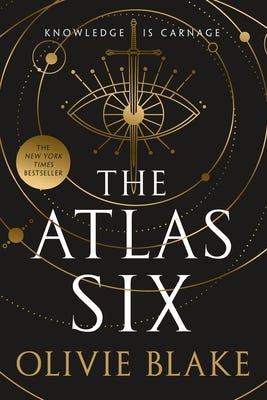
*The Atlas Six by Olivie Blake
The Alexandrian Society, caretakers of lost knowledge from the greatest civilizations of antiquity, are the foremost secret society of magical academicians in the world. Those who earn a place among the Alexandrians will secure a life of wealth, power, and prestige beyond their wildest dreams, and each decade, only the six most uniquely talented magicians are selected to be considered for initiation.Enter the latest round of six: Libby Rhodes and Nico de Varona, unwilling halves of an unfathomable whole, who exert uncanny control over every element of physicality. Reina Mori, a naturalist, who can intuit the language of life itself. Parisa Kamali, a telepath who can traverse the depths of the subconscious, navigating worlds inside the human mind. Callum Nova, an empath easily mistaken for a manipulative illusionist, who can influence the intimate workings of a person’s inner self. Finally, there is Tristan Caine, who can see through illusions to a new structure of reality—an ability so rare that neither he nor his peers can fully grasp its implications.
When the candidates are recruited by the mysterious Atlas Blakely, they are told they will have one year to qualify for initiation, during which time they will be permitted preliminary access to the Society’s archives and judged based on their contributions to various subjects of impossibility: time and space, luck and thought, life and death. Five, they are told, will be initiated. One will be eliminated. The six potential initiates will fight to survive the next year of their lives, and if they can prove themselves to be the best among their rivals, most of them will.
It was the sequel that I read this year, but like, have you read the Atlas Six yet? It’s basically CHOOSE YOUR FIGHTER: intense annoying girl that you either knew or were yourself in college, or possible-sociopath-with-a-conscience, or irritable plant lady who just wants to be left alone (Reina, are you me?). And it’s also WHO’S GONNA MAKE OUT WITH WHO, in the best way, and the answers will surprise you. Seriously, read this with a friend; I screamed at my friend Laurie when I read this and it really enhanced the experience.
Your classic “orphan plucked from obscurity by a wealthy benefactor attends a fancy school” story, except then SHIT. GETS. WILD.
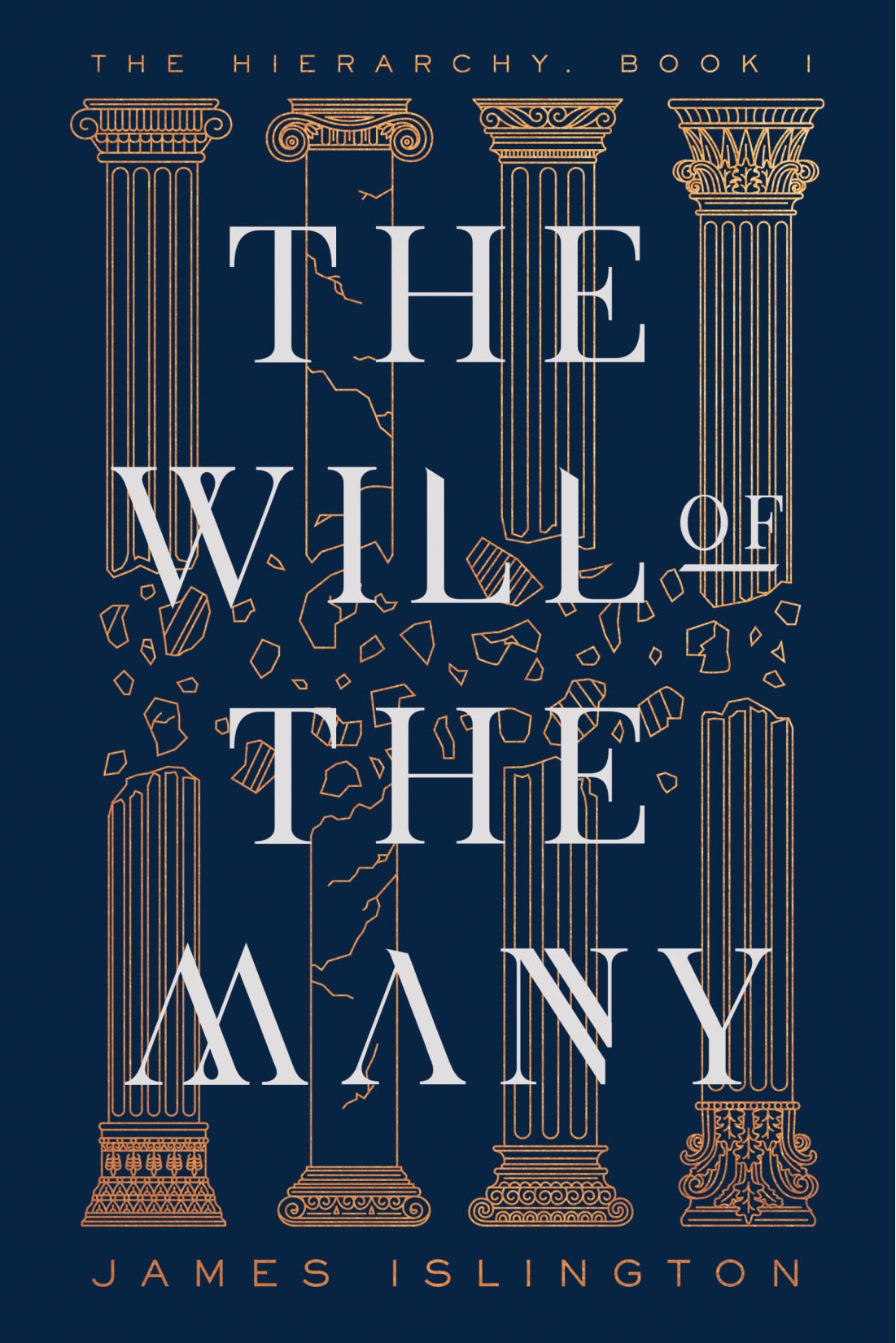
The Will of the Many by James Islington
The Catenan Republic—the Hierarchy—may rule the world now, but they do not know everything.I tell them my name is Vis Telimus. I tell them I was orphaned after a tragic accident three years ago, and that good fortune alone has led to my acceptance into their most prestigious school. I tell them that once I graduate, I will gladly join the rest of civilised society in allowing my strength, my drive and my focus—what they call Will—to be leeched away and added to the power of those above me, as millions already do. As all must eventually do.
I tell them that I belong, and they believe me.
But the truth is that I have been sent to the Academy to find answers. To solve a murder. To search for an ancient weapon. To uncover secrets that may tear the Republic apart.
And that I will never, ever cede my Will to the empire that executed my family.
To survive, though, I will still have to rise through the Academy’s ranks. I will have to smile, and make friends, and pretend to be one of them and win. Because if I cannot, then those who want to control me, who know my real name, will no longer have any use for me.
And if the Hierarchy finds out who I truly am, they will kill me.
There are a lot of familiar beats here— that’s not a criticism, because it can be a real pleasure to know where you’re going in a book and then to put yourself in the hands of a capable author to go there— but what it’s building toward, world-building wise, and how…is a real joy. I am so, so interested in where the sequel will go.
I Need to Have Something In Common with My DadListen: it was published in 1989 and you gotta be ready for some old school sci fi vibes, but it blew my mind a little. I probably just made a science fiction enthusiast shudder with horror at that description.
 On the world called Hyperion, beyond the law of the Hegemony of Man, there waits the creature called the Shrike. There are those who worship it. There are those who fear it. And there are those who have vowed to destroy it. In the Valley of the Time Tombs, where huge, brooding structures move backward through time, the Shrike waits for them all. On the eve of Armageddon, with the entire galaxy at war, seven pilgrims set forth on a final voyage to Hyperion seeking the answers to the unsolved riddles of their lives. Each carries a desperate hope—and a terrible secret. And one may hold the fate of humanity in his hands.
I wouldn’t recommend this to just anyone— you have to be someone who is so enamored of science fiction and fantasy world-building that you’re willing to just surrender to an entire book’s worth of it. But this book is brilliant (coldest take ever; its brilliance is well known). It’s structured like the Canterbury Tales in that it’s a group of people on a journey, each of whom tells a story, and the way their stories build on each other, fleshing out other parts of the world but also piecing together a mystery, is really interesting and satisfying.
What to Add To Your TBRI mean, it’s my newsletter. May 14th, people!
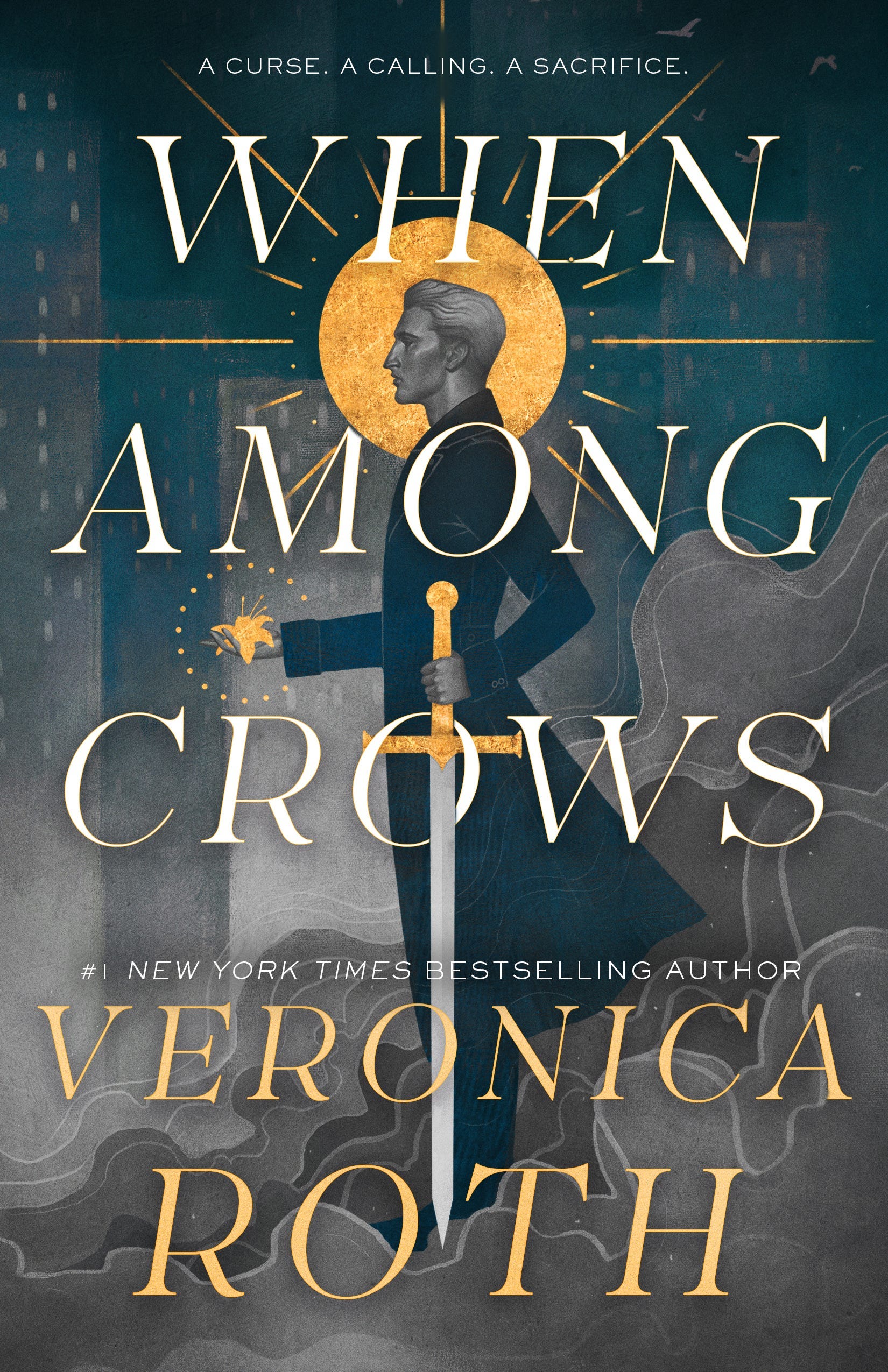
When Among Crows by Veronica Roth
Step into a city where monsters feast on human emotions, knights split their souls to make their weapons, and witches always take more than they give.Pain is Dymitr’s calling. To slay the monsters he’s been raised to kill, he had to split his soul in half to make a sword from his own spine. Every time he draws it, he gets blood on his hands.
Pain is Ala’s inheritance. When her mother died, a family curse to witness horrors committed by the Holy Order was passed onto her. The curse will claim her life, as it did her mother’s, unless she can find a cure.
One fateful night in Chicago, Dymitr comes to Ala with a bargain: her help in finding the legendary witch Baba Jaga in exchange for an enchanted flower that just might cure her. Desperate, and unaware of what Dymitr really is, Ala agrees.
But they only have one day before the flower dies . . . and Ala's hopes of breaking the curse along with it.
Trust me. You’ll love it.
Thanks for reading Veronica Roth! Subscribe for free to receive new posts and support my work.
November 2, 2023
Curiosity and Fear
When I remember my dreams, they’re always about bugs.
Specifically, they’re about infestations of bugs, or swarms of bugs. Usually it goes a little something like this: I’m sitting on the sofa, doing something mundane, and I pick up a pillow. Clinging to its underside are hundreds of insects. I am then obligated to rid my house of the infestation, but I’m unable to contend with the sheer number of them. I wake up somewhere in the middle of a frantic struggle against this repulsive and irrepressible force.
I’m never frightened in the dream, not the way I’d be if I were being chased by an axe murderer. I’m just overwhelmed and horrified. That’s how I know this recurring dream— which I’ve dealt with for most of my adolescent and adult life— is a stress dream. There is no situation more stressful to me than this: unseen and ill-intentioned creatures filling all the empty cracks of my life, to be discovered at random.
The origin of this is easy enough to pinpoint in my childhood: when I was a kid, we had an infestation of millipedes in our house. The pest control guy my mother hired told her there wasn’t a whole hell of a lot we could do about it: millipedes sometimes move in big swarms, and if your house happens to be in their path, the most you can do is caulk the living crap out of your exterior to force them to move around you instead of through you, and wait for them to pass.
Still, I avoided our basement for about a year. If I did go down there, there were always curled-up millipede corpses scattered along all the walls and in the corners. We kept the vacuum down there to suck them up as soon as we found them, but even my mother— my intensely neat, organized mother who has never met a label maker she doesn’t love or a tub she couldn’t find a use for— couldn’t stay on top of the sheer number of them. One morning, after caulking the living crap out of the exterior basement door, she woke up to discover a welcome-mat sized sea of them fighting to get into our house.
For the record, I still don’t like basements.
Despite the fact that spiders, specifically, were never a huge problem for us (or any other bug other than that one absurd infestation), spiders feature regularly in my dreams. It’s because of how they move. Precise and many-legged, they appear to wiggle, but they’re faster than that word implies. There are few things as sudden as a spider.
I’m not usually a dramatic person. I’m comfortable with public speaking, when I get hurt I’m pretty quiet about it, and on one notable occasion in my adolescence, I rolled my mother’s Chevy Blazer on a patch of black ice and called her while upside down in the driver’s seat, only to inform her, levelly, that I was upside down on a nearby road and would need her to come pick me up.
But at the sight of a spider, I used to shriek, and shudder, and scream for my husband to kill it. None of this was melodrama— I was actually too afraid to do it myself.
In the summer of 2020, after we’d been locked down for months in fear of a virus we didn’t understand, as my wounded feelings about a book release thwarted by said lockdowns were starting to fade, I noticed a huge spider web stretched between one of our big planters and the arbor vitae tree next to it. It was wheel-shaped, with perfect unbroken lines of silk. Perched in the middle of it was a reddish brown spider the size of a black bean. It looked, I thought, almost like a crab.
 (from 2020)
Seeing it, I remembered with shame the last time I encountered this type of spider, in a similar web, between two trees that I regularly had to pass by on my way to the back door of our house. I was so unsettled by it at that time that one day I went outside with a bottle of bleach spray to kill it, thinking the bleach would offer it a swift death. That’s not what happened.
When I sprayed it, that spider writhed in apparent agony, and I, horrified, knocked it to the ground to kill it properly.
I later looked it up to find out what type of spider it was, and found out that it was a harmless Orb Weaver. Gentle. “Only bites if provoked,” Google said. I almost cried. I was okay with killing spiders, but I never want to torment an innocent creature, even if they do haunt my dreams.
This one next to my front door was the same, and I had learned my lesson: I wasn’t going to kill this Orb Weaver.
Instead, I checked on it every morning when I let the dog out, watching it grow from bean-sized to nickel-sized to quarter-sized, so I could see the markings on its back. I looked it up and learned that it remade its beautiful web every single day, so each day it would be a slightly different shape and configuration. It became part of my routine: let dog out, check on spider, let dog in, make morning tea, eat breakfast.
I later learned that spiders are surprisingly clever, especially considering their pinhole-sized brains. Though we know they factor in a wide range of variables in building their webs— temperature, humidity, wind, silk supply— and make adjustments accordingly, we don’t know exactly how they make these evaluations. A spider can also navigate a maze.
They also use hydraulics to move. Their bodies are full of a blood-like substance called “hemolymph,” the varying pressure of which extends their legs or, receding, lets their legs naturally contract. This pressure is regulated by the cephalothorax (the “head” of the spider). The creepy wiggling that made my skin crawl was actually a marvel, the cephalothorax acting as a bellows to push fluid, lightning-quick, to the places where its pressure was most required.
Later that summer, I noticed another orb weaver on our back porch, right over our door. Instead of killing it, I trapped it in a glass and carried it to the arbor vitae. I was trembling the whole time.
I’ve seen a few different kinds of spiders around our house. There’s a zebra spider that lives near our kitchen sink, no larger than a grain of rice. I ushered a yellow sac spider away from our toilet the other day. Last week I watched a delicate cellar spider cross my path in our basement while doing a dead lift.
When I see them, I usually talk to them. “Well, that’s not a great place for you to be, is it?” or “Come on, let’s get you somewhere out of the way.” I catch them in glasses or try to get them to crawl on an old magazine so I can put them outside— or I just eyeball the one that lives in the corner of my shower, hoping it’ll stay where it is, because at no time is a spider more intimidating than when you’re naked.
It’s been years since I’ve knowingly killed a spider. I used to make fun of people like me, who escorted arachnids outside instead of just stomping on them. “This is my zone,” I used to say. “I’m fine with them if they stay in their zone, but the second they come into mine, it’s fair game to kill them.” I sneered at our neighbors when they said they got rid of the spiders behind their house by spraying soapy water.
So after a lifetime of “bug dreams,” as I call them, the only way I can explain this change of heart is with curiosity.
That pivotal spider summer, 2020, was a hard time. Weeks of watching the Covid death tolls climb and wiping down my mail with antibacterial wipes turned into a restless summer of protests and, for me, a heightened awareness of injustice in our society and my place in it. I’d spent months living my entire life on a computer, doing regular Zoom calls with my aging parents, visiting a friend’s island on Animal Crossing, and trying my best to promote a book on social media that no one could actually go into a store and buy. I was an exposed nerve, too aware of myself and the darkness of the world around me, and too uncertain about the future to feel anything but dread.
So when I saw that Orb Weaver next to my door, I think I just couldn’t bear to be harsh toward it. Instead, I decided to be interested in it. Curiosity yielded to wonder, as I marveled at these small, smart creatures that populated my yard and the century-old house that I live in. And wonder turned to a warm fondness. I can’t get rid of the primal instinct I have to recoil from them, which I think is probably a survival skill buried deep in my animal hindbrain. I’m not out there catching them in my hands like they’re fireflies— for one thing, that would scare the shit out of them; for another thing, it would scare the shit out of me.
But curiosity makes you gentler. And as I grow older, I think more about how easy it is to let your heart harden into a diamond, unchangeable and unassailable. It’s a protective instinct, like my fear of spiders— it helps you to survive the harshness of the world around you. But while it may serve you some of the time, it will also keep you from growing, from marveling, and from falling in love with something new. And that cost, in my opinion, is far too high.
So it feels like a small miracle, to soften toward something, to open myself up to it, and to let myself change.
A few weeks ago, when it was still warm, I noticed a spider web above our back door. “A spider friend,” I said to my husband, which is what I call them now. When we walked inside, he flipped on the porch light. “To help attract bugs for him,” he said.
Thanks for reading Veronica Roth! Subscribe for free to receive new posts and support my work.
September 25, 2023
"That Wouldn't Be in the Spirit of the Game": Three Deleted Divergent Moments
 (That amazing art from the ten year anniversary editions of the Divergent series is by Victo Ngai.)
As I’ve said before, I’m not someone who has a lot of deleted scenes lying around. First of all, when the Divergent series was coming out, the way to please accounts (“accounts” in this context means major book retailers) was to offer each of them exclusive content, so whatever deleted material I had was distributed among them. Though you can find it all together now in the ten year anniversary editions of Divergent, thankfully.
Second of all, I usually write “short” instead of long, meaning I add scenes as I revise instead of cutting them. So.
But I did reread the Divergent books recently, and it reminded me of a few bits and pieces I haven’t showed anyone before. (As far as I can recall, anyway.) They’re not long, but I do hope you enjoy them.
Before I start, though, I want to make sure you know I’m officially in my troll era.
veronicaroth A post shared by @veronicaroth
Sorry!
…Or am I?
Okay, now on to the main event. This first scene was a potential moment from Divergent. Before I decided on “Capture the Flag” as a Dauntless bonding activity, I played with the idea of a high-risk game of hide-and-seek. Ultimately I decided against it because while it presented some ~sultry possibilities (as you’ll see below), it didn’t have the team-building effect I was going for.
I walk carefully forward, pressing with the ball of my foot on the floor. I was on concrete a moment before, but now I am on something softer. Carpet. I stretch a hand to my left, and feel glass. A window, or a wall—either way, it can be my guide as I walk through this room.
My fingertips slide across the glass as I walk. Four wouldn’t hide along a wall. He wouldn’t make it that easy. I pull away from the wall and step forward, my hands outstretched. I know I must look stupid. If he’s in the room, he’s probably laughing at me. I stop, and let my hands fall. Do I hear suppressed laughter? Shaking shoulders, bursts of air, do I hear them?
I hear something. It has a rhythm like a heartbeat. Or like breaths—inhaling and exhaling. I move slowly toward it, angling my head toward the sound like that will make it easier to hear, only it doesn’t. My foot touches something hard. When I reach out to feel what it is, I realize it’s a piece of furniture, probably a desk, since we’re in what was an office building.
Inhale, exhale. I hope those aren’t my own breaths I’m hearing. I stop breathing for a few seconds to make sure, but the air in, air out sound is still there. Louder. I move faster toward it, eager to see if I’m right, and if I’ve won.
My face hits it first, and then my chest. It’s hard, but not as hard as a wall. I don’t move back, but my hands press to it, and find a contour, find cotton and beneath it, a muscle. Above it, a bone. A collarbone. A person.
Gasping, I step back, and immediately heat rushes into my cheeks.
“Guess you found me,” he says, and his voice is distinct— low and clear— so I know who he is. My face is so hot I press my palms to my cheeks to cool them. Four. Of course it’s Four.
“Why didn’t you say anything?” I demand.
His fingertips touch my cheekbones and slide up, under the blindfold, to lift it away from my eyes.
“Because that wouldn’t be in the spirit of the game,” he replies.
This next one is truly tiny: just two paragraphs from the start of Insurgent, when I thought I might tell the story partly in Caleb’s POV. This idea didn’t get very far, but I do like this glimpse of Caleb’s voice:
I pinpoint the star that shows us north: Polaris. Since the train traveled directly west of the city, we will have to walk north and east to reach the Amity compound. According to Polaris, we are. Whoever Tobias Eaton is, aside from someone who necks with my sister right in front of me, he is a skilled navigator, at least.
My knees ache, probably from the ten foot leap from train to rooftop outside the Dauntless compound, but there is no use complaining when two of our party have bullet wounds. I feel the ghost of my spectacles on my nose, though I abandoned them on the train. I was only Erudite for a few weeks, but they were formative weeks.
Finally, an alternate beginning to Insurgent where I tried out Tobias’s voice. (Can you tell I was having trouble figuring out how to write Insurgent?) If this scene has appeared somewhere else before, I’m sorry— it’s been awhile and I have trouble keeping track of what’s been released and what hasn’t.
I really enjoy this particular kind of moment: wherein a child gets the chance to show their parent that they’ve changed or grown. Here it’s a bit complicated, though, because…Marcus sucks.
Ultimately I decided not to include any other POVs in Insurgent, but I do like Tobias’s voice. The difference between him and Tris is admittedly more subtle than I was going for, but he indulges in poetic descriptions more often, and it’s nice.
I search the horizon line for pinpricks of light, but so far there are none, and we walk only by moonlight.
“Are you sure you know where we’re going?” Peter sounds sluggish, like he is talking around a particularly thick tongue. I grit my teeth and suppress the urge to grab him by the throat, like he did to her just weeks ago.
“Yes,” I say.
“I assume you’ve wandered to Amity headquarters in the dead of night before,” he says. “Because how else could you possibly know the way for sure?”
I stop walking. “Would you like to take the lead, initiate?” My voice falls easily into the cadences of an instructor, though I am not his instructor anymore. Still, it is a more comfortable identity for me than Leader of a Pack of Survivors. I gesture toward the horizon. “Feel free.”
Peter’s pale face looks to me like a dimmer moon in a darker sky. His eyes flick from me to the horizon to Tris to his arm, and he shakes his head.
“I thought so.”
My father’s voice slices the air in half, slices me in half. “We’re all tired,” he says. “There’s no reason to be hostile.”
Hastily I try to mend myself. If anyone else had done the scolding, I would have told them off, but it was him, and his chastisements press down on me like weights, making me silent. They always have. I close my eyes and start to walk again.
She slides her hand around mine. Though she is small and so are her fingers, she feels strong to me, like her bones are steel and her muscles are wire. When she touches me, she presses that strength into me. I have felt it since she first touched me.
I open my eyes and stare at the horizon, where there are tiny circles of light.
“There it is,” she says, leaning into my side.
I nod. “I hope they let us come in.”
“If they don’t,” she says, “we’ll make them.”
I smile a little. “Of course we will.”
Have a good week!
-V
Thanks for reading Veronica Roth! Subscribe for free to receive new posts and support my work.
August 6, 2023
Cover Reveal for When Among Crows!
HELLO, I am thrilled to share an (early!) cover reveal for When Among Crows, my next book*! Out on May 14th, 2024!
*Actually, it’s a novella, but it’s also 40,000 words, so it’s got some heft.Spoiler Alert: I am…obsessed with this cover.
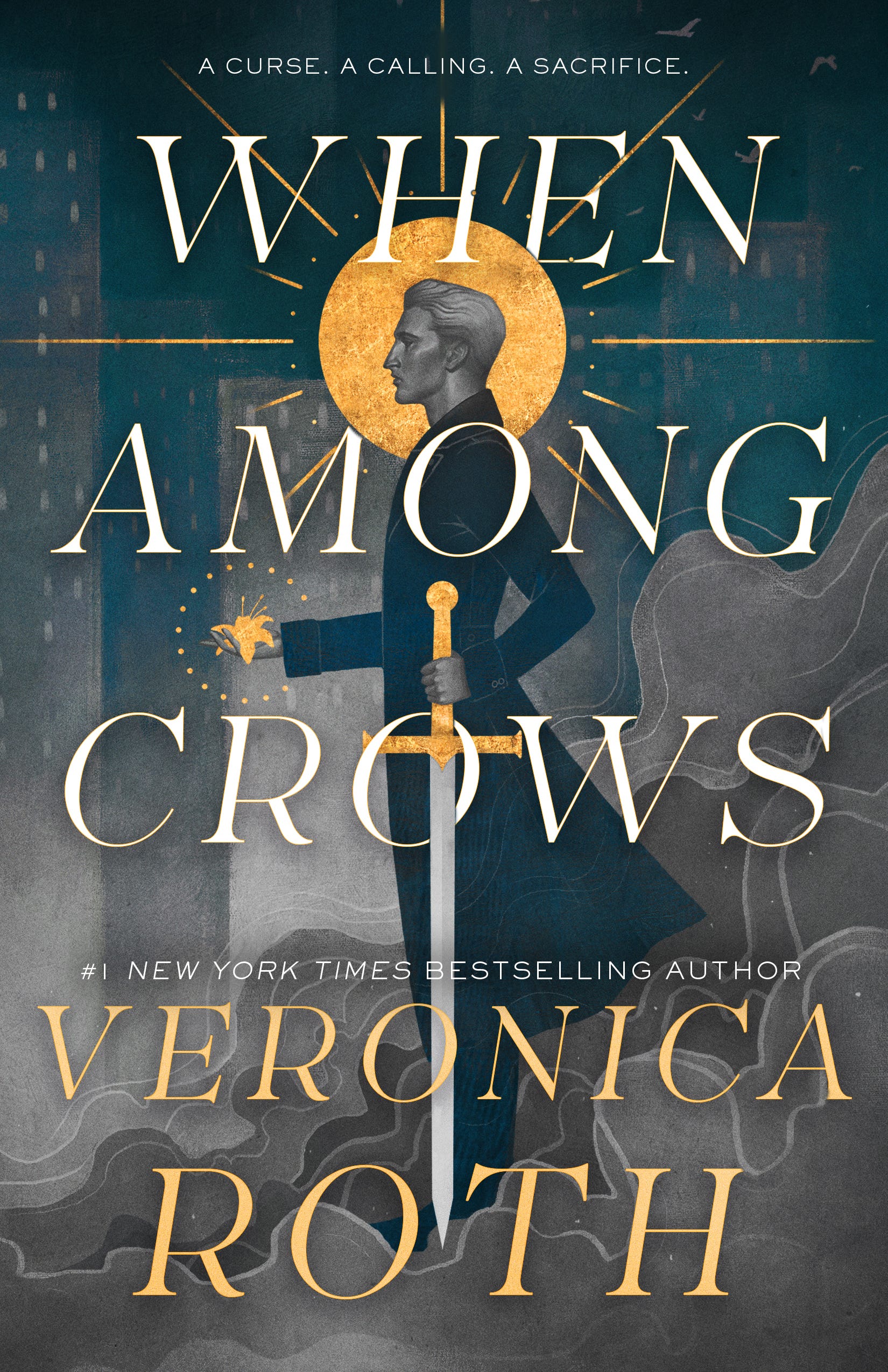
!!!!
This art is by Eleonor Piteira, who is…amazing, and perfectly captured the feeling of this story (and Dymitr!). And big thanks to Katie Jane Klim at Tor for getting us here, too.
This isn’t an official summary, or anything, but let me tell you what it’s about. When Among Crows is about a knight on a holy mission to kill monsters, a mission he’s so committed to that he split his soul in half to do it. For ~mysterious reasons, he travels from the old country to Chicago in pursuit of Baba Jaga, a legendary (and dangerous) witch who always takes more than she gives. But he needs help to find her. Enter Ala, a zmora who feeds on fear and the carrier of a deadly curse.
Without telling Ala what he really is, Dymitr offers her a bargain: if she helps him find Baba Jaga, he’ll help her break her curse. Desperate, she agrees, and over the course of one day, the two of them risk life and limb in Chicago’s monstrous underworld… but Dymitr’s motives— and his secrets— may pose the greatest danger of all.
A few things about this book:
The title comes from a (probably infrequently used) Polish saying: “Kiedy wejdziesz między wrony musisz krakać tak jak one,” or “when among crows, you must caw as they do.” (The equivalent is “when in Rome, do as the Romans do.”) The story is primarily about creatures from Polish folklore— though I of course took quite a few liberties— and as I am a first generation American who never learned the language, my uncle was kind enough to check my Polish to the best of his ability. Dziękuję, Uncle Stan.
Last summer I proposed a summary for a completely different novella to my editor, she was on board, I tried to write it, and then… I ended up writing this instead— almost in a fever dream, unsure of why it was suddenly the only thing I could work on and whether anyone would ever want to publish it. Big thanks to my editor, Lindsey Hall, for receiving “oops, I wrote this contemporary fantasy with strzygi and banshees and wraiths instead!” with enthusiasm. Though I’ve written things with fantastical elements before, this is the first purely fantasy work I’ve ever tackled, and I absolutely loved the challenge of it.
It has a playlist:
And a Pinterest board:

There’s a lot to love about the cover, but let me show you one of my favorite little bits:
It comes out May 14th, and I can’t wait!
<3,
V
Thanks for reading Veronica Roth! Subscribe for free to receive new posts and support my work.
July 24, 2023
CYOW 2: What Do You Have? What Do You Like?
It’s been a couple weeks now since the second session of Choose Your Own World, my pair of worldbuilding seminars. Thank you so much to those who attended, you made the whole thing a joy! If you missed them and want to tune in, they’re now up on Twitch here.
If you just want to know what I talked about, though, you’re in the right place.

SYSTEMS
My quotable quote was: “a system is a description of who holds power and how they hold it.” Systems are governments, religions, companies, schools, criminal organizations, book clubs, unions, you name it. Wherever people organize, there’s a system in place. And fictional worlds are a series of systems, even when those systems are weak or ineffectual. (In which case you have to ask yourself: what made them that way? Will the plot have to center in some part around rebuilding or strengthening them?) Once you build one system, you can start extrapolating from there. In the world we were building (revenge story set in dystopian society controlled by genetically enhanced people), we had a strong government system implied in the premise. In building out this world, my tasks will be: to determine what laws, if any, there are against the pursuit of individual vengeance; to decide what kind of genetic enhancements we’re talking about; to figure out what kind of government this is (dictatorship? monarchy? oligarchy? republic? pure democracy? etc.). Those decisions will affect character— their social status, their capacity to rise, their freedom to move through the world, their involvement with any ~shady characters, their trust in the system (or lack thereof)— and they’ll affect plot (to what extent will the system intrude on the plot and make things difficult for the character?).
System decisions also ripple outward to affect the rest of the world-building. A government, for example, impacts…laws. Buildings. Names of places, of people. News. Holidays. Education (itself another system). Religion (same). The interplay of government against the other potential power centers is also something to consider— does the government permit autonomy in schools, or do they oversee them? Do they work in concert with religious figures— or do they restrict them? Now you’ve gotten the snowball rolling downhill. Just keep following it to the bottom.
BUT HOW DO I CHOOSE?
If the idea of making any of those decisions is intimidating to you, you can fall back on this simple series of questions: what do I have? What do I like?
What do I have? means taking a look at what’s already out there. If you want to write a revenge story, look up revenge stories. If you want to write a high fantasy involving elves, look up high fantasy involving elves. Read widely. Do research. It’s as if there’s already a conversation going on surrounding whatever type of work you’d like to contribute to culture— you want to know what’s already been said in that conversation. That doesn’t mean you have to come up with something completely new to contribute, it just means it’s good to be aware of what you’re repeating, if anything. And how. And how intentionally you go about it.
Seeing what other people have done with a particular thing can also introduce you to the challenges of it, the questions of it, in advance. Revenge stories, for example, carry their own questions— about violence, about grief, about justice, about whether you can really ever “get even,” about how far a character will go to try. If you aren’t interested in those questions, you probably shouldn’t write that kind of story. If you’re excited by them, that’s a good sign.
What do I like? is a bit of an obvious question, but this is more about confidence than anything. Just making a choice because you like it is a perfectly valid way to make worldbuilding decisions. I’m tired of writing about dictatorships so I want to tackle an oligarchy— great. I’m not interested in rewriting Allegiant, so I want our genetic enhancements to be weirder than that— also great. What you like is important, not just for your well being as you write a story, but because other people out there are like you, too. They like the things you like. You can trust yourself to steer your fictional world toward something interesting just by filling it with the things you want.
WHEN YOU’RE STUCK
Go back to these two little loops:
THE SOUP
Plot, character, and world— which one would I like to add to? How does that affect the other two?
HAVING/LIKING
What do I have? What do I like? (What’s already out there? What do I enjoy in stories?)
UPCOMING
My job, now, is to write a short story set in our world— a character on a government-sanctioned revenge quest in a world ruled by people genetically enhanced to resemble gods. Keep your eyes peeled— I’ve got some interesting ideas.
If you watched these seminars and enjoyed them and have ideas for the future, feel free to put them in the comments. I’m already considering a revision one— thoughts?
V
Thanks for reading Veronica Roth! Subscribe for free to receive new posts and support my work.


