Michael Estrin's Blog, page 11
December 17, 2023
I love these stories, so I'm setting them free
Hello and welcome! I’m Michael Estrin. I write Situation Normal for people who take their humor with a side of humanity and a dash of insight. (Be sure to read to the end for a picture of Mortimer, the hardest working dog in the newsletter game🐶)
FIRST, a big thank you to the new paid subscribers at Situation Normal! Annoesjka sent money via PayPal, which is awesome! She also told me a little about her work translating popular books into Dutch. Since I know there are lot of authors in the Situation Normal community, let me say this: when you sell the foreign rights to your book🤞, insist that the translator is paid a fair wage. also sent money via PayPal and asked an important question: does Mortimer answer to Morty? The answer is yes! became an annual subscriber, writing “I’ve enjoyed too many of your posts not to!” Also, Mills leads a team of talented designers at Substack who make all the logistical aspects of publishing a newsletter and podcast super-smooth, so double thanks to you, Mills! Marion B. became an annual subscriber and sent me a lovely private note. Thank you, Marion! signed on for a monthly subscription and told me why: “Michael, I was intrigued by your ‘Substackanomics’ post recently. Somehow you satisfactorily explained “why pay” and how it works. Useful for someone like me also trying to grow paid subscriptions. But, the biggie for me (aka why I’m paying), you write really well and you don’t take yourself too seriously!” A not-too-serious-but-nevertheless-heartfelt thanks, Debbie! Secular Jen bought an annual subscription, rendering unto Situation Normal that which previously belonged to Secular Jen. Thank you! purchased an annual subscription, even though I made her life difficult by encouraging her to read Doppelgängers by Naomi Klein. Thank you, and I’m so sorry, Asha!
Situation Normal is free (except for the last post of the year). The generous financial support from some situation normies helps me bring joy to thousands of situation normies. I think that’s wonderful! If you can, please consider subscribing👇
It only takes 60 seconds to support Situation Normal👇
Or, if PayPal is your thing, send any amount here. I’ll add you to the list so that you receive the first annual Situation Normal Stakeholder Report at the end of the year.
OK, that’s a lot of 💰💰💰—enough to set some Situation Normal stories free, which is exactly what I’m about to do.

At the start of 2023, I turned on payments for Situation Normal. My plan was to make trillions of dollars, then go sit on a beach somewhere and earn 20 percent. Actually, that was Hans Gruber’s plan, and it didn’t work out too well for Hans, did it?
 I don’t know why every Diehard GIF has Hans Gruber falling from Nakatomi Tower wearing a Santa hat. Sure, Diehard is Christmas movie, but I prefer unadulterated GIFS.
Turns out my plan to get rich by writing funny, personal stories and emailing them to strangers wasn’t what the business people call “smart.” I think that’s because there are plenty of better ways to make money than writing comedy. Here are a few can’t-miss money-making ventures I got from a Business Insider article that was written by a low-paid human who used the free version of ChatGPT:
Petty larceny
Smelting
Grand larceny
A lemonade stand
Murder for hire
Selling solar
Writing ransom notes
Creating an AI that writes ransom notes between solar sales gigs
Stealing catalytic converters
Betting on Jai alai
Insurance fraud
Being a Kardashian
Winning Wheel of Fortune
OnlyFans
Filing frivolous lawsuits
Mismanaging a sovereign wealth fund
Plastics
This isn’t a complete list, but it doesn’t matter. I’m not in it for the money. I write Situation Normal because it’s fun for me and you.
Which brings to a confession: I left 98% of you out of the fun on four Situation Normal stories.
Sorry.
I did this on purpose.
Again, sorry.
It was an experiment, I swear. I wanted to see if a paywall would give Situation Normal what the business people call “paying customers.”
Turns out, those four stories did lead to a few paying customers. But I hated using the paywall. Also, most people who pay for Situation Normal do it because they love this newsletter and they want to support it. In other words, I have patrons, not customers.
Going forward, Situation Normal will be 100% free, with two exceptions:
After six months, all stories automatically go behind a paywall. I’m doing this to make it harder on trolls. I also want to harder on AI companies that want to train their models on my work—although I’m not sure paywalling the archives is much of a defense against SkyNet. Finally, I’m locking the archives to make it easier for me to collect the stories and turn them into books at some point. If there’s a story in the Situation Normal archives that you want to read, just ask and I’ll give you a set of keys, unless you’re a troll, or an AI, or an AI troll (god help us).
The last story of the year. That story will be a Stakeholder Report, which means I’ll explain the business side of Situation Normal. There might even be charts!
What about the four stories that were paywalled?Glad you asked! I love them, and as the saying goes, if you love something, set it free. You’ll find those four stories below. They’re all great, but the one about my dad, Bob Hope, and the Sultan of Oman is very close to my heart.
Please enjoy those stories:
A little housekeeping…
There will be two more Situation Normal stories this year.
Next week, I’ll publish a post celebrating this year’s wins. I do this every year. It’s a lot fun, so I hope you’ll join me for that one.
On the last Sunday of the year, which also happens to be the last day of 2023, I’ll publish the First Annual Situation Normal Stakeholder Report. If you want to know more about the business of this funny business, you’ll have to subscribe.
Stick around and chat!You know the drill. I’ve got questions, you’ve got answers.
Do you have any good business ideas? Share!
Is Diehard a Christmas movie? Bring your cold takes!
What would’ve happened if Odysseus had eaten an edible and flown Southwest?
You thought CCR was singing about a bathroom too, right?
Why is the Lyft driver still single?
Who had a better sense of humor: Bob Hope or the Sultan of Oman?
Can YOU ask ME a question?Yes, please do! I love hearing from Situation Normal readers. Ask me (almost) anything, and I’ll answer your question in a future issue of Situation Normal.
Email me at michaelestrin@substack.com
Want more Michael Estrin stories? I’ve got two books!Ride/Share: Micro Stories of Soul, Wit and Wisdom from the Backseat is a collection of my Lyft driver stories🚗🗣
Not Safe for Work is a slacker noir novel based on my experiences covering the adult entertainment industry💋🍑🍆🕵️♂️
The ebook versions of my books are priced between 99 cents and $2.99, so if you don’t have the budget for a Situation Normal subscription, buying an ebook is a great way to support my work. Bonus: you’ll laugh your butt off!
A picture of Mortimer…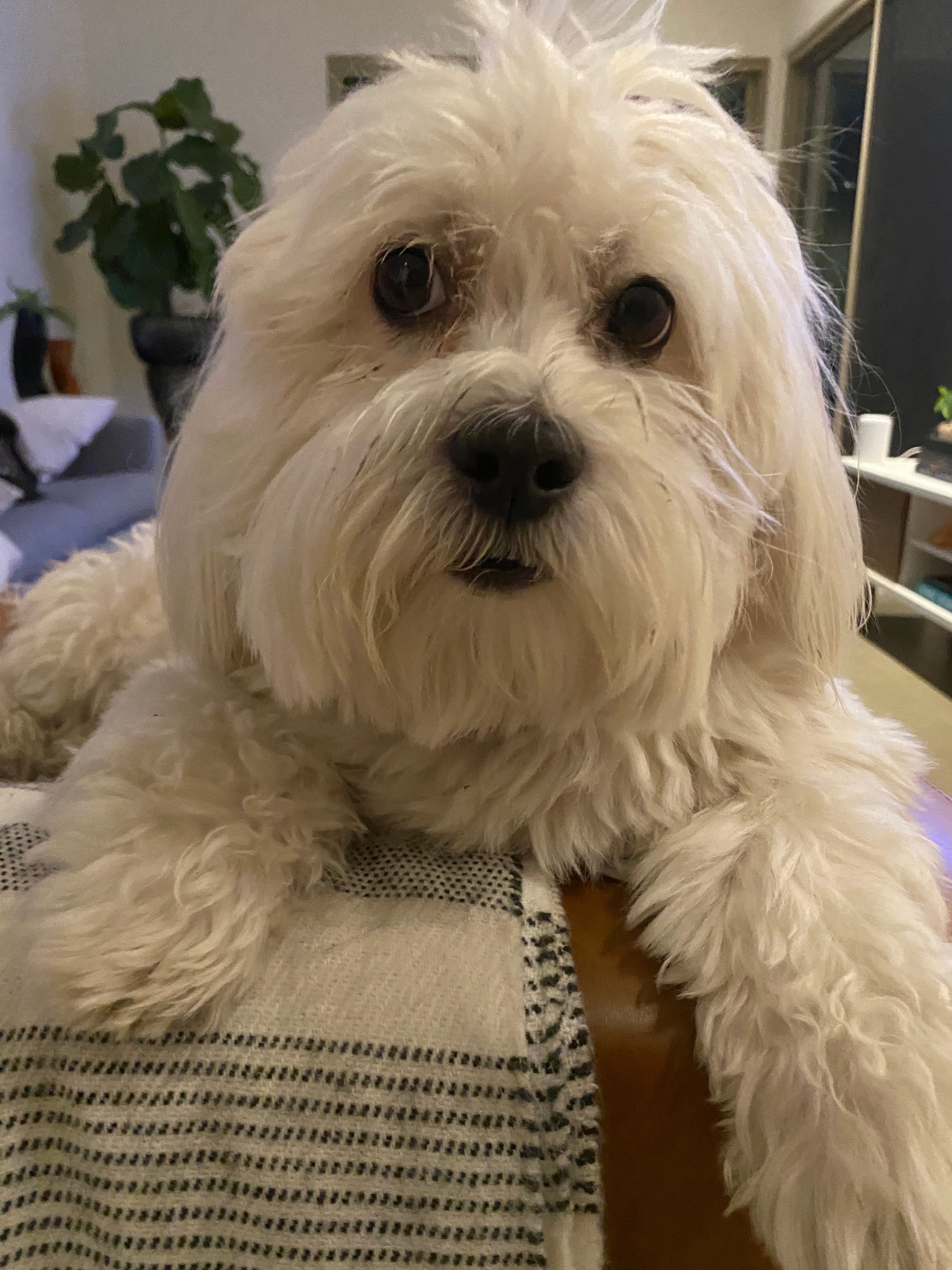 Mortimer moments before the photographer booped his snoot.
Thank you for reading Situation Normal! This post is public so feel free to share it.


December 13, 2023
Episode 4: Does Hanukkah have a marketing problem?
Hello and welcome to episode four of the Situation Normal podcast! The podcast has the same vibe as the newsletter, but instead of reading, you listen to me tell stories to my friend Todd.
In this episode, I tell Todd a couple of Hanukkah stories. We also talk a lot about fried food and holiday traditions for Jews in America. Plus, I share a little about what my Jewish identity means to me.
How to listen to the Situation Normal podcast🎧Every episode of Situation Normal is available for free on Substack, or wherever you listen to podcasts. It’s your call! Be sure to follow / subscribe!
Rate and review this podcast⭐️⭐️⭐️⭐️⭐️Please help more people discover Situation Normal by rating and reviewing this podcast! It takes 30 seconds, and it REALLY HELPS ME. Go here🙏
Tell your friends about the Situation Normal podcast🗣Text or email the link to a friend, post this on social media, hit the Restack button on Substack, or press the share button👇
Support the podcast (and the newsletter), if you can💰💰💰The podcast is free, the stories on Situation Normal are free, but people pay because they love Situation Normal and they want to support my work. If that sounds like you, please consider upgrading to a paid subscription🙏
Stick around and chat💬Anyone can answer these questions, but it’s a lot more fun if you 🎧listen🎧 to the 🎤podcast🎤 first.
Why are there so many ways to spell Hanukkah? Explain!
Donuts or latkes? Hint: both.
How do you eat your latkes? Hint: ketchup is the wrong answer.
Adam Sandler has done four versions of The Chanukah Song (note the different spelling!). Which one is your favorite?
How would you make Hanukkah more popular? Put on your marketing hat!
December 10, 2023
Rest in peace, buddy
I was cleaning dog shit off the sole of a tennis shoe when I found out that my friend Gabe had died. There’s a dark joke in there somewhere, one I’m sure Gabe would appreciate. But I don’t have the heart to find the joke right now—a feeling I’m sure Gabe, who always led with his heart, would understand.
I first came across Gabe Hudson on Twitter. On a platform where everyone seemed to be a self-proclaimed expert on everything, Gabe stood out to me with regular tweets that asked: does anyone know what’s going on?
I replied to some of those tweets, and Gabe always wrote back. But my interactions with Gabe on Twitter weren’t unique. It didn’t matter if you had a blue check mark or zero followers, Gabe wrote back to everyone, not out of obligation, I later realized, but out of a profound sense of our shared humanity. Gabe didn’t just care about people in the abstract, he cared deeply about every single person he ever shared a moment with, and he cared just as deeply about people he’d never meet.
We met for real this summer when Gabe moved his podcast, Kurt Vonnegut Radio, to Substack. Gabe had interviewed a lot of writers who loom large in the literary world and public discourse. Molly Jong-Fast. Merve Emre. Maggie Smith. Charles Yu. Tod Goldberg. Sam Lipsyte. Akhil Sharma. Sari Botton.
On Substack, Gabe reached out to my friend Alex Dobrenko, and then Alex’s Kaufmanesque nemesis Mike Sowden. Alex and Mike are both great writers, and they’ve both emerged as big deals on a growing platform that Gabe was working hard to learn. Reaching out to Alex and Mike made sense to me. But then Gabe reached out to me for an interview, and two thoughts collided in my head: holy shit and why me?
Our interview took ten hours. That’s not an exaggeration. We talked for ten hours over the course of two nights. We covered a lot of ground, but it felt like we still had so much ground to explore. Awkwardly, sounding a little like a teenager asking another teenager if they wanted to be friends, Gabe asked if he could call me sometime just to chat.
“Sure, I’d like that a lot.”
“You have time?” Gabe asked, as if leaving me an out I had no intention of taking.
I explained that freelance writing was slow for me at the moment, that my wife was in the middle of a job search, that aside from game nights with friends, or the occasional movie or meal out, our social calendar wasn’t exactly full at the moment.
“You are around,” Gabe said, emphasizing the last word with a booming, elongated voice.
I was around, and for the next few months, I came to know Gabe’s voice intimately. We spoke every week, usually for three or four hours at a time. Gabe always made it a point to ask, “how you doin’, buddy?” I understood, without Gabe needing to explain it, that this wasn’t small talk, it was personal talk, where every experience and feeling I shared was met with love and compassion. Everyone should have a friend like Gabe.
We also talked about big things. When it came to the big topics, Gabe was here for it, as they say.
Books were a frequent topic. Gabe read everything. If I mentioned a book that Gabe hadn’t read, I felt like the student who stumped the master, but that didn’t happen often.
We talked a lot about one of Gabe’s favorite topics: Generation X. “You’re in two camps,” he told me, “culturally, you’re an Xer, but your formative life experiences are sorta Millennial.” Gabe’s advice: use my experience as a member of a relatively small micro-generation to bridge the gap between old and young. Good advice for finding humanity in digital spaces that are often inhumane.
Mass shootings were another topic we discussed in depth. Gabe’s voice on mass shootings was informed by his experience as a rifleman in the Marines, his vocation as a teacher, his insistence on truth-telling, and above all, his humanity. Gabe had important things to say about mass shootings—the fact that society chose to ignore Gabe’s voice only drove him to speak louder. Gabe’s courage was inspiring.
We also talked a lot about war, weaving together threads of history, politics, hatred, violence, and humanity. In those conversations, it felt like we were a pair of blind men, desperate to understand the shape and dimensions of the elephant called war, so that we might drag it into the light, expose its ugly truths, and march it toward a new place called peace.
Maybe it’s fitting that our friendship was book-ended by the war in Ukraine, which had been raging for more than a year by the time we met, and the war in Gaza, which erupted a few weeks before Gabe died. But the real through line of those conversations was this theme: America’s forever wars. Gabe was working toward something on that front—a great American novel, I think—that would explain the horrors we had inflicted on others, how those horrors had come back to haunt us, and why, if we didn’t tell the truth about those horrors, we’d find ourselves in an even darker place.
Unlike mass shootings—a horror that’s partly a function of America’s forever wars—the forever wars themselves aren’t something we talk about much. But Gabe talked about them a lot, and while it’s natural and true to say his voice will be missed there, it’s important to honor Gabe’s legacy by speaking out and breathing new life into a conversation America prefers to ignore.
Comedy, a subject close to both our hearts, was another frequent topic of my conversations with Gabe. I learned that Gabe had a mission for the new incarnation of Kurt Vonnegut Radio. The idea was to fuse the worlds of literature and comedy. Doing so, Gabe explained, would help make literature more relevant and vital to a mass culture drunk on digital dopamine distractions, but it would also give comedy its due as a true art form.
We talked a lot about the comedians Gabe wanted to interview on Kurt Vonnegut Radio. Each comic Gabe set his sights on was hilarious, but the thing he really wanted to speak with them about was truth-telling. Kurt Vonnegut, Gabe’s hero, wasn’t exactly a novelist in Gabe’s estimation, he was a very funny joke writer who told the truth and spun those truths into stories we call novels. Coming at it from the opposite angle, Gabe saw comedians not as clownish purveyors of low culture but as honest artists in a dishonest world.
Gabe was passionate about truth-telling. Actually, he insisted on it. He took pride in championing truth-tellers. He reminded everyone that “truth-telling is infectious.” It takes courage to tell the truth, and too many of us lack that courage. I lack that courage, sometimes. But whenever I find the courage to speak the truth, it’s because I hear Gabe’s voice urging me on. Truth-telling is infectious—meaning that the truth-teller may feel lonely, but they are not alone.
Gabe’s voice was powerful, but he spoke with a combination of strength and tenderness I’ve never heard before and don’t imagine I’ll ever hear again. Gabe brought that voice everywhere—to our personal talks, to the big topics that were his life’s work, and to various writing communities, including the last one he joined on Substack.
One of the striking things to me about Gabe’s time on Substack is that he helped so many writers see themselves and their work in terms that were clarifying and helpful. Gabe had a gift for explaining you to you, I’ve heard so many members of the Substack writing community say. He gave that gift freely and with generosity. He gave that gift to me in every conversation we had.
Our rambling ten-hour conversation for Kurt Vonnegut Radio was a function our mutual passions, my endless struggles to apply concise labels to my work, and Gabe’s relentless curiosity to understand where a writer was coming from. Gabe cut the interview down to twenty-six minutes, and while it was choppy in places because Gabe was teaching himself to edit audio, his insights changed my writing career in profound ways that I’m still coming to terms with.
“Did I get you right?” Gabe asked me after he published the interview.
I assured Gabe that he had gotten me right, and even better, that he had also helped me clarify so many things about my writing. I didn’t ask Gabe to be my mentor, but he stepped right into that empty space in my work in the same way Gabe showed up for everything else—with love, tenderness, respect, understanding, and ferocious writing chops.
Gabe gave me his time, and he took his time with me. When I struggled to write a professional bio for my creative writing—a constant source of frustration for me and an irritating irony for a humorist working in the ambiguous genre called autofiction—Gabe rolled up his sleeves and got to work.
“Send me what you have,” he insisted.
I sent Gabe crap. The next day, Gabe sent me back gold. Then, as comedy writers do, Gabe sent me a dozen alt lines for buttons to close out my bio. Some were right, some a little off, but all of Gabe’s alts were funny as hell.
Gabe’s generosity was noteworthy, even by the high standards of mentorship and friendship, but Gabe’s true generosity revealed itself after his death. So many writers on Substack and elsewhere described similar experiences with Gabe Hudson that I doubt we’ll ever know his true impact. What I do know is that I’m better for knowing Gabe, even if our friendship was far too brief. I also know that writers and readers, and the world itself, are better because Gabe was here and because he left us his words.
Maybe in that way, Gabe isn’t truly gone. Maybe, to borrow from Kurt Vonnegut’s writing in Slaughterhouse Five, it’s a mistake to be sad about losing Gabe because we haven’t really lost him.
The most important thing I learned on Tralfamadore was that when a person dies he only appears to die. He is still very much alive in the past, so it is very silly for people to cry at his funeral. All moments, past, present and future, always have existed, always will exist…
When a Tralfamadorian sees a corpse, all he thinks is that the dead person is in a bad condition in that particular moment, but that the same person is just fine in plenty of other moments. Now, when I myself hear that somebody is dead, I simply shrug and say what the Tralfamadorians say about dead people, which is “so it goes.”
So it goes, Gabe…
Further reading about Gabe HudsonA really good Los Angeles Times obituary.
John Warner, a former colleague of Gabe’s at McSweeney’s, wrote a wonderful remembrance of Gabe and his work. Here’s that post.
McSweeney’s is collecting memories of Gabe from friends, family, and colleagues in a post fittingly titled: “JUST SAY THE WORD, AND I’LL BRING MY WHOLE HEART TO ANYTHING”
Let’s remember GabeUsually, I end ever Situation Normal post with some discussion questions, but there’s only one thing on my mind: Gabe. If you knew Gabe, or knew his work, or even if you just interacted with him once on the internet, please tell us something about Gabe.
December 3, 2023
The most interesting Lyft driver in Las Vegas
Hello and welcome! I’m Michael Estrin. I write Situation Normal for people who take their humor with a side of humanity and a dash of insight.
A few quick items before we start. Also, be sure to read to the end for a picture of Mortimer, the hardest working dog in the newsletter game🐶
FIRST, thank you to the new paid subscribers at Situation Normal! This newsletter is free (except for the last post of the year), but writing Situation Normal takes time out of my busy freelance writing schedule. The generous financial support from a few situation normies helps me bring joy to thousands of situation normies. I think that’s wonderful!
Thank you to…
Brooke, who wrote a lovely note that she chose to keep between me and her!
, who didn’t leave a note, but is still awesome!
, who didn’t write a note either, but who sometimes leaves awesome comments!
Takoda, who I believe is the awesome son of an awesome woman, if I’ve deciphered the email address correctly!
, who wrote this awesome note and said I could share it with you: “I support your work because I know how difficult and time consuming and anxiety-inducing publishing consistently (with high quality) is over an extended period of time. But also, because I've gotten to know you a bit over the years and I wanted to show my appreciation for your words that often lighten up my inbox and leave me with a smile on my face.”
who also wrote an awesome note that she agreed to let me share with you: “Supporting you because you give me hope that I too will be able to make it here one day :) and even if I don’t, well you deserve to be paid for your time and work that you do! Keep going- you’re awesome!!”
Katie, who didn’t leave a note, but who nevertheless went big by becoming a founding member! Founding members are entitled to a ride to a doctor’s appointment, provided the appointment is in LA County only.
who also wrote an awesome note and said I could share it: “I enjoy your work, and paying less than full retail is always appealing to me.”
By the way, Rick got in on a special 20% offer that ends December 4th. If you hate paying the full retail price follow Rick’s lead👇
And finally, a wonderful member of the Situation Normal community chose to send their very generous support via PayPal! Thank you, Anonymous HeyPal!
If PayPal is your thing, send any amount here. I’ll add you to the list so that you receive the first annual Situation Normal Stakeholder Report at the end of the year.
OK, that’s a lot of 💰💰💰—enough to buy a Substack bestseller badge. But as I said when Substack rolled out that feature, “We don’t need no stinkin’ badges.”
SECOND, Situation Normal has a podcast! The podcast has the same vibe as the newsletter, but instead of reading, you can listen to me tell stories to my friend Todd. Listen wherever you listen to podcasts by going here. You can also REALLY 🙏help🙏 us out by rating and reviewing here⭐️⭐️⭐️⭐️⭐️
OK, that’s enough preliminaries, let’s get to it, shall we?
Before ride/share apps, I usually called a cab when I needed to go to the airport. If something funny happened in the cab, my frame of reference was usually the sitcom Taxi. If something disturbing happened, I’d reference Martin Scorsese’s neo-noir Taxi Driver. And if the experience was peculiar, or strange, or surreal, or beautiful, or overflowing with humanity, I’d reference the underrated Jim Jarmusch film Night on Earth. But none of those references really capture Harold, the Lyft driver who picked me up at my mom’s house in Las Vegas and drove me to the airport.
Harold wasn’t silly like Andy Kaufman’s Latka Gravas. Nor was he disturbing like Robert De Niro’s Travis Bickle. And while Harold could be described as idiosyncratic, I wouldn’t cast him in a Jim Jarmusch picture. But I would put Harold in a Dos Equis ad, because Harold is the most interesting Lyft driver in Las Vegas.

“I love this town,” Harold said. “My daddy took me to Vegas when I was seventeen, and I was hooked.”
Harold looked to be in his late fifties. He had blonde hair and wore aviator glasses. There was twang in his voice, so I asked where he was from originally.
“Florida, the armpit of America.”
I have mixed feelings about Florida. As the husband to a Florida woman, I am grateful to the Sunshine state. As a writer of funny crime fiction, I owe a literary debt to Florida for inspiring the likes of Carl Hiaasen, Tim Dorsey, and Dave Barry—all writers who inspired me to write Not Safe for Work. But I’m not exactly Florida fan. I agree with Homer Simpson, who called Florida “America’s wang.”
“When my daddy died, he made me promise him two things,” Harold continued. “First, I promised him I’d stay with mommy for six months. She still lives in Florida on the Intracoastal. Keeping that promise was hard, but I did it for my daddy.”
“What was the second promise?”
“That I’d get the hell out of Florida and move to Vegas,” Harold said with a chuckle. “Vegas is the town for me. Know why?”
I didn’t know why, so I asked.
“It’s got all the crazy people, just like Florida, but there’s no humidity.”
“Or gators,” I said.
“Exactly. First time I came here with my daddy we stayed on the strip. We had a good ole time. But the thing that hooked me was seeing snow-capped mountains in the distance while walking around in eighty-degree weather. Florida can’t do that, can it?”
“No, sir.”
Suddenly, I had a twang in my voice. That worried me, so I moved the conversation away from Florida.
“How long have you been driving Lyft?”
“Three weeks,” Harold said. “I was bored. I wanted a job where I could talk to people.”
“What did you do before Lyft?”
“Little of this, little of that.”
When I pressed to find out more about “this” and “that,” Harold explained that jobs are for “regular people.”
“I am not regular people,” Harold said. “I’m colorful.”
“Is there good money in being colorful?” I asked.
“Colorful, no. Eccentric, yes. When my mommy dies, I’ll be eccentric. But for now, I’m colorful.”
I didn’t like the sound of Harold’s mommy dying, and maybe that showed on my face. But he told me not to worry about her, before adding that she knew all about his inheritance plans.
“When she goes, I’m getting a lot of money. I already told my lawyer I’m bringing him a big inheritance. His job is to find me a mansion and hide the rest from the government.”
Harold chuckled again. I chuckled too, but just to be polite.
“Of course, it can’t just be any mansion. I need space for a wrestling ring.”
“Huh?”
“Wrestling.”
“Like, Greco-Roman?”
“WWE. I’m a part-time wrestling promoter. It’s a great sport. Very athletic. Very theatrical.”
“So do you work for the WWE?”
“No. I promote independent wrestling matches.”
“But they’re the same as the WWE, right?”
“Oh yes. Same style, but unaffiliated. I used to work for the WWE. I even met Vince McMahon once.”
“Really!?”
“Oh yes. I was a promoter in Tampa back then. The way it worked was, Connecticut called you, but you didn’t call Connecticut. That’s where the WWE headquarters are, but back then they were the WWF. That was before the wild life people handed Vince his butt in federal court.”

“What does a promoter do?”
“Get the word out. I had this idea about how we could get some butts in the seats, and everyone said, ‘you don’t call Vince, he calls you.’ Well, I called Vince. I told the gal answering the phone to put me through to Vince McMahon because I had a million-dollar idea.”
“A million bucks?”
“I exaggerated, a little. But she put me through to Vince. And we talked. When he came down to Tampa, he made it a point to find me. He said, ‘I wanna met the sonofabitch who has the balls to call me.’”
Harold chuckled. I chuckled too, but for some reason, I added, “you had the balls.”
“I had the balls,” Harold confirmed.
For a moment, we were silent. In the rearview mirror, I could see Harold beaming with proud over his Vince McMahon anecdote. But my comment about Harold’s balls worried me. For one thing, it’s my policy not to talk about another man’s balls. Also, I had referred to Harold’s balls in the past tense, which felt… disconcerting.
“How did you get into wrestling?” I asked.
“I was radio DJ,” Harold said. “That was a fun job, but the business went to doo-doo. Nobody listens to radio anymore, unless you’re a lunatic about politics or a religious nut. I’m neither. I’m an old school FM radio guy. I spun records, but it’s all streaming now. I have the gift of gab, but it’s all podcasts and what not.”
“You could start a podcast.”
“No money in that. Joe Rogan took it all and moved to Texas. Besides, I like it live. I like people. You’re probably not going to like hearing this, but I helped make Carrot Top famous.”
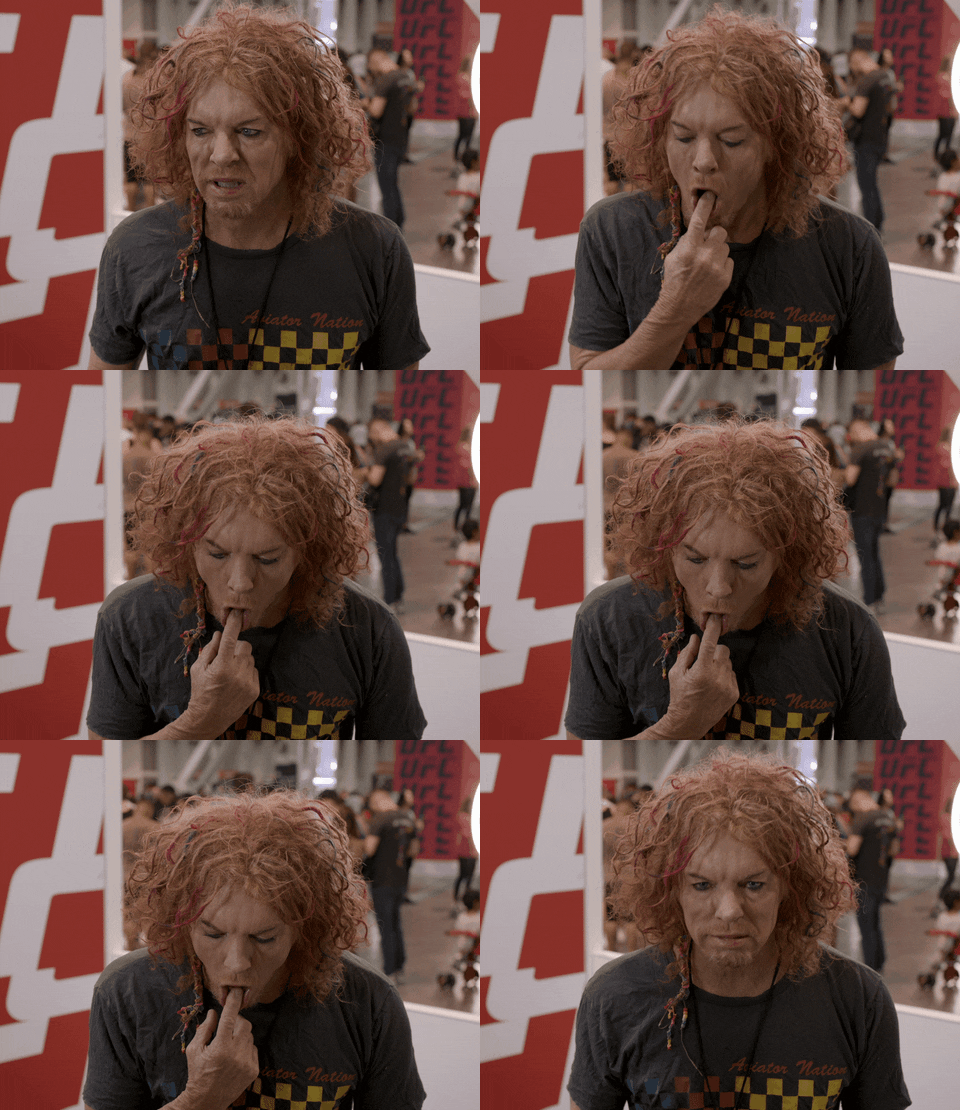
“Carrot Top, the comedian?”
“Yes, sir. One day, I’m sitting there in this bar, and this kid comes in and does his stand-up act.”
“That was Carrot Top?”
“Yeah, but he was just Scott Thompson then. I wasn’t much older than him. He was maybe seventeen. He was good, so I finished my cocktail, went over to him and said, ‘listen, I don’t know doo-doo about doo-doo, but you’ve got talent, my man.’ And the rest was history.”
Harold didn’t cover the history of Carrot Top, or say how he helped make the redheaded prop comic famous, but he did let me know that they’re still friends.
“He has a residency here in Vegas. I take friends to see him all the time. Then I go backstage, knock on the door, and Scott answers. He always says the same thing: ‘what are you doing here, you sonofabitch?’ We laugh and have a good ole time. My friends can’t believe it. They’re partying with Carrot Top. But to me, he’s just Scott.”
“So in addition to working as a DJ and a wrestling promoter, you also work in comedy?”
“In a manner of speaking, yes, but not really. I’m just part of the scene. You ever see Night Court?”
“Hell yes, one of my favorite shows.”
“You remember Roz, the bailiff? The actress who played her is Marsha Warfield.”

“I’ve known Marsha for thirty years,” Harold continued, “but I haven’t talked to her in twenty-five. One day, I’m delivering DoorDash. Don’t ever deliver DoorDash. It’s no fun. You hardly talk to anyone, and your car ends up stinking of French fries that you don’t get to eat.”
“Good tip.”
“I delivered DoorDash to Marsha. I recognized her. I said, ‘I know you.’ She said, ‘the hell you do.’ I said, ‘Marsha, it’s me, Harold.’ I took off my glasses. She recognized me! ‘Get your butt in here, Harold, what the hell are you doing?’ I told I her I was bringing her dinner. She said, I was having dinner with her and her wife, no excuses. So we had dinner. Then she said, I needed to help her with her act.”
“You helped Marsha Warfield with her act?”
“Not really. She didn’t have a closer. I reminded her that she had twenty minutes on slavery that she did back in the day. She said, ‘yeah, but that bit is so damn offensive.’ And I said, ‘Marsha, that bit killed then and it will kill now. She made me come to her show and stand backstage. The bit killed every time. And every time she walked off stage she said, ‘Harold, you’re a genius.’”
My head was spinning. In twenty minutes, Harold had name-dropped Vince McMahon, Carrot Top, and now, Night Court’s Marsha Warfield! A skeptic might say Harold was lying. But the names Harold was dropping didn’t feel like the kind of names a liar would drop. To me, Harold’s celebrity anecdotes sounded too weird to be fiction. Still, as we pulled up to the airport curb, I felt the need to do a little fact-checking.
“Are you really friends with Carrot Top?” I asked.
“Course I am,” Harold said.
Then he proved it. Harold opened up the photo album on his phone, selected a folder labeled “comedy friends” and swiped through a dozen pictures of him and Carrot Top over the past three decades. There were pictures of Marsha Warfield with Harold in there too.
When I got home to Los Angeles, I told Christina about Harold.
“What about Vince McMahon?” she asked. “Did Harold have any pictures with him?”
“I don’t know,” I said. “I didn’t have the balls to ask about Vince.”

Please share this post (no balls required)👇
 Stick around and chat!
I’ve got questions, you’ve got answers.
Why does Harold, a man in his 50s, refer to is parents as “mommy” and “daddy”? Is that a Southern thing? A weirdo thing? A lovely thing? Tell me!
Is Carrot Top a great prop comic, or a real problem?
Do you have the balls to call Vince McMahon? Explain.
The original Night Court was amazing, but the new Night Court leaves me cold. Why? Night Court bonus question: Why wasn’t Dan Fielding disbarred?
Taxi, Taxi Driver, or A Night on Earth? You can only choose one, which will it be? Choose wisely and explain yourself.
Can YOU ask ME a question?Yes, please do! I love hearing from Situation Normal readers. Ask me (almost) anything, and I’ll answer your question in a future issue of Situation Normal.
Email me at michaelestrin@substack.com
Want more Michael Estrin stories? I’ve got two books!Ride/Share: Micro Stories of Soul, Wit and Wisdom from the Backseat is a collection of my Lyft driver stories🚗🗣
Not Safe for Work is a slacker noir novel based on my experiences covering the adult entertainment industry💋🍑🍆🕵️♂️
The ebook versions of my books are priced between 99 cents and $2.99, so if you don’t have the budget for a Situation Normal subscription, buying an ebook is a great way to support my work. Bonus: you’ll laugh your butt off!
Last thing…… if you’re new to Situation Normal, make sure you’re subscribed to receive new posts most Sundays👇
 Mortimer thanks you for reading Situation Normal!
November 29, 2023
Episode 3: AI John Lennon, or user error?
Hello and welcome to episode three of the Situation Normal podcast! I’m Michael Estrin and write Situation Normal for people who take their humor with a side of humanity and a dash of insight. The Situation Normal podcast has the same vibe as the newsletter, but instead of reading, you can listen to me tell stories to my friend Todd.
In this episode, I tell Todd about my battles with our Alexa, which might be trying to kill me. Then we talk about two stories involving text messages. In one story, texting technology robs us of our humanity, but in the other story, texting technology helps us find our humanity. It’s complicated. Then we make things even more complicated by talking about Now and Then, the last Beatles song that some people call “AI John Lennon.” I wrote about Now and Then in a recent post titled “Do baristas dream of electric Beatles?”
Special thanks go out to and who unknowingly contributed insightful comments that I referenced in this podcast. Great job, guys!
How to listen to the Situation Normal podcast🎧Every episode of Situation Normal is available for free on Substack, or wherever you listen to podcasts. Be sure to follow / subscribe!
Rate and review this podcast⭐️⭐️⭐️⭐️⭐️Please help more people discover Situation Normal by rating and reviewing this podcast! It takes 30 seconds, and it REALLY HELPS ME. Go here🙏
Tell your friends about the Situation Normal podcast🗣Text or email the link to a friend, hit the Restack button on Substack, or press the share button👇
Support the podcast (and the newsletter), if you can💰💰💰The podcast is free, the stories on Situation Normal are free, but I pay Todd for his time, tools, and talent. If you can, please consider supporting Situation Normal by upgrading to a paid subscription🙏
Stick around and chat💬Anyone can answer these questions, but it’s a lot more fun if you 🎧listen🎧 to the 🎤podcast🎤 first.
Has Alexa ever tried to kill you, or have you just seen 2001: A Space Odyssey too many times. Be honest, Dave!
What kind of surgery did Birgit receive? Was it a third arm? Wrong answers encouraged!
Is John Lennon Skynet and should we be worried about AI?
Have you experienced “tech lash”? Tell your story!
Does technology serve us, or do we serve technology? Go deep!
Have you rated & reviewed the Situation Normal podcast, then told all your friends to listen? Hint: the correct answer is, “Right on top of that, Rose!”
November 19, 2023
Do baristas dream of electric Beatles?
“Are you fucking with me?” the barista asks.
I am not fucking with her. I came here for coffee, WiFi, and maybe a breakfast burrito to nosh on while I write. But after a brief panic attack, I realize her question isn’t meant for me. Her question is meant for her coworker.
“No, why?” he asks.
“This song, this fucking song,” she says. “I can’t take this fucking song.”
I can’t quite place the song. The voices sound familiar, but the tune is new to me.
“Every time I hear this song, I wanna scream.”
The barista doesn’t scream, but her threat focuses my attention. I listen a little closer. The song warms my ears, but at the same time, it leaves me feeling a little off. It’s an uncanny vibe, kind of like déjà vu, or maybe déjà rêvé, or even déjà entendu. Honestly, I’m not sure because I don’t speak French, and I get my “déjàs” mixed up. But the song! It reminds me of The Beatles. I know their music really well, but I don’t recognize this tune.
“I kinda like it,” the other barista says.
“That’s because you have shitty taste, Tim.”
Tim doesn’t defend himself or his shitty taste. Instead, he comes out from behind the counter and heads over to the sugar station to tidy up.
“Who sings this song?” I ask.
“It’s The Beatles,” the barista says, putting air quotes around the name of the band. “This is their new song, the one they did with an old John Lennon demo and some AI bullshit.”
I heard about this song on a tech podcast I listen to. It’s called Now and Then, which is an interesting title for a song that blends an old recording with new technology to create something that is, well, shitty, at least as far as the barista is concerned.
“I’m a huge Beatles fan,” she says. “This song is ruining my life.”
I believe her. The outrage in her voice is as real as the pain in her eyes. Music taps into something deep inside us—a sacred place in our souls where emotions, identity, and community intersect. If Bill & Ted ever get their shit together and harness the power of music, Wyld Stallyns might just fulfill its fictional destiny and save humanity.

But here in the real world, we have The Beatles—a band that might’ve saved the world too, if only the world had opened its hearts and minds along with its ears. Sadly, The Beatles broke up, then any hopes of a reunion were crushed when John Lennon was murdered. But thanks to machines that learn, but will never learn to feel, The Beatles won’t die.
One might think that the barista would be happy about a new song from The Beatles, but anyone who’s ever had their fandom fucked over by the music industry knows that songs like Now and Then are complicated. The barista looks like she’s in her early twenties, which means she was born around the time George left us, which was decades after John left us. But the timeline doesn’t matter. Dollars to donuts, the first time the barista heard The Beatles she felt their music in her soul. Their music wasn’t old, it was eternal. By the time their music reached the barista’s young ears, it had survived countless cultural cross-currents and changing music formats. Sure, a business had been built around The Beatles, and an industry surrounds that business, but between their music and her ears, there is an uninterrupted chain of humans who grooved, who sang, who shared, who kept the music alive. But now, according to the barista, “it’s a lifeless, soulless machine.”
“Why would they do that?” she asks. “Why would they take something real and make it fake?”
I don’t know the answer to that one. Maybe Paul and Ringo thought it would be cool to give the world one last song from The Beatles. Maybe the record company wanted to squeeze out just a little more profit. Maybe both are true. And maybe, as is always the case with creative matters, some people are going to love it, while others are going to hate it.
“I think there’s going to be a lot more of this,” I say. “Mick Jagger might not be able to get any satisfaction, but I’m sure he’s got an AI solution.”
“Of course he does. The Rolling Stones are cynical fuck-wads. But The Beatles? I believe in the Beatles. Just not this AI bullshit. No thanks.”
I like The Rolling Stones, and while they are many things, I wouldn’t call them “cynical fuck-wads.” But there’s no point in arguing with the barista. Now and Then is a deep cut that cut her deep, and as the saying goes, hurt people hurt people. So I search for something sympathetic to say.
“I’m a paperback writer, and this AI stuff feels like a dagger pressed against my throat,” I tell her.
The reference to The Beatles song—an original, canonic song from The Beatles—makes her smile.
The barista rings me up. I tap my credit card on the reader, but nothing happens. I lift the card off the reader, then tap it again. Nothing.
“Should I insert the card?” I ask.
“No, this machine just sucks ass. Do you have cash?”
I hand her a twenty.
“They can make an AI that gives us a new Beatles song” I say, “but payment solutions are still a work in progress, I guess.”
The irony makes the barista laugh. We could continue our Luddite crusade, but she has work to do, and so do I, so we decide just to Let It Be.
Let It Be SHARED! Situation Normal grows because awesome readers share stories that make them laugh, think, and feel👇
If you use Substack Notes, you can also share by hitting the Restack button🙏
 An important coda to this story
While the barista’s feelings were right on the money, she may have been wrong about the origins of Now and Then. Here’s a 12-minute documentary about the making of the song. I found it fascinating. You should check it out👇
There’s more to this story, so check out the podcast!I’m going to talk about this story and some related tech stuff on the Situation Normal podcast with Todd, who came up as a musican before becoming a production Swiss Army Knife. That episode will come out November 29; we’re skipping a week because of Thanksgiving🦃
Also, please listen to the Situation Normal podcast! I tell Situation Normal stories to my friend Todd, then we chat about them. It’s a lot of fun. Listen on Substack or your favorite podcast app, then rate & review here (ratings⭐️⭐️⭐️⭐️⭐️ and reviews👍👍👍👍👍 really help🙏)
Two ways to support Situation Normal!Situation Normal is (mostly) free. I rely on paying subscribers to keep it going, which means 95 situation normies currently underwrite the enjoyment of 4,100 situation normies. I’m proud of that, and I hope you are too! If you have the means, please consider supporting Situation Normal in one of two ways:
OPTION ONEPurchase a paid subscription through Substack. Monthly subscribers pay $5 per month. Annual subscribers get 17% off. Founding subscribers underwrite a few extra situation normies by paying anywhere between $51 and $250—they’re choice!
Please consider upgrading to paid. It takes 60 seconds to support Situation Normal👇
OPTION TWOSome readers have said they’d prefer to send me a few bucks through PayPay. That’s awesome! Here’s my PayPal link.
Note: If you do send money via PayPal, please email me at michaelestrin@substack.com so I can give you a shout out. Also, I’d love to know more about you and why you chose to contribute your $$$ to Situation Normal, so please feel free to tell me a little more about you in the email.
Stick around and chat!I’ve got questions, you’ve got answers.
Are you a fan of The Beatles, or do you hate good music? Confess!
How do you feel about Now and Then? Is it a Beatles song, machine madness, a gift from the music gods? Go deep on this one!
Do you think Bill & Ted will ever get their shit together and actually save the world, or should we work on a Plan B? Dish!
Conversations with baristas are always a lot of fun. Why is that? Share your theories!
Can you keep your “déjàs” straight? Why are the French so good at describing the different kinds of uncanny feelings we get from time to time?
Have you listened to the Situation Normal podcast? Episode two includes some comments from the situation normie community, so you should probably get on that, right?
Can I ask you a question, Michael?Yes, please do! I love hearing from Situation Normal readers. Ask me (almost) anything, and I’ll answer your question in a future issue of Situation Normal.
Email me at michaelestrin@substack.com
Want more Michael Estrin stories? I’ve got two books!Ride/Share: Micro Stories of Soul, Wit and Wisdom from the Backseat is a collection of my Lyft driver stories🚗🗣
Not Safe for Work is a slacker noir novel based on my experiences covering the adult entertainment industry💋🍑🍆🕵️♂️
The ebook versions of my books are priced between 99 cents and $2.99, so if you don’t have the budget for a Situation Normal subscription, buying an ebook is a great way to support my work. Bonus: you’ll laugh your butt off!

Last thing, if someone sent you this story, make sure you’re subscribed so you get more fun delivered to your inbox👇
November 15, 2023
What's the deal with Substackanomics?
The best gift you can give a writer is cash, but there are plenty of other good gifts too. Coffee makes a nice gift. Ditto for coffee mugs. Pens are always appreciated, as are notebooks. Sharing a writer’s work with friends, influencers, or powerful literary agents is also nice. But one of my favorite gifts is a question. Here’s why: anyone can ask a question, and a question gives me something to write about. That’s a win-win, situation normies.
Recently, I received a very good question from a long-time situation normie named Tab. Here’s what he wrote:
The other night, during a period of insomnia, I was thinking about the
fact that most of the Substack authors I’ve found have been begging for
subscribers (to paraphrase the old Tom Lehrer song line, “Now there is a
fee for what they used to give away for free.” ) You’ve mentioned the
numbers of paid vs. free subscribers coming out as around 2%. And most
subscriptions seem to run about $50-60/year. Would a lower cost get
more subscribers, and a higher total payout, or not attract money from
those who aren’t paying anyway?
Paying for one subscription doesn’t seem all that bad, but as I start
thinking about the requests to pay a bunch of authors, it suddenly adds
up to more than the cost of Amazon Prime which can give me dozens of
hours of entertainment and might even not cost my wife any money for
shipping the tons of packages that show up on my doorstep each day. Or,
more than the cost of buying a book online each month which gives me 300
or so pages to read.
I don’t know the percentage of Substack writers who actually get a
significant number of paid subscribers, making the writing a paying job
rather than a labor of love. It makes me wonder whether the authors
could work out something with Substack to have a monthly Substack
subscription and have Substack pay the authors a percentage of the take
each month based on the number of people who read their posts similar to
what the entertainment strikes have been asking for?
Thank you for this question, Tab! The fact that my financial prospects occupied your sleepless thoughts warms my heart. Seriously! I really appreciate your email because I can tell it come from a place of concern. I’ve been a professional writer for twenty years, and aside from a few friends and relatives, and the occasional creditor, nobody asks these important questions.
OK, let’s get into it.
Can I lower the price?Not really, no. I can offer periodic discounts, but I can’t lower the price of a Situation Normal subscription because Substack sets a minimum price of $5 per month. That means a Situation Normal subscription currently goes for the platform minimum. Or, put another way, Situation Normal is the best darn deal on Substack!
Upgrade now for the best darn deal on Substack!
But wouldn’t it help if I could lower the price below the floor?Before I answer that, I need to confess something. I took a few economics classes at Wesleyan, and I passed most of them, but only because I promised my professors that I wouldn’t become an economist.
ANYWAY, as I understand it—and here I use the word understand loosely—lowering prices to meet demand should raise revenues, all other things being equal. How’s that, Professor Adelstein?
The thing is, I can’t go below Substack’s floor. Here’s why: without a floor, writers will end up in a race to the bottom. At first, that race starts out with writers competing over price. But soon enough, things will turn ugly. We’ll compete over trivia questions, over feats of strength, and even do swimsuit competitions. Nobody wants that, especially me, because my Speedo is in the shop.
Keep my Speedo in the shop (where it belong) by upgrading now👇
What about a Substack writer a bundle?At the moment, Substack doesn’t allow a group of writers to sell subscriptions in a bundle. But I’ve heard plenty of writers and readers ask for a bundle option. And recently, at a fancy literary salon, I heard Substack co-founder say that a bundle was a “possibility.” I probably should’ve asked a follow-up question, but instead I asked about dessert. Sorry. Anyway, maybe we’ll get a bundle someday, and if we do, I hope you’ll support whatever newsletter federation includes Situation Normal in its bundle.
Situation Normal is a reader-supported publication that’s currently served à la carte. Speaking of à la carte, I ended up paying for my own dessert at that fancy literary salon, so please consider upgrading to a paid subscription to help me cover the cost of the baked Alaska I ordered👇
Can we talk about the elephant in the room?You bet! Tab didn’t ask this question exactly, but he made a good point about wanting to support more Substacks than his budget allows. And he made another good point about the value of one Substack relative to a book, or an Amazon Prime membership, which includes free shipping that isn’t free, movies, TV shows, and a bunch of other stuff.
I think about these questions a lot, but I don’t have any answers. Here’s why: I can’t tell you how to set your spending priorities. Situation Normal is a (mostly) free publication. People pay because they love my work and they want to support it. I’m so grateful for that. If you’d rather pay for Amazon Prime, or another Substack, or a book, that’s totally up to you. I won’t be upset, and I won’t exclude you from the fun either.
But if you do want to pay for Situation Normal, you’d really make my day👇
But don’t you need the money, Michael?Yes! I need the money.
I need the money to justify the time I put into Situation Normal.
I need the money to cover minor expenses because sometimes Situation Normal stories incur minor expense, like parking, snacks, and legal fees.
I need the money to pay Todd for his time, tools, and talent so that the Situation Normal podcast can dethrone Joe Rogan and those smug bastards at NPR.
Mostly, I need the money because I promised Christina I’d get the money.
But Situation Normal isn’t my only gig. I’m a freelance writer. I write op-eds for technology leaders. I do some journalism. I do some copywriting. Basically, I’ll write you anything, except a check.
I write Situation Normal on spec. People pay because the love it. I dunno know if that’s a good deal, but it feels like an honest deal👇
Can I ask you a question, Michael?Yes, please do! I love hearing from Situation Normal readers. Ask me (almost) anything, and I’ll answer your question in a future issue of Situation Normal.
Email me at michaelestrin@substack.com
Stick around and chat!I’ve got questions, maybe you’ve got some answers.
Do you pay for any Substacks? Which ones? Shout ‘em out!
Aside from cutting carbs and doing Pilates, how can I improve my chances in the writers swimsuit competition? Think outside the box!
Will Wesleyan revoke my degree after this post? Tell it to me straight.
How did Jeff Bezos convince us to pay for free shipping that isn’t free? Is he wizard, or did he just hire a really good copywriter?
Have you ever been to a literary salon? Did you also make the mistake of thinking that you could get a haircut there?
Have you listened to the Situation Normal podcast?You should! I tell Situation Normal stories to my friend Todd and then we chat about them. It’s a lot of fun. Listen on Substack or your favorite podcast app, then rate & review here🙏
Want more Michael Estrin stories? I’ve got two books!Ride/Share: Micro Stories of Soul, Wit and Wisdom from the Backseat is a collection of my Lyft driver stories🚗🗣
Not Safe for Work is a slacker noir novel based on my experiences covering the adult entertainment industry💋🍑🍆🕵️♂️
The ebook versions of my books are priced between 99 cents and $2.99, so if you don’t have the budget for a Situation Normal subscription, buying an ebook is a great way to support my work. Bonus: you’ll laugh your butt off!

November 12, 2023
Music League Gives Me Life
Two quick things, situation normies.
First, I have a 🎙podcast🎧 where I tell Situation Normal stories to my friend Todd. Listen on Substack or your favorite podcast app, then rate & review here🙏
Second, big shout outs to the newest Situation Normal paid subscribers! Thank you to , , and Paul M! Your generous support helps put out Situation Normal stories every Sunday and compensate Todd for the time, tools, and talent that going into making an awesome podcast💪
When I launched paid subscriptions, my goal was to add 100 paid subscribers AND put out most of that work for free. So far, so good! Situation Normal has 95 paid subscribers underwriting stories that 4,000 situation normies enjoy. I’m really proud of that! If you can, please contribute👇
 Music League Gives Me Life
I don’t think I’d last very long in the zombie apocalypse. I’ve explained this to Christina many times. I’m fluent in zombie stories—The Walking Dead, World War Z, Zombieland, Dawn of the Dead—which is why I’m positive that I lack the classic zombie apocalypse survival skills. I can’t shoot a gun, can’t hot-wire a car, can’t perform an emergency tracheotomy with a fountain pen. Also, there’s no way in hell I’m clearing an abandoned mall and making it into my apocalypse home. Hard pass, George Romero. If the shit gets real and the dead rise from the grave, you can’t count on me. But if we’re thinking about zombies as metaphors, or just escaping into LaMOE (last man on Earth, see World War Z) fantasy, I am here for it. Maybe that’s why the first and only time I won a round of Music League was when the theme was to pick a song to listen to while killing zombies. I chose Heads Will Roll by the Yeah Yeah Yeahs.
Music League is an app that our friend, Mother Truckin’ Cupcakes, turned us on to. (To protect their privacy I’ve given my friends DJ names like Mother Truckin’ Cupcakes). The way it works is simple: Mother Truckin’ Cupcakes (our admin) set up a league that currently consists of sixteen people. Most people in Music League have been friends for decades. I came into the picture through Christina, so I’ve known everyone since around 2008. Each week, there’s a new round with a new theme. Everyone submits a song that matches the theme. The submissions are anonymous, but you can leave a comment explaining why your submission rocks and/or rolls. Once everyone has submitted their song, the app generates a Spotify playlist. Because not everyone uses Spotify, Calvin creates an Apple playlist too.
At the end of each round, we vote. The voting is the only complicated part. The app won’t let you vote for your own song. It also won’t let you complete your ballot without first allocating all ten of your votes. But you can’t vote for one song ten times. The most votes you can give a single song is three. There is no guidance for how to cast your vote. Some people pick songs they enjoy. Others scrutinize each submission and make an aesthetic judgement about how well the song matches the theme. A few people vote strategically—either because they hope to win, or at the very least deny victory to a rival. After voting closes, the app tells us who won. As soon as we have a winner, the group chat lights up with hilarious shit-talking, boasting, and unfounded accusations of cheating. It’s kind of like election night in America, only the stakes are low and the fun is real.
We began this game back in March. As of this writing, we’re nearly halfway through our fourth season. So far, I’ve competed in 33 rounds, which means I’ve shared 33 songs and collaborated on 33 thematic playlists. My record is 1-32, and I couldn’t be happier.
One reason why I almost always lose at Music League is my devotion to Warren Zevon.1 The man only had one hit, Werewolves of London, but he made a lot of great music. For me, Music League is a chance to share Warren’s work. By sharing Warren’s work so often, I’ve created what comedians call a “running gag.” I am a fan of running gags—the longer they run, the better. Warren’s lyrics were dark and funny, so I think Warren would’ve gotten a kick out of a musical joke that just won’t die. But maybe the joke is on me (and Warren too), because he never was a chart-topper, and therefore he isn’t a Music Leaguer. But losing at Music League doesn’t bother me because even when you lose at Music League, you win at life.
First life win: making exquisite corpses with friendsThe playlists we make are a little like making mixtapes—if you remember those glorious musical artifacts of the analog era. Only instead of making a mixtape for a friend, we’re making mixtapes with friends. The weekly theme gives us structure, but it’s up to each of us to contribute something that raises the bar, aesthetically speaking.
The collaborative mixtape concept reminds me of the exquisite corpse—an artistic method whereby words or images are assembled collectively. There are plenty of examples of the exquisite corpse technique, but the one that speaks to me is a novel called Naked Came the Manatee. Each of the thirteen chapters was written, in sequence, by a different Florida writer, beginning with Dave Barry and ending with Carl Hiaasen. That’s exquisite Florida Man energy right there, folks. But an exquisite corpse doesn’t have to be commercially viable to be a work of art. It just has to be something cool you make with other people.
Of course, group projects are like a game of chicken—hit or miss. Nobody wanted to point the finger at an exquisite corpses that missed the mark, but I think the round where the theme was songs “dealing with food or cooking,” felt like a musical potluck with too many casseroles. Sure, there were some good songs, like Greyhound’s winning submission, Ham ‘N’ Eggs by A Tribe Called Quest, but I’m not sure if the overall playlist was cooking with gas.
When I asked the group if any exquisite corpses stuck out as particularly good, there was widespread praise for the instrumentals round. Mother Truckin’ Cupcakes won that round with Apache by Incredible Bongo Band, a song that’s been sampled so many times there’s an entire Spotify playlist featuring more than fifty songs that sampled Apache. Several people also mentioned the round where we picked songs that “make you want to groove at the roller rink.” Mia Toretto won that round with Fantasy by Mariah Carey. But even the last place song, The Bad Touch by Bloodhound Gang, was a solid entry from The Oklahoma Kid. Naturally, I went with Warren Zevon’s Night Time in the Switching Yard, and it warmed my heart when Anne Hackaway, who used to do roller derby, declared in the comments, “this is actually totally groove-able!”
Second life win: breaking Spotify’s algorithm (a little)Our playlists exquisite corpses aren’t just cool, they’re impactful. I’ve read a dozen articles claiming that we stop discovering new music around age 30. These articles might be clickbait, but they feel true. After all, old people are always complaining about the music the kids are listening to these days. But I’m skeptical of those articles because they all cite studies commissioned by music streaming services.
Now, I wouldn’t know an algorithm from the rhythm section, but I do know a thing or two about the tech industry, and I can tell you that the business case for helping a Deadhead “discover” their affinity for Dubstep is fucking zero. The name of the streaming game is simple: learn the user’s personal poison, then feed it to them forever. Music streaming services use your love for music against you. They figure out that you love Dire Straits, convince you to ditch your complete Dire Straits collection by promising you a personalized Dire Straits radio channel, pound you with ads until you buy a subscription, then jam so much Dire Straits into your ears that you hate the group you once loved. Talk about Money for Nothing.
Before we started doing Music League, my daily mixes on Spotify were stale as fuck. I was marching to the beat of the algorithm section, and that beat was driving me bonkers. Maybe that’s why Steel Guitar, the only musician in our group, put his finger on the cure for the algorithm section when he said his favorite rounds are the ones that force us to look for new music.
Actually, there are two cures for the algorithm section. The first cure is to quit the app. There are days when I think long and hard about amputating the app and cauterizing the wound with vinyl. But that feels like something I’m incapable of doing—like nailing a zombie in the eye with a crossbow from ninety yards away. So instead, I rely on the exquisite corpses I create with friends as a kind of medicine to treat the chronic modern condition of app-itis. Each new music playlist disrupts the disruptive discovery algorithms that never really discover anything. Or, put another way, Yoshimi can battle the Pink Robots all she wants, but if she’s going to defeat them, she needs her friends.
Third life win: creating a joyful routineI used to go a life coach. Before I started seeing Greg, I thought a life coach was someone who wore a whistle around their neck and yelled at you while you did meal prep, or drew up plays on a chalk board for you to walk barefoot across hot coals without getting burned. But Greg was just a normal dude who had been through some shit, figured his shit out, and then built a business around helping people figure out their shit. I still use a lot of the things Greg taught me, but one of my favorite lessons from Greg was the idea of a joyful routine.
At first, a joyful routine seemed like an oxymoron. Joy felt like life, or rather livin’, without the “g” because people who live joyful lives don’t sweat details like spelling. But a routine felt like the opposite of a joyful life. To me, a routine felt like drudgery, like death. When I explained that to Greg, he said, “whoa, that’s fucked up, dude.” Actually, he told me to journal about those feelings, then we read my journal together, and Greg helped me see that I was afraid to sit down at my desk and write because I was afraid of dying.
“The goal is to show up and write for twenty minutes,” Greg told me. “It’ll suck at first. But you can show up to anything for twenty minutes because it’s just twenty minutes, OK? You’re gonna write for twenty minutes. That’s it.”
“Then what?” I asked.
“If it feels awful, you can stop. But if it feels good, you keep going. And then you show up the next day and the day after that. The idea is that we’re building a joyful routine by committing to showing up.”
As it happened, the week we started Music League was an awful week for me. Really awful. My mom was in town, and we got into a terrible fight. Soon after that fight, my phone blew up. Everyone had made their Music League submissions, except for me. I was already in a bad mood, and I thought about quitting Music League, digging a hole in our yard, and burying myself in it. In other words, my instinct in that moment was to withdraw from fun, withdraw from friends, withdraw from life.
But then I remembered what Greg said about showing up for twenty minutes and building a joyful routine. I wasn’t exactly feeling it, but I had twenty minutes, and really, I only need two. The theme, somewhat ironically, was called “Pump Me Up.” We were making a workout playlist, so I turned to a song I often turn to when the going gets tough and I need a musical lift to help me gut it out—Cake’s version of War Pigs.
That first Music League round was a rough week for me, but I suspect that by now everyone in Music League has had a rough week here and there. It happens, right? But the other thing that happens, if you show up for it, is a joyful routine. Sometimes that joy is the cherry on top of a really good week. Other times, it’s the bright spot in a dark place. But like a record, or a CD, that joyful routine just keeps spinning.
Fourth life win: fun with friendsIf it isn’t obvious by now, Music League is about having fun with friends. But the thing about having fun with friends is that it used to be so damn easy when I was younger. Sure, I had more angst and I was more likely to get wrapped up in my own bullshit, but I also had more time, which meant that seeing a show on a random Tuesday night, or catching a movie, or just hanging out happened organically. As a forty-something dude, seeing friends takes a lot more planning. Which is fine. Life is complicated and it’s getting more complicated. But as it gets more complicated, it really helps to have a joyful routine that makes space for fun with friends.
Not that Music League is drama-free. If you vote too soon after the exquisite corpse drops, Steel Guitar will jump on your ass. If you’re too slow to vote, The Oklahoma Kid will taunt you with voting GIFs in the group chat. Meanwhile, Calvin and Greyhound will dock you points if you submit a song that’s already been submitted before. No matter what song you pick, Rob Zombie will judge you. And don’t get me started on the thematic questions raised by Ripley, Horror Show, Clown Daddy and, well, everyone. Music League is as spicy as it is eccentric. But Mother Truckin’ Cupcakes keeps us rolling along, and if we ever do a round where the theme is friendship, I already know the song I’m going to submit.
Situation Normal gets by with a little help from its friends. Please help by sharing this post👇
Or, if you use Substack Notes, please hit that Restack button! And if you’re new here, don’t forget to subscribe👇
 Stick around and chat!
You know the drill. I’ve got questions, you’ve got answers.
Some people golf, others enjoy Words With Friends, I Music League. Do you have an ongoing activity that you share with friends? Share with the community!
Have you ever made an exquisite corpse? Details!
Are the music streaming algorithms working for you, or are you working for them? Tell your story!
An upcoming theme is a song from a genre I don’t usually like. I’m not a huge fan of country or techno. Got any suggestions? Help me notch my second win!
Do you have a joyful routine in your life? Please share because you might help another situation normie🙏
Want more Michael Estrin stories? I’ve got two books!Ride/Share: Micro Stories of Soul, Wit and Wisdom from the Backseat is a collection of my Lyft driver stories🚗🗣
Not Safe for Work is a slacker noir novel based on my experiences covering the adult entertainment industry💋🍑🍆🕵️♂️
The ebook versions of my books are priced between 99 cents and $2.99, so if you don’t have the budget for a Situation Normal subscription, buying an ebook is a great way to support my work. Bonus: you’ll laugh your butt off!
 1
1
November 8, 2023
Episode 2: Two Celebrity Doppelgängers, Three Stories
Welcome to episode two of the Situation Normal podcast!
In this episode, Michael tells Todd three doppelgänger stories about two of his celebrity doppelgängers. It’s double the fun, and maybe twice as deep as the last episode.
The conversation includes discussions of:
Director Francis Ford Coppola
Beat poet Allen Ginsberg
Veterans treatment courts
The Big Lebowski
Jennifer Beals
Dave Matthews Band
Naomi Klein’s book, Doppelgänger
Michael’s essay, Bad Doppelgänger Vibes
Special thanks go to , , , , , and (Meg Oolders) for sharing their doppelgänger experiences!
How to listen to the Situation Normal podcast🎧Every episode of Situation Normal is available for free on Substack, or wherever you listen to podcasts. Be sure to follow / subscribe!
Rate and review this podcast⭐️⭐️⭐️⭐️⭐️Please help more people discover Situation Normal by rating and reviewing this podcast! It takes 30 seconds, and it REALLY HELPS ME. Go here.
Tell your friends about the Situation Normal podcast🗣Text or email the link to a friend, hit the Restack button on Substack, or hit the share button👇
Support this podcast, if you can💵💶💷💴🪙💳The podcast is free, the stories on Situation Normal are free, but I pay Todd for his time, tools, and talent. If you can spare it, please consider upgrading to a paid subscription🙏
Stick around and chat💬You know the drill. I’ve got questions, you’ve got answers.
Did you listen to the podcast, or are you faking it? No wrong answers!
What’s your favorite Francis Ford Coppola film? Go deep!
What does Allen Ginsberg mean to you? Explain.
Have you ever heard of veterans treatment courts?
I shared five doppelgänger comments from six situation normies. Which one is your favorite? Dish, but please be kind.
November 5, 2023
Flat
Two quick things.
ONEI have a podcast where I tell Situation Normal stories to my friend Todd👇
After you listen, please go here to rate & review the podcast. Ratings and reviews help new people discover the podcast, and that discovery helps me and Todd make more episodes for you to enjoy. Please spread the word🙏
TWOWhen I launched paid subscriptions, my goal was to add 100 paid subscribers AND put out most of that work for free. So far, so good! Situation Normal has 92 paid subscribers underwriting stories that 4,000 situation normies enjoy. I’m really proud of that! If you can, please consider a contribution because:
I get a fancy badge from Substack when I hit 100 paid subs.
You love Situation Normal and want to support my work!
You love the podcast! Seriously, I’m rolling this year’s revenue into the pod, aka the Todd, because his time, tools and talent make my stories sing🎙
[Insert your own reason to support Situation Normal]
Situation Normal is (mostly) free! The financial support of generous readers helps the newsletter and the pod grow. Please take 60 seconds to make a contribution👇
 Flat
FlatI’m flat. This happens to me sometimes. It’s a classic ME problem, as in Michael Estrin problem.
When I say flat, here’s what I mean: my head, heart, gut, and funny bone have all collapsed under their own weight.
Or, maybe they collapsed under the weight of some heavy news. Because the news is heavy right now.
Or, maybe they collapsed because Christina has a new job, which is good, but also stressful because change is stressful, and when my wife feels stress I feel it too.
Or, maybe they collapsed because my day job is slow at the moment and I’m coming to terms with the fact that I need to reinvent my career once again.
Or, maybe it was the essay I wrote called Bad Doppelgänger Vibes. Maybe that was the straw that broke the camel’s back, causing the camel to fall on me and flatten my head, heart, gut, and funny bone.
Honestly, it’s hard to say why I’m flat because it’s hard to put a finger on the blues, and it’s even harder to sing them.
Sorry for mixing metaphors.
Usually, I’m the opposite of flat.
The opposite of flat is…
[checks ye olde Google machine]

Exciting comes close, I think. Or, maybe excited is more accurate. One thing I’ve learned after twenty years at the keyboard is that when I’m excited to tell a story, it’ll be funny, as long as I remember to get out of my own way and just let the narrative unfold. For a serious essay, I could replace excited with emotional, I suppose. When I write a serious essay, it’s because I’ve got to get something important off my chest.
Usually, I write Situation Normal at the beginning of the week. Unlike most writers I know, I suck at procrastination. But as I write these words, it’s Thursday night in Los Angeles. Technically, I’m still 48 hours away from deadline, but to me that’s cutting it close.
The thing about waiting until Thursday night to start writing this piece is that I spent the entire week feeling flat. Every morning, I’d wake up and say, “I got nothing.” All day long, I’d say, “I got nothing.” At night, I’d put my head on my pillow, and as drifted off to sleep, I’d say, “I got nothing.” By the time Thursday rolled around, I still had nothing.
Actually, that’s not quite true.
I have people who love and support me, no matter what.
I have a dog who loves me, as long as I give him treats.
I have you.
While I have you, it’s a good time to tell you about a milestone. I launched Situation Normal three years ago, almost to the day. When I began this project, I had about 125 subscribers. Today, there are roughly 4,000 of you.

Wow.
I mean, wow!
Also, happy third birthday to Situation Normal!
Also, thank you, situation normies, for showing up, for sharing my work, and for being so dang awesome. I’d write Situation Normal even if nobody came to read it, but writing for you is way more fun, and incredibly fulfilling.

My philosophy for Situation Normal has always been simple. Basically, I tell funny stories from my life. The wrinkle is this: life is messy and complicated, and while finding the humor in life comes naturally to me, I am not a joke machine. I am a human being who cares more about telling the truth than nailing a joke, although I care a lot about my jokes too. That’s why this post isn’t a funny story. Instead, it’s a post about feeling flat, with a few jokes here and there. I prefer to tell the truth.
Actually, I need to tell the truth. If lying to you was a viable alternative, I’d do that. But I’m a terrible liar. Ask Christina. One time I told the IRS they had made a mistake. That cost us of thousands of dollars. Bad liar. Or, maybe compulsive truth teller. I can live with “bad liar” on my resume, but I’d rather be remembered as a “compulsive truth teller.”
Of course, there’s a middle path. You don’t have to lie, but you don’t have to tell the truth either. You can duck the question—something I learned in law school, internalized as a journalist, and perfected working in PR.
I thought about skipping this week because I was feeling flat. Actually, that’s what I planned to do. But then I met with my writing group. I told them I was feeling flat.
Alex and Anne were sympathetic. Jane was sympathetic too, but she also had an idea.
“That’s an essay right there,” Jane said. “You should write about feeling flat.”
I knew Jane was right. I even made a note about what Jane said on my notepad. But as soon as we got off the call, I was like, no way, Jose Jane.
So, instead of writing, I cleaned the house. Despite what I wrote earlier about being bad at procrastination, I can put off a writing assignment if I find another valuable use for my time. There’s a lot of subjectivity in the word “valuable,” but for me it comes down to this: if it’s something enjoyable like eating ice cream or watching a movie, it’s not a valuable use of my time, but if it’s a chore, like running errands, or cooking, or cleaning, it is a valuable use of my time.
I make the rules, but I can’t make them make sense. Sorry.
Anyway, procrastination unlocked!
There are a lot of upsides to cleaning the house. For one thing, you get your steps in. Also, you get a clean house at the end. Plus, the process of cleaning sometimes yields hidden treasures like long-lost socks and loose change in the couch cushions. But by far the biggest upside is that cleaning humbles you.
As I cleaned the toilet, I thought about feeling flat and what that really meant. On the one hand, I feel an obligation to be funny. Basically, I feel like people only want to read Situation Normal because it makes them laugh. But then there’s the other hand—the hand cleaning the toilet bowl, in this case. Basically, that other hand comes down to this: people read Situation Normal because they trust me to tell the truth, and OK sure, the truth is funny, or rather, it’s funny because it’s true, but really, the main thing is that it has to be true, above all else.
So there I was, down on my knees, scrubbing poop off of porcelain, feeling flat, with an imaginary devil on my shoulder telling me to “just be funny” and an imaginary angel on the other shoulder telling me to “be honest.” And OK, that’s a cliche, and the angel and devil were probably just hallucinations caused by inhaling fumes from cleaning supplies, but the angel was making a good case, and the devil was making a good case too. That epic fight for my flat soul had to amount to something, right?
Actually, no.
See, angel shit and devil shit only resolve movie and television shit.

In life, the shit gets real, as they say.
So yeah, I’m flat and Situation Normal, a funny newsletter that just turned three, is marking the occasion with an unfunny post. I want to say that’s a good thing, but you wouldn’t believe that because I don’t believe it. But I can’t quite bring myself to say that’s a bad thing either, because life isn’t as black and white as flat and whatever the opposite of flat is.
It’s just a thing. A real-ass thing.
I am flat this week.
But next week?
Well, that’s another story…
I can’t promise that it’ll pump me up, but I’d appreciate you sharing this post👇

 Stick around and chat!
You know the drill. I’ve got questions, you’ve got answers.
Do you ever feel flat? What do you do when you’re flat? Share your tips!
Are you a procrastinator? Take your time answering.
What do you get a newsletter for its third birthday? Angel’s food cake? Devil’s food cake? Gift card? Socks? All ideas welcome.
What do you think about when cleaning toilets? Dish your shit.
Can a lie be funny? Explain.
Have you listened to the podcast yet?
Want more Michael Estrin stories? I’ve got two books!Ride/Share: Micro Stories of Soul, Wit and Wisdom from the Backseat is a collection of my Lyft driver stories🚗🗣
Not Safe for Work is a slacker noir novel based on my experiences covering the adult entertainment industry💋🍑🍆🕵️♂️
The ebook versions of my books are priced between 99 cents and $2.99, so if you don’t have the budget for a Situation Normal subscription, buying an ebook is a great way to support my work. Bonus: you’ll laugh your butt off!