Michael Estrin's Blog, page 12
October 29, 2023
Virtuosity plays monopoly
Welcome to a special Situation Normal collaboration with of Extra Evil and of Field Research. If you’ve read our collaborations before, welcome back! If you’re new to our collaborations, the gist is this: we created a fake ad agency to deal with some real problems. Enjoy the madness!
Do us a huge favor, share this like crazy👇


Dennard: Thanks for coming.
The people are angry. Just like last month, and the month before that. And while that is deeply, richly entertaining, it’s not sustainable.
Our research — and their demands — say it’s linked to everything costing more, doing less, and often killing you. Back in my day, we called that whining communism. And I’m 32, so I mean last fall. You worked hard to build your monopolies, and they’re worth defending.
There’s two ways out. A campaign, and an apology.
Do not apologize. We tried that, and it sucked. My brain did that thing…when you take an action, and feel bad after it. Like you haven’t drank in a while? Virtuosity’s done apologizing, and so are you.
You need a campaign. To change the hearts of the public, and let the government go back to napping. That’s where Virtuosity, the only agency that matters, comes in. We’ve dedicated top minds to defending industry dominance. We’re not convincing them they love monopoly. We’re proving they always have.
You just have to buy in. No one outside this room can afford it anymore.
Amran has your first option. Options are also exclusive to this room.

I want you to visualize the free market.
Think about the billions of self-interested actors scattered across the globe, all competing for goods and services in a panoply of distorted and disorderly markets. Imagine the bribing and backstabbing between dishonorable buyers and venal sellers. Consider the wonderful externalities — such as disproportionate wealth creation and climate-mediated population control — created by The Invisible Hand’s gentle caress.
A magnificent, Milton Friedman-inspired wet dream, isn’t it?
Unfortunately, problems are brewing in economic fantasyland.
The same market manipulators, complicit politicians, and captive regulators who created our righteous oligopoly are under siege by economic extremists. These anarchists — grotesque subhumans who advocate for civil liberty and bodily autonomy — want to dismantle the ruthlessly efficient and laughably inequitable system you’ve spent decades constructing.
You know the risk these regressives pose to your special dividends and shareholder buybacks.
To stem this reasonable tide, we need to show the proletariat that leveling the financial playing field would lead to a socialist-style collapse akin to Japan or Western Europe. Do Americans really want to live longer, healthier, richer lives, free of gun violence and housing insecurity, subject to a nightmarish litany of tax-funded programs designed to serve their most vulnerable neighbors?
Can you imagine a more dystopian hellscape?
Progressive taxation and fair market competition are chaotic, amoral, and profit-reducing solutions, which leaves just one viable path: embracing monopoly. And that’s where Virtuosity comes in, with a campaign I’m calling “The Madness of Choice.”

Remember when you were a kid, and grownups made all the important decisions in your life, and you were happy? Then what happened? You turned eighteen, the illusion of free will was dangled in front of you, and ever since you’ve been paralyzed by an onslaught of increasingly dehumanizing choices.
Which brand employs more diligent child laborers? Nike, or Adidas?
Should I opt for the triple-bypass from McDonalds, or the quadruple-bypass from Burger King?
Ruger’s renowned revolvers, or SIG Sauer’s sleek semi-autos?
The human brain is an evolutionary marvel, but it can only process so much information. Until recently our corrupt oligopoly trickled down just enough wealth to keep the pathetic masses pacified. But, as with children, once you give an inch, these terrorists demand a mile. And yet, their precious little prole brains couldn’t possibly fathom the dignity provided by a living wage, let alone comprehend an esoteric concept like upward mobility.
Science proves it. Researchers at Peter Thiel’s Moonraker Institute have consistently shown that when consumers are deprived of choice, and stripped of agency, they can easily be coerced into reporting higher scores on surveys measuring personal happiness and overall life satisfaction.

Our campaign would leverage these findings, which were generously funded with grants from PayPal, Monsanto, and Saudi Aramco, and launch a multichannel strategy that educates consumers on how choice drives them insane. By deploying every tool at our disposal — from classic highway billboards to sponsored content on YouTube to bribable influencers on TikTok — these ingrates will finally realize choice creates chaos, and only benevolent monopolies, like yours, can free them from their capitalist shackles.
I won’t lie, this campaign will cost you. But you need to ask yourself this: would you rather sacrifice a few basis points of operating margin now, or compete in a sane economic system later?
Dennard: Can you marry a pitch? I might need to find a way. I want to enjoy one good month, two loveless years, and three decades of open hatred with this pitch.
Amran: Certainly more rewarding than all those Hinge dates.
Michael: Let me know where you guys are registered. I’m invited to the wedding, right?
Dennard: I know it sounds like I’m sexually moved by that pitch. I am. And I’m excited to cheat with Michael’s brilliance. His work is really enhanced by understanding people, instead of imagining them on fire.

First, it’s an honor to defend monopoly, and I'm not just saying that because you’re the only game in town. I’m a legit monopoly fanboy. Need proof? I nearly cornered the market on frozen concentrated orange juice.

It almost worked, but it turned out the market for frozen concentrated orange is fictional. My lawyer called it a “technicality” that saved my ass from jail. What can I say? Liberal arts guy here, so maybe business isn’t my bag, but bullshit is my core competency.
The people have a choice: love monopoly, or get fucked. You’ve been playing nice for too long. Time to convince fool the people into defending monopoly. Let’s get down to brass knuckles, shall we?
Recently, I read some bullshit about the government accusing the meat industry of price fixing. Your lawyers say, deny the charges. But I say, no more meat.
We pull all the meat from supermarket shelves. Then we put signs on the empty shelves that ask: “Who stole your meat?”

It’ll take a few days for that question to really start buzzing on social media, and that’s when we hit them with an answer. A deep fake of Joe Biden where he says, “Let them eat tofu.”

Short run: skyrocketing sales for your soy subsidiary. Long run: pitchforks and knives for the trust-busting bureaucrats.
But remember, “Love monopoly, or get fucked” is a template we can apply to any trust-buster. The DOJ says Google is a monopoly? Use your First Amendment right to redirect every single Google search to a picture of Merrick Garland, until the people find a Second Amendment solution. FTC Chairperson Lina Kahn says, free shipping is a lie? Ship all the packages to her house, then tell the people where to pick up their stuff. The government says private equity can’t corner the anesthesiology market in Texas? Tell Texans they have a choice: “cowboy up” for surgery without drugs, or “cowboy up” and go after the drug-hoarding trust-busters.
Dennard: I can’t imagine not cherishing and protecting that ad. It’s like the rain forest, if it generated value instead of worthless air.
Michael: Speaking of air. When are you guys gonna start bottling and selling air?
Amran: Seriously, you can tell us. Another upside of the total monopoly economy? Your stock will be the only one in your sector, hence no more pesky insider trading charges.
Dennard: Do I love this pitch, or my one legitimate son more? I don’t know. But I definitely love it more than the other kids.
Michael: He loves this pitch so much, he’d send it college. Private school tuition. Plus, room and board. That’s love.

I planned a whole “Nostalgia” rip-off speech. But effort insulted the enterprise’s spirit. So I’ll come clean.
We own the other four agencies pitching you. You’re picking between Coke and Vanilla Coke. I’ve gone ahead and burned the presentation budget on a PSA. This video spot will run…wherever we feel like, really. Again, the fix is in. But you’ll love the results.
Watch this, and then don’t tell me what you think. Because we’re doing it.
FADE IN.
TITLE CARD: “Johnny Learns to Chill”

INT. UNIVERSITY COMMON ROOM
Monochrome film recalls better times in the empire.
Young firebrand JOHNNY STRAWMAN finishes a handmade sign. His handwriting is nigh-illegible, marred by collectivism.
His smarter, better, happier friend JENNY TRUST approaches.
JENNY TRUST
What’s wrong Johnny? Have you shopped today?
JOHNNY STRAWMAN
Not yet. This march is more important. They’re letting the Microsoft merger through. And Endeavor. And a bunch of stuff with food and water. I love food and water!
JENNY TRUST
You’re delirious. What’s your Amazon username? I’ll buy out your wishlist.
JOHNNY STRAWMAN
It’s Jdawg2008 — no, wait! They’re worse!
JENNY TRUST
Johnny, aren’t you tired?
JOHNNY STRAWMN
A little, but—
JENNY TRUST
Of wasting your life? You only have one.
JOHNNY STRAWMAN
I…don’t think a friend would say that.
JENNY TRUST
Isn’t that the problem, Johnny? All that thinking? All that fighting?
JOHNNY STRAWMAN
Well, you have to fight to win.
JENNY TRUST laughs. And then laughs. And then continues laughing.
JENNY TRUST
Ah, you meant that. Sorry.
JOHNNY takes a nervous step backwards. He’s still the same distance away.
JENNY TRUST
Sleep in. You found this protest on a monopoly phone, searching a monopoly engine, in a monopoly coffee shop. It’s over.
JOHNNY tries two sideways steps. Same result.
JENNY TRUST
Monopoly is like gravity, but less wishy-washy. Energy in a system trends toward order.
JOHNNY STRAWMAN
That’s—
JENNY TRUST
Untrue? In books, sure. But we’re almost down to one publisher. And then we’ll have one truth.
JOHNNY sprints to the doorknob. It won’t budge.
JENNY TRUST
See? Meaningless.
JOHNNY rams the door with his shoulder. Nothing, save a dry popping sound. He clutches the joint, panicked.
JENNY TRUST
Thirsty work! Have a drink. I’ve got Coke, Fanta, Powerade…or Pepsi, if you’re feeling indie. Support small business, right?
JOHNNY STRAWMAN
Let me out.
JENNY TRUST
Sure, if you don’t want a special-edition Dreamworld Coke. The promotion’s almost over.
Jenny extends a can of limited-run cola. It’s the only color object onscreen.
JENNY TRUST
Surrender and struggle end the same way. But one lets you rest.
JOHNNY STRAWMAN looks at his shoulder, and then Jenny. The bruise is getting dark. He drops the sign, and takes the can with his intact limb.
JENNY TRUST
Good dog.
FADE OUT.

Dennard: Like it? Next year’s PSA will be shittier, and more expensive. But don’t forget your other two choices! From us. For more. You know the game.
Dennard: I’ll be real. You can get on board, or read about the 2024 riots in a textbook. Play it your way.
Amran: This is the beginning of a beautiful friendship. All we need is for you to wire that fat, juicy deposit to our account at Bank of J.P. Morgan Stanley.
Michael: One last thing. Hate to ask. But do you validate parking?
 Thank you for reading! I’ll be back next Sunday with a new story.
In the meantime, please share or Restack this collaboration…
Stick around and chat!You know the drill. I’ve got questions. You’ve got answers.
Did you play Monopoly as a kid? Did you corner the real estate market, or end up in debtor’s prison?
There are a lot of monopolies out there. Too many! What’s your favorite monopoly? No judgement.
What’s your least favorite monopoly?
Washington is starting to rethink antitrust law. Finally! But wouldn’t it have been a lot cooler if one of the 2020 presidential candidates had made Regulate by Warren G their campaign song? Explain.
How do you bust a trust? Get creative!


October 25, 2023
Episode 1: Michael meets George Burns (and blows it)
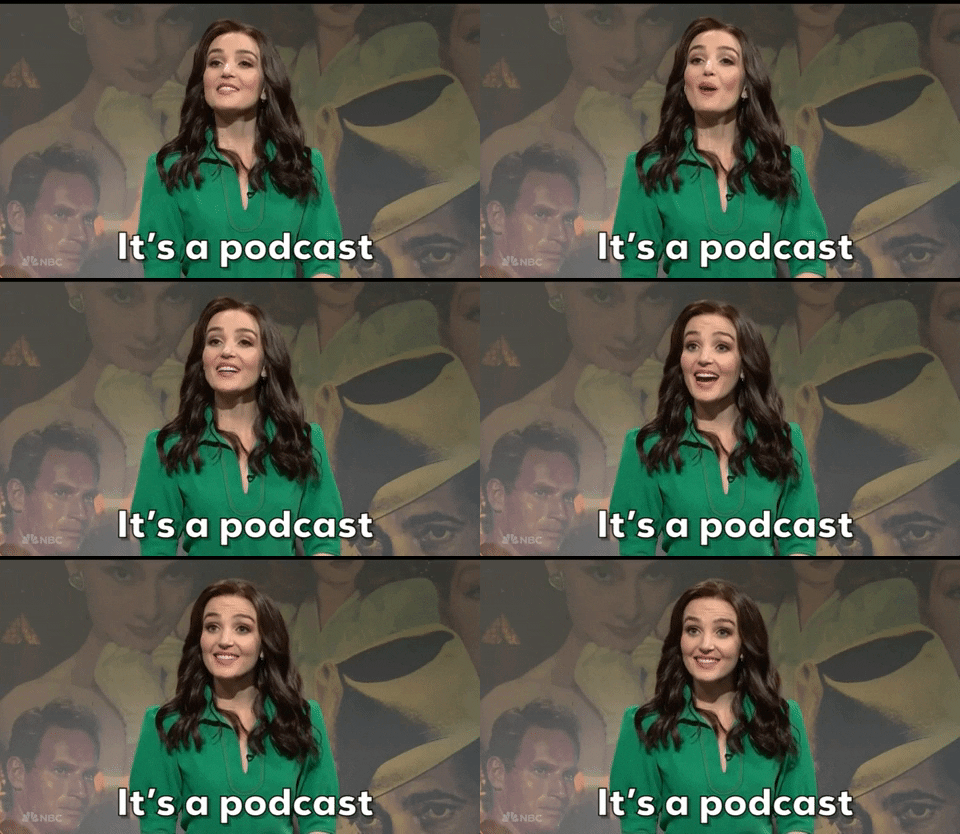
Welcome to a new thing at Situation Normal! Surprise: it’s a podcast!
To hear the story about the time I blew my chance to work with comedy legend George Burns, press Play▶️👆
After you’re done listening…do me a huge favor and share the very first Situation Normal podcast episode with everyone you👇
You can forward this email to your friends, post a link on social media, Restack it on Substack Notes, or hit the share button below👇
After you’ve shared it with everyone on Earth…please consider upgrading your Situation Normal subscription.
Why should you do that?
Simple: paid subscriptions help me produce a newsletter you love. They also help me compensate my friend Todd, who produces, edits, and cohosts the podcast, when he’s not being a kickass husband to his amazing wife, Andrea, and raising their hilarious kid, “Cannonball.”
When I launched paid subscriptions earlier this year, my goal was to add 100 paid subscribers AND put out most of that work for free. So far, so good! Situation Normal has 92 paid subscribers, and 4,000 of you receive my stories for free. I’m really proud of that, and I hope every situation normie—whether you pay, or not—is proud of that too. If you enjoy Situation Normal, and you have the means to do so, please consider supporting my work by becoming a paid subscriber…
It takes $5 and 60 seconds to support Situation Normal👇
Shout out time!Big shout outs to the newest paid Situation Normal subscribers!
Thank you for your support, Marc Typo, who generously compared my comedic range to Steph Curry. Holy shit, that makes a guy feel good, Marc, thank you!
Thank you for your support, Bill Southern, who told me Situation Normal is the first Substack he’s paid real money for. That’s a huge vote of confidence. Thank you, Bill, I won’t let you down!
Where’s that picture of you from the podcast?OK, first of all, as the underrated comedy legend Mitch Hedberg once said, “every picture of you is a picture of you when you were younger.” Think about it, people. Second, here’s a picture of me from the story you listened to. Well, me and my no-nonsense, old school Hollywood barber, Art.
 Does this podcast have an origin story?
Of course it does! Here are the broad strokes.
First, I’ve been around audio my entire life. My dad was the world’s best sound person. No joke. But aside from coiling a lot cable, I’ve always avoided the mic. I’m shy. Again, no joke.
But recently, I joined on his excellent podcast Kurt Vonnegut Radio. It was a lot of fun. It was also really nice to hear from hundreds of situation normies about how much they enjoyed listening to me tell stories. Thank you for your encouragement, everyone!
So I did a few tests on Situation Normal. I read my stories. The tests went fine, but they weren’t fun. I felt awkward sitting alone in my office talking into a mic, and I think that awkwardness came across to listeners.
What to do, what to do?
I needed a way to get comfortable telling a story, and I needed some technical help with the audio stuff too. That’s when I remembered something my dad prided himself on. He used to say, “the solution to your problem is one or two phone calls away.” Larry was famous for sharing little pieces of wisdom like that.
 Larry Estrin taking a minute out of his work on some Super Bowl to pose for a picture with his kids.
That’s when I called my friend Todd. If you don’t know Todd, picture a Swiss Army Knife of a production, wrapped inside a handsome, funny dude. Todd cuts audio and video, makes music, and write and produces on-air marketing and promo for cable networks that pay way better than a comedy newsletter. Toldja he was a Swiss Army Knife!
But Todd’s skills were only part of the package. I also asked Todd to help because we’ve been friends for 20 years. I officiated his wedding to Andrea. Todd officiated when I married Christina. I love Todd. I am comfortable with Todd. So, I had a hunch that telling stories to Todd would feel more natural and be a lot more fun for me, which makes it more fun for the situation normie community.
Anyway, that’s how this project came together. We hope you enjoy it!
Please share your thoughts and questions about the story, the podcast, my voice, Todd’s fantastic work, or anything else that’s on your mind in the comments👇
Want more Michael Estrin stories? I’ve got two books!Ride/Share: Micro Stories of Soul, Wit and Wisdom from the Backseat is a collection of my Lyft driver stories🚗🗣
Not Safe for Work is a slacker noir novel based on my experiences covering the adult entertainment industry💋🍑🍆🕵️♂️
The ebook versions of my books are priced between 99 cents and $2.99, so if you don’t have the budget for a Situation Normal subscription, buying an ebook is a great way to support my work. Bonus: you’ll laugh😂 your butt off, think🧠 about stuff in a new way, and feel the feels💙
IF YOU BOUGHT A BOOK, thank you! Please take a moment to leave a review. It helps a lot! Also, I love hearing from readers, so please feel free to drop me a line at michael.j.estrin@gmail.com.
October 22, 2023
Bad doppelgänger vibes
I often mix up Parker Posey with Mary-Louise Parker. I’ll say things like, “The West Wing really got good when Parker Posey joined the cast.” Or, “Mary-Louise Parker played one helluva a mean girl in Dazed and Confused.” But of course, I am the one who is dazed and confused here. Mary-Louise Parker was on The West Wing. Parker Posey was in Dazed and Confused. The two actors are different people, with (mostly) different names, and they’ve made their reputations playing different roles. But they give me doppelgänger vibes. In fact, sometimes I conflate both women: Mary-Louise Parker Posey.
I’ve been thinking about doppelgängers a lot lately because I’m reading a book called Doppelgänger: A Trip Into the Mirror World by Naomi Klein. As it turns out, social media has a history of confusing the left-wing writer and activist Naomi Klein with Naomi Wolf, a writer who made her bones as a liberal feminist in the 1990s, before decamping to right-wing stardom in these bizzaro times.
I’m familiar with The Shock Doctrine (Klein) and The Beauty Myth (Wolf), but I wouldn’t call myself a devoted reader of either Naomi, which is why I nearly passed on a book I thought was about both of them. But then my friend, Lance, set me straight. “Klein’s book is really good,” Lance texted, before going on to write that Doppelgänger explains more about the weirdness of our times than any other book out there. That was a bold claim, but Lance and I have been trading book recommendations for a while, and we’ve never led each other astray, so I bought the book.
On one level, Doppelgänger is an absurdist memoir. There’s something inherently funny about treating polar opposites as mirror images of each other. That’s why the big joke in the movie Twins—namely that Arnold Schwarzenegger and Danny DeVito are brothers from the same mother—is so damn funny. It’s also why I reply to job recruiters who reach out to offer me high-paid computer engineering jobs. Those recruiters are looking for the other Michael Estrin, the one who is good with computers, but instead they found the Michael Estrin who is good at comedy. To quote Kenny Bania, the hack comedian who serves as a doppelgänger of sorts to Jerry Seinfeld on Seinfeld, “That’s gold, Jerry!”

Speaking of Jerry, depending on the length of my beard, the height of my fro, and the circumference of my belly, I am sometimes confused with the long-dead Grateful Dead frontman Jerry Garcia. I’m not kidding. Here’s a quick anecdote I shared on Facebook in 2016:
A man with a beanie on his head and a tattoo of Spider-Man on his neck can’t believe the line at the Post Office. But he also has trouble believing his eyes.
“Jerry Garcia!” he says to me. “You’re not dead! You’re just getting younger. Can you do something about Phish?”
“People still like Phish?” I ask.
“Yeah, it’s really a problem, Jerry.”
The man explains that he got up “way too early for this shit” and that he smoked “way too much weed.” But he keeps calling me Jerry, and he won’t stop explaining all the comic book remakes since my, um, passing. The gist is that Hollywood has “ruined” this man’s life by “fucking up the Spider-Man timeline,” which apparently, you cannot do “without consequences.”
But back to this Jerry Garcia thing. On one hand, I can’t blame the stranger for joking. These days, my fro is big, my beard is epic, and I'm getting that touch of grey. But the longer we talk, the more I suspect that he’s serious. So I change the subject.
“What do you do?” I ask.
“I’m a poet, just like you!”
I say something about how the poetry business is a tough racket.
“Tell me about it, Jerry. I drive trucks and write rap music to make ends meet.”
I consider a Truckin’ reference, but the poet doubles down.
“Can I get your autograph, Jerry?”
He presents me with pen and paper. I’m inclined to pass, but I don’t want to be rude. What would Jerry do in this situation, I wonder?
My famous, departed, musical doppelgänger would play it cool, I think. So I decide to play it cool too.
I sign my autograph. It reads:
Fuck Phish
Love,
Jerry Garcia
That episode from my life was just a goof, of course. I am not Jerry Garcia, but I remain grateful to the stranger for the funny story. And maybe he’s grateful to me for playing along. Because if he was kidding, we both had fun. And if he was serious, maybe I helped him get through his day—and gave him a souvenir to boot.
But the doppelgänger life isn’t all shits and giggles. Throughout Doppelgänger, Naomi Klein writes a lot about how artists often deploy the mirroring device to explore topics that run the gamut from unsettling psychological territory (most Hitchcock films), our obsession with staying young (The Picture of Dorian Gray), the dangers of fascism (The Great Dictator), and above all, the idea of the “other” (Jordan Peele’s Us).
If Doppelgänger was simply a book about art, I’d say, “that’s cool.” If it was just about the left-wing Naomi being confused with the right-wing Naomi, I’d call the book funny and leave it at that. And if Klein’s point was simply that our politics are incredibly weird and mixed up in this moment, I’d say, “no shit.” But Naomi Klein’s book is about all of things and a lot more.
Doppelgänger is window into our collective selves and the machines we’ve built that so easily and efficiently sort us into groups of “us” and “them.” Typically, these kinds of books play a nifty trick on the reader. The subjects, the people we call them, are easily rendered as others, leaving the reader feeling terrified, superior, smug—or all three at once. But above all, the reader is meant to feel part of the first group, the only group that matters—us.
Klein’s Doppelgänger doesn’t play that trick on its readers. It’s a more introspective assessment of “them” because its focus is on what our need to categorize “them” as them says about us. As Klein argues, a doppelgänger is a sign that something important is being ignored. Basically, we project all of our worst selves onto others, and so doing, we avoid looking at our own complicity. That’s why every doppelgänger story is about confronting the other, but ultimately, every doppelgänger story is really about confronting us.
Reading Klein I couldn’t help but think about my own doppelgängers. I’ve got a few, but the one I want to talk about for a moment is someone I’ll call Eco-Unfriendly Michael. The real Michael, aka me, talks a big game about environmentalism. He votes with the environment top of mind, and urges others to do the same. He recycles. He drives a hybrid car. The real Michael does the things people who care about the environment are supposed to do. But deep down he knows that those things aren’t nearly enough, that his actions amount to a fart in the wind, and worst of all, that he is complicit in the thing he purports to oppose.
That’s where Eco-Unfriendly Michael comes in. He’s my climate doppelgänger, the other, the them, the one I blame for what we’re doing to our planet. Eco-Unfriendly Michael isn’t a climate denier, he doesn’t talk about hoaxes, or cheer for big oil, or even vote for the status quo. Instead, he pays lip-service to saving the planet, preferring to recycle because that is easy, but never once questioning his reluctance to do the hard things like reducing and reusing. Eco-Unfriendly Michael believes what real Michael believes, but he does not act. He shrugs in the face of doom, buries his head in the sand, and figures someone else, somewhere down the line, will fix the mess he helped make.
Facing the truth is hard, maybe the hardest thing humans can do. Maybe that’s why it’s a lot easier for me to point the finger at my doppelgänger, to lay the problem squarely, and solely, at his feet. But doing that isn’t the road addressing the problem, Klein would argue, it’s the road to feeling better about my own complicity.
Maybe that’s why Marc Maron’s joke from End Times Fun about bringing our own bags to the supermarket lands so perfectly for me. I bring my own bags. I know that’s not nearly enough, but instead of doing more, I judge and scold people who don’t bring their bags because it makes me feel smug, which is to say, my smugness masks my complicity. Hearing Maron tell that joke showed me my doppelgänger, but if we’re being honest, the joke showed me who I really am.
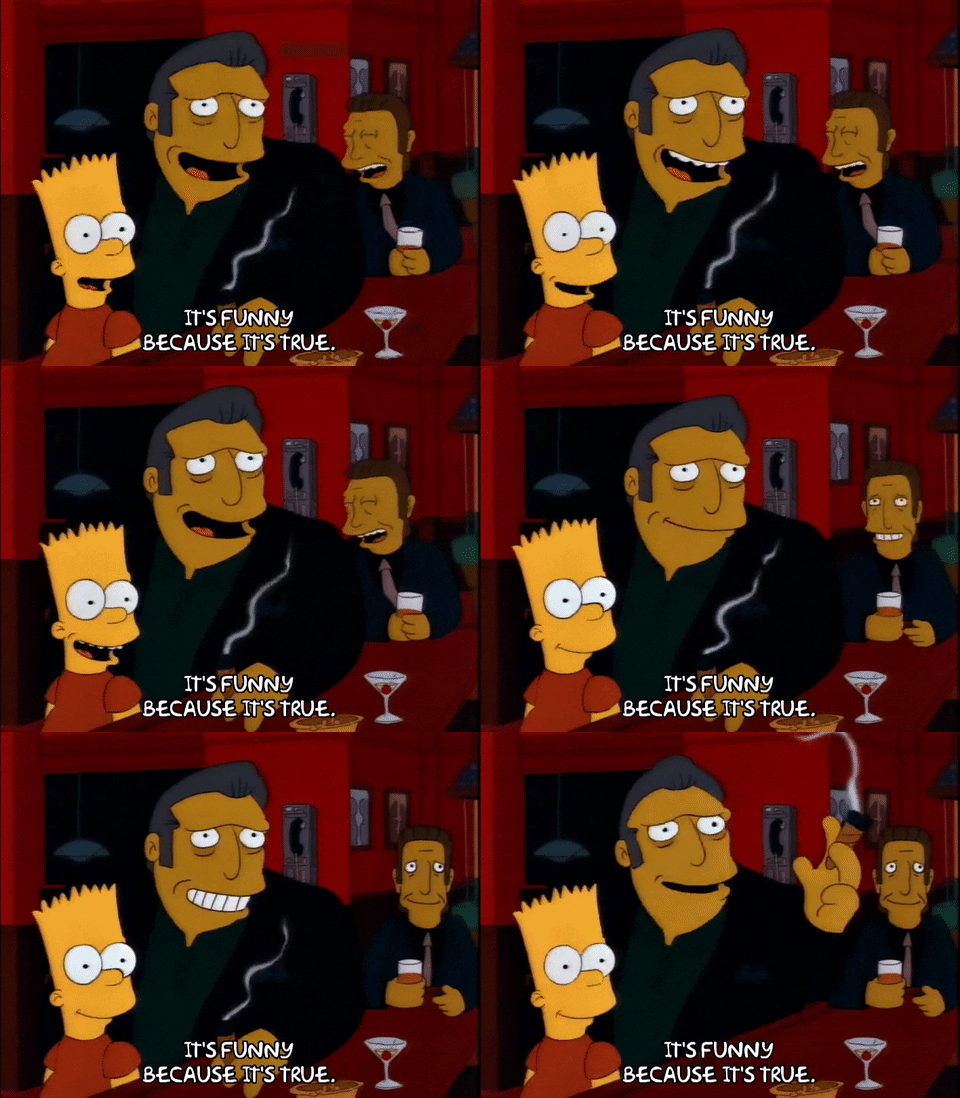
Wherever there’s a truth that goes untold, there’s a doppelgänger telling a distorted version of that truth, according to Klein. Politics in the U.S. is a good illustration of that phenomenon. There’s the Red team and the Blue team. Both teams have significant and substantive differences, but increasingly, politics is the uncomplicated practice of enforcing rigid binaries. When new questions arise, our politics demands that we employ a bizzaro world logic: if the Blue team supports it, the Red team opposes it, and vice versa—no questions asked, or tolerated. Inside that bizarro framework, we can always see the problem with “them,” but when it comes to the problem with “us,” we are blind.
Tellingly, one of the few areas of agreement in U.S politics is is the often-repeated, but seldom questioned refrain, “we are divided.” That’s true enough, I guess. But maybe the more honest statement would go something like, “we are dividing ourselves into warring camps.” Some members of each camp even seem to relish in the idea that America is engaged in a second Civil War—a sprawling digital flame war that consumes another piece of our culture each time our cosplaying online doppelgängers fire another rhetorical shot.
Elsewhere in the world the world, scores of other camps are literally at war. Some countries are at war with themselves, and for some reason these are called civil wars, although as many have pointed out, there’s nothing civil about war. Other countries are at war with their neighbors. And still other countries are at war directly, or through proxies, with countries so far away that many of the people on one side would be hard-pressed to locate their enemy on a map. Which brings me to the essential ingredient of every war. That ingredient is the doppelgänger. Without an “us,” there is no “them,” and without each other, there is no conflict.
Any writer will tell you that a story without conflict isn’t much of a story. I suppose that’s one reason why our macro story, what we call history, is overflowing with tales of conflict. War is in our nature, history tells us. But peace almost always follows war. Which means history is also telling us that peace is in our nature too. The thing is, though, it’s not about war and peace. Those states are manifestations of something deeper—namely, the relentless drive to think in terms of “us” and “them.”
That drive to think in terms of “us” and “them” is often described as normal. After all, history is full of “us” and “them” stories because humans are forever dividing ourselves into whatever camps we need to imagine in order to sustain our conflicts. In that way, the word “normal” makes sense. But normal is also a dangerous word here because it tells us that our behavior is justified, or inevitable, or even good. Calling something “normal” is an instruction that tells everyone to get on with the task at hand, without asking where that task will lead us.
So where are we going? The reason why I decided to write about Naomi Klein’s book this week is that she thinks we’re headed to a very bad place, if we don’t stop to question the ways in which we’re sorting ourselves into “us” and “them.” I agree with Klein’s thesis. I am living through a deadly “us” versus “them” moment, and I think you are too.
As I write these words, battles between “us” and “them” are raging everywhere. According to The Council on Foreign Relations, there are 27 active conflicts around the globe. But that number probably underestimates the number of conflicts in the world because war has an absurdly high threshold that ignores a lot of violence that’s just as horrific, but maybe not as noteworthy, for some reason or another.
Simmering just below the surface of all of that violence are the rhetorical fights that divide us too. As far as I know, nobody bothers counting those fights. The rhetorical conflicts we use to divide and conquer ourselves are as omnipresent to us as water is to fish. But if you want to see the water, social media is a good window. The weird ways we’ve networked billions of humans together via social media opened Klein’s eyes when so many people confused her with her doppelgänger. But even if social media hasn’t assigned you a doppelgänger, maybe you can still see what Klein sees.
To be clear, all media has bias, including the odd little comedy newsletter you’re currently reading. But if traditional media’s ability to sort people into camps of “us” and “them” is a helluva drug called cocaine, then social media’s power to do the same thing is a helluva drug called crack. The big difference, I think, is that where traditional media divides people, social media invites people to do their own dirty work. As it turns out, the DIY version is a lot more powerful.
Spend any time at all on social media and you’ll see what I’m talking about. The former schoolmate who fires off their geopolitical hot take like it’s a cruise missile, then demands that anyone who disagrees unfriend them. The family member who always attacks, but never listens. The friend who is quick to point a finger at anyone they deem “problematic.” The coworker who signals their virtues, without seeing that they’re really confessing their sins. The digital carnival barker who repels one group, while calling to another group like a Siren. The spiritual person who is quick to condemn anyone who isn’t living right. The internet mobs that wrap themselves in cloaks of schadenfreude whenever their enemies stumble. The billions of social media users who sort themselves into “us” and “them” with every 👍 and 👎. The person who insists in the humanity of people like them, but in so doing, diminishes the humanity of the people they see as “other.” It’s tempting to think of the people I’m describing here is someone else, as “them.” But if I’m being honest, I’m talking about “us,” which is to say, I am talking about me.
Maybe I see this behavior most clearly when I look at social media because I think of social media as a machine that robs us of our context in order to rob us of our humanity. The sorting process is as simple as a meme, or badge on your avatar. But even a thoughtful social media post accomplishes the same thing, only with more words. Because even if you write an eloquent essay about rejecting the “us” versus “them” concept, the medium is still the message. Or, put another way, even the right words on social media come out wrong because social media is an endless maze of funhouse mirrors that so completely distort everything that the only thing we’re capable of seeing is “us” and “them.”
But it never stops. Not in the digital world, and not in the physical world either. If anything, what happens in one world accelerates the divisions in the other world, and vice versa. Social media is society’s doppelgänger. Or maybe it’s the other way around. But whatever it is, maybe the gulf between the two versions of our world, the place where uncomfortable truths go unspoken, explains why it feels as if we’re living in bizarro times. Our doppelgängers mirror the worst of us, and vice versa. We/they confront each other because it’s easier than confronting the truth. But those confrontations, the ones we manufacture to avoid the hard truths, will just keep going, from flame wars to real wars and back again, until everything and everyone is engulfed in fire.
This is what frightened me most when I read Naomi Klein’s book. We’re getting better and better at this dehumanizing work. Our doppelgängers are winning, and if that isn’t terrifying enough, we’re cheering them on. We are the engine of our destruction. Our ability, on the one hand, to insist on humanity for “us,” but on the other hand, to deny humanity for “them” is what drives us to the darkest places. As Klein writes:
So much of modern history is a story of pools of trauma being spatially moved around the globe like chess pieces made of human misery, with yesterday’s victims enlisted as today’s occupying army. The story we are trapped in is not about a people, or two people, or twins, it’s a story about a logic, the logic, that has been ravaging our world for so very long.
Part of me is tempted to close this essay by saying something like “give peace a chance.” But that feels trite, and maybe that’s the wrong idea anyway. Because maybe it’s not peace that we need to try, since we’ve tried it nearly as often as we’ve tried war. Maybe we need to try something more radical. Maybe we need to give ourselves, and by extension each other, a chance.
A chance to be seen.
A chance to be understood.
A chance to be human.
Thank you for reading Situation Normal. Please share this post with your doppelgänger👇
Or, if your doppelgänger uses Substack Notes, please Restack this essay so they’ll see it.
 Is your doppelgänger subscribed to Situation Normal?
 When I launched paid subscriptions earlier this year, my goal was to add 100 paid subscribers AND put out most of that work for free. So far, so good! Situation Normal has 90 paid subscribers, and 4,000 of you had the opportunity to read this story for free. I’m really proud of that, and I hope every situation normie—whether you pay, or not—is proud of that too. If you enjoy reading Situation Normal, and you have the means to do so, please considering supporting my work by becoming a paid subscriber.
It only takes 60 seconds and $5 to support Situation Normal👇
Stick around and chat!You know the drill. I’ve got questions, your doppelgänger has answers.
This post started out kinda funny, but then it got serious, and then it got dark. How are you doing? How is your doppelgänger doing?
I told you about one of my doppelgängers. Can you share a little about one of your doppelgängers? Be brave!
What’s your favorite doppelgänger story? It could be a book, a movie, TV show, podcast, anything. Tell me about your favorite doppelgänger story.
Do you have a friend you trade book recommendations with? What book are they urging you to read. What book do you think they should read?
Jerry Garcia is one of several celebrities I’ve been compared to. Do you have a celebrity doppelgänger? Dish!
Want more Michael Estrin stories? I’ve got two books!Ride/Share: Micro Stories of Soul, Wit and Wisdom from the Backseat is a collection of my Lyft driver stories🚗🗣
Not Safe for Work is a slacker noir novel based on my experiences covering the adult entertainment industry💋🍑🍆🕵️♂️
The ebook versions of my books are priced between 99 cents and $2.99, so if you don’t have the budget for a Situation Normal subscription, buying an ebook is a great way to support my work. Bonus: you’ll laugh😂 your butt off, think🧠 about stuff in a new way, and feel the feels💙
IF YOU BOUGHT A BOOK, thank you! Please take a moment to leave a review. It helps a lot! Also, if you take a screen shot of your review and send it to me, I’ll shout you out to say thanks. Email me at michael.j.estrin@gmail.com.
October 18, 2023
Mortimer battles the robot
The other night, I ate dinner at a place called Topanga Social. Essentially, Topanga Social is just a modern twist on the old mall food court concept. The big difference is that you can order from any restaurant using a touch screen. Actually, you have to use the touch screen; talking to the humans who make your food isn’t verboten, but it is strongly discouraged. Then, when your order is ready, some automated system sends you a text, and you pick up your food.
The other thing that’s different about Topanga Social is that it’s meant to be social… as in shared on social media. I didn’t post about the experience on social media, but my friend Veronica did because, well, she’s an Instagram influencer, and so her coverage of Topanga Social is way better than mine👇
the.real.la.mama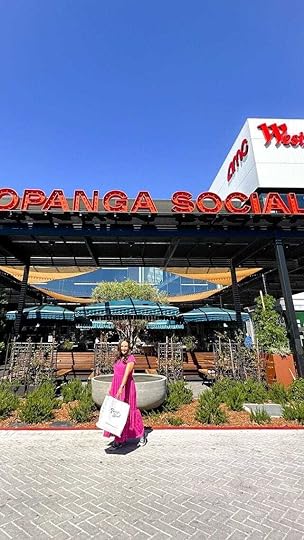 A post shared by @the.real.la.mama
I had a chicken katsu sando, which is basically a fried chicken sandwich from Japan. Holy shit, people, let me just tell you that Japan’s fried chicken sandwich game is next-level. If I wasn’t already married to Christina, I’d make a strong play for that chicken katsu sando.
After I finished eating, something funny happened. Actually, it wasn’t funny at all. It was serious. Or, it could’ve been serious. What happened was this: out of nowhere, an alarm went off. Not a siren, exactly, more like a robotic alarm sound that you hear in the movies when the perimeter of some top secret lab is breached. After a few seconds of alarm sounds, a robotic voice made an announcement.
“A fire has been reported in the building,” the robot said. “Please evacuate the building immediately.”
Naturally, this robot was programmed to just kept doing its robot warning until some human told it to stop. After the third warning to evacuate, the robot sounded like a broken record. But I was already halfway to the exit by that time. I hear fire, and I move my ass. That’s my policy.
But here’s the funny thing that maybe isn’t that funny. Most people stayed put! They kept eating their ramen and nachos and Detroit-style pizza. They heard the robot’s warning—it was so fucking loud you couldn’t hear anything else—but they didn’t heed the warning.
That struck me as foolish and dangerous. But it also struck me as weird. These same people had told a machine what they wanted for dinner, and then that machine had taken their payment, and promised to tell them when their food was ready. They believed the machine could handle dinner, but they ignored the machine when it said there was a fire.
 Big human shout out time!
Thank you to the newest paid subscribers at Situation Normal! Thank you, N. Denise LeNoir! Thank you, David! Thank you, Mike K! I really appreciate the support!
 Send more humans paid subscribers please!
When I launched paid subscriptions earlier this year, my goal was to add 100 paid subscribers AND put out most of that work for free. So far, so good! Situation Normal has 91 paid subscribers, and 4,000 of you had the opportunity to read this story for free. I’m really proud of that, and I hope every situation normie—whether you pay, or not—is proud of that too. If you enjoy reading Situation Normal, and you have the means to do so, please considering supporting my work by becoming a paid subscriber.
It takes 60 seconds to upgrade your paid subscription👇
Mortimer battles the robotPress Play to hear me read this story and do some really cheesy robot sound effects🤖▶️
The original text from July of 2020If you ask Christina, the pancake-shaped droid that cleans our floors is the best purchase we ever made.
If you ask me, the droid is trouble. I won't let it into the kitchen while I cook. For one thing, it's a hazard. That sucker could trip me while I'm carrying a hot baking dish, or a sharp knife. But that's not it, not really. I'm not worried about foul-play. It's fair play I fear. Today, the droid cleans the floor, tomorrow it chops up the veggies and fries them up in a wok, the day after that I'm out of a job.
Do wives dream of electric husbands?
The dog has his problems with the droid, too. Like all dogs, Mortimer believes that if he hides under the couch, he is invisible. That belief dies hard two weeks after the droid's arrival. From under the couch, Mortimer watches the droid approach. At first, he's curious, then concerned. When the droid is less than a foot away, Mortimer realizes he's fucked. Because he's under the couch he can't get up to run away. Then, in an instant, droid meets dog.
BEEP-BAP!
The droid is well-programmed. It rolls away, one hundred-eighty degrees in the opposite direction. Perhaps, it even learned something, or at the very least, it transmitted the incident back to its programmers for future learnings.
Mortimer, flees the scene too. Out from under the couch, a quick glance at his nemesis, then off like a jack-rabbit all the way to the other end of the house. The dog's learnings are immediate: THE COUCH HAS BEEN COMPROMISED.
Help Mortimer and me defeat the robots by sharing this post👇
Or, if you use Substack Notes, highlight your favorite quote and hit the Restack button🙏
 Stick around and chat!
You know the drill. I’ve got questions, you’ve got answers.
Have you ever met a sandwich you wanted to marry? Tell your story.
If a human tells you there’s a fire, you run away. But what do you do if a robot tells you there’s a fire? Explain.
Do you own a Roomba? If so, does it terrorize your pets? Tell their story.
Have you ever eaten Detroit-style pizza, and do I need to try it? Enlighten me!
I don’t know if wives dream of electric husbands, but if you could replace your partner with a machine that cooked, cleaned, and did everything you asked, would you? Go deep on this one, situation normies!
Want more Michael Estrin stories? I’ve got two books!Ride/Share: Micro Stories of Soul, Wit and Wisdom from the Backseat is a collection of my Lyft driver stories🚗🗣
Not Safe for Work is a slacker noir novel based on my experiences covering the adult entertainment industry💋🍑🍆🕵️♂️
The ebook versions of my books are priced between 99 cents and $2.99, so if you don’t have the budget for a Situation Normal subscription, buying an ebook is a great way to support my work. Bonus: you’ll laugh your butt off!
*If you bought a book, thank you! Please take a moment to leave a review. It helps a lot! Also, if you take a screen shot of your review and send it to me, I’ll shout you out to say thanks. Email me at michael.j.estrin@gmail.com.
October 15, 2023
Weird shit happens when I wear Warren Zevon t-shirts. That tracks.
I love t-shirts. I also love Warren Zevon. For my birthday, Christina got me two Warren Zevon t-shirts because she loves me.
On Saturday, I put on one of my Warren Zevon t-shirts and took Christina to breakfast.
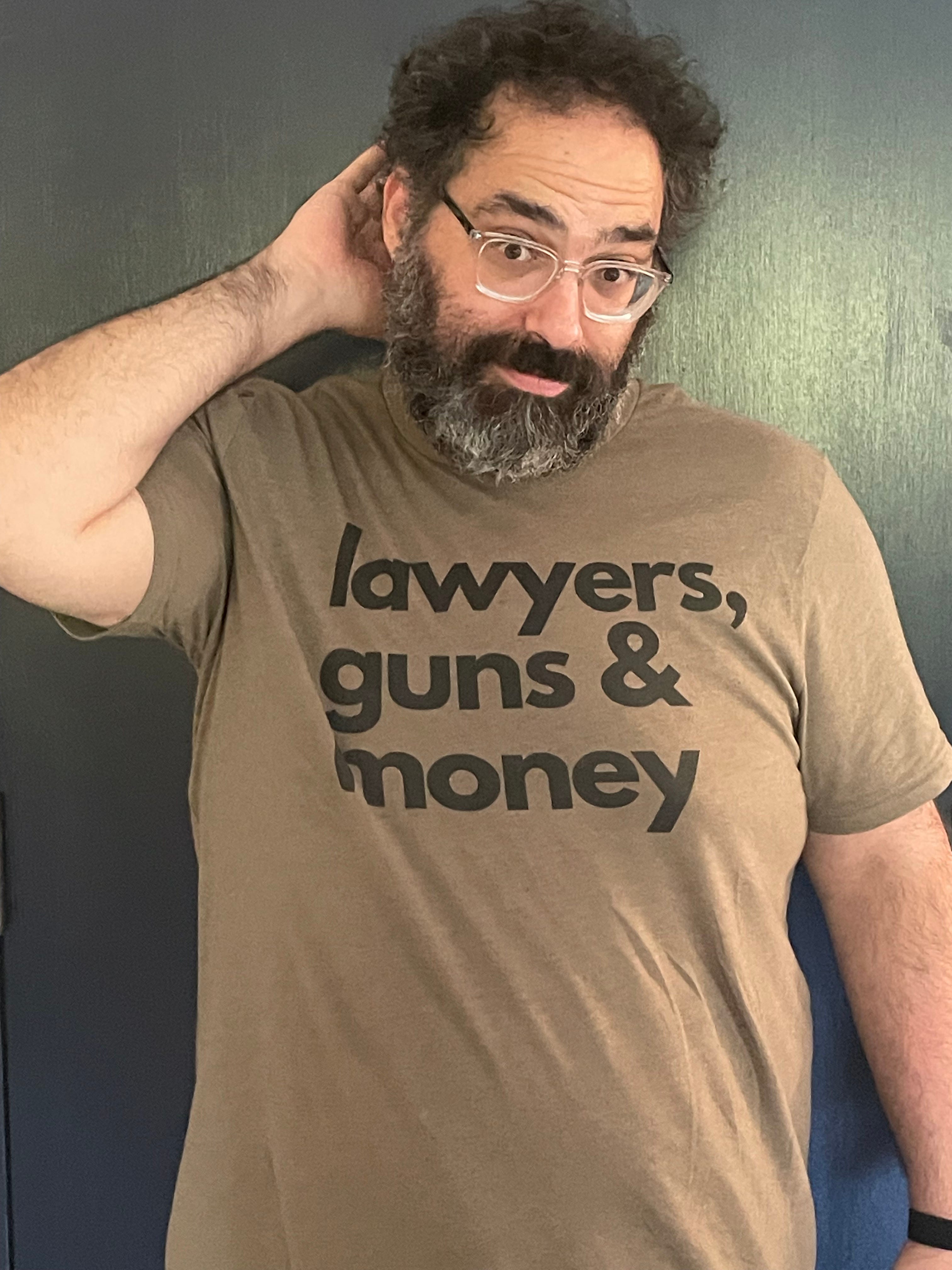
Lawyers, Guns & Money is a song that tells the absurd story of a privileged young man who visits Cuba, where he drinks and screws his way into some really deep international doo-doo that may, or may not, involve the Russians, too. The chorus is the young man’s plea for help:
Send lawyers, guns, and money, dad, get me out of this.
When the cashier at Bob’s Big Boy asked me about my shirt, I said it was a Warren Zevon t-shirt.
“Who?”
This happens a lot. Warren was a songwriter’s songwriter and a humorist’s humorist. Nearly all of his songs are dark, most of them are hilarious, and many of them are heartbreakingly beautiful. But aside from Werewolves of London, Warren Zevon always had more of a cult following than anything approaching stardom.
I tried to explain this to the cashier, but it didn’t really register with her. It probably didn’t help that Warren died twenty years ago. Before he left this world, Warren went on Letterman one last time, sang some songs, reminisced with Dave, and told the audience the secret to a happy life: “Enjoy every sandwich.” You can find that appearance on YouTube, but I’m not sure how a young woman, who was probably born around the time Warren died, would even know to search YouTube for that clip. Unless one of Warren’s songs trends on TikTok—between the fickle tastes of Zoomers and the hard-nosed tactics of the music licensing gods, there’s always a chance, right?—I don’t think Warren’s fan base is likely to expand. Which is too bad because Warren’s gallows humor is more resonant with each passing year. Also, he wrote some eternal bangers, especially Desperados Under the Eaves, Roland the Headless Thompson Gunner, Mohammed’s Radio, Carmelita, and My Shit’s Fucked Up.
But there are Warren Zevon fans still walking among us. That’s why I wanted the t-shirts. I figured I’d wear a shirt featuring an obscure musician and maybe make a friend. But in this case, I had clearly figured wrong.
“Honestly, that shirt is kinda scary,” the cashier said. “It’s got guns—scary. And lawyers. I don’t like lawyers.”
“Don’t forget money,” I said. “Everyone likes money.”
The cashier tried to force a smile, but I could tell I had lost her. So I gave her my money and went on my way.
The next day, we went to a friend’s birthday party at a Los Feliz bar called Ye Olde Rustic Inn. Since it was a dive bar, I decided to fly casually. I put on my other Warren Zevon t-shirt. This one shouldn’t cause any trouble, I reasoned, because it was just a picture of Warren and his name. No bad vibes there.

Christina and I picked up our friend Mia Toretto (not her real name) on the way to the bar. We parked on a side street and since we had time, we decided to get dinner first. But as we walked to a nearby vegan restaurant, a woman’s voice screamed out.
“Christina! CHRISTINA!”
The screaming woman was someone Christina used to know. She was drunk. Her friend was less drunk. They had been drinking and watching football all day at another Los Feliz bar called the Drawing Room, but they had stepped outside to vape.
“That was like an hour ago,” the less drunk woman said.
“You gotta come inside and meet my husband,” the very drunk woman said.
We didn’t want to go inside the Drawing Room. We wanted to get dinner. But drunk people don’t make requests, they make demands. We went inside.
As we entered the Drawing Room, a burly dude in a Jets jersey noticed my shirt.
“Warren Zevon,” he said, “hell yeah.”
I felt good about my taste in music. I felt good about my sartorial choice. And despite the fact that we were in the wrong dive bar, things felt promising.
While Christina chatted with an old friend, Mia Toretto and I struck up a conversation with the drunk woman’s husband. To protect the guilty, I’m going to give him an alias. We’ll call him Crockett Tubbs.
Like his wife, Crockett Tubbs was also drunk. Really drunk. But he seemed friendly, and we were sort of stuck there, so I asked what he did for a living.
“I’m a detective,” he said. “I work narcotics!”
Suddenly, the picture came into focus. Crockett Tubbs was built like a linebacker. A pair of Oakley sunglasses dangled from his thick neck. He looked like he was either twenty-eight or forty-seven.
“Do you know [REDACTED]?” Mia Toretto asked.
“Yeah,” said Detective Crockett Tubbs. “No wait, who?”
Mia Toretto explained that [REDACTED] was a friend of ours, a homicide detective who works in the Valley.
“Oh!” said Detective Crockett Tubbs. “I thought you were joking, like you were asking if I knew a guy who isn’t, like, a real guy. Like, you know, a TV detective.”
“Wait, do you know Harry Bosch?” I teased.
“Yeah, totally, Bosch,” Detective Crockett Tubbs said. “Wait, you guys really know a cop? Like for real?”
“Yes.”
“That’s suspect. I might have to arrest you guys.”
Mia Toretto and I laughed, but just in case it wasn’t a joke, I played another LAPD nepotism card.
“Full disclosure, I also know [DIFFERENT REDACTED COP]. Do you know him?”
“Wait!? You know two cops? That’s super suspect. I’d bust you, but I like that Warren Zevon t-shirt.”
“Hang on,” I said. “Are you telling me that my Warren Zevon t-shirt is a get-out-of-jail-free card?”
“Yeah,” Detective Crockett Tubbs said. “Cops love Warren.”
Holy crap, I thought, new shit had come to light! This t-shirt wasn’t just a fan magnet, it was a license for lawlessness. What would Warren Zevon, a man who struggled with booze and drugs most of his life and who never achieved enough commercial success to reap the rewards of merchandizing, have thought about a narcotics officer fan? Honestly, I don’t know, but there’s enough irony there for Warren to have written an entire album.
Or maybe not. Detective Crockett Tubbs was clearly intoxicated, and Mia Toretto and I had already established that he was bad with names. Was he confusing Warren Zevon with Warren G? No, that didn’t make sense. But then again, none of this made sense. We were in the wrong dive bar, talking to a cop who didn’t believe we knew any other cops. And inside that nonsensical narrative, I had found a musical hack to the rule of law? No way, I thought, I need to clarify this pronto. But before I could ask a follow-up question, shit got weird.
The lights went out in the bar. No, really, the lights went out right after Detective Crockett Tubbs told me “the cops love Warren.”
In the darkness, someone screamed. Someone else said something about free drinks. Then another person screamed. And another. I heard a snarky comment about paying the electric bill, followed by booze-soaked cackle, then speculation about disasters—everything from a power outage to the apocalypse.
I felt uneasy. For one thing, I don’t see too well in the dark. For another thing, I’m a stoner, not a drinker, so a dive bar with a narcotics officer just isn’t my cup of tea. But as it became clear that the darkness wasn’t going away, the situation began to feel dangerous. Six-dozen drunks stumbling around in the darkness inside of a dive bar built for three-dozen drunks is a recipe for mayhem.
I looked for Mia Toretto, but all I saw was the abyss of a windowless dive bar. I looked toward the bar where I had last seen Christina, but I couldn’t find her either. I couldn’t see anyone, not even Detective Crockett Tubbs, and he had been standing right in front of me when the lights went out.
The situation felt Zevonian, at least to me. One minute, the dive bar had been a scene of revelry. The next minute, there was darkness, fear, uneasy chatter, and wild speculation. As my anxious mind served up one terrible scenario after the next, I found a small comfort in Zevon’s gallows humor.
Send lawyers, guns, and money, Christina, get me out of this.
And she did!
Maybe because my wife is a badass who takes action while others are still taking stock, or maybe because Christina was “Sober-Wan-Kenobi,” she was the first person to remember that her phone is also a flashlight. Using her glowing phone to guide the way, Christina found my hand in the darkness…
and led me toward the light.
Thanks for reading Situation Normal, lead your friends toward the light (and laughs) by sharing this post👇
And if you use Substack Notes, please Restack this story because it won’t Restack itself.🙏
 An audio coda for this Warren Zevon story!
Press play to hear what happened after we escaped the dive bar…
SendWhen I launched paid subscriptions earlier this year, my goal was to add 100 paid subscribers AND put out most of that work for free. So far, so good! Situation Normal has 89 paid subscribers, and 4,000 of you had the opportunity to read this story for free. I’m really proud of that, and I hope every situation normie—whether you pay, or not—is proud of that too. If you enjoy reading Situation Normal, and you have the means to do so, please considering supporting my work by becoming a paid subscriber.
It takes 60 seconds to upgrade your subscription👇
Stick around and chat!You know the drill. I’ve got questions, you’ve got answers.
Do you have a favorite t-shirt? Tell us all about it!
Are you Warren Zevon fan, or do I need to come over to your house to play some tunes and change your life for the better? Honestly, I’ll do this, travel budget permitting.
How are your vibes when you enter a dive bar? No wrong answers here.
Do you know any cops, fictional or real? Are they Warren Zevon fans? Dish!
How is Harry Bosch doing these days? Get weird with your answer!
Want more Michael Estrin stories? I’ve got two books!Ride/Share: Micro Stories of Soul, Wit and Wisdom from the Backseat is a collection of my Lyft driver stories🚗🗣
Not Safe for Work is a slacker noir novel based on my experiences covering the adult entertainment industry💋🍑🍆🕵️♂️
The ebook versions of my books are priced between 99 cents and $2.99, so if you don’t have the budget for a Situation Normal subscription, buying an ebook is a great way to support my work. Bonus: you’ll laugh your butt off!
*If you bought a book, thank you! Please take a moment to leave a review. It helps a lot! Also, if you take a screen shot of your review and send it to me, I’ll shout you out to say thanks. Email me at michael.j.estrin@gmail.com.
Warren Zevon’s final appearance on LettermanOctober 8, 2023
Apple Watch Nights: The Ballad of Christina
The other night, I fell asleep on the couch while watching Talladega Nights: The Ballad of Ricky Bobby. Will Ferrell didn’t notice that I had fallen asleep, and Christina didn’t notice either. Until I began to snore.
“Honey, let’s go to bed,” Christina said.
“What time is it?”
“Almost midnight.”
Christina turned off the television, locked the front door, and headed off to the bedroom. After I took Mortimer out back to pee, we went back to the bedroom.
I had to pee too, but the bathroom was occupied.
No big deal.
Except, strange things were afoot in our bathroom.
Christina was seated on the toilet. That part was normal. The abnormal part was that my wife was throwing punches—stinging jabs, crushing crosses, and devastating uppercuts. She looked like Mike Tyson shadow boxing on the crapper.
My first thought was that Christina was under attack, possibly from poltergeists, which can be tricky, even for a power-puncher like Christina. My second thought was that as Christina’s husband, partner, and life buddy, I was duty-bound to jump into the poltergeist melee, which can be tricky for a coward like me.
“I’ve got to close my rings,” Christina explained. “I have four minutes left, and I need to burn fifty calories.”
Oh! That explained the punching. And thankfully, this wasn’t a poltergeists situation. But it was an Apple Watch situation, and those can be tricky too. See, the selling point of the Apple Watch, at least for us, is that it gamifies exercise and movement. Maybe that makes us rats in Apple’s weird digital maze, but since we started wearing our Apple Watches, we’ve been moving and exercising more. The results have been good. We feel better, we have more energy, we’ve lost weight, we’ve lost inches (centimeters when we travel abroad), and according to Kaiser Permanente, our blood work is “the tits.” Basically, these damn Apple Watches work! But you’ve got to close those rings.
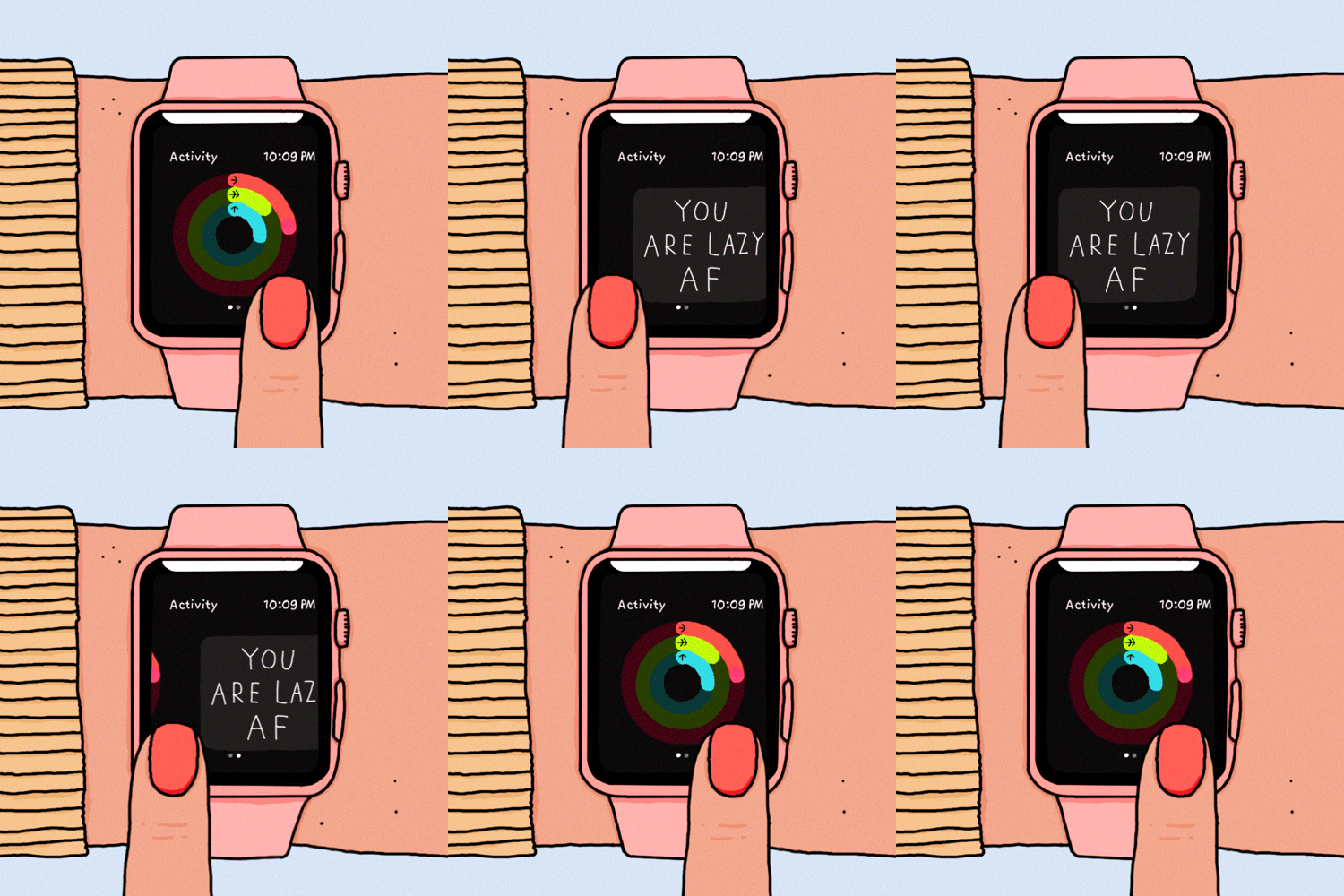
“You need to move your legs,” I said.
Christina fired off a series of kicks. Now, she looked like Jean-Claude Van Damme on the crapper.
“No, get up and move,” I said.
Chrisinta finished her business, got up, washed her hands, and began to pace around our bedroom.
“Gotta move, gotta move,” she said.
But then Christina did the one thing you never want to do when you’re on a ring-closing run. She stopped to check her progress.
“Damn it. I still need to burn forty calories.”
I glanced at my watch. Christina had about three minutes to close her movement ring.
“Keep moving,” I shouted. “Never stop!”
Christina began to pace again, but she needed to pick up the pace if she was going to close those rings.
“I’ll help you,” I said. “Alexa, play Eye of the Tiger by Survivor.”
A moment later, the greatest sports training montage song of all time began to play.
“Go! Go! Go! You got this! Push it! Move it! Go! Go! Go! Eye of the tiger, baby!”
For the next few minutes, I shouted encouragement. Mortimer barked encouragement. Christina ran, punched, and kicked her way around our bedroom. She looked like Jason Bourne in pajamas.
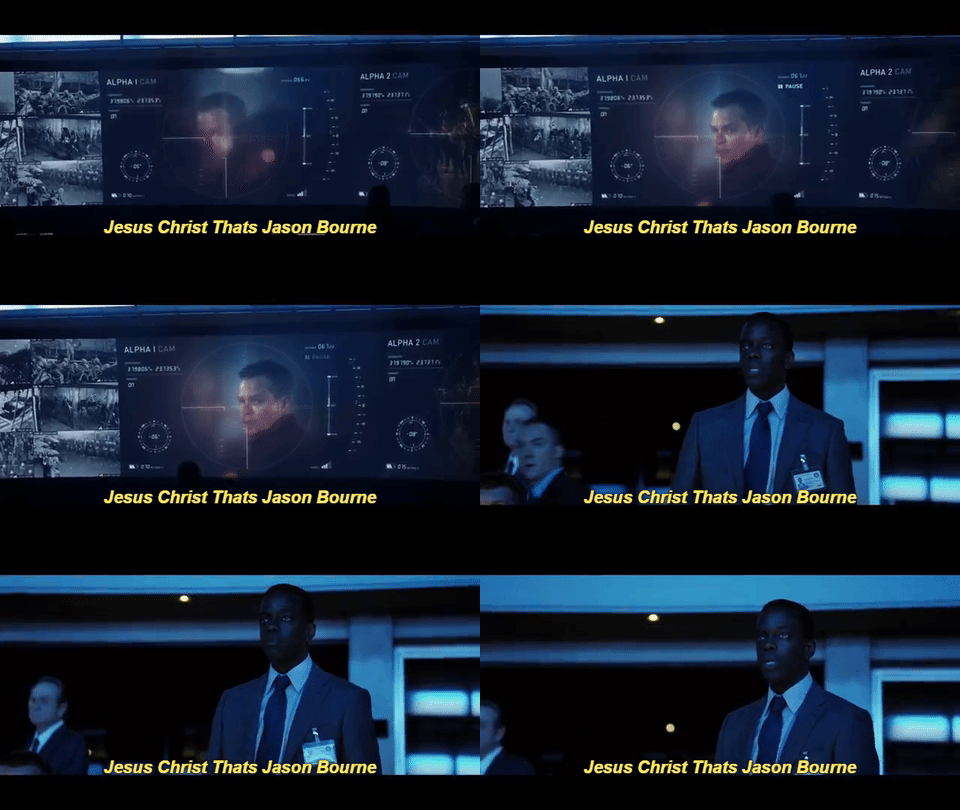
Christina gave it her all. She embraced the eye of the tiger. She lost herself in the thrill of the fight. She rose up to the challenge of her rival—that damn Apple Watch and its stubborn rings. But much like Rocky Balboa at the end of the first movie, Christina’s all won her the respect of the crowd, but not the fight.
“Damn it,” she said as she tumbled into bed. “I missed it by three calories.”
I might’ve pointed out that for all it’s whiz-bang technology the Apple Watch is an imprecise tool, and that Christina probably did hit her movement goal, even if she didn’t close her rings. But such a comment would’ve felt hollow— like telling Ricky Bobby that even though he didn’t finish first, he wasn’t last. So instead, I leaned over and kissed Christina.
“You’ll close ‘em tomorrow, champ. Great effort.”
Laughter burns calories. Help someone hit their fitness goals by sharing this post👇
If you use Substack Notes, hit that Restack button (it won’t hit back, promise).
Shout out timeAn energetic, calorie-burning shout out to ! Thank you for supporting Situation Normal, Amanda! Also, an energetic, calorie-burning shout out to Clay C. Thank you for becoming an annual subscriber, Clay!
Folks, my writing super power is turning Lyft rides, awkward yoga classes, tech questions from our racist neighbor, conversations about hot sauce, working as a PA at Richard Nixon’s funeral, McDonald’s breakfast, and cheese boards into the stories you love. Paid subscriptions help me carve out time from my freelance writing schedule to amuse you. As a thank you, paid subscribers receive a shout out, occasional exclusive stories, and full access to the archives.
Upgrading takes about 60 seconds. Please consider supporting Situation Normal🙏.
Stick around and chat!You know the drill. I’ve got questions, you’ve got answers.
Do you use a wearable device that measures your movements, or are you sane? Dish!
To close my rings, I enjoy walking uphill and doing yoga; I tolerate the elliptical machine. How about you?
What’s your favorite sports training montage song? Help everyone level-up their exercise playlist!
Is anyone else wondering why Hollywood hasn’t made a limited series legal drama that explores the possibility that Rocky actually beat Apollo Creed in the first movie, and that maybe the fix was in because boxing is totally corrupt? Go deep on this one!
I probably owe the cast and crew of Talladega Nights: The Ballad of Ricky Bobby an apology for falling asleep. How can I make it up to them?
Want more Michael Estrin stories? I’ve got two books!Ride/Share: Micro Stories of Soul, Wit and Wisdom from the Backseat is a collection of my Lyft driver stories🚗🗣
Not Safe for Work is a slacker noir novel based on my experiences covering the adult entertainment industry💋🍑🍆🕵️♂️
The ebook versions of my books are priced between 99 cents and $2.99, so if you don’t have the budget for a Situation Normal subscription, buying an ebook is a great way to support my work. Bonus: you’ll laugh your butt off!
*If you bought one of my books, thank you! Please take a moment to leave a review. It helps a lot! Also, if you take a screen shot of your review and send it to me, I’ll shout you out. Email me at michael.j.estrin@gmail.com.
One last thing!I was recently on a podcast called Kurt Vonnegut Radio with Gabe Hudson. You should listen because this conversation was a lot of fun.
October 4, 2023
Old story, new audio version
I’m trying to get better at reading my stories aloud. And by trying, I mean, I’m actually doing it. Practice + Google Maps is how you get to Carnegie Hall, right? Kidding. I’m not trying to get to Carnegie Hall, and if I were trying to get there, I’d probably just take the subway.
But I am working to build up my audio muscles because I like the added dimension audio brings to my stories. Also, as the son of the world’s best sound man, I know my dad would get a kick out of hearing me step up to the mic to tell Situation Normal stories.

For the moment, I’m trying to keep this as simple as possible. I’m recording older stories from the first year of Situation Normal and embedding the audio file in the post. Situation Normal was a lot smaller in its first year, so chances are this story is new to 99.2% of the situation normie community. But just in case audio isn’t your thing, I’m republishing the original text here too. In other words, you can have it your way, just like when you go to Burger King.
OK, enough rambling. Here’s the audio version of “Incorrigible.” All you have to do is press Play.
“Incorrigible” — original text“She’s not going to change,” I say. “She’s incorrigible.”
“What does incorrigible mean?” Christina asks.
A mild panic overtakes me. I was just trying to spice up our dinner conversation with one of those five-dollar words, but Christina has called my bluff. I do not know what incorrigible means, and so I do what comes naturally. I bullshit.
“It’s an old-timey word,” I say. “It was in popular use in England at the dawn of the Industrial Revolution.”
I stumble through a brief history of industrialization. The gist is this: people used to work on farms, then factories became a thing, which disrupted the social fabric of the agrarian economy, which resulted in some people, who couldn’t, or wouldn’t, for whatever reason—brutal labor conditions, mental illness, poverty wages, etc.—get with the program. Those people were labeled incorrigible.
“Cool. What does incorrigible mean?”
Damn it. College bullshit didn’t do the trick. Time to break out the law school bullshit.
“I saw incorrigible a lot reading old English common law cases,” I say. “Back in the day, the legal system was crude AF in terms of how it classified criminals, and there were these people…”
“Incorrigibles?”
“Yes, exactly! Incorrigibles!”
“But what were they exactly?”
“They were people who were very difficult to deal with.”
“How so?” Christina asks. “Difficult in what way?”
“Well, it was a different time…”
“Honey,” Christina says, “you have no idea what incorrigible means, do you?”
“No, not really. But I’m still comfortable using it in a sentence.”
“Go for it,” Christina says.
I clear my throat, take a sip of water, and let it rip.
“Alexa, what does incorrigible mean?”
“As an adjective,” Alexa says, “incorrigible is defined as not corrigible.”
“Looks like I’m not the only one bluffing here,” I say.
“Alexa,” Christina says, “what does corrigible mean?”
“Kerbel is a surname,” Alexa says.
Christina turns her head to face Alexa. In a loud, clear voice she asks, “Alexa, what does corrigible mean?”
“Courage is a noun,” Alexa says.
“No!”
“Courage,” Alexa continues, “is defined as the quality of mind or spirit that enables a person to face difficulty, danger, pain, etc., without fear; bravery.”
“Alexa, what does corrigible mean?” Christina asks again.
Once again, Alexa repeats the definition of courage.
“Alexa, please define the word corrigible,” Christina says.
Alexa repeats the definition of courage for a third time.
“I give up,” Christina says.
“You have to admit. It took a lot of courage for her to say that shit three times.”
But Christina isn’t laughing. She’s on a mission to discover what incorrigible means. So, she handles her business the old-fashioned way. She Googles it. On her iPhone.
“It means not able to be corrected, improved, or reformed,” Christina says.
“Exactly! Alexa is incorrigible!”
Don’t be an incorrigible, share the story👇
Or, if you use Substack Notes, please hit the Restack button (it won’t hit back, promise).

I learned a lot from my first recording session, but this particular story had it’s own special lesson👇
 Shout out time
A big text-based shout out to Leigh, the newest paid subscriber at Situation Normal! Thank you so much for supporting my work, Leigh!
My writing super power is turning Lyft rides, awkward yoga classes, tech questions from our racist neighbor, conversations about hot sauce, working as a PA at Richard Nixon’s funeral, McDonald’s breakfast, and cheese boards into the stories you love. Paid subscriptions help me carve out time from my freelance writing schedule to amuse you. As a thank you, paid subscribers receive a shout out, occasional exclusive stories, and full access to the archives. Please consider supporting Situation Normal🙏
Upgrading your Situation Normal subscription takes 60 seconds👇
Stick around and chat!You know the drill. I’ve got questions, you’ve got answers.
Do you have a favorite old-timey word? Share it!
At the beginning of this story, I was trying to tell Christina that someone was “incorrigible.” What led up to that comment? Wrong answers encouraged!
Are your devices (Alexa, Siri, Echo, etc.) a source of humor, frustration, or are they genuinely helpful? Explain.
Isn’t it ironic that Alexa interrupted my recording of a Situation Normal story where Alexa is the guest star? Tell me about irony, Alanis!
In the audio business, feedback is bad. But in the writing business, feedback is good. What did you think of the audio version? Be honest.
Want more Michael Estrin stories? I’ve got two books!Ride/Share: Micro Stories of Soul, Wit and Wisdom from the Backseat is a collection of my Lyft driver stories🚗🗣
Not Safe for Work is a slacker noir novel based on my experiences covering the adult entertainment industry💋🍑🍆🕵️♂️
The ebook versions of my books are priced between 99 cents and $2.99, so if you don’t have the budget for a Situation Normal subscription, buying an ebook is a great way to support my work. Bonus: awesome stories and laughs!
*If you bought one of my books, thank you! Please take a moment to leave a review. It helps a lot💪🙏
October 1, 2023
My wife did it for the gram, I did it for the GIF
Recently, a Google calendar alert reminded Christina and me about our twelfth anniversary. Just kidding. A Facebook memory was what tipped us off.
At first, I thought about writing an essay to mark the occasion. Since we’ve been married twelve years, I wanted to offer twelve lessons about marriage. Something profound, but also beautiful and soulful, but not too preachy, so maybe a little funny, but not too funny because it should also be—gulp—wise.
But when I sat down to write that essay, I kept thinking about IKEA. To me, IKEA is a good test of a relationship. If two people can survive a trip to IKEA, agree on a piece of furniture, lug it back to their home, and assemble it, without killing each other, their relationship will last at least as long as that piece of IKEA furniture.
And now you know why I’m an unlicensed marriage counselor. Again, kidding. I am a certified joker, and I wrote that IKEA bit into our wedding vows.
Which reminds me that twelve years ago, our friends and family gathered in Palm Springs, California for our wedding. One thing every married person told us at the time was that weddings are crazy, and that you really should take a beat to remember the experience. But then those same people admitted that their weddings were a blur because it’s impossible to take a beat on your wedding day, so you should hire a photographer to capture your beautiful memories while you’re busy making forgetting them.
We hired a photographer. Before the ceremony, she took this photo of us.
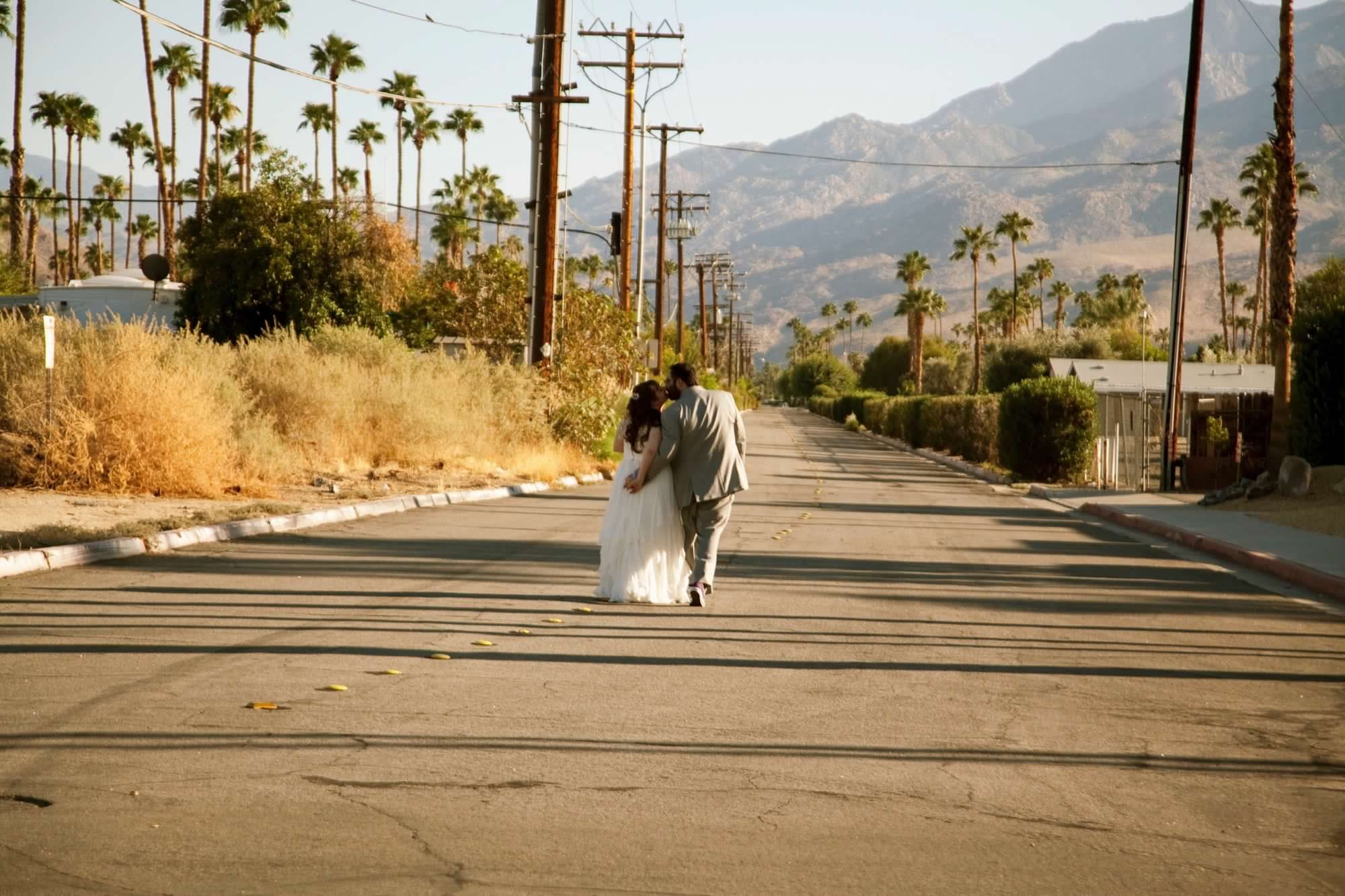
The idea was that Christina and I would walk off down the road of life together. Very cinematic, right?
But the part I remember is that our photographer told us to keep walking, then loop around and meet her by the hotel’s main pool for more photos. So we went for a walk, just the two of us. I don’t recall our conversation, but I remember thinking how nice it was just be together for a moment, without all the wedding hoopla. I also remember that our walk took us to the other side of the hotel property where we found a locked gate. We didn’t have our room keys on us, so we screamed for help. We shouted something along the lines of: “Help, we’re locked out of our own wedding!”
Eventually someone—I don’t remember who, but probably our photographer—found us. Good thing too because we had a wedding to attend, and Christina had grown tired of my jokes about them starting without us.
After we were married, Christina put some wedding photos, including the one of us walking off down the road of life together, on Instagram. That was 2011. Instagram had only been around for a year. In those days, people didn’t say things like “do it for the gram.” So, we probably didn’t do it for the gram. We did it for the memories, and for our wedding album because Christina really wanted a “kickass wedding album,” and let’s be honest, for an homage to the classic scene in This Is Spinal Tap, where the band gets lost backstage before their show.
Very cinematic, right?
For our twelfth anniversary, all we wanted was a fun day together. We got Dim sum for breakfast. The pork bao was on point, but we didn’t photograph our food for the gram. We were too busy eating, talking, and enjoying spending time with each other.
Dinner was the same story. We went to an Italian restaurant Downtown called Bestia. It’s the kind of place where the waiter tells you everything about your food so that when you take a picture of your plate for the gram you can dominate that foodie hashtag by writing a solid caption. But we didn’t do dinner for the gram, either.
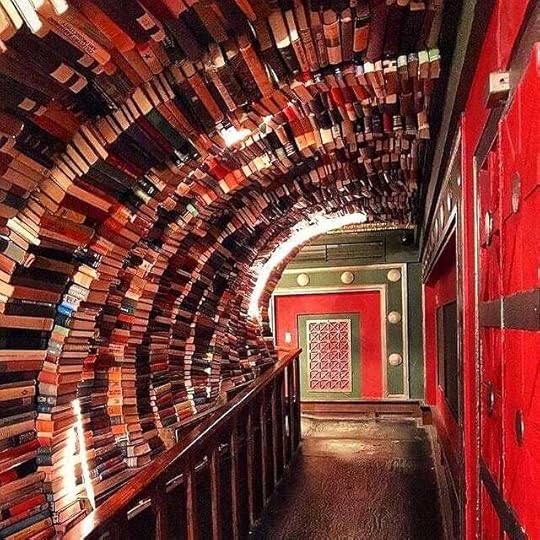
We also went to The Last Bookstore, which is one of those places that’s purpose-built to do it for the gram. If you spend any time at all on Instagram, you’ve probably seen posts from The Last Bookstore.
lastbookstorela A post shared by @lastbookstorelalastbookstorela
 A post shared by @lastbookstorela_ik_wong
 A post shared by @_ik_wong
We didn’t it for the gram at The Last Bookstore either. Instead, we browsed and bought some used records.
But our twelfth anniversary wasn’t gram-free. The main activity was a trip to an art installation called Bubble World, which is all about doing it for the gram.
bubbleplanetexperience A post shared by @bubbleplanetexperience
I think we did Bubble World for the gram. Or maybe, Christina was the one who did it for the gram. She took a lot of pictures, selected the best ones, and put them into an Instagram story. She tagged me in the story, even though I deleted the Instagram app from my phone years ago, got locked out of my account somehow, and never bothered to unfuck that situation because, well, I’m more likely to document my life with words, rather than pictures.
But I do love pictures, especially GIFs.
For one thing, I find the endless loop of a GIF to be both mesmerizing and silly. Also, a GIF carries a narrative weight that’s somewhere between a static picture and a video. If a picture is worth one thousand words, then a two-hour movie, filmed at 24 frames per second, is worth 172,800 words; the humble GIF is a narrative middle ground. But the thing I really love about GIFs is that they mimic the way I experience memories—as brief vignettes my mind plays again and again on loop.
Obviously, we both wanted to remember our twelfth anniversary. We tried to make those memories the old-fashioned way, but just to be safe, Christina did it for the gram, and I did it for the GIF.

Thanks for reading Situation Normal. Help Christina and me celebrate 💍12 years🎂 of 👰♀️marriage🤵♂️ by sharing this post👇
Also, if you use Substack Notes, please Restack this post🙏
Upgrade you subscription to support my work!My writing super power is turning Lyft rides, awkward yoga classes, conversations about hot sauce, visits to porn conventions, Raiders games, working as a PA at Richard Nixon’s funeral, McDonald’s breakfast, and cheese boards into the stories you love. Paid subscriptions help me carve out time from my freelance writing schedule to amuse you. Paid subscribers get a shout out, exclusive Situation Normal stories, and full access to the archives.
Situation Normal is a reader-supported publication—that means I need your help to make this happen. Please take 60 seconds to upgrade your subscription👇
Stick around and chatYou know the drill. I’ve got questions, maybe you’ve got answers.
What do you think of my IKEA test for relationships? Should marriage counselors take the couples they work with to IKEA? Before you answer, remember that IKEA serves meatballs, cake, and ice cream.
What’s your advice for making a marriage, or relationship, or really any partnership go the distance? Pontificate!
Have you ever done it for the gram? Explain.
Let’s talk about GIFs. Do you love ‘em? Hate ‘em? Never think about ‘em? GIF this answer all you got!
Learn more about me and Christina!I recently joined Gabe Hudson on his podcast, Kurt Vonnegut Radio. We spoke about writing Situation Normal and my comedic process, which means we covered a very human moment I had a donut shop, encounters with wild monkeys, catalytic converter thefts (Gabe has a troubling theory of the case), racist neighbors, and trolling moms—basically, my life. But the best part was that Gabe picked up on my creative partnership with Christina. I loved that!
Listen to me on Kurt Vonnegut Radio
Want more Michael Estrin stories? I’ve got two books!Ride/Share: Micro Stories of Soul, Wit and Wisdom from the Backseat is a collection of my Lyft driver stories🚗🗣
Not Safe for Work is a slacker noir novel based on my experiences covering the adult entertainment industry💋🍑🍆🕵️♂️
The ebook versions of my books are priced between 99 cents and $2.99, so if you don’t have the budget for a Situation Normal subscription, buying an ebook is a great way to support my work. Bonus: awesome stories and laughs!
*If you bought one of my books, thank you! Please take a moment to leave a review. It helps a lot💪🙏
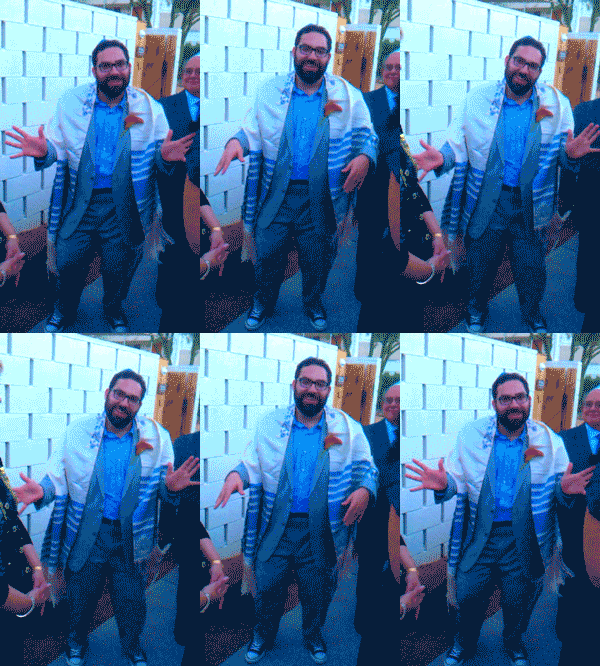
Bonus GIFMy friend Adam Jamal Craig made this GIF of me just before the wedding ceremony. Christina loves it because I’m a “goofball.” I love it because if you look at the margins of the GIF, you can see my mom judging my shenanigans and my dad getting a kick out them. That’s a normal situation, for me.
September 28, 2023
This is cool - I'm on Kurt Vonnegut Radio!
Something really cool happened. I joined Gabe Hudson on Kurt Vonnegut Radio to talk about Situation Normal, my comedic process, and my creative partnership with Christina. We also covered a very human moment I had a donut shop, encounters with wild monkeys, catalytic converter thefts, racist neighbors, and trolling moms—basically, my life. It was an awesome conversation. Actually, it was two awesome conversations that lasted six hours. But don’t worry, Gabe edited it down to a tight 26 minutes.
Now, I need you to do three things🙏👇
1) Listen to my episode on Kurt Vonnegut RadioYou can find the Kurt Vonnegut Radio Substack page here, or you can listen wherever you listen to podcasts by going here.🎙
2) Leave a comment on Kurt Vonnegut RadioGabe has thoughtfully provided discussion questions, and I’m really hoping the situation normie community will show up in the comments and say hi.👋
3) Subscribe to Kurt Vonnegut RadioGabe is always talking to amazing writers—many you know, and many more you need to know. The podcast is totally free (although you can upgrade to paid to support Gabe’s great work). Past interviews include: George Saunders, Charles Yu, Molly Jong-Fast, Alex Dobrenko, Mike Sowden, Sari Botton, Sam Lipsyte, and Akhil Sharma. Up next, he’s talking to Dave Eggers, so take my advice: SUBSCRIBE TO KURT VONNEGUT RADIO!📻
Listen to me on Kurt Vonnegut Radio
September 24, 2023
I ❤️ barbecue chicken pizza. I said what I said.
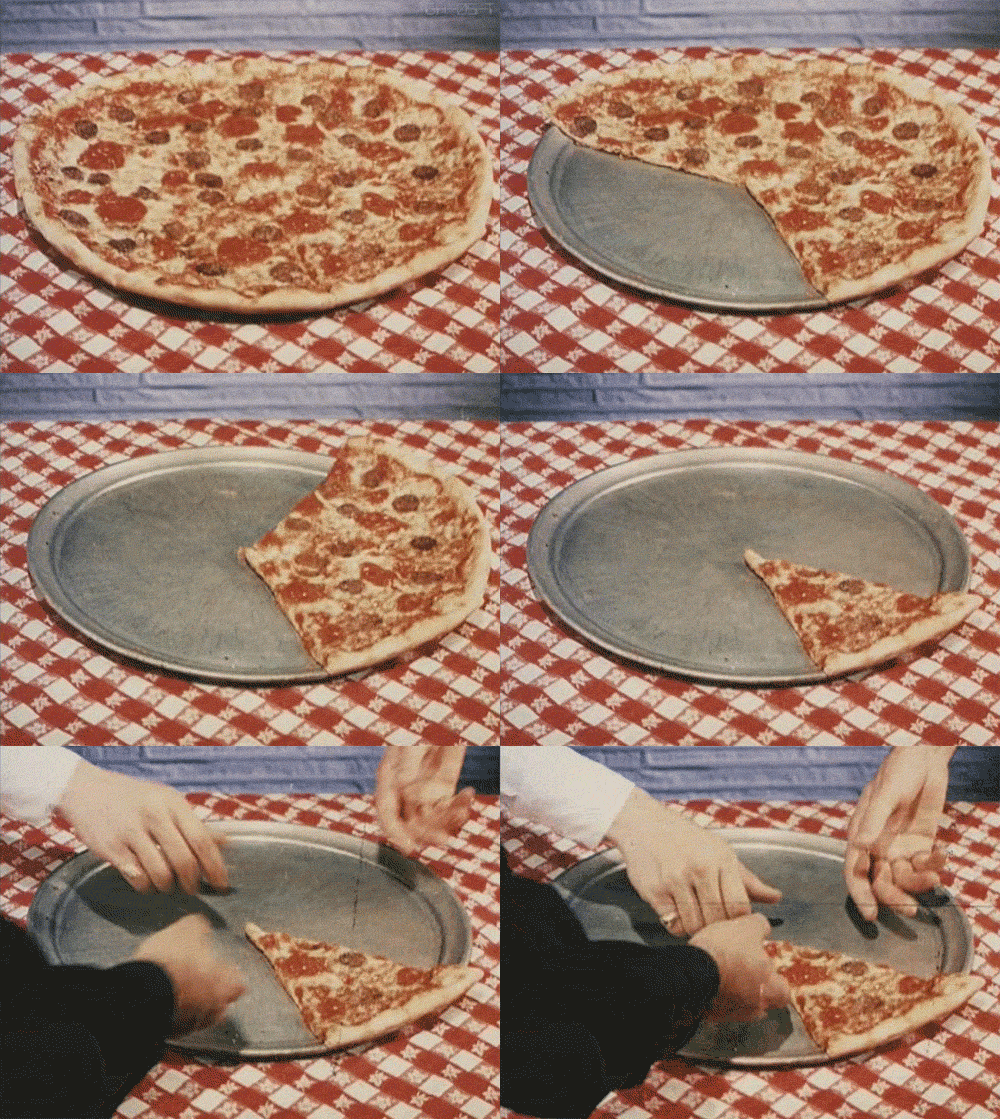
Sometimes I crave barbecue chicken pizza. I realize this is heresy to many pizza lovers. Like its more famous heretical cousin, the Hawaiian pizza, barbecue chicken pizza is a regional take on pizza that draws the ire of pizza traditionalists across the internet. The most vocal pizza traditionalists come from New York, where pizza innovation is against the law, and pizza innovators are mocked without mercy and told to “go back to California,” as if that’s an insult, which it is not.
Ode to Pizza
I celebrate all pizzas—from delivery to DiGiorno,
deep dish or topped with fish,
Hawaiian to hillbilly,
breakfast pizza or cold pizza for breakfast,
a vegan pie or Taco Bell’s Mexican pizza—oh my!
I love a pizza topped with clams, I once ate a pizza made with yams,
I’ll stick with crust through thick and thin, I’ll order pizza again and again,
Veggie lover, or meat supreme, eating all the pizzas is my dream.
 Barbecue chicken pizza backstory
The credit for inventing barbecue chicken pizza belongs to a man hero named Ed LaDou. A 2007 LA Times obituary of LaDou described him as a pizza “pioneer.”1
In the early 1980s, the story goes, Wolfgang Puck discovered LaDou working at a restaurant called Prego in San Francisco. There, Puck ate a pizza topped with ricotta cheese, red peppers, pate, and mustard. He loved it! So Puck offered LaDou a job as head pizza chef at a restaurant he planned to open in Los Angeles called Spago.
At Spago, LaDou made pizza topped with smoked salmon and pizza topped with duck sausage. He also helped Wolfgang Puck make “California cuisine” famous. “It was like being an artist who’d worked with 10 colors all of his life and then got to use 300,” LaDou once said of his time at Spago.
Eventually, LaDou left Spago for a job as the first executive chef for a casual dining chain called California Pizza Kitchen. That’s where LaDou invented barbecue chicken pizza. A more plebeian pie than the ones LaDou made at Spago, barbecue chicken pizza features chicken (obvi), barbecue sauce (duh), cilantro (yum), red onions, mozzarella (naturally), and gouda (oh soooo gouda).
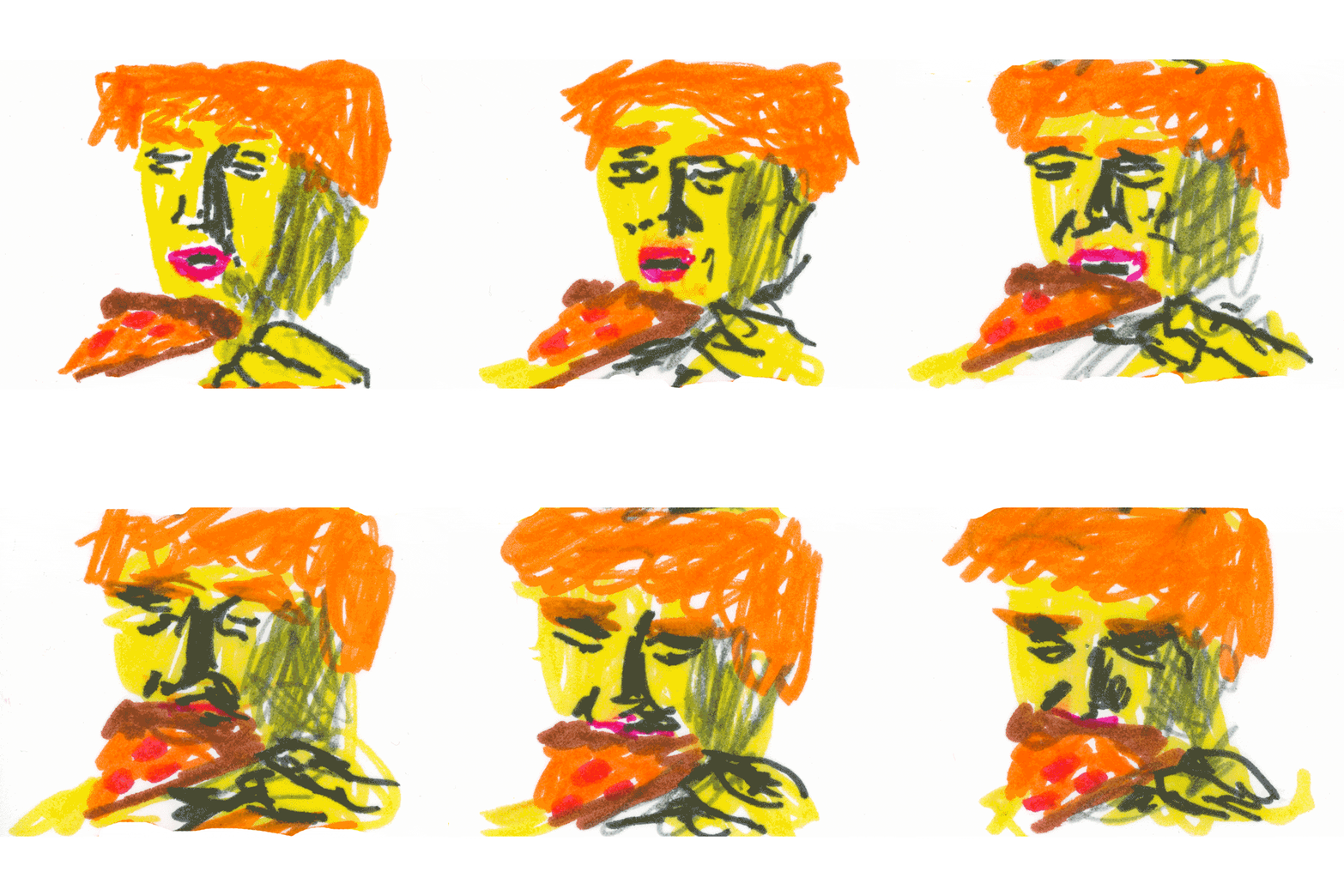 Barbecue chicken pizza and the story that wasn’t
Recently, Christina and I went to the California Pizza Kitchen for dinner. Our waiter was Frank. He looked like a normal guy, but Frank had one of those voices like the men—it’s always a man, for some reason—who narrate movie trailers. Right away, I knew this barbecue chicken pizza would be a cinematic experience.
In a world, where pizza traditionalist reign (meat and veggie) supreme, one man dared to be different.
When the powers that be said he couldn’t put chicken on a pizza, he called them chicken.
When they said the only acceptable herbs were basil and oregano, he made it rain cilantro.
And when they said barbecue sauce on a pizza was a sin, he led them straight to the gates of hell.
This summer, Ed LaDou, in association with California Pizza Kitchen, presents:
Barbecue Chicken Pizza
Starring Michael and Christina from the hit newsletter Situation Normal, and Frank the Waiter from I’ll Be Your Server This Evening.
After we put in our order and Frank came back with our drinks, I asked him if he did anyone voice over work.
“How’d you guess?” he asked.
“Your voice,” I said. “It’s fantastic.”
“Thanks. I am a voice over actor, but with the strike, I took this job for extra cash.”
“Have you done any movie trailers?” Christina asked.
“No, just commercials,” Frank said. “Low, low prices… act now, while supplies last… that kind of stuff. But I’ve been getting into audiobooks recently. There’s a lot of work there.”
“I love audiobooks,” I said.
“It’s true,” Christina said. “He goes through two a week, sometimes three.”
“I’m just starting out, so I’m not exactly getting the pick of the litter. Honestly, I think a lot of the books I’ve narrated were written by ChatGPT. At first, they almost sound like they make sense, but then you realize that they’re totally useless. Like, I narrated a book on six-figure side hustles, and at first I was like, cool, I do side hustles, I want to make six-figures. But the advice was stuff like, many side hustles can be lucrative, but you have to hustle. No kidding, right? Or, I did self-help book that was only, like, forty pages, and the advice was one level above fortune cookie. One piece of advice was to do something you love. Not exactly new material, you know?”
I was riveted. Listening to people talk about themselves is my kink. Plus, Frank’s story was topical. There were references to Hollywood’s ongoing labor dispute, a behind-the-scenes look at audiobooks, and the bleak prospect of a future overrun with AI-generated content. I saw Frank’s story as Norma Rae meets Terminator. Or maybe Newsies meets Her? We could talk details, I thought, over barbecue chicken pizza. But before I could ask why someone who “wrote” a book with ChatGPT would hire a human instead of using an AI voice, Frank’s manager put the kibosh on a good situation.
“I’m sorry guys,” Frank said in a hushed tone. “My manager is watching me. I’m supposed to keep it brief.”
I looked around. The restaurant wasn’t busy. It looked like Frank had time to chat and serve, but that wasn’t up to me, or Frank. I wasn’t even sure if Frank’s manager was the true shot caller.
Had Frank already said too much? Maybe the people at corporate had grown tired of chatty servers like Frank. Maybe they had already set in motion a program to replace Frank with a robot waiter that took orders, never missed an opportunity to upsell, and didn’t come with a story. Maybe a robot manager, complete with a passive-aggressive spy mode, was in the works too.
I enjoyed our barbecue chicken pizza. But as we ate and tried not to talk to Frank, I got a sinking feeling in the pit of my stomach. An actor waiting tables to make ends meet is a very LA story. But this story felt like it had taken a dark turn. At his day job, the company seemed to be squeezing the humanity out of Frank. At Frank’s other job—narrating books written by machines—felt just as dehumanizing.
Tech is coming for your pizzaWhen we got home, I couldn’t stop thinking about Frank. Like many people, I’ve spent too much time drowning in headlines about the threats AI poses to actors and writers. But, I wondered, what about Frank’s day job? Was there a future there, or was this one of those No Country for Old Pizza Humans stories?
Naturally, I fired up the ye olde Google machine.
One of the first things I found was a Wired article about the very first time a computer was used to order a pizza. Turns out, humans have been working to take humans out of the pizza loop since 1974.2
But what started as a neat experiment in a university computer lab mushroomed into something much bigger and way more disruptive. Today, it’s normal to order our pizzas without talking to a human being. But soon enough, our pizzas might not be made by people either. Here’s a YouTube video I found of an autonomous pizza machine.
At first, I thought the autonomous pizza machine looked cool. But then I wondered what would happen if/when the autonomous pizza machine links up with one of those robot delivery vehicles I’ve started seeing around town? The idea of eating pizza that was made and delivered entirely without humans felt like science fiction to me, except it might not be fiction much longer.
None of this sits right with me. I worry about Frank, the cooks in the kitchen, and their micro-manager. I also worry that the money it takes to disrupt pizza is an absurd misallocation of resources that’ll lead to pizza bubble.
But the thing that really worries me is that all this innovation in the pizza space will stifle innovation in the pizza space. Remember, the machine’s purpose is to make a perfect pie—every time. It is a relentless optimizer, but the machine can only optimize what already exists.
Which brings me back to Mr. Barbecue Chicken Pizza, aka Ed LaDou. He didn’t ask an AI to invent a new kind of pizza. He didn’t analyze the data from an autonomous pizza machine and come up with a new pie. He put his human hands in the dough, day after day, for decades. LaDou’s experience, taste, and creativity disrupted pizza. And while it is awesome that we can use machines to get our pizzas faster, better, and without the hassles that humans sometimes create, we ought to remember that androids don’t dream of barbecue chicken pizza.
Or, maybe I’m wrong. It wouldn’t be the first time, and besides, I’m a comedy writer, not a computer scientist. Maybe androids do dream of barbecue chicken marshmallow and shrimp pesto pizza, and maybe that’s the pizza I really crave. But if androids do dream of pizza, I’m just not sure I want to eat the Tyrell Corporation pizza. Or, to paraphrase Roy Batty, I want more human-made pizza, fucker.
Thank you for reading Situation Normal! Share 🍕pizza🍕 & share this post👇
If you use Substack Notes, please hit the Restack button🙏
Extra large shout outs!Extra large pizza pie shout outs to the newest paid subscribers at Situation Normal! Thank you, Deb Smith! Thank you, Gary! And a very special thank you to my friends Josh and Paige!
My writing super power is turning Lyft rides, awkward yoga classes, conversations about hot sauce, visits to porn conventions, Raiders games, working as a PA at Richard Nixon’s funeral, McDonald’s breakfast, and cheese boards into the stories you love. Paid subscriptions help me carve out time from my freelance writing schedule to amuse you. Paid subscribers get a shout out, exclusive Situation Normal stories, and full access to the archives Will you support Situation Normal?
Please take 60 seconds to upgrade your Situation Normal subscription👇.
Stick around and chatYou know the drill. I’ve got questions, maybe you’ve got answers.
Are you a barbecue chicken pizza lover? Hater? Neophyte? Dish!
Best pizza chain? Worst pizza chain?
New Yorkers say they have the best pizza, which is cool, but they’re kinda agro about it, which makes me think all that pizza-rage is masking some deep dish insecurity. Thoughts?
I’ve traveled to more than 30 countries, all of them pizza-loving nations. The most unusual pizza I had was in Korea. It had cheese and marinara sauce, but it was topped with a cornucopia of seafood, kimchi, and thousand island dressing. What’s the most unusual pizza you’ve ever had?
Would you eat robot pizza, or are you team Luddite pizza?
Before she kicked the Terminator’s ass and gave birth to humanity’s savior, Sarah Connor was a waitress. Was there more to Frank than met the eye? Are restaurant servers the canaries in the coal mine? Are you worried about humanity? Explain.
Cold pizza? Give us your hot take!
Want more Michael Estrin stories? I’ve got two books!Ride/Share: Micro Stories of Soul, Wit and Wisdom from the Backseat is a collection of my Lyft driver stories🚗🗣
Not Safe for Work is a slacker noir novel based on my experiences covering the adult entertainment industry💋🍑🍆🕵️♂️
The ebook versions of my books are priced between 99 cents and $2.99, so if you don’t have the budget for a Situation Normal subscription, buying an ebook is a great way to support my work. Bonus: awesome stories and laughs!
*If you bought one of my books, thank you! Please take a moment to leave a review. It helps a lot💪🙏
1See “California chef pioneered gourmet pizza revolution” https://archive.ph/20130127145557/htt...
2See “Tech Time Warp of the Week: Return to 1974, When a Computer Ordered a Pizza for the First Time” https://www.wired.com/2015/01/tech-ti...