K. Tempest Bradford's Blog, page 32
October 9, 2012
I Still Have That Dream
Been wondering why I’m in such a funk lately, then my calendar reminded me again this morning that today is my mother’s birthday. Her name is Marjorie Bradford and she died 13 years ago now, but the pain feels pretty fresh whenever I stop to think about her (which is often).
For many years after her death I tried to write a story that encapsulated how I felt about what happened and how much I loved her, but nothing ever came out quite right.
After she died, I had tons of dreams about her, but most of them had a common theme. In them, I was often aware that I only had a little bit of time to spend with her because I understood that she was sick and still dying. In some dreams she was very sick, in others almost completely healthy. A few times in my dreams I even asked her “How much time do we have?” and she’d say “Only a little while” or “A few days” or something.
It was as if, in my dreamscape, I was able to roll back the clock a little and revive her, but not completely and for good.
In mulling over why she almost always manifested in this way in my dreams led me to finally being able to write a story about her that did all of my memories and feelings and her impact on me justice. The story is “Elan Vital” and you can read or listen to it over at Escape Pod.
I’ve never read that story in public and probably never will because any attempt to do so will end up with me curling up in a ball sobbing. I don’t even read it to myself for that same reason.
However, when the story first appeared on the podcast I saw so many people praising the reading of it, I decided to listen to just a few minutes. I ended up listening to the whole thing. Mur Lafferty, as you may know, is an extremely talented reader. She did such justice to that story I can’t praise her enough.
Happy birthday, mom. I miss you and love you and I still have that dream.
I Still Have That Dream is a post from: K. Tempest Bradford




October 2, 2012
I’m A Chick Who Likes To Unravel Time

click me for a bigger version
I’ve dropped hints about this for a while, but now it’s official and on the record! I have an essay in the forthcoming Chicks Unravel Time, a follow up to the Hugo Award-winning Chicks Dig Time Lords. Woot! This is my last essay for books from Mad Norwegian Press, so I’m really glad it will be in such an awesome book.
This one is different to the first in that editors Deborah Stanish and L M Myles asked each contributor to consider a specific series of Doctor Who and to explore it in any way we liked. So, not every essay could be classed as “a celebration”, but they’re all written by women who clearly love Doctor Who and who have intelligent and deep thoughts on the show.
Also, the cover art is awesome! Katy Shuttleworth once again being all badass.
Here’s the full table of contents so you can get a taste of what everyone is talking about:
Regeneration – Shaping the Road Ahead by Barbara Hambly
The Doctor’s Balls by Diana Gabaldon
A Dance With Drashigs by Emma Nichols
No Competition by Una McCormack
Identity Crisis by L.M. Myles
The Still Point by Anna Bratton
For the Love of Tom by Sarah Lotz
Donna Noble Saves the Universe by Martha Wells
I’m From the TARDIS, and I’m Here to Help You: Barbara Wright and the Limits of Intervention by Joan Frances Turner
I Robot, You Sarah Jane: Sexual Politics in Robot by Kaite Welsh
Between Now and Now by Juliet E. McKenna
What Would Romana Do? by Lara J. Scott
The Women We Don’t See by K. Tempest Bradford
The Ultimate Sixth by Tansy Rayner Roberts
Maids and Masters: The Distribution of Power in Doctor Who Series Three by Courtney Stoker
Robots, Orientalism and Yellowface: Minorities in the Fourteenth Season of Doctor Who by Aliette de Bodard
David Tennant’s Bum by Laura Mead
Superficial Depth?: Spirituality in Season Eleven by Caroline Symcox
The Problem With Peri by Jennifer Pelland
All of Gallifrey’s a Stage: The Doctor in Adolescence by Teresa Jusino
All the Way Out to the Stars by Iona Sharma
Build High for Happiness! by Lynne M. Thomas
Nimons are Forever by Liz Barr
Ace Through the Looking Glass by Elisabeth Bolton-Gabrielsen
Hey, You Got Science in My Fiction! by Laura McCullough
Seven to Doomsday: The Non-Domestication of Earthbound Doctor Who in Season Seven by Mags Halliday
Harking Back and Moving On by Jenni Hughes
Anything Goes by Deborah Stanish
How the Cold War Killed the Fifth Doctor by Erica McGillivray
Waiting for the Doctor: The Women of Series Five by Seanan McGuire
Timing Malfunction: Television Movie + the BBC Eighth Doctor Novels = A Respectable Series by Kelly Hale
Guten Tag, Hitler by Rachel Swirsky
Reversing Polarities: The Doctor, the Master and False Binaries in Season Eight by Amal El-Mohtar
There’s one essay for each series of the show, classic and current, plus the TV movie.
My essay is about Series 13. When Deb first asked me to be in the book and told me the premise, I loved the idea right away. I let her pick a series for me since I’m not very familiar with classic Who and she hoped to get some fresh perspectives on the older stuff.
At the time, the series I would have chosen for myself is #3 of the modern era. Deb rightly pointed out that my CDTL essay was pretty much an exploration of Series 3 through the lens of my love for Martha. The only other series I have many FEELS about is #4. After that my ability to deal with Doctor Who flies out the window.
The choice of Season 13 ended up being a good one. Tom Baker’s Doctor is the only one of the classics I’m familiar with. I’ve seen some of Series 12 and a few of his adventures with Romana. But I came into #13 fresh.
I won’t spoil the essay for you, but I will say that I was a little surprised at some of the things I found there, despite knowing in advance that I would see some problematic stuff. What I found very interesting, and only touched on a bit in the essay, was how much of new Doctor Who I saw in those old episodes. I can tell that some writers have been influenced by those episodes for good and for bad.
I now also have a full appreciation for how eye-roll worthy it is that the Doctor’s race is called the Time Lords, as if there are only men running around on Gallifrey. This plays out in interesting way during this series.
Chicks Unravel Time is out on November 13th, and you’d better believe that I’m going to remind you several times before the actual day. I should also note here that it’s almost a 100% done deal that I’m attending Chicago TARDIS over Thanksgiving weekend so I can take part in the panel about the book! I’m just waiting to see if I can get a press pass.
Until then, pre-order and spread the news!
I’m A Chick Who Likes To Unravel Time is a post from: K. Tempest Bradford




October 1, 2012
Seanan McGuire on why she will not add rape to her stories to add “realism”

If you’ve been reading my blog long enough, you know my feelings about the way rape is used in most fiction. If you’re unaware or have forgotten, please click over to my post here, my post on ABW, and my post on Jeff Vandermeer’s blog about the subject.
The bottom line of each of those is that I really do not like it when authors decide to have their female (and it’s almost always female) characters raped for bullshit plot or character development “reasons”. The kind of writers who do this are generally not very good ones since they have to use cheap tricks in order to show that the female character is “strong” or the male character is “evil” or to wink and nod to any reader out there who might think that a female character could possibly ever get away with being smart and confident and badass without being taken down a peg.
I also get angry at this trope because I firmly believe that it contributes to rape culture in a big way. When the message from fiction is constantly that rape is inevitable, especially if you as a woman step outside of the box of what is acceptable, and that’s just how it is. Whenever I suggest that authors just NOT include rape as an inevitable consequence of being a woman in fiction, I get told that this is completely unrealistic.
Thus, I am not at all surprised that this happened to author Seanan McGuire:
Last night, I was asked—in so many words—when either Toby or one of the Price girls was finally going to be raped.
Not “if.” Not “do you think.” But “when,” and “finally.” Because it is a foregone conclusion, you see, that all women must be raped, especially when they have the gall to run around being protagonists all the damn time. I responded with confusion. The questioner provided a list of scenarios wherein these characters were “more than likely” to encounter sexual violence. These included Verity forgetting to change out of her tango uniform before going on patrol, Toby being cocky, and Sarah walking home from class alone[1]. Yes, even the ambush predator telepath with a “don’t notice me” field is inevitably getting raped.
When. Finally. Inevitably.
My response: “None of my protagonists are getting raped. I do not want to write that.”
Their response: “I thought you had respect for your work. That’s just unrealistic.”
Go and read the whole post, because everything that Seanan has to say in response to this nonsense is right on and should be read by every person ever, especially authors.
I’ve said this before and I will say it again: Writers, when you write fiction you get to create the world. Yes, even if are writing in the “real” world and not that of the speculative, you get to decide what happens to your characters and why. Spec writers in particular get to create stuff out of whole cloth, if they like. And more of them should choose not to bring rape into their narratives. Because if we want to create a world in which rape happens less, we need to show worlds where rape isn’t the inevitable consequence of being a woman.
Then maybe there won’t be readers out there who claim that no rape means a book is unrealistic. Because: really? Gross.
Footnotes
Does it occur to anyone else that this person has thought way too much about the ways in which these characters may end up raped? If I were Seanan I would stay away from the fan fiction for a bit…
Seanan McGuire on why she will not add rape to her stories to add “realism” is a post from: K. Tempest Bradford




Diverse Energies Launches Today!
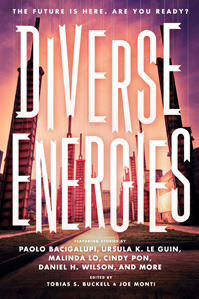 The Diverse Energies anthology is now officially available in fine bookstores near you. Find it at a local, independent bookstore through IndieBound or grab it from Barnes & Noble or Amazon. I haven’t yet seen any eBook versions, but I think you’ll be able to find them through GoodReads.
Diverse Energies has 11 stories on a dystopian them for YA readers. Editors Tobias S Buckell and Joe Monti wanted to create an anthology full of characters that reflected the diversity they see in their own lives, so all of the protagonists are of color. Many of the authors are of color as well, and the stories well up from our perspective and experiences.
My story, “Uncertainty Principle”, features a girl of mixed Latina and Middle Eastern background who finds that the world changes around her — big changes that no one else but her notices.
Here’s the full TOC:
“The Last Day” by Ellen Oh
“Freshee’s Frogurt” by Daniel H. Wilson
“Uncertainty Principle” by K. Tempest Bradford
“Pattern Recognition” by Ken Liu
“Gods of Dimming Light” by Greg van Eekhout
“Next Door” by Rahul Kanakia
“Good Girl” by Malinda Lo
“A Pocket Full of Dharma” by Paolo Bacigalupi
“Blue Skies” by Cindy Pon
“What Arms to Hold” by Rajan Khanna
“Solitude” by Ursula K. Le Guin
Thus far I’ve seen many positive reviews of the book from advance readers. The Kirkus review even mentions my story:
Readers will find poor children working in mines and factories, a have-not yao boy kidnapping a rich you girl and a girl reeling as the world inexplicably changes around her, and no one else notices. Although many stories imagine bleak futures, their tones are refreshingly varied. Daniel Wilson’s tale of a robot attack at a frozen-yogurt shop takes the form of an almost-comical police-interview transcript. Ursula K. LeGuin’s “Solitude” is a sweeping, nostalgic epic. K. Tempest Bradford’s “Uncertainty Principle” is a character-driven time-travel tale. Understanding many of the stories takes patience: Readers are plunged quickly into complex worlds, and exposition often comes slowly.
There are a couple of other reviews that mention it as well, but everything is full of spoilers!
If you read the book and like it, please let folks know and leave reviews where possible. Also, buy it for the young persons in your life who like SF or like to read anything and everything.
Diverse Energies Launches Today! is a post from: K. Tempest Bradford




September 12, 2012
My Favorite Fiction from August 2012

As I predicted, this is way late thanks to WorldCon. All things can be blamed on WorldCon. The good thing about going was being at the Hugo ceremony to see many deserving writers and artists get their shiny rockets. It’s sort of a coincidence (but not exactly) that many of the Hugo Award winners also have fiction on my list below. A coincidence because I didn’t plan it that way, but not because it’s no surprise that I’d love their stories given their track record.
Last month I also did some novel reading. I finally finished Liar by Justine Larbalestier. If you haven’t read it yet, go now! It’s so good. I also read the last of the Midnighters books by Scott Westerfeld. I put it off a long time because I love the first two so much I didn’t want to be done with those characters.
September is already shaping up to be a great month, especially since there’s a new issue of Electric Velocipede out. Also, did you know they have a Kickstarter? They so do.
Waiting for Beauty By Marie Brennan
So, this story. It’s fairly short, but even so I saw the ending coming pretty early. I’m not sure how I feel about what it says about Beauty and the Beast, and thus I’m not sure how I feel about the story as a whole. I’d welcome some discussion on it.
The Bookmaking Habits of Select Species by Ken Liu
“Everyone makes books.” Not only do I just love this story for the glimpses into other worlds and other species, I also love that it made me start thinking about the kind of books exist in the worlds I create in fiction. Oddly, it’s not a question I generally ask myself, though you’d think it would be one of the first things to come to mind. Wouldn’t this make an excellent interview question for any writer? What kind of books do your characters create?
Mantis Wives by Kij Johnson
I’m not entirely sure this is science fiction or fantasy, but it’s certainly speculative. Regardless, Johnson pulled me in with the descriptions of these intricate art pieces.
Honey Bear by Sofia Samatar
This story is just sad! I feel like people who desperately want to be parents will appreciate it in particular.
Fade to White by Catherynne M. Valente
Because I read the first paragraph of this story, got interrupted, then came back later, I didn’t remember that Cat wrote it until I got to the end and went back to read it again. I love, love, loved this and I already suggested it to the Tiptree jury. I really dug the way she played with gender roles and with the commentary on advertising and marketing slyly added in. It’s just a really good story, go read.
The Bear with the Quantum Heart by Renee Carter Hall
At first, this story reminded me a lot of the movie A.I., but it did move beyond that. I’m including this on the list less because it’s a favorite story and more because I want to discuss it with people who’ve read it. Would love to read some reactions to the Kayla character.
Love Might Be Too Strong a Word by Charlie Jane Anders
Charlie Jane spins a lot of cool stuff about gender in this with a little bit of commentary on the nature of love in the public square.
Cotillion by Delia Sherman
I can’t decide which aspect of this I like best: the funny take on life as a Deb, the old-school New York, or the mythy aspects. As usual, Delia blends everything perfectly.
Visit my Favorite Fiction tag to see all the other short stories I’ve liked so far this year.
My Favorite Fiction from August 2012 is a post from: K. Tempest Bradford




August 20, 2012
POC Dinner @ WorldCon

By popular demand we’re bringing the POC Dinner from WisCon to ChiCon. On Friday, August 31st, the POC attendees of the World Science Fiction Convention are invited to dine in glorious splendor (or just in a nice restaurant).
If you’d like the deets on this event, please contact me through the contact form on my website if you don’t already have my email. If we’re friends on Facebook, check your events list since it’s likely I’ve already invited you.
Looking forward to hanging with folks at WorldCon!
POC Dinner @ WorldCon is a post from: K. Tempest Bradford




August 15, 2012
Kindred Reading Series September: K. Tempest Bradford (that’s me!) & Ibi Zoboi
Next month I have the pleasure of reading alongside Ibi Zoboi at the Kindred Reading Series. September’s reading will take place at Bluestockings Books in New York City and it starts at 7PM.
I will likely read my story from Dark Faith: Invocations and maybe a teaser from “Uncertainty Principle”, my story in Diverse Energies. But, who knows, I may change my mind :)
I don’t know if I’ve mentioned the Kindred Reading Series here before, but it’s the brainchild of Jenn Brissett, an African-American writer from Brooklyn. She wanted to create a reading series for genre writers of color since there’s a general misconception that POC don’t write or read science fiction, fantasy or horror.
A secondary goal was to raise money for the Octavia E. Butler scholarship which helps writers of color attend Clarion and Clarion West, two intensive writing workshops for new authors.
If you’re in the New York area the last week of September, please drop by!
Kindred Reading Series September: K. Tempest Bradford (that’s me!) & Ibi Zoboi is a post from: K. Tempest Bradford




August 12, 2012
My Favorite Fiction From July 2012
Sorry I’m so late in posting July’s picks, all. Got caught up in work stuff, as usual. I’m also behind on my August reading. And with Worldcon coming up in a couple of weeks I might be late with my picks after that.
Speaking of WorldCon, one of the reasons I started these lists and keeping track of the stuff I read that I like is that I’m trying to be better about suggesting fiction for awards. Not just the Hugos, but also the Tiptree, Carl Brandon, World Fantasy and Million Writers Awards, to name a few. Remembering favorite short stories is harder for me than remembering favorite novels. Now I have all of the stuff I like cataloged over on Delicious with tags that will help me find appropriate stuff easier.
If anyone would like to join me in tagging and keeping up with loved stuff in this manner, my username on Delicious is ktempest.
And now, the fiction:
One Ear Back by Tina Connolly
People who don’t like cat stories might still like this one. Again, the conclusion of this story is what sold me on it. And again, it would be a spoiler to tell you why.
Song Of The Body Cartographer by Rochita Loenen-Ruiz
I initially wasn’t going to put this on my favorites list because, when I got to the end of this I thought: this is half a story! But I decided to include it, anyway, because I like so many other things about it.
Lady Marmalade by E. Catherine Tobler
Not sure I really get this story completely, but I love the imagery and the writing a lot. I like the idea of memories, impressions, essence being stored in jars of marmalade.
We Can Remember It For You Retail by Mary E. Lowd
Unexpectedly depressing… Still, a good story. The reason I like it so much has to do with the ending, and I don’t want to spoil it.
Lost by Seanan McGuire
Being a tween is hard and full of sorrow.
Astrophilia by Carrie Vaughn
Post-apocalyptic stuff usually isn’t my thing, but this story manages to make that trope feel less like window dressing than most other stories I’ve read.
My Teacher, My Enemy by Kelsey Ann Barrett
I don’t even know how to describe this one except to say that, when I started reading, I didn’t think I would like it and by the end I did.
Visit my Favorite Fiction stack to see all the other short stories I’ve liked so far this year.
My Favorite Fiction From July 2012 is a post from: K. Tempest Bradford




August 10, 2012
Putting a hard line between art, science, commerce, and creativity
Earlier this summer I read a book by Jonah Lehrer called Imagine: How Creativity Works after reading a snippet of the book in a magazine or on a blog. Read the whole thing, loved it, recommended it to friends. And then a few weeks ago the world finds out that Lehrer did a very bad thing by making up or improperly smashing together quotes from Bob Dylan in said book.
It called all of the facts in the book into question (and since then people have found other errors in other chapters) and rightly cost Lehrer his job at the New Yorker and the respect of fellow writers and readers. I still think there are some good aspects of the book, but I recognize now that the conclusions have to be taken more as Lehrer’s conjectures or opinions.
In reading all the linked blog posts about this scandal, I came across this review of the book, published many months before said scandal. This was held up as an example of people calling shenanigans on Lehrer long before the Bob Dylan stuff was revealed. But as I read the review, I found it to be full of a huge dose of bullshit as well as what seems a real personal anger at Lehrer and all writers like him[1]:
IMAGINE is a collection of stories—all pop-science these days must be translated into stories, as if readers, like children, cannot absorb the material any other way[2].
…
Lehrer does not see creativity or imagination as being intricately connected to art, or to science, or to anything that we would generally term “imaginative.” It is all about success. … Lehrer’s unwillingness to distinguish between these types of thinking, between art, science, and commerce, is discouraging. Inside or outside, the only place that finally interests Lehrer is the marketplace. …the problem of differentiating between artistic distinction and commercial distinction is especially problematic here. …if you are trying to explain the most ambitious and the most admirable exertions of human imagination and intelligence, some disaggregation, some discrimination, is necessary.
To start, I disagree with Isaac Chotiner’s assessment of Lehrer’s points and that all that interests him is the marketplace.
I heavily contest that one has to distinguish between art, science and commerce when in a discussion of creative thinking.
I always think of the book A Beautiful Mind when stuff like this comes up. It’s about the life of John Forbes Nash, the brilliant mathematician who struggled with paranoid schizophrenia for many years. In the prologue, the author recounts a day when a friend of Nash’s came to visit him in the hospital.
The friend asked: “How could you, a mathematician, a man devoted to reason and logical proof… believe that extraterrestrials are sending you messages?”
Nash’s answer: “Because the ideas I had about supernatural beings came to me the same way that my mathematical ideas did. So I took them seriously.”
As a writer, I often get flashes of insight or inspiration that seem to come from a part of my brain not entirely connected to the conscious part I’m aware of. I love when this happens because it usually leads to great stories. When I read that quote I realized for the first time that this happens to scientists as well.
Not that all great scientific discoveries are the result of this, but that ideas that then collide with your knowledge, understanding and experience come from a part of the mind that’s not readily accessible (like memory) happens not just to artists was very eye-opening for me. It made me realize that art and science aren’t on opposite ends of a spectrum.
Thus, I roll my eyes at Mr. Chotiner and his disdain for narrative and his assertion that just can mix up art and science and commerce and stuff because REASONS.
Whatever Lehrer’s crimes with this book, this isn’t one of them.
Thoughts?
Footnotes
I found that many journalists and older writers had a huge hate hard-on for Lehrer for years. They are way too gleeful over his downfall.
Dude, narrative is a building block of our culture. It’s not just for children. If you don’t understand that, how can I trust you to review books, even of the non-fiction variety?
Putting a hard line between art, science, commerce, and creativity is a post from: K. Tempest Bradford




July 18, 2012
Coming Soon: My stories in Dark Faith: Invocations and Diverse Energies

Those of you who view the blog proper may notice a couple new covers on the sidebar. I have stories in two anthologies coming out this fall and I’m very excited about both.

The first one to come out will be Dark Faith: Invocations. From the Apex website:
Religion, science, magic, love, family — everyone believes in something, and that faith pulls us through the darkness and the light. The second coming of Dark Faith cries from the depths with 26 stories of sacrifice and redemption.
My story is “The Birth of Pegasus”. The full TOC is here and includes such awesome authors as Nisi Shawl, Jeffrey Ford and Tim Pratt. It launches at WorldCon in Chicago. If you won’t be there but want to pre-order a copy, click here. (You can get 10% off with coupon code: DFBradford)
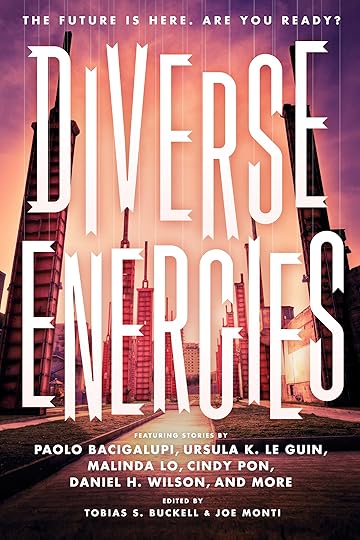
Next is Diverse Energies, a YA dystopian anthology where all the stories feature characters of color. It will be out in October. I’m sharing a TOC with Ursula K LeGuin. I have not yet stopped doing the boggie about that.
You can’t pre-order Diverse Energies yet but I’ll let you know when you can.
What do you think of the covers?
Coming Soon: My stories in Dark Faith: Invocations and Diverse Energies is a post from: K. Tempest Bradford