K. Tempest Bradford's Blog, page 30
February 5, 2014
It’s sort of like an Exquisite Corpse…

There’s a long-term project I want to do with the Interstitial Arts Foundation, but it will require quite a bit of coordination and people power, so I’m not entirely sure how to get it started. However, I know I have about 7 million intelligent and creative friends who might be able to help out or point me in the right direction or give advice, so I decided to post my idea here.
So far the IAF has done several great projects to support interstitial fiction and writing about interstitiality. There are the anthologies, Interfictions and Interfictions 2, and the magazine Interfictions online. We’ve done two auctions where we asked visual artists and crafters to create art based on the fiction, but we’ve never done the reverse and not a lot with interstitial art outside of literature. This isn’t because the IAF is only concerned with lit, it’s more to do with who is doing most of the volunteering and driving the projects–i.e. artists whose focus is mainly writing.
This project will eventually grow to involve artists from all the different disciplines and will start with musicians. The idea is to invite musicians, singers, and songwriters to create songs, symphonies, sounds, or whatever else they’re moved to do based on interstitial fiction. Just as with the last auction, we can provide copies of stories from the Interfictions anthologies. Plus, there are now several available online for free. This time, we won’t limit it to interstitial writing published by the IAF — musicians can base their music on any piece of writing they see as interstitial. I know there’s a list of interstitial fiction around somewhere that we can dig up.
Once all the musicians involved are done and the music available to all, we can move on to the next artist group. My thinking is that we ask dancers and other movement-based artists to create a short performance or dance based on the music. Then, once those are complete, maybe visual artists create art based on the dances or textile artists create clothing for the dancers. And on and on until we hit multiple artistic disciplines and perhaps, way down the line, bring it back around to writers.
This could turn into quite a big project, thus the need for excellent project management. We’d need at least two people to coordinate who are musicians themselves and have contacts in that community. One of these people should be familiar with how rights work and help us craft the best way to present the idea to musicians. The IAF wouldn’t want exclusive rights to publish the music, but would like the ability to include the song on a compilation album of our own. Plus, we want other artists to be able to freely build upon the music for the next step in the project.
There are probably other considerations I haven’t thought of–please let me know your thoughts in the comments. Does this seem like a doable idea?
It’s sort of like an Exquisite Corpse… is a post from: K. Tempest Bradford




January 20, 2014
Wiscon 38 Panel Brainstorming Post

Panel submissions for WisCon 38 close soon, and I have many ideas! I know many of my friends have ideas too, but might need some help brainstorming or fleshing them out. Thus, I have created this post.
Anyone who has an idea can put it in the comments, not just me! Let us know what you need, such as: making a kernel of an idea into a full-fleshed panel, help crafting an effective description, coming up with a punchy title, or finding fellow panelists so you can submit a pre-populated idea.
It will make discussions easier if you put one panel idea per comment (make as many as you want) and then folks can reply below each in the thread.
That’s it, let’s have fun!
Wiscon 38 Panel Brainstorming Post is a post from: K. Tempest Bradford




October 12, 2013
Writer Fears About Writing The Other: Here’s How To Get Over It

Here’s one of the great circular conundrums of our time:
We need more characters of color/LGBT characters/characters with disabilities/characters that aren’t the default white, able-bodied cis male in speculative literature.
I, a speculative fiction author, am afraid of writing characters of color/ LGBT characters/characters with disabilities/characters that aren’t like me or from my cultural and social understanding because I might get it wrong, and if I get it wrong people will be angry at me and yell and also ruin my career.
I’ve seen and heard writers (mostly white) express some version of that at least a hundred times since RaceFail 09. They point to that discussion or any number of other public Fails since then and go: SEE?! You see? That’s what happens when we try!
There are a few things about this that need addressing. First, large, public Fails actually happen when authors don’t try. Second, the problem is rarely that the author tried and didn’t get it exactly, 100% right. It’s that they failed and then acted like an ass when someone pointed it out to them. Third, avoiding author Fail isn’t as hard as some people make it out to be.
Most importantly, the consequence of being ruled by that fear is that you aren’t helping with the first problem. And if I may be so bold, I think the issue of representation is far, far more important than individual fears of getting it wrong. I also know that it’s hard to tackle that first issue without also addressing the second. Luckily, I have the solution.
Next summer I’m teaching at the Writing the Other workshop/retreat alongside Nisi Shawl, Cynthia Ward, David Anthony Durham, and Mary Robinette Kowal. Tomorrow, registration for this workshop opens up. If you are the type of author who has been held back from addressing the issue of representation in SF by fear that you’ll get it wrong, this workshop will give you tools to help you get it right. There’s no guarantee that you will always, 100% get it right if you attend this workshop. I am confident that at the end of it you won’t be 100% ruled by fear.
Registration opens tomorrow, October 13th, at 12pm Eastern. The workshop fee is $500 and includes meals but does not include accommodations. Click over to the Eventbrite page to see all the details.
How many of you will I see there?
Writer Fears About Writing The Other: Here’s How To Get Over It is a post from: K. Tempest Bradford




July 24, 2013
Inspiration | Resonance: The Art of El Anatsui
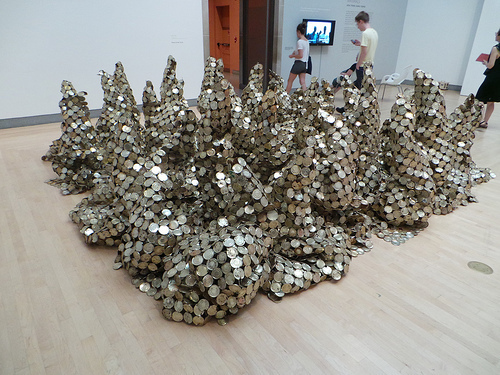
A couple of weeks ago I saw an amazing exhibition of works by Ghanaian artist El Anatsui at the Brooklyn Museum. Anatsui takes found materials like metal and wood — considered trash by most — and turns them into amazingly flowy pieces of art that evoke cloth and drapery and alien landscapes. The intricacy of the works and the amount of time he clearly puts into them brings to mind intricate beadwork and quilt-making. Thinking about the time involved in connecting all those old tin can lids or aluminum bottle caps or metal strips from liquor bottles together by hand almost overwhelms me, but then I remember how I feel when I’m stringing beads together or working on an art project that requires tedious repetition. In the moment I’m not really thinking about that, I’m more focused on the end result. Working on projects as big as Anatsui’s would require getting into a meditative state in order to not drive yourself nuts, but it’s not hard to imagine doing so.
The way the exhibition is set up, the pieces get more and more flowy as you go along. In the last room I found my favorite piece: Peak. I immediately saw this as a post-apocalyptic or alien landscape and spent a good amount of time trying to imagine how it would look from eye-level. A bunch of the pictures I took were from as close to that perspective as I could get.
I also took this video in an effort to get a sense of how it would be on the inside of this sculpture and also how it would look to someone approaching it at eye-level.
Inspiration | Resonance: The Art of El Anatsui is a post from: K. Tempest Bradford




July 22, 2013
Inspiration | Resonance: Cellist Zoe Keating

A recent conversation with N. K. Jemisin made me realize that I have not been vocal enough about my love for musician Zoe Keating even though I’ve been a big fan for over four years. She’s one of my go-to artists when I need writing music that sets a mood or fades into the background just enough to let me work but not enough that I don’t actively enjoy it. Other than just loving the sound, I also geekily enjoy how Zeating makes music. It’s very techie.
The first time I heard Zeating’s music was on the RadioLab podcast titled The Quantum Cello, and that’s how I think of her stuff: quantum music. Using MIDI recording tools and a laptop, Zeating overlaps repeating phrases to create multilayered music all from the same instrument. It’s hard to grasp how awesome this is when listening to a recording because it’s easy to create layered music in a studio. Keating does it live. She records each phrase as she plays it, then the laptop repeats it back (controlled with a petal) while she plays and records another bit. The layers build and build into ever more complex interactions. Watching this happen in real time is more amazing than I can recount.
The other thing I love about Zeating’s music is the wide variation of sound she gets out of a cello. There are several tracks where, if I didn’t know better, I would swear a piano or a whistle or a flute was involved.
The only sadness with being a Zoe fan is that she doesn’t produce new albums all the time. Her last one, Into the Trees, came out in 2010. Before that she put out two EPs in 2004 and 2005. I can’t very well complain since she’s a label-less indie artist and thus can’t just spend all of her time composing new stuff for me (uh, I mean, for all her fans…). I am pleased to see her music getting attention all over the place. I started hearing it as interstitial music between news segments on NPR’s Morning Edition and All Things Considered a few years ago. The Elementary staff and producers love her stuff, too, and so her tracks are all over that show.
You can buy her EPs and album from her website or on iTunes. I suggest buying them all, but if you start with One Cello x 16: Natoma you’ll get a good feel for her overall style. If you listen to the EPs and album in order you’ll note that her music gets more and more complex as she goes on. It makes me excited for what she’ll produce next.
Inspiration | Resonance: Cellist Zoe Keating is a post from: K. Tempest Bradford




Another kind of backup

New post over on the tech blog that will be of interest to you writer types:
“As I was in the process of moving from one house to another… someone broke into the passenger side window of my car and grabbed the backpack containing several notebooks I’d filled, since early 2001, with handwritten stories and poems. The backpack also contained a couple of journals, two screenplays, my passport, and two half-read books. The hardest losses were the stories and poems in the notebooks. I had been looking forward, in particular, to reviewing and fine-tuning hundreds of pages of, for me, uncharacteristically long and unguarded poetry that had been written during a series of very quiet nights spent in the Sahara Desert in late 2002.
“…I spent a lot of time and effort in the following weeks scouring my part of town, looking through trash cans and alleyways, offering no-questions-asked rewards, doing anything I could think of to find what was irreplaceable for me and probably completely useless to whoever had stolen it. Finally, I let most of it go…”
–Viggo Mortensen
The specific thing that made me recall that story was testing Evernote’s Page Capture feature. … The idea of scanning a paper journal to a digital file isn’t exactly new. But with smartphones being so wide-spread and the cameras in them getting better and better, I wonder if it’s now just convenient enough that writers would spend a couple of minutes every day adding their journals to Evernote and if that would end up being an effective backup system?
Click here for the full post & discussion.
Another kind of backup is a post from: K. Tempest Bradford




June 14, 2013
Are You Shocked?

Yesterday I spent more time than is strictly necessary reading blog posts by Vox Day and some other people of his caliber. I started my journey at Vox’s response to N. K. Jemisin’s Continuum GoH speech and ended up in some serious weeds once I got to a giant manifesto about how John Scalzi is the soul of racism against whites. No, I’m not linking. I read it so you don’t have to and TRUST ME you do not have to. I’ve also read many responses to Vox’s post, including this one from Amal calling for him to be booted from SFWA. Amen to that.
In several posts and status updates I came across variants of this sentiment: don’t dismiss Vox Day as just some troll. I feel like this isn’t getting said enough. Not because there needs to be more vehement objection to his very existence (there is plenty), but because I think a lot of people have a tendency to consider him extreme and way far out of the mainstream and maybe even purposefully jerking us around not because he believes what he says but because he gets joy from making us all angry. Old Theo probably does enjoy making everyone angry. He also means everything he says. That is important to realize. He’s not a parody, he is serious, that is really the way he thinks. And there are plenty of other people who think just like him. Not only the pathetic commentors on his blog. There are tons of people with his same attitude in the world.
I know why so many people look at him and want to just dismiss it as whiney baby attention grabbing bullshit. There are likely many people who, like me, are pretty selective about the people they allow in their lives or selective about the circles they socialize in or spend more time on friendships that are mainly digital due to distance. I spend most of my time with awesome people. So when I run across someone who says something super misogynist or blatantly racist I’m often taken aback for a few seconds because: really? People like you still exist? Somebody honestly thinks it’s okay to say something like that to me? Or to her? Or him? Why, yes.
Mind you, I’m used to people saying or doing bigoted things out of ignorance or blindness or unexamined privilege. That’s different. That is understandable if not forgivable. But people who just outright call a black person a savage by virtue of them being black? Who does that?
The image of the type of person who does that is often the southern redneck with a KKK hood in the closet. That person surely exists. They are not the only type of person who would unashamedly say that sort of thing. That’s the reality. You and I may not encounter a person like this every day or every month or year or for many years. They still exist. And pretending they’re just some dismissible hillbilly does not, in fact, make them go away or make them less dangerous to our culture.
Make no mistake, the Theodore Beale/Vox Days of the world are depressingly common.
Instead of being OMG Shocked! by it, acknowledge it and make a determination of what you’re going to do about it. I don’t mean going after the dude with torches and pitchforks. he probably would enjoy that too much. You can go after his ideas, though. Drag them into the light and expose them for the vile entities they are. You can provide counterpoint, a less hateful view, and support for the types of people he seeks to put down and belittle. Make it clear where you stand and who you stand with. Demand the best of yourself and your community.
And realize that by doing so you are not making this all about him but all about the people you do want in your community or your life or your inner circle.
Are You Shocked? is a post from: K. Tempest Bradford




June 3, 2013
Demanding The Best
A couple of weekends ago at WisCon I attended a party where one of the hosts asked people to write down a sentence or two about why they love WisCon. One of the answers was: “I love WisCon because it demands the best of me.”[1] I believe I screamed YAAAAAAS because that is exactly why I love WisCon. The conversations are awesome, of course, and getting to see people I love or really want to meet and discovering how intelligent and fun they are is high on my list. But WisCon isn’t just some old con, it’s a feminist convention with a specific aim and community vibe. And while I am well aware that there have been and continue to be issues and problematic aspects of the con on a systemic and individual level, there are plenty of people who demand the best of all of us and it makes the con a better place year by year.
There are many who don’t agree. I remember being quite pissed at a certain someone saying that WisCon isn’t a “safe space” for him, but when you count safety as “no one ever challenges me on my behavior or speech, even if that behavior or speech is hurtful” then yeah, it’s not safe and that’s good. Those who don’t want to be challenged for hurting other people are best off staying at home in general and away from WisCon in particular because, yes, we demand you be better than that.
Demand is a really strong word, and I know that there are plenty who will bristle at the use. I don’t care. When it comes to the things WisCon attendees demand, such as equality and the ouster of -ist attitudes (sexist, racist, homophobic, fatphobic, plus way more), you have to go right to the strongest possible terms. The history of this country and of many others shows that equal treatment does not come from asking politely, but demanding on the basis of what is right. Even people who want to trot out that old Malcolm vs Martin crap need to understand that MLK never politely, meekly asked for equal rights, he stood at podiums and in front of microphones and demanded it in very strong terms. So, if you want to puff out your feathers and get all harrumphy about the idea of someone demanding you be better? Then you clearly have no place in polite society.
I will acknowledge that out here in the non-WisCon world, it isn’t always possible to be in a community that demands the best of people. I accept that and I have my ways of dealing with it. It is in that context that I’m watching the newest argument around SFWA unfold. There is tons of background here[2], so I’m only going to give the short version. In the latest SFWA Bulletin there is a column (ongoing) penned by Mike Resnick and Barry Malzberg in which they have a dialogue about censorship and bullying that boils down to: Young people and women are liberal fascists because they want to silence us for saying some sexist stuff. Not even Jerry Fallwell ever tried to censor us! You can read their ramblings here[3].
Plenty of right-thinking people are upset about this and plenty of non-right thinking people are upset at the upsetness. There’s been a lot of discussion about how this reflects on SFWA as a whole. Mike and Barry aren’t officers or representatives of SFWA, but the column appeared in the official publication of the organization. What does the publication of the column say about SFWA and the people who run it and the people who are in it? There are many answers to that question and many debates around it and plenty of great things being said about the complexities. I encourage you to read them.
I know that SFWA is made up of a multitude of people, some of whom are quite despicable, some who are just annoying, and some who are working to improve the organization. The improvers are tackling issues around how the org works, how it can better help the writer members, and how SFWA can better reach out and tell people about itself. All wonderful things. Then there’s the aspect of SFWA that’s about dealing with the culture of the community. SFWA represents professional authors, not all of fandom. Still, the cultures sometimes mirror each other. And depending on the time and place, fandom might take cues from the culture around the pro writers (many of whom are fans, too). Whose job is it to address cultural issues such as sexism, racism, oppression, bigotry, etc. within SFWA’s ranks? That is the big question, and that is part of what people are wrestling with right now.
The officers and board members can set a tone but they can’t control people. The membership (and outsiders) cannot put all of this on them. What needs to happen is that the all of people who belong to and run SFWA need to demand the best of their community[4]. Demand that sexism no longer be treated lightly, that it be called out and put down and not tolerated. Unless you demand the best of people there will be plenty who will be completely comfortable giving you their worst.
How do I know this to be true? Read the SFWA Bulletin. All the proof you need is there.
Footnotes
If anyone remembers who wrote this, please tell me!
Jim Hines has a nice link roundup which should lead you to many more
Scroll to the bottom for images of the column and an OCR text version
I know many SFWA members already do this. Most of them (on this issue) are women. They need all the other members to step up and help them and have their backs. Especially the men.
Demanding The Best is a post from: K. Tempest Bradford




May 31, 2013
eBook Library Lending Is Still A Mess And Now I Know Why: Publishers
Yesterday at Book Expo America I attended a panel titled “E-Books From Libraries: Good For Authors?” because I’m writing a piece for a magazine on the state of eBook library lending. What I learned is that the reason things are going so poorly in the world of eBooks and libraries is because publishers, agents, and people who claim to be representing the best interests of authors are super ignorant and will probably destroy everything if allowed to continue making decisions. Since I can see no pixel-stained techno peasant uprising on the horizon, I think we’re all in for a bad time.
The panelists were as follows: Ginger Clark, Literary Agent (Moderator); Carolyn Reidy, President and Chief Executive Officer, Simon & Schuster; Jack Perry, Owner 38enso Inc.; Maureen Sullivan, President, American Library Association (ALA); Steve Potash, President and CEO, Overdrive; Paul Aiken, Executive Director, Authors Guild. I’m going to point out from the start that both Ms. Sullivan of the ALA and Mr. Potash of Overdrive both had really great things to say on the panel and are both very smart about this issue. This is not surprising since they both understand the issue from the side of the libraries. Mr. Perry didn’t say too much at the panel. And Mr. Aiken arrived late, and by doing so saved us from having to listen to him be aggressively wrong for too long. That leads us to: Ms. Reidy.
Early in the panel the moderator asked her to talk about Simon & Schuster’s strategy around eBooks for libraries. This is part of what she said:
Publishers didn’t resist coming up with programs because they didn’t think it was good for their business. … They’re protecting not only their business but every author’s, too. We’re the representative of the author in this transaction. Why would we ever want to do anything to destroy that? Publishers have always thought that having an author’s work in a library is a good thing.
What changes with digital is that you can sit at home and if you have a library card you can order any book, you never have to go anywhere. And if you could get every book you wanted free, why would you ever buy another one? That’s the question we had about it in our first meeting. … That is the danger. You could literally undermine the market for every author and for [the publishers]. … Obviously, there is some discovery through libraries. There’s also some ability for people who people who aren’t ever going to buy books to read them and be a part of the conversation. We’ve always believed that the cultural contribution of libraries is important.
But this frictionless ability for people to download books does make a sea change difference.[1]
There is a lot to argue with in this statement, but what struck me is that last line: “frictionless ability.” That right there is an indication of why S&S and possibly many other publishers will continue to have wrong thinking on this subject.
Borrowing an eBook from a library is Not Frictionless. It’s just not. In the past few years, Overdrive and a small number of other companies that actually build the lending technology have made the process a little bit easier, especially if you have a smartphone, tablet, or other iOS, Android, or BlackBerry device. However, if you have an eInk device from B&N, Sony, Kobo, etc., the process for setting things up and moving library books over is more complex than it needs to be and confuses a lot of people. I’m very tech-savvy and I don’t do it because it’s a damn hassle. Think of all the people who want to do it but don’t have access to the technology needed (it’s less expensive to buy a Nook than a computer or a tablet or to own a smartphone) or just don’t understand how to work it. Now realize that this is a major segment of the population that libraries serve.
This is Not A Frictionless Experience.
When Q&A time came I brought this up and then asked: Why are people in publishing so worried about this problem now? No one is having panels with hand-wringing about all those free paper books in the libraries.
Ginger Clark jumped in to answer that question: “Because [eBooks from libraries] can be pirated quite easily.”
Piracy was the big, scary demon in the room for a lot of this panel. But I thought that most of the speakers were thinking about it in correct ways. At one point Clark asked if “windowing” was going the way of the dinosaur. This is the practice of not selling new books to libraries for months or even years after initial release in order to increase sales. Everyone agreed that it was going away mostly because it didn’t increase sales, it increased piracy. Plus, there was a lot of talk of not making the same mistakes as the music industry.
So for Clark to say that there’s this worry about eBooks in libraries because they’re easy to pirate? Guess what: that’s all eBooks. The DRM scheme that Overdrive uses for EPUB is the same DRM that B&N uses and Kobo and Sony and Google and just about everyone else (except Apple). It’s not hard to strip that DRM (so I’m told) and it is no harder to do so if you buy the book than if you get it from the library. So what it seems that Clark and others are actually worried about is that library patrons are more likely to be evil pirates than everyone else. Leaving out that most of the time when media is put up on a torrent or file sharing service, the original was purchased by someone.
I will also point out that NetGalley, a service that provides free eBook ARCs (advanced reader copies), uses the same DRM. And yet I don’t see any hand-wringing about that. Maybe because the people with access to NetGalley can supposedly be trusted? Because they’re not poor people in libraries.
This fear of library pirating also makes no sense in the face of the data brought to the table by Overdrive President Steve Potash, who said that there weren’t many (or any) complaints of library books ending up on torrent sites. This doesn’t surprise me, since Reidy kept saying how there was “no data” on which strategies for library lending would work best and Potash repeatedly said that he had plenty of data, up to 10 years worth, and yet still there was talk of no data.
After Clark got done saying ridiculous things about pirating, Reidy made an answer that showed she has not ever actually used the technology under discussion.
It may be difficult to download a file onto an eReader — although most of them are made so it’s not — but let’s just say that it is today. It could be completely different in six months the way technology goes. We’re not trying to make decisions on what to do just based on what we see in front of us today. After all, it’s taken us a while to get here and things were much clunkier even a year ago. It’s the fact that a digital file can in fact be downloaded very easily. And once somebody learns how a library system works… it will become easier for them to use.
There is a real difference between a digital file and a physical book. And the fact that you have to go to the library and pick it up ad check it out vs. hit a few buttons.
This woman has a real talent for packing in the fail, doesn’t she? Before we even get to how she completely ignored the part about access to technology, let’s address the part where she handwaves away the difficulties and is sure the ones I’m imagining won’t be there in six months.
First, it’s really not as simple as just clicking and downloading a file, particularly if you’re working with an eInk eReader. Even once you’re in the system it’s not that easy. Second, I spent a long time yesterday talking to reps from Overdrive and 3M (who also have an eBook lending platform) and Kobo, and I specifically asked about how they are working toward making the lending process easy and seamless. Every last one of them said that, yes, it’s a goal and, yes, they are working on it, but they can’t always get it done because the eReader companies have to partner with them, except the eReader companies say that the lending software people have to make it work and it’s all their fault.
The only company with a mostly easy mechanism for eInk devices is Amazon, and apparently publishers (or just S&S) don’t like how Amazon brings library patrons into Amazon’s system in order for this ease to happen, and so some books just aren’t available to the Kindle.
Has Reidy spent even the hour I did talking to Overdrive and 3M and Kobo and B&N and Sony about this? Sounds like not. Because from the answers they gave me, this problem is no where near being solved in six months because no one is really working in concert to make it happen. Including the publishers.
Third thing is that last bit about how eBooks are different because a person just has to click, whereas with physical books you have to go to the library and pick it up. What this immediately brought to mind is that the difference is difficulty. It’s okay to let people have free books if there are barriers in place to ensure they won’t take too much advantage of it. Because how dare they. When I countered with this, Reidy was all: No, that’s not what I mean! But then Paul Aiken of the Authors Guild took control and told me that I had made my point in a tone that suggested I should shut up.
He launched into some tirade about how eBooks mean that people don’t have to come to libraries anymore and then we’ll lose libraries and that will be bad for everyone and did we hear about some library in California that was getting rid of all physical books and going digital only and redesigning their library to look more like an Apple store AND ISN’T THAT JUST TERRIBLE THINK OF THE CHILDREN!? I don’t know why anyone allows the Authors Guild to represent them because this dude is all kinds of out of touch.
You can imagine the look on my face as this all went down, but what made it better is that Maureen Sullivan of the ALA spoke after him and said pointedly that my question was a fair one and also addressed some of the stuff I raised about access to technology and how librarians are often the ones called on to help patrons navigate and understand the eBook lending system. She said very many awesome things over the whole discussion and kept bringing it back to how what librarians want is to ensure that everyone has equal access to knowledge and literature at a fair price. One of the things she said in response to my question really shows how much more she (and probably librarians in general) understands the eBook landscape.
“…this is the classic example of disruptive innovation. It causes a lot of misunderstanding, it brings fears to light. … When we experience disruptive innovation, it’s much more effective to think not ‘either/or’ but ‘and’.”
Yes. That.
Many of the people in the audience were librarians and the ones who got to ask questions also seemed concerned with the attitudes of the publishing folks about a host of things. They swarmed the Overdrive guy once it was over to thank him for standing up for libraries in a similar way to Ms. Sullivan. Overall, I would trust the two of them to look out for the real interests of authors on this issue than some of the others on that panel.
It’s so disheartening to go to an event like BEA and have supposed industry experts show you how clearly they do not understand the deeper issues surrounding eBooks or even the underlying technology. Before Carolyn Reidy makes any more decisions about eBooks and lending, she should be forced to use the system. And not just with one piece of technology, but one from every platform: eInk, iOS, Android, computer, NO computer, library computer. Before Ginger Clark talks about the ease of piracy for library eBooks I need her to talk about all the worrying she’s doing over piracy of eBooks from a major retailer and how that is different. Before Paul Aiken opens his mouth ever I need him to not do so.
Until all of these people and the others like them actually do some real work in concert with the software/hardware developers and the librarians on the eBook lending ecosystem, it’s not going to get any easier or less confusing for library patrons and it’s not going to get any better for libraries themselves. But considering the desire to keep eBook lending from being too “frictionless” lest people stop buying books forever because of Free, I suspect this problem isn’t going to get fixed. Not in six months and maybe not in six years.
Footnotes
I have a recording of this panel which I will provide to anyone who wishes to listen. On this quote, I re-arranged some of what she said to make it flow better, but I did not change the context at all. Also: emphasis mine.
eBook Library Lending Is Still A Mess And Now I Know Why: Publishers is a post from: K. Tempest Bradford




April 9, 2013
Favorite Fiction (Feb & March 2013) plus new ways to find my faves
Over at io9 my list of best short stories from February and March is now live. Those ten stories represent my very top picks, but there are several more I hearted over the past couple of months. I listed them below.
Before we get to that, a couple of things! First, I created a Flipboard magazine recently where I intend to collect all the stories I favorite each month. It’s the same list you’ll see here, so it’s basically another way to see the same info. With a Flipboard magazine you’ll get an update every time I add a new story and won’t have to wait for the end of the month. Plus, the stories will just show up in your regular Flipboard, no need to do anything extra. To subscribe, search for “ktempest” in Flipboard. The magazine is called Fantastic Flippin’ Fiction.
I mentioned in January’s post that I was looking for a venue where I could discuss short stories in depth. Not just the ones I like, but any one worth discussing, including stories I don’t like. To that end, I’m doing some experimenting. I created a Google+ community. I intend for it to be a participatory thing, not just me. Anyone can post links to stories, start a discussion, or make recommendations. If you have a Google account, you can join.
Now, onto the picks!
Soul Song By Frankie Seymour
I’m always down with a story about animal rights (not to mention cool, futuristic animals). Post-apocalyptic.
Terrain by Genevieve Valentine
All the classic elements of the good Western are here, inflected with steampunk gadgetry as well as characters you would have found in the real west but aren’t usually the protagonists of the media about the time period.
Blood Amber by Keyan Bowes
A folk tale-ish story that had me imagining how much I’d love to sail away on a magical boat that provided me with food every day. The ending doesn’t quite stick its landing. The overall story holds together, though.
A to Z Theory by Toh EnJoe
There are so many ways to make fun of academia, and I’m sure anyone who’s had to deal with journal articles and competing theorems and dramas around such will appreciate this story. However, there’s another group of folks who will as well and i can’t say why without a spoiler. It’s twistier than it seem, trust me.
Armistice Day by Marissa Lingen
While reading this, I kept getting the feeling that the creatures in the story were inspired by the house elves of Harry Potter. No idea if that’s true. Politics and revolution.
The Bolt Tightener by Sarena Ulibarri
The old man told him not to skip a bolt. There’s a reason!
Bakemono, or The Thing That Changes by A.B. Treadwell
Some interesting perspectives on assimilation and betrayal here.
A Family for Drakes by Margaret Ronald
Though this feels like a setup for a novel starring Netta and Vigil, I have no problem with that. I’d like to see their further adventures given how well crafted their characters are in this piece. Good mix of adventure, mystery, and young girl kicking ass.
The Rescue by Margrét Helgadóttir
I find it hard to pin down why I like this story as it’s complex, and there are several elements that engaged me on different levels. Characters dealing with solitude and duty, the devastation of discovering the world isn’t the way you’ve been taught, the struggle with self-doubt.
Built in a Day by Anna Caro
I’m not sure I completely grokked this story entirely. I just like the way it spiraled through my brain and made me think and ponder and try to work it out.
Eternal Return by Rodolfo Martínez
Even “minor” superpowers have their uses. Fun story of discovery that combines elements of the Groundhog’s Day theme — living a moment over and over until you get it right. From the page: “Eternal Return” was published in Spanish in Porciones individuales (February 2013, Sportula). This is its first publication in English.
Painted Birds and Shivered Bones by Kat Howard
I’m a big proponent of the connection between the artist and the spiritual or even the magical world, and this story illuminates that connection well.
PauseTime by Mary Soon Lee
I like that this story deals with issues you don’t often see in science fiction, like child rearing and single parenthood and how difficult it can be to raise a baby and get work done. Also the cruelty of bougie parents who value men over women. This is a story about a society that values men over women and children in a general, and it’s so harmful. Excellent commentary on our own society’s attitudes towards both.
The Lady Astronaut of Mars by Mary Robinette Kowal
This story snuck up on me. I enjoy the alternate history-ness of it as well as the idea of a woman being the poster girl astronaut because the government needed to convince housewives that space travel is safe.
My Voice is in My Sword by Kate Elliott
Another from the Shakespeare issue. There is so much excellence in this story. It’s for everyone who has ever loved the Scottish play and everyone who has ever had to put up with an insufferable jerk for no good reason and everyone who appreciates just desserts. I love the aliens, not only for their small role in the plot, but for how very alien they are.
Early Retirement By Kris Herndon
Herndon is trying to do a lot of things with this story, and it works for the most part but doesn’t *quite* get there in the end. However, I have it on this list because, for all the reaching and falling short, the story did engage me with the main character and the setup of the world. Superheroes as corporate drones, executives pondering the nature of power and the drawbacks of such. It’s a nice blend of mundane and fantastic. (The ending I could do without.)
Gravity by Erzebet YellowBoy
The hook for me is the relationship between the mother and daughter here, though that’s only one aspect of the story that I liked. A small group of people sent on a mission to the sun, hailed as heroes who will save an entire planet. You’d think a story of triumph, right? Nope. The way Yellowboy explores what goes on with these characters is both familiar and fresh.
The Wanderers by Bonnie Jo Stufflebeam
The SFnal furniture the author plays with here is the stuff of (what could be) tired old tropes by now. Post-apocalypse, first contact, evil aliens. This story remixes those concepts in a way that’s both fun and also makes the tropes feel fresher, in a way. Punk aliens, even if they are into splatterpunk, rock.
Visit my Favorite Fiction tag to see all the other short stories I’ve liked so far this year.
Favorite Fiction (Feb & March 2013) plus new ways to find my faves is a post from: K. Tempest Bradford