Hal Young's Blog, page 10
November 9, 2017
Christian Health Care Sharing – After Several Years and Claims
A few years ago, we got a very upsetting letter from our insurer – our rates were going up to $2500 a month, which was literally impossible for us. Several friends have received similar letters this month, so we thought it was time for an update on our experience with a totally different system.
For several years now, we’ve been members of Samaritan Ministries. It’s not insurance, but it fulfills the same function. Here’s how it works:
Every month, we receive from the office the name and address of a member family that has had a healthcare need. We send our check straight to that family, along with a note of encouragement. It’s great knowing our money is going directly to a Christian family with a need! Once a year, we send our share to the office to pay for overhead. That’s right, only a little over 8% of our money goes to office stuff!
When we have a need, we go online to the Samaritan site and sign in. From there we can tell the ministry about the healthcare need we’re having and upload our documents and bills. If we have any questions, we can call the office. Every time I have talked to Samaritan employees, it’s been a blessing and every time they have asked if they could pray with us. The attitude is entirely different than when we’ve dealt with insurance companies.
You’re probably wondering what happens if the person assigned to send you money when you have a need doesn’t do what they are supposed to do. We wondered that ourselves. We’re told (it’s never happened to us) that the missing amount would be reassigned to someone else the next month. People have to be current in their payments to file claims, so they are.
We’ve had several claims, including some pretty big ones. You guys know the challenges we’ve had to deal with! How humbling and encouraging to get checks from other believers and to hear they are praying for us. Guys, this is awesome.
Sounds great, what’s the catch?

Well, there are a few. If you have pre-existing conditions, for the most part, you can’t file claims for them, although you can submit them as a special need that people are invited to donate for. There’s no guarantee those will be paid, though.
Also, prescriptions are covered for only 120 days. That’s been very hard for us, since several of us have needed long term prescriptions. We’ve submitted them as special needs, but, honestly, donations have not come close to covering them.
That said, Samaritan is soooo much cheaper than ordinary insurance that you can afford a lot of prescriptions AND pre-existing conditions. We pay about $500 a month for our entire big family. That’s a whole lot better than the alternative! Plus, membership in Samaritan exempts you from the Obamacare tax.
Also, if you are able to get any discounts for being self-pay, those discounts count toward your deductible! Deal! Speaking of deductibles, they now have two levels of coverage, so you can accept a higher deductible and pay less each month, if you wish.
So, we’ve got to say that we wholeheartedly recommend Samaritan Ministries. It’s a great alternative to the whole bureaucratic mess that is insurance right now. It’s a way that the church can be the church and take care of each other. It’s encouraging. It’s affordable.
If you decide to join up, would you tell them Hal & Melanie Young referred you? If you do, they’ll give us a discount on our share next month and that’s always a help! Even if they didn’t, though, we’d still tell you: This is a good idea!
Your friends,
Hal & Melanie


October 22, 2017
I’d Rather Be Your Mommy – a Picture Book with a Purpose
Once when our children were young, we had just watched a video about careers when one of them said, “Mommy, what are you going to be when you grow up?” I was just devastated. They didn’t understand that I had a degree in the hard sciences, could have done any number of amazing things, but that I had chosen to be their mommy. This book would have been just what I needed.
When Stacy Farrell told us about her new book, we were surprised. Stacy is the author of the remarkable Philosophy Adventure curriculum. Philosophy Adventure makes studying ancient philosophers that have impacted world thought as enjoyable as reading a magazine. Her Mere Christianity Critical Analysis Journal and Walking with the Waodani, a missions unit study, were also written in a thoughtful, serious vein, so we raised an eyebrow when Stacy mentioned she’d written a picture book.
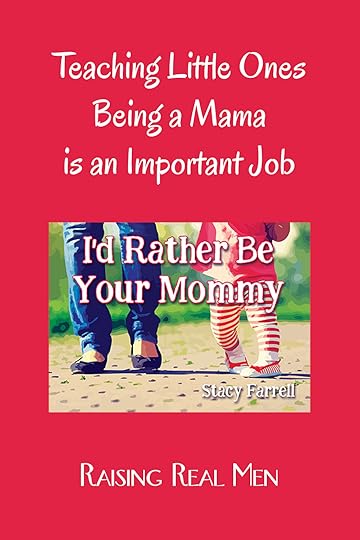
Really, though, many of our ideas about the world are determined in the picture book stage. That’s when we learn the difference between good and evil, begin to understand how society works, and start to think about what we want to do in our own lives. What better time to show our children that the work of a mother is worthy of honor!
I’d Rather Be Your Mommy, a delightful little book with engaging illustrations, tells children all the exciting things you, their strong, competent mother, could have done like run for office or flown an airplane, but reassures them that, “I’d rather be your mommy.” What a great message for little ones.
I’d Rather Be Your Mommy by Stacy Farrell, $16.95, Highly Recommended. Find it here.
Your friend,
Melanie

We were given a free copy of I’d Rather Be Your Mommy (or perhaps sent an ebook) shortly before it was published. We only endorse and recommend those books which we love and would use in our own home, though.
October 18, 2017
Why Luther is Important for My Kids
Our family makes a point this time of year to talk about the courage of Martin Luther, but there are reasons beyond a spirit of “Yaaaay, TEAM! Go, Protestants, go!”
There are some serious lessons that we want our children to absorb from Luther’s life, and they’re not Protestant-vs-Catholic talking points – they apply to all of us who name the name of Christ.
First of all, Luther’s guiding principle was to seek peace with God. He was a promising law student with a great career ahead of him when a near miss from a lightning bolt prompted a surprising promise – he chucked it all and entered a monastery before the month was out. A snap decision, maybe, but he felt a tremendous uncertainty about God’s good intentions toward him, he felt the weight of his sin and imperfection, and he had a sense of God’s wrath very near! Taking holy orders was the best path he knew to draw closer to God. And when the monastic life and ordination as a priest didn’t bring peace, he kept searching.
Second, Luther was willing to follow God whatever the cost. If pursuing God meant abandoning his future plans for law school, prosperity, status, marriage and family–well, God was worth it. That was the reality of becoming an Augustinian friar. Later, when his pursuit of God brought him to a deadly conflict, he was willing to keep going even if it cost his life.
Luther made his conscience “captive to the Word of God.” He pointed out that human Church leaders had contradicted each other and changed directions over the years, but the Bible was unchanging. Even then, when he found the Bible taught differently than his Church, he didn’t immediately overthrow everything around him. He studied deeply, prayed long, sought his counselors, and thoroughly tested whether these things were so (like the Bereans in Acts 17:11) But when he was firmly convinced from the Bible, then he refused to be turned aside – no matter what.
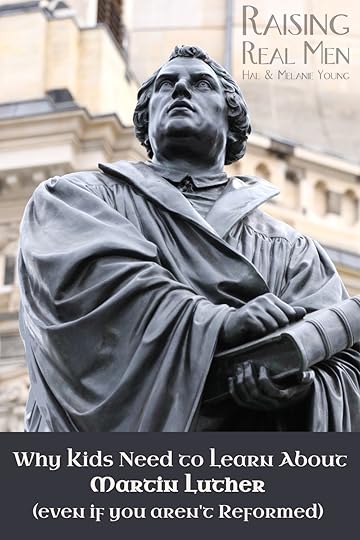
Luther was willing to face consequences for the truth. Throughout his life, Luther embraced the consequences of his faith. He knew his father Hans would be furious to see his son become a monk. He knew that joining the priesthood would overrule all of his prior plans. And he recognized that earlier reformers had suffered for the beliefs he now taught. Yet where he believed the Bible led him, he would continue — knowing full well what the outcome might be.
When Luther stood trial to defend or recant his teaching, he had already been thrown out of his Church by the Pope himself. He faced an angry ruler who could order his execution — it had happened to another reformer just 140 miles away. Yet at the critical moment, he told the Emperor to his face, “To go against conscience is neither right nor safe. I cannot and will not recant. Here I stand … God help me.”
Why is this important to my kids today? Because the culture has moved sharply away from basic principles we grew up with. Our common understandings of male and female and humanness have been overthrown. The Constitutional protection of speech, religion, and the press is under widespread attack at all levels. People with Biblical principles face growing pressure to change, compromise, or conceal those convictions – or face retaliation.
So our children will need the courage of Luther to stand for truth in their day – in spite of angry teachers, classmates, employers, and officials – just as Luther did. And we want them to think about his example when the pressure’s up.
That’s a need which crosses all sorts of denominational boundaries.
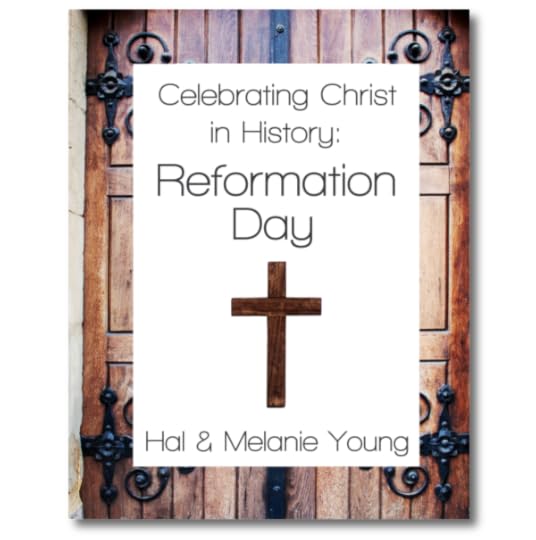
We’ve been celebrating Reformation Day for many years in our family, as a way of reminding us to teach these things to our children. We just released a new book about how to celebrate Reformation Day! It’s called Celebrating Christ in History: Reformation Day and it has history to share with your children, ideas for celebrating as a family or church, Reformation hymns and their history, and great recipes, too!
We’ve also introduced a new line of shirts I designed highlighting the principles of the Reformation, the Five Solas: Sola Scriptura (Scripture alone), Sola Gratia (Grace Alone), Sole Fide (Faith Alone), Solus Christus (Christ Alone), and Soli Deo Gloria (For the Glory of God Alone). Wear your faith on your shirt! Here’s our son John Calvin in one of the shirts…

This October 31st is the 500th Anniversary of the day Martin Luther nailed his Ninety-Five Theses to the door of the church at Wittenburg and lit a fire of Reformation that swept across Europe and still impacts us today. What better time to start a new tradition in your family and celebrate the heroes of the faith?
Happy Reformation Day!

In Christ,
Hal
September 28, 2017
Review: Homeschool Mom Fitness
This post may contain affiliate links which provide commissions that help keep our ministry going. Thanks for clicking!
One of the wonderful things about homeschooling is that you can stay in your pajamas on the couch many days. One of the bad things about homeschooling is that you can become a couch potato if you’re not careful. After a couple of years fighting illness, I was feeling the need to get active again when my friend, Heather Bowen, announced she was launching a new Homeschool Mom Fitness program that could double as a fitness program for the whole family. I bought it right away and I can’t wait to tell you about it.

What I loved:
There’s a short, clear video illustrating every one of the exercises. That really helped my girls figure some of them out since they didn’t have the benefit of football practice experience, which is where our boys learned how to do those things.
There’s a modified way to do each exercise for those of us who have bad knees or just need to work up to the regular exercise form.
There’s a private Facebook group for purchasers where you can ask questions and get ongoing encouragement.
There are tons of great charts and inspirational stuff you can print out. They’re cute, too.
You only need short bursts of 5 minutes or so and no special equipment. That makes it way easier to fit into my mobile, busy life. You can do the five-five minute workouts spread through the day (there’s a lot of recent evidence that short intense bursts are really good for you) or all at once, which still takes less than 30 minutes. I’m pretty excited about the no special equipment part, too, since we are on the road so much. We usually get back to the hotel as the gym is closing and walking is problematic in a strange town at night.

What could be better:
In the intro, I wanted a little less, at least at some point. I really wanted a short, simple “Here’s what you do first” bullet list. I’m over-committed and I confess, I skim. I wanted the executive summary telling me where to find each thing and in what order right now.
In other places, I wanted a little more. For example, there’s a chart to record your change in body fat percentage, but it doesn’t tell you how to calculate it.
Overall, though, this is a really good program to get both moms and kids in shape. And it’s really affordable at $29.97 (with no monthly payment, that’s it, plus you can use the coupon save10 to save $10!)
If you want to give it a try, (affiliate link coming!) click here to check Homeschool Mom Fitness!
Your friend,
Melanie

September 27, 2017
Remembering a Nearly-Forgotten Founder
September 27 is the birthday of one of the nearly-forgotten Founding Fathers, Samuel Adams. His cousin John Adams became George Washington’s vice president and then his successor; Samuel is known for a modern beer brand.
In fact, this founder of the Sons of Liberty and eventual governor of Massachusetts was actually a political activist and an intellectual powerhouse in the fight for independence. When Thomas Jefferson was writing his inaugural address, he said, “I often asked myself, is this exactly in the spirit of the patriarch of liberty, Samuel Adams? Is it as he would express it? Will he approve of it?”
He was that formidable in the minds of other founders, and some of his strategy is being played out in full view today.
Adams understood that grassroots effort could leverage public opinion against entrenched power. To promote the movement for independence, Adams became a journalist, writing an endless stream of letters and articles for newspapers and magazines, often under a pen name. He wanted to focus public attention on the erosion of liberty under the royal governors, and was successful spearheading a recall petition that got one such governor recalled by King George III. On his way out of office, the disgraced official muttered, “Damn that Adams, every dip of his pen stung like a horned snake.”
He also realized that active citizens could push issues past their complacent neighbors. “It does not take a majority to prevail,” he wrote, “but rather an irate, tireless minority, keen on setting brushfires of freedom in the minds of men.”
Adams was a devout Christian, and he firmly believed that civil liberty and freedom of religion are inescapably linked. “We have appealed to Heaven for the justice of our cause, and in Heaven we have placed our trust,” he wrote. “We shall succeed if we are virtuous.”
His faith gave Adams both security and boldness, and he refused to be bought or silenced. When the British General Thomas Gage was appointed military governor of Massachusetts in 1774, he offered Adams a bribe to drop his revolutionary activities and “make peace with his King.”
“Sir, I trust I have long since made my peace with the King of kings,” Adams responded. “No personal consideration shall induce me to abandon the righteous cause of my country. Tell Governor Gage it is the advice of Samuel Adams to him no longer to insult the feelings of an exasperated people.”
“Our contest is not only whether we ourselves shall be free, but whether there shall be left to mankind an asylum on earth for civil and religious liberty.”
That is a sobering thought to keep in mind today, as well.
(Hal wrote a longer review of Ira Stoll’s biography, Samuel Adams: A Life – CLICK HERE to read more …)
Book Review – SAMUEL ADAMS: A LIFE by Ira Stoll
In a dinner party discussion of David McCullough’s recently released biography of John Adams, Ira Stoll volunteered that his favorite Adams was Sam. Everyone thought he meant the beer. Actually, Stoll admires the uncompromising and incorruptible Samuel Adams, who was an indifferent brewer but a zealous patriot. This volume is Stoll’s attempt to clear away the fog which settled on Sam Adams’ legacy.
Samuel Adams was indefatigable. He thought deeply, wrote convincingly, argued passionately for the liberties of men born free and accountable to God before the King. John Adams said of his cousin, “Without the character of Samuel Adams, the true history of the American Revolution can never be written.” Thomas Jefferson wrote that his first inaugural address was based on Adams’ thought: “In meditating the matter … I often asked myself, is this exactly in the spirit of the patriarch of liberty, Samuel Adams? Is it as he would express it? Will he approve of it?” Although he never held a federal office above the level of congressman, Adams occupied nearly every level of state and local office between sanitation inspector and governor of Massachusetts.
Yet the vague obscurity he suffers today seems almost pre-ordained — which Adams, a staunch Calvinist, would have found unsurprising. Only a week after his death, friends warned that he would be “basely forgotten.” John Adams had to intercede with Massachusetts officials not to replace a state portrait of the late Governor Adams with a painting of George Washington.
Stoll spends most of the volume displaying the thought and character of the man, rather than pondering on history’s treatment of him. Stoll says that Adams burned much of his personal papers and did not leave a wealth of documentary records to study, but he brings him to life through a succession of letters, state documents, and newspaper articles. Adams was first and foremost a journalist, writing under several pen names to focus public attention on the blessings of liberty and its erosion under royal governors. He was effective, too; one governor, recalled by George III after an Adams-led petition, muttered on his way out, “Damn that Adams, every dip of his pen stung like a horned snake.” After independence, his editorializing moved toward policy statements, but he still itched to write for newspapers. “It is painful for me, you know, to keep secrets,” he confided to a friend.
Most importantly, says Stoll, Adams was a devout Christian who saw all of life through biblical lenses. Boston was moving away from its original Puritan culture, but Adams never did. He saw civil liberties as inseparably linked with religious freedom, and the failure in one would destroy the other. “We shall succeed if we are virtuous,” he wrote, and said that one who truckled to despotic royal officials had “very little if any true religion”; the habit would render him a “hardened sinner against GOD and COUNTRY.” When Governor Gage tried to bribe him to drop his revolutionary activities and “make peace with his King,” Adams replied calmly, “Sir, I trust I have long since made my peace with the King of kings. No personal consideration shall induce me to abandon the righteous cause of my country. Tell Governor Gage it is the advice of Samuel Adams to him no longer to insult the feelings of an exasperated people.”
This free and unashamed mixing of religion and politics is one reason, Stoll thinks, that Adams has suffered in history; it’s hard for modern, secularized historians to understand him. Like many Puritans, Adams had strong views against Roman Catholicism, and he found the supposedly neutral Quakers too Tory — “If they would not pull down kings, let them not support tyrants,” he growled. However, he was liberal enough to support the general freedom of religion, and was quite friendly with noted skeptics like Thomas Jefferson and willing to defend patriotic-minded heretics on occasion. It doesn’t fit the popular (and inaccurate) view of Puritans, leading some writers to accuse Adams of cynicism, yet a lifetime consistency in his personal writings and public statements rules out a faith of political expedience. There was a serenity in his faith, Stoll says, that gave Adams both energy and stability that others remarked.
It was not the only factor in Adams’ thinking, though. Stoll writes:
“If there is an alternative explanation to religious belief for Adams’s motivation in the revolutionary cause, it is economic. Adams stressed property rights almost as much as religious rights in arguing against Britain’s treatment of the colonies, and he described taxes imposed by Britain as an infringement upon those rights. And as a tax collector for the town of Boston who had trouble collecting what he was supposed to, Adams had a deep understanding of how much colonial Americans did not like to pay taxes.”
Adams remarked in 1768, “It is observable, that though many have disregarded life, and contemned liberty, yet there are few men who do not agree that property is a valuable acquisition, which ought to be held sacred. Many have fought, bled, and died for this, who have been insensible to all other obligation. … Now, what property can the colonists be conceived to have, if their money may be granted away by others, without their consent?” Like many of his words, these ring true 241 years later.
(This review originally appeared in Carolina Journal, a publication of the John Locke Foundation)
September 20, 2017
Do You Need a Glass of Wine?
I get it. I really do. I have more than my share of awful days.
Like when we speak 15 times in three days (for an hour each time!) and stand at the booth in between sessions, counseling and praying with folks. By Saturday night, I feel like I’ve been mugged. I’m too stupid to order a pizza, so I collapse on the hotel bed in hunger and avoid even getting up to walk on my aching feet to the bathroom.
Or when two of our kids are both hormonal at the same time. Nobody gets any work done, just bicker, bicker, bicker all the time, punctuated with tears and recriminations and the occasional utter meltdown. Sometimes I feel like screaming and running from the room.
Being a parent is HARD. Being a stay at home mom is HARD. Being a homeschooling, work-from-home, ministry-oriented stay-at-home mom, like many of us are, is downright brutal some days.
More and more, I see my friends saying, “I need a glass of wine,” and I wince.
I wince, even though I understand. Sometimes we just want something to take it all away, to just let us catch a break. I feel that way right now. School was a failure today. And thanks to a business crisis, I got about two hours less sleep than I needed last night. All I want is peace and quiet and a nap. (Thank you, dear daughters, for that marzipan cake, though. That really helped.) Sometimes I think, too, “I wish I could just have a glass of wine.”
I don’t, even though there is wine in my cupboard – good wine (I really love marchand du vin sauce). I don’t, for several reasons:
All encouragement is not created equal. It really is qualitatively different to say, “I need coffee” or “I need a brownie,” and to say, “I need a drink.” Alcohol is really, seriously addictive in a way caffeine and chocolate are not. Alcohol causes a dopamine release that your brain quickly adapts to and finally needs to function.
I know, I know. It’s only once in a while; it’s only when it’s been a really bad day.
That’s the problem, though. When you use alcohol to help with a bad day, what do you do when you have a bad year? We’ve had them. The year our youngest was born with a life-threatening heart condition, three of our other children had surgery, our business was struggling, and Hal was diagnosed with stage IV cancer. It nearly killed me.
If you need a glass of wine to get through a day with whiny kids, what are you going to do when real trials hit, one after another, until you think you’ll go mad? I’m not judging you, I’m just concerned.

Diet Coke and brownies don’t break up homes. A young mother I know was arrested for child endangerment when she passed out in her car in the discount store parking lot. Her small children ran inside the store to get help because “Mama is sick!” Yes, she was, but not the kind of sick they thought. She had become an alcoholic and it had destroyed her judgment. Don’t be too quick to write her off — I met her before all this, at a parenting group. She was a very good mother then … before “needing a glass of wine” took over her life. Really.
No, this isn’t about legalistically forbidding drinking at all. I have zero problem with having a glass of wine with a fine meal or drinking champagne to celebrate an occasion. After all, the Lord told those unable to travel to Jerusalem in Deuteronomy 14:26, And you shall spend that money for whatever your heart desires: for oxen or sheep, for wine or similar drink, for whatever your heart desires; you shall eat there before the Lord your God, and you shall rejoice, you and your household. He wouldn’t tell us that if drinking wine in moderation in celebration was wrong. It’s not. That’s not what I am seeing every day on social media, though. I’m seeing alcohol being used as an anesthetic, a spiritual one.
The Proverbs tell us, Give strong drink to the one who is perishing, and wine to those in bitter distress; let them drink and forget their poverty and remember their misery no more.
Why are God’s children, the redeemed, the ones who have seen God’s grace, resorting to numbing themselves from misery? And can we truly say that our “bad days” rate as Biblical-level misery? I think we’d do better to get on our knees.
Growth is difficult. When we say “I need _________ to get through this day,” I wonder if we’re short-circuiting the learning God has for us. Maybe He is allowing these things in our lives so that we will seek Him and His grace and mercy and power, not just something to take the pain away.
Proverbs further warns, Do not look at wine when it is red, when it sparkles in the cup and goes down smoothly. In the end it bites like a serpent and stings like an adder. Your eyes will see strange things, and your heart utter perverse things.
It’s mind altering. It changes our perceptions and lowers our inhibitions. It can make it easier to fall into temptation. It really is different from a cup of coffee or a piece of pie.
Please, sweet mamas, be careful. You really don’t need a glass of wine. There is One who says to you, My grace is sufficient for you, for my power is made perfect in weakness. There is safety there. Refreshment. What you really need to keep going.
I know you probably know that. I realize it was probably just a throw away line to tell your friends, “I’ve had it. I’m beat,” but your kids are listening and so are your friends. Maybe some of them are struggling – or will one day. Let’s be careful what we’re throwing around.
With much love and sympathy,
Melanie
September 19, 2017
The College Application Dance
We’ve homeschooled forever and ever, and since we’ve got four adult sons, we’ve talked with quite a few college administrators. One of the interesting questions we’ve discussed is, “Do you see any problems with incoming homeschoolers?”
Surprisingly, we have never heard complaints about “socialization.” Instead, college officials have told us that homeschooled kids seem to find their place on campus very quickly. They don’t seem unusually awkward or shy – in fact, the opposite seems to be true. And professors tend to like them because they tend to be curious and unafraid to ask questions in class.
What problems do they have?
We read somewhere that homeschoolers forget to put their names on the top of their papers. When do they ever do that at home? More importantly, they’re not the best for observing deadlines or realizing class rules aren’t always negotiable. Ouch.
One place we parents may have trouble, though, is giving our kids enough credit. We’re so concerned about grade inflation in our homeschools, we tend to grade more harshly than classroom teachers. And that can hurt our students when it’s time to fill out their college applications and high school transcripts.
How can you help your student create a really good application package, without being arrogant or untruthful? (click on the graphic to listen to the podcast!)
Remember as Christians, we are always meant to “speak the truth in love” (Ephesians 4:15) and we are warned that “God resists the proud, but gives grace to the humble.” (James 4:6). But,
If your student honestly has gifts, talents, achievements, or honors, it’s right to acknowledge them as God’s blessings — without becoming arrogant or prideful! The apostle Paul often reminded his readers that he had studied under the top Biblical scholars, been a leader in the Jewish community, and was appointed by Jesus Himself as an apostle – not because he wanted to boast (remember he said he counted his proudest achievements as “rubbish” compared to knowing Christ, Philippians 3:8) but because he needed to establish credibility or authority to speak in certain situations.
It’s okay to claim any qualification you’re entitled to. When Paul dealt with government officials, he claimed his rights as Roman citizen (look at Acts 16, Acts 21-22, and Acts 25). If your student qualifies for state scholarships, special needs programs, or need-based financial aid, for example, don’t be shy about applying for them.
Start early! Colleges may send out acceptance notices for the fall semester as late as April 1, but financial aid deadlines are often months earlier – at some schools, as soon as early October! And latecomers may find their favorite schools have already accepted all the students they had room for. Don’t underestimate the amount of time it can take to fill out the paperwork, either.
Keep notes as you go. There’s a lot of duplication on admission forms from one college to the next. You can even re-use essays if the prompts are similar! Keep a document listing all your student’s contact information, extracurricular activities, and answers to questions and essays – it will save lots of time.
Figure on applying at several schools. There is a growing pool of students applying for college, and there’s no guarantee your student will get in at any given college. It’s okay to dream, just be sure you have more than one option running.
Consider a full range of colleges. Look at any of the websites that rate colleges and list their average test scores and cost of attendance for incoming freshmen. Pick several that are a close match to your student’s interests and abilities. Go ahead and apply for one or two dream schools – you may be pleasantly surprised at the results! But also pick a couple that are “safety” choices, schools where your student almost certainly would be accepted, and the price is affordable in case financial aid doesn’t cover it.
Keep in mind that colleges change over time. Your alma mater today is probably different than you remember it – larger, smaller, a different culture. Your own point of view has changed, too, and what attracted you as an undergraduate may look different through the eyes of a parent. Try to stay objective when you visit!
Finally, remember You can always say “No,” but you can’t invite yourself. You don’t have to attend every college that accepts you, but you have to apply to get accepted … so put those applications in and give yourself some options.

CLICK HERE to get our free
College Decision Resource Package
September 17, 2017
How My Old Band Director Influences My Family Life Today
My 8th-grade band director taught me something really important about relationships.
Last week, my old band director passed away. Pat Wylie (it’s still hard to think of him by his first name) was a major part of my young life, for two years in middle school and four in high school (where he assisted with the upper level music program). He’s the one who finally taught me to read music, something that’s been part of my life for more than forty years. He was one of those teachers who was both fearsome and loved. He was stern and demanding, but not a tyrant. He cared about us, and we knew it.
My classmates recall his catch phrase, “Results, not excuses!” and lessons he drummed into us about the value of discipline and practice. I agree with all that, but I remember a more personal lesson in particular.
One day in eighth grade, several of us were hanging around the band room during lunch. We were clowning around with our instruments, pulling out the tuning slides to see just how discordant we could make them, blatting and blurting notes to produce the most awkward sounds possible. It was hilarious to a middle schooler.
Mr. Wylie’s soul was vexed, and he finally stepped out of his office and called us down.
“Every time you pick up your instrument,” he said, “you are either becoming a better musician, or a worse one.”
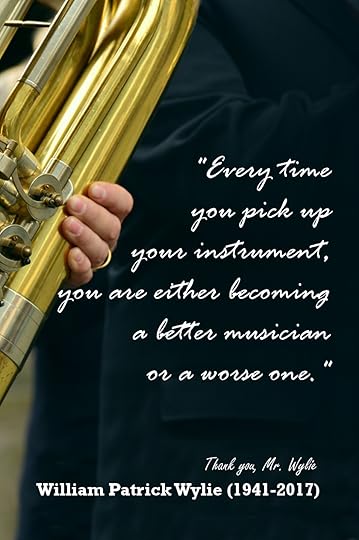
Sheepishly, we packed up our horns and quieted down.
That sentence has come back to me over and over in the decades since. It’s not just about music, although it certainly applies. I’ve heard my sons’ football coaches reminding them, “The way you practice is the way you’re going to play.” It’s true whether you’re on the field for four quarters or the halftime show.
But I’ve seen it in relationships. Every time you speak to your kids, every time you talk with your mate, you’re either building the relationship, or you’re weakening it. Stephen Covey compared it to a relational checking account – every transaction is making a deposit, or making a withdrawal. Keep writing checks, keep drawing on the account, and eventually the goodwill balance goes into the red. When that happens, it takes a long series of deposits to get that balance back on the positive side. Researchers have noted the additive effects of conversations between couples – positive or negative. It’s real.
Mr. Wylie was right. Life is a series of moments. Every time we pick up our instrument, our tools, or our relationships, we’re either going to get a little bit better, a little stronger, a little kinder, a little smarter – or we’re going to tear something down a little bit. The way you practice and the way you rehearse will predict the way you perform when the curtain goes up and the game’s for real.
It pays to think about that. Thank you for the lesson, Mr. Wylie.
In Christ,
Hal
September 12, 2017
Hypocrisy and Boiled Peanuts
Have you ever had an embarrassing parenting moment? Yep, just had one. To be fair, my kids thought it was funny, but I was pretty embarrassed.
Hal and I decided before we even had kids that we would try to help our kids avoid being picky eaters. So, they hear us say some things over and over:
“Just try it. You never know.”
“If you didn’t like it cooked that way, try it another way.”
“Always take a few bites; your tastes change.”
“Eat it anyway.”
Except I’ve always hated peanuts. That wouldn’t change. Nope. Not ever. Don’t talk to me about peanuts. Don’t offer me peanut butter. Yuck. Ick. Bleah.
Then the other day, one of my adult sons was noshing on some boiled peanuts. Yes, that’s a thing. At least in South Carolina, it’s a thing. It’s a thing everywhere in South Carolina. I remember the newstand in my grandparent’s hometown sold them. Every farmer’s market has someone boiling them. Gas station? There’s a crockpot of hot boiled peanuts. There’s even a cauldron of them at the front at Wal-Mart. It’s kind of an everyman’s snack around here.
“Hey Mom, you ought to try these,” he said. “They really don’t taste anything like peanuts usually do.”
I looked around and saw all those kids I’d encouraged not to be picky looking at me … and well…gulp.

“Okay. I’ll try one, but you’ve got to shell it for me.” I just couldn’t face touching that shell – it meant “This is yucky” to me.
Munch. Munch. Munch.
Then it was confession time. “I love them! I really do! Why didn’t you tell me they tasted like pinto beans?”
I’ve had them several times since and I really, really love them. And I feel really, really stupid. REALLY stupid. Here I’ve missed a treat for decades that I could have been enjoying. Because I was too pig-headed to try it.
That’s exactly what we’ve been trying to teach our children not to do. For the most part, we’ve succeeded. Folks are amazed at the things our kids will eat. Owners of ethnic restaurants give our little kids free desserts when they watch 6- and 8-year-olds happily gobbling up octopus, tandoori chicken, vindaloo, crawfish. Hooray, our kids aren’t picky!
Kids are more likely to listen to us when we practice what we preach, though. When we don’t … it’s hypocrisy. And kids have really strong hypocrisy meters. They want to know their leaders are worthy of leading. When we tell them to do as we say, not as we do, we tempt them to rebellion.
So what do you do if you’ve blown it? If you’ve sinned and your kids know it? You model for your kids what a Christian does when they’ve done wrong. You confess your sin and ask for forgiveness.
What if it doesn’t rise to that level? What if you didn’t really sin, you just weren’t a great example? The same thing. Admit it, apologize, and do better.
Our kids know we’re not perfect. They already know we’re sinners. Let’s make sure we point them to the only cure for sin – the blood of Jesus Christ, who died so that we could be forgiven.
That’s really the whole point of parenting — to point our children to the One who made them and died for them. And that is worth a bit of embarrassment any day of the week!
I think I’ll go snack on some boiled peanuts.
Your friend,
Melanie