
Janice Hardy's Blog, page 113
March 7, 2018
The Circle of Write (Or Why Some Books Kick Our Butts)
 By Janice Hardy, @Janice_Hardy
 I was chatting with a fellow author recently, and we were commiserating over manuscripts that drove us crazy and were hard to write. I’m in the middle of rewriting one of those manuscripts right now, but this time around, the writing is going really well. It made me think about what changed, why some books are harder to write than others, and what we can do when we’re faced with a book that makes us want to yank out our hair and throw away our keyboards.
I’ve loved and wanted to write this particular YA fantasy idea for close to ten years, but it’s been a hard book to write. The core of it has stayed the same—an undercover spy and the emotional stress it causes—but the plot and the character arcs of the two main characters has changed over and over. Draft after draft just didn’t do what I wanted it to do.
Read more »Written by Janice Hardy. Fiction-University.com


March 6, 2018
4 Mistakes to Avoid When Building Suspense in Your Novel
 By Laurence MacNaughton, @LMacNaughton
 Part of the How They Do It Series (Contributing Author)
Have you ever read a book that you just couldn't put down? The whole time you were turning pages, you were probably desperate to discover the answer to a burning question. That's the essence of suspense, and it makes readers devour your book. So how do you build suspense in your novel? Start by avoiding these four suspense-destroying mistakes.
Mistake #1: Answering all of the questions.
At or near the beginning of every scene in your book, you need to fix a question firmly in the reader’s mind. Give them something to worry about.
For example:
Who committed the murder?Does he really love her?Will she get the jobIs someone really trying to kill him?It doesn't have to be a huge, dangerous question. It could be as simple as, “Will she make it to work on time?” Readers will worry about almost any question, if—and this is a big if—you make it clear that the question is crucial to the outcome of the story.
As long as the answer to that question is important, the reader will keep worrying about it until you answer it.
And you do need to answer it, sooner or later. Smaller questions should be answered by the end of the scene. Bigger questions can take the whole book.
But here's the trick: never, ever answer all of the questions. Always make sure there are at least one or two questions in the reader’s mind at any given time. Before you answer one question, ask a new one. Keep those questions coming, and readers will keep reading.
Mistake #2: Giving the main character a vague goal.
Vague goals are the next biggest killer of suspense. If the reader doesn't know exactly what the main character is trying to do, then they won't worry about whether or not she will succeed. No worrying means no suspense.
A suspenseful story goal needs to meet three specific criteria:
1. The goal needs to be personally important to the main character.
2. The main character can only reach the goal by taking action.
3. Reaching the goal needs to be a specific event that you can visualize, like crossing a finish line or planting a flag on top of a mountain. It needs to be something that you could photograph. Otherwise, the reader won't necessarily know when the goal has been achieved.
Here's an example. In my novel A Kiss Before Doomsday (the Dru Jasper series, book 2), one of the main characters, Greyson, has gone missing and is presumed dead. But Dru has reason to believe the man she loves is still alive. Her goal is crystal clear: find Greyson.
That goal meets all three of the criteria. It’s personal, because she loves him. It’s active, because she has to go out looking for him. And you can visualize it: the moment she finds him, you'll see it happen.
For your novel, write down your main character’s goal in a single sentence, like this:
CHARACTER must VERB the OBJECT.
Example: Dru must find Greyson.
Use your character's name, plus a verb such as find, win, deliver, escape, stop, etc. And then finish the sentence with what he or she is after.
By using a verb, you're automatically making the goal active, because the hero has to take some kind of action to achieve it.
Next, check to make sure that the goal is personally important to the main character. It has to directly affect the main character’s life in a powerful way. (Note: in your story, make sure to show the reader why this is important.)
Finally, make sure the reader would be able to visualize the specific moment when the goal is achieved. In your notebook, write down a few sentences describing what happens in that moment.
If you can't describe a specific event, then it's a sign that your goal is not specific enough. Take a close look at the verb you used in the sentence (find, escape, etc.). Is it active enough? Keep working on it until you know what that winning moment looks like.
Once you have it, you'll be able to keep readers in suspense as they wait for it to happen.
Mistake #3: Making the stakes too low.
There's a lot of talk out there about the “stakes” in the story. But what are the stakes, exactly?
What's at “stake” is what the main character will gain by achieving the goal, or lose by failing to achieve the goal. Here's an easy way to think about it:
Imagine two tables playing poker. At one table, the players each have to stake a single dollar. At the other table, the players each have to stake a million dollars. Which game is more exciting?
Exactly.
Now, imagine that in the back room, there's a third table full of gun-toting criminal masterminds, and the players each have to stake their very lives.
Those are high stakes.
How high do the stakes need to be in your story? It doesn't necessarily have to be a matter of life or death. But some important part of the main character's life needs to be at stake, and it will literally or metaphorically die if she fails to achieve the goal.
Some example elements that could be at stake in your story: the main character's life, her career, her marriage, her family, her reputation. You get the idea.
In my novel It Happened One Doomsday (the Dru Jasper series, book 1), the story starts with Dru trying to help a handsome hot rod mechanic named Greyson. The guy has been afflicted with an ancient curse, and unless Dru can break it, he will lose his mortal soul. So right from the get-go, the stakes are high.
Do the same thing in your book. You don't have to endanger someone's mortal soul, necessarily. But you do have to make sure that something life-changing is at stake. If the main character fails in their quest, he or she will pay a steep price.
Mistake #4: Not raising the stakes.
The stakes should not only start out high, they need to actually get higher during your story. That ups the tension, which builds the suspense.
How do you do it? In your notebook, write down your original stakes, then add the phrase “even worse” and come up with something, well, even worse.
Here's an example. Halfway through It Happened One Doomsday, Dru discovers the nature of Greyson’s curse: he will not only lose his soul, he will also become one of the Four Horsemen of the Apocalypse. If Dru can't break his curse, she'll lose Greyson—and, even worse, the Four Horsemen will ride forth to bring about doomsday. The entire world will come to a fiery end.
That's definitely worse. The stakes are raised, the suspense builds, and the second half of the book just flies by.
In the beginning of your book, let your reader know what's at stake. How will the main character suffers if he or she doesn't succeed? Then, somewhere in the middle of your book, raise the stakes even higher. Not only will the main character suffer, but something else will happen that’s even worse.
Remember: suspense is all about asking questions.
Building suspense in your novel is not a one-time event. It's a constant process. You have to continually pose crucial questions throughout your book, starting in the very beginning, and keep the reader asking questions faster than you answer them. Make your readers worry about a burning question, and they'll keep turning the pages to find the answer. That's how you create page-turning suspense.
Do you struggle with building suspense, especially in the middle of your book?
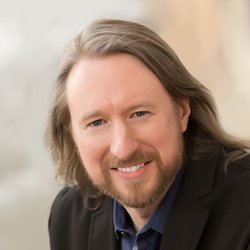 Laurence MacNaughton writes funny books about magic crystals, possessed muscle cars, and the end of the world. His books include It Happened One Doomsday, A Kiss Before Doomsday, and No Sleep Till Doomsday (July 2018). Find out how you can get a free ebook at www.laurencemacnaughton.com.
Website | Facebook | Twitter | Goodreads
About A Kiss Before Doomsday (Dru Jasper, Book 2)
 When an undead motorcycle gang attacks Denver's sorcerers, only one person can decipher the cryptic clues left behind: newly minted crystal sorceress Dru Jasper. A necromancer is using forbidden sorcery to fulfill the prophecy of the apocalypse and bring about the end of the world. To learn the truth, Dru must infiltrate the necromancer's hidden lair and stop the prophecy. But she needs to do it fast, before legions of the undead rise to consume the souls of everyone on earth…
Amazon | Barnes & Noble | iTunes | Indie Bound | Kobo
Written by Janice Hardy. Fiction-University.com

March 5, 2018
The 5 Turning Points of a Character Arc
 By Janice Hardy, @Janice_Hardy
 For most novels, the character arc is a critical part of the tale. It’s the emotional layer that makes readers care about all the cool plots and exciting scenes we put before them. Readers enjoy seeing how a character grows, and how they handle the emotional trials of the story.
Just like a plot, the character arc has several turning points that fall at specific structural moments throughout the novel. There’s wiggle room as to where, but they generally fall along the same path as the plot, since the plot is what triggers or impacts these moments.
Read more »Written by Janice Hardy. Fiction-University.com

March 4, 2018
Writing Prompt: The Re-Write: Who Doesn’t Like Cake?
 By Janice Hardy, @Janice_Hardy
This week’s prompt is a new type! One of the early prompt challenges was to edit a purposefully bad bit of writing. In that spirit, I’m adding a prompt designed to let you practice your revision skills without the risk of messing up your manuscript.
You have to keep the bones of the piece, but you can move things around and add dialogue and internalization and whatnot. As long as you can still identify this scene as the scene I started you’re good—so no completely rewriting it from scratch. The goal is to make my monstrosity better.
Edit the bad writing, strengthen and clarify the goals, conflict, and stakes, develop the setting, establish the character, etc. You know the drill.
Your challenge: Turn this snippet into something worth reading:
She had no idea what she was doing. It seemed like a good idea at the time, going to the movies with that guy George, who worked in accounting when he wasn’t taking people to the movies, and that had to have been her first mistake. Going into the break room for cake.
The cake was delicious. Three layers of chocolate with white frosting, the corners shaped into tiny flowers of pink and yellow. Between each layer was a strip of raspberry sauce with bits of real raspberry about a quarter inch thick. It sat on an old china plate someone must have brought from home. Stella maybe, or Lolita, or maybe that dude from purchasing, Augustus.
Augustus was cute, but George was cuter. She should have asked him what he was doing this weekend. He had a sweet way about him, even if he didn’t like cake, and really, who didn’t like cake? That should have been her first clue that this wasn’t going to go well.
Have fun! Written by Janice Hardy. Fiction-University.com

March 3, 2018
Real Life Diagnostics: Does This Synopsis Work?
 Critique By Janice Hardy, @Janice_Hardy
Real Life Diagnostics is a weekly column that studies a snippet of a work in progress for specific issues. Readers are encouraged to send in work with questions, and we diagnose it on the site. It’s part critique, part example, and designed to help the submitter as well as anyone else having a similar problem.
If you're interested in submitting to Real Life Diagnostics, please check out these guidelines.
Submissions currently in the queue: Zero
Please Note: As of today, RLD slots are open.
This week’s questions:
Does this synopsis work?
Is it confusing and hard to follow?
Do you get a sense of characters?
Market/Genre:
On to the diagnosis…
Read more »Written by Janice Hardy. Fiction-University.com

March 2, 2018
Does Your Novel Have Too Many Characters?
 By Janice Hardy, @Janice_Hardy
 In one of her posts, Robyn Hood Black shared an exercise about testing the relationships of your characters to each other using cut out pieces of paper. I loved this idea, and it got me thinking that this was a great way to test a very common writing question:
Does my novel have too many characters?
Read more »Written by Janice Hardy. Fiction-University.com

February 28, 2018
Writing Workshops & Events from Janice Hardy in 2018
 By Janice Hardy, @Janice_Hardy
 On the event and workshop front, 2018 might be my busiest year to-date. I’ve already gone to two (the Orlando Writers Conference and the Coast Magic Convention) and there are more to come. It’s been so busy that I realized yesterday I hadn’t had time to tell everyone about everything yet! Let's fix that right now.
I don’t anticipate any more events after August, but if one happens, I’ll let everyone know.
Here’s where I’ll be in 2018:
Read more »Written by Janice Hardy. Fiction-University.com

February 27, 2018
Upstaged by Backstory: Are You Writing the Wrong Novel?
 By David Mack, @DavidAlanMack
Part of the How They Do Series
JH: You don't always know where a story is going to go, and what you set out to write isn't always what you end up with. Please help me welcome David Mack to the lecture hall today, to share his thoughts on the backstory that became the novel.
David Mack is the New York Times bestselling author of more than thirty novels of science fiction, fantasy, and adventure, including the Star Trek Destiny and Cold Equations trilogies. His writing credits span several media, including television (for episodes of Star Trek: Deep Space Nine), film, short fiction, magazines, and comic books. He resides in New York City.
Website | Goodreads | Facebook | Twitter | Read an excerpt
Take it away David...
Read more »Written by Janice Hardy. Fiction-University.com

February 26, 2018
How Over-Explaining Will Kill Your Novel
 By Janice Hardy, @Janice_Hardy
 Writers have trust issues sometimes. We worry whether or not our readers will get what we're trying to do. Will they spot that oh-so-subtle hint in chapter three? Will they get the subtext between the romantic leads in scene five? Is the protagonist’s backstory clear or should we throw in a flashback that explains it?
We sometimes worry so much that readers might miss something, we end up shoving the story right down their throats.
And that's bad.
Read more »Written by Janice Hardy. Fiction-University.com

February 23, 2018
Come See Janice Hardy at the Coastal Magic Charity Book Signing

By Janice Hardy, @Janice_Hardy
If you happen to be in the Daytona Beach, FL area this weekend, I'll be at Coastal Magic meeting folks and signing books--including my brand-new Blood Ties , as well as the new targeted editing books.
I'm one of over 50 authors in the fantasy, urban fantasy, and paranormal genres, so there are a lot of great books to be found--and great authors to meet.
I'm attending the convention as well, so look for me and say hello!
Here's more on the signing and the convention itself. I believe there are still some day slots available for anyone who wants to attend.
Just look at this line up:
Read more »Written by Janice Hardy. Fiction-University.com


