Angela Slatter's Blog, page 88
March 3, 2015
A Nasty Fairy Tale: Bluebeard’s Daughter
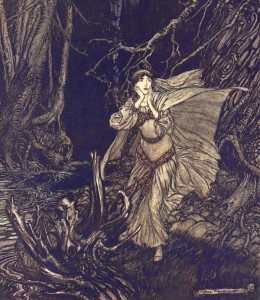
Arthur Rackham
Continuing the process of remembering how to write short fiction, I’ve started a tale tentatively titled “Bluebeard’s Daughter”. I’m trying to roll in a bunch of fairy tale motifs – without making them cheesy – to dig down into all the layers of nastiness that hide at the heart of old tales. It’s what I do.
Bluebeard’s Daughter
‘Here,’ she says, ‘have an apple.’
Yeah, right. As if I know nothing about stepmothers. As if I know nothing about apples. But I’m polite and I’m not stupid, so I put the green orb in my pack, and thank her.
‘Now, don’t forget: you’ll need to be careful and cunning. You’ll need all your wits about you. It’s hidden deep, the treasure, and there will be all kinds of obstacles.’ She puts her hands on her hips and surveys me critically. ‘It’s a long journey, but you’ve got the most fat on you of all of us. You’ll be fine; the exercise will do you good. Don’t forget that apple.’
As if I’m likely to forget that apple. Nice of her to manage a dig at my weight ? I come from a long line of women who eat their grief, yet she’s of thin stock, my father’s fifth wife. Busy, busy, busy all the time, bustling and fidgeting, organising and ordering, hating anyone to be idle; she’s got the energy of a hummingbird and a heart of stone. Gods forbid anyone should spend an afternoon sitting on their arse, reading a good book.
That was how I got caught; sitting on my arse, buried in a book, oblivious to the world. The rest of the family had made themselves scarce, knowing she was on a tear about too little food, too many mouths; as if we were poor, as if my father didn’t provide for all the children he’d fathered, and all those that had been brought by previous wives and left here when said wives had gone.
As if she wasn’t just trying to cull the herd.
As if she hadn’t done it before.
As if a horrifyingly large number of my siblings, both full, half, and step, haven’t ended badly.
‘Here’s the map, but you want need a compass, you’ve got a wonderful sense of direction.’ We both know I get lost in the library sometimes. ‘Remember to be polite and biddable to any creature you meet on the way. Be home before winter … then again, your natural insulation should keep you warm. We’re all counting on you, Beth. And don’t forget that apple, if you’re peckish.’
She finishes adjusting the strap of my satchel and stands back, surveying me with the resigned disappointment of a woman who knows she’s done her best with second-rate materials. ‘Well, that’s you done then.’
Or so she bloody well hopes.
***
?


The Heart is A Mirror for Sinners
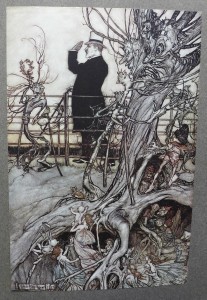
One of Arthur Rackham’s illustrations for J M Barrie’s Peter Pan in Kensington Gardens
“The Heart is A Mirror for Sinners” has been finished and sent off. This was a difficult story to write because I’ve been doing so much longer fiction – I had to remember (with much reminding from Lisa) how to write a short, sharp tale. But I got there in the end!
The Heart is a Mirror for Sinners
By Angela Slatter
The crypt of St Bride’s is cold, colder than the air outside, and I welcome it, find it invigorating, for I did not sleep well, nor have I done since my return. Florie, long gone, chose last night to haunt my dreams. Her face and figure – not as I saw them that final occasion – were perfect and pink and plump and whole. We spoke of old times, all the childish play we’d shared, hide’n’seek in the empty rooms and dusty attics of Norwood Hall, the tarts and pies and treats we’d stolen and eaten beneath the great oak in Mathilda’s Wood, not far from the churchyard. We chatted as friends, but when, moved and ecstatic, I reached out to touch her hand, she changed, her beauty gone and ripped, and she appeared to me the way I’d left her.
I’d woken with a start to find my room flooded with daylight and Florie herself pulling back the blue velvet drapes around my bed. I screamed, I admit it, and scrambled away from what I thought to be a phantasm, only to blink and realise it was the little maid, poor Mary, shaking with fright.
‘I brought your breakfast, sir. I’m sorry. I heard you speaking and thought you were awake already, otherwise I’d never have-’
I waved a hand. ‘Not to worry. I dreamed is all. A nightmare.’ I sat up, propped myself against the pillows and shooed her when she tried to help me. The thought of her touch instilled as much strange dread as intense arousal, and the dark voice in my mind threatened to sing. ‘Go, leave me.’
***
The Bitterwood Posts: By My Voice I Shall Be Known
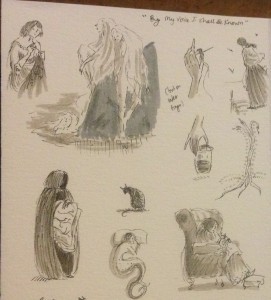
Sketches by Kathleen Jennings for By My Voice I Shall Be Known
In “By My Voice I Shall Be Known” I wanted to combine elements that contained echoes of stories about the Lorelei Rock, the rusalkas, and Melusine, all wrapped up with a traditional kind of betrayal and revenge tale. The title comes, I think, from something I read about one of the Sybils … but unfortunately I can’t quite remember which one and I don’t seem to have kept a note about it. Bad writer. But I love the idea of that ringing sound, that bold statement that her voice will be all she needs … even though it’s been taken from her.
My mother is a quilter and I find what she does absolutely fascinating and very beautiful – yet I’m not a person with any talent for crafting thing with my hands, so it does seem a kind of witchcraft to me. When I was writing, I remembered a comment by my friend, Alan Baxter, who’d said that watching his wife knit was like watching folk magic happen – and I thought that quilting was pretty much like that too.
You’re creating something to cover you at night, a protection from cold, mozzies, and monsters (it really is!) – why wouldn’t it be magical? I thought further about the idea of glory boxes that young women used to prepare for their marriages – why wouldn’t they want a thing to bring them good luck, a prosperous and happy future? Something to cover their marriage bed? Maybe even something that might influence a husband’s behaviour? And what if the magic could be made to work in different ways?
By My Voice I Shall Be Known
If I still had a voice, I would cry out.
The fabric is thick and my needle blunt – I should have sharpened it before now – so I put too much weight behind my thrust and forced the point. Not only the quilt, but also my finger is impaled. I do not wail, though I long to, determined not to make the hideous grunt that is the only noise left to me. In my memory, I still hold the sound of my voice, but each time I bellow it lessens, chips away at the timbre so lovingly preserved in recollection. Slowly, carefully, I draw the thread fully through, then pull my injured digit off the silver shaft. A scrap of spare cloth is wrapped around the glistening blue-ruby drop, then the needle itself is assiduously cleaned. I set the bulky bundle of material aside and limp, my legs stiff from hours of sitting, to the basin in the far corner of the tiny room Mother Magnus has given me. Washing the injury, applying a salve, then bandaging the deep wound; I look out the window, not really seeing so much as remembering what is there before me.
Bellsholm sprawls along the banks of the wide Bell River, loose-limbed as a sleeping giant;  a rough crescent with its northern tip truncated by the bulk of the Singing Rock. In the foothills that hug the edge of the town some few ramshackle houses have crept, not too high, and certainly nothing up on the majestic outcropping of the promontory. At the furtherest boundaries there are farms to supply the markets and businesses best located away from the centre of town, such as the carriage maker, the foundry, the marble worker’s studio, three carpentry and joinery firms, and Ballantyne’s Coffin Emporium where the strange woman employs four apprentices and, rumour has it, keeps a locked room filled entirely with mirrors. There is also the hostelry, where travellers with no interest in the hamlet can rest, eat, exchange their tired horses for fresh ones, then continue their journeys. Down by the river are the docks, brimming and bobbing with great ships from afar filled with all the finest things a prosperous place requires, and small local boats that bring in fish and travel up and down the reaches too narrow for the caravels and barques.
I can hear, dimly, the melodies of the rusalky, wafting up from the base of the Rock, where they laze daily (except Sundays when the sound of church bells sends them into hiding) and serenade anyone who will listen. Murdered maidens, those unfortunate in love, gather their spirits to sit on the rocks, dangling luminescent toes in the water. The weak of will may traipse too close and fall in. Some drown. The natives are, by now, mostly inured to the strains and are all brought up to swim like eels – indeed, Léolin will tell you that as a young man only his strong stroke saved him on the day when he was distracted by a particularly lovely ballad. The greatest danger is to travellers, on ships and on the roads, unfamiliar with our ladies.
***
Le Guin on writing fantasy
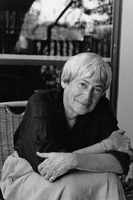 This is an extract from Ursula Le Guin’s review of Ishiguro’s Buried Giant, and I think it sums up very well some of the problems that occur when lit writers assume writing genre is an easy thing.
“A wild country inhabited by monsters, an old couple who must leave their home without knowing exactly why, a sense that important things have been, perhaps must be, forgotten… Such images and moods could well embody a story about the approach of old age to death, and indeed I think that is at least in part the subject of the book. But so generic a landscape and such vague, elusive perceptions must be brought to life by the language of the telling. The whole thing is made out of words, after all. The imaginary must be imagined, accurately and with scrupulous consistency. A fantastic setting requires vivid and specific description; while characters may lose touch with their reality, the storyteller can’t. A toneless, inexact language is incapable of creating landscape, meaningful relationship, or credible event. And the vitality of characters in a semi-historical, semi-fanciful setting depends on lively, plausible representation of what they do and how they speak. The impairment of the characters’ memory in this book may justify the aimlessness of their behavior and the flat, dull quality of the dialogue, but then how is it that Axl never, ever, not once, forgets to address his wife as “princess”? I came to wish very much that he would.”
The rest is here and,the little bit of snippyness aside, it is a very well considered piece.
March 2, 2015
Reminder: Goodreads Competition
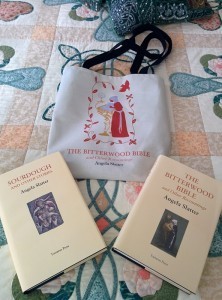 Just a reminder, my Goodreads competition will close in a couple of days. You can win:
1 x hardcover of Sourdough and Other Stories
1 x hardcover of The Bitterwood Bible and Other Recountings
1 x limited edition bookbag with art by Kathleen Jennings
Sourdough was a finalist for both the Aurealis Awards and the World Fantasy Awards in 2011, and Bitterwood is an Aurealis Finalist this year.
Go here to enter.
March 1, 2015
Last Year, When We Were Young: Andrew McKiernan
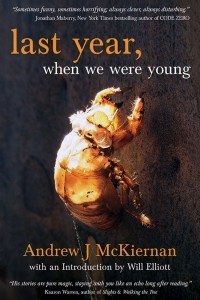
Andrew J McKiernan is an author and illustrator from Narara, on the Central Coast of New South Wales. First published in 2007, his stories have since been short-listed for multiple Aurealis, Ditmar and Australian Shadows awards and reprinted in a number of Year’s Best anthologies. He was Art Director for Aurealis magazine for 8 years and his illustrations have graced the covers and internals of a number of books and magazines.
His debut collection, Last Year, When We Were Young – described by New York Times bestseller Jonathan Maberry as “A troubling collection of weird and twisted tales. Sometimes funny, sometimes horrifying; always clever, always disturbing. Highly entertaining!” – was recently released in print and ebook formats by Satalyte Publishing and can be purchased on Amazon.
So, what do new readers need to know about Andrew J McKiernan?
I’m an author and (occasional) illustrator living on the Central Coast of New South Wales, Australia, with my wife, two teenage boys, and two cats. At various times in my life I’ve been a bank teller and a warehouse storeman, a purchasing and logistics officer, a production manager, a graphic designer, a web developer, a typesetter and an Art Director. I’ve played in bands, was a member of a secret occult organisation, and my wife and I were ordained priest and priestess of a Gnostic Church for almost ten years. I currently work part time at one of those weird/creepy self-storage facilities.
What was the inspiration behind your new short story collection, Last Year, When We Were Young?
Less an ‘inspiration’ and more an initial request from Satalyte Publishing to see everything I’d published to date. This is all the stories I’ve written and published since 2007 and, though I tried to find an order and flow that works for the collection, there isn’t really any over-arching theme or inspiration. I guess that, mainly, it’s a line drawn in the sand. I certainly haven’t given up on short stories, but my focus for now is novels, and I (and my publisher, Satalyte) thought this was a great way to bring everything together as a sort of milestone.
How did you connect with Satalyte Publishing?
They contacted me. I’d been posting little ‘Work In Progress’ snippets to Facebook from a crime novel I was working on called A Quiet Place. Seems those snippets were enough to catch the eye of Satalyte’s owner, Stephen Ormsby, and he asked to see what I had. I’d written less than 5,000 words at that stage, only three chapters, but he read that and offered me a contract straight away. That’s when he asked to read my previously published short stories too. I think he read them while he was in a hospital waiting for his wife to give birth to their daughter. A few days later, Stephen called me back and made me an offer to publish the collection.
What attracts you to the darker side of fiction? 
I really don’t know, and I’d prefer not having a psychologist poking around trying to find out why. I was watching Universal and Hammer films from a really early age, probably 6 or 7. And lots of B- and Z-grade stuff too (Roger Corman and the like). My mum is a huge film buff, all types of films from the best to the worst, and that gave me a good grounding. My grandmother (my mum’s mum) was more a book-nut, and she was also the cleaner of our local library. She’d take me with her at night, and I’d have the entire place to myself, all the aisles dark and towering around me with books. She let me borrow books from the ‘Adult’ section, so I got to read Dracula and Frankenstein and Shirley Jackson fairly early on too. I read Carrie sometime between the age of 9 and 10; read it aloud at lunchtimes to a group of entranced 4th Grade girls from my school. So, I really don’t know what the attraction is — no childhood traumas, loving family, normal upbringing, nothing to mark me as especially weird — but that attraction has certainly always been there.
In general, who and/or what are your writing influences?
Oh boy, I collect influences like some people collect Beanie Babies! Lovecraft and Clark Ashton Smith. Shirley Jackson and Flannery O’Connor. William Faulkner. Cormac McCarthy. Daniel Woodrell and James Sallis. William Gay. Tim Winton. Margaret Atwood. Paul Haines and Kaaron Warren and Dale Bailey and Nathan Ballingrud. I like to think all these authors have changed/influenced/improved the way I write to some degree.
Who is your favourite villain in fiction?
Judge Holden from Cormac McCarthy’s Blood Meridian. Seven feet tall and totally bereft of body hair (even eye-lashes), skin pale, and enormously strong. Scalp-hunter, murderer, naturalist, nihilist, philosopher. There are even hints that the Judge is more than just a mere man and something supernatural. He’s one very scary guy!
“Whatever exists, [the Judge] said. Whatever in creation exists without my knowledge exists without my consent.”
When did you first decide you wanted to be a writer?
If there was a moment, I don’t remember it. I’ve been writing for as long as… well, for as long I could write, I guess. I entered short story contests from the age of 6 or 7 onwards. Just local things, Council Library and Book Week and that sort of thing. Won a few. But, it was just something I did. I never really thought it was something I would actually DO, like become an astronaut or a lion tamer. And then I left high school to become an English Teacher, deferred Uni to get a job and a car, and… never made it back to Uni. I became stuck working horrible day jobs and thought that was life, until my wife told me to write something seriously and submit it. I took her advice (which is always a sensible thing to do) and my first story (‘Calliope: A Steam Romance’) was accepted by the first anthology submission call I sent it to. Maybe that was the moment I realised that I’d always wanted to be a writer, but never dared consider it. Now, I don’t want to be anything else.
What scares you?
Bigotry. Our government. The gullibility and ignorance of people. The future.
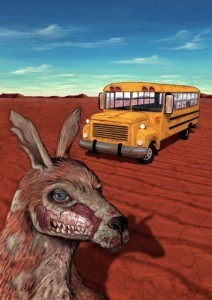
Artwork by Andrew McKiernan
Name five people, living or dead, you’d like to invite to dinner?
British comedian David Mitchell; Actor Richard E. Grant; Author Iain Banks (now, so sadly, deceased); Author Margaret Atwood; Author Paul Haines (because I never got the chance to just sit down, and eat and drink, with one of the most amazing people I ever had the fortune of knowing).
What is next for Andrew J McKiernan?
Finish the crime novel. That is the only thing that is next for me at the moment. A Quiet Place is due to Satalyte this year, and I’ve still got a ways to go. But, I’ve shut down my web-development/graphic design business and stopped accepting illustration commissions. Even though this is my first attempt at writing something so large, my head is in a good place and I’m still confident I can maintain the pace and the quality and reach an ending that works. Once that’s done, I have other novel ideas — an historical bushranger novel, for instance — and a few more Clowntown stories to write. But, for now, the novel is where my head is staying.
February 28, 2015
Some Perspective for Awards Season
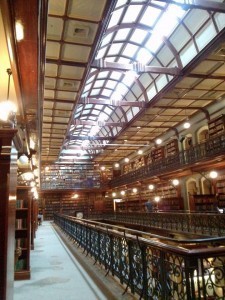
Look at all of the books, so many many books.
Just a little note for some perspective during awards season.
While I’m utterly delighted and very humbled to be nominated for this year’s Aurealis Awards, I’m also very aware that it’s a bit of a crap shoot. One year you may have produced work that you consider to be your best, yet judges don’t agree and you don’t make any lists. Other years you may think the fuss is a bit much because you don’t think you turned out anything super-duper; but you’re on lists.
My point? The shortlists and the awards, while they are very nice, are not the be-all-and-end-all of your career.
There’s a lot of amazing work that hasn’t made the shortlists, not due to any shortcomings, but purely due to individual tastes on the judging panels (who, let us remember, do their best and do not get paid for the time and effort they put in). Awards are not something you can control, they’re also not anything anyone ‘deserves’ or has a right to. Sure, everyone gets a bit miffed and butt-hurt to feel ignored, but being on or off doesn’t change anything about you as a writer. It doesn’t make you better or worse if you win or lose; it doesn’t make your readers love your more or less whether you’re shortlisted or not. It doesn’t mean your book is an ugly baby coz it’s not on a list.
“Easy for her to say” some will sniff, but this is something I’ve said for years (here and here). I’ve been on lists and I’ve been off them; I’ve won awards and I’ve lost them. It’s lovely to feel appreciated, but a shortlisting or an award doesn’t make me write more, or better, and it doesn’t make me stop writing any more than bad reviews or someone else’s public shouting of spite about me.
You don’t write for the awards: you write because you can’t do anything else. You write for one person, first and foremost: yourself. Sometimes, if you’re lucky, an audience chooses to come along for the ride. Who you are as a writer doesn’t change whether you’re awarded/shortlisted or not. The awards are the jam; some days you get it, some days you don’t.
So be gracious, always. Be sane, as much as you can. Be hopeful, but not expectant. Keep your foul moods and snide remarks for the privacy of your own home. Most of all, keep writing for no one but yourself.
February 27, 2015
Aurealis Awards Shortlists are GO!
 The shortlists for the Aurealis Awards are out and there are some wonderful works nominated.
I’m truly grateful and humble to have six noms this year.
“St Dymphna’s School for Poison Girls” and “The Badger Bride” are up for Best Fantasy Short Story along with great work by Thoraiya Dyer, Charlotte Nash and Deb Kalin.
“Home and Hearth” is up for Best Horror Short Story, again with fantastic work by Kirstyn McDermott, Garth Nix, James Bradley and Deb Biancotti.
And last but not least, The Bitterwood Bible, Black-Winged Angels, and The Female Factory (co-written with the fabulous Lisa L. Hannett) are all on the Best Collection shortlist, with very fine works from Rosaleen Love, Simon Petrie, and Ian McHugh.
Congrats to all my friends and colleagues!
The full list is here.
February 26, 2015
In the mail: Year’s Best Australian Fantasy and Horror 2013
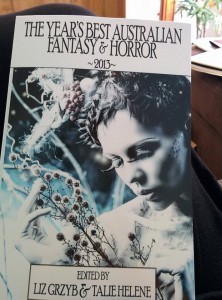 Another beautiful volume in the Australian Best Of series from Ticonderoga Publications, edited by Liz Grzyb and Talie Helene.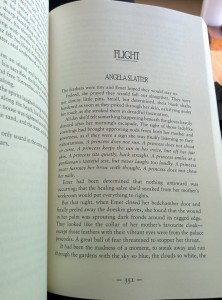
February 25, 2015
The Monstrous
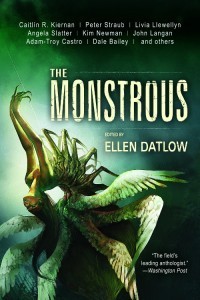 The new anthology from Ellen Datlow is The Monstrous, out from Tachyon Publications in October.
The cover by Reiko Murakami is amazing.
Pre-order here.