
Maggi Andersen's Blog, page 59
June 1, 2013
The Folly at Falconbridge Hall is up for Book of the Month at Long & Short Reviews!
I'd love a vote! Here's the link: http://wp.me/p2ZcT9-4IT


May 31, 2013
A LOOK AT THE COUNTRY HOUSE SERVANT - The Footman
As my new release, THE FOLLY AT FALCONBRIDGE HALL is set in a big Victorian house, I had to research how these huge houses operated. I’ve focused today on the footman, and some of the interesting facts I found. There wasn’t a footman at Falconbridge Hall – if you read the book, you’ll find out why!
![[footmen+hauling+luggage+(2).jpg]](http://1.bp.blogspot.com/_LCVZWFAEodk/R_MZ9KF73iI/AAAAAAAALTs/Nh1LgcB4mQw/s1600/footmen%2Bhauling%2Bluggage%2B%282%29.jpg) Footmen always were more decorative than anything else. Their duties were light compared to those of other servants and the most important thing was that they should be tall and good looking and reflect well on their employers. At a time when servants were relatively cheap to employ, and mostly more than earned their keep, footmen were a complete luxury - which is why most people didn’t have them and they were a status symbol.
Footmen always were more decorative than anything else. Their duties were light compared to those of other servants and the most important thing was that they should be tall and good looking and reflect well on their employers. At a time when servants were relatively cheap to employ, and mostly more than earned their keep, footmen were a complete luxury - which is why most people didn’t have them and they were a status symbol. It was no myth that they were chosen for their looks - according to Daniel Pool in What Jane Austen Ate and Charles Dickens Knew, footmen wore:

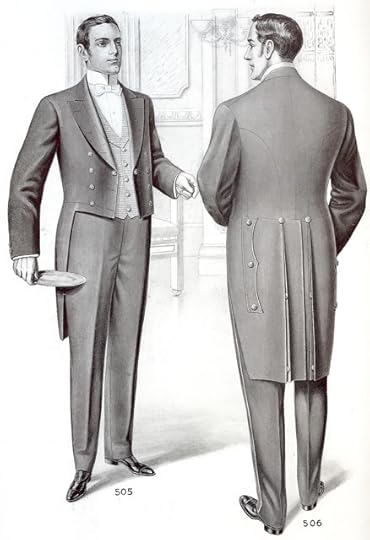
'livery,' or household uniform of fancy coat, knee breeches, stockings, and powdered hair, a costume that endured to the end of the 1800s. Because of their appearance at dinner and in public with the family, footmen were supposed to be the most 'presentable' of the male servants. They were evaluated on the basis of the appearance of their calves in silk stocking, and they often gave their height when advertising for positions in the paper–it was considered absurd to have a pair of footmen who didn’t match in height. (Poole, p. 221)
 Distinctive livery was a feature of male servant's dress in aristocratic households for two centuries from the Restoration of Charles ll in 1660. This livery outfit with its bold yellow colouring for the breeches and waistcoat, dates from the middle of the 19th century and still shows features of 18th century dress including the style of the coat, and the breeches. This type of retrospective styling was also used for court dress, reinforcing the timeless and traditional feel, and the difference from changing contemporary fashions.
With household uniforms, this distinctive garb also served to distinguish the servant clearly from his master, as well as ensuring that such employees felt noticeably subserviant. Only male servants wore such uniforms, although some advocated its introduction for female staff. In 1725, Daniel Defoe wrote a broadsheet urging the adoption of uniforms for women servants, professing that he had mistakenly kissed a chamber maid, believing her to be one of his friend's guests! It was not until the later 19th century that female house servants were usually dressed in similar cotton print dresses with white bibbed cotton aprons and caps.
 Footmen had to powder their hair – a throwback to the 18th century when footmen wore a bag wig with queue and tail. It was universally disliked, as they believed it caused premature balding and colds. The hair had to be dampened, then stiffened with soap and powder. It was necessary to wash and oil the hair at night to prevent it turning a foxlike colour. Either the powder was provided, or the footman was given ‘powder money’ with which to buy it.
The running Footman: The running footman was required to be a healthy and agile man, and both in his dress and his diet a regard was had to the long and comparatively rapid journeys which he had to perform. A light black cap, a jockey coat, white Linen trousers, or a mere linen shirt coming to the knees, with a pole six or seven feet long, constituted his outfit. On the top of the pole was a hollow ball, in which he kept a hard-boiled egg, or a little white wine, to serve as a refreshment in his journey; and this ball-topped pole seems to be the original of the long silver-headed cane which is still borne by footmen at the backs of the carriages of the nobility. A clever runner in his best clays would undertake to do as much as seven miles an hour, when necessary, and go three-score miles a day; but, of course, it was not possible for any man to last long who tasked himself in this manner. The nobility lived in a very dignified way, and among the particulars of their grandeur was the custom of keeping running footmen. All great people deemed it a necessary part of their travelling equipage, to have one or more men running in front of the carriage. For appearances sake more than anything else, although they may be required to lift the carriage out of ruts, or assist it through rivers. Coach travel was slow, seldom above five miles an hour, and was not difficult for these strong, agile gentleman until the end of the 18th Century. Then the speed of travel increased as a consequence of improved roads and equipages, and the custom began to be given up.
“…Well developed calves and a supercilious expression. Several times a day he partakes freely of nourishing food, including a surprising quantity of beer,” says Lady Violet Greville in the National Review in 1892. Footmen have had bad press. Called ‘lackey’ and ‘flunkey’, ‘peacocks among domestics’ and ornamental parasites.
 It was true that footmen were heavy drinkers and many liked to gamble. It didn’t get much better in the 20th Century. When Mr. and Mrs. Chichester’s household went out for the day, the moment their carriage was out of hearing, down to the cellar the butler would go and ring the bell to summon all stable hands, gardeners and workmen …And the beer would flow… both the butler and a footman died of drink. Many an insurance company then would refuse to insure a butler because of his ready access to drink. They were given beer and ale allowances as normal practice. But when you examine the kind of life they lived, it’s not hard to understand why they drank.
 The footman was responsible to the butler. For carriage work, he answered to the coachman or the gentleman of the horse. He was expected to help out with valeting for male guests or family members. He was also expected to serve food and lay tables. He needed to develop a wide range of skills, many of which involved intricate rules of etiquette. He was also involved in menial aspects of large scale domestic management: cleaning, lighting, security and endless travelling. But the job was most closely associated with ‘waiting’. To stand on duty at a specific station waiting for his services to be required, perhaps to mend the fire, take a message to someone, or receive and announce guests.
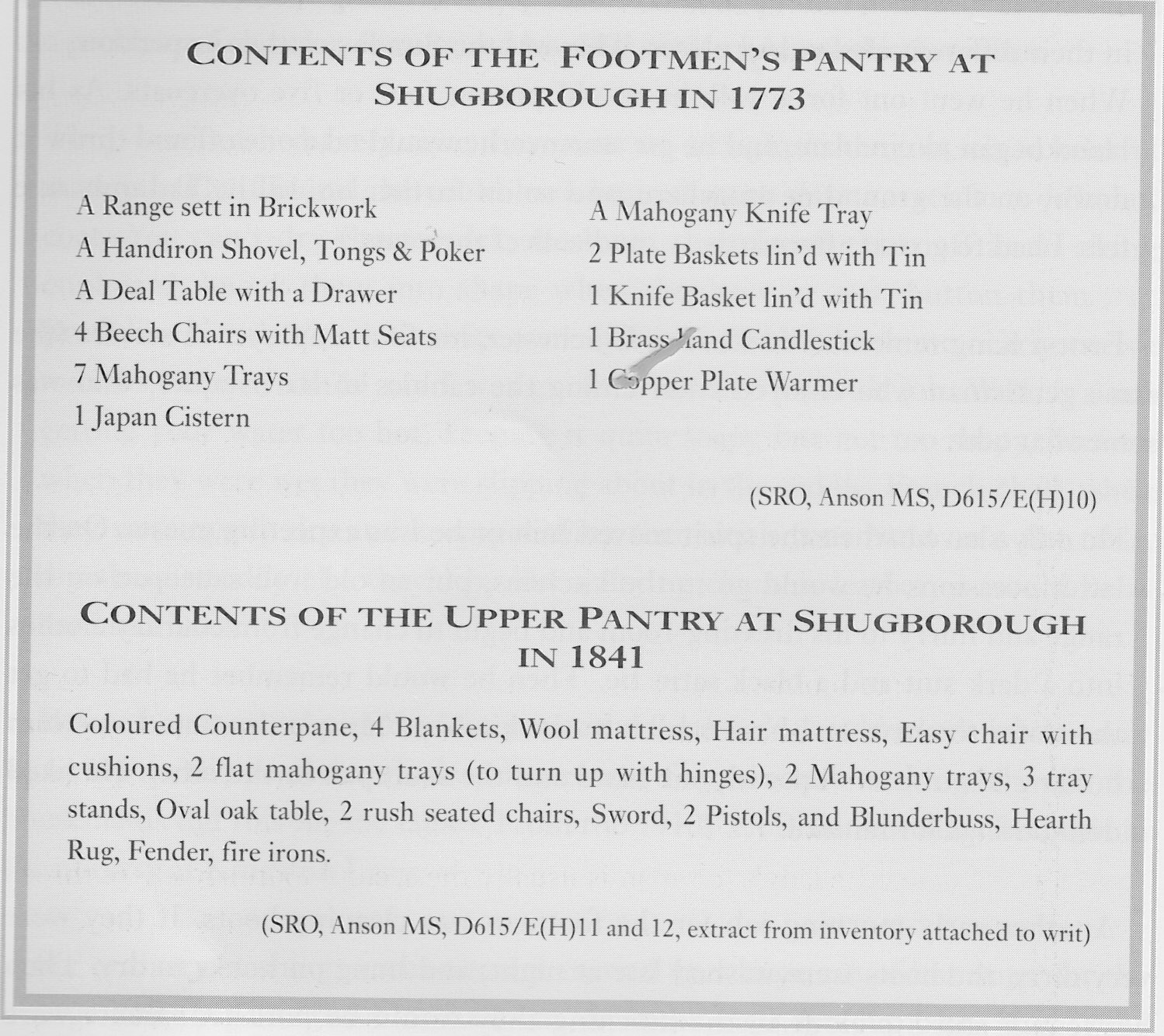
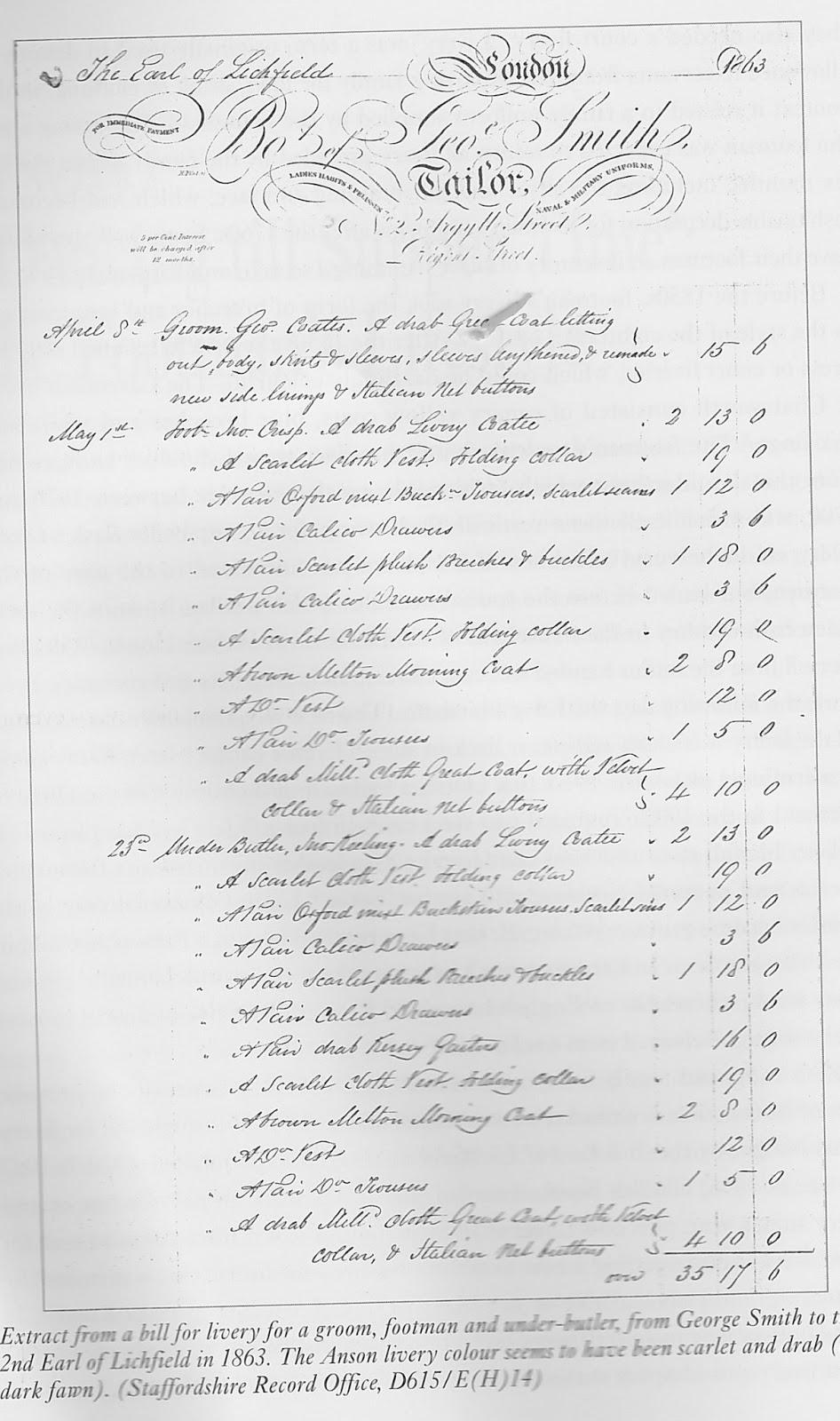
The life of a gentleman servant was not unlike a bird shut up in a gilded cage. They were chosen for their appearance and paid according to their height. Their livery was expensive. In 1863, a single bill for livery items bought by the 2nd Earl of Lichfield at Shugborough, totalled: 120 pounds 7 shillings and 10 pence. It was usual to provide one or two livery suits a year, plus court livery. In many houses, it was the custom to wait to see if a new footman was suitable before measuring him for livery. In some houses, a new male member of staff was shown a variety of second hand livery suits, hoping that one would fit.
In the 19th century, dormitory or single-bedroom accommodation was unusual. Footmen often slept in pull down beds in the servant’s hall. They were the last servants to retire for the night and considered it early if they got to bed at 12.15 am. Even if a footman was out on carriage duty until the small hours, he still had to get up early in order to vacate his bed when breakfast was being served in the servant’s hall.
In 1896 in London, it was usual for menservants to sleep in the basement, well away from the women in the attic.
The footman might have been called an ‘ornamental parasite’, but the footman was the mainstay of a household.
They were a mark of status, and were essential in an age where male fashion was so elaborate no gentleman could dress himself; furniture was so finely wrought that it needed skilled cleaners, and even in the nineteenth century, being waited on at dinner by a manservant carried higher status than a mere parlour maid.
Towards the end of the 19th century, however, the shortage of menservants became such that in many country houses parlour maids took over many of the duties of footman.
 Thomas from Downton Abbey, Edwardian era.
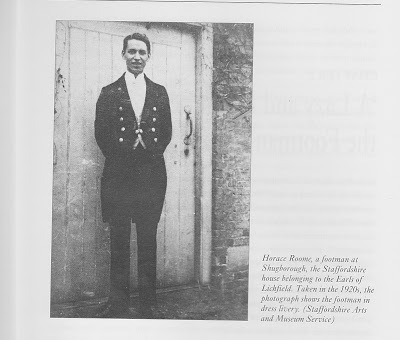
 By the 20th Century their livery and duties had changed.
Sources: Chambers Book of Days
Servant Livery Manchester Art Gallery
Daniel Pool in What Jane Austen Ate and Charles Dickens Knew
May 29, 2013
My review of SALT REDUX by Lucinda Brant
SALT REDUX by Lucinda Brantby maggiandersen
 Sequel to Salt Bride- Salt Hendon series book 2BLURBJane and Salt -- four years of Happily Ever AfterSir Antony Templestowe -- four years of Exile
Lady Caroline -- four years of Heartache
Diana St. John -- four years plotting Revenge
The time has come...RHL ClassificationsSetting: Georgian EnglandHistorical RomanceHeat Level 15 Stars/Top PickREVIEW BY MAGGI Although Book 1, Salt Bride, was my favorite, Lucinda Brant has written another superb romance set in Georgian England. Her descriptions of the life and times of the period are quite breathtaking. Her characters are charismatic and appealing faults and all. Four years ago, Sir Anthony Templestowe, who has loved Lady Caroline for years, loses any chance of marrying her due to mistakes they both make. He has now returned from Russia, supposedly a new man, having overcome an inherent weakness. He believes Lady Caroline has married another, but is drawn back to London by the ingenious plotting of cunning villainess.Apart from the skillfully woven romance between Sir Anthony and Lady Caroline, the chilling suspense plot kept me reading and on the edge of my seat. Salt and his wife, Jane, have returned to London with a new baby and unwittingly exposed their family to great danger.While Salt was a great favorite of mine, Sir Anthony is also a very attractive hero. Brant resists intense love scenes between him and Lady Caroline, while still revealing their passionate impatience for each other. I enjoy Brant’s humor as well as the beautifully wrought historical detail, and look forward to her next book.Maggi Andersen's Website: http://www.maggiandersenauthor.com maggiandersen | May 28, 2013 at 12:01 am | Tags: Georgian England, Lucinda Brant, Romance, Suspense, Tags: Historical romance | Categories: 5 STAR TOP PICK, CLEAN/SWEET/MILD, GEORGIAN, HISTORICAL ROMANCE, OUR TOP PICKS! | URL: http://wp.me/p2t1no-13v
Sequel to Salt Bride- Salt Hendon series book 2BLURBJane and Salt -- four years of Happily Ever AfterSir Antony Templestowe -- four years of ExileLady Caroline -- four years of Heartache
Diana St. John -- four years plotting Revenge
The time has come...RHL ClassificationsSetting: Georgian EnglandHistorical RomanceHeat Level 15 Stars/Top PickREVIEW BY MAGGI Although Book 1, Salt Bride, was my favorite, Lucinda Brant has written another superb romance set in Georgian England. Her descriptions of the life and times of the period are quite breathtaking. Her characters are charismatic and appealing faults and all. Four years ago, Sir Anthony Templestowe, who has loved Lady Caroline for years, loses any chance of marrying her due to mistakes they both make. He has now returned from Russia, supposedly a new man, having overcome an inherent weakness. He believes Lady Caroline has married another, but is drawn back to London by the ingenious plotting of cunning villainess.Apart from the skillfully woven romance between Sir Anthony and Lady Caroline, the chilling suspense plot kept me reading and on the edge of my seat. Salt and his wife, Jane, have returned to London with a new baby and unwittingly exposed their family to great danger.While Salt was a great favorite of mine, Sir Anthony is also a very attractive hero. Brant resists intense love scenes between him and Lady Caroline, while still revealing their passionate impatience for each other. I enjoy Brant’s humor as well as the beautifully wrought historical detail, and look forward to her next book.Maggi Andersen's Website: http://www.maggiandersenauthor.com maggiandersen | May 28, 2013 at 12:01 am | Tags: Georgian England, Lucinda Brant, Romance, Suspense, Tags: Historical romance | Categories: 5 STAR TOP PICK, CLEAN/SWEET/MILD, GEORGIAN, HISTORICAL ROMANCE, OUR TOP PICKS! | URL: http://wp.me/p2t1no-13v
May 23, 2013
Wonderful review of THE FOLLY AT FALCONBRIDGE HALL
*****REVIEWThe Folly at Falconbridge Hall by Maggi AndersenMay 23, 2013

The Folly at Falconbridge Hall by Maggi Andersen
Publisher: Knox Robinson
Genre: Historical romance
Length: Full (350 pgs)
Heat: Spicy
Rated: 5 stars
Review by SnapdragonVanessa Ashley felt herself qualified for a position as governess, until offered the position at Falconbridge Hall.Left penniless after the deaths of her artist father and suffragette mother, Vanessa Ashley draws on her knowledge of art, politics and history to gain employment as a governess. She discovers that Julian, Lord Falconbridge, requires a governess for his ten-year-old daughter Blyth at Falconbridge Hall, a huge rambling mansion in the countryside outside London.Lord Falconbridge is a scientist and dedicated lepidopterist who is about to embark on an extended expedition to the Amazon in search of exotic butterflies. An enigmatic man, he takes a keen interest in his daughter’s education, but Vanessa feels that he may disapprove of her modern methods.As she prepares her young charge to enter into the modern world, Vanessa finds the girl detached and aloof. As Vanessa learns more about Falconbridge Hall, more questions arise. Why doesn’t Blythe feel safe in her own home? Why is the death of her mother, once famed society beauty Clara, never spoken of? And why did the former governess leave so suddenly without giving notice?The opening of The Folly at Falconbridge Hall immediately fills the reader with anticipation; especially if you are a fan of the classic romance novel. It is England in the late nineteenth century, and the new governess Vanessa arrives at Falconbridge Hall. It is The Perfect Setting. Vanessa admits she is less than beautiful – and penniless; our perfect heroine.She is shown in ‘to the master’s study.’ What phrase could sum up the situation better? It is both a backdrop and statement about the style of life, the man of the house, even the stature of the house. The master is neither cuddly nor dashing, and we see no great hope in him right off the bat. He is, shall we say …intriguing? With a variety of intellectual interests. There are moments when we sense kindness, yet we cannot quite be sure. There is also that rather too interested groom, Lovel, but the romance part of this romance is in no hurry. And there are no early spoilers – just hints, so I’ll make no further comment. At this point, you are as sure as I that when love arrives it will be ‘just right’ as is everything here.Vanessa’s tale progresses at just the right pace, and we are slowly drawn into the world that is Falconbridge Hall: the community of staff, events and operations of the great hall. Ms. Andersen’s star quality is truly her superbly strong and interesting main character, yet her descriptions are worth notice as well. “…rode around the estate enjoying the titter of swallows in the trees, past the gnarled old apple trees, the grass dotted with fallen fruit after the harvest…” The genteel old world aura is enjoyably supported in the most subtle ways throughout.Oh, but a tiny, almost unnoticed thread of disquiet twists its way through the tale. The thread regards a ‘captive’ beauty and that too, is worth waiting for. It is a curiosity, but also, perhaps, ominous. Vanessa’s life will go on an unpredictable course…Author Maggi Andersen never disappoints in the wonderful romance, that truly transports readers to this other, older world. Reading this novel is sitting down hoping for a proper tea and being served fruit cake along with the plum jam and scones. My recommendation: put this right to the top of your reading list.
Great 5 Star Review!
***** Read more about the book and enter the giveaway here
.
 The Folly At Falconbridge Hall by Maggi Andersen
My rating: 5 of 5 stars
From the moment I began reading this book, I knew this was my kind of book. I was not far into the book before I saw the connection between this book and “Jane Eyre.” That was always a favorite book of mine, and there were some definitely comparisons including romance, a little girl, and a lot of mystery in a big English manor. It was fairly easy to decipher what would ultimately happen, but the writing of the book kept me so engaged that I practically lost track of the time.
As to any issues that require warning: very little profanity (nothing too bad, in my opinion) and intimate bedroom scenes only following marriage. I did not find myself repulsed during the bedroom scenes, and I am glad that the couple did not live in the bedroom (I get tired of books that do that). Vanessa, Julian, and Blythe were well-developed characters, and I found their interactions period-appropriate and rather humorous at times. I often forgot that this was a book written in this century rather than during the 1800′s.
This is the first book I have ever read by Maggi Andersen, but she is definitely my kind of author. No cheesiness, semi-realistic situations, sweet and hot romance/love, and a bit of mystery. And, of course, it takes place in England–where else? If you love historical fiction and romances, this just may be for you.
I was sent a copy of this book in exchange for my honest review. I was not financially compensated, and all opinions are 100 percent mine.
View all my reviews
Interested in subscribing to all my site's updates? Subscribe below! Subscribe to My Devotional Thoughts
May 15, 2013
Today, I'm welcoming the lovely Anne Brear to my blog.
 Anne has a new release!
 I'm reading and greatly enjoying this novel. A review will follow.
Here's a taste!
Virtue of a Governess
BlurbIn 1867 Nicola Douglas attends a London lecture that inspires her to change her life. With no family, but a good education, she boards a ship to Australia with high hopes of a fresh start in a new country as a governess. But Sydney is full of young women with similar hopes and equally poor prospects. When Nicola is at her lowest, she meets Nathaniel West. Try as she might, her attraction to Nathaniel West grows. She also meets a visiting American, Hilton Warner. As both men shower her with attention, Nicola reaches a crisis. She came to Australia expecting to be a governess, but finding love, and being married, shows how empty her life has been since her parents' death. Her achievements at the Governess Home are vital to her. Can she have both? To reject both men would relegate her to spinsterhood, but if she makes that choice, would her career ever be enough to sustain her?
Excerpt:Nat shook the sweat from his eyes, ducking his head and weaving to the side, making sure he kept his shoulders and fists up high to protect his chin. From the corner of the chalked square, he made out the old hunched-back man, who stood and, holding the brass bell aloft, rang it heartily three times. Cheers and shouts went up, there was a surge towards the fighters but the organiser’s men held the rowdy mass back. “Christ man, what’s taking you so long?” Tristan thumped Nat’s back, laughing. “You should have had him in the first minute. The man is lead-footed.”Nat wheezed the air into his lungs and wiped the sweat from his eyes. “I want to keep out of his reach, he can hit like a hammer.”“Nonsense, man. He’s like a windmill, arms everywhere.”“Shut up will you, and get me some water.” Nat closed his eyes for a moment, trying to block out the sight and noise of men baying for his blood. What possessed him to agree to this fight? He was no longer a young man of twenty. It’d been a few years since he celebrated his thirtieth birthday, which should have been enough warning to give up this sort of sport and stick to cricket. He hadn’t been practising in months, and it showed.Tristan thrust a crude tin cup into his hands and water sloshed over his wrist. “It’s only water, perhaps you need something stronger.”“Sod off.” He gulped the water down just as the hunchback rang the bell again. Surging to his feet, he berated himself once more in agreeing to this madness. Already his opponent, some dockland fellow with missing teeth, had jabbed him in the ribs, which ached when he moved. Another lucky punch had caught his eye and likely tomorrow he’d have the bruise to show for it.He raised his fists, keeping light on his feet as he’d been taught as a schoolboy back home in England. His wiry opponent gave a little jab, testing the way it was to be in this round, but Nat was tired of the game. It’d been a spur of the moment decision to enter the square, a desperate need to burn off some restless energy that bedding with his current mistress didn’t do last night.Weaving, ducking, he circled the opposite man, looking for a way to end the match so he could return to his club and drown his sorrows for another day. He thought of her then, the woman who’d haunted his mind. Nicola Douglas. His blood grew thick in his veins as an image of her face swarmed before him.He never saw the punch, just felt the intense pain of the other man’s fist hitting his jaw. The impact made him bite his tongue and the stinging pain joined the thudding ache of his face. He staggered, tasted blood. The crowd, mainly all working class, shouted encouragement to their champion and jeered at Nat when he readied himself again.Anger cursed through Nat and brought him awake and into focus. Thinking of that damned woman had been his downfall. He’d be on his back if he didn’t concentrate.Uttering a filthy swear word, he pivoted on one foot, danced a side-step and taking the fellow unawares gave him a quick three jab attack that sent the man to his knees. Nat jigged away, hopping from foot to foot at the edge of the square, waiting to see if he regained his feet, but the fellow knew he was beat and surrendered the purse.Declared the winner by Mr Kent, the organiser, Nat was given the purse of four guineas. The unruly crowd went into a frenzy, the shouts and yelling growing into a deafening roar, as not many had backed Nat. He knew their thinking, a workingman’s strength up against a toff who did nothing but sit around in his club all day. But who’d got the last laugh this time? Little did they know that he enjoyed physical pursuits and had been fighting since he was a small boy. Not many had the better of him.“Excellently done, West.” Tristan once more thumped his back and gave Nat his shirt and coat. Nat winced, moving his shoulders to ease on the shirt over the wet stickiness of his sweat-soaked body.“Let’s get out of here.” Nat grabbed the rest of his belongings from Tristan. Now the fight was over, it wouldn’t pay to stay in this rough neighbourhood. The four guineas was hardly worth it really, but then it’d never been about the money, just the sheer joy of beating another. However, today the win left him with a sour taste in his mouth that had nothing to do with the bloodied tongue and lip.“Wait, I’ve yet to collect.” Tristan disappeared into the press of workingmen.Nat groaned in frustration. Hanging around would only be asking for trouble. Already he was sensing a change in the atmosphere. He kept his head down but managed to glance around, taking in the situation. Mr Kent was arguing in the corner with five men, all baying for blood. They’d lost heavily by the looks of it. Shrugging on his jacket, Nat walked backwards a bit, heading towards the barn doors and the alley beyond. Damn Tristan, where was he?“Mr West!”Nat swung around and waited for Kent to wield a path through the thick of the crowd towards him. “I’ve an appointment, Kent, got to go.”“Can I book you in for another fight next month?”“No, not this time.” He wasn’t stupid. Kent had scored a high profit today.Tristan joined them, hurriedly stashing coins into his bulging pockets like a child stealing sweets. “Nice afternoon’s entertainment,” he said with a grin.“Let us go.” Nat made for the door, glaring at any man who made eye contact with him. Lord, he was stupid to risk his neck at these back alley fights. If anything happened to him, Frances would be alone.Once clear of the old barn, he squinted in the harsh sunlight. The squeal of pigs came from the slaughterhouse on the right. He shivered, despite the mild spring warmth of the September day.“Shall we have a drink at the club?” Tristan replaced his hat as they headed left. “I don’t particularly care. I just want to be clear of that lot in there.”“You think it could have turned ugly?”“I’m sure of it. Too much money changed hands. Kent has pulled a fast one I think. He’s seen me fight before but that was a new crowd.” As if to justify his words, a shout came from behind them. When Nat turned and saw the dozen or so men spilling out of the barn, yelling fit to be tied, his guts squeezed dread. He turned to Tristan and had to smile at the shock on his face. “Well, friend, I hope you can run fast.”
Buy for Kindle or paperback from Amazon UK :http://www.amazon.co.uk/Virtue-of-a-Governess-ebook/dp/B00COW2A64/ref=sr_1_2_bnp_1_kin?ie=UTF8&qid=1368645906&sr=8-2&keywords=anne+brear
Amazon USAhttp://www.amazon.com/Virtue-of-a-Governess-ebook/dp/B00COW2A64/ref=sr_1_3?s=digital-text&ie=UTF8&qid=1368646928&sr=1-3&keywords=Anne+brear
May 12, 2013

May 11, 2013
Melissa's Mochas, Mysteries and More: The Folly at Falconbridge Hall Blog Tour: The Infl...
Melissa's Mochas, Mysteries and More: The Folly at Falconbridge Hall Blog Tour: The Infl...: Thanks for inviting me to your blog. I thought I’d talk about the influence Victoria Holt, had on my writing. I’ve been a fan of ro...


