Stephanie Morrill's Blog, page 20
June 21, 2017
Besides writing, how do you support the publishing industry?
Hi, everyone. Jill here. I hope you're enjoying the summer panels. This week Shannon Dittemore and I are at the SoCal Christian Writers Conference in La Mirada, California watching (and possibly participating in) some live writing panels. I'm teaching spec fiction and Shannon is teaching the teen track. I do love all kinds of writer's conferences. So. Much.
In case you missed it, this summer we're doing Q & A panels. Each day during the months of June, July, and August, we'll post one question. Each of us will answer it, and we want you to answer too!

Besides writing, how do you support the publishing industry?
 Jill WilliamsonI buy new books. That's one of the best things a person can do to support the publishing industry. I buy used books as well. (I'll buy books anywhere!) But as an author, I know how important it is to buy books new. If I love an author, I make sure to show it by purchasing his or her books.
Once upon a time I reviewed books as well. I reviewed hundreds of books back when I was Novel Teen Book Reviews. Reviews are the third best way you can support your favorite authors next to buying their books new and telling your friends about those books. I don't do as many reviews these days because I haven't been able to read as much and because it can be tricky to review books when you're an author and you start meeting these people at conferences or conventions. (Awkward.) Because of such moments, a few years back I adopted the mantra "If you can't say anything nice in your review, don't write a review." I know how it feels to get negative, hurtful book reviews, and I don't want to do that to another author.
Some other ways I support the industry is to shop for books at places other than Amazon.com. I well understand how convenient it is to buy everything from Amazon, but a healthy market is important to this industry. So I have a Barnes and Noble membership, and I buy as many new books from them as I can, online or at a store. I also try to buy books from indie bookstores whenever possible.
Also, checking out books at my local library helps the publishing industry. If the library doesn't have the book, I request an inner-library loan or outright ask the library to order it. Three times now I've requested an inner-library loan and the library responded to say they decided to order a copy of the book. It's so helpful for authors when libraries order their books! And I'm always super excited when my library orders something I requested.
 Shannon DittemoreI make a concerted effort here. One of the things I do is work to be encouraging even when I’m having a hard day. When I’m dealing with rejection or a particularly hard edit, I remind myself that it’s a good day for someone. A day where I get to congratulate them and take part in their joy. This takes practice, you guys. The tendency is to be jealous or bitter that it’s not YOUR DAY. But work to choose joy. It might feel awkward the first time. Might even feel forced, but that just means you’re choosing to act despite discomfort and, honestly, that’s brave. It will change your life. It will change your writing. It will change how you cope with the hard stuff. And everyone deals with hard stuff. Everyone.
 Stephanie MorrillWhat Shannon said about the feelings when it’s not YOUR DAY rings really true to me. Like when a friend gets a better review in a trade magazine than I do, or is swimming in contract offers when I feel like I’m fighting for each one. Supporting other writers through words of encouragement, even when I’m feeling only 75% happy for them and 25% jealous. Also, publishing is a business, and we vote with our dollars. I use mine to show publishers what books I want there to be more of. And I ask for books for presents for my birthday and Christmas. I’m also raising three little readers!
What about you guys? Tell us how you support the publishing industry.


June 19, 2017
When you became a published author, what surprised you the most?
I had hoped to join in the fun word warring last week, but I was too busy having fun with the teen writers at the One Year Adventure Novel Summer Workshop. I've taught there for several years, and it's such a fun and loving environment.
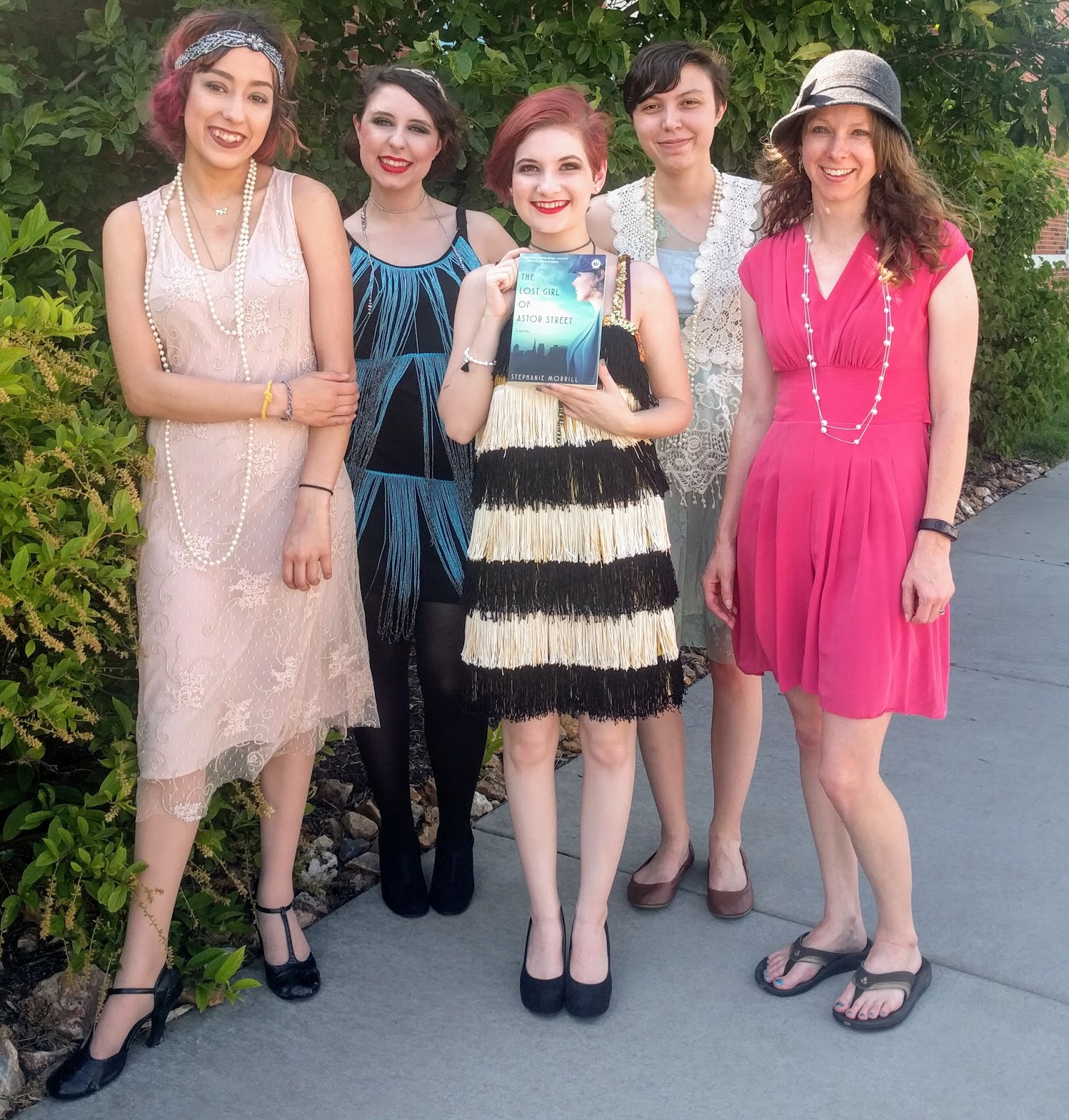 These girls are dressed up for a 1920s party and let me take a picture with them! Aren't they darling? They would have been swell flappers.
 Emily, who I've seen at most of the workshops I've been to, brought me a bookmark! And another girl brought a paper lotus to our appointment. So much creativity in that group!
Onto the day's discussion! If you're just joining us, we've decided to do something new for the months of June, July, and August. We're taking turns answering writing questions, just as if we're sitting on a panel at a fancy writing conference. The best part is, we'd love you to answer the questions as well.
Here's today's question:
When you became a published author, what surprised you the most?
Stephanie MorrillThat the insecurity was still there. I thought once I had my contract--or surely when I saw my book on shelves--I would feel validated and confident and all that stuff. Sadly, no.
Jill WilliamsonI was most surprised to discover how little time I would have for writing first drafts. Before I was published, I worked and worked to get my manuscripts just right so that they would have the best chance of getting published. Once I had a book out, though, publishers started buying my ideas. (That’s the dream, really.) Yet over and over I underestimated how long it would take me to write those books. I am normally a pretty fast writer, but creating a complex storyworld takes a great deal of effort too. Most often, by the time I had created the world and fell into the swing of my story, I was often behind. I don’t like asking for extensions, so I would work myself frazzled trying to get books in on time. And since I don’t tend to write to any formula, my books are never quite the same in regards to plot, number of characters, or length. This made it very challenging to guestimate how much time I would need when working out the details of a new contract. I think I have finally figured that out, though I’ve also learned that I don’t have to say “yes” to every offer that comes along. I can say “no” or even “not yet,” and I could write the first draft before selling it. Sure, there is always the chance that an offer might disappear and that a finished book won’t sell, but there are times I would feel better knowing I’ve written the book the way I wanted to and didn’t have to rush.
Shannon DittemoreAll the work. You think I’m joking, but I’m not. Outside of the actually writing, there is a ton of marketing work and publicity stuff that authors are expected to do. And depending on your publisher, there’s not always a ton of direction. In all fairness, publishers are often fighting to keep up with current trends and the ever-evolving world of social media. By the time they figure one out, another platform crops up and we’re all expected to be geniuses. It’s a lot to juggle.We want to hear from you too! If you're published, what surprised you most? If you're not, what's something you learned about writing or being an author that has surprised you?
June 16, 2017
June 2017 Word War: Day Five
Shannon here!
I hope you're all enjoying your summer break. I mean that. I hope you're enjoying the sunshine and the water. I hope you've got your eyes wide open looking for adventures. I hope you're busting your behind at a summer job or heading off to summer camp. I hope you've found something or someone who could use your strong arms and wily brains. I hope you're squeezing the life out of every sunshine-laden minute.
And, of course, I hope you're making some time to write it all down.
This is it, folks! The last day of the June 2017 Word War!
What's a word war? A word war is when you and another writer (or in this case, lots of other writers!) compete to see who can write the most words in a designated period of time. Sometimes these are also referred to as "word sprints."
How does it work?Write as much as you're able to today, and when you're done, leave a comment in this post about how the day went. You can share how many words you wrote, stumbling blocks, a favorite line you wrote, whatever you want!
You can also start mini word wars in the comments section of this blog, or on the Go Teen Writers Community Facebook group.
The goal is to buckle down and focus on our manuscripts whenever we can, make good use of our writing time, and encourage each other as we write. Hopefully you'll be meeting new writers and deepening friendships as the war goes on!
How long does it last?This word war began Monday and will end TONIGHT at midnight Pacific. It's a come-and-go, write-when-you-can style of war, so it's never too late to join, and you don't have to participate every day.
Write on, my friends!
I hope you're all enjoying your summer break. I mean that. I hope you're enjoying the sunshine and the water. I hope you've got your eyes wide open looking for adventures. I hope you're busting your behind at a summer job or heading off to summer camp. I hope you've found something or someone who could use your strong arms and wily brains. I hope you're squeezing the life out of every sunshine-laden minute.
And, of course, I hope you're making some time to write it all down.
This is it, folks! The last day of the June 2017 Word War!

What's a word war? A word war is when you and another writer (or in this case, lots of other writers!) compete to see who can write the most words in a designated period of time. Sometimes these are also referred to as "word sprints."
How does it work?Write as much as you're able to today, and when you're done, leave a comment in this post about how the day went. You can share how many words you wrote, stumbling blocks, a favorite line you wrote, whatever you want!
You can also start mini word wars in the comments section of this blog, or on the Go Teen Writers Community Facebook group.
The goal is to buckle down and focus on our manuscripts whenever we can, make good use of our writing time, and encourage each other as we write. Hopefully you'll be meeting new writers and deepening friendships as the war goes on!
How long does it last?This word war began Monday and will end TONIGHT at midnight Pacific. It's a come-and-go, write-when-you-can style of war, so it's never too late to join, and you don't have to participate every day.
Write on, my friends!
June 15, 2017
June 2017 Word War: Day Four
Jill again! This is DAY FOUR of the Go Teen Writers summer word war. How are you all doing?
Today, I've got a writing quote to help you reach your goal(s). Here is some wisdom from author Neil Gaiman:
“This is how you do it: You sit down at the keyboard and you put one word after another until its done. It’s that easy, and that hard.” —Neil Gaiman
So, get to it, all of you! Put one word after another. I believe in you!
What's a word war?
A word war is when you and another writer (or in this case, lots of other writers!) compete to see who can write the most words in a designated period of time. Sometimes these are also referred to as "word sprints."
How does it work?
Write as much as you're able to today, and when you're done, leave a comment in this post about how the day went. You can share how many words you wrote, stumbling blocks, a favorite line you wrote, whatever you want!
You can also start mini word wars in the comments section of this blog, or on the Go Teen Writers Community Facebook group. (If you apply to join, leave me a comment on the blog so I can get you approved.)
The goal is to buckle down and focus on our manuscripts whenever we can, make good use of our writing time, and encourage each other as we write. Hopefully you'll be meeting new writers and deepening friendships as the war goes on!
How long does it last?
This word war began Monday and will end Friday night. It's a come-and-go, write-when-you-can style of war, so it's never too late to join, and you don't have to participate every day.
Hope you have a great writing day!
Today, I've got a writing quote to help you reach your goal(s). Here is some wisdom from author Neil Gaiman:
“This is how you do it: You sit down at the keyboard and you put one word after another until its done. It’s that easy, and that hard.” —Neil Gaiman
So, get to it, all of you! Put one word after another. I believe in you!
What's a word war?
A word war is when you and another writer (or in this case, lots of other writers!) compete to see who can write the most words in a designated period of time. Sometimes these are also referred to as "word sprints."
How does it work?
Write as much as you're able to today, and when you're done, leave a comment in this post about how the day went. You can share how many words you wrote, stumbling blocks, a favorite line you wrote, whatever you want!
You can also start mini word wars in the comments section of this blog, or on the Go Teen Writers Community Facebook group. (If you apply to join, leave me a comment on the blog so I can get you approved.)
The goal is to buckle down and focus on our manuscripts whenever we can, make good use of our writing time, and encourage each other as we write. Hopefully you'll be meeting new writers and deepening friendships as the war goes on!
How long does it last?
This word war began Monday and will end Friday night. It's a come-and-go, write-when-you-can style of war, so it's never too late to join, and you don't have to participate every day.
Hope you have a great writing day!
June 14, 2017
June 2017 Word War: Day Three
Jill here! We're hosting a summer word war this week on Go Teen Writers, and we've reached day three. I must confess, I'm not word warring this time around. Why, you ask? Because King's War (book three in the Kinsman Chronicles) is due. Today!
Whoo!
So I'm working hard to give the beast a few more tweaks and a major spell check before sending it to my editor at Bethany House.
I'm so excited.
But that doesn't mean I'm not cheering for you all as you get a lot of writing done.
What's a word war?
A word war is when you and another writer (or in this case, lots of other writers!) compete to see who can write the most words in a designated period of time. Sometimes these are also referred to as "word sprints."
How does it work?
Write as much as you're able to today, and when you're done, leave a comment in this post about how the day went. You can share how many words you wrote, stumbling blocks, a favorite line you wrote, whatever you want!
You can also start mini word wars in the comments section of this blog, or on the Go Teen Writers Community Facebook group. (If you apply to join, leave me a comment on the blog so I can get you approved.)
The goal is to buckle down and focus on our manuscripts whenever we can, make good use of our writing time, and encourage each other as we write. Hopefully you'll be meeting new writers and deepening friendships as the war goes on!
How long does it last?
This word war began Monday and will end Friday night. It's a come-and-go, write-when-you-can style of war, so it's never too late to join, and you don't have to participate every day.
Hope you have a great writing day!
Whoo!
So I'm working hard to give the beast a few more tweaks and a major spell check before sending it to my editor at Bethany House.
I'm so excited.
But that doesn't mean I'm not cheering for you all as you get a lot of writing done.
What's a word war?
A word war is when you and another writer (or in this case, lots of other writers!) compete to see who can write the most words in a designated period of time. Sometimes these are also referred to as "word sprints."
How does it work?
Write as much as you're able to today, and when you're done, leave a comment in this post about how the day went. You can share how many words you wrote, stumbling blocks, a favorite line you wrote, whatever you want!
You can also start mini word wars in the comments section of this blog, or on the Go Teen Writers Community Facebook group. (If you apply to join, leave me a comment on the blog so I can get you approved.)
The goal is to buckle down and focus on our manuscripts whenever we can, make good use of our writing time, and encourage each other as we write. Hopefully you'll be meeting new writers and deepening friendships as the war goes on!
How long does it last?
This word war began Monday and will end Friday night. It's a come-and-go, write-when-you-can style of war, so it's never too late to join, and you don't have to participate every day.
Hope you have a great writing day!
June 13, 2017
June 2017 Word War: Day Two
The first of our summer word wars began yesterday! I had every intention of waking up early yesterday morning and writing before my kids got up, but I've been struck down by a lousy head cold. Ugh!
So I'm at zero words. Today I'm teaching at the One Year Adventure Novel summer workshop, so I think today will be another zero words day.
But tomorrow! Tomorrow is my day!
What's a word war?
A word war is when you and another writer (or in this case, lots of other writers!) compete to see who can write the most words in a designated period of time. Sometimes these are also referred to as "word sprints."
How does it work?
Write as much as you're able to today, and when you're done, leave a comment in this post about how the day went. You can share how many words you wrote, stumbling blocks, a favorite line you wrote, whatever you want!
You can also start mini word wars in the comments section of this blog, or on the Go Teen Writers Community Facebook group. (If you apply to join, leave me a comment on the blog so I can get you approved.)
The goal is to buckle down and focus on our manuscripts whenever we can, make good use of our writing time, and encourage each other as we write. Hopefully you'll be meeting new writers and deepening friendships as the war goes on!
How long does it last?
This word war began yesterday and will end Friday night. It's a come-and-go, write-when-you-can style of war, so it's never too late to join, and you don't have to participate every day.
Hope you have a great writing day!
So I'm at zero words. Today I'm teaching at the One Year Adventure Novel summer workshop, so I think today will be another zero words day.
But tomorrow! Tomorrow is my day!
What's a word war?
A word war is when you and another writer (or in this case, lots of other writers!) compete to see who can write the most words in a designated period of time. Sometimes these are also referred to as "word sprints."
How does it work?
Write as much as you're able to today, and when you're done, leave a comment in this post about how the day went. You can share how many words you wrote, stumbling blocks, a favorite line you wrote, whatever you want!
You can also start mini word wars in the comments section of this blog, or on the Go Teen Writers Community Facebook group. (If you apply to join, leave me a comment on the blog so I can get you approved.)
The goal is to buckle down and focus on our manuscripts whenever we can, make good use of our writing time, and encourage each other as we write. Hopefully you'll be meeting new writers and deepening friendships as the war goes on!
How long does it last?
This word war began yesterday and will end Friday night. It's a come-and-go, write-when-you-can style of war, so it's never too late to join, and you don't have to participate every day.
Hope you have a great writing day!
June 12, 2017
June 2017 Word War: Day One
The first of our summer word wars starts NOW!
What's a word war?
A word war is when you and another writer (or in this case, lots of other writers!) compete to see who can write the most words in a designated period of time. Sometimes these are also referred to as "word sprints."
How does it work?
Write as much as you're able to today, and when you're done, leave a comment in this post about how the day went. You can share how many words you wrote, stumbling blocks, a favorite line you wrote, whatever you want!
You can also start mini word wars in the comments section of this blog, or on the Go Teen Writers Community Facebook group. (If you apply to join, leave me a comment on the blog so I can get you approved.)
The goal is to buckle down and focus on our manuscripts whenever we can, make good use of our writing time, and encourage each other as we write. Hopefully you'll be meeting new writers and deepening friendships as the war goes on!
How long does it last?
This word war begins today and will end Friday night. It's a come-and-go, write-when-you-can style of war, so it's never too late to join, and you don't have to participate every day.
Looking forward to a fun—and productive—day!
What's a word war?
A word war is when you and another writer (or in this case, lots of other writers!) compete to see who can write the most words in a designated period of time. Sometimes these are also referred to as "word sprints."
How does it work?
Write as much as you're able to today, and when you're done, leave a comment in this post about how the day went. You can share how many words you wrote, stumbling blocks, a favorite line you wrote, whatever you want!
You can also start mini word wars in the comments section of this blog, or on the Go Teen Writers Community Facebook group. (If you apply to join, leave me a comment on the blog so I can get you approved.)
The goal is to buckle down and focus on our manuscripts whenever we can, make good use of our writing time, and encourage each other as we write. Hopefully you'll be meeting new writers and deepening friendships as the war goes on!
How long does it last?
This word war begins today and will end Friday night. It's a come-and-go, write-when-you-can style of war, so it's never too late to join, and you don't have to participate every day.
Looking forward to a fun—and productive—day!
June 9, 2017
How Do You Feel About Deadlines?
Happy Friday, friends! Shannon here.
FIRST OF ALL, thank you so much to those participating in our first ever Go Teen Writers Instagram challenge. We've been having a ton of fun and it is never, ever too late to jump into a challenge. For more information, click here or visit us on Instagram.
We also want to thank you all for making our summer panels so much fun. We are learning so much about you all as we read through your answers.
If you're just joining us, we've decided to do something new for the months of June, July, and August. We're taking turns answering writing questions, just as if we're sitting on a panel at a fancy writing conference. The best part is, we'd love you to answer the questions as well.
You ready for today's question?

How do you feel about deadlines? Do you impose them on yourself?
Stephanie MorrillDeadlines and I are okay. They don’t stress me out too much, but part of that is I know how much work I can get done, and I don’t allow deadlines that I don’t think I can meet. Some seasons they pile up, but mostly I do well with it. The deadlines I set for myself usually revolve around my kids’ school calendar. Something like, “I want to finish this first draft by the time school is out for the summer.” Or, “I want to finish edits before spring break.” As much as I can, I try to build my schedule so that I can really enjoy and maximize the usefulness of being away from my book while my kids are out of school.
Jill WilliamsonDeadlines are important to keep me on task. For the past several books, I’ve found myself dealing with deadlines that were too tight—and part of that was life circumstances adding stress and time constraints that I never could have anticipated. But even if I didn’t have a publisher or an agent giving me a deadline, I’d still give myself deadlines because they help me stay on schedule. I have a general idea of how long it takes me to write a book, so I will make an estimate and choose a deadline, then I’ll count up the workdays on the calendar until that deadline, then divide my estimated work count by the number of workdays, and that will give me a daily goal. This keeps me on track both in making sure I write or edit at least X amount of words per workday, but it also keeps me from living in work-a-holic mode, because I’m the kind of person who could sit at that computer all day and there would always be more I could do. Since I know that’s not healthy or wise, having an end goal helps me know when I’ve worked enough and it’s okay to stop for the day.
Shannon DittemoreIt’s a love/hate relationship, I think. I definitely write faster when I’m on a deadline and there’s an argument to be made that I actually writer better on a deadline. And yes, I do impose deadlines on myself if I’m not working with a publisher, but I’m nice and I let myself off the hook if life takes over. I probably shouldn’t do that.How about you guys? How do you feel about deadlines? Do you impose them on yourself?
June 7, 2017
Do you remember the first (long) story you ever wrote? What was it about?
Jill here. Happy Wednesday, everyone.
In case you missed it, this summer we're doing Q & A panels! Each day during the months of June, July, and August we'll post one question, and each of us will answer it. But that's not all. We want you to answer too! So read the question, read our answers, read the other reader's answers, then use the comments section to post your own answer.
Let's have fun learning all about each other.
Ready to play?
Do you remember the first (long) story you ever wrote? What was it about?
Stephanie MorrillOh, yes I do. I wrote it in high school, and it was about a failed long distance relationship that I kept inexplicably trying to make work. My first few long books were all quasi-autobiographical teen drama type stories. The first book I ever wrote that wasn’t ripped my own life became
Me, Just Different
, my debut novel.
Jill WilliamsonMine was for 10th grade English class, and it was supposed to be a short story. Here is what I remember:A boy and some friends were flying a remote-controlled toy helicopter in the park, and the helicopter went down in a nearby forest. So my crew went into the woods to find it. While they were wandering around, they stumbled onto an old cabin. They went in, of course, and were looking around at the really old canned goods in there and a loaf of bread that was being eaten by maggots. And they wondered who had lived there and what ever became of that person.
I had a plan for the story, but I can't remember it now. At the point I left off above, I was at twenty-some hand-written pages. (We didn’t have computers in all the classrooms back in 1990, so we still wrote the old way.) Since the assignment had been a short story (five-ten pages in length), I was WAY over my word count. The time came to turn in the story, and I remember showing my twenty-some pages to my teacher and trying to explain that it wasn’t done yet—that I didn’t know how long it might take me to finish it. He told me to turn in what I had so far, and so I did. By the time I got it back, there was other homework to do, and my story was forgotten. I seem to have lost it, too. I’ve asked my mom to keep an eye out for it as she cleans the attic and such. Alas, there has been no sign. I'd really like to read it now.
I wouldn’t again try novel writing (which was what I’d been doing whether or not I realized it), until college. (My roommate had a computer, and I started a murder mystery on that machine—one that never got very far—maybe twelve pages.) And after that, I didn’t write stories until around 2004, when I started The New Recruit , which was the first novel I completed.
Shannon DittemoreNow, when you say long . . . Truth? The first long story I ever wrote was
Angel Eyes
. It’s been on the shelf for almost five years now and I still have trouble pitching it! Angel Eyes is about a broken girl who is given the ability to see the invisible world around her. What she sees is beautiful and terrible . . . and dangerous. A battle rages in a place most human eyes cannot see and innocent lives hang in the balance. She can’t simply stand and watch. She must fight. But how do you fight the invisible?I realize many of us will complete more than one book before we’re ever published. I know my story is a little different in that way, but the truth is that after my first three books came out, I did complete a book that is still looking for a publisher. Our journeys are all so different. Careful when you compare yours to others. We often don’t know the battles they’ve had to fight to get to where they are.
What about you guys?Tell us about the first long story you wrote.
June 5, 2017
What is one craft book and one novel that has influenced your writing?
Hi, writers!
In case you missed last Friday's post, where Shannon kicked off our Summer Panel series, here's what's going on.
For the months of June, July, and August, we thought it would be fun to take a writing-related question and have all three of us answer it. This idea was inspired by how all three of us will be teaching at various conferences this summer, and one of our favorite aspects of conferences are panels, where you can hear writers and other industry professionals give different perspectives about the same topic.
The part we're really pumped about is getting to hear your answers in the comments! Once you've heard what we have to say, we'd love you to use the comments section below to answer the same question. There's so much knowledge and creativity floating around in our community, and we want us to all be able to learn from each other!
So here's today's panel question:
What is one craft book and one novel that has influenced your writing?
Shannon DittemoreOh my goodness! So many! The first fiction book that comes to mind is Hunger Games. I read it at a really important time on my own writing journey. It was the book that showed me how valuable writing in the present tense could be. On the craft side of things, I can’t nail down a single book; I’m staring at my shelf, trying to decide which one to talk about. A lot of the craft books are written for adults, so sometimes the language is a bit rough, but one of my favorites is definitely Bird by Bird by Anne Lamott.
Stephanie MorrillOh, Bird by Bird is one of the first and most influential craft books I ever read too! I could also mention On Writing by Stephen King, but I talk about that one a lot too. So I’ll say Writing the Breakout Novel by Donald Maass. I read it when I was really getting the hang of writing complete stories, and it pushed me deeper into my craft and helped me to think about elements of my stories in different ways.For fiction, This Lullaby by Sarah Dessen was one of the first contemporary YA novels I read, and I was like, “This! This is what I’m trying to do!”
Jill WilliamsonHarry Potter and the Sorcerer’s Stone was the book that inspired me to write detail-oriented and fully-realized storyworlds. The concept of the Harry Potter books is not all that complex. It’s the way that Rowling takes readers into a fantastical place that adds a sense of wonder to the story that is so impressive. I wanted to create storyworlds like that.As far as nonfiction goes, Save the Cat really helped me refine my outlining/storyboarding process. Before I read that book, I wrote skeleton outlines for my plot before I started writing. Save the Cat gave me a visual way to do that—and I’ve always been a visual learner. So now I storyboard my novels, and later on, when I get stuck, I pull out that storyboard again or often re-do it, adding and cutting scenes to re-work my plot until it is right.
Now it's your turn! Tell us one craft book and one novel that has influenced your writing.