Diane Lockward's Blog, page 39
June 9, 2011
If you're looking for a good memoir for your summer re...
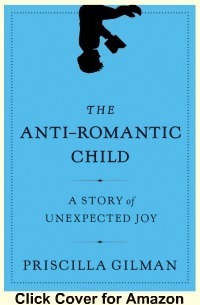
If you're looking for a good memoir for your summer reading, I'd like to recommend The Anti-Romantic Child: A Story of Unexpected Joy. This is a different sort of memoir, different in that it fuses together memoir and poetry. Author Priscilla Gilman seemed to have a very charmed life. She was raised in a home that was rich in culture and opportunities. She was exposed to lots of poetry, especially the work of the Romantic poets. She went to Yale, fell in love, married. Both partners pursued doctoral degrees at Yale, Gilman doing her dissertation on Wordsworth. Her husband was brilliant if somewhat odd. Together, they envisioned a life filled with children and all the joys of family life.
Gilman had a vision of childhood fueled by her own childhood and the vision imparted by the poets she loved, i.e., Wordsworth and the other English Romantics. Then came her first child, Benjamin. Initially, he appeared to be astonishingly brilliant. He read early, was a whiz with numbers, and adored music. He spouted poetry. Then around age 3 everything changed and all the signs of Benj's brilliance became signs of something else.
While poetry may have given Gilman a false image of childhood, it also sustained her through the years of raising Benj. Inserted throughout this very readable narrative are passages of poems, those lines that seemed to Gilman to say something about her, her life, and her child.
If you visit the Amazon page linked above, you'll find a trailer with Gilman talking about her book. There's also an interview which can be opened and read there or downloaded as a pdf.


If you're looking for a good memoir for your summ...
If you're looking for a good memoir for your summer reading, I'd like to recommend The Anti-Romantic Child: A Story of Unexpected Joy. This is a different sort of memoir, different in that it fuses together memoir and poetry. Author Priscilla Gilman seemed to have a very charmed life. She was raised in a home that was rich in culture and opportunities. She was exposed to lots of poetry, especially the work of the Romantic poets. She went to Yale, fell in love, married. Both partners pursued doctoral degrees at Yale, Gilman doing her dissertation on Wordsworth. Her husband was brilliant if somewhat odd. Together, they envisioned a life filled with children and all the joys of family life.
Gilman had a vision of childhood fueled by her own childhood and the vision imparted by the poets she loved, i.e., Wordsworth and the other English Romantics. Then came her first child, Benjamin. Initially, he appeared to be astonishingly brilliant. He read early, was a whiz with numbers, and adored music. He spouted poetry. Then around age 3 everything changed and all the signs of Benj's brilliance became signs of something else.
While poetry may have given Gilman a false image of childhood, it also sustained her through the years of raising Benj. Inserted throughout this very readable narrative are passages of poems, those lines that seemed to Gilman to say something about her, her life, and her child.
If you visit the Amazon page linked above, you'll find a trailer with Gilman talking about her book. There's also an interview which can be opened and read there or downloaded as a pdf.
June 4, 2011
Books NJ 2011: A Celebration of Books

What: Books NJ 2011
When: Sunday, June 12
Time: 1:00 - 5:00 PM
Where: Paramus Public Library, 116 East Century Rd., Paramus, NJ
I'm looking forward to participating in this biannual event, now in its second season. It is run by Paramus librarian, Arlene Sahraie, with lots of help from other employees and volunteers. This multi-genre book fair will host more than 100 authors, including Mary Higgins Clark who will be honored during the event.
Tents will be set up on the grounds of the library. There will be readings and lots of panels. A book tent will be run by Barnes & Noble. Books by the authors will be available for sale and signing.
I will be one of eight poets participating. We poets will gather in Tent 7 and participate in a group reading at 1:00. Then we will each be part of one of several poetry panels. Mine is Manuscript Preparation and will take place in Tent 7 at 2:45.
Check the website for the Full Schedule and Directions. Then please hope for a beautiful day, and if you live anywhere near Paramus, NJ, please join us.
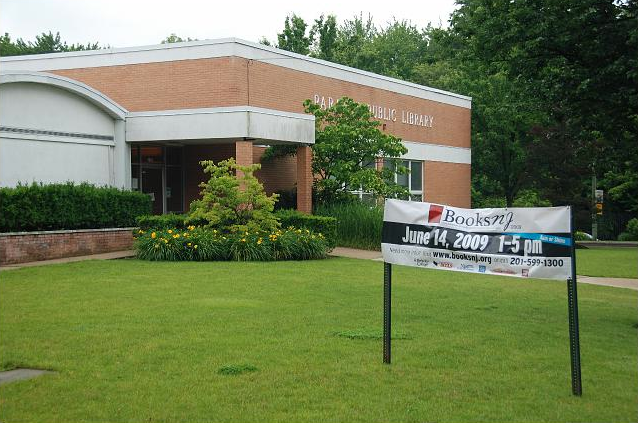
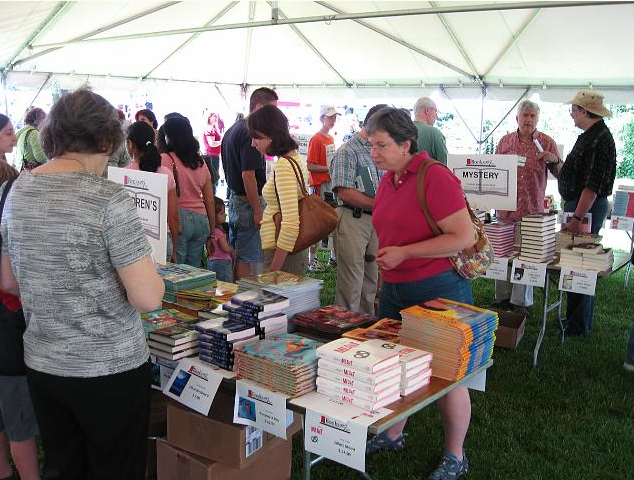
To entice you a bit, here are some photos from the 2009 Books NJ.




May 27, 2011
Poetry Salon: Sherry Chandler
I wish I could meet poet Sherry Chandler in person, but she lives in Kentucky and here I am in New Jersey. However, we share the same publisher, Wind Publications. I recently read Sherry's first full-length collection, Weaving a New Eden, and really loved it. It's full of women's voices, history, story, and terrific poetry. I felt transported to the Kentucky of years ago. But since I'm not there then or now, I've invited Sherry to join me here for an online Poetry Salon. So please pull up a chair.
Sherry will first talk to us about her book.
Diane: Tell us how you went about writing these poems and
assembling them into a collection.
Sherry: I had a twofold purpose in
writing these poems. One was simply to preserve my mother's voice and some of
the stories she told me about her rural childhood between World Wars I and II.
This is work I began with my Finishing Line chapbook, Dance the Black-Eyed Girl. I am always struck by the contrast
between the cultural modernism of history books and the rusticity of life in
our rural and small-town backwaters. In many ways, when my mother was born in
1917, life for farm women in Kentucky hadn't changed a lot since Rebecca
Boone's day.
The other purpose was to use
these persona poems to create a balance to the romance of the farmer that runs
strong among Kentucky's men of letters (gender use deliberate). Reading a book
called Pioneer Families of Missouri,
I found an anonymous quotation that I stole and put in Rebecca Boone's mouth,
"The men and dogs have a fine time, but the poor women suffer."
Eventually a friend suggested
that I could take the poems all the way back to Rebecca Boone. So I wrote a
grant that was funded by the Kentucky Foundation for Women. It allowed me to
work with Leatha Kendrick as an editor and guide to assembling the manuscript.
It was Leatha who urged me to keep a lyric presence in the book along with the
persona poems. One model was Natasha Tretheway's Native Guard and another was Ellen Bryant Voigt's Kyrie. My treatment of Rebecca Boone was
highly influenced by Maurice Manning's previous treatment of Daniel Boone in A Companion for Owls.
The rest was a matter of
reading copiously and finding tidbits about women that could be used to create
a character. For my grandmothers, I leaned heavily on genealogical work
generously shared by others. Form played a tremendous role in helping me
differentiate so many voices. Rebecca Boone speaks mostly in the best
approximation I can achieve of blank-verse dramatic monologue. I think of her
as my Shakespearean character, the Chorus who steps to the edge of the
proscenium and comments on events. She knows more than she could possibly know.
Other characters speak in
Ginsberg's American sentence (a form I think I learned about on your blog), a
ghazal, a triolet, and acrostics. The constraints of form forced me away from
my own voice and provided me a way to give each speaker her own rhythm and
mood.
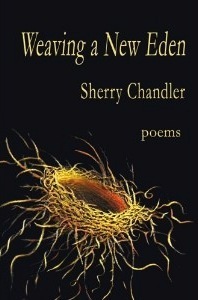
Diane: Tell us the story behind your cover.
Sherry: Because the title is Weaving a New Eden, I had at first
suggested that we use something like a landscape as a tapestry coming off a
loom. That turned out to be a better idea in theory than in execution. Then
Wind publisher Charlie Hughes suggested that we turn to Suzanne Stryk for
suggestions. We were still looking for landscape,
and we tried several, but they were too Edenic in the Biblical sense, with
trees and snakes and such. Then Suzanne suggested floating this nest on a
near-black background and it was just perfect – there was the weaving, the
wilderness, the disconnectedness. I could not be more pleased with the cover of
this book. And I urge everyone to visit Suzanne's website and experience some
of her art.
Diane: Why did you title the book Weaving a New Eden?
Sherry: When Kentucky was being
settled, it was promoted by land speculators as a New Eden, and, as I've said,
some of the romance lingers. Kentucky is still a beautiful verdant place,
though mountaintop removal mining is ruining our mountains. Nevertheless, the
New Eden aspect was always a part of the story.
When Maurice Manning reviewed
a selection of the poems, he suggested that eventually, as I kept writing, an
over-arching metaphor would emerge. That metaphor was always weaving. Early on,
I knew that I wanted Rebecca Boone to be a weaver. The Boones had been cottage
weavers in Wales and carried the skill with them to the United States. And, of
course, weaving was an essential skill for women on the frontier. In one
source, I read that worn-out clothes were a major hindrance for men who came
into Kentucky to claim land. Nakedness caused some of them to turn back. So
when "Rebecca Boone's Loom Has Its Say," what it says is that "My cloth
provided cover for a conquest." Further, weaving is as mythic as Eden itself.
And finally, I use weaving
forms of poetry – pantoum, sestina, sonnet crown – so you might say the title
was inevitable. What you might call the title poem, "Rebecca Boone Weaves a New
Eden," is a monster sestina that took me weeks to get right. At one point I had
to just scrap it and start over. And yet, I felt I had to get it right, had to
have it in the book.
Diane: What do you hope readers will take away from your
book?
Sherry: Friends and acquaintances who
have read this book have compared it to a saga. Some even say they can't put it
down, so on the simplest level, I want readers to find this book a good read.
Others have said it's a history book, and I would like readers to learn a
little bit about the complexities of history and the cost of U.S. expansionism.
Although Kentucky is a backwater now, the move to cross the Appalachians was
the first very important step in accomplishing Manifest Destiny. I wouldn't
mind if readers finished the book with a new respect for the possibilities of
form as a way to create dynamic poetry. Most of all, I want readers to hear
these women, to hear the woman's side of the story. These grandmothers of mine
are individuals, but I hope they are also everywoman.
Diane: Please choose a favorite poem for us and, if you
like, tell us why you chose this one.
Looking Over into the Promised Land
When Rebecca stood on Big
Hill and gazed
over into Eden, into a land
of salt-lick springs and
canebrakes,
did she snap
with her strong teeth the
skin of an apple,
a Northern Spy or Summer
Winesap,
suck its juice onto her
tongue as it ran,
as streams along that
savannah,
into the palm of her hand?
As she gaped at flocks
of pigeons that blacked
the sun, herds of brown-black
bison whose trampled traces
made her highways,
was she amazed
or did she just eat an apple?
Sherry: I wrote many long serious
poems in Weaving a New Eden, but from
time to time I did try to strike a lighter, more whimsical note. I wrote a
limerick, a roundeau, a triolet; I wrote a poem in the voice of a cat, but of
all the lighter pieces in the book, this nonce-form, rhyming poem is my
favorite.
For one thing, it is just
mouth candy. I wrote it for sound, to chime and rhyme. But I also like this
notion of Rebecca as a reverse-Eve, who eats the apple and enters Eden. Has her
cake and eats it, too.
I think I got a brilliant inspiration
when I thought to equate the apple juice running into the creases of her palm
with the streams running through the Bluegrass savannah, identifying Rebecca's
body with Kentucky. I was eating an apple myself at the time.
Winesap and Northern Spy are
legacy varieties of apple, but I don't know if their legacy stretches back to
the 18th Century. I'm also told that people in the Boones' time
didn't eat apples the way we do, but rather used them for cider and cooking.
But I think humans have
always snapped their teeth into apples.
Diane: Now let's all gather round while Sherry reads her poem for us.
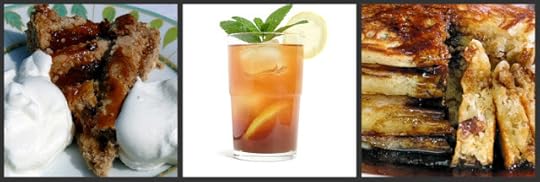
Party Time! Sherry has put together a delicious assortment of Kentucky goodies. Please help yourselves to fried apple pie, moonshine juleps sweetened
with maple syrup and sprigs of peppermint, and hoe cakes drizzled with
sorghum molasses. Sherry says, "Not exactly dainty fare, but all these foods are mentioned in the book."
Overheard at the Party:
"Few poets can move, dazzle,
and enlighten us in a single book, but Sherry Chandler can—and does—in this
volume of poems."—Leatha
Kendrick
"Weaving a New Eden is personal, historical, political, inspired—a
thoroughly satisfying work of art." —Maurice Manning
Before you leave, be sure to pick up a copy of Sherry's book. You'll be glad you did. Then while you enjoy your snacks, please feel free to leave some comments or questions for Sherry in the Comments section.
Click Cover for Amazon

Sherry will first talk to us about her book.
Diane: Tell us how you went about writing these poems and
assembling them into a collection.
Sherry: I had a twofold purpose in
writing these poems. One was simply to preserve my mother's voice and some of
the stories she told me about her rural childhood between World Wars I and II.
This is work I began with my Finishing Line chapbook, Dance the Black-Eyed Girl. I am always struck by the contrast
between the cultural modernism of history books and the rusticity of life in
our rural and small-town backwaters. In many ways, when my mother was born in
1917, life for farm women in Kentucky hadn't changed a lot since Rebecca
Boone's day.
The other purpose was to use
these persona poems to create a balance to the romance of the farmer that runs
strong among Kentucky's men of letters (gender use deliberate). Reading a book
called Pioneer Families of Missouri,
I found an anonymous quotation that I stole and put in Rebecca Boone's mouth,
"The men and dogs have a fine time, but the poor women suffer."
Eventually a friend suggested
that I could take the poems all the way back to Rebecca Boone. So I wrote a
grant that was funded by the Kentucky Foundation for Women. It allowed me to
work with Leatha Kendrick as an editor and guide to assembling the manuscript.
It was Leatha who urged me to keep a lyric presence in the book along with the
persona poems. One model was Natasha Tretheway's Native Guard and another was Ellen Bryant Voigt's Kyrie. My treatment of Rebecca Boone was
highly influenced by Maurice Manning's previous treatment of Daniel Boone in A Companion for Owls.
The rest was a matter of
reading copiously and finding tidbits about women that could be used to create
a character. For my grandmothers, I leaned heavily on genealogical work
generously shared by others. Form played a tremendous role in helping me
differentiate so many voices. Rebecca Boone speaks mostly in the best
approximation I can achieve of blank-verse dramatic monologue. I think of her
as my Shakespearean character, the Chorus who steps to the edge of the
proscenium and comments on events. She knows more than she could possibly know.
Other characters speak in
Ginsberg's American sentence (a form I think I learned about on your blog), a
ghazal, a triolet, and acrostics. The constraints of form forced me away from
my own voice and provided me a way to give each speaker her own rhythm and
mood.
Diane: Tell us the story behind your cover.
Sherry: Because the title is Weaving a New Eden, I had at first
suggested that we use something like a landscape as a tapestry coming off a
loom. That turned out to be a better idea in theory than in execution. Then
Wind publisher Charlie Hughes suggested that we turn to Suzanne Stryk for
suggestions. We were still looking for landscape,
and we tried several, but they were too Edenic in the Biblical sense, with
trees and snakes and such. Then Suzanne suggested floating this nest on a
near-black background and it was just perfect – there was the weaving, the
wilderness, the disconnectedness. I could not be more pleased with the cover of
this book. And I urge everyone to visit Suzanne's website and experience some
of her art.
Diane: Why did you title the book Weaving a New Eden?
Sherry: When Kentucky was being
settled, it was promoted by land speculators as a New Eden, and, as I've said,
some of the romance lingers. Kentucky is still a beautiful verdant place,
though mountaintop removal mining is ruining our mountains. Nevertheless, the
New Eden aspect was always a part of the story.
When Maurice Manning reviewed
a selection of the poems, he suggested that eventually, as I kept writing, an
over-arching metaphor would emerge. That metaphor was always weaving. Early on,
I knew that I wanted Rebecca Boone to be a weaver. The Boones had been cottage
weavers in Wales and carried the skill with them to the United States. And, of
course, weaving was an essential skill for women on the frontier. In one
source, I read that worn-out clothes were a major hindrance for men who came
into Kentucky to claim land. Nakedness caused some of them to turn back. So
when "Rebecca Boone's Loom Has Its Say," what it says is that "My cloth
provided cover for a conquest." Further, weaving is as mythic as Eden itself.
And finally, I use weaving
forms of poetry – pantoum, sestina, sonnet crown – so you might say the title
was inevitable. What you might call the title poem, "Rebecca Boone Weaves a New
Eden," is a monster sestina that took me weeks to get right. At one point I had
to just scrap it and start over. And yet, I felt I had to get it right, had to
have it in the book.
Diane: What do you hope readers will take away from your
book?
Sherry: Friends and acquaintances who
have read this book have compared it to a saga. Some even say they can't put it
down, so on the simplest level, I want readers to find this book a good read.
Others have said it's a history book, and I would like readers to learn a
little bit about the complexities of history and the cost of U.S. expansionism.
Although Kentucky is a backwater now, the move to cross the Appalachians was
the first very important step in accomplishing Manifest Destiny. I wouldn't
mind if readers finished the book with a new respect for the possibilities of
form as a way to create dynamic poetry. Most of all, I want readers to hear
these women, to hear the woman's side of the story. These grandmothers of mine
are individuals, but I hope they are also everywoman.
Diane: Please choose a favorite poem for us and, if you
like, tell us why you chose this one.
Looking Over into the Promised Land
When Rebecca stood on Big
Hill and gazed
over into Eden, into a land
of salt-lick springs and
canebrakes,
did she snap
with her strong teeth the
skin of an apple,
a Northern Spy or Summer
Winesap,
suck its juice onto her
tongue as it ran,
as streams along that
savannah,
into the palm of her hand?
As she gaped at flocks
of pigeons that blacked
the sun, herds of brown-black
bison whose trampled traces
made her highways,
was she amazed
or did she just eat an apple?
Sherry: I wrote many long serious
poems in Weaving a New Eden, but from
time to time I did try to strike a lighter, more whimsical note. I wrote a
limerick, a roundeau, a triolet; I wrote a poem in the voice of a cat, but of
all the lighter pieces in the book, this nonce-form, rhyming poem is my
favorite.
For one thing, it is just
mouth candy. I wrote it for sound, to chime and rhyme. But I also like this
notion of Rebecca as a reverse-Eve, who eats the apple and enters Eden. Has her
cake and eats it, too.
I think I got a brilliant inspiration
when I thought to equate the apple juice running into the creases of her palm
with the streams running through the Bluegrass savannah, identifying Rebecca's
body with Kentucky. I was eating an apple myself at the time.
Winesap and Northern Spy are
legacy varieties of apple, but I don't know if their legacy stretches back to
the 18th Century. I'm also told that people in the Boones' time
didn't eat apples the way we do, but rather used them for cider and cooking.
But I think humans have
always snapped their teeth into apples.
Diane: Now let's all gather round while Sherry reads her poem for us.
Party Time! Sherry has put together a delicious assortment of Kentucky goodies. Please help yourselves to fried apple pie, moonshine juleps sweetened
with maple syrup and sprigs of peppermint, and hoe cakes drizzled with
sorghum molasses. Sherry says, "Not exactly dainty fare, but all these foods are mentioned in the book."

Overheard at the Party:
"Few poets can move, dazzle,
and enlighten us in a single book, but Sherry Chandler can—and does—in this
volume of poems."—Leatha
Kendrick
"Weaving a New Eden is personal, historical, political, inspired—a
thoroughly satisfying work of art." —Maurice Manning
Before you leave, be sure to pick up a copy of Sherry's book. You'll be glad you did. Then while you enjoy your snacks, please feel free to leave some comments or questions for Sherry in the Comments section.
Click Cover for Amazon
May 24, 2011
Adanna: Last Chance for Pre-Publication Discount

The first issue of Adanna is coming soon! Editor Christine Redman-Waldeyer expects to have the journal ready for mailing in June. She is offering the half-off price of $5 until May 31. That includes shipping and handling. After that, the price will be $10 per copy which is still a great bargain. Click HERE to order. You can use PayPal or snail mail.
Submissions have now closed. The list of contributors—and it's an impressive list—is available at the website. We have a total of 59 contributors who represent many states in the US as well as several other countries. The journal will include poetry, short stories, non-fiction pieces, and one book review.
Christine and I are thrilled with the work in this first issue. We thank everyone who submitted.

May 22, 2011
Summer Journals: Q thru Z
Here's the third and final installment of the list of print journals that read during the summer months. Remember that the asterisks indicate that the journal accepts simultaneous submissions. Again, please let me know if you spot any errors or omissions. Good luck!
This mailbox is lucky!
**The Raleigh Review—1x
All year
**Rattle-2x—email subs ok
**Redactions—1x—by email
Redivider—2x—online
**Rhino-1x-April 1-Oct 1
**River Oak Review--2x
**River Styx-2x-May thru Nov
**Rosebud--3x
**Slipstream-1x
**Smartish Pace--2x
**Sonora Review—2x—online
reads but does not respond in summer
**South Dakota Review-4x
Southern Humanities Review--4x
**Southern Poetry Review—2x
**The Sun-12x-prev pub ok
**Third Coast--2x
**Turnrow—2x
**Tusculum Review—1x
**Weave Magazine—2x
deadline July 31


This mailbox is lucky!
**The Raleigh Review—1x
All year
**Rattle-2x—email subs ok
**Redactions—1x—by email
Redivider—2x—online
**Rhino-1x-April 1-Oct 1
**River Oak Review--2x
**River Styx-2x-May thru Nov
**Rosebud--3x
**Slipstream-1x
**Smartish Pace--2x
**Sonora Review—2x—online
reads but does not respond in summer
**South Dakota Review-4x
Southern Humanities Review--4x
**Southern Poetry Review—2x
**The Sun-12x-prev pub ok
**Third Coast--2x
**Turnrow—2x
**Tusculum Review—1x
**Weave Magazine—2x
deadline July 31
May 20, 2011
Summer Journals: G thru P
Here's the second installment of the list of journals that read during the summer months. I've removed several from last year's list, but have not checked each and every one. If you find any errors or have others to add to the list, please let me know. Good luck with your submissions.

This mailbox is ready to receive lots of good mail.
**Indicates that simultaneous submission is ok
**The Grove Review—1x
Hanging Loose--3x
**Harpur Palate—2x
**Hawk & Handsaw—1x—email subs
Aug 1-Oct 1
**Hayden's Ferry--2x
**Hiram Poetry Review-1x
Hudson Review-April 1-June 30 (all year if a subscriber)
**Hunger Mountain-1x
**Inkwell-Aug 1-Nov 15
**The Journal--2x
**Jubilat--2x
**Lake Effect—1x
**Literal Latte--6x
Louisiana Literature-2x
**Madison Review-2x
(will hold until Sept)
Manhattan Review-1x
(prefers no sim but will take)
Michigan Quarterly Review-4x
**Mid-American Review-2x
**The Midwest Quarterly Review--4x
Missouri Review-3x--6-12 poems
**The Nation
**Natural Bridge-July 1-Aug 31-2x
**New American Writing—June-Jan—1x
**New Orleans Review—2x
**New York Quarterly—3x
**Nimrod—2x
North American Review—5x
**Parnassus: Poetry in Review—2x
**Pleiades—2x
**Ploughshares—June 1 to January 15--3x
**Poet Lore—2x
**Poetry Miscellany-1x-tabloid-e-mail


This mailbox is ready to receive lots of good mail.
**Indicates that simultaneous submission is ok
**The Grove Review—1x
Hanging Loose--3x
**Harpur Palate—2x
**Hawk & Handsaw—1x—email subs
Aug 1-Oct 1
**Hayden's Ferry--2x
**Hiram Poetry Review-1x
Hudson Review-April 1-June 30 (all year if a subscriber)
**Hunger Mountain-1x
**Inkwell-Aug 1-Nov 15
**The Journal--2x
**Jubilat--2x
**Lake Effect—1x
**Literal Latte--6x
Louisiana Literature-2x
**Madison Review-2x
(will hold until Sept)
Manhattan Review-1x
(prefers no sim but will take)
Michigan Quarterly Review-4x
**Mid-American Review-2x
**The Midwest Quarterly Review--4x
Missouri Review-3x--6-12 poems
**The Nation
**Natural Bridge-July 1-Aug 31-2x
**New American Writing—June-Jan—1x
**New Orleans Review—2x
**New York Quarterly—3x
**Nimrod—2x
North American Review—5x
**Parnassus: Poetry in Review—2x
**Pleiades—2x
**Ploughshares—June 1 to January 15--3x
**Poet Lore—2x
**Poetry Miscellany-1x-tabloid-e-mail
May 18, 2011
Summer Journals: A thru F
It's that time of year again. During the summer many of us have more time to write and submit, but quite a few journals close their doors to submissions for the summer months. Do not despair. There are still many journals that do read during the summer and some that read only during the summer. This is the first of a 3-part list of those journals. I have given it a somewhat cursory updating, so if you note any errors, please let me know. These are all print journals. Sadly, a number had to be removed this year as they have closed their doors permanently.

This mailbox only accepts Acceptances!
**Indicates that simultaneous submission is ok
**American Poetry Journal—2x
(summer only for subscribers)
American Poetry Review--6x-tabloid
**Another Chicago Magazine-2x-Feb-Aug 31
**Asheville Poetry Review--3x--Jan. 15-July 15
**Atlanta Review--deadlines June 1 &
Dec 1
**Baltimore Review-2x
**Barn Owl Review—1x—June 1--Nov. 30—email sub
**Barrow Street--2x
**Bat City Review—May 1-Nov 1-1x
**Bateau—year round—2x—email sub
Beloit Poetry Journal--3x—online sub
Birmingham Poetry Review-2x--deadlines Nov 1 & May 1
**Black Warrior Review-2x
Bloodroot Literary Magazine-April 1 thru Sept 1--1x
**Briar Cliff Review--1x-Aug 1-Nov 1
**Burnside Review—2x—email sub ok
**Caketrain—1x—email sub ok
**Center: A Journal of the Literary Arts—July 1-Dec. 1
Chariton Review
Chelsea-2x
Cider Press Review--1x-email subs
April 1-Aug 31
**Cimarron Review-4x
**Columbia—2x
**Columbia Poetry Review—Aug 1-Nov 30
**Conduit-3x
**Crab Orchard Review—Aug 10-Nov. 1 (special issue)
**Crazyhorse--2x
**Edison Literary Review—1—email
5 AM--2x-tabloid
**The Florida Review--2x


This mailbox only accepts Acceptances!
**Indicates that simultaneous submission is ok
**American Poetry Journal—2x
(summer only for subscribers)
American Poetry Review--6x-tabloid
**Another Chicago Magazine-2x-Feb-Aug 31
**Asheville Poetry Review--3x--Jan. 15-July 15
**Atlanta Review--deadlines June 1 &
Dec 1
**Baltimore Review-2x
**Barn Owl Review—1x—June 1--Nov. 30—email sub
**Barrow Street--2x
**Bat City Review—May 1-Nov 1-1x
**Bateau—year round—2x—email sub
Beloit Poetry Journal--3x—online sub
Birmingham Poetry Review-2x--deadlines Nov 1 & May 1
**Black Warrior Review-2x
Bloodroot Literary Magazine-April 1 thru Sept 1--1x
**Briar Cliff Review--1x-Aug 1-Nov 1
**Burnside Review—2x—email sub ok
**Caketrain—1x—email sub ok
**Center: A Journal of the Literary Arts—July 1-Dec. 1
Chariton Review
Chelsea-2x
Cider Press Review--1x-email subs
April 1-Aug 31
**Cimarron Review-4x
**Columbia—2x
**Columbia Poetry Review—Aug 1-Nov 30
**Conduit-3x
**Crab Orchard Review—Aug 10-Nov. 1 (special issue)
**Crazyhorse--2x
**Edison Literary Review—1—email
5 AM--2x-tabloid
**The Florida Review--2x
May 16, 2011
Poetry Festival: The Morning After
Yesterday was the Poetry Festival: A Celebration of Literary Journals. This is an event I began 8 years ago with the idea that it would be a one-time thing. However, the West Caldwell Library, which hosts the event, wanted to do it again the next year, and the next year, and the next. So did the poets and the editors. Me too. It's now become a tradition.
I invite the editors of 12 journals to participate. I ask them to each invite two poets to represent their journal. The event is always held on a Sunday, 1:00 - 5:00 PM, a day the library is closed to the public. However, the library opens for the event and the public is invited to come. The Assistant Director works with me during the planning stages of the event and is present throughout the day. Volunteers man the book sale area.
The editors and journals set up in the Reference area, two journals per table. Computers are turned on around the perimeter of the room so that journal websites can be displayed. Editors answer questions and provide subscription information and submission guidelines. Journals are available for purchase.
The readings are held in another room, The Community Room. I divide the afternoon into four 30-minute sessions. Three journals—6 poets—read during each session. I introduce each editor who then describes his or her journal and introduces the two poets. Each poet is asked to read two poems, totaling no more than 5 minutes. Following each reading session, there is a 20-minute break, during which time people browse the journals.
There is also a Book Sale area at the front of the library where reading poets can offer books for sale—one title per poet. Book sales were down this year which was my one regret. However, journal sales were up and that's good news as the primary function of the day is to honor the journals that make it possible for us to publish our work.
We had a really good turnout, and everyone seemed to have a great time. Here are some photos which tell their own story.
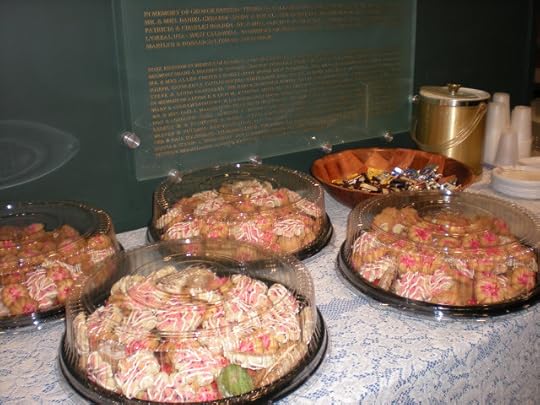
Cookies donated by the West Caldwell Shop-Rite. These and the candy added to the fun.
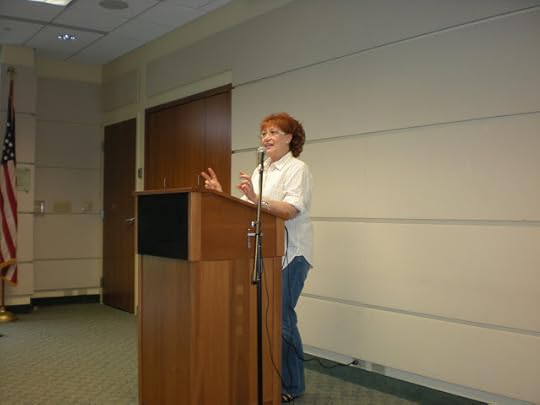
Adele Kenny reading for the Paterson Literary Review
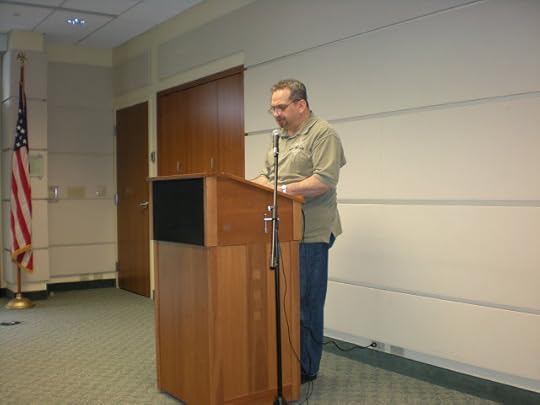
Anthony Buccino reading for the Paterson Literary Review
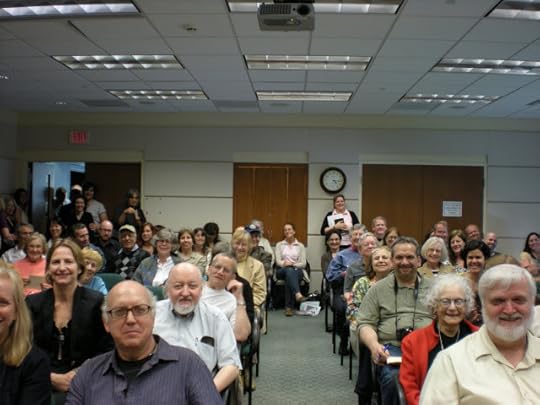
Audience. Notice the extra chairs at the back and the people standing in the doorway and hallway. Don't all these people look happy? Imagine how happy the poets were to read for an audience like this!
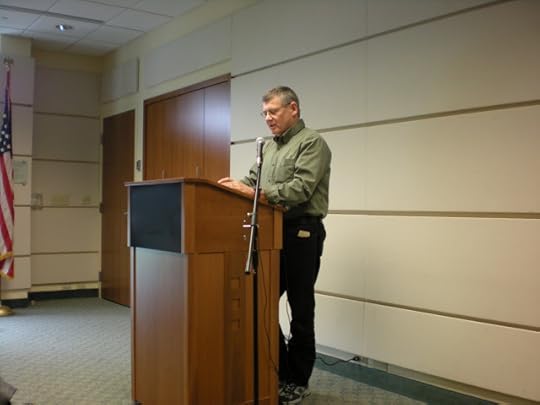
Peter Murphy reading for The Literary Review
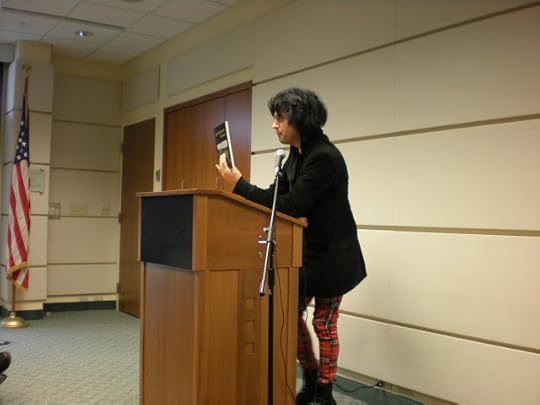
Quincy Lehr, editor of The Raintown Review. Prize for best pants.
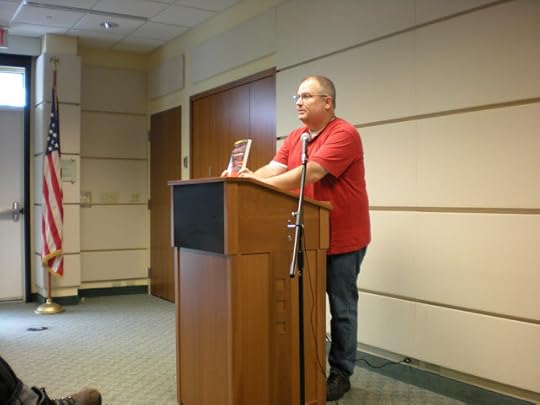
Ray Hammond, editor of New York Quarterly
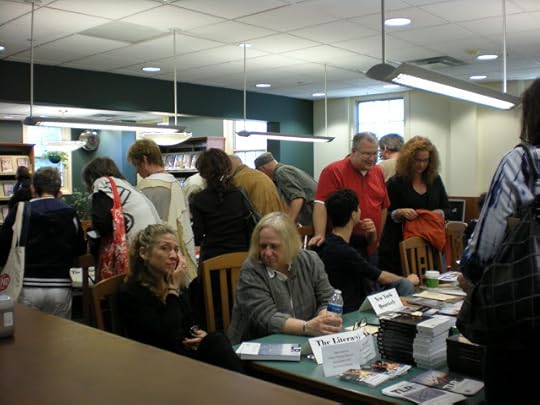
Tables with journals, crowd browsing during break
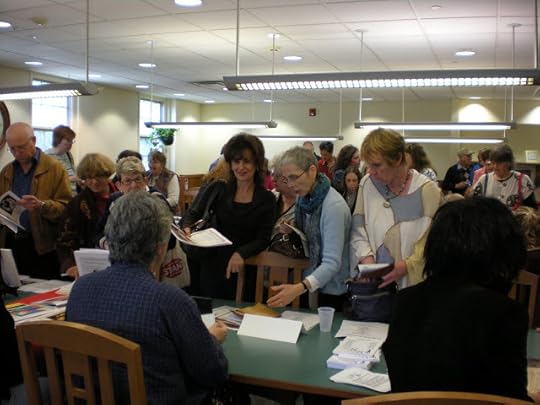
Crowd browsing. Much excitement stirred up over the brand new Stillwater Review

I invite the editors of 12 journals to participate. I ask them to each invite two poets to represent their journal. The event is always held on a Sunday, 1:00 - 5:00 PM, a day the library is closed to the public. However, the library opens for the event and the public is invited to come. The Assistant Director works with me during the planning stages of the event and is present throughout the day. Volunteers man the book sale area.
The editors and journals set up in the Reference area, two journals per table. Computers are turned on around the perimeter of the room so that journal websites can be displayed. Editors answer questions and provide subscription information and submission guidelines. Journals are available for purchase.
The readings are held in another room, The Community Room. I divide the afternoon into four 30-minute sessions. Three journals—6 poets—read during each session. I introduce each editor who then describes his or her journal and introduces the two poets. Each poet is asked to read two poems, totaling no more than 5 minutes. Following each reading session, there is a 20-minute break, during which time people browse the journals.
There is also a Book Sale area at the front of the library where reading poets can offer books for sale—one title per poet. Book sales were down this year which was my one regret. However, journal sales were up and that's good news as the primary function of the day is to honor the journals that make it possible for us to publish our work.
We had a really good turnout, and everyone seemed to have a great time. Here are some photos which tell their own story.

Cookies donated by the West Caldwell Shop-Rite. These and the candy added to the fun.

Adele Kenny reading for the Paterson Literary Review

Anthony Buccino reading for the Paterson Literary Review

Audience. Notice the extra chairs at the back and the people standing in the doorway and hallway. Don't all these people look happy? Imagine how happy the poets were to read for an audience like this!
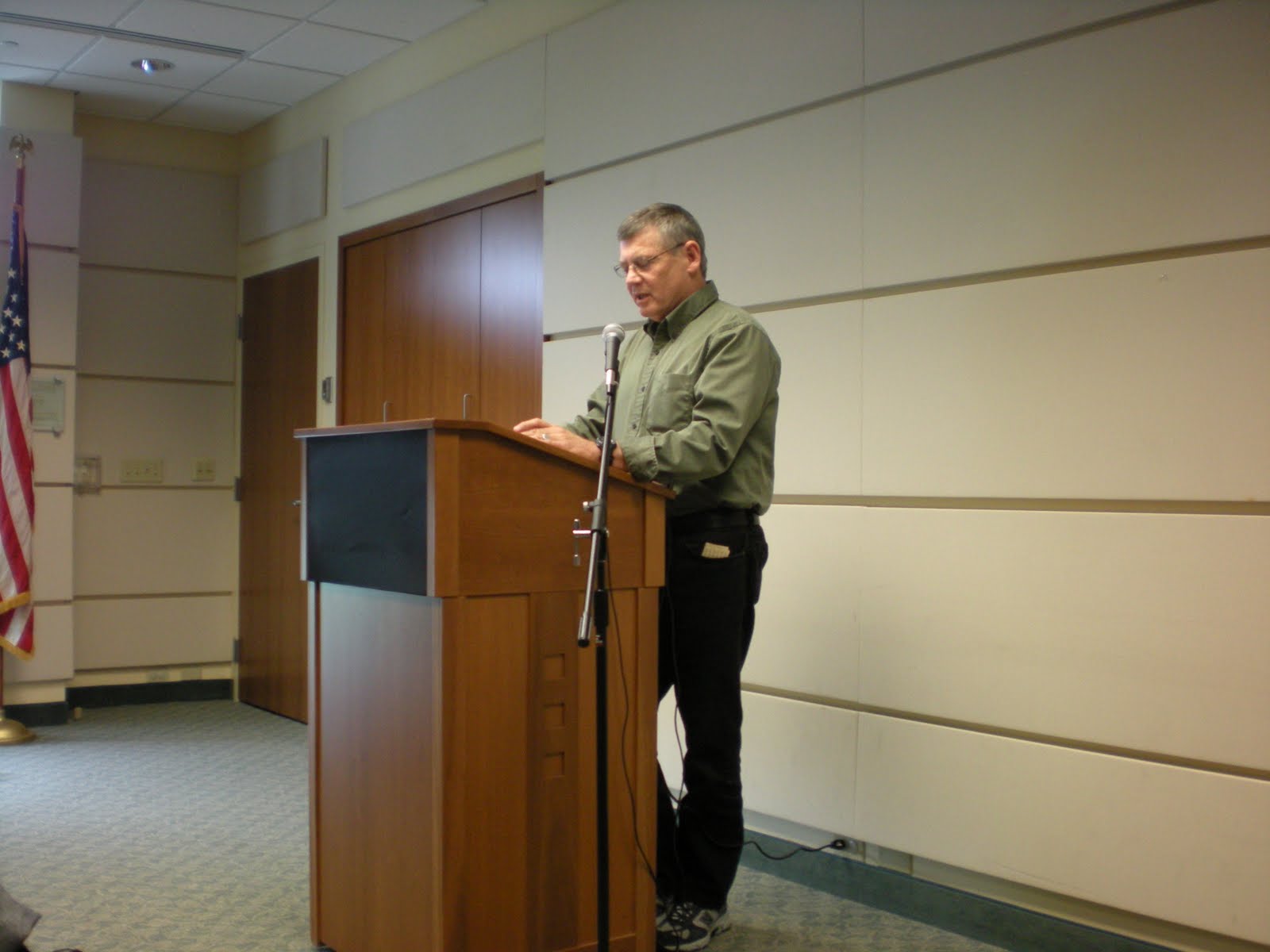
Peter Murphy reading for The Literary Review

Quincy Lehr, editor of The Raintown Review. Prize for best pants.

Ray Hammond, editor of New York Quarterly
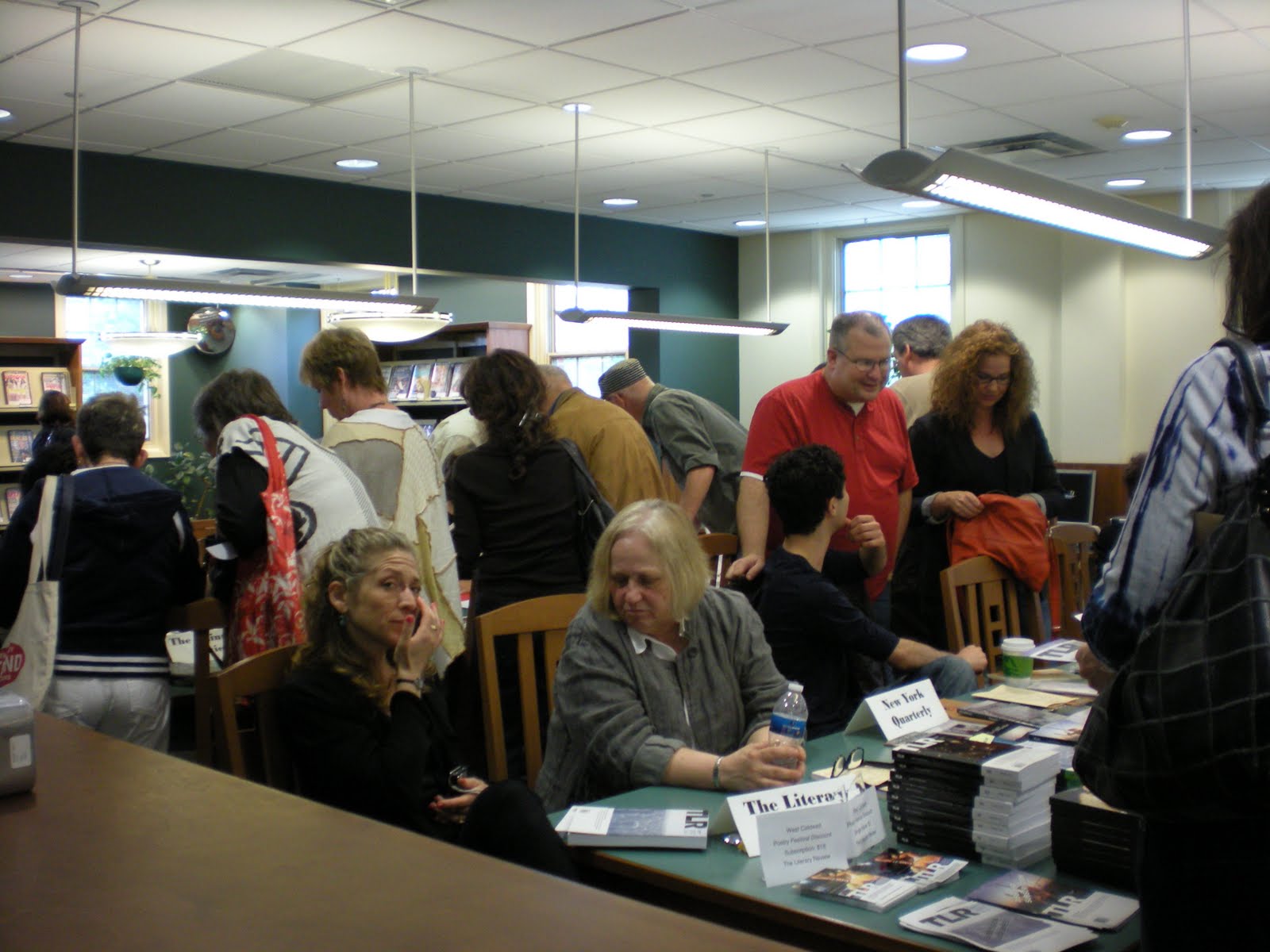
Tables with journals, crowd browsing during break

Crowd browsing. Much excitement stirred up over the brand new Stillwater Review
May 9, 2011
Poetry Festival: A Celebration of Literary Journals
If you're anywhere near NJ, please join us for the 8th year of this showcase event.
Sunday, May 15, 2011
Poetry Festival: A Celebration of Literary Journals
12 Journals and Editors
Edison Literary Review, Exit 13, Journal of New Jersey Poets,
Lips, The Literary Review, New York Quarterly, Painted Bride Quarterly,
Paterson Literary Review, Raintown Review, Stillwater Review,
Tiferet, and US 1 Worksheets
Journals will be available along with subscription and submission information.
Editors will answer questions about publishing.
24 poets will read throughout the afternoon.
Books will be available for sale and signing.
West Caldwell Public Library
30 Clinton Rd.
West Caldwell, NJ
1-5 PM Free
Contact library: 973-226-5441
For full schedule and directions: Click HERE
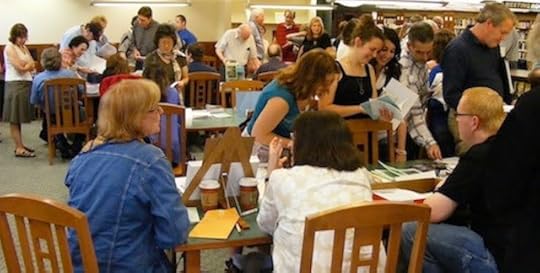
During the 2010 Festival, visitors browsing the journals and talking to the editors
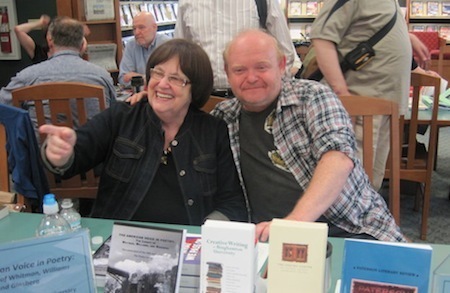
Maria Mazziotti Gillan, editor of the Paterson Literary Review, and poet Joe Weil at the 2010 Festival

Sunday, May 15, 2011
Poetry Festival: A Celebration of Literary Journals
12 Journals and Editors
Edison Literary Review, Exit 13, Journal of New Jersey Poets,
Lips, The Literary Review, New York Quarterly, Painted Bride Quarterly,
Paterson Literary Review, Raintown Review, Stillwater Review,
Tiferet, and US 1 Worksheets
Journals will be available along with subscription and submission information.
Editors will answer questions about publishing.
24 poets will read throughout the afternoon.
Books will be available for sale and signing.
West Caldwell Public Library
30 Clinton Rd.
West Caldwell, NJ
1-5 PM Free
Contact library: 973-226-5441
For full schedule and directions: Click HERE

During the 2010 Festival, visitors browsing the journals and talking to the editors

Maria Mazziotti Gillan, editor of the Paterson Literary Review, and poet Joe Weil at the 2010 Festival