Steven Harper's Blog, page 68
April 5, 2018
Writing, Kidney Stones, and Me
It stole my writing from me. Dealing with this took all my energy, including my creative energy. You would think that while I'm confined to a chair or bed, I'd have plenty of time to write, and you'd be right in saying I had TIME, but the writing wasn't there. Everything that got on the page was awful, and it took enormous effort to produce just the crap.
This made me angry and upset in new ways. I mean, I've been through operations before. The year previous, my gall bladder had to come out, and that flattened me for a month. But in that case, I knew it was coming, knew the recovery period would be difficult, knew I wouldn't be able to write. The operation also didn't slap me in the face with memories of sexual assault. So I was ready for it and had prepared.
The kidney stones came out of nowhere. The operations went on and on and on and on. The pain was continuous and debilitating. The regular use of anesthesia triggered deep depression, anxiety, and outright terror. The anesthesia was the most horrible. I had no control over what was happening to me while I was unconscious, and I eventually found out they had done things to me and not told me about them.
And so I lost more than four months of writing.
In the grand scheme of things, this isn't a big deal, I suppose. I wasn't under deadline, so that wasn't a worry. (Though not having a deadline is in itself a worry!) Lots of writers go through periods where they aren't writing because of Life Stuff--having babies, family emergencies, and so on.
But this loss hit me hard, and I simply can't "put it into perspective," as well-meaning people tell me to do. This is partly because this shit came out of nowhere, hugely because the nature of the operations tore open wounds surrounding sexual assault that I thought were long healed, and partly because writing is my main way of coping with the world. I use words on a screen to retain control. I control the story, I control the characters, I control the narrative of my own life on this blog. So not only had I lost control of my body. I had lost control of the way I keep myself stable.
A big part of my identity is writing no matter what. I've never missed a deadline, ever. When we were in Ukraine, adopting the boys, I wrote on my laptop during the down times and finished the book on time. When I got divorced and found myself a single father of three boys with enormous psychological and physical needs, I still finished the book. When things got really horrible and my family was being torn apart by homelessness and abuse, I still finished the book. (I had even, for the first time in my life, asked my editor for an extension on the last one, and she said I couldn't have it because the book was already listed in the catalogs. So I finished the book.)
This wrecked me. It stole my writing, it stole my identity, it stole my control, and it stole my mental stability.
The writing eventually started to come back. I knew it would. This was never a question, really, and all the well-meaning people who said, "Don't worry; it'll come back" miss the point. I lost four months of my writing life, and I can't get them back. This has had an impact on the novel I'm working on. It should have been done by last January. Here it is April, and the book isn't done yet. I should be four months into my next book. I'm not.
The events also created bad triggers for me. I can't watch TV shows or movies set in a hospital, especially when a patient is drugged, unconscious, in a coma, given anesthesia, or loses their memory (many of my operations gave me short-term amnesia, which removed my decision-making power). The show JESSICA JONES has this as a running theme, and I have to skip past large sections of it to make it watchable for me. When I see these things, I get angry and anxious and feel like someone is coming for me.
There are also more anxiety/anger/paranoia triggers than the above, ones I don't want to discuss here because they're too personal even for this blog.
My counselor says, "Avoid the triggers. Do things or think about things that don't create the fear."
Seems common sense, right? But it isn't. I WANT MY LIFE BACK THE WAY IT WAS. Why the hell should I have to avoid these simple things I used to enjoy or were a harmless part of my life? I want to confront, not avoid.
It still has a further impact on my writing. Before the hospital shit started up, I had already plotted out the novel I was writing. I had already decided a character was going to survive being buried alive. However, this is an event for which the phrase "worst trauma ever" was invented, and I didn't want the rest of the book to be about how the character coped. So I'd decided said character would be drugged into insensibility before the actual burial and wouldn't remember anything until after his rescue.
However, this turned out to be prescient of my own situation, in a very bad way. Versed, which prevents short-term memory from becoming long-term memory, is a standard drug in many operations. The patient is awake, or semi-conscious, and goes through all the pain, but doesn't remember it. I read about one case in which a surgeon had flayed open a patient's arm, only to have the patient wake up due to an error by the anesthesiologist. The man screamed in agony, but the surgeon had to keep on operating. He screamed and screamed until the anesthesiologist could does him with Versed and more anesthetic. So when he woke up afterward, he had no memory of the incident at all, even though he'd been awake for it. The OR nurse who wrote about it said it was the only time he ever threw up during a procedure. This horrifies me. Did anything like this happen while =I= was out? My head knows I'm more likely to get into a car accident than have this happen to me, and I'm worrying about the wrong stuff, but my emotions shout, "What the hell do you know?"
Anyway, I got to the scene in the book when the character was about to be drugged and buried. When the drug was forced on the character, my heart rate went way up and I had to stop writing. I came back to it the next day, got out a couple sentences, and had to walk away again. It took me over a week just to write two paragraphs.
So eight months after the operations began and four months after they ended, they're still having an impact on me and my writing.
I know life is change and we all become different people than we were because of events exactly like this. But I don't LIKE this person I've become. He's fearful and cowardly and anxious and needy and he has to tiptoe around certain topics and he takes a steady stream of anxiety meds to get him through the week. I don't like this new me. I haven't gained anything from this. When Nietzsche said "That which does not kill us, makes us stronger," he was being an ass. I'm weaker than I was, not stronger. Survival doesn't equal strength.
All I can do is keep working on it with my counselor and myself. This I'm doing.
 comments


Sucking the House
I do know that the house gets dusty quickly. All this points toward dirty ventilation ducts.
As I write this, a pair of workmen are bustling about the house doing arcane things with long hoses connected to a very strange truck in the driveway:
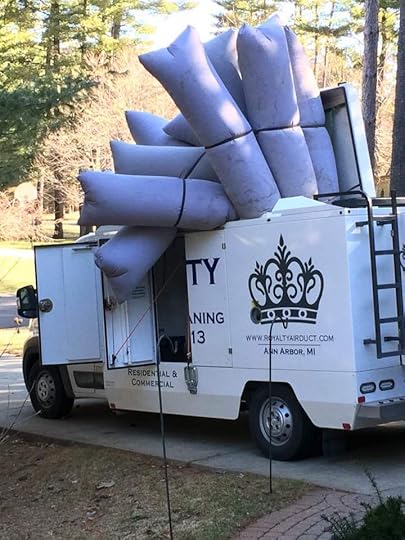
The puffy things poking up with tumescent urgency are vacuum filters.
The cats were unceremoniously stuffed into the basement store room, where they've since folded themselves into tiny singularities and vanished. Nothing gets more freaked than a cat who sees a giant hose snake through the house.
And soon we'll have clean air. Yay!
 comments
Break!
So it was greeted with great relief when spring break finally arrived.
We haven't done much, ourselves. Darwin is in the middle of budget season at work, so he's extra busy and we can never take a trip. I've been just resting a lot, really--puttering around the house, doing some extra cleaning, playing Corey more.
When we get back, we head into the downhill part of the year, which is another battle. My seniors (and I have three sections of them) always figure the year ends at spring break. A lot of them take trips to somewhere summery, and when they get back, they want the year to be over. We also have a number of activities that disrupt the usual schedule--state testing, AP tests, senior meetings and assemblies, and so on.
Off we go!
 comments
March 24, 2018
Recipes Lie
--"With these fresh ingredients you can easily find at your farmer's market or food co-op..." TRANSLATION: This recipe calls for shit you've never heard of and will have to spend hours tracking down.
--"Start by mixing the dough in your mixer, then knead on the countertop until smooth..." TRANSLATION: Your arms will fall off before you're done.
--"This takes only 20 minutes to make." TRANSLATION: That's 20 minutes AFTER you spend 15 minutes gathering the ingredients, 45 minutes chopping a hundred different vegetables, and 15 minutes heating the oven.
--"Requires only four ingredients..." TRANSLATION: Those "four ingredients" include a box of gluten-free cake mix and a type of fruit that only grows in South America between March 31 and April 1. Available at your farmer's market or food co-op.
I have nothing against complicated recipes. I =like= complicated recipes. They're fun, when you want a kitchen project. But sometimes you just need something quick. I think all recipe writers figure that if they put "simple" in the title, it magically becomes simple.
Or they figure they'll get more clicks if they lie.
Let me heat up my frying pan.
 comments
Urologist, Deferred
Well, yes. But not with him, thanks. I quietly didn't make an appointment, and the UU's office hasn't called ME about it, either. So the breakup is mutual.
I already had an appointment with Dr. L-- down in Detroit set up for early March. I hadn't cancelled it despite my little fling with the UU, so I decided I would use that as my follow up. I got all my records and notes from the UU's hospital (including the operating room notes) and readied them to give to Dr. L--.
Brief aside. Despite the fact that the awful Winter of Five Operations is a couple months behind me now, and I'm not in pain anymore, I still have to psych myself up for a urology visit. Days beforehand, I have to build myself up and tell myself it'll be fine, nothing's going to go wrong, this will be routine, I won't need any more operations, and so on. It takes a fair amount of mental work to keep myself out of a victimhood/survivor state of mind, and it doesn't always work.
So anyway, my appointment with Dr. L-- was coming up, and then I got an email message from his office. They had rescheduled my appointment to be with someone else, but on the same day. The new person was a female PA.
My experiences with having a female urologist taught me to avoid them. This isn't because I feel female urologists are less qualified than males. It's because the female urologist I had before made me feel tricked more than once, and because of other personal psych reasons I don't want to go into here. And then there was the female nurse who wrongly, and embarrassingly, admonished me over some post-op care. So my experience with women in urology has not been good, and I'm not up for more of them.
I called Dr. L--'s office. "This new appointment won't work for me," I said.
"Is there a problem?" said the receptionist.
"I don't really want to see this PA," I said carefully. "I'd rather see Dr. L--. Can we reschedule for a day he'll be in?"
This was possible, but it would be nearly three weeks. I wasn't in pain or other dire straits, and this was "just" a follow-up appointment, so I agreed to faraway time slot.
"Just so you know, though," the receptionist said, "our PAs can do everything the doctor does except surgery. They aren't residents or interns. They're fully qualified."
"I understand that," I replied politely. "But for this particular problem, I need to see a man. It's nothing against the PA; I just need to see a man."
"Not a problem," said the receptionist, and the new appointment was made for a Monday in late March.
This Monday, as it happens.
As I said, urology visits take some psyching up for me, and I'd been working on this for a few days, readying myself and getting myself into a "You've got this" kind of mood.
And then my phone rang. It was during my prep period, so I was able to answer. It was Dr. L--'s office. They needed to cancel Monday. Again. The next available appointment wouldn't be until late April.
I was more than a little miffed here. I'd been rescheduled twice now. Is there something about urology that makes people unreliable? What the heck?
But before my miffed-ness could go too far, the caller explained that Dr. L-- was on medical leave of his own. Yipes! He was expected to return in mid-April, but it might not be until later. My miffed-ness changed into sympathy, and we worked out an appointment a couple of weeks after his earliest return date, just to make it more likely he'd be seeing patients again.
So while I'm hoping everything goes well for Dr. L--, all that psych-up work went out the window, and I have to do it all over again next month.
Really, more than anything, I want the appointments to stop--or at least drop to a once-a-year checkup.
 comments
War for PotA
And what was with all the water? Everyone in this movie, human and ape alike, lived in filthy squalor that was dripping, puddled, muddy, or just plain wet. In the second half of the movie, we're in a bleak winterscape of snow, snow, snow. The captive apes are denied water (though it rain a LOT on them), and Donkey dumps cold water over Caesar while he's tied to a St. Thomas's cross. In the end (spoiler) a convenient avalanche of snow destroys the evil military base. If there was a point to all this wet misery, I couldn't see it.
Awful, terrible movie.
 comments
March 11, 2018
Cooking Save!
I tasted it, corrected some seasoning, and tasted again. Not that great. Edible, but definitely blah. Apparently this recipe wasn't very good.
Darwin came home and asked what smelled funny. Not a good sign. By now, the soup had simmered another couple hours, so I asked him to taste it and see what he thought.
"Not bad," he said.
I was half ready to order out or something, but we decided to try the soup anyway. I called Max to the table.
It was weird. As we ate it, the soup started tasting better and better. In the end, everyone had more than one bowl.
Cooking save!
 comments
March 5, 2018
Max the Cadet
A while ago, Max showed deep interest in becoming a police officer. The interest hung on for a long time, to the point where he was researching on-line to watch videos of what it was like to be a cop (reality TV shows ain’t it) and how to do various jobs cops are expected to do.
Last fall, through the school, I heard that the Oakland County Sheriff Department has a cadet program for young people. If they’re accepted into the program, they start actual training as police officers and perform police-related jobs that are age-appropriate for them. It doesn’t pay, but it does let you know what police work is like and if it’s something you really want to do—in time to find another career, in case you don’t like it. And the program is a resume builder.
Max enthusiastically applied, and some weeks later, he got a notice that he’d been accepted. We were very proud around here.
This Saturday, he goes to the training program, which is an all-day thing. He’s both excited and nervous. We’ll see how it goes!
 comments
Comedy and Us
A few weeks ago, Darwin and I bought tickets for an LGBT comedy festival. We made a night of it with our friends Steve and Joe. It was part of my and Darwin’s super-secret agenda to spend more time with gay friends. Don’t tell!
We met for supper at Andiamo, a very nice restaurant near the comedy venue in Dearborn. We were seated promptly, and the very nice server got us started. The food was delightful (I had rustic salmon, which is fish with new potatoes and a marinara sauce), and the conversation was sparkly. We all decided to hit up dessert (so much chocolate and cheesecake!). The only disappointment was that Andiamo had no cherry or raspberry wine to go with. A travesty!
A number of similarities between the two couples was observed. The two Steven/Steves discovered they handle the same certain chores in their respective households, while Darwin and Joe handle the same other certain chores, and it was very interesting to discover this.
You are not allowed to read anything into the word “chores.”
And then we adjourned to the comedy club venue, which was just up the road. After a little kerfluffle over FINDING the place, we finally got into the right line and found seats. So many gay people! Darwin encountered the Kissing Lesbian, a woman who skittered past us to get to her seat and who loudly cheek-kissed each person she passed (if they allowed it). Darwin thought this was splendid, and did an elaborate smooch. During intermission, when we decided to hang out in our seats, she slipped by again, and Darwin demanded another kiss, which she cheerily gave. And then a third on her way back to her seat.
“Flirting with the lesbians,” I said. “Brave!”
At last the show began. Because it was a fundraiser, a number of interminable speeches were made by people who had no business giving them, but at last the first comedian came out, so to speak. She was an older transgender woman, and was extremely funny. (“You call that a dick? I cut off a bigger one than that.”) The second comic, a big, muscled gay man, was less funny. I gave him a C+. A large part of his problem was things went too long between punchlines, and some of his material was barely funny anyway. The third comic, a 29-year-old twink, started strong. (“People always say my eyelashes are super long. But I’m thinking of getting eyelash reduction surgery. These are hard on my back. And I want to be able to run.”) But then he kind of petered out. Too many long stories that went nowhere and had no good punchline at the end. The fourth comedian was, like the first, extremely funny. (“After I’d had an affair with a man twice my age, got pregnant, and had an abortion, I had sex with a girl and went, ‘Ohhhhh! That’s how it works!’ So I told my mother I was a lesbian. She said, ‘I think that’s for the best.’”)
The four of us had a fine time. So, next weekend, guys?
 comments
February 21, 2018
One More Time
However, multiple painful cystoscopies and follow-up procedures turned me into a nervous wreck when it comes to hospitals, a condition that only worsened as Friday approached. My head knows litho is very different, but my body and my emotions scream in total panic. So I asked the urologist for a Valium scrip for me to take before-hand. That way they wouldn't have to drag me screaming into the room.
When I've gotten pre-op Valium before, the scrip was for a single tablet. This time when I filled the scrip, I had ten! I'm not sure how panicky they figured I'd be, but whatever.
On Litho Day, we had a half day of school and my procedure was scheduled for 2:00, with a noon arrival time. This meant I didn't have to take time off work, and that I'd have something to occupy my mind in the morning, which worked out well. When I got home, I decided to do my run right away, partly because I knew I wouldn't be able to run for a while after the litho and partly to keep me from panicking more. When I finished up, I took up the Valium bottle. The instructions said to take one or two tablets a day, so I took two.
Darwin drove me to the hospital, and by the time we arrived, the Valium was seriously kicking in, and I couldn't walk safely. They had to bring me in with a wheelchair. I was calm, though.
There was the changing of the clothes. I asked for two gowns--one to use as a sort of bathrobe--and the nurse refused me. "We have to have the gown open at the back so we can do the lithotripsy," she said.
I got mad, like I did last time. And then it hit me. One of the things that upsets me the most is that I have no idea what goes on when I'm under anesthesia. I'm completely reliant on what the doctor says afterward and on the operating room notes (which I have to get special from the records department--they don't include them in your discharge papers, for some reason). I know it's illogical. I know it makes little sense. But when you're a survivor of sexual assault undergoing procedures that hit you right where you were assaulted, you're allowed not to make sense.
Meanwhile, they plugged in an IV and did other prep work. This included Dr. H-- signing my right arm to ensure they remembered to do the correct side.
The gown had a pocket on the chest for a heart monitor. I asked the nurse if they were going to put me on one. "You never know," she said, which irritated me more. (Why not just say, "We don't plan to, but we might need to"?) They'd already hooked me up to an EKG, so I didn't see a reason for a monitor anyway, and I've become an unfortunate expert in this stuff.
And then I had an idea. When I had a moment alone, I called up the voice memo app on my phone, set it to record, and dropped it into the pocket on my chest. Then I pulled the blanket up. A couple of times, nurses fussed with this or that, and I was careful to keep the blanket pulled up as if I were cold or hugely modest or both. Despite being high on Valium, I pulled this off without even Darwin noticing.
At last, the time arrived. I said good-bye to Darwin and they wheeled me down to a tiny room with a lithotripsy machine on it. It's a table with a long white arm looming over the top. That's the fluoroscope, a weak x-ray that locates the stone. Wedged on the side of the table is a round, rubbery object which rests against your side and conducts the sound waves in a directed cone. Guided by the fluoroscope, the sound waves focus on the stone and shatter it so it can pass easily.
The tech's name was J--, a tall, dark-haired man I couldn't see very well because his work station was hidden behind a leaded window. The nurse came to administer anesthetic through the IV. They said they didn't need to intubate or use gas, which I appreciated.
They positioned me on the table, and the nurse hit me with anesthetic. It burned like fuck.
"What are you using?" I asked.
"A bunch of stuff. Some Valium, some propofol, and several different things, here." she said. "Are you starting to feel it at all?"
"No," I said. It always takes a while for anesthetic to start in on me. I don't know why this is. I remember when I got my wisdom teeth out at 19, the dentist gave me Versed and asked me to count back from 10. I did, then said, "Now what?" He was surprised I'd gotten that far and told me to try again. I got to six before I felt dizzy.
Here, the nurse also seemed surprised I didn't feel anything. She gave me another shot, and I asked what it was. "Just an antibiotic," she said.
"It's cold," I said. "What is it?"
"Ancef," she said.
Meanwhile, another nurse said, "Penicillin" from across the room.
Alarm bells rang, and I got panicky again. "Penicillin?" I wasn't feeling anything yet, but my speech was a little slurred from the Valium I'd taken earlier. "Did she say penicillin?"
"That's what you're allergic to," the second nurse said.
"Okay."
She gave me yet another shot, and this one hurt quite a lot. What the fuck, man? Finally, I started feeling dizzy, and said so. This was about three or four minutes after the first shot of anesthetic.
"Just relax," said the nurse. "Let yourself fall asleep. It's all good."
Around then, everything went dark for me. But the recording continued. According to the sound file, another four minutes went by, and then you can hear them pulling me around on the table to get the sound emitter positioned properly. Several more minutes passed, and J-- said, "24" several times, and the pounding started. It sounds like a plastic ruler hitting a vinyl seat cover in a regular rhythm.
J-- turned on some music to pass the time, and he and the nurse made idle conversation.
"I didn't think he was ever going to go to sleep," J-- said at one point.
The nurse laughed a little. "I didn't either! He was asking me every single thing I gave him, too."
"He seemed to know every one of them," J-- replied. "Just an observation."
About 40 minutes passed, with background conversation and the steady THUMP of the litho machine. A LOT of people wandered in and out of the room, talking. Finally, J-- said, "That's it?"
"That's it!" said the nurse.
"15:06," J-- said, calling the time, and the thumping ended.
"Steven!" shouted the nurse, but apparently I didn't respond.
"He'll wake up in recovery," J-- said.
Another nurse said, "I heard it was . . . "
"Interesting?" J-- supplied. His tone said "interesting" meant "problematic."
"Yeah."
"Well, that's . . . he just wants to stay appraised of the situation."
Here, we have an editorial aside. Have you ever noticed that whenever you read material about how to handle a doctor visit, the literature always, ALWAYS says, "Ask questions. If you don't understand something, ask questions." And, as both a teacher and a patient, I DO ask questions. I need to know not only WHAT is going on, but WHY it's happening. If I don't understand the why, I get angry and rebellious, exactly the kind of patient hospital staff hate the most. So I ask questions until I'm satisfied I know what's going on. Because I grew up in a medical family (I'm one of the few people in my family who doesn't work in a hospital or clinic), my knowledge of medical procedures, medications, and hospital regulations goes far beyond most laymen, so my questions get very specific and pointed. This helps my post-assault traumatized self cope.
But despite the admonition to "ask questions," the doctors and hospital staff I've encountered inevitably act surprised, or even annoyed, that I'm asking. I'm not sure why this is. I certainly have a right to know what procedures will be performed on me and exactly what medications will be administered, especially when I'll be unconscious for a chunk of it and can't object or change my mind, and it's part of the staff's job to answer patient questions. Not only that, either I or my insurance company is paying for these medications and procedures. When you get your oil changed, you get a comprehensive list of every single thing the mechanic did to your car and how much each costs, but when you go to the hospital and they do things to your body, they get weird when you want exact details.
More conversation between J-- and the nurses. J-- said the stone broke up easily, which was good. They slid me onto the gurney with J--'s help, and I made a weird groaning sound.
"You're all done!" called one of the nurses.
"All done!" another one repeated.
"Open your mouth!" the first one said. I don't remember this, and don't know if I obeyed or not. "Gonna take you to recovery."
"How you doing? Tuck your elbow in for me!" another nurse called at me. So I must have been waking up. I don't remember any of this, though.
Then you can hear the gurney rolling and nurses talking about charts and slots in the recovery room. Cloth rustled a lot. Another nurse read off my allergies and noted my heart rate.
"Fifties?" she said in surprise.
"That's where it's been the whole time," the other nurse said.
Several minutes passed. I was sleeping--you can hear me breathing. And then the recording finally overlapped with memory. My first memory is about someone in the background talking about the Eastern Market in Detroit, and that comes through on the recording. Finally, a nurse asked if I was awake and if I wanted my head up. I usually can't speak when I come out of anesthesia. My tongue feels too heavy and I can't summon words. She asked if anyone was with me, and I nodded.
More minutes passed, and they finally brought Darwin back to sit with me while I slid in and out of a doze. Darwin commented that my heart rate kept fluctuating--up to 50, then down to 42, then back into the 50s, and then down to 38. "Unpredictable," he said gently, "just like you."
The nurse went over discharge instructions with me and Darwin. This included a warning that I might have bruising, redness, or soreness at the site of the lithotripsy. This was indeed the case, but it was minor and way, way, way below cystoscopy. My current pain levels were nothing compared to that.
Unlike the other procedures, they didn't have me empty my bladder before I left the hospital, but I wasn't in real pain, either. They wanted me to bring a urine strainer home to collect the stone pieces when they passed, and I asked why. The nurse said it was so I could bring the pieces in for analysis. I refused the strainer on the grounds that, after two dozen kidney stones, we already know what they're made of.
"Did they give me any other medicines while I was under anesthesia?" I asked.
"Like what do you mean?" the nurse asked.
I repeated the question, not sure why she didn't just answer.
"You got anesthesia by injection," she said. "What else do you mean?"
"I don't know," I said. "That's why I'm asking."
See? This reluctance to answer questions baffles me.
"Well, we gave you some anti-nausea medication, and some pain medicine, and everything else was part of the sedation."
"What was the pain med?" I asked.
"Fentanyl," she said. "They gave it to you right at the beginning." (She didn't mention the antibiotic the nurse in the litho room told me about, and the nurse in the litho room didn't tell me about the fentanyl or the antt-nausea med. This is why I ask multiple people the same question--the answers seem to change.)
Here, the nurse went to attend another patient. I pulled my phone out of the pocket and shut off the recording.
When I got home, I went to the bathroom. I have to say I'm very tired of watching for blood and blood clots. This time it was a nice surprise. There was blood at the beginning, but it cleared up and vanished after just a couple seconds. I had no blood after that. About the third time I went to the bathroom, I felt some fragments pass, but they didn't hurt at all.
I spent a groggy afternoon and evening. I slept most of Saturday, too. Darwin, the cats, and Max kept wandering into the room, waking me up, and got pissed at them after a while, and they finally left me alone. I'm awful when I get home from the hospital--cranky, miserable, and I snarl at everyone like a wounded animal. Afterward, I always feel bad about the way I treat everyone, but I can't seem to stop. I can't always talk right, either. Darwin will ask me a question, and I can't form an answer, even to something as simple as, "Do you want me to order Chinese for supper?" It makes me a difficult patient.
I kept waiting for the crying jag. Whenever I come out of anesthesia, I eventually cry like someone has just died. The previous time, I mentioned this to the anesthesiologist, who monkeyed with the medication, and I didn't cry when I woke up. That was great! But about an hour after I got home, a hurricane of bawling swept over me, and I couldn't stop. The anesthesiologist was able to delay the crying, but not stop it. I know it's a brain chemistry thing, but that doesn't make it any less miserable when it happens.
So I was waiting. And I waited. Finally, three or four hours after I got home, I figured, "Yay! I won't do it this time. Maybe it was the kind of anesthesia they used." I was taking a shower at the time and got out to dry off, and--WHAM! I was crying again. Jesus fuck. Darwin heard me, and came running in to see what was wrong. Same shit, different day. He got me into bed.
Later, I downloaded the recording to my computer and listened to it. It was "interesting," to use J--'s words. Parts of it relieved me--I knew pretty much everything that happened while I was unconscious. Parts of it ticked me off--I didn't much like some of the comments the staff made. (I didn't reproduce them here.) I understand why they made them, and I know they wouldn't have made them within my hearing if I were awake, but it's "interesting" having a recording of what people say about you in the same room when they think you're unconscious.
Would I do it again? Yes. I'm sure I'll have more of these procedures, and I'll probably have to have a full cystoscopy again at some point, and I want to know what happens when I'm out, even if it makes me angry. I want the unvarnished truth. One thing a recording like this does is arm me with more knowledge, so next time I can tell the staff, "I don't like ___, so please don't do it."
I talked to Lenny, my counselor, about the recording, and he shifted uneasily. "You're not happy about it," I observed.
"Well, no," he said. "It makes me wonder if you're recording us right now, for example."
"I don't have to record us now. I'm awake and I know what's going on."
"But you can understand why a medical team wouldn't like it," he said. "They'd be wondering if you were planning a lawsuit or something else."
"Don't care," I said. "This makes ME feel better, and it's not my job to stop them from worrying. It's their job to stop ME from worrying."
"If you were recorded in the classroom," he countered, "how would that make you feel?"
"I get recorded in the classroom all the time," I said. "My students record me during lectures, and god only knows how many cell phones record class that I don't notice. I used to record classes and post them on YouTube, but the new software the school bought makes that a technical nightmare, so I don't do that anymore. I =expect= to be recorded at my job. Besides, these recordings help me get answers to questions, and let me know what to ask later. The staff never answers completely, and that frightens me. I need to know everything, and I need to know why it's happening so I can cope."
I paused. "This I don't understand. The staff acts like I'm weird for asking all these questions. Don't other people want to know this stuff? I mean, it seems like there'd be a few who'd say, 'Just do it and get me out of here, I don't want to know the details,' but I don't understand why MOST people seem to act that way. It's MY body, and I want to know everything that's done to it, especially when I'm unconscious and under the total control of strangers who can--and do--perform any procedure they like without my knowledge."
"Here's what you can do for that," Lenny said. "It'll mean repeating a lot, but tell the staff that you're a trauma survivor, and you need complete, step-by-step details for everything that's going to happen, including a list of medications and the steps, even the little ones, the staff will be taking during the procedure. Then they'll understand why you're being unusually inquisitive and they won't take it the wrong way."
I agreed this was a good idea.
I'm still going to record the next procedure.
 comments