Denise Domning's Blog, page 7
May 27, 2019
All Grown Up
No, not the puppies, although they are growing by great big leaps and bounds. Only two weeks ago they were cute cuddly not-very-heavy things. Now I swear they weigh twice what they did when they came and are all legs. I’m amazed at how well they’re doing, as far as training goes. They’ve already mastered “sit.” It’s become their go-to reaction to any scolding, as if they think sitting is the ultimate apology. They’ve learned to stay close to me when we walk the pastures and they come about 50% of the time they’re called. They also both know that the very loud “No!” means they must immediately stop chasing the sheep.
I don’t understand why the sheep allow themselves to be chased by these little girls. Tiny especially doesn’t tolerate it from any other dog. She’ll charge and stamp her feet, which pretty much resolves the situation. I suspect it has something to do with how unpredictable puppies, or any baby four-footer, can be. I’m almost certain that this fearful ovine reaction will cease the moment the lambs are born. And, by the way, I’m beginning to worry that Tiny is carrying four, not three babies. She’s once again HUGE!
As for Moosie and Bear, Moosie is still in a snit over the puppies. Although he refuses to allow them to lick his mouth, he has agreed to show them how to dig for gophers. Meanwhile Bear thinks these girls are the best gift I’ve every given him. He and Radha have bonded and Bear now comes along every time I walk the girls. As for Radha, she might weigh less than twenty pounds but she’s fearless. When they play, she goes straight for Bear’s throat, growling as if she’s taking on, well, a bear. Bear obligingly rolls onto his back, his feet in the air, while she, still snarling, chews on his jowls, his ear, his lips and his throat. Meanwhile, Kali, who is more cautious about playing with such a big dog, chooses to chew on Bear’s tail. When he turns to wrassle with her, she leaps up and runs circles around him. What fun all four of them could have together if only I could convince Moosie to stop sulking.
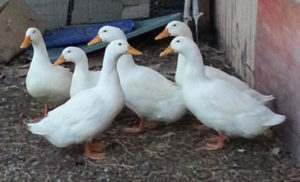 The “All Grown Up” is about the ducks. Just as my friend Lu promised when I bought the ducklings from her, only eight weeks have passed and the ducks now look like ducks. My chickens, who are now 3 months old, look stunted next to these hulking white Pekins.
The Pekins turned out to be interesting to raise. First, I’m surprised at how bonded they are to each other. Not even my turkeys are like this. If one of these shiny white guys moves, all the others move with him as if they’re somehow strung together. A few weeks into their life here, I traded out their little water basin for one of the pig troughs. They loved it. They got in and out so often that I had to change the water twice a day due to mud build up. Even though they acknowledged me as the official feeder and water renewer, no matter how many times I entered their run, they acted like I was the local ax murderer.
Hmm. I guess I am the local ax murderer when it comes to birds. At any rate, they have never become accustomed to me and ever time I come in, they flee to the far end of the run, which is where they are in that picture.
Then one day I had one of those moments when all becomes clear. I went to the pond and raked up a bucket of pond grass–water weed–and added that in their tub. As usual, the ducks waited until I had closed the gate before going to inspect this strange new offering. One of them cautiously dipped in its beak and pulled out a strand of grass. He, or she, slurped it down like spaghetti and immediately went crazy. That set the others off and they were crawling over each other in the tub, chowing down on grass as if there was no tomorrow. Now, even though they still move to the back of the run as I enter, they start quacking the moment they see me coming with the grass bucket. The quacking gets louder as the grass goes in, then louder again as I back out of the run. The moment I shut the gate, it’s every duck for itself. They still crawl all over each other, fighting to get the biggest beak full.
I’m looking forward to moving them out of the brooder coop. I’m no longer certain that these ducks are going to work for snail and slug patrol. I think they’re too skittish and shy to tolerate a movable coop. Instead, they’ll probably end up living in the little yellow coop next to the pond, where the hens will lay wonderful duck eggs that I’ll turn into omelets. There’s only one problem. The puppies have turned that coop into a playground, dashing in through the lower door then clambering out of the upper door, after which they slide into the pond to chase frogs. Somehow, I’m certain if the puppies chase the sheep, they’ll also chase ducks, especially if there’s swimming involved. Time to put up more fencing.
Happy Memorial Day!


May 20, 2019
Time for fruit
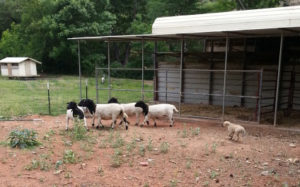 Before I get to today’s post I want to do some updating. The puppies are doing very well. They have mastered “sit” and the art of herding chickens and sheep, when they are not herding dogs. I’ve roundly scolded Tiny for allowing them to do this. Every other dog that has attempted to put the moves on my little herd has been soundly challenged with stomping feet and harsh sheep grunts. Honestly, my neighbor’s chihuahua is terrified.
Speaking of the sheep, now that we’re a month and a half away from lambing, Tiny is seriously huge. That girl! I don’t know what it is about her and big babies, but that’s what she prefers. Only Tiny is once again looking like she might have three. NO-o-o-o! I will not bottle-feed lambs ever again. (What is that saying? Never say “never again?”) The other four girls also look plenty preggers. Mari also looks bigger this time than she did with her first set of lambs. Rosie and Petunia have that chunky look. You know, that look that requires a shirt that says “I’m not fat, I’m pregnant.” Millie still looks like a dork, what with her curls cut back to a pouf on the top of her head. She will be delivering last, toward the end of July or beginning of August, so she still has time.
Moosie has at last given up or rather given in to the arrival of puppies. Two days ago I took the girls for a walk around the property— we’ve been working on boundaries— and Moosie decided to join us. At first he kept himself very aloof, still harboring his snit. Then all of a sudden he was digging in a pile of red sand left behind by the flood and looking over his shoulder at the little girls as if inviting them to play. When they came near enough, he took off running in big circles. Running as fast as he can in circles is how Moosie shows joy. The girls didn’t recognize the invitation at first, but within a moment or two they were dashing and chasing him. Then, as swiftly he had started to play, Moosie took off for the house, leaving the girls staring after him in surprise. As for Bear, he babysat the pups on their first night then refused to do it again. Since then, he’s tried to invite them to chase him while he has a stick in his mouth (a particularly strange Bear game). Unfortunately, the puppies are a little intimidated by the size of the stick Bear uses to entice them.
Now, onto the start of fruit season here on the farm. Let me say I was very worried this year, what with this strange cold/hot/cold/hot weather we’ve had. I shouldn’t have. The peaches, apricots and my single nectarine have all set on with a vengeance. Even that struggling Elberta Peach near the ditch, the one the beaver nearly killed, has a dozen peaches on it.
For the first time since I planted apples on the hillside beneath my pump house– I think that was 2013– I’ll be picking apples off more than one tree. I bought the trees from a landscaper friend who had kept them in pots for too long, so I knew death or fruitlessness was a risk. But the price was right and I love a challenge. What’s most interesting is that none of the supposedly easy-to-grow varieties are giving fruiting, although I think they may next year. Instead, it’s the picky Pink Ladies and Winter Bananas that are doing the very best.
My elderberries have gone crazy! I’m going to have a bumper crop. (Huh, what a strange phrase, “bumper crop.” I just realized I have no idea how that term came to be. I may have to research this a bit.) I remain in awe of how well these bushes do on what is likely the hottest, driest hillside I have. They are so lush and thick that they’ve crowded out the prolific Johnson grass that used to own that space.
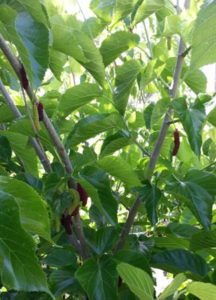 On the eastern end of that same hillside are my Pakistani mulberries. They were planted in 2014 and were supposed to be bushes. Instead, they’ve become bushy trees. They’re covered with 3 to 4 inch long dimpled fruit. They look sort of like a very long blackberry and are without a doubt the best tasting berry ever. Well, until the raspberries come in, that is. Of course, by then the mulberries will be gone. Everything in its own time.
As for those recalcitrant figs, I have one–count it, one– fig on only one of the two massive Brown Turkeys near my water tanks while my struggling 3-foot-tall Kadota fig near the willow tree has a dozen on it. @#^$% Well, at least I now know that both of those Brown Turkeys are capable of producing fruit, one each a year. Maybe next year I’ll get two each.
And now, for the piece de resistance. I am eating cherries off my own trees!
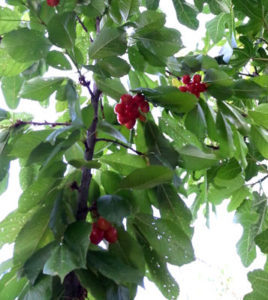 I have always wanted to grow cherries. It’s one of my favorite fruits but buying organic cherries is just too expensive, and health-wise I can’t afford to eat conventional fruit. The Stellas made it into the ground here in the spring of 2016. I only bought five because I really didn’t believe they would survive in Arizona. I chose Stellas because they’re self-fruiting; they don’t need a different variety of cherry for pollination. I did it reluctantly because, I regret to admit it, I’ve always been prejudiced against them. Who wouldn’t choose a dark red Bing over the Stella’s sunset yellow and rose fruit? I’m here to report that the scales have fallen from my eyes. Stellas are every bit as delicious despite their multiple colors. And of course I now wish I’d planted the whole property with them and done it the first day I moved here.
Yep, it’s that grazing time of year again. I stop at the cherry trees for a snack, go down to the garden and grab a few leaves of lettuce to balance fruit with veggies, then stop to munch on mulberries as I watch the puppies drive the sheep crazy. Life is good!
May 13, 2019
Puppies!
New dogs on the farm has been an idea swirling in my head for a year now. Bear, God love him, is now seven–not six as I’ve been telling folks for apparently for two years– and slowing down. Although I’m successfully treating his arthritis with enzymes at the moment, he’s still aging and slowing down. And, while Moosie’s predicted life span is longer than his big buddy’s, Moosie isn’t likely to pick up the slack as far as guarding livestock goes. He’s far too busy hunting raccoons and other critters.
That I can’t keep the farm going without a livestock guardian on the property came home to me again last month when I lost two of my three my barn cats. These were the two that spent most of their time outside my perimeter fence, beyond the protection of the dogs. I’m guessing that the mountain lion is once again walking my fence line. And why shouldn’t she? It’s been a good hunting ground for her. For the last three years and despite all my efforts to convince them otherwise, my turkey hens are drawn to nest down by the creek in or near the thick stand of blackberries that had grown up between the fence and the creek. The lion didn’t find the brambles a deterrent. After all, what’s a few thorns when you’re set on feeding your babies a tasty, free-range, pastured turkey or two or three? As for those hens who chose to put their eggs against the interior of the fence, well, that was a quick and safe hop in and out for a big feline. I don’t expect she’ll every come any farther than that on my property, not if this is the same lion that the boys treed a few years back. I’ll never forget the panic on that lion’s expression when I found her in the willow tree, both Bear and Moosie doing their best to get to her. She’d clearly never expected to find herself cornered and frightened by a pair of mere dogs.
There won’t be any turkeys for her or any other big predator to take this year. Tom’s two remaining hens are presently nesting under the house. I put their choice up to the fact that this year’s floods scoured away all the blackberries and most of small trees. The whole area is now wide open, meaning not bird friendly.
Still I was hesitating about adding new dogs, especially puppies, and I was clear I wanted puppies. I wanted to raise them in the pastures so they would bond with the sheep and not me. Then, serendipity happened, just as it did when Bear found his way onto the farm. A friend and former relief cow-milker called to tell me that someone in Camp Verde had rescued a pregnant Anatolian Shepherd who had gone on to produce 10 puppies in need of the right homes for the breed. I was hooked when he said “Anatolian Shepherd.”
My first livestock guardian dog Tango was a Great Pyrenees/Anatolian cross. Weighing in at a measly one hundred pounds, Tango was amazing. Unlike Bear who has the Kuvasz’s goofy sense of humor, Tango was all business. His first week here he nearly caught the rogue male coyote that had been stealing my chickens. The coyote never again entered the property. He drove a black hawk into the ditch and chased every raven he saw crossing the pastures. When he was bored, he’d go to the high end of the property and wait for a car to start past the fence, then race it to the house. Tango won every time. (For those who haven’t driven on Page Springs Road, the speed limit is 35 but I don’t think anyone drives slower than 45 even though there are some seriously dangerous curves on this road. Those of us who live here all have interesting stories about the cars that have appeared in our front yards.)
Unfortunately, at that time I didn’t yet have the property completely fenced and our neighbor’s beagle, a juvenile delinquent of a dog, came over daily to tantalize Tango into going walkabout with him. An hour or two after they’d take off, I’d get a call from someone twenty miles away telling me that they’d found my dog. Fearing that he might get hit by a car or worse, I ended up giving Tango to friends who own a small farm in the Village, two acres fully fenced. He’s still there and has continued to be an amazing livestock guardian dog, tangling with owls, coyotes, bobcats, fox and more.
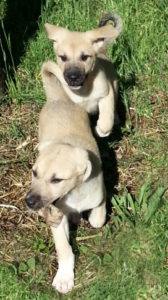 Kali in the front and Radha in the back.
So I said yes, not to one puppy but to two, sisters who will keep each other company as they bond with and learn to protect the sheep, chickens, ducks, turkeys and whatever else I get crazy enough to try raising. Why girls? I’m hoping that two young females and two mature male dogs will mean less jostling for dominance. Guess I’ll discover if I’m right in a few months.
The girls arrived yesterday. They’re still tiny, just twelve pounds at 8 weeks. I don’t think they’ll get as big as Tango, but I’m guessing they’ll eventually be taller– and longer and leaner– than Moosie. They’ll probably just as fast as he is as well, which will be a challenge for him.
Actually, I think the very fact there are puppies on the property is a challenge for Moosie. While Bear greeted them enthusiastically, Moosie surprised me by acting unusually standoffish as if he knew these two were not just visiting but here to stay. We took them down to the orchard where they’ll live until I think they’re old enough to understand and avoid the many hazards that come with a farm. I invited Bear and Moosie to enter the fenced enclosure with them. Bear went in. Moosie backed off and shot me the stink eye, as if to say “You’ve got to be kidding me. I’m Midwife Moosie, not a babysitter.” He sat outside by himself and watched sourly as everyone went to meet the new girls. Bear remained in the orchard after the humans departed, more than willing to play chase and “Bite My Tail” with the new arrivals. He even slept with them last night, doing so happily. I think that really irked Moosie, who continued to sulk on the porch, and did all of Bear’s usual barking for him.
After that, there was only one more thing to do; give the girls their real names. I suggested Anna and Tolly, but no one thought that was a good idea. After trying on a few more options, I ended up asking Shri, my new guy who happens to Indian, for some names of Hindu goddesses. I decided to reach high, just in case character follows the name. So now I have two little canine goddesses. Radha, the one in the back of the picture, is very like her namesake, loving and clearly devoted to her sister. As for Kali in the front, she’s already showing her superior strength and protective nature..
So far, so good, although the girls haven’t been here a full 24 hours. I have the livestock guardian dogs-in-training I wanted, Bear has new toys to play with, Tom is interested in the new additions to his strange flock, the chickens are irritated because they can no longer get into the garden, the sheep are uncertain but curious, and the cats haven’t noticed the puppies yet.
As for Moosie, he continues to sulk, refusing to enter the orchard. Give it up, Moosie! The sooner you do, the sooner you can start playing with them too. Trust me, you’ll like it!
May 6, 2019
A’sheep Shearing Go
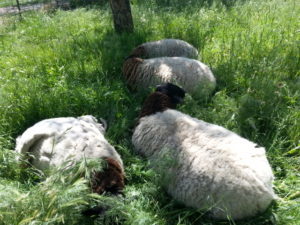
Back when I first starting writing historical novels, I fell in love with a folk group with the odd name of Steely Eye Span. Their music set the mood for my first few books. On one of their albums (I had cassette tapes back then, but graduated to disks, then put them on my computer where they’ve been ever since) was a song called “A Rosebud in June.” It’s definitely a spring song, starting with the line: It’s a rosebud in June and the violets in full bloom, and the small birds are singing love songs on each spray.
Of course, here in Arizona, the violets have already bloomed, as have the roses. But I definitely have small birds singing love songs. Wait. Those aren’t love songs. Instead, those sweet bird calls are actually songs of war, declarations that “Sweetie, mate with me because if anything gets close to my nesting territory, I will employ all my might to kill it–or at least drive it off.” The Cardinals and Western Tanagers are already at war again, chasing each other out of the fruiting mulberry tree. At least their battles are beautiful, what with the tanagers being yellow, black and orange while the pursing cardinal is a brilliant red.
The point of introducing the song was because of this verse: We’ll pipe and we’ll sing love, We’ll dance in a ring love, When each lad takes his lass all on the green grass, And it’s oh to plough where the fat oxen graze low, And the lads and the lasses do sheep shearing go.
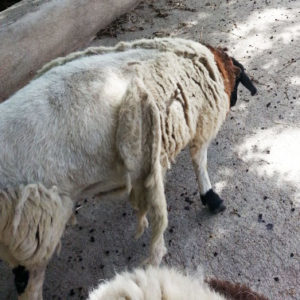 Poor Petunia
That right. My pregnant ewes were sheared yesterday, and thank heavens for that! One of the promises of Dorper Sheep is that they lose their hair–they are called hair sheep because their “wool” isn’t usable wool. As my faithful readers may recall, last year Tiny, my matriarch, lost all but a patch of wool on her back which she managed to turn into felt. Also last year, I finally had Mari sheared, because she didn’t drop so much as a strand. This year, both Rosie and Petunia lost some but not all and ended up looking like Rastafarians on acid. Mari again lost nothing, and her daughter Millie clearly takes after her. As for Tiny, she was so uncomfortable that she was willing to stand still and let me tug tufts of hair off of her.
So Jason the Shearer came. I thought I was ready for him. I had the girls locked in the orchard, trapped where they might be easier to catch. I thought that because they’re pregnant they might be slower.
You can guess where this is going, can’t you?
The girls knew without even being chased that whatever was happening here wasn’t something in which they wished to participate. Even three months pregnant they were unbelievable fast. And agile. At once point, Rosie vaulted four feet in the air to escape the shepherd’s hook. Even Tiny, who is the largest of them despite her name, managed a good number of leaps, pirouettes, and vaults. I started out in the corner of the orchard, to be available if help was needed, but quickly retreated out of the danger zone after Petunia slammed into me.
Kudos to Jason and his assistant! Shearing is as dangerous as herding irate dairy cows. Jason said, as he did when he came to shear my former (and very tasty) ram Cinco, “Man, have you got athletic sheep!” I guess that’s the problem with not keeping them confined to a small space. The more they walk, the stronger they get.
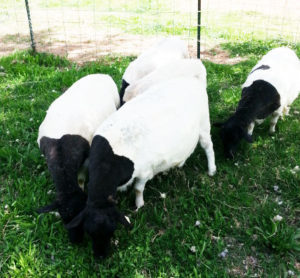 Clean sheep
It took about an hour before all five were once again healthy-looking (as in not as fat as I thought) black-and-white sheep. Once they calmed down, it was clear they were all very much more comfortable, especially Petunia who was no longer being followed by a long tail of knotted wool/hair. And here I’d been giving myself grief, thinking I’d let Tiny get fat. It was only her wool/hair. Although she’s clearly bigger than her daughters–even Rosie who was made pregnant on the same day as her mother, and granddaughter. But then, Tiny likes to produce big babies. Fingers crossed that she doesn’t do that three lamb thing again. If she does, I know what she’ll do. She’ll once again send me the look that says, “I’ll take these two, you, strange-looking-two-legged sheep, can have that one.”
I’ll deal with that in July. All I care about is that after Jason left, Tiny lifted her head to me, wanting me to press my nose to hers as she accepted my apology. Boy, has she got me figured out.
April 29, 2019
Vacation
I don’t leave the farm often, mostly because it takes about a week to prepare to go and a week to catch up on the work that didn’t get done while I was gone. However, when the offer to go to Costa Rica arose, I jumped at it. There was a time (prior to the farm) when I did a lot of traveling, mostly international. During that period I fell in love with Central America. What’s not to love? It’s mostly tropical, there are oceans available both to the east and the west, and they have ripe pineapples that cost next to nothing at roadside stands. There’s nothing sweeter in this world than a ripe (not a green-and-let-it-sit-on-the-counter) pineapple.
Okay, truth be told, the reason I like Central America so much is that it’s located to the south. If you fly from north to south or south to north, there’s no jet lag. Over the years I’ve figured out how to deal with jet lag– never eat the meals, instead snack the whole way and drink a couple of liters of water. This method worked even for that horrible flight to Tahiti. I was living in Japan at the time but the only way we could get to Tahiti was to fly from Tokyo to Los Angeles, then LA to Tahiti. OMG.
 For this trip I was in charge of accommodations, and what I wanted was a house, because I prefer not to eat in restaurants, in the jungle. Guess what? I found exactly that, a house about 300 meters from the entrance to the Monteverde Cloud Forest reserve. Of course, having a kitchen meant shopping for food, which allows me to once again test my theory. I believe that grocery cart makers size each country’s cart so that it costs the shopper about $100 US dollars to fill it. Thus, in Japan the cart is the size of a small basket while an American Walmart cart is massive. Costa Rica’s carts–at least the carts at the Super-Pali where we stopped to buy seven days worth of vegetarian chow and a seven chicken thigh/drumsticks for the non-vegetarians– are about half the size of a standard American supermarket cart. Sure enough, my cart was about two-thirds filled and it cost me $87. I got a kick out of the supermarket names, which included Megasupers and Super-compros. I think there may also have been Maxisupers and SuperMegas.
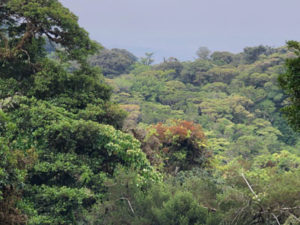 View of the jungle around the house
The house was perfect, surrounded by trees dressed in layers of bromeliads in every possible shade of green, as well as mosses and mushrooms, while thick lines of strangler figs wrapped around their trunks. Any one tree could have a dozen different sorts of leaves showing in its crown.
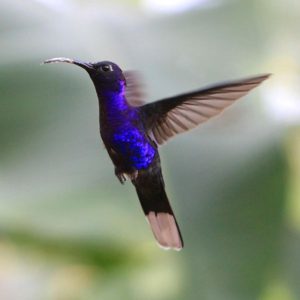 Violet Sabrewing Hummingbird
After we settled in, I filled the available hummingbird feeders. Within moments there were at least 7 different species vying for sugar water, including a tiny orange-and-green one whose wings beat so fast it sounded like an angry bee. Another was bright green with a speckled green breast, and there was one that looked black until the sun hit it then it gleamed either bright blue or emerald green, depending on the angle. But my favorite remains the Violet Sabrewing. It’s about the size of a sparrow and beats its wings very slowly. Later, a pair of Bananaquits, a tiny little yellow and brown/black bird, came to rob syrup from the feeders, darting in while the hummers were busy trying to drive each other off. A pair of dark-colored, blue-billed Guan, a turkey-sized bird, showed up daily to entertain us with their ability to walk out to the twig ends of branches. They shared those trees with the gorgeous Motmot bird, which says “mot-mot.” Surprise!
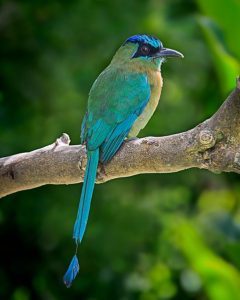 Motmot bird
An Agouti (half-rabbit, half-rat) showed up, as did a Coatimundi, and on the final day, an orange-and-black tarantula made her way under the house. There were Brown Jays in the treetops, Fairy Wrens dancing around the front porch, sweet little black-and-white thrashers, and a small flock of parrots that flew past us morning and evening. Later in the week both a Toucanet and a Toucan, the one we all expect, showed up. We walked in all three nearby reserves where the three-wattled Bell birds were calling, their call being a metallic “bonk” followed by a squeal that sounds like a gate in need of oiling, and white-headed Capuchin monkeys.
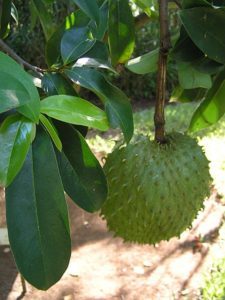 Guanabana
But I guess it won’t come as a surprise if I admit that the best part of the trip for me was our visit to a small farm owned by the family of Raul, the house’s caretaker. His brother is a beekeeper and his father a former cattle rancher. This means he still has cattle. Farmers and ranchers never die, they just reduce the size of their herds. We tasted jungle flower honey and enjoyed a glass of freshly made Guanabana (wha-NA-bah-nah) juice. I may have a new favorite fruit. Later, we found a “wild” mango tree and picked as many small yellow ripe mangoes as we had bags in the car.
I swear I brought a bit of the jungle back with me. My mulberry tree is once again covered in fruit. So far I’ve seen Phainopepla, a crested black bird with white spots on its wings, a scarlet Tanager, orange-and-black Western Tanagers, Meadowlarks with their yellow breasts, and a brilliant yellow gold finch. This is along with the black hawks, great blue herons, vultures, turkeys, and chickens, of course. And there are ducklings that are almost the size of full-grown ducks!
I’m glad to be home.
April 15, 2019
Too Stinking Cute
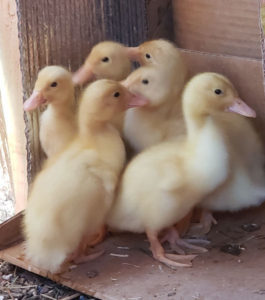
I gotta ask. Are these not the most stinkingly cute critters you’re ever seen? Ducklings! I got ducklings and it’s not even Easter yet.
I’ve been wanting to raise ducks for almost ten years, from the moment the stock pond went in. Why? Because it’s seriously cool to have a pond filled with cattails, lined with mint and water irises that has a flock of white ducks gliding around in it.
Okay, that’s one reason, but the real reason I’ve wanted ducks is for snail and slug patrol. I cannot believe how many snails live on this property. Yes, here in Arizona! As for slugs, sometimes I think I’ve moved to the Amazon rain forest. I swear I’ve got banana slugs. Some of them are longer than my hand. Along with the rollie-pollie bugs, otherwise known as pill or sow bugs (and which aren’t really bugs but crustaceans), the snails and slugs wreak havoc in my gardens. I’m told that ducks love to eat all three.
The reason I haven’t been successful bringing ducks onto the property is Moosie. Moosie wants to kill ducks almost as much as he wants to (and does) kill raccoons. He’s over 30 coons now. I blame this blood lust on his first experience with ducks. He wasn’t more than 4 months old when a pair of wild ducks visited the pond. Moosie stood at the edge of the pond watching them, his head tilted to one side, then stepped out onto the water’s surface as if he expected it to be solid. Needless to say, he sank like a stone. (And needless to say I roared with laughter.) From that moment on he’s made it his mission to drive off all ducks.
You may recall that I made an attempt to bring in ducks a few years back when my friend Su gave me her last three Rowan ducks. To prevent a Moosie mistake, I fenced in the pond. Although Moosie didn’t get to them, life occurred. One of the drakes made it to the ditch and swam off while I’m guessing the hen was taken by an otter. Su took the lonely drake home and an owl took him. That escapee drake may still be alive. I think he went off to mate with a wild mallard. I think it’s he who returns to the pond each winter, bringing his new family with him. This has been a good thing, because the more often the ducks appear, the more Moosie gets accustomed to seeing them and the more chances I get to point at them and inform Moosie “these are mine and you can’t kill them.”
Earlier this year I began buying duck eggs from another farmer-friend, Lu, and fell in love with their taste. They’re higher in protein than chicken eggs –it’s actually a different protein and folks who are allergic to chicken eggs can often tolerate duck eggs– and make excellent omelets. A month ago Lu informed me she was putting a clutch of duck eggs into the incubator and did I want some ducklings? I immediately said yes even though I knew as I spoke the word that I have some serious hurdles in front of me if I’m going to successfully raise waterbirds. Clearly, keeping them in the pond, while aesthetically pleasing, isn’t going to work. More importantly, keeping them in the pond isn’t going to help me with one of my most difficult gardening problems and the reason I wanted ducks in the first place.
You see, ducks love to eat snails and slugs. Yes, here in dry Arizona, I don’t just have snails, I have slugs that are the length of my hand. I swear that my slugs are the same ones found in the Amazonian rain forest. I’m also told that ducks enjoy rollie-pollie bugs, otherwise known as pill or sow bugs, which are actually not bugs at all but crustaceans, and those I have by the million. So what I really need is ducks living in a mobile coop that I can position in the garden where and when I need it.
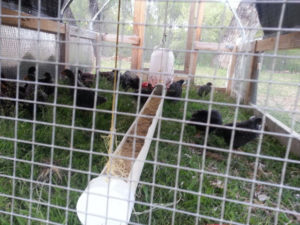 That brings me to my six-week-old chicks. I had to move them from the brooder coop to make room for the ducks. Since they’re still small enough to get through chain link, I put them in the mobile coop I built last summer, the one June the Cow broke into just because she could. Rather than replace the cow-smashed door, I fixed it, the fix consisting of drilling a hole through the separated pieces then wiring them together. Hey, it worked. Actually, the latch even aligns better. More importantly, the little hens fell in love with it. They get so excited when they realize their house on wheels is about to move. They all rush to the front of coop, wanting to be the first to reach the fresh grass and untouched soil.
So even though it makes me sad that I won’t see my ducks gliding across the water of the pond, I think I will be happier and they will be safer if they’re cooped up. That means sometime next month I’m going to once again enter the barn and once more risk my ability to type by using power tools as I attempt to make a duck-friendly mobile coop. Until then, I’m going to keep visiting the ducklings a few times a day.
I don’t care that they cringe when they see me coming. I don’t care that they try to hide under each other as I reach out to catch one of them. I don’t care that the one I catch is screaming in duck, “Help! She’s going to hug me!” They are just so stinking cute!
April 8, 2019
A Naked Bear
First, an apology for missing last week. I expected to be late with my post because I spent a good part of the previous week immersed in a grand experience. It was my first ever Indian wedding, and the celebration included everything but the elephant. There was incense, chanting priests, blue-faced gods, gorgeous saris, amazing vegetarian food and even Bollywood dancing. However, As my return flight landed in Phoenix Monday night, I discovered that my mother had suffered a serious stroke earlier in the day. Fortunately, she’s made a miraculous recovery, although she still has a long way to go.
Now onto my de-furred dog.That’s right. It’s that time of year, the season in which Bear loses his fur. I sent him to the groomer on Friday and he returned at least 10 pounds lighter, in need of sunscreen for our sunny days and a thick blanket for our still chilly nighttime temperatures. But boy oh boy, does he look clean!
First, an apology for missing last week. I expected to be late with my post because I spent a good part of the previous week immersed in a grand experience. It was my first ever Indian wedding, and the celebration included everything but the elephant. There was incense, chanting priests, blue-faced gods, gorgeous saris, amazing vegetarian food and even Bollywood dancing. However, as my return flight landed in Phoenix Monday night, I discovered that my mother had suffered a serious stroke earlier in the day. Fortunately, she’s made a miraculous recovery although she still has a long way to go.
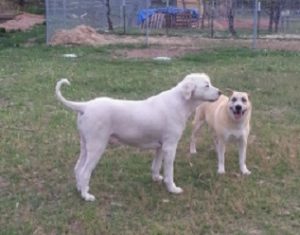 Now onto my de-furred dog.That’s right. It’s that time of year, the season in which Bear loses his fur. I sent him to the groomer on Friday and he returned at least 10 pounds lighter, in need of sunscreen for our sunny days and a thick blanket for our still chilly nighttime temperatures. But boy oh boy, does he look clean!
As usual everyone on the farm has had a different reaction to the annual appearance of the naked Bear. Moosie is annoyed. He’s gotten used to having their doghouse all to himself. Since the big shave, he’s been sleeping outside on the dog couch while his otherwise buddy takes shelter from the cold on the comfy pillows and mattresses in the dog house.
Tom doesn’t recognize the new and improved Bear, which is sort of a relief. From his first day on the farm, Bear has made a habit of running through a flock of chickens or turkeys at least once a day. I think he believes the birds think it’s as funny as he does. Tom has turned frustrated umbrage into his own habit, and makes it a point of charging Bear at least once a day, just to remind the dog not to misbehave.
My ewes have been completely freaked out by the appearance of this strange new creature. The moment Bear made his entrance onto the pastures the sheep came running toward him. They stopped in a protective knot a short distance away. Then, as one, they brought their ears forward (something I don’t usually see them do) and fixed their gazes on him. They watched closely as Bear, who clearly enjoys feeling so much lighter, encouraged Moosie into a game of “Bite Your Tail.” I could see it on the sheep’s faces. Although they recognized his voice and his movements, they couldn’t make those compute with the fur-less creature in front of them. Where was their familiar Yeti?
It’s now day four since the big shave and the ewes remain cautious, Tom is still ignoring Bear, and Moosie has begun to enjoy sleeping on the couch. As for me, I’m thrilled to see the form that was hidden under that heavy coat. About a year ago I took Bear to the vet and was warned most stringently that my now elderly dog weighed too much. I returned home and reluctantly removed all the emergency backup dry dog food that I kept out, just in case. (I have a problem with the idea of anything on the farm going hungry.) This left Bear no choice but to eat his official meal. He and Moosie are on the BARF–bones and raw food–diet. There are days when one or the other, or both dogs turn their noses up at what’s being served. “Really? We have to have pasture-raised pork again?! Yuck. Why can’t we have store-bought chicken?”
Until the fur was off I wasn’t sure how his diet was progressing. I can now happily report that forcing Bear to eat what he’s given has worked. The naked Bear is one sleek looking dog. Not bad for an old man, not bad at all.
March 25, 2019
Burrowing Chicks
I thought I had them. But N-O-O-O. I have burrowing chicks.
Raising these chicks is like a remake of “Chicken, Run.” (I must be on a children’s movie kick.) The chicks are relentless in their attempts to escape. It’s not like I didn’t know there would be a period during which they’d be small enough to fit through the 4″ x 2″ openings in the horse fencing I’d used. That’s why I added a layer of bird netting over the fence and buried the bottom of both in the soil. By the way, if you’ve never seen, or worse unrolled a length of bird netting, this is the most frightening fencing-type stuff I’ve every used. It acts like a really sticky spider web. As you unroll it, it tangles around the buttons of your shirt. It catches on the ends of tools. I swear it wraps itself around your feet just to trip you. I used it as a barrier against the javelina when I first moved up here. They never challenged it. If javelina won’t challenge it, surely it could control tiny little chickens.
I didn’t count the determination of these birds. It started with them scratching along the edges of their enclosure. I didn’t give that much thought because chickens love freshly turned soil, and that’s what I’d done when I buried the base of the fence. It took me a few days before I realized that they weren’t just scratching in the dirt. They were burrowing! Down, they went until they scratched up the bottom edge of the bird netting. After that it was an easy thing for them to wiggle-waggle themselves upward, between metal fence and bird netting, until they could pop out through their choice of a rectangular opening.
After catching the escapees, I went along the fence and reburied all the edges of the netting then turned all the soil in their run so they would have more to focus on than just the edge of the fence. By now, a cadre of burrowers had formed. One would exploit a weak spot and the others would swiftly follow. This time, I went back along the edges and lined it with rocks. Still, they escaped.
By then Moosie had noticed there were chicks on the outside of the coop. Once again, I took him down and informed him that these were “Mine!” So now I was watching both the chicks and the dog. It was a good thing I was because if I hadn’t been I would have noticed him as he walked casually up to the fence then a moment later turned and started just as casually away toward the ditch.
I dashed out onto the porch and shouted, “Drop it!” He immediately spat out the chick he was holding in his mouth and continued to walk out of my view. Meanwhile, the completely unharmed chick made her frantic way back to the coop. I counted after that, just to be sure I hadn’t missed Moosie doing this once or twice before. He hadn’t.
That caused me to add boards to the inside of the enclosure. That meant nothing to my burrowing chicks. Down, they went, looking for a way under them. Although this was more effective than rocks, it wasn’t the answer. They were still escaping, but at least now they were limited to only a few places from which to escape. More importantly, when I was chasing them down to return them inside, they were all making their way back to the same place–the rar end, where the enclosure met the barn wall.
Aha! I had them. I pinned the bird netting against the barn wall with a board, then zip-tied the netting at the base, middle, and added more at the top. Feeling triumphant at having outsmarted 3 week old chicks, I returned to the house to finish up my work so I could start this post. Every so often, I’d glance outside. Not a misplaced chick to be seen! I had done it! I walked into the laundry room to start a load of wash, then returned to the kitchen and glanced out the door. Not one, not two, but five chicks were outside the enclosure turning over cottonwood leaves as they were digging holes in the rich soil. (Ha! “Holes” is another kid’s movie. I need to get off this kick before I find a way to work in “Shark Boy and Lava Girl,” one of my favorites.)
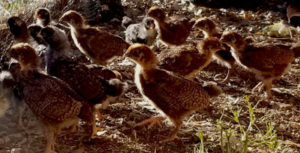 Trapped!
Gnashing my teeth in frustration, I recruited Christina to help me and got serious. Together, we covered the outside of the fence with chicken wire, then buried the bottom edges of the fence, netting and chicken wire. The chicks eyed us in suspicion while we worked, but soon forgot we were there and went back to their frenetic digging. We had started in the “weak” corner, and as we made our way toward the gate, I kept my eye on the leader of the escape crew. Sure enough, she made her way to that corner. Who says chickens can’t remember? Three followers joined her a moment later. The four of them dug at the newly buried netting, then pressed and pushed. One got herself between the netting and the fence. And there she stayed. I worried for a moment that she was actually trapped. But no, she was just checking for options. Apparently there weren’t any, because she backed out of the netting and went somewhere else to dig.
Gotcha! At least for today. At the rate they’re growing today might be enough. If not, then by the end of the week they’ll definitely be too big to get through the fence.
But what I really want to know is why can’t I have normal animals?
March 19, 2019
The Great Ram Wrangle
First, I apologize that this post is a day late. Work came out of the woodwork yesterday, chores and tasks falling over each other, all needing to be completed NOW. Then it was dark and I was too tired to consider writing what is sure to be a short post. And why might you ask is this going to be a short post? How could a post with such a great title not be an equally juicy story? That’s because I titled the post before the event.
I was absolutely certain getting my borrowed ram back into the trailer to take him home was going to be a you-tube worthy event. I mean, not only had he completely bonded with my girls but he’d never warmed to me. Nor had he once tried to head-butt me. Moving a shy animal usually takes a rodeo roping champ. Ah well, here’s the story even if it doesn’t live up to the title.
Because I was so certain that this would be an ordeal, I’d called the ram’s owners and asked for their help, along with my friend Jim, who was bringing the trailer. By 10:00 AM Sunday everyone was in place. That’s when I finally learned the ram’s name: Kristoff. When I raised a quizzical brow at the name, I was told that Kristoff was the hero in the Disney movie Frozen. Ah, yes. They are a young couple with equally young children.
This is what happens when a person no longer has little ones showing up at her house on a regular basis. I don’t see any of the new kids’ movies. I’m not sure that’s a bad thing. When my boys were little it was all about Star Wars, episodes 4, 5, and 6. There was a time when I could recite the Death Star destruction scene from episode 4 by heart. Hey, everyone has a talent and mine is to be a human parrot. If I hear something often enough it sticks in my brain like that song you can’t stop singing.
By the time my youngest had moved onto R-rated movies my younger-by-ten-years sister had two girls. Having always wanted to know what it was like to play with little ones not interested in light sabers or force fields, I volunteered to watch my nieces one day a week. That exposed me to a whole new genre of kiddie movies. I’ll admit to having a few favorites among the Disney/Dreamworks/Pixar library. Shrek tops the list for me. I was the one who got to take my older niece to the theater the first time she saw the movie. She was so excited that she brought a special dress and we did her hair in a braid because she already knew that’s how Fiona (the heroine) wore her hair. After having spent too much time with The Little Mermaid and Aladdin– to the point that I had a few scenes locked in my memory– I expected no more from this event than to enjoy my niece’s excitement. Instead, she and I switched roles. I adored the movie, which was clearly meant for adults, and my niece left the theater complaining, “That is not how it’s supposed to end! She’s a princess. She’s supposed to be beautiful.”
The only other kids’ movie that stuck with me was Lilo and Stitch. Who knew that Disney would take such a risk? No princess, no silly fairy tale plot even though the story is about an alien life form coming to earth. Instead, there’s a troubled child, her “doing-her-best” older sister, and a whole lot of tongue-in-cheek jokes.
All of that is to say I now know who the ram’s name and that the ewes who came with him were Elsa and Anna, the obligatory princesses in the Frozen story, and that there was a chicken named Olaf. Olaf is apparently a talking snowman. I suppose using a chicken as a substitute for a snowman is necessary in Arizona.
So we backed the trailer up to the orchard gate, into which all six sheep were locked, arranged the gates so no one could escape, then began doing the job of border collies. Not very good border collies, I might mention. No matter which way we turned, the sheep stayed in tight flock. After a few minutes of this I got smart. I brought out the treat bucket and the lead I used for my cow. I showed my ewes the bucket, opened the gate to the garden area, and they were outta there, leaving Kristoff in the orchard, bleating at their betrayal.
Now that there were three humans (the fourth hanging back to guard the gates) and one ram, we had the advantage. Although Kristoff had slimmed down quite a bit, he was still slow on his feet. After a few more minutes of driving him around the orchard, he made the mistake of ducking into the shelter built into the southwest corner. At that point it was a matter of one of us following him in to slip the lead over his head while the other two covered all escape routes. The next five minutes were spent pushing, pulling, shoving and twice uprighting Kristoff when he tried the old, “I’ll just lay on my back” trick. Then, just like that, he was locked inside the trailer and ready to go home.
I was glad I rode with Jim. It was nice to watch Kristoff leave the trailer. He clearly recognized that he was home and made a beeline for the familiar corral. As for my girls, they didn’t even shed a tear at his departure. Fickle girls! Now that they don’t need him, he’d become nothing but that extra mouth stealing the alfalfa they wanted.
For me, it’s hurry up and wait. There’ll be lambs here somewhere between July 1st and August 15th. Judging from my girls’ bellies, I’m betting they’ll all deliver before the end of the July.
Good work, Kristoff!
March 11, 2019
The Chicks Are Here
I intended for my new chicks to arrive a few weeks ago, but their delivery date coincided with Oak Creek making its foray onto my property. Fortunately for me, I heeded the warning of the USGS and put off delivery until “sometime in early March.” “Sometime” turned out to be Friday.
In case you’ve never purchased chicks from a hatchery, it isn’t the stork that brings the babies. It’s the USPS. The chicks hatch, are sexed (I pay extra to get all hens which means I get mostly hens and one or two roosters. Hey, they’re small. I can’t even imagine how anyone can tell what they are at that age.), then popped into a heavy, aerated cardboard box with some sort of nutritive goop tucked into their bedding and sent on a two day journey. The only reason this is feasible is because they’re birds.
Honestly, chickens have procreation figured out. No interior carrying. No hiccups or kicking. Instead, there’s this egg that not only contains everything the embryo needs to grow into a chick, but the exterior of the eggshell is coated with a special wax. The wax seals the shell, preventing bacteria and other nasties from penetrating it to kill (and eat) the embryo. As long as that wax isn’t washed off the egg stays viable and fresh for months. By the way, this fact is why we have hard-boiled eggs for Easter. Back in the Old Days, before light bulbs extended a hen’s laying season to 12 months a year, hens stopped laying as the days grew shorter and colder. Thus, those exquisitely preserved, extra summer eggs could be stored by humans in a cool, dry place over the winter months. Then, when the days again lengthened around the Vernal equinox, to which the calculation for Easter Day is tied, and the hens again began to lay, all those stored eggs, now six months old, were boiled up. For the record, old eggs make the best egg salad as far as I’m concerned.
Anyway, Mama Hen lays her waxy, fertile eggs at a rate of about one a day until she has at least eight in her nest, then settles on top of them for the twenty-one day journey to chick eruption. Because of that wax-coated shell, when she begins her sitting, each egg is at the exact same stage of development no matter if it was her first egg or her last.
Given that, you’d think that hatching would happen all at once. It doesn’t. Instead, the chicks seem to have some instinctive need for an individual birth moment. That means the Chick #15 can make its appearance a full two days after Chick #1. More than once I’ve had turkey hens decide that ten hatchlings are plenty. They take their ten and turn their backs on the six other eggs that are clearly already in the process of hatching. I miss that white, bantam Cochin hen I once had. She had a passion for hatching eggs and always went broody (meaning she wanted to sit on eggs even though she didn’t have a nest) about the same time the turkeys were hatching. I’d just keep slipping ready-to-hatch turkey eggs under her and she happily cared for them until they’d fought their way free of their shells. It was pretty funny to watch her, as small as she was, perched on eggs four times the size of any she laid. It’s that time-lag in hatching that makes it possible to mail chicks. Each chick has a built-in two day survival reserve.
Once my peeping box of babies made it here, my new guy and I took them down to the official Farm on Oak Creek Brooder Coop. I’d turned on the heat lamps the previous night so their space was plenty warm. One by one, he handed me a chick and I stuck its beak into their water reservoir. This isn’t just to give them a drink, but so they know where the water is located in their coop. Once their beaks were wet, I set them down and watched. Thirty-one of them went skittering off, darting here and there as they realized their world had suddenly expanded by orders of magnitude. Number Thirty-two was the smallest of them. Rather than run off, she stood with her head down and her tiny stubby wings held away from her body. That’s a sure sign the stress of mailing had been more than she could take. Sure enough, she was gone the next morning.
As for the rest, their activity level said they were clearly very healthy. Their first night, I came down twice to check and was very pleased with my brooder setup. Everyone was comfortably resting, their spacing under the heat lamps saying they were neither too hot nor too cold. Then came day 2 and the strangest, grossest chore required of chicken owners: Pasty Butt patrol.
Pasty Butt is really what it’s called and dealing with it is probably the strangest chore required of buying chicks from a hatchery. (IF I have a hen that hatches out her own babies, I figure their butts are her concern.) As the chick’s digestive system begins to work, their first stools can be hard and sticky. Rather than falling off their back ends the way it should, it dries in place. If it’s not removed, well, you can imagine how that might not be a good thing. Since it’s deadly, I keep a close eye on my new babies’ back ends. For the record, while my new guy is gung-ho about gaining farm experience, when I gave him the option of helping me wipe a chick’s butt, he chose wisely.
By this morning I’d lost two more chicks. Since none of the chicks act sick or stressed, I’m certain these are the two I caught poking at a bit of exposed foam insulation. It was just a tiny edge, barely exposed in a crevice that I hadn’t noticed. Suffice it to say, I’ve made certain that won’t happen again.
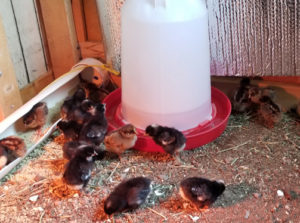 Although they are only a few days old, I’ve already begun their chicken education. Yesterday and today, I brought them a shovel full of dirt to scratch in. Today, as I spread it out for them, I noticed a small worm writhing in surprise at being uncovered. Dropping to my knees, I tapped my index finger next to the worm. That’s how a hen shows her children what to eat, she taps her beak on the ground next to whatever it is she wants them to try.
Sure enough, a dozen chicks came running to see what I’d brought them. I tapped again, right next to the worm. Standing in a studious half-circle around my hand, each chick tilted her head and eyed the stringy, strange-looking thing. I tapped one more time. This time, my tapping made a spilled crumb of their commercial food bounce. The nearest chick snatched it up and took off running at full speed. The other eleven chased her, all of them intent on stealing whatever it was she’d found. This, when there was a feeder full of the same stuff right behind them.
I see I still have work to do before I’m a master “Chicken Educator.”