Denise Domning's Blog, page 10
October 15, 2018
Pig update
I’d so like to tell you that June delivered her calf. I can’t! I swear, she’s doing this just to make me crazy. Actually, the only reason I’m not crazy is because I know there really is a calf and that calf was alive and well a couple of weeks ago. I’m hoping that means it’s still alive and well. As I mentioned a while back, she’s well beyond the due date her previous owner gave me. That makes me certain the calf is going to be an Angus mix. That’s beef in two years for me.
But June’s failure left me scrabbling for a subject for this week’s post. I considered mud. Somehow, my farm was teleported to western Washington State last week. It rained almost continuously for the full week until I was almost sick of the moisture. Now I’m trapped in a sea of mud. This isn’t your average mud. This is mud bog mud, beautiful, shiny, slick, suck-you-down-and-preserve-your-body-for-all-time mud.
Since mud didn’t really appeal to me, I went back to wracking my brain until this morning. That’s when I realized I no longer had PIGS IN HE-E-E-AT! (That was the Muppet episode no one saw.)
A week ago Sunday, one of the girl piggies went into heat. The previous day I’d managed to confine their brother in the orchard, guaranteeing his sister couldn’t get to him. The orchard fence is my strongest fence. (Being a greenhorn back in 2011 I believed a tall fence would prevent coyotes and mountain lions from reaching my chickens. Piffle to that.) And so it proved once again, because that piggy girl did everything she could to break in, crying and grunting the whole time.
By Tuesday her brother was in the refrigerator and piggy girl #2 went into heat. Rather than continue to repair fences, and potentially have to chase those girls home from my neighbors’ in the rain, I put all four of them into the orchard and double-chained the gates. Gotcha!
That was just as the rain closed in. Sure enough, while safely confined piggy girl #3 followed her sisters into heat. That leaves the question of pregnant pigs only to piggy girl #4.
Being trapped in a small area–the orchard is only a tenth of an acre–with nothing to do but sit in their shelter and watch it rain, the girls got pretty bored. Eventually, they started turning the earth in the area where I feed them. They may have thought they were getting even with me, but I’m thrilled. Here comes my winter garden!
Then this morning a bright yellow sun appeared in an equally bright blue sky and I took pity on them. With the pasture gates closed and double-chained, I opened the orchard gate. They exploded out onto the green grass, grunting to beat the band, then set off at full speed (which is impressively fast if you’ve never seen pigs run) around the pasture’s perimeter fence. I’d like to think that they were running for pure joy, not because they were hoping to break free.
They’ve spent all day grazing, lazing in the sun, slopping in the mud bog, chasing frogs in the pond, and napping on the opposite side of the fence from June. I swear she’s staying close to that fence for their benefit. Who knew pigs could be so attached to a cow or a cow to pigs?
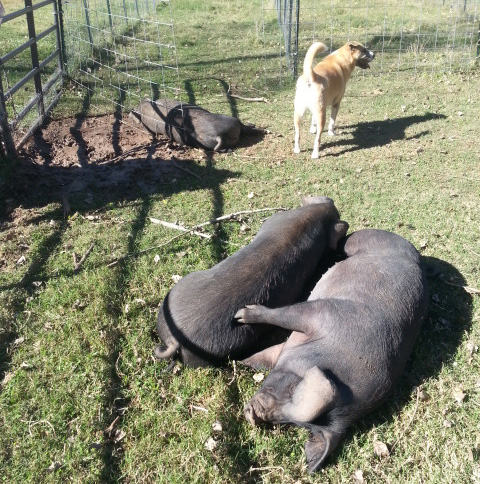 one girl is trying to butt to the head of the belly rub line here.
When I went down a while ago to check on them a little while ago, I was surprised when they all “assumed the position.” Unlike my other pigs, these guys have remained very cautious around me. I blame that on their ears. They have the (Devon) Black ears, which cover their eyes. Being half-blind all the time makes them startle more easily and leaves them on edge. However, slowly and steadily they’ve stopped seeing me as a threat. Belly rubbing remained off limits until the little boy got sick after eating poison ivy. It didn’t take him long to understand that I was offering comfort rubs and within a day or two of allowing me to rub his ears, he was offering me his belly. He continued to allow belly rubs after he returned to his herd. His sisters were worried. They’d gather around him, grunting in anxious warning as he laid on his side and let me touch him. Then, one by one, they took the risk and dropped onto their sides in invitation.
Today, girl #4 finally took a chance on me and I had four piggy girls wanting belly rubs. Yep, the farm is drying out and doing all right this week. It’s be doing a whole lot better if that cow would just have that freaking calf.


October 10, 2018
Squash Soup
First, I would so like to report that I have a new calf. I can’t. Although June is getting more serious about letting that baby go, she continues to bide her time. Obviously, her previous owner was incorrect about her due date. She may also have been incorrect about the Holstein bull being the father, although she did state there was a possibility that it was the little Angus bull that got to June. While that’s disappointing on the milk front, I’ve shifted my hopes from a little half-Holstein heifer to half-Angus calf that I can raise for meat. What I don’t want is a half-Holstein calf or a half-Angus heifer. Dairy bulls, I’m told, are flat out dangerous, having been bred for carrying on the milk-producing gene and not easy handling, while the Angus isn’t known for milk production. The Jersey half is good in either instance. I’m told by people who know that Jersey meat is the best bar none. So there you go.
I missed my Monday blog deadline because of my little boy pig. I knew he was getting close to becoming a boar and I really did want him in the freezer before that happened, but there were extenuating circumstances…THE BOOK WILL NOT END! I have reached the wrap up chapters for The Final Toll and I cannot bring the book to a proper close. I’ve now written that wrap up chapter six times. I think I might actually like what I’ve written when I look at it this morning. I hope. At any rate, because of the writing difficulties, I didn’t want to walk away from the computer to spend a day processing pork.
However, on Saturday, the little boy pig somehow escaped the back pasture and made his way up to the orchard all by himself. It was too good an opportunity to miss. I ran down and closed him into the very heavy, very well made chain link fence that surrounds my orchard. I chained both gates, because pigs are very clever when it comes to opening gates. Then Sunday dawned as another of the glorious, cold, rainy days that I’m not sure I’ve been enjoying. At midday, one of the girl pigs went into heat and immediately showed me the weak spot in the fence surrounding my back pasture. I found her circling the orchard, begging for a little help from her brother. Knowing they couldn’t get to each other, I went back and patched my fence in the rain. When I thought I’d found every possible spot, I returned to the barn pasture and I found her snuggled up to June, literally grazing under the cow’s neck. The light bulb went off over my head. I led June back to the back pasture and along came the girl, her crazy time having apparently ended. Then I called my friend Jim.
I spent Monday processing that little boar, who turned out to be closer to 200 pounds than the 150 I thought, into dog food. Tuesday was consumed catching up on everything I hadn’t done on Sunday and Monday, including writing three version of that wrap up chapter. Today, I’m almost breathing again. So, with nothing else to report on the farm front, I’m going to offer my new Squash Soup recipe.
This year, I grew Hubbard squash, which as you can see from the picture (those are two very nice sized spaghetti squash with it), are huge, roundish, warty squash with a blue-green skin. Or, rather, I am still growing Hubbard squash. My goodness, but it’s prolific! I may not have had zucchini to give away, but after processing three 25 pound Hubbards, I gave away three more with probably 3 more to harvest (I think I see them peeking out of the leaves in the garden).
Why Hubbards? Because I’d bought a package of seeds some years ago and tried growing them but had gotten no squash but, being a seed hoarder, save the rest of the seeds. Then, because I thought I was moving this year, I went through my seed supply and the Hubbard package was one I decided to empty, not caring if it grew. Grow they did, then they set on like crazy. I waited until the end of September to bring in the first one and nearly broke my arm doing it. I couldn’t get the whole squash in the oven, which is how I usually cook a squash–1 hour, 400 degrees, having poked the whole squash at least 6 times with a knife to let the air escape. I then seed and peel after it’s cooled. Since that wasn’t happening this time, I cut the squash in half, not an easy feat by the way, then set aside the seeds for the chickens and tried to fit both halves onto my largest cookie sheet. They were still too big, so I baked them one half at a time.
Once they were cooked, I scraped out the flesh and tasted it. I was surprised that I liked it because it’s not as sweet as a Kabocha, which I really like, or a Butternut. Instead, it has a nice sort of green tang. As it was cold and wet that day, I decided I had to make soup. For me, that is usually super simple, with just squash and chicken broth, salt and pepper. But I wanted something more that day and I liked what I came up with–still simple, but with just a bit more flavor. This recipe will make a very thick soup, which I like–more side dish than soup. Add more broth, to thin. Or use water, if you don’t want to the meat to mask the taste of the squash. Hubbards taste much like pumpkin to me, so if you like “pumpkin pie soup” you could add 1/2 tsp each of ginger and allspice plus 1/4 tsp cloves to this, and some cream, if you really want that “Thanksgiving” experience. (By the way, the soup is perfect with pork.)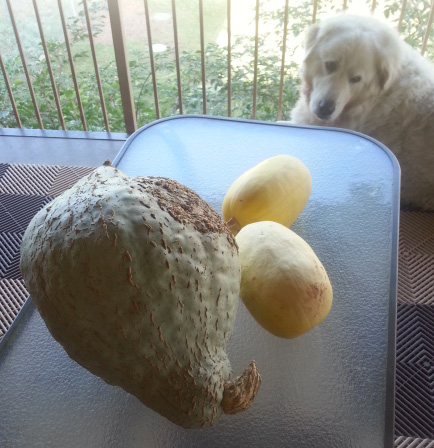
Hubbard Squash Soup
3 pounds cooked Hubbard squash flesh in chunks or mashed
1 quart broth
1 tablespoon agave syrup
2 teaspoons ground cinnamon
salt and pepper to taste
ground nutmeg to taste per each bowl
Mix all ingredients except nutmeg in a saucepan. Heat almost to boiling, stirring to keep it from splattering. Carefully blend soup in batches with a food processor or blender until smooth. Serve topped with nutmeg.
October 1, 2018
Still Waiting!
Sigh. There’s no calf yet, at least not outside of June’s body. All the signs are there. Her tail’s loose as are the muscles around the birth canal. Her pin bones are low, her bag is filling up, and every day there are gooey strands wrapped around her tail. That cow! I swear she’s doing this on purpose.
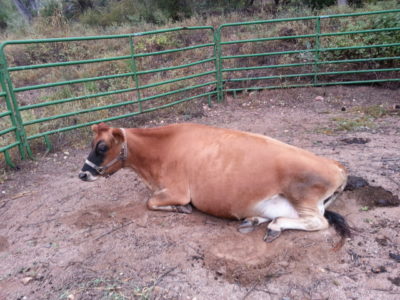 June, faking contractions in her precious corral
Every morning, as soon as I open the gates, she’s on her way to my neighbor’s corral. That’s where she stays for the whole morning. If I’m watching, she has a few regular contractions, spews a little goo, and gets a good giggle at faking me out. Just in case you’re cow-knowledgeable, I want you to know these aren’t grunty, I-got-a-little-twist-in-my-gut pang. These are legs-stiff, tail-kinked-over-the-back contractions. After she’s spent the morning moving that calf a millimeter closer to the outside world, she gets up and goes back to grazing.
I wasn’t prepared for this version of calf delivery. None of my previous cows have had a start-and-stop birthing. Instead, at about three weeks out, each one explored the property and came up with “the spot,” then they went back to grazing non-stop until the moment arrived. At that point, they walked back to their spot and dropped their calf in about an hour and half.
When I still didn’t have a calf by Thursday, I got worried, especially when June’s nose felt unusually warm. Was the calf dead? Many thanks to Phil, the ranch manager at Tres Hermanas. He came over, checked June, then checked the calf. If you don’t know how that’s done, it requires inserting your arm up to the armpit inside the cow. He said when he pushed on the calf, the calf pushed back. Whew. Not dead. But then, why is she waiting?
I blame the coyotes. Until Monday night, there hadn’t been a coyote near the place in months, certainly not since June arrived. Starting Monday night, they’ve circled the farm at least three times a night. They can smell her hormones. They know she’s getting ready to deliver and they’re hoping to be at hand the moment that calf drops.
I think they scared June. I think she sucked that baby right back in and that’s where she’s keeping it until I agree to let her deliver in my neighbors’ corral.
It’s clear to me that June was raised with pipe fencing all around her. To her, those even lines of metal tubing mean safety. What she doesn’t know is that the corral sits right on the edge of about 6 acres of wasteland. I’ve got news for her. The coyotes would be under those panels in an instant and the mountain lion could jump over them with ease.
Elena offered to let me put Bear in their pasture while June had an overnight in the corral. That’s not something I can do to anyone, especially someone I like. Love that dog, but he’s got a deep resounding bark, and he barks all night long. I’ve learned to tune him out, because his barking is meant to warn predators off. I worry when I hear Moosie barking.
Which brings me to this inconvenient truth. It’s not Bear who needs to stay with the cow, it’s midwife Moosie. Not only would he help with the birthing, but, once ‘his’ baby is born, there’s not a predator in theworld that would get through him to hurt that newborn. But if the coyotes can get into the corral, Moosie can get out. He’d love nothing more than a little walkabout in the wilds. He could do a little hunting. His preferred prey would be the herd of javelina that lives in there.
Since that’s not happening, every evening I disturb June’s apparently carefully planned delivery procedure by bringing her home. She, being the bossy pants that she is, throws a snit and refuses to give me her calf. I have news for her. I know exactly who wins this war and precisely how it ends.
If only I knew when!
September 24, 2018
In the Waiting Room
I’ve waited to the last minute to post this, hoping I could report that the big event has happened. A calf is born!
That’s right, after three years, here I am again, pacing like an expectant farmer in the waiting room set aside for those who own pregnant cows. June is ready to drop her calf.
It wasn’t long after I started this blog some three years ago that my then-cow Elsie presented me with a little heifer, Hannah. I was so excited! A heifer! I was looking forward to having two milk cows and expanding my infinitesimal cheese empire to something slightly less infinitesimal. Then disaster struck. Elsie refused to wean Hannah, and Hannah wasn’t giving up those teats for hell or high water. Finally, after listening to the two of them call for each other every day for three months, I sold them to my friend Becki, a dairywoman with 25 years experience. I was somewhat gratified when she also failed to wean Hannah. It wasn’t me! Those two were just unbelievably bonded. In the end, she had to sell Elsie,because the minute she let the two of them together, Hannah was trying to suckle…even after she had her own calf!
Since then, I’ve discovered that there are plastic weaning rings for calves. They’ve got a spring-like ring that fits into their nose and a plastic paddle that will fall in place in front of their mouths when they stretch their necks upward, the way they do when they’re nursing. However, when they put their heads down to graze, the paddle falls forward, out of the way of their mouths. That way moms and babies don’t have to be separated while weaning and the babies naturally gravitate to only grass. What I’m really hoping is that June will turn out to be like Brighty, my first cow. Brighty did her obligatory three months of nursing, then kicked the baby off with a, “Okay kid, you’re on your own now.”
If I had been more alert when I was told June would deliver in September, I’d have looked up the date for September’s full moon. That’s the Harvest Moon, if you’ve ever wondered, and it happens to be today. For some reason, four-footers like to deliver on the full moon. Maybe this is because the night sky is bright enough that the new moms can see the predators coming. Of course, the reverse is also true, that the predators can better see the babies. Whatever the reason, it seems that a full moon mean birthing.
I did fret over whether June was pregnant at first. She’d been here about two weeks when she spent a day bellowing. To me, it sounded like a cow in heat. I counted 22 days from that one and marked it in the calendar. Cows have a standard fertility cycle, just like humans, but just like humans each one is unique. Day 22 passed, then day 23, and, just as I was breathing in relief, on day 24 she spent the day bellowing again. Yikes! That was well within the norm for a not-pregnant cow.
I ordered an AI stick for August, but once the month got going, so did she. As that 24th day rolled around, she’d expanded like a balloon, both her belly and her udder, and had begun to waddle. Yep, pregnant.
On the first of September I dug out my free choice mineral setup and laid out all the packages. The theory is that animals’ bodies know what they need and the animals can discern these things by smell. So you offer them a bank of all the minerals they might need and let them pick and choose.
I guess I shouldn’t have been surprised when she picked a mix that was high in calcium. By the second week of the month she’d finished off ten pounds of that stuff. I ordered another 25 pounds. She finished that off today. Half of me is reassured, because she chose this mix and she should only be taking exactly what she needs. The other half is worried. The healthier the cow, the more likely it is that she’ll have Milk Fever when her calf begins to nurse. Milk Fever is the mammalian body cheating itself of calcium in order to produce milk. It happens to humans as well as all other mammals. The problem is that the heart doesn’t work well without calcium.
With a weaker cow, her body will hold onto its calcium, knowing it can’t afford to give it all up. But a cow who’s accustomed to getting all she wants, when she wants it, will let loose, draining it all. But I’m ready for that possibility, too, armed with the staples of my arsenal: apple cider vinegar and Vitamin C powder. I’ve had some unbelievably good experiences using Vitamin C with my animals as a general tonic. As for apple cider vinegar, dosing with ACV changes the body’s pH. When the pH changes, so does everything else. In this case, as has happened in the past for me, it will slow the stripping of calcium.
And how will I know things have gone south with June and Milk Fever is setting in? Well, I won’t wait until she drops, as happened with my cow Dixie–my first experience with Milk Fever. Instead, I’ll be checking hourly to see if her ears have gone cold. Cold ears are a sure sign the heart isn’t working the way it should.
But those are worries for after the baby arrives.Until then, I’m stuck up here in the house, pacing and watching. My fingers are crossed. I’m hoping it’s a spotty little heifer!
September 17, 2018
Arachne
For those who don’t know the story, there was once a beautiful and talented weaver in ancient Greece named Arachne. She was so talented that the goddess Athena, also a weaver, challenged her to a weave-off. They both made four pieces. Athena’s pieces all extolled the wonders and goodness of the Greek pantheon, while those pieces woven by politically incorrect Arachne dared to point out that the gods, especially Athena’s father Zeus, weren’t really all that nice to the folks they ruled. This, and the fact that Arachne’s work was actually better than Athena’s, totally pissed off the goddess. To punish Arachne for her heresy, Athena turned the beautiful woman into a the world’s first spider, thus proving Arachne correct about the uncaring capriciousness of the gods.
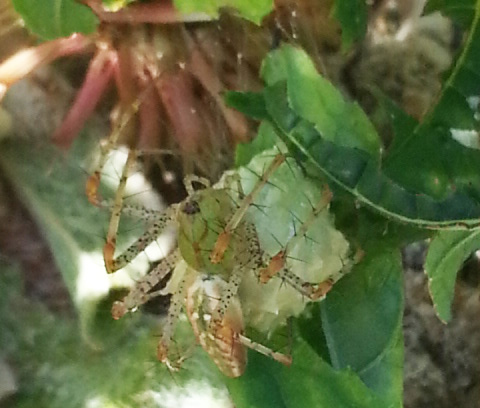 The bee balm spider
Guess what this post is about? Spiders! That’s because I have a beautiful descendant of Arachne living in my front flower bed.
Before you shudder and decide you can’t bear to read this article, hold on a moment. First, you need to know that I dislike spiders as much as most people. I like what they do for me, but I really, really don’t want them crawling on me. Should one happen to appear on my body, I scream just like, well, just like the little girl I once was, the same girl who had to have one of her siblings knock a spider off her leg. The same girl who refuses to eat Alaskan King Crab, because I don’t want to eat a spider. Yuck.
Perhaps because I don’t use any modern chemical pesticides, I have an amazing assortment of spiders on my property. There are the usual venomous black widows and brown recluses, as well as the big wolf spiders and tarantulas, which the turkeys eat. And then there are all the rest.
Until I came to live here, I had no concept of how many shapes, sizes, and colors of spiders there are. At night, in the beam of my LED headlamp, the field spiders gleam like jewels–bright sapphire, deep ruby red, vibrant emerald green. I once found a canary yellow spider in my broccoli patch, eating yellow and black broccoli bugs. I wondered if that was why it was yellow. I have a ghost spider in the house, and yes, it is white. I once ended up with a white crab spider, which was about half the size of my palm, on my shoulder. Neither of us were particularly happy about the situation.
But the spider I saw two days ago on my struggling bee balm plant is truly unbelievable. She is a good-sized spider, with a leg span about the size of a silver dollar. But it’s her coloring that stunned me. Her head is a vivid green, her legs are cream and pink, while her cream-colored abdomen is patterned with what looks like a line of downward facing green leaves outlined in a beautiful pink. Those colors exactly match the colors of the bee balm leaves and flowers. Is a spider like a chameleon? Can she change colors to match her environment?
The moment I saw her, I knew I had to have a picture. I have a feeling she may be one of a kind. When I went back the next day with my phone, I discovered her previous big round abdomen had given way to an egg sack just about the same size. Looking much slimmer now, she spends her day crouched on top of the massive sack. As I turned the leaf trying to catch a photo, she moved with the plant, trying to protect her children from me. Because she doesn’t have a web, at least that I can see, I’m guessing she’s not a web spinner, but a free hunting spider. But I really don’t know that.
If anyone out there can identify her, I’d love to know what she is and why she’s so perfectly camouflaged in that specific plant. Even if I never identify her, I’m proud of myself. I’m actually enjoying one of Arachne’s amazing descendants.
September 10, 2018
Toadly
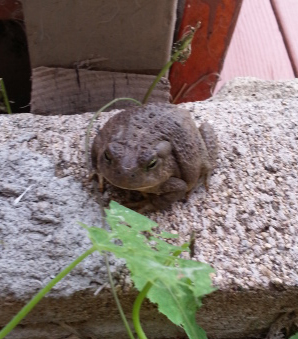 He was trying to climb the stairs to the house
The other day I sadly swept a small, dead, completely desiccated toad out of my basement. I love my toads. I love them despite the fact they make the weirdest sound of all the creatures on the farm.
Wait, I take that back. I have a blue heron who has begun spending the night on the property, which is really new and different. And dangerous, because I also have a pair of great horned owls who hoot from the roof on a regular basis. The owls are either hunting or trying to chase off the heron, because it has flown past my window these last few nights making panicked “grok-grok-grok” cry. Now, that is a dinosaurishly strange sound.
As for my toads, they croak like they’ve got a sore throat and are only opening one corner of their mouths to let the sound out. It’s kind of a “Brrrr-ACK!” Get a chorus of that going and I start closing the windows. Close the windows, yes. Remove the toads? Never! I want as many of them around my house as possible.
When I first moved in, the house was infested with crickets and something the locals called ‘waterbugs.’ Whatever you call it, it’s still a big roach. There were also tons of medium-sized brown beetles that remind me of Japanese beetles but lack the iridescence. With a basement that’s buried in the earth except for the doorways, they made their way inside through every crack and crevice down there.
However, I was patient, quick with the heel of my shoe, but patient. Sure enough, the toads arrived and went to town on those meaty ‘waterbugs.’ Slowly, steadily, their population grew. There are now relatively few crickets and no more ‘waterbugs’ in my basement. The only beetles that make it inside are the ones that fly through my usually open door. Most importantly, Moosie has learned the difference between a frog, which is delicious, and a toad, which will make him froth at the mouth for a few minutes should he attempt to eat it.
This year I noticed I seem to have several toad bloodlines at work. There are the usual dirt-brown toads and the new, F-1 hybrids (I’m making that up) that are almost ivory colored. A dozen tiny babies of that color appeared in the barn this year. It’s an improvement. They’re bright enough against the concrete that I don’t step on them by mistake.
What I don’t want is toads in the house. Not because I couldn’t use them on the inside as well as on the outside, or because of their hoarse cry, or that they leave fairly large (given their size) turds wherever it suits them. It’s because, although toads don’t need water to keep their skin moist like the bullfrogs in my pond, they need water to drink. Putting out water bowls for the toads would only encourage my cats to see how many of those bowls they could tip over each day.
So I make regular rounds, checking the quiet corners and looking under the dressers, hoping to relocate my amphibian visitors before mummification sets in. Yep. I’m toadly a fan of toads.
August 29, 2018
Morning Chores
This morning, in the middle of my chores, my inner voice got to going. I haven’t mowed the grass yet and it’s once again knee-high. And the garden is waiting to be prepped for winter planting. And I need to harvest cow poop for the resting gardens. And it looks like our spate of daily rains is over, so I reminded myself I have to water the “pretty” gardens. It ended it’s tirade with “You’re doing too much sitting! You need some exercise!”
My upset with myself lasted for about a second. Exercise? Just a second there, inner voice. That sent my thoughts tumbling over my morning routine.
I’m up early. For the record, something really strange is going on between me and my clock. For the last month I have woken up exactly at 4:44 AM. Not 4:43, not 4:45. At 4:44 AM. That’s my first laugh of the day. I thank the clock, put on my robe and go into the kitchen where I make water for tea, empty the dishwasher, turn on the computer and, most importantly to them, feed the cats.
I’ve recently moved all the cat food bowls out of the house. None of my cats, not even the one who has designated herself as the “house cat” are inside animals. All of them are capable of taking care of themselves out-of-doors and all of them hunt. The reason I moved their food outside is Bear, my 135 pound Kuvasz. He’s on a diet. I’m not certain how a dog that size manage his level of stealth, but I was finding completely clean cat bowls, something that doesn’t happen when the cats eat their food, five days out of seven and hadn’t even seen him move. The cats are very unhappy with this change in their daily routine, but so far we’ve had no Bear-malfunctions.
It’s dawn by then and time to start my chores. I feed my barn cats, then I’m off and walking. The first trip is from the barn across the small grassy expanse between the barn and the orchard, with pig food and a small bucket of Black Oil Sunflower seeds for the turkeys and chickens. For reasons that will soon become obvious, the pigs get fed in my fenced orchard. If I was alert the previous night, the gate in the fence that cuts the orchard in half is closed, which allows me to fill pig bowls without their help. If not, then I’m dancing over happy piggies. Once they’re eating, I close and chain both the front and back orchard gates, then retreat to my barn where I open the gate between my house and my neighbors’ pasture.
June the Cow loves their pasture. She loves the stalls, even though she can’t get into them, and really loves the old horse corral. She’ll sit in there for hours, chewing her cud. However, before I can her into that area, I have to make sure the gate leading up to their house is closed. That means walking about a 100 yards and up a hill to check. On the way to that gate I make sure her water bucket is filled. On the way back, I make sure I still have both dogs. Moosie would dearly love to climb through the corral fence and go hunting in the wild area behind it.
Leaving that gate open, I once again pass my barn, this time making my way to the front gate of the first pasture, which I leave open behind me. I trek past the pond and open the back gate of that pasture. This is where the sheep are waiting. Each of my ewes gets a handful of Black Oil Sunflower seeds, which they think is almost as good as chicken food, but not nearly as tasty as hog chow. From time to time, I do forget to close that back orchard gate, something that leads to chaos between pigs and sheep. Hope springs eternal for Tiny, my oldest ewe. She always races to that gate to check. Once she realizes she can’t get it, it’s full speed ahead for the gate into the neighbors’ pasture. That’s because they have mature apple trees and sometimes delicious things fall from the heavens.
I follow, still carrying that bucket of sunflower seeds, to close the gate behind them. Then I again walk past the barn, past the orchard, across the first pasture, then cross the second pasture on my way to the turkey barn. That’s where June is waiting for me, sitting in front of gate one into my back pasture, the pig pasture. June has a sort-of stall there. There is no fence around it, it’s just an open area under the corrugated roof that has a thick layer of (now heavily cow-manured) straw. She likes it there, mostly because it’s an easy dash from that gate to the chicken coop, which she always checks in case I forget to close it after releasing the birds.
That’s why I enter the pig pasture from the second gate, the one that sits on the other side of the turkey barn. I sneak swiftly around the corner to double check that the gate June is guarding is properly chained. One of June’s most interesting skills is that she can wiggle a fence chain from its slot with her mouth. That’s why all my gates are now closed with latched chain loops.
Once I’m sure she’s locked out, I release the birds, spreading the sunflower seeds for them. Then I walk almost to the end of my property to check that my final irrigation valve is still dribbling. For years my birds have been drinking water from a running stream, not bird waterers. When I fenced them into the back pasture, I locked them away from their stream. To satisfy their need for fresh water my friend Laurie and I built a tiny stock pond beneath that irrigation pipe. It turned out to be a pretty answer to their need for running water.
Certain that the bird’s are good, I return to June. After much tugging on her bridle and a swat, because she won’t move without a swat, we start back across the pastures. Like Tiny, June stops to head-butt that back orchard gate just in case I forgot to latch the chain. Then, with a heavy bovine sigh, she makes her way toward her favorite pasture. She has to stop to taste the grass along the way mostly because she knows I want her to walk faster, and check to see if I left the people-sized barn door open. Then it’s a dance to get her inside the gate to the neighbors’ pasture without letting the sheep escape.
After I’ve chained that gate, back I go to first pasture, where I open the same gate that June head-butts. The pigs are still eating, but I want them to have access to the pond and the grass while they wait for their morning constitutional. Keeping them where I want them means once again crossing that first pasture to secure its back gate, chaining a handy panel to it. Without that, the piggies will knock the bottom of the gate open wide enough to slither through.
With all my gates secured, I make my way back to the house, feed the dogs, drink a pot of tea and eat breakfast. By the time I’ve finished eating, the pigs are eager to get to the back pasture. They adore that space. Lots of tall trees, plenty of soft dirt, a nice mud wallow, and a dribbling snout-sized irrigation pipe.
And I’m off again, walking from the house down to the barn, across my ‘yard’ to the orchard. Once in the front pasture, I start clapping my hands and calling “Pig, pig, pig! Walkies!” And we do. The pigs walk better than the dogs.
They follow me across the second pasture and gather in front of the gate to the back pasture. Once the gate opens, they head straight for the grass while I dart around the corner and put up the barrier meant to keep four-leggeds out of the chicken coop. With that, I begin my final walk of the morning–all the way back to the gate to the neighbors’ pasture, where the sheep are impatiently waiting for me. I open the gate and my well-trained ewes line up behind their shepherdess. Off we go, back to the farthest pasture. With all the rain, the rocky hillside above that space is lush with the green stuff– I can’t call it grass, because it’s not–that the sheep love. So this time, I walk all the way to the end of my property to make sure the sheep remember where the bridge is. Leaving them happily grazing, I return the full length of my property to start work for the day, a day that will end with much the same routine as it began.
Snort. Giggle. Inner voice, keep your opinions to yourself. I’m getting plenty of exercise.
August 27, 2018
An Epic Battle
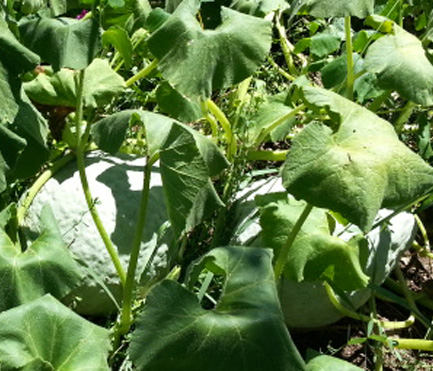 It’s been an interesting year for squash here on the farm. Early in the season I planted Hubbard squash from a three-year-old package and spaghetti squash seeds from a package that was even older. Much to my surprise, they went crazy. I have three huge Hubbard squash ready for me to take …where? Where the heck do you keep a squash that big and can I even lift it? The spaghetti squash is producing like crazy, which is nice. This is one squash I really enjoy, having learned to love it back when I had to be gluten-free.
These squash are planted in the orchard garden and when they began to take over the world, I guided their tendrils up the chain link of the orchard fence. I was mistaken in thinking none of my critters would eat squash vines. I mean, seriously? Who eats something covered with stinging little hairs? Obviously, I was wrong. For the past two months, right around the new moon and the full moon, the sheep and June the cow make their way to the exposed vines and eat them until they’re gone. Hmm. Pumpkin seeds are recommended for de-worming. I wonder if squash vines work as well as the seeds?
My summer squash has completely betrayed me. I planted six zucchinis. When I mentioned that to someone, that person laughed and asked what I was going to do when I was knee-deep in zucchini. I wish!
It’s official. I’m the only person on the planet who can grow a healthy zucchini plant yet not get enough squash to make vegetable lasagna. This was another innovation of mine from back in my wheat-free days. I would thinly slice zucchinis, eggplant, and portabello mushrooms then grill them. After that, I layered them with fresh basil, mozzarella, and ricotta cheeses, and some sort of red sauce and baked for about 20 minutes, until the cheese was nice and gooey.
I’m not entirely certain my squash is infertile. I suspect there may be a pesky family of squirrels that are coming by for their daily nibble of baby squash. The plants are so big and healthy that no one, not even Moosie, sees them.
As for my lack of crookneck yellow squash, I blame myself. Silly me. I was trying to avoid squash pollen contamination and put these guys in the garden right below the road. With all the rain, I’m thinking they’ve been poisoned by cadmium wash off.I guess it’s okay that they didn’t produce. I don’t think I’m deficient in cadmium.
But what I miss most this summer is cucumbers. Like the other curcurbits, I emptied an old seed package. Out of ten seeds I got three healthy plants. Not bad for a seven-year-old packet. When it came time to transplant, I again searched for a spot that wouldn’t allow them to cross with any of the other squashes. I ended up planting them right next to my entryway stairs then installing a couple of handy panels for them to climb.
I immediately lost two of the plants to something. Snails, most likely. I really need ducks, especially this year. The third plant went crazy. It was healthy beyond healthy, with leaves at least twice the size of any cucumber I’ve ever grown. I harvested one gorgeous and delicious cuke, admired the dozen other babies that were setting on…sigh. Then the farmer ants appeared.
Lordy, how I hate those critters. It’s bad enough that aphids show up on their own. It’s far worse when they have swarms of tiny little protectors armed with stinging bites. The ants and I are presently engaged in an epic battle. I have spent time squishing the aphids and spreading their guts all over their home leaf. There’s good scientific evidence that bugs won’t repopulate an area where their brothers have died. However, this isn’t something I do every day. Not only is it time-consuming, I don’t really like getting aphid slime all over my fingers. I sprayed the plant with the hose, knocking off a good bunch of those little sapsuckers. The ants redoubled their efforts. So did I, adding soap to the sprayer. That dropped the number of aphids, but a few days later the ants had regrown their livestock numbers to overwhelming.
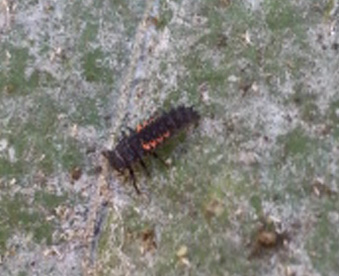 That’s when I pulled out my big guns. I covered the stair rails, the leaves, and the ground around the plant with diatomaceous earth. Of course, it immediately rained and washed away much of that fine powder, so I started round two. While I was spreading it the second time, I turned over a leaf. Standing tall on their delicate stems was a line of green lacewing eggs. I quickly flipped over another leaf and found tiny ladybug larvae. On yet another leaf was a clutch of golden Assassin bug eggs. Reinforcements have arrived!
That sidelines me and my heavy-handed interventions. What kills aphids also kills the aphid eaters. I checked again this morning and found the backs of a few leaves populated with nothing but three ladybug larvae. I can’t say I’m hopeful that my plant will produce any more cucumbers this summer, but at least I’m not in this fight by myself anymore.
I’m finding it hard to be patient, which means I’m still considering the nuclear solution. I’m thinking about mixing up 50%-50% batch of boric acid and sugar, and piling that all along the ant line. Feed that to your babies, you little cucumber decimaters!
August 20, 2018
Death Defiance
That cow! Remind me the next time I decide to buy a cow that I need to ask if she was raised by other cows or raised by humans. I definitely prefer cow-raised cows.
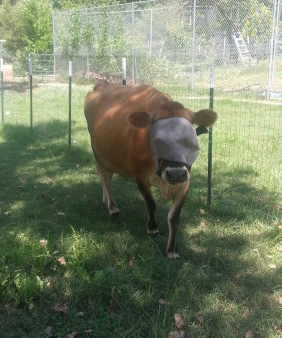 She has a snazzy new fly mask.
Almost from the moment June arrived here a couple of months back, it was clear that she was very bonded to humans. By her second week–after she got over the shock of realizing I wasn’t going to give her flakes of alfalfa and instead expected her to eat that green stuff on the ground–she began to react toward me and my women visitors in a way that said she really liked human girls. By about week 2.5, when she was hopping for joy around my blonde friend Laurie, I pretty accepted that she had been hand-raised by a blonde girl. Maybe she was a 4H project, or maybe an orphaned heifer.
And what’s wrong with that? Just like Bear, my now-135 pound dog (he lost ten necessary pounds, yay!), who wants to be a lap dog, June still thinks she’s that calf, loving on her new girls, when she’s anything but. She doesn’t have appropriate boundaries, the sort that cow-raised cows naturally develop. Just like the pigs think of June as a strange-looking pig, to June, humans are strange-looking cows. Just like the pigs think of June as a strange-looking pig, to June humans are strange-looking cows. By the way, I caught another pig pedicure procedure the other day. June was laying on the ground with three pigs working on her hooves. I really do have weird animals.
That’s not to say that whoever raised June didn’t do their best to give her boundaries. She knows the word “No.” When corrected, she lowers her head in a plea for ear scratches. If I really want her attention, all I have to do is tap her on a hindquarter with a stick. She becomes instantly alert and does exactly what I tell her. Frankly, if it weren’t for that, she’d already be hamburger.
It’s the game she most likes to play that’s the problem. I think we can call it a cow version of Tag, which I just learned is an acronym for touch-and-go. It works like this: June runs in a crazy circle, then comes barreling at you, head lowered, only to stop on a dime about four inches away, her head wagging in the pretense of threat.
This reminds me of when the three neighbor kids visited a few years ago and began a game of tag with my (delicious) ram Cinco. Cinco was still a youngster then and he wanted to head butt them in the worst way. But there were three of them and they were all going in different directions. Just as he’d get close to one, that laughing kid would climb the fence or close a gate. Within minutes, Cinco had gone from wanting to do harm to enjoying the running and dodging as much as the kids were. When they left, he stood at the gate and baaed after them as if begging them to come back.
That’s how I imagine June playing with her first humans, kids laughing and running as she bounced after one, then another, her head lowered as if to hit them. And that’s what happened Saturday night after that gorgeous little storm we had. The brief spate of rain had left everyone feeling cool and comfortable after a sticky, humid day. It was well into twilight and the dogs were playing when we all heard a huge crack. Worried for my fences, I put on my headlamp and started for the back pasture. The dogs joined me, then the sheep followed. I thought June had stayed behind in the pig pasture, but as I neared my back fence a 1000 pound juggernaut went galloping past me at full speed, aiming for Moosie. Being Moosie, he easily dodged her. As he watched her in surprise, she turned and came straight at me at the same astonishing speed.
Trapped between the fence and the cow, I held out my hands and shouted, “No!” as loudly as I could. In the back of my mind I’m wondering if she’s eaten Datura and is truly crazed. Thoughts of the damage a galloping, hallucinating cow can do to a much smaller human followed. I hoped the dogs would wait until I was dead before they ate me, but I was pretty sure the pigs would get to me first.
She stopped a hair’s breadth in front of my hands, shook her head at me, swiveled and heading off for the sheep. My little flock of ewes was completely unprepared for a cow attack. They watched transfixed until the the cow was in the middle of them, swinging her head. Needless to say, she scared the begeezus out of them.
Just as I was thinking I’d have to borrow my neighbor’s .22, Moosie came racing up to June. With a quick yip, he crouched in that posture dogs take on when they want to play. And off they went, the 1000 pound cow chasing the “faster than the wind” dog. Not Datura then, just bovine joy.
It took me ten minutes to calm a panting, terrified Tiny, who was so frightened she was head-butting Mari for getting too close to her. By the way, Tiny is now felt-free. I used a utility knife and shaved it off her back. This might actually have been the cause of June’s crazies. She’s a jealous cow. She doesn’t want to share my attention with those other creatures and earlier that day she’d tried more than once to interrupt the makeshift shearing process.
Before anyone worries, I’m pretty sure statistics show that even I am more likely to die while driving on the freeway than via joyful cow. Still, I’ll admit that the sooner that cow has her own calf to play with, the better. And she damn well better be as good a milker as I was promised. Or else!
August 13, 2018
Felt-backed Ewe
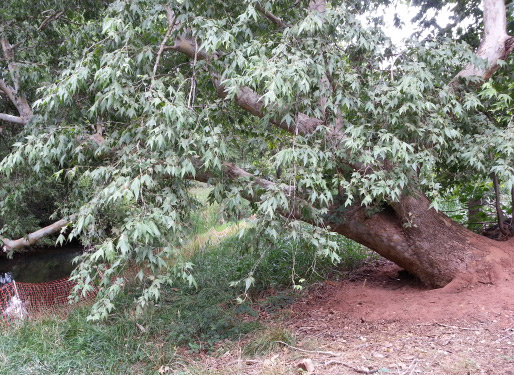 She crams herself under the trunk and rubs
I now know why sheep have to be sheared, even though my Dorpers don’t have wool and supposedly shed their “hair.” Tiny has been working on rubbing off last year’s hair for six months now. That was problem number one. You see, she should have shed it all two months ago.
The second problem is what she’s been using as her hair scraper. Back in the corner of the property there is an old Sycamore. It has a massive trunk and a thick branch that juts out over Oak Creek. Being a Sycamore, the trunk is very smooth. More importantly, time has encouraged it to lean toward the creek, creating the perfect place for a moderately-sized ewe (Tiny has long since outgrown her name) to use when rubbing her back.
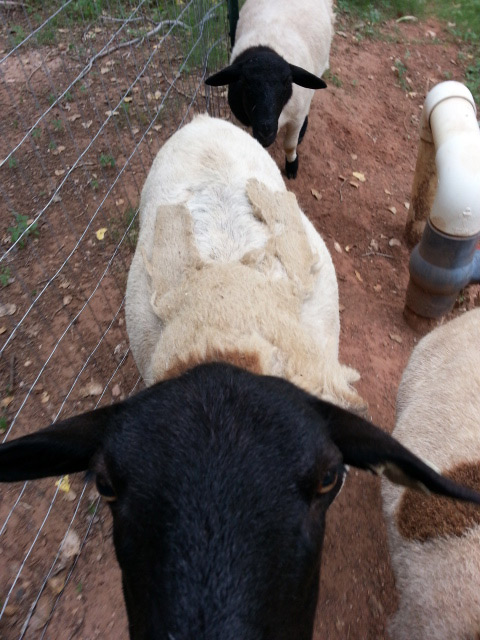 Tiny’s felt
The third problem is our summer rains. Sheep don’t mind standing out in the rain. They’re not crazy about hail, but even that doesn’t always drive them to find shelter. I expect rain must be a welcome relief, given their coats and the fact that it’s been so hot and humid lately. Just like me, standing in the rain probably leaves them feeling cool and clean.
Add these three together–damp wool-like hair being pressed repeatedly against hard wood–and you have the all the steps necessary to make felt, which Tiny has successfully done.
It has become a clash of wills. Everything in me wants to make her more comfortable while everything in her wants to avoid the weird sensation of the scissors working through her hair. It didn’t take her long to recognize the shape of scissors. I can’t get close to her with them in my hands. That leaves me no choice but to stand over her and pry at the patches, hair by tiny hair. She’ll tolerate that for thirty seconds or so. I can’t believe she’s going to make me call the shearer for two small patches of felted wool!
On a more positive, less expensive note, the pigs have happily become aquatic animals. They adore the pond. They’re like three-year-olds in a wading pool. 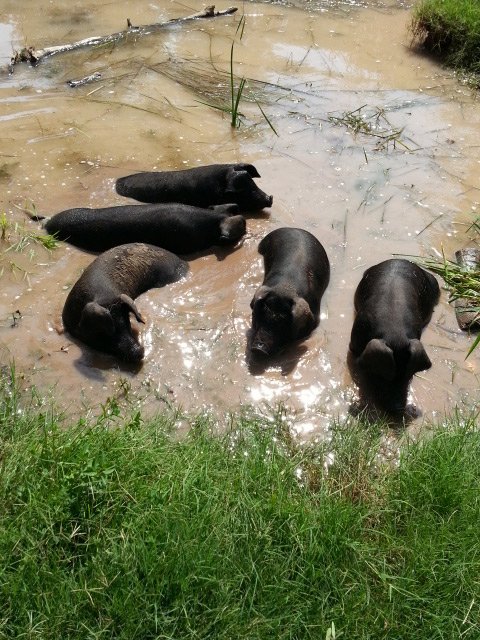 With the water never more than shoulder- (pig shoulder, which is knee high to a human) deep, they go scooting across the bottom on their bellies with their noses held up out of the water like snorkels. Then they put their snouts into the water and just blow bubbles, something they clearly do for amusement and nothing else. They’ve also discovered that the pond is a smorgasbord. They’ve eaten most of the young cattails, or rather, eaten the tubers and left the leaves floating on the now mucky water. They’ve begun cleaning up the banks. Floating on their bellies, they graze the thick bermuda grass and even nibble on the mint. Most of the water grass that my friend gave me from her much larger pond is also gone. There are also far fewer tadpoles and frogs. I suspect pigs think frogs taste like chicken, or maybe snails, which they also enjoy. Yesterday, I sat outside next to the pond just to watch them.
Forget the dog days of August. It is a snorkeling pig’s life here on the farm!